
The optimization of microbial biomass through tailored media formulations is critical for advancing microbiology and agricultural biotechnology. This study aimed to investigate the effect of beneficial microorganisms on enhancing soil fertility and crop yields, focusing on Bacillus subtilis, Candida utilis, Pediococcus acidilactici, Rhodopseudomonas palustris, and Brevibacillus borstelensis. Using an Automated Media Optimization System (AMOS), 180 nutrient formulations were screened and optimized, employing Box-Behnken design and response-surface methodology (RSM) to identify the optimal macro- and micronutrient combinations. B. subtilis exhibited 37.38% growth increase with manganese, cobalt, and sodium chloride supplementation, while C. utilis showed a 28.15% increase with ammonium sulphate, calcium, and yeast extract. In contrast, P. acidilactici demonstrated minimal improvement (0.87%) with beef extract and cobalt. R. palustris favoured sodium chloride and boron but declined with excessive manganese, while B. borstelensis achieved an 8.09% increase with iron and sodium bicarbonate but displayed reduced growth with cobalt and copper. Reproducibility tests confirmed remarkable biomass yields, with B. subtilis reaching 1.384 g/L and B. borstelensis 1.563 g/L in 1 L flask cultures. These findings highlight the crucial role of tailored nutrient formulations in promoting effective microbial growth and demonstrate the reproducibility of results across different cultivation conditions. This study presents a scalable approach for enhancing microbial biomass production, offering significant potential for industrial applications, including the development of sustainable biofertilizers to improve agricultural productivity.
Research Article · Volume 9, Issue 5, 22 October 2025 · Open Access
Automated Media Optimization for Enhanced Biomass Production of Effective Microorganisms
· · · · · · · · · ·
Affiliations & Notes ⌄
- 1School of Biology, Faculty of Applied Sciences, Universiti Teknologi MARA, Shah Alam Campus, 40450 Shah Alam, Malaysia
- 2Collaborative Drug Discovery Research (CDDR), Faculty of Pharmacy, Universiti Teknologi MARA, Puncak Alam Campus, 42300 Puncak Alam, Malaysia
- 3Faculty of Applied Sciences, Universiti Teknologi MARA, Cawangan Perlis, 02600 Arau, Malaysia
- 4University of Queensland, School of Agriculture and Food Sustainability, Chancellor Place, St Lucia, Queensland, 4072, Australia
- 5Advantage Plants Consulting, South Brisbane, Queensland, 4101, Australia
- 6Hydro Plant Sendirian Berhad, Gateway 16 Industrial Park, Bukit Raja, 41050 Klang, Malaysia. *Correspondence | Khairul Adzfa Radzun, Hydro Plant Sendirian Berhad, Gateway 16 Industrial Park, Bukit Raja, 41050 Klang, Malaysia
- 7Email: khairuladzfa@uitm.edu.my
Article Info ⌄
- Journal:
- Novel Research in Microbiology Journal
- Published:
- 22 October 2025
From the article
- This study effectively identified and optimized essential nitrogen and carbon sources to enhance growth rates of five microorganisms: B. subtilis, C. utilis, P. acidilactici, R. palustris, and B. borstelensis.
- These optimized media formulations not only improved growth rates but also highlighted the significance of micronutrients in microbial metabolism.
- Our findings demonstrate that fine-tuning micronutrient concentrations can modulate metabolic pathways, optimize resource utilisation, and improve overall biomass yield, thereby offering a framework for cost-effective media formulation in industrial settings.
- This study also underscores the utility of RSM in nutrient optimization, with potential applications in microbial biomass production and sustainable biofertilizer development for improving agricultural productivity.
Selected from the article's own text.
Abstract
Introduction
The optimisation of microbial biomass via tailored media formulations is a critical area of research in microbiology and agricultural biotechnology. Microorganisms, particularly effective microorganisms (EMs), play an important role in promoting sustainable agricultural practices by enhancing soil fertility, plant growth, and crop yields . EMs consist of beneficial microorganisms, including bacteria, yeasts, and photosynthetic microorganisms, which work synergistically to solubilize nutrients, suppress plant pathogens, and increase microbial activity in the rhizosphere . Recent studies have explored the potential of EM in various applications. Chaudhary et al. (2025) found significant increases in soil microbial biomass carbon, phosphorus, and nitrogen when using facultative endophytic fungi, mainly Serendipita indica and Azotobacter chroococcum; a nitrogen-fixing bacterium. Co-inoculation of these microorganisms showed a synergistic effect, enhancing soil fertility more than individual treatment or control. Similarly, Ma et al. (2025) examined the effects of Bacillus velezensis SQR9 or Trichoderma harzianum NJAU4742- amended biofertilizers on pear seedling growth, revealing significant improvements in biomass and soil nutrient levels. These studies collectively demonstrate the versatility of EM in soil improvement and agricultural applications, while emphasizing the need for further research to fully understand and optimize their potential across various fields.
Despite the proven benefits of EMs, their large-scale application as biofertilizers faces challenges due to the complex and strain-specific nutritional requirements necessary for their cultivation . Unlike the chemical fertilisers, which have uniform nutrient profiles, EMs require tailored growth media to optimize their growth and activity . For example, optimal sources of carbon, nitrogen, micronutrients, pH levels, and growth conditions may vary greatly across the microbial taxa . The traditional trial-and-error approaches to media preparation are often inefficient, highlighting the need for systematic and scalable methods.
To address this challenge, the current study employed the Automated Media Optimization System (AMOS); an advanced high-throughput platform, to identify the optimal nutrient formulation for five EMs, mainly Bacillus subtilis, Candida utilis, Pediococcus acidilactici, Rhodopseudomonas palustris, and Brevibacillus borstelensis. These strains were selected based on their well-documented efficacy as biofertilizers ; ; ; , including their abilities to enhance nitrogen fixation, photosynthesis, and biocontrol. For example, B. subtilis, has been extensively studied for its biocontrol properties , while R. palustris, contributes substantially to nitrogen fixation and photosynthetic activity, supporting the development of a diverse and resilient microbial consortium that enhance soil fertility and crop productivity, critical for sustainable agricultural systems .
Automated Media Optimization System enables a precise and high-throughput evaluation of multiple variables simultaneously, allowing for a more efficient exploration of nutrient interactions compared to the traditional methods ; . A factorial design and RSMs can be utilised to optimize carbon and nitrogen sources, macro- and micronutrient ratios, and pH levels. Such systematic approaches provide insights into the synergistic nutrient effects while minimising the inhibitory interactions, ensuring scalability and reproducibility in agricultural applications.
The objective of this study was to optimize the biomass production of selected EM by systematically determining key nutrients, evaluating nutrient interactions, and validating reproducible formulations using an AMOS. By developing optimized media formulations tailored to EMs, this study advances microbial biotechnology and addresses critical barriers to sustainable agriculture. These findings not only enhance the scalability of EMs production but also align with global efforts regarding the environmental impact of agriculture. This work represents a step forward in bridging theoretical researches with practical ones and commercial applications, demonstrating how EMs can be integrated into ecofriendly agricultural practices to promote food security and sustainability.
Materials and Methods
The current study was carried out in three distinct phases using an AMOS to optimize the biomass of EMs. A detailed flowchart (Figure 1) outlines the used methodologies.
Selection of EM and preparation of stock cultures
Four bacterial strains, Bacillus subtilis, Pediococcus acidilactici, Rhodopseudomonas palustris, and Brevibacillus borstelensis, in addition to a single yeast strain (Candida utilis) were selected for their known biofertilizer properties in the formulation of EM. A previous study isolated these bacterial cultures from salted seafood and soil samples collected from an oil palm plantation in Tawau, Sabah, Malaysia . P. acidilactici was grown in deMan-Rogosa-Sharpe (MRS) broth and agar, whereas B. subtilis, B. borstelensis, and R. palustris were grown on nutrient broth (NB) and nutrient agar (NA). C. utilis was cultured in potato dextrose broth (PDB) and potato dextrose agar (PDA). The inocula contained 5×10³ cells/mL and were kept at optimal pH levels, mainly pH 6.4 for B. subtilis, B. borstelensis, and C. utilis; pH 6.2 for P. acidilactici, and pH 6.8 for R. palustris. To prevent cross-contamination, the cultures were kept separated and incubated at 30°C with agitation at 80 rpm. R. palustris was exposed to continuous white fluorescent light at a brightness of about 2220 lux.
Screen 1: Nutrient interaction analysis and optimization using factorial box-behnken design
An analysis of the compiled literatures was carried out to evaluate and determine the optimal nutrient and growth conditions (i.e., nitrogen and carbon sources and their concentrations, pH, agitation condition, and basal media composition) for an EM basal medium formulation. The average nutrient concentrations and conditions were calculated based on information of several previous studies for B. subtilis ; Basamma et al,, 2017; ; , P. acidilactici (Nguyen et al., 2018), R. palustris , and B. borstelensis ; . The first full factorial design used in screen 1 was to determine the optimal nitrogen and carbon sources and their concentrations for EM at five different concentration levels, as shown in Table 1. Other micronutrient and macronutrient concentrations were kept constant during this experimental design. Each concentration level was tested in triplicate. The EM Screen 1 optimization process included both positive and negative control
Table 1: Full factorial design of different nitrogen and carbon sources and their concentrations for EMs production.
| Effective microorganism (EM) | Nutrient sources | Test nutrients | Concentrations range (mM) |
| Pediococcus acidilactici | Nitrogen | Beef extract | 0, 2.5, 5.0, 7.5, 10.0 (g/L) |
| Manganese | 0, 0.125, 0.25, 0.375, 0.5 (g/L) | ||
| Bacillus subtilis | Nitrogen | Yeast extract | 0, 2, 4, 6, 8 (g/L) |
| Peptone | 0, 3.5, 7.0, 10.5, 15.0 (g/L) | ||
| Carbon | Glucose | 0, 10, 20, 30, 40 (g/L) | |
| Sodium bicarbonate | 0, 10, 20, 30, 40 (g/L) | ||
| Brevibacillus borstelensis | Nitrogen | (NH4)2SO4 | 0, 3, 6, 9, 12 (g/L) |
| Yeast extract | 0, 2, 4, 6, 8 (g/L) | ||
| Carbon | Glucose | 0, 10, 20, 30, 40 (g/L) | |
| Sodium bicarbonate | 0, 10, 20, 30, 40 (g/L) | ||
| Rhodopseudomonas palustris (PSB) | Nitrogen | Yeast extract | 0, 0.9, 1.8, 3.6, 7.2 (g/L) |
| Carbon | Glucose | 0, 10, 20, 30, 40 (g/L) | |
| Sodium bicarbonate | 0, 10, 20, 30, 40 (g/L) | ||
| Candida utilis (Yeast) | Nitrogen | (NH4)2SO4 | 0, 3, 6, 9, 12 (g/L) |
| Peptone | 0, 3.5, 7.0, 10.5, 15.0 (g/L) | ||
| Carbon | Glucose | 0, 14, 28, 42, 56 (g/L) | |
| Sodium bicarbonate | 0, 14, 28, 42, 56 (g/L) |
Where; PSB: Photosynthetic bacteria.
Table 2: Culture conditions and plate well nutrient compositions for each EM production.
| Effective microbes (EM) | Optical density reading (nm) | pH | Agitation (rpm) | Medium composition in the plate well (µL) |
| Bacillus subtilis | 600 | 6.4 | 80 | Basal Media: 9; CaCl2.2H2O: 3; PBS: 5; EM culture: 15 |
| Candida utilis | 600 | 6.4 | 80 | Basal Media: 9; CaCl2.2H2O: 3; PBS: 5; EM culture: 15 |
| Pediococcus acidilactici | 600 | 6.2 | 80 | Basal Media: 9; CaCl2.2H2O: 3; PBS: 5; EM culture: 15 |
| Rhodopseudomonas palustri | 680 | 6.8 | 80 | Basal Media: 9; CaCl2.2H2O: 3; PBS: 5; EM culture: 15 |
| Brevibacillus borstelensis | 600 | 6.4 | 80 | Basal Media: 9; CaCl2.2H2O: 3; PBS: 5; EM culture: 15 |
Where; CaCl2.2H2O: Calcium chloride dihydrate; PBS: Phosphate buffered saline
media, specifically MRS media for P. acidilactici, NB for B. subtilis, R. palustris, and B. borstelensis, and PDB for Candida utilis, alongside a basal medium serving as EM’s base formulation.
Optical density (OD) was measured at 600 nm for non-photosynthetic strains (B. subtilis, P. acidilactici, B. borstelensis, and C. utilis) and at 680 nm for the photosynthetic strain (R. palustris) to account for pigment absorbance. For preparation of the screening experiment with the EM, 50 mL of each EM harvested during the logarithmic growth phase (indicated as OD600/680 ≈ 0.8–1.0, corresponding to mid-log phase) were collected by centrifugation at 2,800 × g for 10 min at 4°C to obtain a cell pellet ; . The samples were then rinsed several times with phosphate-buffered saline (PBS) to remove any remaining media. The EM cells were inoculated into sterile 96-well microwell plates, according to the experimental design, and resuspended in an appropriate volume of PBS at the specific pH required for each microorganism. The starting inoculum, indicated as OD600/680, was set to 0.1 through a serial dilution using a microwell plate reader. All EM strains were cultured in a 96-well plate, with each well containing 150 μL of the culture on an orbital shaker at a specified rpm under continuous dark conditions, except for the R. palustris that was exposed to white light of approximately 2220 lux.
Each well contained a variety of tested elements (i.e., nitrogen and carbon sources and their concentrations, Table 1), basal media, PBS, CaCl2, and EM cells, either with or without vitamins as described in Table 2. The volume of sterile dist. water was adjusted according to the amount of tested elements. The miniaturized robotic screening system (AMOS) enabled cultivation up to 72 h to minimize the evaporation effects under the tested culture conditions (Table 2). Individual optimization screenings for each effective microorganism were performed using separate 96-microwell plates; with maintaining a sterile environment for all. The robotic system was regularly sanitized with 70% aseptic ethanol, especially when the culture plates were briefly removed for photography. Growth rate data was automatically recorded at hourly intervals.
Screen 2: Nutrient interaction analysis and optimization using factorial box-behnken design
The optimization for screen 2 utilized the best concentration of the tested nutrients obtained from screen 1, specifically the high endpoint of OD600/680 ; . This optimization was based on a statistically incomplete factorial Box-Behnken design, which involved a 3×10 setup with three concentration levels for 10 different nutrients, including calcium, zinc, magnesium, iron (ferrous), cobalt, copper, manganese, molybdate, sodium, and boron. In screen 2, a total of 180 formulations were tested for each effective microorganism (B. subtilis, C. utilis, P. acidilactici, R. palustris, and B. borstelensis) which included 20 centre points or controls. The different EMs required different combinations of these 10 nutrients, each were tested at three concentration levels.
The concentration range was determined as previously described by Radzun et al. (2015) to establish initial points and endpoints for optimal nutrient concentrations. The average concentration identified in the literatures served as the midpoint, while a two-fold increase from this midpoint defined the high concentration, and a two-fold decrease defined the low concentration. Additionally, the same amounts of chelating agents, mainly 0.5373 mM Na-EDTA (pH 8.0) and 100 mM PBS (with pH levels of 6.2 for P. acidilactici, 6.4 for B. subtilis, C. utilis, B. borstelensis, and 6.8 for R. palustris) were included as buffers. Other essential elements, such as yeast extract and sodium selenite were also added to the formulated media as additives. The effects of micro and macro-elements were measured on the growth performance of the EMs at three concentration levels, coded as -1 (low), 0 (medium), and +1 (high).
Phase 2: Determination of key nutrients and nutrient interactions via AMOS and RSM analysis
The growth rate of an EM was systematically analyzed through optical density (OD) measurements, as described previously by Radzun et al. (2015). Absorbance readings were obtained using an Infinite M1000 microplate reader, (Tecan, Männedorf, Switzerland) with OD measurements taken at 600 nm for P. acidilactici, B. subtilis, B. borstelensis, and C. utilis, and 680 nm for R. palustris. These measurements served as reliable proxies for assessing the microbial growth. Throughout a 48-h nutrient optimization process, OD readings of the EM were recorded at regular intervals beginning at 0 h. Graphical representations were created to elucidate the bacterial growth patterns and rates. The growth rate was quantitatively determined using the following equation reported by Graspeuntner et al. (2023):
μ (/h) = 2.303 lg (ODt2 – ODt1)/t2 – t1
Where; ODt1 = Optical density at time 1 and ODt2 = Optical density at time 2. t1 = time 1, t2 = time 2. μ = Growth rate unit is per hour (/h)
Following nutrient optimization via the AMOS , the highest recorded growth rates data of EM’s were subjected to analysis using RSM with Minitab 18 software (Minitab Inc., USA). The main effects and interaction effects were comprehensively evaluated to identify the specific influences of nutrients and their statistical interactions; thereby elucidating the significance of nutrients in enhancing microbial growth rates. The main effect analysis determined the individual contributions of the specific nutrients on the growth rate, while the interaction effect analysis revealed the combined significance of the various nutrients and their synergistic impacts.
Phase 3: Reproducibility testing in miniaturized and large-scale systems
The obtained three nutrient media formulations were developed, corresponding to the lowest, medium, and highest growth rates for each EM from phase 2 . The initial biomass density of EM in each cultivation flask was set at approximately 0.1 (calculated as OD600/680 as described earlier). The cultivation conditions were carefully maintained to align with the optimal parameters for agitation, pH, temperature, and light availability. Cultures of R. palustris were exposed to white light, while the other EM cultures were incubated in the absence of light. The OD of the EM cultures was measured using an Infinite M1000 microplate reader, (Tecan, Männedorf, Switzerland), which allowed for calculation of the corresponding growth rates.
The experimental conditions included media formulations that resulted in the observed lowest, medium, and highest growth rates as determined in phase 2 . The media for each EM were prepared using the formulas for higher growth media (+1), middle growth media (0), and lower growth media (-1). Each used medium, including NaEDTA and PBS was freshly prepared as needed, monitored, and adjusted to its optimal pH. The culture samples were systematically collected in triplicate after incubation for 2 h. Following cultivation, the microbial biomass was harvested through centrifugation, and drying was performed using a drying oven set at 65°C for 3 to 5 d. The weight of the pellet was measured daily in triplicate to monitor the reduction in moisture. The dry cell weight (DCW) obtained from this process represented the biomass collected for this study.
Statistical analysis
The RSM was employed to analyze the nutrient interactions. Main and interaction effects were visualised through 3D response surface plots. Lack-of-fit tests ensured model robustness, and any models with R² < 50% were flagged for further refinement. Statistical analysis was conducted using Minitab 18. GraphPad Prism 8 (GraphPad Prism Inc., USA) was employed to generate a sigmoidal curve fit that accurately captured the progression of bacterial growth from the lag phase to the stationary phase under the optimal growth conditions. In instances where the main and interaction effects demonstrated statistical significance (p ≤ 0.05), the implicated nutrient factors were systematically refined to optimize the growth performance. Based on the data obtained, three distinct formulations for each EM were developed, emphasising the key nutrients and their interactions that significantly facilitated the microbial growth. The formulation media corresponding to the lowest, medium, and highest growth rates for each microorganism were systematically utilized in the subsequent phase of this investigation.
Results and Discussion
Identification of the optimal nutrient sources
Screening using AMOS was conducted for 30 h to investigate the effects of nitrogen and carbon sources, each at five different concentration levels for Screen 1. After 48 h of incubation, the growth rates measurements demonstrated that the tested nutrients at the specific concentrations in Screen 1 positively influenced the growth performance of each experimental model, as illustrated in the 3D response surface plots (Figure 2). Based on their performance, this study selected three different types of nitrogen sources, mainly yeast extract, beef extract, and ammonium sulphate (NH4)2SO4.
The RSM analysis plot for B. subtilis in Figure 2a indicated that the growth rate increased with both the glucose and yeast extract concentrations, reaching a peak starting from moderate levels of yeast extract (4 g/L) and higher glucose concentrations (30–40 mM). The formulation media for B. subtilis exhibited the highest growth rate of 0.07248/h when supplemented with 6.0 g/L of yeast extract and 40.0 mM of glucose. Abd Aziz et al. (2020) demonstrated that a 1.0% glucose concentration supported optimal B. subtilis growth, yielding a specific growth rate of 0.7995/ h with a corresponding doubling time of 52.02 min. Consistently, Stamenković et al. (2020) confirmed glucose as an effective and readily available substrate, reporting enhanced cultivation within the 5–15 g/L range and maximum biomass production at 10 g/L, with a specific growth rate of 0.273/h. In terms of nitrogen supplementation, Sahoo et al. (2020) identified yeast extract as the most effective source, with supplementation at 10 g/L increasing caseinolytic activity to 833.43 U/mL. Extending this observation, Olszewska-Widdrat et al. (2024) demonstrated that 10% yeast extract supported the highest specific rates of glucose consumption and microbial growth in B. coagulans, achieving a glucose-to-lactic acid yield of 0.99 g/g. This suggested that higher concentrations of glucose and yeast extract were optimal for maximising B. subtilis growth due to their roles in supplying energy and essential nitrogen-based nutrients.
For the C. utilis, the highest growth rate was reported at 0.0795±0.003/h in media supplemented with 12 mM ammonium sulphate and 42 mM glucose (Figure 2b). The surface chart highlighted a synergistic effect between ammonium sulphate as a nitrogen source and glucose as a carbon source, indicating that their concentrations effectively supported yeast metabolism and growth. Statistical analysis (ANOVA) confirmed that the growth rate under these conditions was significantly higher (p < 0.05) compared to lower nutrient concentrations, emphasising the critical role of balanced carbon and nitrogen supplementation.
For P. acidilactici, the highest growth rate was reported at 0.18433±0.007/h in media containing 10 g/L beef extract and 0.125 mM manganese (Figure 2c). The plot revealed that a low concentration of manganese combined with a high concentration of beef extract considerably enhanced the microorganism’s growth.
This may be attributed to the manganese’s role as a cofactor in enzymatic reactions, particularly those involved in oxidative stress management, while beef extract provided peptides and amino acids necessary for protein synthesis. Beef extract was also regarded as the most effective complex nitrogen source compared to the other alternatives such as peptone and yeast extract. This is attributed to its relatively higher total nitrogen content compared to the others. Moreover, an adequate supply of nitrogen from meat extract not only promoted the growth of P. acidilactici but also supported pediocin production .
Rhodopseudomonas palustris showed the highest growth rate of 0.14557±0.006/h with the media supplementation of 7.2 mM yeast extract and 40 mM sodium bicarbonate (Figure 2d). The RSM demonstrated that elevated sodium bicarbonate levels promoted autotrophic carbon assimilation, while yeast extract supplied the essential nitrogen needed for biosynthesis. Papapanagiotou et al. (2024) revealed that sodium bicarbonate concentration substantially affected biomass production in Chlorella sorokiniana, with optimal conditions including 750 mg/ L NaHCO3. Similarly, Kusi et al. (2024) reported that bicarbonate concentration influenced carbon utilization rates, with several microalgal species achieving >85% carbon removal efficiency at 6 g/ L NaHCO3, though optimal concentrations varied by species. The plateauing effect observed at bicarbonate concentrations beyond 40 mM suggested saturation of the carbon assimilation pathways, indicating an optimal threshold.
As for B. borstelensis, the highest growth rate was reported at 0.102/h in media containing 4.0 g/L yeast extract and 10 mM sodium bicarbonate (Figure 2e). The flat growth response across the varying tested yeast extract concentrations suggested that B. borstelensis was relatively tolerant to low nutrient conditions but performed optimally at balanced levels of carbon and nitrogen. Comparatively, B. borstelensis exhibited a lower growth rate than P. acidilactici, indicating a slower metabolic response to the same range of nutrient concentrations.
Based on the analytical results from screen 1, three distinct nitrogen sources, including yeast extract, beef extract, and ammonium sulphate demonstrated preferential utilization by B. subtilis, C. utilis, P. acidilactici, R. palustris, and B. borstelensis. This preference may be attributed to the highly nutritive characteristics of the medium derived from yeast extract and beef extract, as they provided a richer array of amino acids, water-soluble vitamins, and carbohydrates compared to the conventional nitrogen chemical sources . In addition, ammonium sulphate, although being a simpler nitrogen source, proved effective for supporting the yeast growth, indicating its potential cost-effectiveness for industrial fermentation processes. Similarly, demonstrated that ammonium sulphate was the best nitrogen supplement among the tested sources (i.e., ammonium phosphate, sodium nitrate, urea, and glycine), enhancing ethanol production and cell viability in Saccharomyces cerevisiae, with maximum ethanol percentage of 8.3% achieved using 2% ammonium sulphate concentration. However, Prins and Billerbeck (2021) employed ammonium sulfate as a nitrogen source in synthetic complete drop-out medium, although reported difficulties in maintaining a stable pH when relying solely on this component. The stability and activity of the secreted proteins during yeast fermentation are often dependent on the culture pH. Since yeast metabolism will acidify the medium, thus buffering is required to maintain the desired extracellular pH throughout biomass production. The authors proposed a buffered medium supplemented with urea, which provided a stable pH control across a broad range without impairing yeast growth.
In terms of the different carbon sources, both glucose and sodium bicarbonate were relatively favoured by the EM’s being essential for their growth. The obtained findings indicated that growth performance of these microorganisms was significantly enhanced (p < 0.05) when both nutrients were administered at elevated concentrations, as demonstrated by the maximum specific growth rates achieved under the optimal conditions illustrated in Figure 2. This finding supported the conclusion that high carbon availability correlated with increased microbial biomass. For instance, a previous study conducted on microalgae such as Scenedesmus sp. in a medium supplemented with sodium bicarbonate (up to 12 mM) considerably boosted the biomass and photosynthetic pigment production . Similarly, glucose is a well-documented carbon source that enhances microbial growth by serving as a primary energy source, facilitating robust metabolic activity. These findings confirmed the synergistic role of such carbon sources in optimizing the microbial growth. A recent study revealed that in P. aeruginosa, glucose provided the highest microbial growth rates (0.2-0.5 logOD/ h) among the tested carbohydrates such as glycerol, soy hull hydrolysate (SHH), and mimicking soy hull hydrolysate (MSH), supporting robust rhamnolipid production at 2.78 g/L . The observed synergistic effects of combining optimal carbon and nitrogen sources highlight the importance of balanced nutrients formulation for maximizing microbial productivity, particularly in biotechnological applications.
Nutrient interaction analysis and optimization of EM using factorial box-behnken design
Table 3 displays the results of optimizing the specific growth rates and nutrient variations for each EM using a factorial Box-Behnken design in screen 2. The analysis showed that optimal nutrient levels varied greatly among the microbial species, emphasising the importance of tailored nutrient profiles to meet the specific microbial growth requirements. Detailed analysis revealed that certain nutrient conditions exhibited significantly higher mean values (0.553/h, 0.470/h, 0.083/h, 0.351/h, and 0.251/h for B. subtilis, C. utilis, P. acidilactici, R. palustris, and B. borstelensis, respectively) compared to the centre point (0.473/h, 0.425/h, 0.079/h, 0.334/h, and 0.243/h for B. subtilis, C. utilis, P. acidilactici, R. palustris, and B. borstelensis, respectively.
B. subtilis exhibited the most significant growth enhancement, recording a 37.38% increase compared to screen 1. This increase was correlated with elevated concentrations of manganese, sodium chloride, calcium, potassium, and cobalt. The ANOVA results derived from the quadratic model indicated that B. subtilis demonstrated improved growth under nutrient-rich conditions characterized by increased levels of Mn, NaCl, Ca, K, and Co (Table 3). Among the nutrients, Mn functions as a critical cofactor for the various enzymes involved in cellular processes, including modulation of the oxidative stress and metabolic pathways. Evidence from several studies demonstrated that Mn enhanced the activity of antioxidant enzymes in Bacillus spp.; thereby facilitating growth under nutrient-rich conditions ; ; . Other nutrients, such as cobalt, plays a crucial role in the synthesis of cobalamin (vitamin B12), facilitating the metabolic processes of certain microorganisms . The model’s p-value was 0.610, suggesting that it was not statistically robust in elucidating the variation in growth rates. Nonetheless, the lack of fit p-value was 0.445, implying that the model reasonably fitted with the observed data, despite recording a low R² value of only 34.79%, indicating that additional factors may influence the growth variability of B. subtilis. De Leersnyder et al. (2018) reported that media composition strongly influenced bacterial responses, displaying that elevated concentrations of tryptone, yeast extract, or sulfide mitigated silver ion toxicity, thereby underscoring the critical role of medium components in shaping the experimental outcomes.
Table 3: The summary of specific growth rate and optimum medium composition of the EMs in screen 2.
| Effective microorganism | Highest µmax (/h) | Centre point µmax (/h) | Increase over screen | Medium with highest µmax | Nutrient variation in best media | ANOVA |
| B. subtilis | 0.553 ± 0.459 | 0.473 ± 0.449 | 37.38 | 115 | Mn (+1), NaCl (+1), Ca (+1), K (+1), Co (+1) | Model’s p-value: 0.610; Lack-of-fit p-value: 0.445; R2 value: 34.79 % |
| C. utilis | 0.470 ± 0.307 | 0.425 ± 0.169 | 28.15 | 33 | Ca (+1), K (-1), YE (+1), Co (+1) | Model’s p-value: 0.013; Lack-of-fit p-value: 0.004; R2 value: 47.93% |
| P. acidilactici | 0.083 ± 0.061 | 0.079 ± 0.050 | 0.87 | 21 | Glucose (+1), Co (+1) | Model’s p-value: 0.664; Lack-of-fit p-value: 0.111; R2 value: 34.07 % |
| R. palustris | 0.351 ± 0.208 | 0.334 ± 0.200 | 6.40 | 88 | NaCl (+1), Co (-1), Ca (-1), B (+1), Mn (-1) | Model’s p-value: 0.011; Lack-of-fit p-value: 0.705; R2 value: 48.26 % |
| B. borstelensis | 0.251 ± 0.160 | 0.243 ± 0.186 | 8.09 | 115 | Fe (+1), Co (-1), Cu (-1) | Model’s p-value: 0.811; Lack-of-fit p-value: 0.777; R2 value: 31.81 % |
Where; The effects of micro- and macro-elements on the growth performance of EMs were assessed at three different concentration levels, denoted as -1 (low), 0 (medium), and +1 (high). Mn (manganese), NaCl (sodium chloride), Ca (calcium), K (potassium), Co (cobalt), YE (yeast extract), B (boron), Fe (iron), Cu (copper). The model’s p-value ≤ 0.05 indicates that the model is statistically significant. A lack-of-fit p-value ≤ 0.05 indicates a significant lack of fit in the model.
Candida utilis demonstrated a growth increase of 28.15% compared to screen 1, primarily attributed to higher levels of calcium and yeast extract, alongside a beneficial reduction in potassium (Table 3). ANOVA analysis revealed a model p-value of 0.013, indicating statistical significance in explaining the variation in µmax. However, the model’s fit was inadequate, as indicated by a lack-of-fit p-value of 0.004. Nevertheless, the increase in µmax highlighted the importance of calcium and yeast extract for enhancing C. utilis growth, supported by a recorded R² value of 47.93% (Table 3). Calcium plays a crucial role in maintaining the integrity of cell walls and is essential for stabilising the cellular processes, particularly in response to stress conditions ; Choudhary et al., 2024). Additionally, yeast extract is an important source of amino acids, peptides, vitamins, and essential growth factors, vital for the yeast metabolic processes ; .
In contrast, P. acidilactici exhibited only a marginal growth enhancement of 0.87% as observed in screen 1, which can be attributed to the increased concentrations of glucose and cobalt. Despite a recorded model fit of 0.111, the statistical model showed a lack of significance with a p-value of 0.664. These values indicated limited predictability and low explanatory power, as evidenced by a recorded R² value of 34.07% (Table 3). The modest increase in maximum growth rate (µmax) suggests that P. acidilactici may require complex nutrient sources for significant growth enhancement, including specific vitamins and nitrogen compounds beyond glucose or cobalt supplementation ; .
Rhodopseudomonas palustris demonstrated a growth enhancement of 6.40% in response to elevated concentrations of sodium chloride and boron, concurrently accompanied by a reduction in levels of manganese, cobalt, and calcium. The statistical model employed exhibited a significant efficacy, as evidenced by a recorded p-value of 0.011, a lack of fit p-value of 0.705, and a R² value of 48.26%, indicating a moderate explanatory power (Table 3). Sodium chloride functions dually as an osmotic regulator and a key influencer of nutrient transport processes ; . Additionally, boron; a crucial micronutrient, plays a significant role in preserving the membrane integrity and facilitating enzyme activity in the photosynthetic microorganisms ; .
On the other hand, the growth rate of B. borstelensis improved by 8.09% with an elevated iron and a low concentration of cobalt and copper. Although the model had no remarkable lack of fitness (Lack of fit p-value = 0.777), the recorded model’s p-value was greater than 0.05, indicating a lack of predictive strength (Table 3). Iron is essential for electron transport and enzymatic activities in the extremophiles and the thermophilic microorganisms, supporting metabolic and energy-generating pathways ; .
The findings from screen 2 highlight the critical importance of customized media formulations in facilitating optimal growth conditions for each EM. The examination of both positive and negative nutrient variations revealed considerable interactions among the individual nutrients and the metabolic pathways of the microorganisms. Although several models revealed low predictive power (R² values < 50%), reasonable fits were observed in the lack-of-fit analyses, with recorded p-values exceeding 0.05. It is important to note that several statistical models displayed a low predictive power (R² values <50%). Therefore, further refinement of the optimization process is necessary, focusing on additional nutrient interactions and environmental factors to enhance the model accuracy and predictability.
The optimized media for EM culture
The optimal media compositions for B. subtilis, C. utilis, P. acidilactici, R. palustris, and B. borstelensis were established through a systematic nutrient screening process utilizing the Box-Behnken Design that are presented in Table 4. The resultant optimized media formulations were derived from the key nutrients that considerably influenced the growth dynamics of these microorganisms. This systematic optimization underscores the critical roles of the tailored media compositions in enhancing the metabolic performance of each EM, reflecting their distinct physiological requirements and environmental adaptations.
All EM demonstrated varying degrees of nitrogen source utilization using yeast extract, with C. utilis being uniquely dependent on ammonium sulfate. Furthermore, P. acidilactici was the sole microorganism that utilized beef extract and peptone
Table 4: The Optimized media compositions for EMs production.
| Nutrients | Optimal media compositions concentration (mM) | ||||
| Bacillus subtilis | Candida utilis | Pediococcus acidilactici | Rhodopseudomonas palustris | Brevibacillus borstelensis | |
| Yeast extract | 6.0 g/L | 0.7 g/L | 10.0 g/L | 2.3 g/L | 4.0 g/L |
| Beef extract | - | - | 10.0 g/L | - | - |
| Peptone | - | - | 2.5 g/L | - | - |
| (NH4)2SO4 | - | 12.000 | - | - | - |
| Glucose | 40.0 | 42.000 | 72.100 | 40.000 | - |
| Sodium bicarbonate | - | - | - | - | 10.000 |
| MnCl2.4H2O | 9.900 | 0.505 | 0.125 | 1.617 | 9.900 |
| K2HPO4 | 8.611 | 2.800 | 8.209 | 4.305 | 8.610 |
| MgSO4.7H2O | 3.200 | 0.122 | 1.217 | 1.217 | 0.974 |
| CaCl2.2H2O | 5.680 | 1.700 | 0.517 | 1.034 | 5.680 |
| NaCl | 8.562 | 85.616 | - | 32.248 | 33.000 |
| Sodium acetate | - | - | 30.477 | - | - |
| CuSO4.7H2O | 0.721 | 0.180 | 1.440 | 0.180 | 0.721 |
| ZnSO4.7H2O | 1.700 | 0.696 | 0.348 | 0.550 | 1.700 |
| FeSO4.7H2O | 16.000 | 2.698 | 3.500 | 2.698 | 7.000 |
| CoCl2.6H2O | 2.360 | 0.441 | 1.180 | 1.765 | 23.620 |
| H3BO3 | 0.970 | - | - | 13.909 | - |
| Na2SeO3 | - | - | - | 0.046 | - |
| Na2MoO4 | - | - | - | - | 0.024 |
| Na2EDTA | 0.5373, pH 8.0 | 0.5373, pH 8.0 | 0.5373, pH 8.0 | 0.5373, pH 8.0 | 0.5373, pH 8.0 |
| Phosphate Buffer Saline | 100, pH 6.4 | 100, pH 6.4 | 100, pH 6.2 | 100, pH 6.8 | 100, pH 6.4 |
as nitrogen sources. This differentiation emphasised the importance of nitrogen source variability in microbial growth and suggested that C. utilis may preferentially metabolize inorganic nitrogen, while P. acidilactici relied on more complex organic nitrogen sources. This observation highlights the diverse metabolic adaptations among the microorganisms to the various nitrogen sources ; .
Glucose was identified as the primary carbon source for all EMs, with the notable exception of B. borstelensis. Instead, B. borstelensis predominantly utilized sodium bicarbonate, which likely supported its adaptation to carbon-limited and more alkaline environments. This finding underscored the metabolic versatility of B. borstelensis, suggesting its reliance on inorganic carbon fixation pathways rather than glycolysis, which was more prevalent in the other EMs. Probst et al. (2017) reported the central role of the Wood–Ljungdahl (WL) pathway in carbon fixation and metabolic versatility across diverse microbial lineages, noting that in high-CO2 subsurface environments, the WL pathway and Calvin–Benson–Bassham cycle were the most prevalent carbon fixation strategies. Many autotrophs in these systems employed mixotrophic growth, further enhancing their metabolic adaptability. This divergence highlighted the metabolic versatility of B. borstelensis in utilizing inorganic carbon via several fixation pathways, contrasting with the glycolytic reliance observed in the other EMs.
Most EMs required elevated Mn concentrations, essential for their enzymatic activity, oxidative stress management, and cell wall integrity . Manganese acts as a crucial cofactor for various enzymes, facilitating essential biochemical pathways, particularly in B. subtilis and B. borstelensis, which displayed the highest Mn requirements. Exceptions included P. acidilactici and C. utilis, which exhibited lower Mn dependency. Specifically, C. utilis required a lower concentration of Mg (0.122 mM), whereas P. acidilactici necessitated Ca at a concentration of 0.517 mM. The differential requirements for Mg and Ca reflected the species-specific needs for ionic stabilization, enzymatic function, and membrane integrity. Wang et al. (2019) emphasized that divalent cations were essential nutrients for bacterial growth and cell maintenance, exerting multifaceted effects on cell attachment and biofilm formation through physicochemical interactions, gene regulation, and biomacromolecular structural modifications.
Sodium chloride served as a universal salt requirement for most EMs, with the exception of P. acidilactici, which predominantly utilized sodium acetate. This indicated that P. acidilactici may have a distinct osmotic regulatory mechanism, relying on sodium acetate as both a carbon source and an osmotic stabilizer. In contrast to the strain-dependent osmoadaptation observed in P. freudenreichii , this dual role of sodium acetate suggests that different lactic acid bacteria have evolved species-specific strategies to cope with osmotic stress. Such diversity in osmoadaptive mechanisms highlights the metabolic versatility of the bacteria under fluctuating environmental conditions. Notably, there were marked variations in the required concentrations of Fe and Co, wherein B. subtilis required elevated levels of Fe and B. borstelensis exhibited a higher requirement for Co. This variation suggests differences in ionic regulation, electron transport, and cofactor biosynthesis, particularly for the enzymes dependent on Fe and Co ; ; . To maintain pH stability, all media were standardized with 0.5373 mM Na2EDTA and supplemented with PBS. EDTA served as a chelating agent to prevent metal ion precipitation, ensuring the bioavailability of essential micronutrients such as Mn, Fe, and Co. The pH of the media was meticulously adjusted using HCl, H2SO4, or NaOH to align with the species-specific optimal growth conditions, which were determined in screen 1 based on several previous studies ; . Maintaining the optimal pH is essential for enzyme function, nutrient solubility, and membrane stability, thereby enhancing microbial growth and metabolic efficiency. Higher pH soils have been shown to support more complex and stable microbial networks with enhanced nutrient cycling functions, particularly for carbon, nitrogen, phosphorus, and sulfur metabolism . Moreover, pH interacts with other environmental factors in complex and non-additive ways to optimize microbial processes .
Micronutrient supplementation plays a species-specific role in supporting the growth of EMs. Boric acid exhibits a vital role in maintaining membrane integrity and facilitating enzymatic activity, particularly in photosynthetic microorganisms such as R. palustris . In this study, boric acid was found to be essential for both B. subtilis and R. palustris, indicating a shared dependency, whereas sodium selenite was uniquely utilized by R. palustris. In contrast, B. borstelensis relied on sodium molybdate, underscoring distinct micronutrient preferences among these microorganisms. Collectively, these findings emphasized that differential micronutrient requirements shaped the metabolic adaptability and ecological niches of EM species. All microbial media were standardized to contain precisely 0.5373 mM of Na2EDTA at a pH of 8.0. The inclusion of sodium selenite and sodium molybdate reflected the specific metabolic pathways of R. palustris and B. borstelensis, respectively, including electron transport and nitrogen fixation. Previously, Fixen et al. (2018) used R. palustris as a model microorganism to investigate the regulatory and physiological factors governing nitrogenase activity. The obtained results demonstrated that ferredoxin Fer1 was the primary; though not exclusively, an electron carrier protein encoded by R. palustris, which donated electrons to nitrogenase. In a similar pattern, the same concentration of PBS was utilized across all used media as a buffering agent, albeit with varying pH values. Following the addition of the buffer, the pH levels were meticulously measured and monitored using a pH meter. Adjustments to the acidity or alkalinity of each medium were executed through the addition of HCl or H2SO4 to increase the acidity and NaOH to elevate the alkalinity, aligning with optimal pH levels determined in several previous literatures ; . This rigorous pH control ensures that the intracellular and extracellular environments are conducive to optimize microbial growth, supporting the physiological requirements of each EM.
Reproducibility of the optimized formulation
The dry cell weight results were collected after 2 h of cultivation in a 1 L flask inoculation system, as detailed in Table 5. The yield patterns revealed distinct metabolic adaptations among the tested EMs, underscoring their varying strategies for nutrients utilization. The yield patterns derived from the tabulated data exhibited a consistent trend across the various EM, with the exception of B. subtilis and C. utilis. Notably, microorganisms such as B. subtilis and B. borstelensis displayed superior growth in nutrient-limited media, indicating their metabolic flexibility and resource efficiency . The biomass produced in low-nutrient media demonstrated slightly superior productivity compared to high-nutrient media, with the middle-nutrient levels yielding intermediate results. For instance, B. subtilis achieved the highest biomass production of 1.384 g/L in low nutrient conditions, followed by 1.083 g/L in middle medium, and 0.662 g/L in high nutrient conditions. This inverse correlation between nutrient concentration and biomass for B. subtilis suggested the potential growth inhibition at elevated nutrient levels, likely due to osmotic stress or nutrient imbalances. These findings highlight the ability of B. subtilis to optimize the metabolic pathways under stress conditions, supporting its suitability for cost-effective industrial applications.
Table 5: Dry cell weight of EMs production after 2 hour of flask scale cultivation.
| Cultures | Cell dry weight (g/L) | ||
| High (1) | Middle (0) | Low (-1) | |
| Bacillus subtilis | 0.662 ± 0.02 | 1.083 ± 0.006 | 1.384±0.08 |
| Candida utilis | 0.188 ± 0.01 | 0.075 ±0.015 | 0.143±0.008 |
| Pediococcus acidilactici | 0.028 ± 0.02 | 0.025 ± 0.015 | 0.030±0.01 |
| PSB | 0.333 ± 0.05 | 0.323 ± 0.01 | 0.388±0.01 |
| Brevibacillus borstelensis | 1.085 ± 0.25 | 0.933 ±0.38 | 1.563±0.35 |
Where; The cell dry weight is represented in mean of triplicate ± standard error of the mean (sem); PSB: Photosynthetic bacteria.
In contrast, C. utilis displayed its highest biomass yield of 0.188±0.01 g/L in high nutrient media, followed by a yield of 0.143±0.008 g/L in low nutrient, and 0.075±0.015 g/L in medium nutrient conditions. This trend indicated that C. utilis benefited from nutrient-enriched environments, likely due to its enhanced capacity for nitrogen and carbon assimilation when nutrients availability was high. The comparatively lower yield observed in the middle medium may reflect that suboptimal nutrient concentrations did not fully support its metabolic demands. For P. acidilactici, nutrient composition had a pronounced effect on growth, with maximum specific growth rates increasing from ~0.05/ h under low manganese and beef extract to ~0.27/ h at optimal conditions (i.e., 0.25 mM Mn and ~5 g/L beef extract). Beyond this range, higher nutrient concentrations reduced growth efficiency, though a secondary increase was observed under high beef extract (~10 g/L) combined with elevated manganese (~0.5 mM). These negligible differences suggested that P. acidilactici demonstrated a robust growth profile across varied nutrient environments, due to its adaptability to nutrient uptake mechanisms. However, the overall low biomass may indicate slower growth rates or limited metabolic activity within the brief cultivation period.
The photosynthetic bacterium R. palustris displayed a modest increase in biomass in low nutrient media (0.388 g/L), followed by a yield of 0.333 g/L in high, and 0.323 g/L in medium nutrient conditions. The superior yield in low-nutrient environments suggested a preference for minimal nutrient concentrations, possibly due to its inherent ability to utilize light as an energy source and its capacity for inorganic carbon fixation. B. borstelensis recorded a peak biomass yield of 1.563 g/L in low nutrient medium, with reductions to 0.933 g/L in medium and 1.085 g/L in high media. Similar to B. subtilis, B. borstelensis demonstrated improved growth in nutrient-limited conditions, aligning with their previously identified thermophilic and stress-resistant characteristics, which may confer advantages in environments characterised by moderate nutrient stress . This suggests that B. borstelensis can be a viable candidate for industrial processes that prioritize resource efficiency and environmental sustainability.
The dry cell weight data presented herein highlight the diverse metabolic strategies employed by the various EMs under different nutrient conditions. While microorganisms such as C. utilis exhibited enhanced growth in enriched media, others as B. subtilis and B. borstelensis thrived in nutrient-limited environments. This metabolic diversity highlights the importance of tailoring cultivation conditions to the specific nutrient preferences and stress tolerances of each microorganism, ensuring optimal biomass production and metabolic efficiency. This study holds significant potential for advancing microbial biotechnology and promoting sustainable and regenerative agriculture. By optimizing the media formulations, it supports the large-scale production of high-quality EMs for consistent biofertilizers performance. This study further enhances the understanding of EM nutritional ecology, emphasising the strategic use of nutrient-limited conditions to maximize the growth of microorganisms with stress-adaptive metabolic pathways. Aligned with the global efforts to reduce the agriculture’s environmental impact, the present study advocates for EM as a sustainable alternative to the chemical inputs, contributing to food security and environmental sustainability. Through utilizing advanced tools such as AMOS, the current study bridges the theoretical insights with practical applications, establishing EM as a cornerstone for eco-friendly agricultural systems and enhancing global efforts toward green biotechnology.
Conclusions and Recommendations
This study effectively identified and optimized essential nitrogen and carbon sources to enhance growth rates of five microorganisms: B. subtilis, C. utilis, P. acidilactici, R. palustris, and B. borstelensis. By integrating systematic screening, RSM, and Box-Behnken Design, the authors developed species-specific nutrient formulations that considerably boosted growth performance across various conditions, emphasizing the versatility of microbial metabolic pathways. The findings of this study resulted in the development of tailored nutrient mixtures that maximized the specific growth rates (µmax), validated under laboratory-scale (1 L flask) cultivation with recommendation for pilot-scale confirmation. Among the tested strains, B. subtilis exhibited the most promising enhancement, achieving 37.38% growth increase under manganese, cobalt, and sodium chloride supplementation, with a reproducible biomass yield of 1.384 g/L. This highlights the B. subtilis’s ability to leverage trace elements for its metabolic efficiency and stress resistance, positioning it as a strong candidate for agricultural and biotechnological applications. C. utilis showed 28.15% increase when cultivated with ammonium sulphate, calcium, and yeast extract, underscoring its reliance on ammonium-based nitrogen assimilation pathways. In contrast, P. acidilactici demonstrated only marginal improvement (0.87%) with beef extract and cobalt, while R. palustris displayed moderate gains (6.4%) with sodium chloride and boron, with sensitivity to excessive manganese. B. borstelensis recorded 8.09% increase with iron and sodium bicarbonate supplementation, yielding 1.563 g/L biomass in flask cultures, confirming its thermophilic iron dependency as an advantage for high-temperature bioprocesses. These optimized media formulations not only improved growth rates but also highlighted the significance of micronutrients in microbial metabolism. Our findings demonstrate that fine-tuning micronutrient concentrations can modulate metabolic pathways, optimize resource utilisation, and improve overall biomass yield, thereby offering a framework for cost-effective media formulation in industrial settings. This study also underscores the utility of RSM in nutrient optimization, with potential applications in microbial biomass production and sustainable biofertilizer development for improving agricultural productivity. Future research studies should focus on validating the scalability of these formulations in bioreactor systems to assess their commercial viability. Additionally, elucidating the mechanistic pathways governing nutrient utilization such as the activation of nutrient-specific transporters, metabolic flux redistribution, and regulatory network modulation will provide deeper insights into microbial adaptation and optimization strategies. Further, linking nutrient optimization with systems biology approaches (e.g., transcriptomics, fluxomics, and proteomics) is recommended to establish predictive models for precision fermentation tailored to specific industrial applications, including biofertilizers, bioremediation, and scalable synthesis of high-value biochemicals.
Acknowledgment
We would like to express our gratitude to Hydro Plant Sdn. Bhd., who supplied the effective microorganisms) and the Faculty of Pharmacy, Universiti Teknologi MARA Puncak Alam Campus that provided the laboratory facilities.
Novelty Statement
Using AMOS and Box-Behnken Design, this study optimized nutrient formulations for five EMs, achieving remarkable strain-specific biomass improvements. The obtained results were reproducible in scaled-up cultures, demonstrating a robust and high-throughput strategy for enhancing microbial growth. This approach supports the scalable biofertilizers development for sustainable and efficient agricultural biotechnological applications.
Author’s Contribution
KAR, MFI and ES: Conceptualization.
NS, KI, AI and MSA: Methodology.
MFI and NS: Analysis of results.
MFI, ES and KAR: Review writing and editing.
Ethical approval
There is no ethical approval required for this study.
Funding source
This work was jointly supported by the Faculty of Applied Science, Universiti Teknologi MARA (UiTM) and the Ministry of Higher Education Malaysia (MOHE) via the Fundamental Research Grant Scheme (FRGS), My GRANTS Reference Code: FRGS/1/2018/WAB01/UITM/02/9 and Project ID: 14282.
Generative AI and AI-assisted technology statement
The authors confirm that no generative artificial intelligence (AI) tools were used in the conception, data collection, analysis, interpretation, or writing of this manuscript. All content was created solely by the authors.
Conflict of interests
The authors have declared no conflicts of interest.
Figures
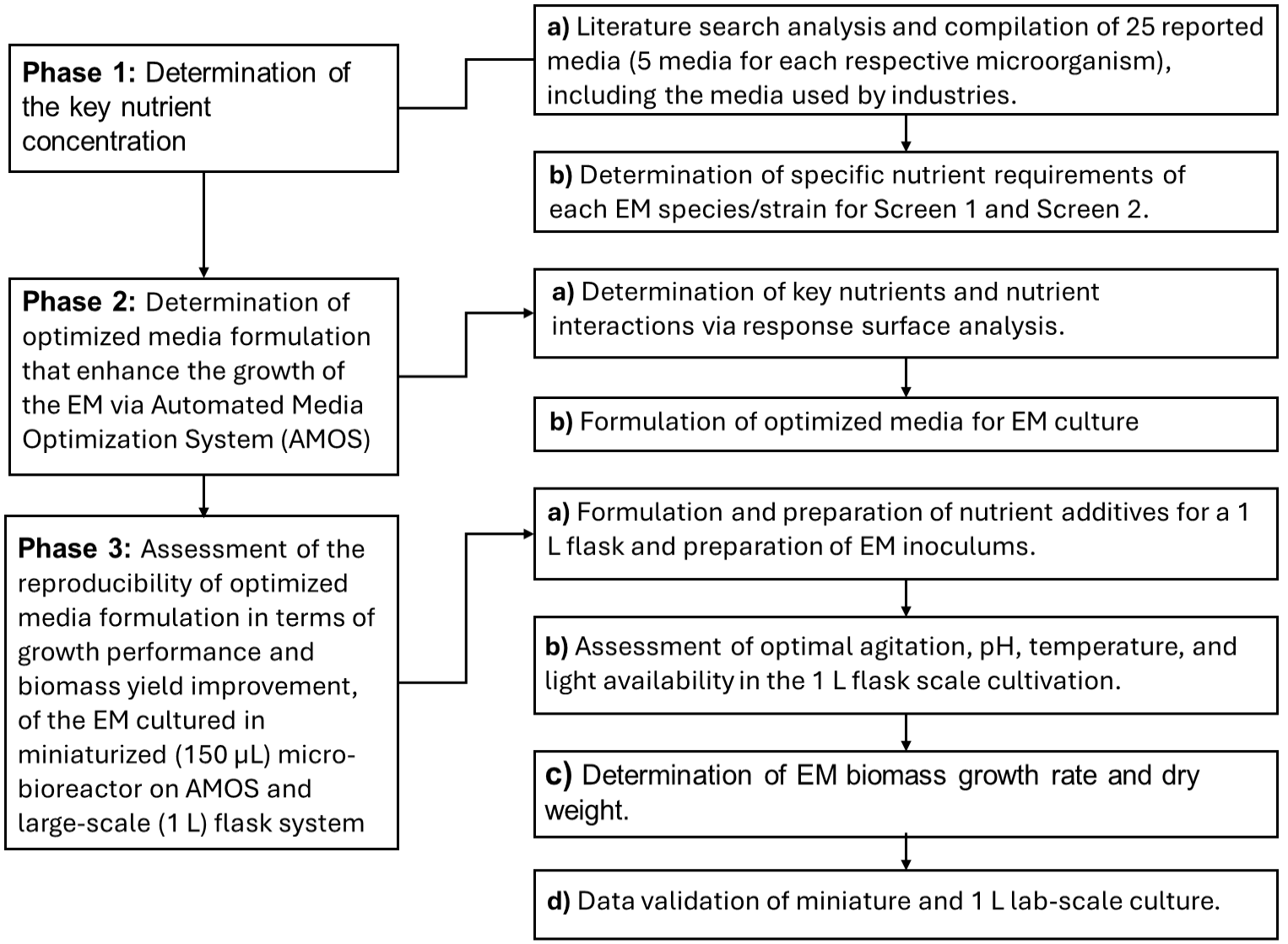
Workflow using automated media optimization system (AMOS) to optimize the biomass of EMs.
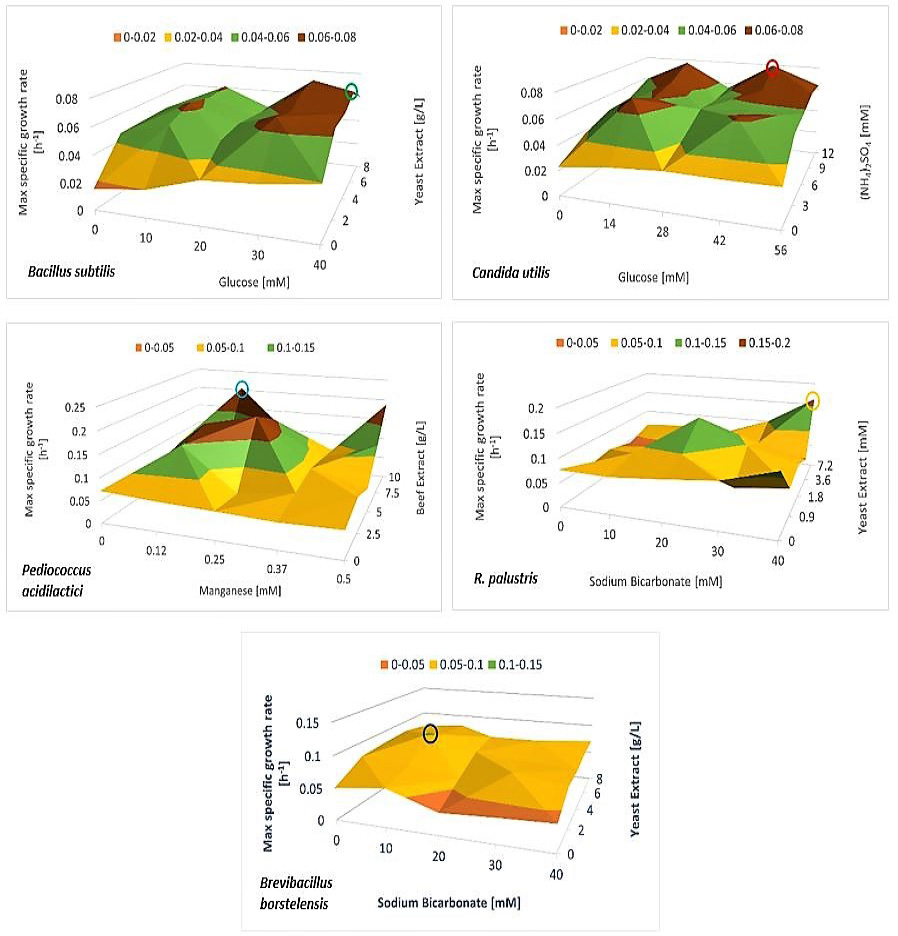
Surface chart analysis of EMs in Screen 1: (a) Bacillus subtilis, (b) Candida utilis, (c) Pediococcus acidilactici, (d) Rhodopseudomonas palustris, and (e) Brevibacillus borstelensis. Growth rates of the microorganisms are indicated by coloured circles based on their nitrogen and carbon sources: (a) Light green circle: B. subtilis in 40 mM glucose and 6 g/L yeast extract; (b) Red circle: C. utilis in 42 mM glucose and 12 mM ammonium sulfate (NH4)2SO4; (c) Blue circle: P. acidilactici in 0.125 mM manganese and 10 g/L beef extract; (d) Yellow circle: R. palustris in 40 mM sodium bicarbonate and 7.2 mM yeast extract; (e) Black circle: B. borstelensis in 10 mM sodium bicarbonate and 4 g/L yeast extract.
References
- Abd Aziz, N., Salleh, N.H.M., Anuar, A., Samat, A.F., Lian, O.L., Hassan, S.A.M. and Hassan, A.F.A., 2020. Growth optimisation of Bacillus subtilis in medium supplemented with prebiotic gum Arabic. IOP Conf. Ser. Mater. Sci. Eng., 932(1): 012-014. https://doi.org/10.1088/1757-899X/932/1/012014[CrossRef]
- Abdulhameed, A.S., Jawad, A.H., Kashi, E., Radzun, K.A., Al-Othman, Z.A. and Wilson, L.D., 2022. Insight into adsorption mechanism, modeling, and desirability function of crystal violet and methylene blue dyes by microalgae: Box-Behnken design application. Algal Res., 67: 102864. https://doi.org/10.1016/j.algal.2022.102864[CrossRef]
- Ali, S., Tyagi, A., Mir, R.A., Rather, I.A., Anwar, Y. and Mahmoudi, H., 2023. Plant beneficial microbiome a boon for improving multiple stress tolerance in plants. Front. Plant Sci., 14: 1266182. https://doi.org/10.3389/fpls.2023.1266182[CrossRef]
- Aqel, H., Farah, H. and Al-Hunaiti, A., 2024. Ecological versatility and biotechnological promise: Comprehensive characterization of the isolated thermophilic Bacillus strains. PLoS One, 19(4): e0297217. https://doi.org/10.1371/journal.pone.0297217[CrossRef]
- Arya, R., Mishra, N.K. and Sharma, A.K., 2016. Brevibacillus borstelensis and Streptomyces albogriseolus have roles to play in degradation of herbicide, sulfosulfuron. 3 Biotech, 6: 1-7. https://doi.org/10.1007/s13205-016-0562-z[CrossRef]
- Azeem, M., Haider, M.Z., Javed, S., Saleem, M.H. and Alatawi, A., 2022. Drought stress amelioration in maize (Zea mays L.) by inoculation of Bacillus spp. strains under sterile soil conditions. Agriculture, 12(1): 50. https://doi.org/10.3390/agriculture12010050[CrossRef]
- Basamma Hadimani, B.H. and Shripad Kulkarni, S.K., 2017. Ideal growth conditions for mass production of biocontrol agent Bacillus subtilis (Ehrenberg) Cohn.
- Bosma, E.F., Rau, M.H., van Gijtenbeek, L.A. and Siedler, S., 2021. Regulation and distinct physiological roles of manganese in bacteria. FEMS Microbiol. Rev., 45(6): fuab028. https://doi.org/10.1093/femsre/fuab028[CrossRef]
- Chaudhary, M., Garg, A. and Jabborova, D., 2025. Synergistic Influence of Bacterial and Fungal Inoculum on Microbial Biomass Carbon, Phosphorus and Nitrogen. Int. J. Plant Soil Sci., 37(1): 510-518. https://doi.org/10.9734/ijpss/2025/v37i15291[CrossRef]
- Choudhary, P., Bhatt, S. and Chatterjee, S., 2024. From freezing to functioning: Cellular strategies of cold-adapted bacteria for surviving in extreme environments. Arch. Microb., 206(7): 329. https://doi.org/10.1007/s00203-024-04058-5[CrossRef]
- Chowdhury, N.B., Alsiyabi, A. and Saha, R., 2022. Characterizing the interplay of rubisco and nitrogenase enzymes in anaerobic-photoheterotrophically grown Rhodopseudomonas palustris CGA009 through a genome-scale metabolic and expression model. Microbiol. Spect., 10(4): e01463-01422. https://doi.org/10.1128/spectrum.01463-22[CrossRef]
- Christmann, J., Cao, P., Becker, J., Desiderato, C.K., Goldbeck, O., Riedel, C.U., Kohlstedt, M. and Wittmann, C., 2023. High-efficiency production of the antimicrobial peptide pediocin PA-1 in metabolically engineered Corynebacterium glutamicum using a microaerobic process at acidic pH and elevated levels of bivalent calcium ions. Microb. Cell Fact., 22(1): 41. https://doi.org/10.1186/s12934-023-02044-y[CrossRef]
- De Leersnyder, I., De Gelder, L., Van Driessche, I. and Vermeir, P., 2018. Influence of growth media components on the antibacterial effect of silver ions on Bacillus subtilis in a liquid growth medium. Sci. Rep., 8(1): 9325. https://doi.org/10.1038/s41598-018-27540-9[CrossRef]
- Dimkić, I., Janakiev, T., Petrović, M., Degrassi, G. and Fira, D., 2022. Plant-associated Bacillus and Pseudomonas antimicrobial activities in plant disease suppression via biological control mechanisms-A review. Physiol. Mol. Plant. Pathol., 117: 101754. https://doi.org/10.1016/j.pmpp.2021.101754[CrossRef]
- Fixen, K.R., Pal Chowdhury, N., Martinez‐Perez, M., Poudel, S., Boyd, E.S. and Harwood, C.S., 2018. The path of electron transfer to nitrogenase in a phototrophic alpha‐proteobacterium. Environ. Microb., 20(7): 2500-2508. https://doi.org/10.1111/1462-2920.14262[CrossRef]
- Gao, T., Wong, Y., Ng, C. and Ho, K., 2012. L-lactic acid production by Bacillus subtilis MUR1. Biores. Tehnol., 121: 105-110. https://doi.org/10.1016/j.biortech.2012.06.108[CrossRef]
- Gaucher, F., Bonnassie, S., Rabah, H., Leverrier, P., Pottier, S., Jardin, J., Briard-Bion, V., Marchand, P., Jeantet, R. and Blanc, P., 2019. Benefits and drawbacks of osmotic adjustment in Propionibacterium freudenreichii. J. Proteomic., 204: 103400. https://doi.org/10.1016/j.jprot.2019.103400[CrossRef]
- Ghazanfari, N., Fallah, S., Vasiee, A. and Yazdi, F.T., 2023. Optimization of fermentation culture medium containing food waste for l-glutamate production using native lactic acid bacteria and comparison with industrial strain. LWT, 184: 114871. https://doi.org/10.1016/j.lwt.2023.114871[CrossRef]
- Graspeuntner, S., Koethke, K., Scholz, C., Semmler, L., Lupatsii, M., Kirchhoff, L., Herrmann, J., Rox, K., Wittstein, K. and Käding, N., 2023. Sorangicin a is active against chlamydia in cell culture, explanted fallopian tubes, and topical in vivo treatment. Antibiotics, 12(5): 795. https://doi.org/10.3390/antibiotics12050795[CrossRef]
- Guo, Y., Song, B., Li, A., Wu, Q., Huang, H., Li, N., Yang, Y., Adams, J.M. and Yang, L., 2022. Higher pH is associated with enhanced co‐occurrence network complexity, stability and nutrient cycling functions in the rice rhizosphere microbiome. Environ. Microb., 24(12): 6200-6219. https://doi.org/10.1111/1462-2920.16185[CrossRef]
- Haleema, B., Shah, S.T., Basit, A., Hikal, W.M., Arif, M., Khan, W., Said-Al Ahl, H.A. and Fhatuwani, M., 2024. Comparative effects of calcium, boron, and zinc inhibiting physiological disorders, improving yield and quality of Solanum lycopersicum. Biology, 13(10): 766. https://doi.org/10.3390/biology13100766[CrossRef]
- Harwood, C.S., 2022. Rhodopseudomonas palustris. Trends Microb., 30(3): 307-308. https://doi.org/10.1016/j.tim.2021.12.001[CrossRef]
- Hussain, N., Mumtaz, M., Perveez, W. and Hafsa. 2024. Extremophilic microorganisms for environmental bioremediation. Microb. Based Approach. Manage. Hazard. Contam., pp. 82-107. https://doi.org/10.1002/9781119851158.ch6[CrossRef]
- Ionuț, S.A., Cristina-Gabriela, G., Lidia, F., Moroi, A.M., Franck, K.Y. and Elena, B.G., 2017. Successful fodder yeast production from agro-industrial by products through a statistical optimization approach. Rom. Biotechnol. Lett., 22: 12671-12679.
- Joshi, J., 2014. Enhanced production of ethanol from red potatoes grown in hilly regions of Nepal using various nitrogen sources. Int. J. Appl. Sci. Biotechnol., 2(1): 41-44. https://doi.org/10.3126/ijasbt.v2i1.9191[CrossRef]
- Krupodorova, T., Barshteyn, V., Tsygankova, V., Sevindik, M. and Blume, Y., 2024. Strain-specific features of Pleurotus ostreatus growth in vitro and some of its biological activities. BMC Biotechnol., 24(1): 9. https://doi.org/10.1186/s12896-024-00834-9[CrossRef]
- Kusi, P.A., McGee, D., Tabraiz, S. and Ahmed, A., 2024. Bicarbonate concentration influences carbon utilization rates and biochemical profiles of freshwater and marine microalgae. Biotechnol. J., 19(8): 2400361. https://doi.org/10.1002/biot.202400361[CrossRef]
- Li, Z. and Shaw, G.S., 2023. Role of calcium-sensor proteins in cell membrane repair. Biosci. Rep., 43(2): BSR20220765. https://doi.org/10.1042/BSR20220765[CrossRef]
- Ma, Y., Zuohereguli, K., Zhang, L., Kang, Y., Shi, L., Xu, H., Ruan, Y., Wen, T., Mei, X. and Dong, C., 2025. Soil microbial mechanisms to improve pear seedling growth by applying bacillus and trichoderma‐amended biofertilizers. Plant Cell Environ., 48(6): 3968-3980. https://doi.org/10.1111/pce.15395[CrossRef]
- Moravcová, M., Siatka, T., Krčmová, L.K., Matoušová, K. and Mladěnka, P., 2024. Biological properties of vitamin B12. Nutr. Res. Rev., pp. 1-33. https://doi.org/10.1017/S0954422424000210[CrossRef]
- Mwampashi, L.L., Magubika, A.J., Ringo, J.F., Theonest, D.J., Tryphone, G.M., Chilagane, L.A. and Nassary, E.K., 2024. Exploring agro-ecological significance, knowledge gaps, and research priorities in arbuscular mycorrhizal fungi. Front. Microbiol., 15: 1491861. https://doi.org/10.3389/fmicb.2024.1491861[CrossRef]
- Naik, K., Mishra, S., Srichandan, H., Singh, P.K. and Sarangi, P.K., 2019. Plant growth promoting microbes: Potential link to sustainable agriculture and environment. Biocat. Agric. Biotechnol., 21: 101326. https://doi.org/10.1016/j.bcab.2019.101326[CrossRef]
- Nguyen, N.K., Vo, D.T.V., Le, T.X., Morton, L.W., Tran, H.-T., Robatjazi, J., Lasar, H.G.W. and Tecimen, H.B., 2024. Isolation, and selection of indigenous potassium solubilizing bacteria from Vietnam Mekong Delta rhizospheric soils and their effects on diverse cropping systems. Biocat. Agric. Biotechnol., 58: 103200. https://doi.org/10.1016/j.bcab.2024.103200[CrossRef]
- Olszewska-Widdrat, A., Babor, M., Hoehne, M.M.-C., Alexandri, M., Lopez-Gomez, J.P. and Venus, J., 2024. A mathematical model-based evaluation of yeast extract’s effects on microbial growth and substrate consumption for lactic acid production by Bacillus coagulans. Process Biochem., 146: 304-315. https://doi.org/10.1016/j.procbio.2024.07.017[CrossRef]
- Ortega-Villar, R., Escalante, A., Astudillo-Melgar, F., Lizárraga-Mendiola, L., Vázquez-Rodríguez, G.A., Hidalgo-Lara, M.E. and Coronel-Olivares, C., 2024. Isolation and characterization of thermophilic bacteria from a hot spring in the state of Hidalgo, Mexico, and geochemical analysis of the thermal water. Microorganisms, 12(6): 1066. https://doi.org/10.3390/microorganisms12061066[CrossRef]
- Othman, M., Ariff, A.B., Wasoh, H., Kapri, M.R. and Halim, M., 2017. Strategies for improving production performance of probiotic Pediococcus acidilactici viable cell by overcoming lactic acid inhibition. AMB Express, 7: 1-14. https://doi.org/10.1186/s13568-017-0519-6[CrossRef]
- Papapanagiotou, G., Samara, C. and Chatzidoukas, C., 2024. Managing the interactions of illumination, nitrogen, and sodium bicarbonate for autotrophic biomass production and macromolecules accumulation in the microalga Chlorella sorokiniana. Algal Res., 80: 103550. https://doi.org/10.1016/j.algal.2024.103550[CrossRef]
- Prakash, O., Waghmare, U., Chauhan, A. and Patil, Y., 2025. Optimizing experimental conditions: the role of buffered environments in microbial isolation, physiological studies, and taxonomic characterization. Appl. Environ. Microbiol. pp. e01728-01724. https://doi.org/10.1128/aem.01728-24[CrossRef]
- Prins, R.C. and Billerbeck, S., 2021. A buffered media system for yeast batch culture growth. BMC Microbiol., 21(1): 127.
- Probst, A.J., Castelle, C.J., Singh, A., Brown, C.T., Anantharaman, K., Sharon, I., Hug, L.A., Burstein, D., Emerson, J.B. and Thomas, B.C., 2017. Genomic resolution of a cold subsurface aquifer community provides metabolic insights for novel microbes adapted to high CO2 concentrations. Environ. Microb., 19(2): 459-474. https://doi.org/10.1111/1462-2920.13362[CrossRef]
- Qadir, M., Hussain, A., Iqbal, A., Shah, F., Wu, W. and Cai, H., 2024. Microbial utilization to nurture robust agroecosystems for food security. Agronomy, 14(9): 1891. https://doi.org/10.3390/agronomy14091891[CrossRef]
- Radzun, K.A., Wolf, J., Jakob, G., Zhang, E., Stephens, E., Ross, I. and Hankamer, B., 2015. Automated nutrient screening system enables high-throughput optimisation of microalgae production conditions. Biotechnol. Biofuel., 8(1): 65. https://doi.org/10.1186/s13068-015-0238-7[CrossRef]
- Ross, B.S., 2024. The effect of light intensity and reactor configuration on Rhodopseudomonas palustris growth and hydrogen production. Unpublished Master’s thesis.
- Saharuddin, A., Rashid, N., Noor, N.M., Rahman, N.A., Ismail, A., Razak, W., Pardi, F., Jawad, A., Ismail, K. and Radzun, K., 2018. High-throughput optimization of effective microbes nutrient formulation via automated media optimization system (AMOS). Int. J. Eng. Technol., 7(4.14): 1-6. https://doi.org/10.14419/ijet.v7i4.14.27461[CrossRef]
- Sahoo, A., Mahanty, B., Daverey, A. and Dutta, K., 2020. Nattokinase production from Bacillus subtilis using cheese whey: Effect of nitrogen supplementation and dynamic modelling. J. Water Proc. Eng., 38: 101533. https://doi.org/10.1016/j.jwpe.2020.101533[CrossRef]
- Sánchez, Á., Arrabal, A., San Román, M. and Díaz‐Colunga, J., 2024. The optimization of microbial functions through rational environmental manipulations. Mol. Microbiol., 122(3): 294-303. https://doi.org/10.1111/mmi.15236[CrossRef]
- Sánchez-Clemente, R., Igeño, M.I., Población, A.G., Guijo, M.I., Merchán, F. and Blasco, R., 2018. Study of pH changes in media during bacterial growth of several environmental strains. Proceedings, https://doi.org/10.3390/proceedings2201297[CrossRef]
- Saxena, A.K., Kumar, M., Chakdar, H., Anuroopa, N. and Bagyaraj, D., 2020. Bacillus species in soil as a natural resource for plant health and nutrition. J. Appl. Microb., 128(6): 1583-1594. https://doi.org/10.1111/jam.14506[CrossRef]
- Screpanti, L., Desmasures, N. and Schlusselhuber, M., 2024. Exploring resource competition by protective lactic acid bacteria cultures to control Salmonella in food: An Achilles’ heel to target? Crit. Rev. Food Sci. Nutr., pp. 1-15. https://doi.org/10.1080/10408398.2024.2416467[CrossRef]
- Sharma, N., Gupta, A. and Gautam, N., 2014. Characterization of Bacteriocin like inhibitory substance produced by a new Strain Brevibacillus borstelensis AG1 Isolated from’Marcha’. Bra. J. Microb., 45: 1007-1015. https://doi.org/10.1590/S1517-83822014000300033[CrossRef]
- Sharma, R. and Lamsal, B.P., 2025. Growth and rhamnolipid production performance of Pseudomonas aeruginosa on crude biomass carbohydrates and bioenhancer-based growth media. Appl. Sci,, 15(5): 2531. https://doi.org/10.3390/app15052531[CrossRef]
- Sheng, F., Hu, X., Zeng, J., Tian, X. and Wu, Z., 2023. Citrus pomace co-fermentation improved its protein and amino acids by Bacillus amyloliquefaciens and Candida utilis. Process Biochem., 130: 545-554. https://doi.org/10.1016/j.procbio.2023.05.007[CrossRef]
- Singh, R.P., Yadav, P., Kumar, A., Hashem, A., Al-Arjani, A.-B.F., Abd-Allah, E.F., Rodríguez Dorantes, A. and Gupta, R.K., 2022. Physiological and biochemical responses of bicarbonate supplementation on biomass and lipid content of green algae Scenedesmus sp. BHU1 isolated from wastewater for renewable biofuel feedstock. Front. Microbiol., 13: 839800. https://doi.org/10.3389/fmicb.2022.839800[CrossRef]
- Solórzano-Acosta, R., Toro, M. and Zúñiga-Dávila, D., 2023. Plant growth promoting bacteria and Arbuscular mycorrhizae improve the growth of Persea americana var. zutano under salt stress conditions. J. Fungi., 9(2): 233. https://doi.org/10.3390/jof9020233[CrossRef]
- Somda, M.K., Nikiema, M., Keita, I., Mogmenga, I., Kouhounde, S.H., Dabire, Y., Coulibaly, W.H., Taale, E. and Traore, A.S., 2018. Production of single cell protein (SCP) and essentials amino acids from Candida utilis FMJ12 by solid state fermentation using mango waste supplemented with nitrogen sources. Afr. J. Biotechnol., 17(23): 716-723. https://doi.org/10.5897/AJB2017.16361[CrossRef]
- Stamenković, S.S., Karabegović, I., Beškoski, V., Nikolić, N. and Lazić, M., 2020. Bacillus subtilis NCIM2063 batch cultivation: The influence of the substrate concentration and oxygen transfer rate on the biomass yield. Adv. Techol., 9(1): 44-49. https://doi.org/10.5937/savteh2001044S[CrossRef]
- Sun, J., Li, Y., Ren, T., Gao, Q., Yin, L., Liang, Y. and Liu, H., 2024. Effects of yeast extract supplemented in diet on growth performance, digestibility, intestinal histology, and the antioxidant capacity of the juvenile turbot (Scophthalmus maximus). Front. Physiol., 15: 1329721. https://doi.org/10.3389/fphys.2024.1329721[CrossRef]
- Tao, Z., Yuan, H., Liu, M., Liu, Q., Zhang, S., Liu, H., Jiang, Y., Huang, D. and Wang, T., 2023. Yeast extract: characteristics, production, applications and future perspectives. J. Microbiol. Biotechnol., 33(2): 151. https://doi.org/10.4014/jmb.2207.07057[CrossRef]
- Timira, V., Chen, X., Zhou, P., Wu, J. and Wang, T., 2024. Potential use of yeast protein in terms of biorefinery, functionality, and sustainability in food industry. Comp. Rev. Food Sci. Food Saf., 23(3): e13326. https://doi.org/10.1111/1541-4337.13326[CrossRef]
- Wang, T., Flint, S. and Palmer, J., 2019. Magnesium and calcium ions: Roles in bacterial cell attachment and biofilm structure maturation. Biofouling, 35(9): 959-974. https://doi.org/10.1080/08927014.2019.1674811[CrossRef]
- Yánez-Mendizábal, V., Falconí, C.E. and Kanaley, K., 2023. Production optimization of antifungal lipopeptides by Bacillus subtilis CtpxS2-1 using low-cost optimized medium. Biol. Contr., 185: 105306. https://doi.org/10.1016/j.biocontrol.2023.105306[CrossRef]
- Zhao, W., He, C.H. and Zhang, G.M., 2010. Culture medium optimization for photosynthetic bacteria. Adv. Mater. Res., 113: 1443-1446. https://doi.org/10.4028/www.scientific.net/AMR.113-116.1443[CrossRef]
- Zou, W., Huo, Y., Zhang, X., Jin, C., Li, X. and Cao, Z., 2024. Toxicity of hexagonal boron nitride nanosheets to freshwater algae: Phospholipid membrane damage and carbon assimilation inhibition. J. Hazard. Mater., 465: 133204. https://doi.org/10.1016/j.jhazmat.2023.133204[CrossRef]
Services
Article usage statistics
Loading…