
Carbapenem resistance conferred by metallo-β-lactamase (MBL) has increasingly being reported worldwide among Enterobacteriaceae. In this study, 240 non repetitive gram negative clinical isolates were studied for antimicrobial resistance. Presence of bla NDM was determined by polymerase chain reaction. Among 240 strains, prevalence of MBL in K. pneumoniae, P. aeruginosa, E. coli and Acinetobacter Species was 26%, 52%, 27% and 5% respectively. Prevalence of blaNDM-1 gene was 51% identified in 14 strains of P. aeruginosa, 2 strains of A. Baumanni, 29 strains of E. coli and 18 strains of K. pneumoniae. In conclusion, high prevalence of blaNDM-1 in our strains is a serious concern. A careful use of carbapenems is important to prevent the spread of these organisms.
Short Communication · Volume 52, Issue 3, 21 March 2020 · Open Access
Prevalence of New Delhi Metallo Beta-Lactamase (NDM) Producing Gram-Negative Bacteria from Different Tertiary Care Hospitals in Lahore, Pakistan
· ·
Affiliations & Notes ⌄
- 1Department of Zoology, Lahore College for Women University, Pakistan 2 Clinical Pathology Labs, Institute of Nuclear Medicine and Oncology, Pakistan , * Corresponding author: mariamfaiz@gmail.com
Article Info ⌄
- Journal:
- Pakistan Journal of Zoology
- Published:
- 21 March 2020

From the article
- Among the 240 bacterial isolates, 70% (168/240) were ESBL producing strains whereas 52% (124/240) were found to be MBL positive as determined by phenotypic methods.
- All MBL producing strains showed higher resistance levels (>50%) against meropenem and imipenem.
- The PCR amplification of blaNDM-1 gene among MBL positive gram negative bacterial strains were shown in Figure 2.
- The isolates displaying blaNDM-1 gene identified through PCR included 14 strains of P. aeruginosa, 2 strains of A. Baumanni, 29 strains of E. coli and 18 strain of K. pneumoniae.
Selected from the article's own text.
Abstract
Materials and methods
A total number of 240 clinically significant, non-duplicate strains were collected from different tertiary care referral hospitals in this study during November 2017 to January 2018. The isolated strains included Pseudomonas aeruginosa (n= 90), Klebsiella pneumonia (n=70), Acinetobacter baumannii (n=12) and Escherichia coli (n=68). These strains were isolated from various samples (urine, pus, blood, sputum, cerebrospinal fluid, human vaginal swab etc. of patients. Gram negative strains were identified by gram staining and by standard biochemical tests.
Antimicrobial susceptibility testing for different classes of antimicrobials such as cephalosporins (cefepime, ceftazidime, cefotaxime); β-lactam/β-lactamase inhibitors (piperacillin/tazobactam); carbapenems (imipenem, meropenem); fluoroquinolones (ciprofloxacin) was performed for all the isolates by Kirby Bauer disk diffusion method and interpreted according to Clinical Laboratory Standards Institute guidelines 2009 (CLSI, 2009). Isolates showing resistance to at least one agent in each of these three or four groups (cephalosporins, carbapenems, fluoroquinolones and/or aminoglycosides) were considered as MDR and included in the study for further characterization.
ESBL production was determined in all bacterial isolates by double disk synergy test (DDST) as explained elsewhere . The phenotypic detection of the carbapenemase production was performed by the modified Hodge test by using a imipenem disc (10 µg) as described by CLSI (CLSI, 2009). DNA extraction was performed from the screened positive bacterial isolates through standard alkaline lysis method. PCR assays were performed to amplify blaNDM-1 gene from the extracted DNA using the target specific primer set Forward: (5′-CAGCGCAGCTTGTCG-3′) Reverse: (5′-TCGCGAAGCTGAGCA-3′) .
Results
We determined the antibiotic resistance rates of E. coli, P. aeruginosa and K. pneumoniae and Acinector spp isolated from different patients against different antibiotics that we evaluated in this study. Among the 240 bacterial isolates, 70% (168/240) were ESBL producing strains whereas 52% (124/240) were found to be MBL positive as determined by phenotypic methods. The percentage of MBL positive K. pneumoniae, P. aeruginosa, E. coli and Acinetobacter Species were as 26%, 52%, 27% and 5% respectively. Among MBL positive strains, most of the isolates were recovered from urine and pus. MBL positive bacterial strains (E coli, K. pneumoniae, P. aeruginosa) were found highly resistant to third generation cephalosporins and flouroquinones (Fig. 1A, B, C). The same holds true for carbapenms. All MBL producing strains showed higher resistance levels (>50%) against meropenem and imipenem.
The PCR amplification of blaNDM-1 gene among MBL positive gram negative bacterial strains were shown in Figure 2. Out of 124 MBL producers, 63 (51%) isolates carried bla NDM-gene. The isolates displaying blaNDM-1 gene identified through PCR included 14 strains of P. aeruginosa, 2 strains of A. Baumanni, 29 strains of E. coli and 18 strain of K. pneumoniae. Highest number of MBL gene (blaNDM-1) was found in E. coli.
Discussion
In the last few years, numerous reports indicated that infections due to Enterobacteriaceae are an important cause of morbidity and mortality worldwide. Carbapenems, e.g. imipenem and meropenem are the last choice to treat multidrug- resistant (MDR) Gram-negative bacteria infections (Nordman et al., 2011). However, resistance to carbapenemases producing Enterobacteriaceae isolates seems to be increasing worldwide. ; . New Delhi metallo-β-lactamase (NDM)-mediated carbapenem resistance has been identified in Enterobacteriaceae from numerous countries including those of the Indian subcontinent and is a serious concern in Pakistan. In the present study, a high number of metallolactamases producing bacterial strains (52%) was observed. A previous study from Pakistan reported that 26% of isolates harbor ndm gene from two hospitals . Similarly, among the metallo-lactamases strains, frequency of blaNDM-1 gene was found to be (51%) indicating substantial number of studied strains harboring blaNDM-1 gene. The present data and previous reports showed the need to control the distribution of carbapenemase producing Enterobacteriaceae in hospital as well as in the community ; . This control will require the improvement of fast, inexpensive and easy-to handle diagnostic methods for the recognition of carbapenemase producers. Because of the multi drug resistant nature of these bacteria, the worldwide distribution of Enterobacteriaceae producing NDMs will have serious implications for the treatment of hospital acquired infections. Moreover, there are small numbers of antibiotics available with activity against these gram-negative bacteria.
This study was restricted mainly to the detection of metallo beta lactamases and the resistance mediated by blaNDM-1 type gene in bacterial strains. Further research is required to evaluate the phylogenetic analysis about possible variations with respect to blaNDM-1 possessing bacterial isolates from other parts of the world. In conclusion, NDM-1-producing Enterobacteriaceae is a growing healthcare problem with increasing prevalence in Pakistan, especially in hospitalized patients, leaving few therapeutic options. A high prevalence of NDM-1 necessitates the implementation of strict infection control to prevent the spread of these organisms. In addition, careful use of carbepenem is important to prevent the spread of these organisms.
Acknowledgement
The authors would like to acknowledge Lahore College for Women University Lahore for their support towards this research.
Statement of conflicts of interest
There are no conflicts of interest.
Figures
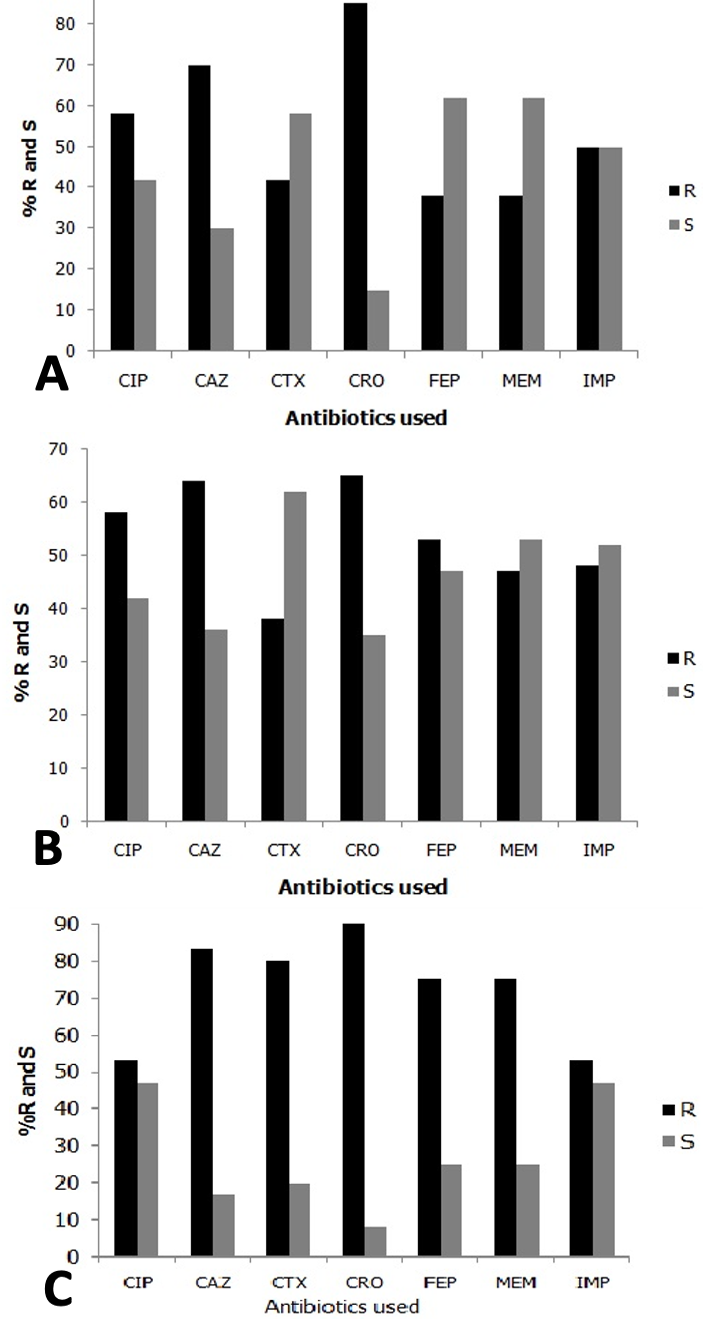
Resistance pattern of MBL production E. Coli (A), K. pneumonia (B) and P. aeruginosa (C) strains against various antibiotics; R: Resistance; S: Sensitive; MBL: Metallo-β-lactamases; IPM: Imipenem; MEM: Meropenem; FEP: Cefepime; CIP: Ciprofloxacin; CAZ: Caftazidime; CTX: Cefotaxime; CRO: Ceftriaxone.
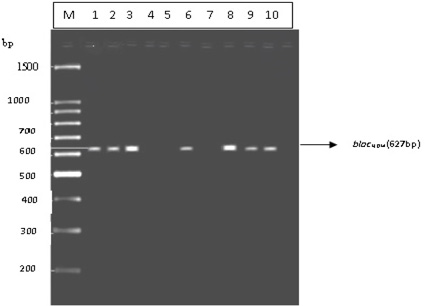
PCR amplification of blaNDM-1 gene in different bacterial strains. M: DNA ladder 100bp. Lane 1,3,6: Amplified PCR product of P. aeruginosa blaNDM-1 gene. lANE 2: Amplified PCR product of K. pneumoniae blaNDM-1 gene. Lane 8,9,10: Amplified PCR product of E. coli blaNDM-1 gene.
References
- Bush, K., Jacoby, G.A. and Medeiros, A.A., 1995. Antimicrob. Agents. Chemother., 39: 1211-1233. https://doi.org/10.1128/AAC.39.6.1211[CrossRef]
- Cornaglia, G. and Rossolini, G.M., 2010. The emerging threat of acquired carbapenemases in Gram negative bacteria. Clin. Microbiol. Infect., 16: 99-101. https://doi.org/10.1111/j.1469-0691.2009.03114.x[CrossRef]
- Nordmann, P., Cuzon, G. and Naas, T., 2009. Lancet Infect. Dis., 9: 228-236. https://doi.org/10.1016/S1473-3099(09)70054-4[CrossRef]
- Queenan, A.M. and Bush, K., 2007. Clin. Microbiol. Rev., 20: 440-458. https://doi.org/10.1128/CMR.00001-07[CrossRef]
- Walsh, T.R., Weeks, J., Livermore, M. and Toleman, M.A., 2011. Lancet Infect. Dis., 11: 355-362. https://doi.org/10.1016/S1473-3099(11)70059-7[CrossRef]
- Hafeez, A., Kiani, A.G., Din, S., Muhammad, W., Butt, K., Shah, Z. and Mirza, Z., 2004. J. Pak. med. Assoc., 54:187–191
- Kaleem, F., Usman, J., Hassan, A. and Khan, A., 2010. J. Infect. Devel. Count., 4: 810-813. https://doi.org/10.3855/jidc.1050[CrossRef]
- Ashraf, W. and Ahmed, A., 2015. Am. J. Infect. Dis., 11: 98-101. https://doi.org/10.3844/ajidsp.2015.98.101[CrossRef]
- Yong, D., Toleman, M.A., Giske, C.G., Cho, H.S., Sundman, K., Lee, K. and Walsh, T.R., 2009. Antimicrob. Agents Chemother., 53: 5046-5054. https://doi.org/10.1128/AAC.00774-09[CrossRef]
- Clinical and Laboratory Standards Institute (CLSI). 2009. Performance standards for antimicrobial susceptibility testing. Nineteenth informational supplement. CLSI document; M100-S19, Wayne, PA, (USA).
- Jarlier, V., Carlet, J., McGowen, J., Goossens, H., Voss, A. and Harbath, S., 1988. Antimicrob. Resist. Infect. Contr., 1: 101-106.
- Poirel, L., Lagrutta, E., Taylor, P., Pham, J. and Nordmann, P., 2010. Antimicrob. Agents Chemother., 54: 4914-4916. https://doi.org/10.1128/AAC.00878-10[CrossRef]
- Nordmann, P., Naas, T. and Poirel, L., 2011. Emerg. Infect. Dis., 17: 1791–1798. https://doi.org/10.3201/eid1710.110655[CrossRef]
- Nahid, F., Amir, A.K., Sana, R. and Rabaab, Z., 2013. J. Infect. Publ. Hlth., 6: 487-490.
Services
Article usage statistics
Loading…