
In pregnancy, any disturbance in the balance between antioxidants and oxidants in favor of the later can cause serious problems such as abortion. So the investigation of the oxidants/antioxidants status during early stages of pregnancy is urgently needed to help us solving such health issues. In this current study, One hundred and thirteen aborted women (73 known causes group, 40 unknown group) and control group (23 normal delivery women (control positive), 10 normal unmarried women (control negative) were recruited in this study. Levels of lipid peroxidation (MDA level), catalase activity (CAT), total antioxidant capacity (TAC) and reactive oxygen species (ROS) were measured in the serum of all studied groups. MDA levels were significantly higher (p≤0.05) in aborted women with T. gondii compared to negative control. MDA levels were also significantly higher (p≤0.05) among aborted women with Cytomegalo virus compared to negative and positive control groups. All aborted women had significantly higher levels of TAC levels (p≤0.05) compared to the control groups. However, catalase activity and ROS levels in all the aborted women did not differ statistically from that of control. Our data indicated that the aborted women had increased the level of serum oxidative stress (MDA) and this elevation may be driving the detrimental effects induced by parasitic or vial infections.
Short Communication · Volume 52, Issue 3, 21 March 2020 · Open Access
Effect of Early Spontaneous Abortions on Reactive Oxygen Species, Antioxidants and Lipid Damage in Women
·
Affiliations & Notes ⌄
- 1College of Science, Babylon University, Babil, Iraq 2Department of Pathological Analysis Techniques, Al-Mustaqbal University College, Babil, Iraq , * Corresponding author: Fatimahashim109@gmail.com
Article Info ⌄
- Journal:
- Pakistan Journal of Zoology
- Published:
- 21 March 2020

From the article
- Post-hoc analysis showed significant (P value= 0.001) variations in serum total antioxidants and catalase activity between unknown aborted women and controls (negative.
- Lipids oxidative damage was significantly (P-value= 0.001) greater in all aborted women compared to the values observed in the control groups.
- This potential explanation was confirmed by our findings in which the levels of MDA were positively correlated with levels of TAC (Pearson correlation=0.68, P=0.02), indicating that the women with higher lipid damage increased their antioxidant capacity as a compensating approach.
- It is also suggested that the antioxidant supplementation could be an option for reducing the expected oxidative damage during pregnancy.
Selected from the article's own text.
Abstract
Materials and methods
One hundred thirteen enrolled women (73 known causes and 40 unknown causes) were recruited in this study. Subjects that have chronic and genetic disease, infections, previous and recurrent abortions and smokers were excluded from the current study. Twenty-three enrolled women were considered as positive controls (normal delivery) and ten unmarried women were enrolled as negative controls.
Blood samples (5 ML) were collected from all enrolled women in appropriate sterile tubes by arm venous puncture. Serum was separated from whole blood by centrifugation at 2000 R.P.M for 5 minutes, then collected serum was kept at -20ºC until being used.
Serum anti-toxoplasma (IgG and IgM) and anti-cytomegalic (IgG and IgM) antibodies were identified by enzyme linked immunosorbent assay (ELSA) using a commercial kit (Company Calbioteck, USA).
Total ROS in serum was determined using a method developed by Erel (2005). TAC were measured by using CUPRAC (cupric reducing antioxidant capacity) spectrophotometric method (Apke et al., 2008). Serum lipid peroxidation was estimated by thiobarbituric acid reactive substances (TBARS) . Catalase activity was measured according to the method mentioned in Hadwan and Abed (2016).
The data presented here were tested for normality (Shapiro-Wilk) and the correction was performed for those non- normal distrusted data. Statistical Analysis and histograms were performed utilizing Sigma-plot System (version12.5) software. One-way ANOVA and Turkey post–tests were performed to explore the significant differences among studied groups. Mean±standard deviation were applied in the current study. Values of p< 0.05 were considered statistically significant.
The protocol of current study was conducted according Iraqi federal and local ethical committee policies, where all principles such as respect to persons, beneficence, risk and justice were accounted. Control and subjects were informed about the aim and details of the study.
Results and discussion
Figure 1 shows the levels of ROS, Total antioxidant capacity, catalase activity and MDA in different groups. The ROS levels were generally reduced non-significantly in all aborted women groups compared to what we have seen in the control groups.
Post-hoc analysis showed significant (P value= 0.001) variations in serum total antioxidants and catalase activity between unknown aborted women and controls (negative
and positive). In addition, same direction was also true for the levels of serum total antioxidants (TAC) between Cytomegalic group and control positive groups. The levels of enzymatic antioxidant activity (Catalase) were, however, not significantly (P value < 0.05) changed among all groups.
Lipids oxidative damage was significantly (P-value= 0.001) greater in all aborted women compared to the values observed in the control groups. This difference, however, disappeared among aborted women from different groups. The correlation matrix across different measured variables within each group revealed that only lipid oxidative damage in aborted women with T.gondii was positively correlated with the levels of their total antioxidants capacity (Pearson correlation=0.68, P=0.02) (Fig. 2). However, there were no significant correlations among other variables in all studied group (p>0.05).
In the current study, we have investigated the oxidative status by measuring the ROS, antioxidants (catalase and total antioxidants) and lipid oxidative damage in aborted women and compared that with healthy women who had normal delivery. In agreement with the previous research , aborted women had experienced greater levels of oxidative damage measured by serum MDA. In addition, this damage was not significantly changed among different subgroups of abortion. However, the changes observed in aborted groups compared with the controls did not seem to reflect to the changes found in the levels of ROS. Although the exact reason for such elevation of MDA is unknown, one possible mechanism is that the host’s cell initiated to produce more free radicals which are important to create the toxic environment for killing the invading parasites and the elevation of these free radicals would have been more pronounced in the tissues rather than blood. This might be a possible explanation for why we did not detect any significant change in the levels of ROS among groups. The increased levels of lipid damage was seen to be paralleled with high levels of serum total antioxidants among aborted women, suggesting that the subjects may have been under physiological stress which was expressed by greater levels of TAC. This potential explanation was confirmed by our findings in which the levels of MDA were positively correlated with levels of TAC (Pearson correlation=0.68, P=0.02), indicating that the women with higher lipid damage increased their antioxidant capacity as a compensating approach. It has been suggested that the levels of antioxidants are changeable according to the level of oxidative damage especially in toxoplasmosis . Evaluation of total antioxidants rather than single antioxidant has been recommended as the former could reflect to all of the antioxidant capacity including enzymatic and non-enzymatic enzymes . Thus providing us with a comprehensive picture of the balance between oxidants and antioxidants capacity in the measured system. Previous work showed considerable evidences for the variations in the oxidative stress status (MDA and SOD) among women who had toxoplasma infections . Also, experimental work on animals infected with Toxoplasma showed significant differences in endogenous antioxidant biomarkers such as CAT., SOD, MDA, GPX and GSH measured heart and liver . In the same direction, a study done by Dincel and Atmaca (2016) on mice brain tissue indicated a significant increase in glutathione reductase and decrease in SOD activity. Since it has been demonstrated that the oxidative damage can vary among the biological molecules being measured . It would therefore be interesting if other markers of oxidative damage like protein and DNA damage are to be tested in the context of aborted women which could expand our understanding of the candidate mechanism underling the abortion among pregnant women.
Conclusions
Our findings have highlighted the importance of an oxidative damage as a proximal mechanism that could drive the abortion among pregnant women. In addition, other biomarkers of oxidative damage to the biological molecules as well as different kinds of repairing markers should urgently be needed to explore more about the role of oxidative stress for aborted women. It is also suggested that the antioxidant supplementation could be an option for reducing the expected oxidative damage during pregnancy. Thus could potentially minimize the level of frequent pregnancy loss.
Acknowledgment
The authors would like to thank all staff at the Biology Department, College of Science, University of Babylon, Iraq for their help and support to accomplish this work.
Conflict of interest
Authors have declared no conflict of interest.
Figures
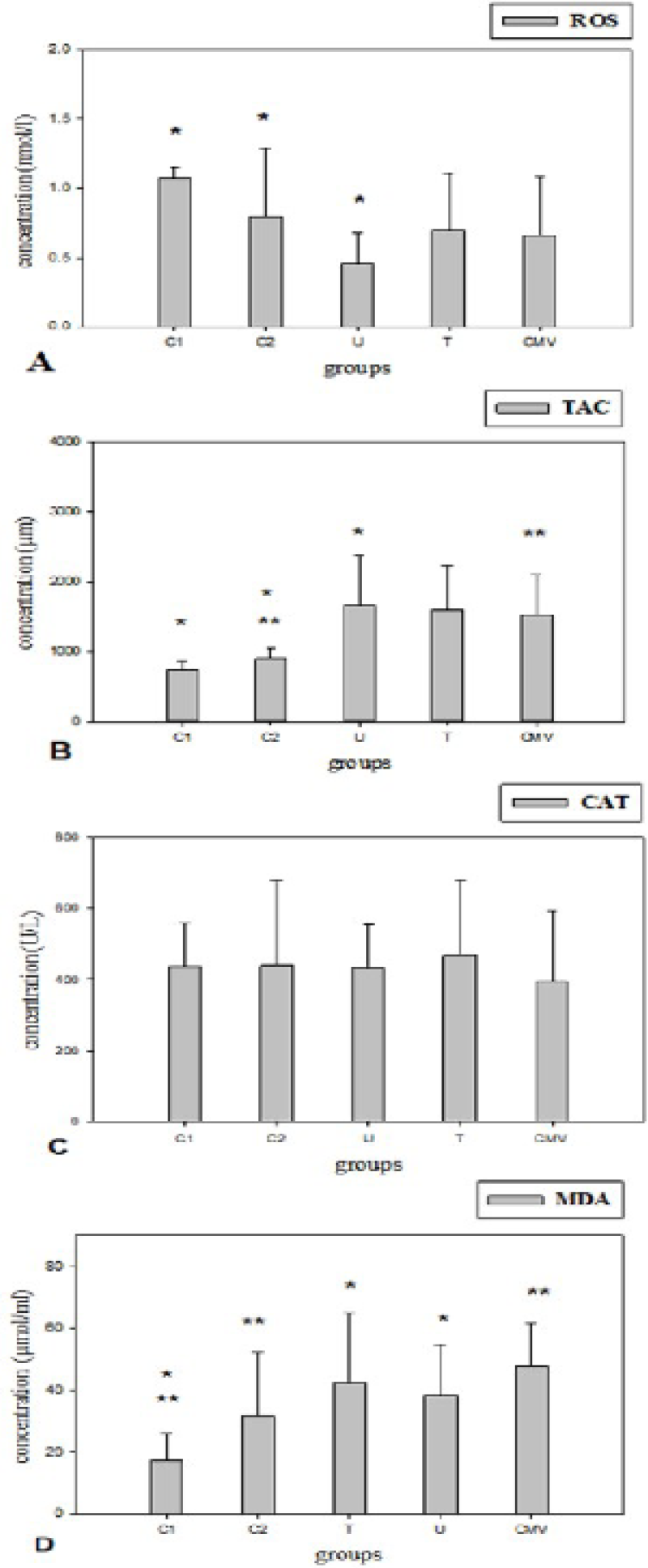
Concentration of reactive oxygen species (nmol/l) (A), total antioxidant capacity(µm) (B), catalase activity (U/L) (C), and MDA (µmol/ml) (D) in aborted women with unknown abortion, T. gondii and Cytomegalovirus comparing with controls. Where C1, negative control; C2, positive control; U, unknown abortion; T; T. gondii, CMV, Cytomegalo virus. Different stars indicate significant differences between groups, post-hoc Tukey tests, p < 0.05.
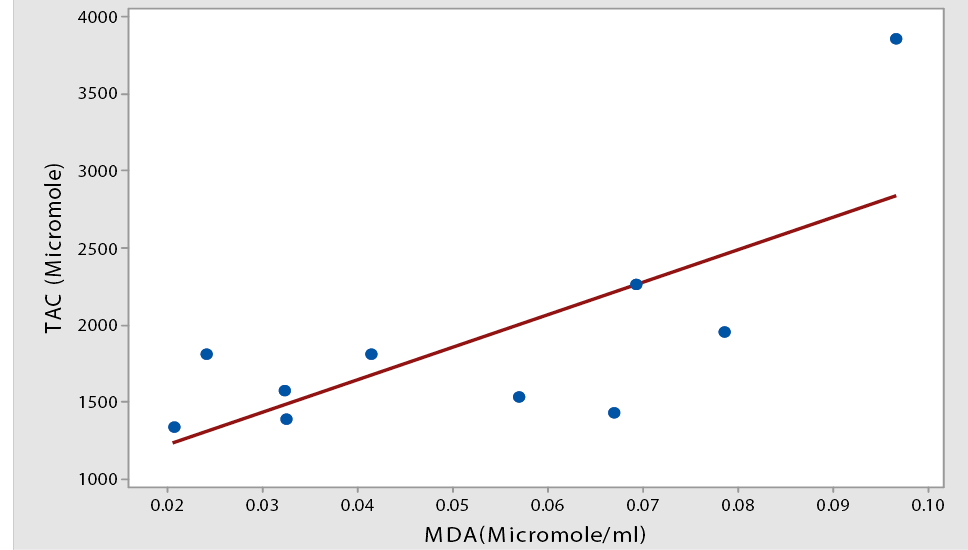
The correlation between the concentration of MDA (Mean±SD; µmol/ml) in aborted women with T. gondii, and correlation of total antioxidant capacity (TAC; µm).
References
- Apak, R., Güçlü, K., Özyürek, M. and Çelik, S. E., 2008. Microchim. Acta, 160: 413–419. https://doi.org/10.1007/s00604-007-0777-0[CrossRef]
- Atmaca, N. and Cinar, M., 2015. Ankara Univ. Vet. Fak. Derg., 62:165-170. https://doi.org/10.1501/Vetfak_0000002675[CrossRef]
- Bahrami, S., Shahriari, A., Tavalla, M., Azadmanesh, S. and Hamidinejat, H., 2016. Oxid. Med. Cell. Long., 1: 1-6. https://doi.org/10.1155/2016/8045969[CrossRef]
- Buege, J.A. and Aust, S.D., 1978. Methods Enzymol., 52: 302-310. https://doi.org/10.1016/S0076-6879(78)52032-6[CrossRef]
- Cencioni, C., Spallotta, F., Martelli, F., Valente, S., Mai, A., Zeiher, A.M. and Gaetano, C., 2013. Int. J. mol. Sci., 14: 17643-17663. https://doi.org/10.3390/ijms140917643[CrossRef]
- Cunningham, F.G., Spong, C.Y., Dashe, J.S., Huffman, B.L., Casey, B.M. and Sheffield, J.S., 2014. William’s Obstetrics, 24 ed. McGraw-Hill, New York, NY.
- Dincel, G.C. and Atmaca, H.T., 2016. Int. J. Immunopath. Pharmacol. 29: 226–240. https://doi.org/10.1177/0394632016638668[CrossRef]
- Dubey, J.P., 2009. Toxoplasmosis of animals and humans. 2nd ed. FL: CRC Press, Boca Raton.
- Halliwell, B. and Gutteridge, J.M., 1995. Free Radic. Biol. Med., 18: 125–126. https://doi.org/10.1016/0891-5849(95)91457-3[CrossRef]
- Halonen, S.K. and Weiss, L.M., 2013. Handb. clin. Neurol., 114: 125–145. https://doi.org/10.1016/B978-0-444-53490-3.00008-X[CrossRef]
- Hung, J., 2007. J. Chin. med. Assoc., 70: 430-432. https://doi.org/10.1016/S1726-4901(08)70032-7[CrossRef]
- Jothery, A.H.A., Vaanholt, L.M., Mody, N., Arnous, A., Lykkesfeldt, J., Bünger, L., Hill, W.G., Mitchell, S.E., Allison, D.B. and Speakman, J.R., 2016. Sci. Rep., 6: 36353.
- Juliano, M., Dabulis, S. and Heffner, A., 2008. Annls Emerg. Med. 52: 143-147. https://doi.org/10.1016/j.annemergmed.2008.03.002[CrossRef]
- Kohen, R. and Nyska, A., 2002. Toxicol. Pathol., 30: 620-650. https://doi.org/10.1080/01926230290166724[CrossRef]
- Lyu, S.W., Song, H., Yoon, J.A., Chin, U.K., Sung, SR., Kim, Y.S., Lee, W.S., Yoon, T.K., Cha, D.H. and Shim, S.H., 2013. Placenta, 34: 133-140. https://doi.org/10.1016/j.placenta.2012.12.003[CrossRef]
- Hadwan, M.H. and Abed, H.N., 2016. Data Brief, 6: 194–199. https://doi.org/10.1016/j.dib.2015.12.012[CrossRef]
- Nathan, C. and Shiloh, M.U., 2000. Proc. natl. Acad. Sci., 97: 8841–8848. https://doi.org/10.1073/pnas.97.16.8841[CrossRef]
- Niki, E., 2009. Free Radic. Biol. Med., 47: 469-484. https://doi.org/10.1016/j.freeradbiomed.2009.05.032[CrossRef]
- Odo, G.E., Agwu, E.J., Ossai, N.I., Ezea, C.O., Madu, J. and Eneje, V., 2017. Pakistan J. Zool., 49: 433–444. https://doi.org/10.17582/journal.pjz/2017.49.2.433.444[CrossRef]
- Erel, O., 2005. Clin. Biochem., 38: 1103–1111. https://doi.org/10.1016/j.clinbiochem.2005.08.008[CrossRef]
- Rafeeinia, A., Tabandeh, A., Khajeniazi, S. and Marjani, J.A., 2014. Open Biochem. J., 1: 83–88. https://doi.org/10.2174/1874091X01408010083[CrossRef]
- Tenter, A.M., Heckeroth, A.R. and Weiss, L.M., 2000. Int. J. Parasitol., 30: 1217–1258. https://doi.org/10.1016/S0020-7519(00)00124-7[CrossRef]
- Türkoğlu, Ş.A., Yaman, K., Orallar, H., Camsari, C., Karabörk, Ş. and Ayaz, E., 2018. Annls Parasitol., 64: 241-247.
- Vural, P., Akgül, C., Yildirim, A. and Canbaz, M., 2000. Clin. Chim. Acta, 295: 169–177. https://doi.org/10.1016/S0009-8981(99)00255-7[CrossRef]
- Yigenoglu, Ö., Ugur, M.G., Balat, Ö. and Erel, Ö., 2011. Inönü. Üniv. Tip Fakül. Derg., 18: 236-239.
Services
Article usage statistics
Loading…