
A surveillance of avian influenza viruses in Hazara region of Khyber Pakhtunkhwa Pakistan was carried out from April 2013 through September 2014. Pooled morbid material and fecal samples from 600 different locations across the region were analyzed for isolation. Isolation was carried out on embryonated chicken eggs. Identification of H protein was undertaken through hem agglutination Inhibition (HI) test while N typing was done using reverse transcriptase polymerase chain reaction (RT-PCR) procedure. Out of 600 examined locations twenty two (22) H9N2 subtypes isolates were recorded. The total prevalence recorded was 3.66%and out of 498 broiler operations yielded 17 (3.4%) positive isolates and 44 golden type native chicken farms yielded 05 (11.36%) isolates of AIV H9N2 and 58 captive pheasant’s samples were negative. It was observed that frequency of H9N2 prevalence in poultry population was directly proportional to temperature, season and elevation.
Short Communication · Volume 49, Issue 4, 29 July 2017 · Open Access
Prevalence of H9N2 Avian Influenza Viruses in Hazara Region of Pakistan
· · · · · · ·
Affiliations & Notes ⌄
- 1Poultry Research Institute, Jaaba Mansehra, Khyber Pakhtunkhwa, Pakistan 2NRLPD, National Agricultural Research Centre, Islamabad, Pakistan 3Veterinary Research and Disease Investigation Centre, Abbottabad, Khyber Pakhtunkhwa, Pakistan , * Corresponding author: ayaz1961@hotmail.com
Article Info ⌄
- Journal:
- Pakistan Journal of Zoology
- Published:
- 29 July 2017

From the article
- Of the 600 avian locations examined, 22 yielded H9N2 avian influenza subtype isolates with an overall prevalence of 3.66%.
- The present findings indicated the prevalence of H9N2 spread across the Hazara region (Table II).
- The present study indicated the existence of H9N2 avian influenza in Hazara region of Pakistan.
- The higher prevalence in golden type native chicken is alarming.
Selected from the article's own text.
Abstract
Materials and methods
An active surveillance had been done in Hazara region of Pakistan to record the prevalence of avian influenza viruses (H9N2) following the protocol as previously described by . Sampling was carried out from random locations of poultry farms and live bird markets across the region spread over 18000 km2. For this purpose swab samples (oral and cloacal) along with
Table I.- Sample collected from various localities and area wise prevalence of H9N2.
| Area and elevation | Commercial poultry farms | Live bird market | No of H9N2 isolates | Area wise prevalence (%) | No of H9N2 isolates | Area wise prevalence (%) |
| Abbottabad (4000 ft) | 113 | 21 | 41 | 26 | 11 | 50 |
| Mansehra (3600 ft) | 96 | 11 | 38 | 8 | 6 | 27.3 |
| Battagram (3400 ft) | 36 | 4 | 21 | 7 | 1 | 4.5 |
| Haripur (1700 ft) | 76 | 8 | 26 | 14 | 3 | 13.7 |
| Kohistan (1500 ft) | 32 | 0 | 19 | 3 | 1 | 4.5 |
| Total | 353 | 44 | 145 | 58 | 22 |
Table II.- Prevalence of H9N2.
| Broiler operations | Native golden type | Captive pheasants | |
| No of H9N2 isolates | 17 | 05 | 0 |
| Prevalence | 3.41 | 11.36 | 0 |
morbid material (trachea, lungs and spleen) from 5 birds each from each selected location were collected as described in Tables I and II. The swabs and morbid material was pooled separately from each location and were brought to laboratory on ice. While these samples along with the standard samples collection information were transported to National Reference Lab for Poultry Diseases (NRLPD), NARC, Islamabad through special messenger in sample shipment boxes provided by NRLPD for further evaluation. A copy of the sample information form was also kept for record in the laboratory future reference.
The virus isolation and identification was carried out at NRLPD. Briefly swabs were re-suspended in sterile PBS, centrifuged and filtered through 0.2 µm disposable syringe filters (Sartorius Minisart Cat# 16534K, Germany). The morbid material was also processed for a final homogenate 10% w/v through tissue homogenizer Stomacher-80 (Seward, UK), centrifuged at 1000 rpm for 1 min in refrigerated centrifuge, and the supernatant was collected with 0.2 µm syringe filter (Sartorius Minisart Cat# 16534K, Germany). The processed material was inoculated in 9-11 days old embryonated chicken eggs. The virus identification from the positive allantoic fluid was done through hemagglutination inhibition test and the confirmation was done through RT-PCR .
Results
Of the 600 avian locations examined, 22 yielded H9N2 avian influenza subtype isolates with an overall prevalence of 3.66%. Out of 498 broiler operations tested against H9N2 presence, 17 broiler locations yielded H9N2 viruses and the prevalence percentage being 3.41%, likewise five H9N2 viruses isolated from 44 locations of native type golden chicken farms showing the prevalence being 11.36% (Table I). Fifty eight captive pheasants examined for the type found negative. Area wise prevalence was highest in Abbottabad (50%) followed by Mansehra (27.3%), Haripur (13.7%), Battagram (4.5%) and Kohistan (4.5%). Altitude was also considered and it was found that prevalence of H9N2 virus was higher at high altitude (Table I). The month wise study of the prevalence indicated higher in cold months of the year (Fig. 1).
Discussion
Hazara region, an area of 18000 sq.km is located north of Islamabad. A big population of poultry, as estimated in economic survey of Pakistan 2014-15, rural poultry 3 million, parent stock 4 million, layer 1.5 million and broiler 5 million exist in the region. Two fly ways (East African-West Asia and Central Asia) traverse over the region specially the Indus river route termed as green flyway being followed by migratory ducks having stopover in Tarbela Lake on river Indus which runs at the western boundary of the region .
Suitable geo-ecological situation of Hazara region had been popular among commercial poultry producers of the country. Parent breeding farmers were attracted in the region in early 1980, soon after, broiler farming also started and within ten years the region was heavily populated by commercial poultry. Haphazard poultry establishment made the biosecurity measures difficult to implement at individual farm which paved the way for easy spread of infectious diseases like avian influenza. The first ever outbreak of H7N3 was recorded in the region in 1995 . A low pathogenic avian influenza outbreak of H9N2 was recorded in 1999 inflicting drop in egg production and low mortality up to 2% . From 2003-04 an epizootic of high pathogenic avian influenza H7N3 and later on H5N1 during 2006-08 affected the major poultry of the region ; ; . This was accompanied by an outbreak of low pathogenicity AIV H9N2 in commercial chicken population which continued during 2005. The present findings indicated the prevalence of H9N2 spread across the Hazara region (Table II). Importantly frequency of this subtype is increasing noticeably in countries like Iran, Pakistan, United Arab Emirates and India ; ; ; . The above findings are in line with our present study.
Elevation may also be another cause of difference in incidence as Abbottabad is at higher altitude (above 4000 ft.) followed by Mansehra (above 3500 ft.) and Haripur (above 1700 ft.) above sea level. The highest incidence was again in non-descript chicken (11.4%) as compared to previous study. The seasonal spread of incidence was highest in cold months of December and January (Fig. 1).
Conclusion
The present study indicated the existence of H9N2 avian influenza in Hazara region of Pakistan. The higher prevalence in golden type native chicken is alarming. This type of chicken is kept as domestic layer, hence endemicity of the virus in rural area should be further studied in other parts of the country.
Acknowledgement
This study was partially sponsored through FELTP, CDC, (Grant No. GH10-1002 5U2RGH000070) which is gratefully acknowledged.
Statement of conflict of interest
Authors have declared no conflict of interest.
Figures
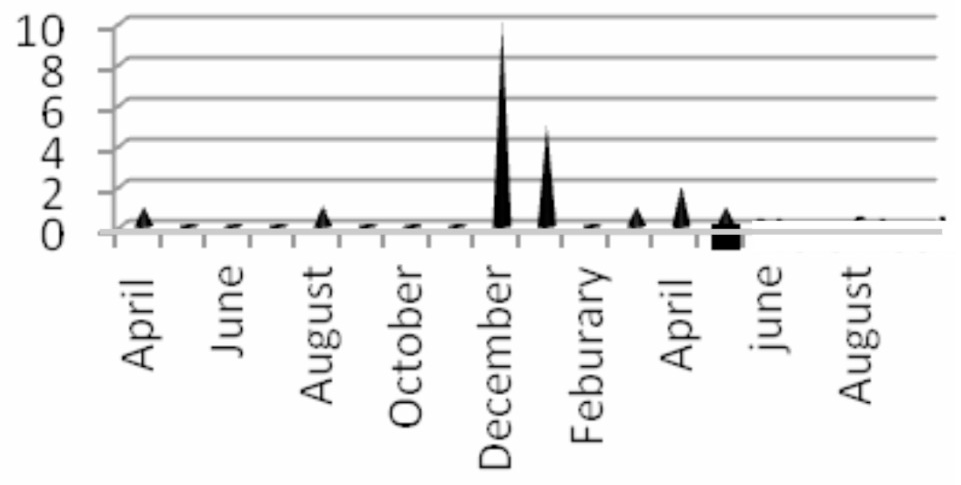
Seasonal prevalence of H9N2. The figure shows number of isolates.
References
- Amir, U.B., Wernery, U., Ilyushina, N. and Webster, R.G., 2007. Virology, 361: 45-55. https://doi.org/10.1016/j.virol.2006.10.037[CrossRef]
- Abbas, M.A., Spackman, E., Swayne, D.E., Ahmed, Z., Sarmento, L., Siddique, N., Naeem, K., Hameed, A. and Rehmani, S., 2010. Virol. J., 7: 137. https://doi.org/10.1186/1743-422X-7-137[CrossRef]
- Ayaz, M., Naeem, K., Qayyum, A., Sajid, M., Ahmad, I., Hussain, A. and M., H., 2010. J. Anim. Hlth Prod., 21: 21-23.
- Capua, I. and Alexander, D.J., 2004. Avian Pathol., 33: 393-404. https://doi.org/10.1080/03079450410001724085[CrossRef]
- Iqbal, M., Yaqub, T., Reddy, K. and McCauley, J.W., 2009. PLoS One, 4: e5788. https://doi.org/10.1371/journal.pone.0005788[CrossRef]
- Khamas, E.J., 2008. Iraqi J. Vet. Med., 32: 223-230.
- Liu, M., He, S., Walker, D., Zhou, N., Perez, D.R., Mo, B., Li, F., Huang, X., Webster, R.G. and Webby, R.J., 2003. Virology, 305: 267-275. https://doi.org/10.1006/viro.2002.1762[CrossRef]
- Naeem, K. and Hussain, M., 1995. Vet. Rec., 137: 439. https://doi.org/10.1136/vr.137.17.439[CrossRef]
- Naeem, K., Siddique, N., Ayaz, M. and Jalalee, M.A., 2007. Avian Dis., 51: 189-193. https://doi.org/10.1637/7617-042506R.1[CrossRef]
- Naeem, K., Ullah, A., Manvell, R.J. and Alexander, D.J., 1999. Vet. Rec., 145: 560. https://doi.org/10.1136/vr.145.19.560[CrossRef]
- Nagarajan, S., Rajukumar, K., Tosh, C., Ramaswamy, V., Purohit, K., Saxena, G., Behera, P., Pattnaik, B., Pradhan, H.K. and Dubey, S.C., 2009. Vet. Microbiol., 133: 154-163. https://doi.org/10.1016/j.vetmic.2008.06.013[CrossRef]
- Nili, H. and Asasi, K., 2002. Avian Pathol., 31: 247-252. https://doi.org/10.1080/03079450220136567[CrossRef]
- Sarwar, M., Muhammad, K., Rabbani, M., Younus, M., Sarwar, N., Ali, M.A. and Ahad, A., 2013. J. Anim. Pl. Sci., 23: 388-392.
- Shirazi, S.A.J., 2005. International visitors: Birds come flying in. Avaialable at: http://www.wildlifeofpakistan.com/PakistanBirdClub/birdcomeflyingin.html
- Siddique, N., Naeem, K., Abbas, M.A., Ahmed, Z. and Malik, S.A., 2012. Virol. J., 9: 300. https://doi.org/10.1186/1743-422X-9-300[CrossRef]
- Siddique, N., Naeem, K., Ahmed, Z. and Malik, S.A., 2008. Int. J. Poult. Sci., 7: 1122-1127. https://doi.org/10.3923/ijps.2008.1122.1127[CrossRef]
- Sohaib, M., Muhammad, S., Khushi, M., Rabbani, M., Altaf, M. and Hanif, A., 2010. Pakistan J. Zool., 42: 325-329.
- Spackman, E., Suarez, D.L. and Senne, D.A., 2008. Avian influenze diagnostics and surveillance methods. Blackwell Publishers, Ames, Iowa.
- Wasilenko, J., Pantin-Jackwood, M., Khan, T., Ahmed, A., Rehmani, S., Lone, N., Swayne, D. and Spackman, E., 2012. Virus Genes, 44: 247-252. https://doi.org/10.1007/s11262-011-0689-2[CrossRef]
Services
Article usage statistics
Loading…