
Study was conducted on breeding and mortality of Royal Bengal Tiger (Panthera tigris tigris Linnaeus 1758). There are five big cat species in the genus Panthera and tiger is the biggest one. Data were collected by recording observations on breeding of Royal Bengal Tiger in captivity at Bahawalpur Zoo from June 2012 to July 2014 (two years) on prescribe sheets. Data from June, 2003 to December, 2011 (nine years) were collected from zoo management. In two years study Tiger breed once and produce four cubs (female) while in nine years it breed three times; first three cubs (one male and two female), two and one cubs were produced in 2003, 2005 and 2006, respectively. Six days estrous cycle and 107 days gestation period was observed in tigress. Mortality of one cub of 32 days in August, 2013 and second cub in Jannaury, 2014 of 173 days was observed due to congenital abnormality of liver. Parent tigress (Rani) was also died in May, 2014 due to respiratory failure and cardiac arrest and female cub died in 2005 due to canabalism.
Short Communication · Volume 49, Issue 4, 29 July 2017 · Open Access
Breeding and Mortality of Royal Bengal Tiger (Panthera tigris tigris Linnaeus 1758) at Bahawalpur Zoo, Punjab, Pakistan
· · · ·
Affiliations & Notes ⌄
- 1Department of Life Sciences, The Islamia University of Bahawalpur,Bahawalpur, Pakistan 2Department of Zoology, University of Education, Lahore, DG Khan Campus, Pakistan 3Punjab Wildlife & Parks Department, 2-Sanda Road, Lahore, Punjab, Pakistan , * Corresponding author: ahmads1976pk@yahoo.com
Article Info ⌄
- Journal:
- Pakistan Journal of Zoology
- Published:
- 29 July 2017

From the article
- Tiger bred only once during study period and produced four female cubs (Table I).
- In 2005 and 2006 two (one male and one female and one (female) cubs were born, respectively.
- It was observed that one cub of 32 days in 2013 while second cub in 2014 of 173 days died due to congenital abnormality of liver.
- Parent tigress (Rani) also died in 2014 due to respiratory failure and cardiac arrest (Table II); and another female cub had died in 2005 due to canabalism.
Selected from the article's own text.
Abstract
Material and methods
Bahawalpur (N 29.3956°, E 71.6836°), now a large city has been a part of Cholistan desert, where the tiger was once naturally distributed. The average rainfall in Bahawalpur is 20 to 25 cm annually. Tiger breeding data spanned over eleven years since July 2003 to June 2014 has been analysed for this study. Data for two years, from July 2012 to June 2014 were collected by our research team by recording direct observations while the nine years data since July 2003 to June 2012 were clollected from the Zoo management (Wildlife and Parks Department of Punjab). During pregnancy a close watch was kept on female’s behavior and only one keeper would attend the female to reduce the disturbance level. Gestation period and congenital defects were also recorded. Cubs or adults mortality causes were examined by postmortem examination with the help of veternarian. Data analysis and Graphs were made using Excel 2007.
Table I.- Breeding record of Royal Bengal Tiger during the study period July 2012 to June 2014.
| Study name of animals | Duration of oestrus | Date of birth | Gestation period in days | Breed name | Litter size | ||
| M | F | M | F | ||||
Raja (9 Y) | Rani (13 Y) | 23-28 March 2013 | 12 July 2013 | 107 | CBT-1 | - | 4 |
Total CBT during study period, 4.
Results and discussion
The age of parent tigress was 13 years while male parent tiger was 9 years old at the start of the study i.e., July 2012. Tiger bred only once during study period and produced four female cubs (Table I). Previous data (2003-2011) showed that that the pair bred for the first time in 2003 when three cubs (one male and two female) were produced. In 2005 and 2006 two (one male and one female and one (female) cubs were born, respectively. However, breeding was not recorded during the period 2007 to 2012 (Fig. 1). According to Sunquist (1981) the captive tigeress breeds mostly from two to sixteen years of age however maximum litters are produced when her age is above 6.2 years.
Very little information is available on these aspects in wild tiger populations. Sunquist (1981) once observed the oestrus in a thirty month old female that was perhaps the earliest. Sunquist (1981) also observed that in wild tiger populations litter size ranged from one to seven cubs.
During present study six days esterous cycle and 107 days gestation period was observed in the tigeress (Table I), while Mazak (1979) reported three to six days of esterous cycle and 104 days of gestation in tigeress. Further he reported that gestation period ranged from 96 days to 111 days.
In our study mating was observed in the month of March (Table I) while several scientists stated that mating in Tigers may occure throghout the year; however this was most likely to happen from November to the April ; ; ; ; , 1978; .
It was observed that one cub of 32 days in 2013 while second cub in 2014 of 173 days died due to congenital abnormality of liver. Parent tigress (Rani) also died in 2014 due to respiratory failure and cardiac arrest (Table II); and another female cub had died in 2005 due to canabalism. No death of male tiger has been reported during the period 2003 to 2014 (Fig. 1). Cavaliere in 2015 reported that the Seigfried and Roy’s white lion died due to cardiac and respiratory arrest.
Table II.- Mortality of Royal Bangal Tigeress and cubs during the study period July 2012 to June 2014.
| Study name of animals | Male/Female | Date of death | Total age | Reason of death |
| CBT-1 (1) | Female | 12.08.2013 | 32 Days | Congenital abnormality of liver |
| CBT-1 (2) | Female | 31.01.2014 | 173 Days | Congenital abnormality of liver |
| Rani | Female | 18.05.2014 | 14 Years | Respiratory failure and Cardiac arrest |
Mortality of female cubs, 2; Mortality of breeding female, 1; Total mortality, 3.
Aknowledgement
Authors are grateful to the management of Bahawalpur Zoo for their cooperation and providing us access to the previous data on tigers. We also grateful to the attendant of the Zoo for handling the tigers during observation and data collection.
Statement of conflict of interest
Authors have declared no conflict of interest.
Figures
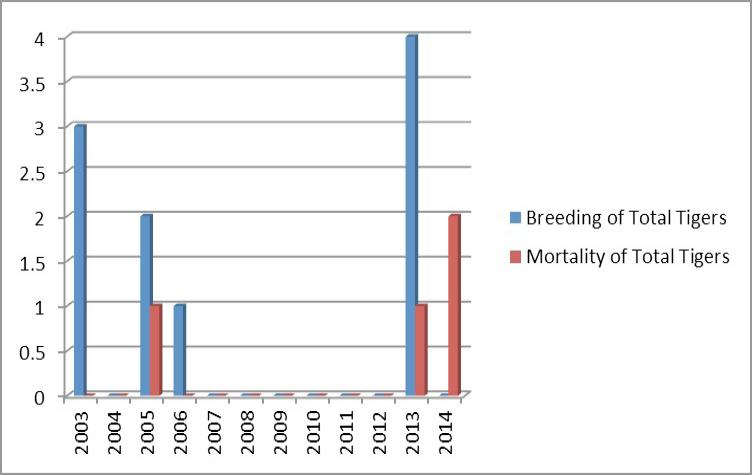
Total breeding and mortality of tigers by years (2003-2014).
References
- Abramov, V.K. and Pikunov, D.G., 1976. The rare species of carnivores of the Far East of USSR, Redkie mlekopitayushchie fauny SSSR (The Rare Mammals of the Fauna of USSR), Nauka, Moscow, pp. 67–96.
- Anwar, M.B., Nadeem, M.S., Shah, S.I., Kiayani, A.R. and Mushtaq, M.A., 2012. Note on the diet of Indian wolf (Canis lupus) in Baltistan, Pakistan. Pakistan J. Zool., 44: 588-891.
- Cavaliere, V., 2015. Siegfried and Roy’s white loin, legend, dies following diagonostic procedure. www.phillyvoice.com/siegfried-and-roys-white-lion-dies-procedure/
- Corbett, J., 1961. Man-eaters of Kumaon. Oxford University Press, London, pp. 252.
- Davis, B.W., Li, G. and Murphy, W.J., 2010. Mol. Phylogenet. Evol., 56: 64-76. https://doi.org/10.1016/j.ympev.2010.01.036[CrossRef]
- Geptner, V. G. and Sludskij, A.A., 1972. Mlekopitajuščie Sovetskogo Soiuza. Vysšaia Škola, Moskva. (In Russian; English translation: Heptner, V.G., Sludskii, A. A., Komarov, A., Komorov, N., Hoffmann, R. S., 1992. Mammals of the Soviet Union. Vol III: Carnivores (Feloidea). Smithsonian Institution and the National Science Foundation, Washington DC.
- IUCN, 2011. http://www.iucnredlist.org/details/15955/0
- Kaplanov, L.G., 1948. Tigers in Sikhote-Alin. Tiger, red deer, and moose, pp. 18-49.
- Krumbiegel, I., 1955. Biologie der Säugetiere. Band 1. Agis Verlag GmbH, Krefeld, pp. 356.
- Locke, A., 1954. The tigers of Trengganu. Museum Press Ltd., London, pp. 192.
- Mazák, V., 1965. Der Tiger: Panthera tigris Linnaeus, 1758. 1st ed. Wittenberg Lutherstadt: A. Ziemsen. (Neue Brehm-Bücherei; Vol. 356) (German), pp. 162.
- Mazák, V., 1967. Mammalia, 31:537-573. https://doi.org/10.1515/mamm.1967.31.4.537[CrossRef]
- Mazák, V., 1979. Der Tiger: Panthera tigris. 2nd ed. Wittenberg Lutherstadt: A. Ziemsen, (Neue Brehm-Bücherei; Vol. 356) (German) (Second, revised and expanded edition), pp. 228.
- Miquelle, D.G., Smirnov, E.N., Zaumyslova, O.Y, Soutryina, S.V. and Johnson, D.H., 2015. Integr. Zool., 10:315-328.
- Roberts, T.J., 1997. The mammals of Pakistan. Oxford University Press Pakistan, pp. 525.
- Sankhala, K.S., 1967. Int. Zoo Yearb., 7:133-147. https://doi.org/10.1111/j.1748-1090.1967.tb00353.x; https://doi.org/10.1111/j.1748-1090.1967.tb00354.x[CrossRef]
- Sankhala, K.S., 1978. Tiger! The story of the Indian tiger. Collins, London, pp. 220.
- Stroganov, S.U., 1969. Carnivorous mammals of Siberia. (Zveri sibiri: Khishchnye). Izdatel’stvo Akademii Nauk SSSR, Moskva 1962. Translated from Russian. Jerusalem: Israel Program for Scientific Translation.
- Sunquist, M.E., 1981. Smithsonian Contrib. Zool., 336: 1-97. https://doi.org/10.5479/si.00810282.336[CrossRef]
Services
Article usage statistics
Loading…