
Qinghai to Tibet highway (QTH) and railway (QTR) tracks are running parallel to each other with an in between distance of 0 to 2.5 km from Kunlunshankou to Wudaoliang sections which is about 107 km. An expressway will be built along these two lines in the near future to improve further accessibility between Qinghai and Tibet. Understanding the overlapping impact of QTH and QTR on ungulates will facilitates locating the route selection parameters for the proposed upcoming expressway. Using the procedures of field investigation along QTH during months of May, August and December in 2014 and 2015, we recorded the occurrence frequency, number of ungulates, and the perpendicular distance between QTH and QTR. To improve the protection mechanism for the four large ungulates viz., Tibetan antelope Pantholops hodgsonii, Tibetan gazelle Procapra picticaudata, Kiang Equus kiang) and Wild Yak Bos grunniens; we suggest that the distance between the proposed route for the expressway and the present highway and railway should at least be 1500m, and ideally, it should be 2500m.
Short Communication · Volume 49, Issue 4, 29 July 2017 · Open Access
The Overlapping Impact of Qinghai-Tibet Highway and Railway on Ungulates
· · · · ·
Affiliations & Notes ⌄
- 1ChinaAcademy of Transportation Sciences, Beijing, 100029, China 2Qinghai to Tibet Highway Division, Tibetan Highway Administration, Golmud, 816000, China 3China Agricultural University, Beijing, 100193, China , * Corresponding author: wangyun80314@163.com
Article Info ⌄
- Journal:
- Pakistan Journal of Zoology
- Published:
- 29 July 2017

From the article
- The distance between QTH and QTR has significantly influenced the occurrence frequency and number (X2=77.190, df=4, p=0.000, X2=1089.932, df=4, p=0.000).
- As shown in Figure 1C, occurrence frequency and number of Kiang were positively correlated (r=0.951, p=0.013).
- Therefore, the occurrence frequency was highest at the distance 1000-1499m, occupying 41.46% of total frequency.
- Both the occurrence frequency and number were found at peak levels at the distance 0-499m, amounting to 54.01% of total frequency and 51.02% of total number, respectively.
Selected from the article's own text.
Abstract
Methods
The study was conducted between Kunlunshankou (2900 milestone) and Wudaoliang (3007 milestone), about 107 km section along Qinghai-Tibet Highway (QTH), which was built in 1950s and marked the boundary between Kekexili National Nature Reserve and Sanjiangyuan National Nature Reserve. The section is located at an altitude of about 4600m, with no human settlements along the roadside. Four large ungulates occur in this area including Tibetan antelope (Pantholops hodgsonii), Tibetan gazelle (Procapra picticaudata), Kiang (Equus kiang) and Wild Yak (Bos grunniens). Among them, Tibetan antelope migrates westward in spring and eastward in August .
By driving along QTH at moderate speed (about 50km/h) during months of May, August, December in 2014 and 2015, we searched for ungulate by eyesight, when we found them we stopped on the road with the nearest distance between wildlife and road, then we recorded data on ungulate species, occurrence frequency (the times that we found the ungulates), number of ungulates, milestone location and the perpendicular distance between QTH and QTR (by range finder “Onick6000”, with measure furthest distance of 9999 m).
Chi-square test was used for statistical analysis to determine the difference among the frequency and number of ungulates crossing at different distance points between QTH and QTR. Pearson correlation coefficients were used to assess the correlations between occurrence frequency and number of ungulates. All data were analyzed using SPSS 16.0 and Excel 2010, and P-value <0.05 was considered statistically significant under the study.
Results
As shown in Figure 1A, occurrence frequency and number of Wild Yak showed positive correlation (r=0.979, p=0.004), and the distance between QTH and QTR significantly influenced the occurrence frequency and number (X2=14.000, df=4, p=0.007, X2=68.435, df=4, p=0.000). The occurrence frequency of Wild Yak was 13.33%, 10%, 30%, 6.67% and 40% at the distance 0-499m, 500-999m, 1000-1499m, 1500-1999m, and 2000-2499m. Therefore, the highest occurrence frequency was at the distance between 2000-2499m, making 40% of total population. The number of wild yak was 6.58%, 9.21%, 43.42%, 6.58% and 34.21 at the distance 0-499m, 500-999m, 1000-1499m, 1500-1999m and 2000-2499m, respectively. Therefore, the number was most at the distance 1000-1499m, making 43.42% of total population.
Figure 1B reveals a positive correlation and non-significant difference between occurrence frequency and number of Tibetan antelope (r=0.361, p=0.550). The distance between QTH and QTR has significantly influenced the occurrence frequency and number (X2=77.190, df=4, p=0.000, X2=1089.932, df=4, p=0.000). The occurrence frequency of antelope was 57.14%, 13.10%, 17.86%, 3.57% and 8.33% at the distance 0-499, 500-999, 1000-1499, 1500-1999, 2000-2499m, respectively. Therefore, the occurrence frequency was highest at the distance 0-499m, occupying 57.14% of total population. The number of Tibetan antelope was 27.79%, 5.46%, 61.89%, 1.82% and 3.03% at the distance 0-499, 500-999, 1000-1499, 1500-1999 and 2000-2499m, respectively. Therefore, the number was highest at the distance 1000-1499m, occupying 61.89% of total number.
As shown in Figure 1C, occurrence frequency and number of Kiang were positively correlated (r=0.951, p=0.013). The distance between QTH and QTR has influenced the occurrence frequency and number significantly (X2=13.146, df=3, p=0.004, X2=73.350, df=3, p=0.000). The occurrence frequency of Kiang was 36.59%, 9.76%, 41.46%, 0% and 12.20% at the distance 0-499, 500-999, 1000-1499, 1500-1999 and 2000-2499m, respectively. Therefore, the occurrence frequency was highest at the distance 1000-1499m, occupying 41.46% of total frequency. The number of Kiang was 31.25%, 14.38%, 49.38%, 0% and 5% at the distance 0-499, 500-999, 1000-1499, 1500-1999 and 2000-2499m, respectively. Therefore, the number was highest at the distance 1000-1499m, occupying 49.38% of total number.
Both the occurrence frequency and number were the highest at the distance 1000-1499m, occupying 41.46% of total frequency and 49.38% of total number, respectively.
Figure 1D explains that occurrence frequency and number of Tibetan Gazelle were positively correlated to each other (r=0.951, p=0.013). Similarly, the distance between QTH and QTR has significant impacted the occurrence frequency and number X2=13.146, df=3, p=0.004, X2=73.350, df=3, p=0.000. The occurrence frequency of Tibetan Gazelle was 54.01%, 17.52%, 15.33%, 5.11% and 8.03% at the distance 0-499, 500-999, 1000-1499, 1500-1999 and 2000-2499m, respectively. Therefore, the occurrence frequency was highest at the distance 0-499m, occupying 54.01% of total frequency. The number of Tibetan Gazelle was 51.02%, 17.42%, 12.91%, 9.63% and 9.02% at the distance 0-499, 500-999, 1000-1499, 1500-1999 and 2000-2499m, respectively. Therefore, the number was highest at the distance 0-499m, occupying 51.02% of total number.
Both the occurrence frequency and number were found at peak levels at the distance 0-499m, amounting to 54.01% of total frequency and 51.02% of total number, respectively.
Discussion
Earlier studies have found the avoidance distance for Wild Yak and Kiang as about 1000m and 500m, respectively to QTH. Both the species are large sized mammals, hence needed to avoid QTH with further distance to acquire enough food . Present research concludes similar results, the number of Wild Yak and Kiang, and the occurrence frequency of Kiang were the highest when the distance between QTH and QTR was 1000-1499m, and the frequency of Wild Yak was the most when the distance was between 2000-2499m.
Due to small sized body within all ungulates in Tibet, Tibetan Gazelle has the highest frequency of vigilant activity and can adapt to high predation risk environment, therefore, the avoidance of which is the least . The population density of Tibetan gazelle was significantly higher within the area of 0-500m than of 501-3000m from QTH, and the barrier effect of highway on Tibetan gazelle was obvious for the time spent to cross highway much longer . This study also supports these findings, the frequency and number of Tibetan gazelle was the most when the distance between QTH and QTR was 0-499m.
Tibetan antelope has the habit of migrating more frequently , hence it frequently crosses the area between highway and railway. The maximum numbers were recorded within a wide area (distance is 1000m to 1499m). Presently, Tibetan antelopes cross QTR mostly through Kekexili passage (K2998), and the usage rate is 84.64 (westward), 82.10 (eastward) . The reason is that the distance between QTH and QTR is 1270m and also the hump landform blocks the visual disturbance of traffic flow for Tibetan antelope .
Considering all these findings and the four large sized ungulates, the route of expressway in the future should locate at least 1500m away from the present highway and railway but it would be ideally if built at 2500m distance from QTH and QTR. However, during the route selection of expressway some other parameters should also be considered, such as investment in infrastructure, feasibility of construction, plan of land usability, and vegetation protection.
Acknowledgements
This study was funded by the National Key Technology Research & Development Program (Grant no. 2014 BAG 05B 06) and Central level, scientific research institutes for basic R & D special fund business (Grant no. 20150605) and Western China Communications construction and Technology Project (Grant No. 2013 318 490 010).
Statement of conflict of interest
Authors have declared no conflict of interest.
Figures
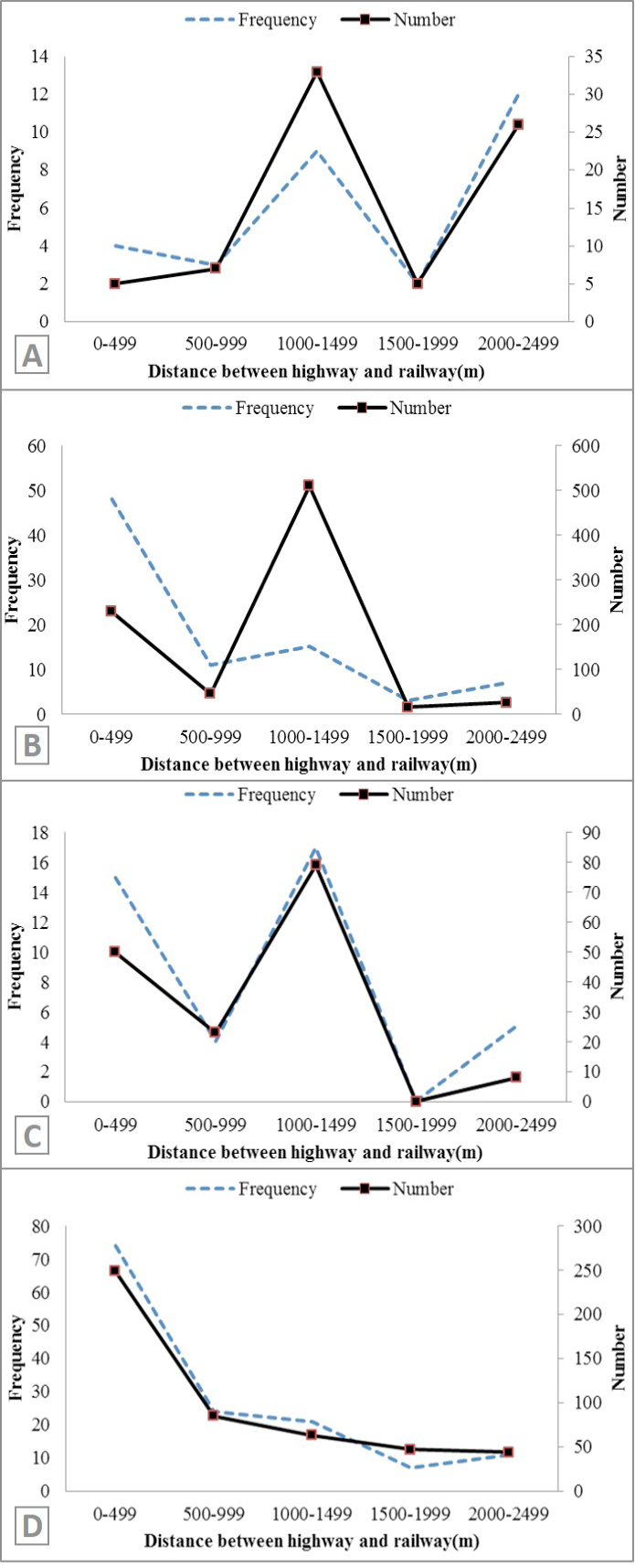
Relationship among frequency, number of Yak (A), Tibetan antelope (B), Kiang (C) and Tibetan Gazelle (D) and the distance between highway and railway track.
References
- Li, Y.Z., Zhou, T.J. and Jiang, H.B., 2008. China Railw. Sci., 29: 127-131.
- Lian, X.M., Zhang, T. and Cao, Y.F., 2007. Behav. Proces., 76: 192-197. https://doi.org/10.1016/j.beproc.2007.05.001[CrossRef]
- Lian, X.M., Zhang, T.Z., Cao, Y.F., Su, J.P. and Thirgood, S., 2011. Wildl. Res., 38: 141-146. https://doi.org/10.1071/WR10158[CrossRef]
- Lian, X.M., Li, X.X. and Xu, T., 2012. Chinese J. Ecol., 31: 81-86.
- Qiu, L. and Feng, Z.J., 2004. Acta Zool. Sin., 50: 669-674.
- Sun, H.L., Zheng, D., Yao, T.D. and Zhang, Y.L., 2012. Acta Geogr. Sin., 67: 3-12.
- Wang, Y., Guan, L., Chen, J.D. and Kong, Y.P., 2014. Highw. Nature, 21: 106-109.
- Yang, Q.S. and Xia, L., 2008. Nature, 452: 810-811. https://doi.org/10.1038/452810a; https://doi.org/10.1038/nature06740; https://doi.org/10.1038/452810b; https://doi.org/10.1038/nature06889; https://doi.org/10.1038/452810c[CrossRef]
- Yang, Y., Luo, X. and Liu, W., 2014. Pakistan J. Zool., 46: 833-840.
- Yin, B.F., Yu, Z.Y., Yang, S.M., Huai, H.Y., Zheng, Y.L. and Wei, W.H., 2007. Chinese J. Ecol., 26: 810-816.
Supplementary material
Services
Article usage statistics
Loading…