
The population dynamics of the peach fruit fly, Bactrocera zonata (Saunders) and oriental fruit fly Bactrocera dorsalis (Hendel) were monitored from January to December 2018 in guava orchards of the Sindh Pakistan. The investigations were done at different localities of Hyderabad and Larkana using Steiner type traps incorporated with methyl eugenol. The trap catches of B. zonata and B. dorsalis in both climatic zones shown a similar pattern during the study with a major peak in August in off seasoned guava. Whereas decreased population of Bactrocera flies were obtained in the month of January in Larkana (16.5±1.18, 12.9±1.47) and Hyderabad (19.3±1.28,13.4±1.39) regions, respectively. The abundance of fruit flies showed a significant correlation with temperature and slight negative relativity with humidity. The result suggests that high temperature enhances the fruit flies activity in connection with the availability of fruiting parts. The present investigations would be helpful to attain effective integrated pest management campaign in guava orchards.
Short Communication · Volume 53, Issue 5, 19 August 2021 · Open Access
Population Fluctuation of Bactrocera zonata and Bactrocera dorsalis in Guava Orchard Agro-Ecosystem in Sindh Region
· · ·
Affiliations & Notes ⌄
- 1Department of Zoology, University of Sindh, Jamshoro, Pakistan 2Nuclear Institute of Agriculture (NIA), Tando Jam, Pakistan , * Corresponding author: zainabro128@gmail.com
Article Info ⌄
- Journal:
- Pakistan Journal of Zoology
- Published:
- 19 August 2021

From the article
- Highest monthly population of B. zonata was recorded at Hyderabad (1020.7±96.86) followed by B. dorsalis (776.4±39.07).
- In present studies it was observed that population of Bactrocera zonata and Bactrocera dorsalis in different climatic zones of Sindh start increasing in the first week of March with highest peak in August.
- High temperature enhances the activity of Bactrocera species due to the accessibility to full-grown fruit.
Selected from the article's own text.
Abstract
Materials and methods
The experiment was conducted in the guava orchards of Nuclear Institute of Agriculture (NIA), Tando Jam, 25º25’60N 68º31’60E Hyderabad and Bakrani, 27º26’46.66”N 68º11’07.11”E Larkana using commercial formulation of methyl eugenol (steiner type traps/ Tandojam traps) during 2018.
Traps were prepared from transparent plastic jars (20 cm in length and 8 cm in diameter) for fruit flies capturing. Meanwhile, a small cotton wick dipped in male lure (4 ml methyl eugenol) having 5% (pyramid 10% AS) were suspended inside each trap, near the center. These traps had two holes on each side to allow the flies to enter inside. Male flies were attracted to lure, and slain by the insecticide on the cotton wick. The traps were deployed at three meter height in all selected locations from 01.01.2018 to 31.12.2018. The captures were collected on weekly basis and cue lure was replenished at fortnightly interval. The trappings were brought to the laboratory in Tando Jam where flies from each trap were identified and counted.
A total area of 5 acres was selected at each guava orchard of discrete zones for observing the B. zonata and B. dorsalis population fluctuations and effect of weather parameters on it. Experiment was designed in randomized complete block design (RCBD) having ten replications, Where each trap was considered as one replicate.
Meteorological data used in this study were obtained from Regional AGRO-MET Centre Tando Jam and Larkana, Sindh, Pakistan.
All statistical analyses were done with the help of Statistix® Version 8.1, Analytical Software, Inc., and Tallahassee, FL, USA. Statistical analysis was calculated using two-ways analysis of variance ANOVA for different parameters followed by Tukey’s Post Hoc HSD test for the significance of data.
Results and discussion
The population dynamics of male B. zonata and B. dorsalis has shown similar pattern in two climatic zones of Sindh with a major peak in off seasoned guava in August (Table I). Highest monthly population of B. zonata was recorded at Hyderabad (1020.7±96.86) followed by B. dorsalis (776.4±39.07). Similarly, in Larkana region significantly (P<0.05) higher B. zonata population was recorded in the month of August (1009.3±100.63) followed by B. dorsalis (416.8±19.83) and the lowest population of both species were recorded in the month of January in both the climatic zones. The results show that population of B. zonata starts increasing from May onwards and the maximum population is recorded in August whereas, B. dorsalis population started increasing from June with major peak in August in Hyderabad region (Fig. 1A). The population declines slowly from October to December after which it is to some extent static until up to March (Fig. 1A). In Larkana where conditions are hot and dry B. zonata population started increasing in May onwards till September with peak population in off seasoned guava in August and B. dorsalis population started increasing from July to September peak population in the August. Temperature had positive and highly significant correlation with Bactrocera flies caught per trap in both climatic zones. While RH % has negative effect on the fruit flies catches in Hyderabad region and slightly negative effect on fly trappings in Larkana (Table II).
Table I. Month wise population fluctuation of B. zonata and B. dorsalis during January to December, 2018 (Mean±SE) in guava orchards of Sindh region.
| Months of 2018 | Hyderabad | Larkana | ||
| B. zonata | B. dorsalis | B. zonata | B. dorsalis | |
| January | 19.3±1.28 e | 13.4±1.39 f | 16.5±1.18 e | 12.9±1.47 h |
| February | 24.5±2.29 e | 20.6±1.44 f | 19.1±0.97 e | 16.4±1.49 h |
| March | 97.6±12.43 de | 81.1±4.32 def | 83.2±3.21 de | 75.9±13.04 fg |
| April | 162.7±12.11 cde | 125.9±6.22 cde | 155.4±10.75 cde | 96.5±5.47 ef |
| May | 242.7±12.52 c | 198.3±14.98 c | 233.7±18.81 cd | 100.5±11.60 ef |
| June | 270.6±9.46 c | 201.4±15.47 c | 264.7±21.99 c | 136.3±12.38 de |
| July | 586.8±22.52 b | 516.9±30.26 b | 580.2±28.86 b | 203.2±14.15 c |
| August | 1020.7±96.86 a | 776.4±39.07 a | 1009.3±100.63a | 416.8±19.83 a |
| September | 561.3±22.55 b | 428.8±43.72 b | 532.7±29.27 b | 355.9±22.76 b |
| October | 178.7±12.40 cd | 166.7±16.39 cd | 167.1±15.27 cde | 162.1±12.97 cd |
| November | 39.9±4.77 de | 27.3±3.17 ef | 30.8±3.99 e | 22.3±2.04 gh |
| December | 26.7±2.04 e | 15.4±1.49 f | 20.5±2.60 e | 14.3±1.15 h |
Values followed by different letters are significantly differ at 5% according to Tukey’s honest significant difference (HSD) test.
Table II. Pearson’s correlation between weather parameters and population fluctuations of B. zonata and B. dorsalis in guava orchards of Sindh region.
| Meteorological factors | Hyderabad | Larkana | ||
| B. zonata | B. dorsalis | B. zonata | B. dorsalis | |
| Temp (°C) | ||||
| Minimum | 0.7120 * | 0.4218* | 0.6950* | 0.6852* |
| Maximum | 0.4056 * | 0.5865 * | 0.5372* | 0.5295* |
| Relative humidity (%) | -0.5899 | -0.6413 | 0.3016 | 0.3332 |
*Positively significant at (p < 0.001) according to Pearson’s correlation significance test.
In northern Bihar, India the maximum fly populations were detected during the third week of June (357.0 flies/trap), whereas the lowest numbers were recorded during the last week of August (14.3 flies/trap) (Agarwal et al., 1999).Our results are in contradiction to their’s because in our studies B. zonata population started increasing in June with peak population in August. Our findings are in line with Siddiqui et al. (2003) who recorded the higher number of adult flies of B. zonata in the first week of June and the lowest in January. Ali et al. (2011) reported similar results in Egypt as in our study that during warm months April to May the flies B. zonata were more active in as compared to that of cold weather period (December-February) months. Draz et al. (2016) reported that the peach fruit fly was very active fruits orchards in Kafer El-Shikh Governorate, Egypt in warm months (June-August) and it caused severe damage to a wide range of fruits such as guava, peach, mango, and apricot. Sarwar et al. (2014) observed that population increase of B. dorsalis in Pakistan starts from April onwards and the maximum population is recorded during June-August with a peak in July. In Bangladesh, Uddin et al. (2016) reported the highest population of B. dorsalis male in the month of July and the lowest in the month of January. The results of the present findings are almost similar to that of the aforementioned authors.
The positive correlation was observed between fruit flies population and temperature in both districts (Figs. 1 and 2) where as relative humidity had negatively effect on fruit flies captured from Hyderabad and Larkana (Figs. 1 and 2). Our results are in agreement with these previous researchers ; ; .
Conclusion
In present studies it was observed that population of Bactrocera zonata and Bactrocera dorsalis in different climatic zones of Sindh start increasing in the first week of March with highest peak in August. High temperature enhances the activity of Bactrocera species due to the accessibility to full-grown fruit.
Acknowledgments
The authors wish to thank all the staff of Fruit Flies Laboratories, NIA, Tando Jam who helped in sample collection and transportation during field visit.
Statement of conflict of interest
The authors have declared no conflict of interest.
Figures
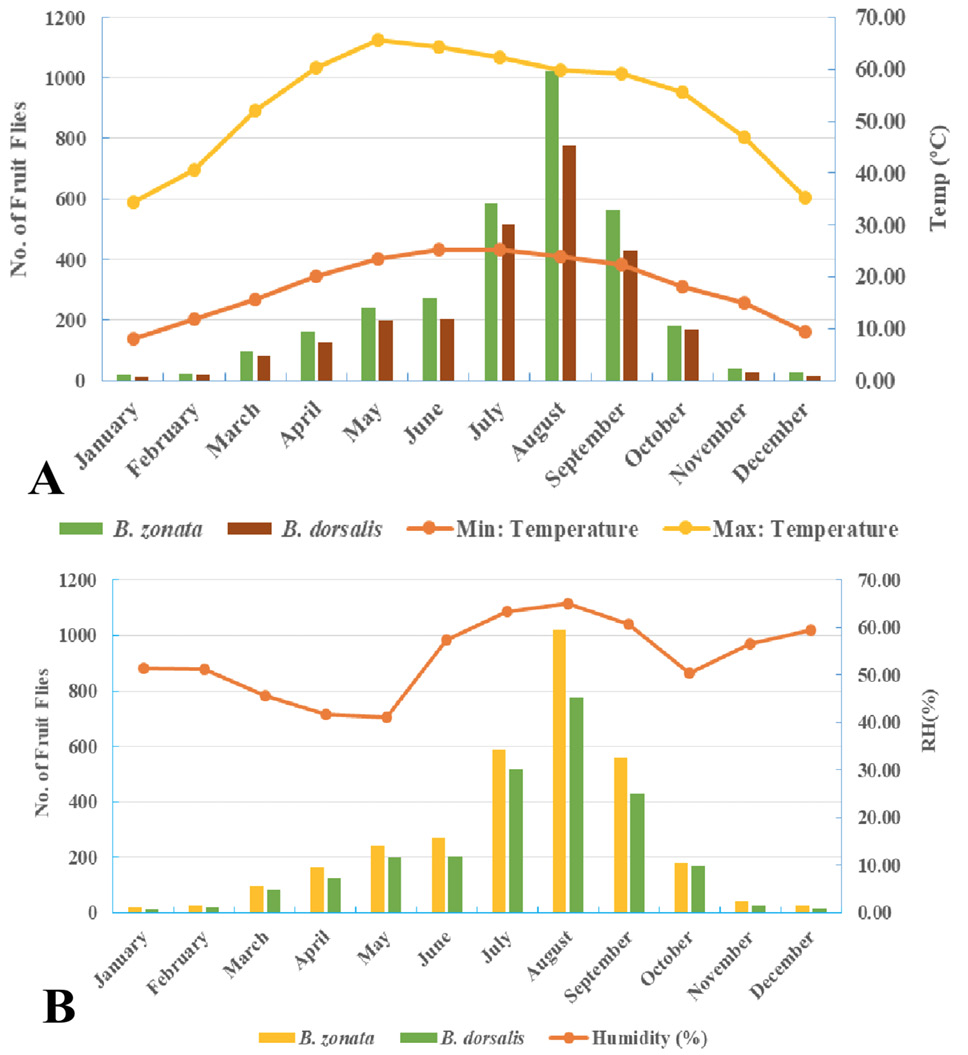
Influence of temperature (oC) (A) and relative humidity (%) (B) on population fluctuation of B. zonata and B. dorsalis in guava orchard agro-ecosystem in district Hyderabad.
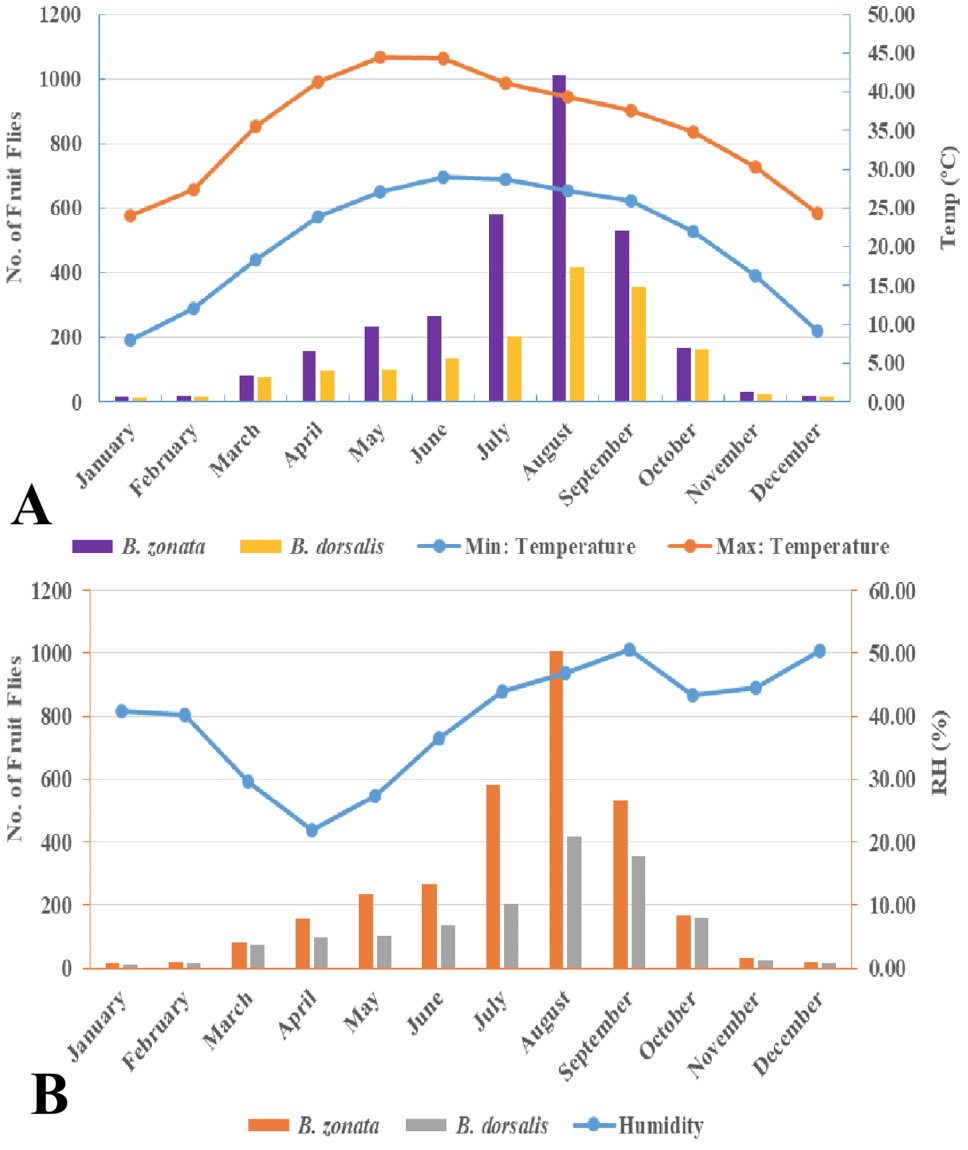
Influence of temperature (oC) (A) and relative humidity (%) (B) on population fluctuation of B. zonata and B. dorsalis in guava orchard agro-ecosystem in district Larkana.
References
- Abro, Z.A., Baloch, N., Khuhro, N.H., Qazi, W.A. and Saeed. N.A., 2017. Sarhad J. Agric., 33: 331-337. https://doi.org/10.17582/journal.sja/2017/33.2.331.337[CrossRef]
- Agarwal, M.L., Kumar, P. and Kumar, V., 1999. Shashpa, 6: 189-191.
- Ali, N.A., Awad, A.A. and Mohammed, H.O., 2011. Assiut. Univ. J. Zool., 40: 1-15.
- Draz, K.A., Tabikha, R.M., El-Aw, M.A., EL-Gendy, I.R. and Darwish, H.F., 2016. Arthropods, 5: 28-43.
- Grewal, J.S. and Kapoor, V.C., 1987. J. entomol. Res., 11: 203–206.
- Gupta, D.A.K. and Verma, B.O.P., 1990. Indian J. agric. Sci., 60: 471–474.
- Heather, N.H. and Hallmann, G.J., 2008. Pest management and phytosanitary trade barriers. CAB International, Oxfordshire, UK., pp. 257. https://doi.org/10.1079/9781845933432.0000[CrossRef]
- Kapoor, V.C., 1993. Indian fruits flies: (Insecta: Diptera: Tephritidae). Oxford and IBH Publishing Co. Pvt. Ltd., New Delhi, India. pp. 228.
- Laskar, N. and Chatterjee, H., 2010. J. appl. Sci. environ. Manage., 14: 53–58. https://doi.org/10.1241/johokanri.53.58[CrossRef]
- Leblanc, L., Hossain, M.A., Khan, S.A., San Jose, M. and Rubinoff, D., 2013. Proc. Hawaiian entomol. Soc., 45: 51–58.
- Merrill, R., Gutierrez, D., Lewis, O., Gutierezz, J., Dies, S. and Wilson, R., 2008. J. Anim. Ecol., 77: 145–155. https://doi.org/10.1111/j.1365-2656.2007.01303.x[CrossRef]
- Mohamed, A.M., 2002. Assuit. J. agric. Sci., 33: 329–337. https://doi.org/10.1016/S0020-1383(02)00011-6[CrossRef]
- Pena, J.E., Mohyuddin, A.I. and Wyoski, M., 1998. Phytoparasitica, 26: 129-148. https://doi.org/10.1007/BF02980680[CrossRef]
- Ranjitha, A.R. and Shashidhar, V., 2006. Karnataka J. agric. Sci., 19: 45-49.
- Sarwar, M., Hamed, M., Yousaf, M. and Hussain, M., 2014. Int. J. scient. Res. environ. Sci., 2: 113-119. https://doi.org/10.12983/ijsres-2014-p0113-0119[CrossRef]
- Siddiqui, Q. Ahmad, N. Rashdi, S.M.M.S. and Niazi, S., 2003. Asian J. Pl. Sci., 2: 228-232.
- Uddin, M.S., Reza, M.H., Hossain, M.M., Hossain, M.A. and Islam, M.Z., 2016. Int. J. expt. Agric., 6: 1-3.
Cited by 3 articles
In journals published by ResearchersLinks.
- Controlling Bactrocera spp. (Diptera: Tephritidae) Through Release of Parasitoids and Mass-Trapping in Orchard Agro-Ecosystem of SindhPakistan Journal of Zoology · 2024
- Field Evaluation of Different Pest Management Strategies against Citrus Fruit Fly, Bactrocera dorsalis HendelPunjab University Journal of Zoology · 2023
- Population Survey of Natural Enemies of Bactrocera Flies from Mango and Guava Septic Fruits of Sindh RegionJournal of Innovative Sciences · 2022
Services
Article usage statistics
Loading…