
The great majority of avian species is diurnal and thus endures variation in light intensities, associated with daily, seasonal or lunar cycles. These diurnal birds search their food in light abundant environment and raise their broods in dark cavities. However their visual performance in dim light conditions is largely unknown. Here, we compared light intensity threshold of activity in two groups of passerines, i.e. secondary cavity and non-cavity nesting. For this purpose, different species of secondary cavity and non-cavity nesting passerines were subjected to two phases of trials: in the first trial birds were released in an experimental cage and allowed them to accommodate themselves in darkness for 10 min. In the second trial we turned on the dimmer to a given luminance for 2 min. We found that activity threshold for secondary cavity nesting passerines ranged from 0.05 to 0.2 cdm-2 and non-cavity nesting passerines from 22.00 to 16.00 cdm-2. Our results shed light on the question about potential effect of luminance on visual performance by secondary cavity and non-cavity nesting passerines.
Short Communication · Volume 53, Issue 5, 19 August 2021 · Open Access
Effect of Luminance on Visual Performance by Secondary Cavity and Non-Cavity Nesting Passerines
· · ·
Affiliations & Notes ⌄
- 1Jilin Engineering Laboratory for Avian Ecology and Conservation Genetics, School of Life Sciences, Northeast Normal University, Changchun, China 2Government Girls Degree College, Mansehra 21300, Khyber Pakhtunkhwa, Pakistan 3Government Postgraduate College, Nowshera 24100, Khyber Pakhtunkhwa, Pakistan 4Department of Zoology, University of Swabi, Swabi 23340, Khyber Pakhtunkhwa 5Jilin Key Laboratory of Animal Resource Conservation and Utilization, Northeast Normal University, 5268 Renmim Street,
Article Info ⌄
- Journal:
- Pakistan Journal of Zoology
- Published:
- 19 August 2021

From the article
- Data represented in this context showed the intensity threshold of vision ranged from 0.05-0.2cdm-2 in secondary cavity nesting passerines and 22.00 to 16.00 cdm-2 in non-cavity nesting passerines.
- Moreover, we found the significant difference in luminance between two groups of birds i.e. secondary cavity nesting (t = 2.897, df = 12, p-value < 0.001) and non-cavity nesting passerines (t = 3.402, df = 12, p-value = 0.05) (Fig. 1).
Selected from the article's own text.
Abstract
Materials and methods
In this study, secondary and non-cavity nesting birds were caught with trapping cages in Jilin city and the adjacent areas in Jilin Province, China, between May and June 2016 and January and February 2017. We used 7 adult birds of each selected species. Secondary cavity nesting birds included great tit (Parus major) and sparrow (Passer domesticus), and non-cavity nesting birds included red-billed leiothrix (Leithrix lutea) and Eurasian siskin (Spinus spinus). Within 4 h individuals of these species from various populations were transported to the laboratory. On arrival at the research facility, individuals were housed in 0.9 m×0.4 m×0.5 m cages under a 12:12 h photoperiod, each with side and back walls, compact upper and lower surfaces, wire netting and three small perches (Bibi et al., ). The worms, commercial seed mixtures, sunflower seeds and water were provided to the birds ad libitum. Sex of all the birds was determined following . Exposure to humans was minimized, and the individuals were left undisturbed overnight. The individuals were released back to their natural habitat after completion of the experiment.
Individuals were placed in a light safe testing room, with walls covered with black curtain (H×L×W: 4.0×2.4×2.3 m) . We placed two feeders in the experimental cage and monitored bird’s activity with two cameras in the side walls. The two groups of birds were trained to hunt for prey in the experimental cage at varying luminance level 0-22 cdm-2 until they reached a constant latency to search and capture rate. Each test contained two blocks. In the first block, we released the birds in the experimental cage and allowed them to accommodate darkness for 10 min, then turned on the dimmer to a given luminance for 2 min and observed whether the test bird foraged or moved to engage in other activities and then the trial was terminated. Birds were trained according to the Lind and Kelber (2009) protocol for parrots . A white paper placed horizontally just below the feeders and a luminance meter (LMT 1009) were used to calculate the luminance. Luminance meter (LMT 1009) has an angular field 3°, 1°, 20’, 6’ selectable. Photometer head with Si-photoelement, fine V (lamda)-approximation. It could measure distance approx. 0.50 m to infinity. During the trial we switched on the dimmer, a single detector on the luminance meter detected and measured the brightness displayed on the screen. We also recorded the readings for further use. When evaluating the light sources, we can calculate the luminance or illuminance of the source. Luminance (L) is also referred to as brightness of light source and measured in candela per square meter (cd/m2). Illuminance (E) is the volume of light on a surface per unit, expressed in lux or lumen per unit meter2, lm/m2. The third unit of light is luminous intensity (I) which is amount of light radiating in a specific direction. It expresses itself in candela (cd). However, amount sum of light emitted by light source is denoted as luminous flux (LM). It is measured in lumens (lm).
During trial, only worms were provided to testing individual to increase their desire to feed the feeders.
Individuals were first trained at varying luminance levels. Individuals were considered as efficiently trained when they started using feeders in one trial out of two at given luminance resulting to P = 0.05 (two tailed binomial test) . We then continued testing from decreased luminance to maximum point. Upon acclimatization for at least 10 min, individuals were presented with one feeder and we observed whether the test bird foraged or moved to engage in other activities and then the trial was terminated. Feeding latency and light intensity were recorded, however maximum latency was given to the birds that did not move or forage. After the trial, testing individuals were taken back to their aviary before release .
Comparison between the secondary and non-cavity nesting birds were made using the independent sample t test. Difference in feeding latency between secondary and non-cavity nesting birds were calculated using generalized linear model. Individual identity was used as random factor and trial as fixed factor. We checked data for normality, and transformed variables to meet the assumptions of generalized linear model (GLM). All tests were two tailed and alpha level was set at 0.05. All data were analyzed in SPSS (V. 20 IBM). Descriptive statistics with the first and third quartiles (Q25–75%) were viewed as a mean ± standard deviation or as a median (Me) .
Results and discussion
Data represented in this context showed the intensity threshold of vision ranged from 0.05-0.2cdm-2 in secondary cavity nesting passerines and 22.00 to 16.00 cdm-2 in non-cavity nesting passerines. Moreover, we found the significant difference in luminance between two groups of birds i.e. secondary cavity nesting (t = 2.897, df = 12, p-value < 0.001) and non-cavity nesting passerines (t = 3.402, df = 12, p-value = 0.05) (Fig. 1). It is also found that there is a significant difference in feeding latency in secondary cavity nesting passerines (W = 21.568, p < 0.001) and non-cavity nesting passerines (W = 19.664, p < 0.001) (Table I).
Table I.- Difference in feeding latency between secondary and non-cavity nesting birds.
| Passerines | Parameter | DF | W | P |
| Secondary-cavity nesting | Feeding latency | 13 | 21.568 | <0.001 |
| Non-cavity nesting | Feeding latency | 13 | 19.664 | <0.001 |
In this study intensity threshold of vision was tested between two groups of passerines. In our study range of luminance in secondary cavity nesting passerines is comparable to the similar values of about 0.4 and 0.1 cdm-2 which have been reported in budgerigars Melopsittacus undulatus and Bourke’s parrots Neopsephotusbourkii . Similarly, our results for secondary cavity nesting passerines are also comparable with Wesołowski and Maziarz (2012) for marsh tits Poecile palustris and great tits Parus major, where they reported the same figure of the range of luminance threshold (0.05 to 0.2 cdm-2). Our study is also comparable with Podkowa and Surmacki (2017), where light in open nesting species like great tits Parus major was shown to be less important due to higher overall illumination compared to secondary cavity nesting birds constructing deeper nests.
Interestingly, several previous studies investigated chick coloration in cavities or egg in Parus species described variation in parental behavior manipulated a reflectance over a broad variety of wave lengths or UV ranges ; ; . These earlier investigations did not, however, determine which indications were used, except in one case where birds might use brightness .
As these cavity nesting birds have additional issues to address i.e. their optical system adapts to rapidly fluctuating light rates, aside from the need to be able to see in low light conditions . Apparently, these cavity nesting birds can adapt even to fluctuating light levels, but it remains uncertain how do they do that? Certain mechanism and function of highly dynamic pupil may be involved . Like other vertebrates, the process of dark full adaptation is relatively low also in bird’s eyes, taking up to 40 min . It might also be possible that vision of these cavity nesters is not well adapted to the luminance level within cavities or they employ some additional but unexplained light/dark adaptation mechanisms. A detailed investigation to highlight and uncover these mechanisms will definitely be worthwhile.
In summary, the current research has shown that the tree cavities may be really dark spots and open nesting places have higher luminance but, both secondary and non-cavity nesting birds must be able to see in low light only under certain threshold. However, for cavity nesters tending broods within the dark cavities may be possible with sustainably poorer spatial resolution relative to local foraging. Our analysis also shows that under certain natural conditions of illumination, enough light availability would be unlikely in the cavities to make vision of birds while non-cavity nesters possess a greater luminance. It means that using cavities by cavity nesters possess real sensory challenges. Therefore, we propose that it would be very instructive to record these measurements with different species; living in contrasting environments.
Acknowledgements
We thank Zheng Han, Qianxi Fan, Fatima Fazal and Robina Kausar for their assistance in this work. This work was supported by the National Natural Science Foundation of China (31770419 to HW), the Science and Technology Research Project of the Education Department of Jilin Province (JJKH20190281KJ) and the Open Project Program of Jilin Provincial Key Laboratory of Animal Resource Conservation and Utilization (1300289105).
Statement of conflict of interest
The authors have declared no competing interests.
Figures
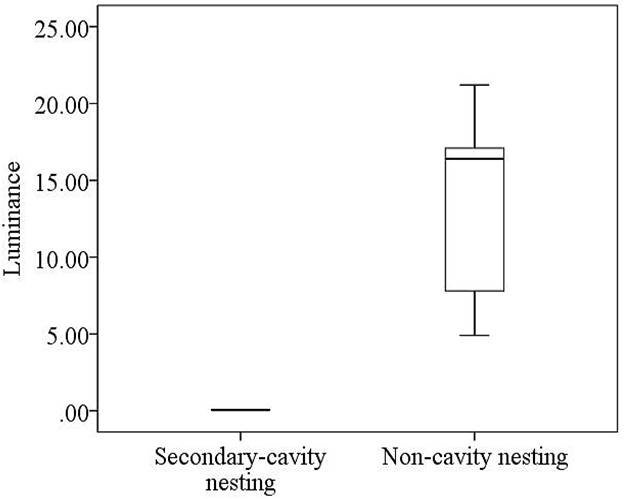
Comparison between the secondary (great tit and sparrow, n = 14) and non-cavity nesting passerines (Eurasian siskin and red-billed leiothrix, n = 14) on the onset of activity/ foraging. Medians are shown (a filled line, 25–75% quartile).
References
- Antonov, A., Aviles, J.M., Stokke, B.G., Spasova, V., Vikan, J.R., Moksnes, A., Yang, C.C., Liang, W. and Roskaft, E., 2011. Ethology, 117: 1128-1137. https://doi.org/10.1111/j.1439-0310.2011.01969.x[CrossRef]
- Bibi, N., Wei, Y., Xu, H., Liang, J., Hussain, I., Ahmad, M.S. and Wang, H., 2019. Behaviour, 1: 1-6.
- Cassey, P., 2009. Curr. Biol., 19: R1083-R1084. https://doi.org/10.1016/j.cub.2009.10.014[CrossRef]
- Corfield, J.R., Price, K., Iwaniuk, A.N., Gutiérrez-Ibáñez, C., Birkhead, T. and Wylie, D.R., 2015. Front. Neuroanat., 9: 102. https://doi.org/10.3389/fnana.2015.00102[CrossRef]
- Dingemanse, N.J., Both, C., Drent, P.J., Van Oers, K. and VanNoordwijk, A.J., 2002. Anim. Behav., 64:929-937. https://doi.org/10.1006/anbe.2002.2006[CrossRef]
- Dominoni, D., Quetting, M. and Partecke, J., 2013. Proc. R. Soc. B-Biol. Sci., 280: 3017. https://doi.org/10.1098/rspb.2012.3017[CrossRef]
- Dominoni, D.M., Halfwerk, W., Baird, E., Buxton, R.T., Fernández-Juricic, E., Fristrup, K.M., McKenna, M.F., Mennitt, D.J., Perkin, E.K., Seymoure, B.M. and Stoner, D.C., 2020. Nat. Ecol. Evol., 16: 1-0.
- Dugas, M.B., 2009. Anim. Behav., 78: 767-772. https://doi.org/10.1016/j.anbehav.2009.07.009[CrossRef]
- Fernández-Juricic, E. and Tran, E., 2007. Anim. Behav., 74: 1381-1390. https://doi.org/10.1016/j.anbehav.2007.01.005[CrossRef]
- Gomez, D., Grégoire, A., Granado, M.D., Bassoul, M., Degueldre, D., Perret, P. and Doutrelant, C., 2014. J. exp. Biol., 217: 3775-3778. https://doi.org/10.1242/jeb.107573[CrossRef]
- Land, M.F. and Nilsson, D.E., 2002. Animal eyes. Oxford University Press.
- Larsen, O.N., Wahlberg, M. and Christensen-Dalsgaard, J., 2020. J. exp. Biol., 223: jeb217265. https://doi.org/10.1242/jeb.217265[CrossRef]
- Lind, O.E. and Kelber, A., 2009. J. exp. Biol., 212: 3693-3699. https://doi.org/10.1242/jeb.035477[CrossRef]
- Lind, O.E., Kelber, A. and Kröger, R.H., 2008. J. exp. Biol., 211: 2752-2758. https://doi.org/10.1242/jeb.018630[CrossRef]
- Martin, G.R., 2011. J. Ornithol., 153: 23-48. https://doi.org/10.1007/s10336-011-0771-5[CrossRef]
- Martin, G.R. and Osorio, D., 2008. In: The senses (eds. R.H. Masland and T.D. Albright), Volume 1. Academic Press, London, pp. 25-52. https://doi.org/10.1016/B978-012370880-9.00401-1[CrossRef]
- Martin, G., Rojas, L.M., Ramírez, Y. and McNeil, R., 2004. Naturwissenschaften, 91: 26-29. https://doi.org/10.1007/s00114-003-0495-3[CrossRef]
- Oishi, T., Yamao, M., Kondo, C., Haida, Y., Masuda, A. and Tamotsu, S., 2001. Microsci. Res. Tech., 53: 43-47. https://doi.org/10.1002/jemt.1067[CrossRef]
- Podkowa, P. and Surmacki, A., 2017. Scient. Rep., 7: 1-9. https://doi.org/10.1038/s41598-017-01430-y[CrossRef]
- Podkowa, P., Malinowska, K. and Surmacki, A., 2019. J. Avian Biol., 50: 11. https://doi.org/10.1111/jav.02254[CrossRef]
- Reynolds, S.J., Martin, G.R. and Cassey, P., 2009. Anim. Behav., 78: 209-215. https://doi.org/10.1016/j.anbehav.2009.03.003[CrossRef]
- Svensson, L., 1992. Identification guide to European Passerines. Stockholm, Sweden.
- van der Hoek, Y., Gaona, G.V. and Martin, K., 2017. Divers. Distrib., 23: 1120-1131. https://doi.org/10.1111/ddi.12601[CrossRef]
- Wesołowski, T. and Maziarz, M., 2012. J. Avian Biol., 43: 454-460. https://doi.org/10.1111/j.1600-048X.2012.05704.x[CrossRef]
- Wiebe, K.L. and Slagsvold, T., 2009. Anim. Behav., 78: 1413-1420. https://doi.org/10.1016/j.anbehav.2009.09.013[CrossRef]
- Zhang, R., Liu, J., Liu, Q., He, H., Xu, X. and Dong T., 2019. Can. J. Forest. Res., 49: 491-499. https://doi.org/10.1139/cjfr-2018-0270[CrossRef]
Services
Article usage statistics
Loading…