Research Article · Volume 38, Issue 1, 5 April 2023 · Open Access
Field Evaluation of Different Pest Management Strategies against Citrus Fruit Fly, Bactrocera dorsalis Hendel
· · ·
Affiliations & Notes ⌄
1Department of Entomology, College of Agriculture, University of Sargodha, Sargodha 40100, Pakistan. 2Department of Entomology, Faculty of Agriculture, The Islamia University of Bahawalpur, Bahawalpur 63100, Pakistan 3Department of English, University of Sargodha, Sargodha 40100, Pakistan Corresponding Author: Muhammad Zeeshan Majeed zeeshan.majeed@uos.edu.pk
Fruit infestation was observed in the treated and control plots and was found significantly affected by different treatments (p= 0.018, LSD= 0.096).
Marketable fruit yield in combined (T4) treatment was significantly different from other both IPM treatments, but yields for all these treatments were significantly higher than the control treatment.
In brief, findings of this field study showed the effectiveness cultural practices, pheromone-based male fly traps and protein based female fly bait application either alone or in combination against fruit fly infestation and significantly decreased the yield and cost-benefit ratio as compared to control treatment.
Based on these findings, it is concluded that combining different IPM methods such as field sanitation and attract and kill traps and baits could be effective to control fruit fly infestations in citrus orchards.
Selected from the article's own text.
Abstract
Fruit flies (Tephritidae: Diptera) are among the most destructive and economic pests of horticultural crops. They infest and destroy a wide range of fruits. Bactrocera dorsalis Hendel is an emerging threat to the export of Pakistani citrus fruits to overseas markets. Integrated pest management (IPM) is an appropriate and sustainable strategy for controlling fruit flies as it is based on integrated application of all available pest control methods with minimum implication of hazardous synthetic insecticides. In this study, five treatments including field sanitation (T1), pheromone-based attract and kill strategy (T2), protein-based bait method (T3), combination of all three methods (T4) and control (T5) were evaluated against B. dorsalis infestation in citrus during 2015 and 2016. Data of percent infested fallen fruits, percent pupae recovered from these fallen fruits, percent adult deformity, percent sex ratio and cost-benefit ratio were recorded. Results showed that when all of the components were used together (T4), fruit damage was significantly reduced remained 0.32 to 0.49% in both years. In addition, T5 (control) plots where no IPM treatments were applied showed highest number of infected fruits (3.06 to 4.59%) in both years. Moreover cost-benefit ratio was lowest for the combined treatment (T4) during both years i.e., 2.7:1 for 2015 and 3.08:1 for 2016 as compared to other treatments. Overall results of this field trial demonstrate the significance of integrated pest management strategies in reducing the fruit flies infestation and enhancing citrus fruit yield.
Novelty Statement | This field study demonstrates the practical significance of integrating different pest management techniques, i.e. field sanitation practices, installation of methyl eugenol pheromone based male fly trapping and application of protein hydrolyzate based female fly trapping baits, for the management of fruit fly infestation in citrus orchards. Combination of these IPM strategies significantly reduced fruit infestation and enhanced fruit yield.
Introduction
Fruit flies are destructive pests of a wide range of horticultural crops. They attack and destroy many fruits such as guava, citrus, mango and vegetables such as tomatoes, pepper and cucurbits. They have enormous host range, strong reproductive potential and climate adaptation ; . Bactrocera dorsalis (Hendel), also known as oriental fruit fly, is one of the most destructive pests of fruits and vegetables in South East Asia and in the Pacific region due to its polyphagous nature ; Sarwar et al., 2014; .
B. dorsalis is a severe horticultural pest in Pakistan. Farmers particularly guava, mango and citrus growers suffer considerable quantitative and qualitative losses due to its infestation ; ; . Farmers exclusively rely on the recurrent applications of persistent synthetic insecticides to control fruit fly infestations in their orchards resulting in environmental contamination and health hazards due to pesticidal residues (Sayed et al., 2014). Moreover, many field populations of B. dorsalis in Pakistan have developed resistance against commonly used insecticides such as spinosad and trichlorfon .
Integrated pest management (IPM) refers to a strategic approach encompassing all feasible and available measures to lower the population of different insect pests in order to prevent the hazardous use of toxic insecticides . It is imperative to integrate different fruit fly management strategies in order to mitigate indigenous farmers’ reliance on synthetic pesticides. Adult fruit flies are usually targeted in most of the pest management programs as it is complicated to control egg and larval or pupal stags of fruits because these are found either inside the fruit or under soil surface ; . This field study was aimed to evaluate the effectiveness of three commonly used IPM strategies, i.e. cultural control (field sanitation), pheromone-based male fly trapping and protein-based female fly baiting, either alone or in combination against fruit fly infestation and yield of citrus fruits in district Sargodha.
Materials and Methods
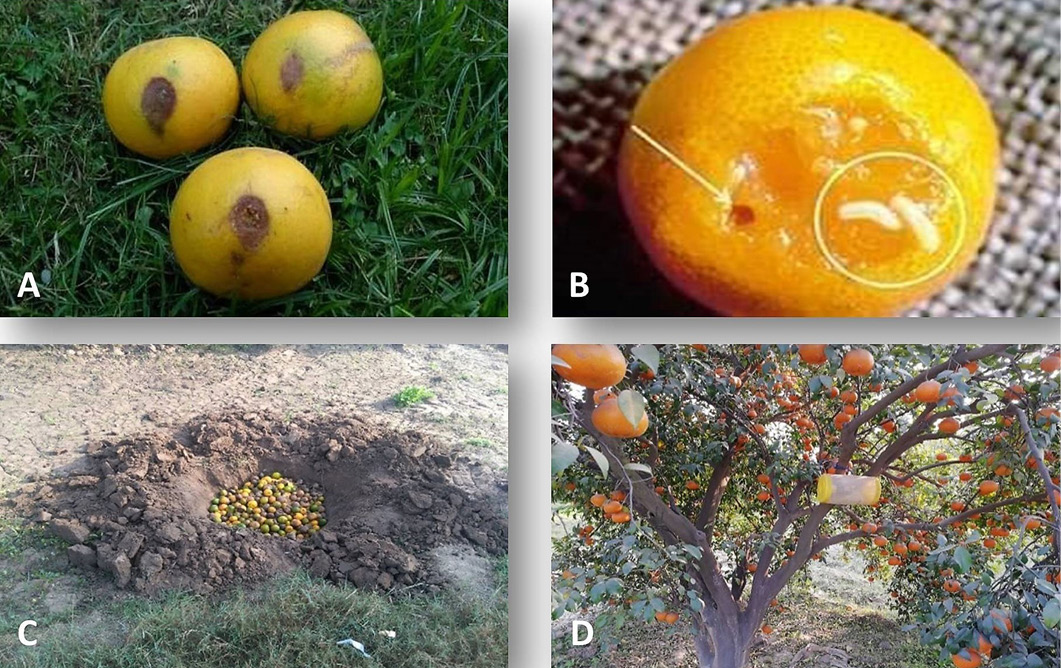
The experiment was conducted during the years of 2015 and 2016 at farmer’s citrus fields (cv. Kinnow mandarin Citrus reticulata var. Blanco) located in district Sargodha. Treatments as described below included control, cultural control (T1), pheromone-based male fly attract strategy (T2) and female fly attract-and-kill strategy (T3) and their integration (T4). Experimental design was randomized complete block (RCBD) with five treatments replicated thrice in three randomly selected citrus orchards. Each orchard had a one hectare size and was divided into four blocks. All other standard agronomic practices were applied at proper time. Thirty fruits were randomly selected from each treatment plot. For each fruit picking, safe and damaged fruits were separately collected, recorded and data were collected based on the total percentage of fruit infestation within a particular treatment. Criteria to affirm infested fruits were based on the larval-exit hole or presence of maggots on fruits (Figure 1A and B).
Cultural control method (T1)
Three random orchards of almost uniform age (6 years) were selected based on fruit fly infestation for this treatment, and no insecticides were applied during the experiment. Sanitation measures including ploughing, field hygiene and weeding were practiced. Collection and destruction of under-canopy fallen fruits were done from these orchards at fifteen-day intervals. At regular intervals, these fruits were gathered and buried in the ground at a depth of 10 to 12 inches and the soil was tightly compacted to prevent the emergence of any larvae, pupae or adults from them (Figure 1C).
Pheromone-based male fly trapping (T2)
It was involved installation of plastic traps (Figure 1D) having a male lure and an insecticide to attract-and-kill the male fruit fly population. After every 14 days, 0.5 ml of methyl eugenol (4-allyl-1, 2dimethoxy benzene-carboxylate) plus spinosad insecticide (3:1) was added to each trap. Traps were hanged on trees at 1.5 to 2.0 meter above the ground. Data was collected after 15 days of interval. Ten plants were selected from each orchard for data collection. Data of fruits infestation were recorded as described above.
Protein-based female fly baiting (T3)
Ten plants were selected randomly from each orchard. Bait solution containing one liter of protein hydrolyzate plus three milliliter of malathion 50 EC (95:05) mixed in 967ml water was applied on these selected plants twice with a 10 days interval, starting at the fruit setting stage using battery-operated knapsack sprayer (Model: AP-16B). Protein bait was applied inside about 50 to 100 ml on the edges of the canopy. Data of fruit infestation was recorded at 15 days intervals.
Combination of three treatments (T4)
In combined treatment, all three above mentioned strategies including cultural control, male traps and female baits were applied collectively in the single orchard. The experiment was replicated three times in three different orchards/blocks. Ten plants were chosen at random for bait application across the orchards. The entire orchard was practiced under cultural control. Four traps per acre were set up for trapping male fruit flies.
Control treatment (T5)
The control treatment was selected 3 km away from other treatments. No treatments were applied in T5. The infestation level was recorded as described in previous treatment. During the fruiting season, data were collected for two consecutive years 2015 and 2016 and fruit infestation and yield data were calculated by taking their average and percentages.
Cost-benefit analysis
The costs involved with each treatment were focused on the appropriate inputs to manage each treatment. Costs of transport and equipment rates were collected from the local markets. The gross variable costs had calculated as the sum of both the total quantity of used inputs/labour and market prices. Fruit selling prices were based on the price that smallholders could get by selling their products to the local market. Price used in the study to calculated cost-benefit ratio was based on the average of interviews of ten members from the local market (Sargodha). This is a quantitative approach used to measure the costs and benefits of alternative investments over a particular period.
Statistical analysis
Using software Statistica® 8.0 (Statsoft Inc., USA), the effects of treatments on fruit infestations and fruit yield/loss were evaluated by one way analysis of variance (ANOVA) and the treatment means were compared using the least significant difference (LSD) post-hoc test.
Results and Discussion
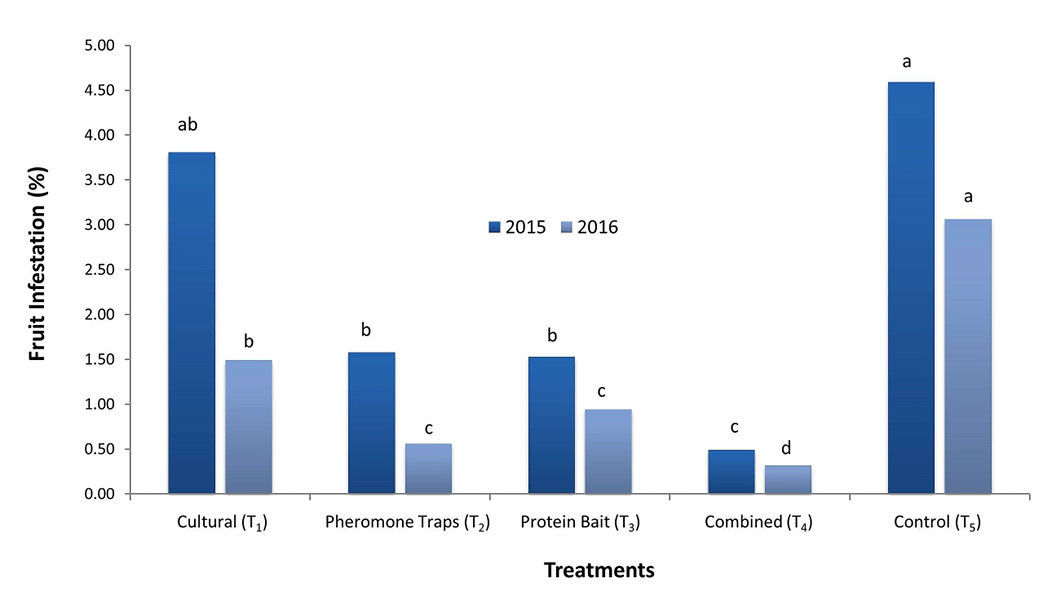
All above mentioned treatments were employed in order to assess the damage caused by fruit flies particularly by B. dorsalis in citrus orchards. Fruit infestation was observed in the treated and control plots and was found significantly affected by different treatments (p= 0.018, LSD= 0.096). During 2015, treatment with combined management strategies (T4) was the most effective as only 0.49 % fruit damage/infestation was recorded, followed by protein hydrolyzate based treatment (T3) and pheromone based male traps treatment (T2) causing 1.53 and 1.58% fruit infestations, respectively. The infestation was 3.81% in the cultural treatment practiced with field sanitation etc. (T1). Maximum fruit infestation (i.e. 4.59%) was recorded in control (T5) (Figure 2).
In 2016, the application of these treatments resulted in a significant reduction in fruit infestation level in the treated plots. Similar trend of fruit infestation was observed this year as well. The least infestation was observed in combined treatment (T4). The infestation level was reduced from 3.81 to 1.49 % in cultural treatment (T1), from 1.58 to 0.65% in pheromone traps treatment (T2), from 1.53 to 0.94% in protein bait treatment (T3) and from 0.49 to 0.32% in combined treatment (T4) plots. Maximum fruit infestation (i.e. 3.06%) was recorded in control treatment plots. The combined treatment (T4) appeared significantly different and successful than all other treatments, followed by pheromone traps treatment (T2), protein bait treatment (T3) and cultural treatment (T1), while maximum infestation was recorded for control treatment (T5) plots (Figure 2).
Table 1: Cost-benefit ratio of citrus orchards/plots treated with different fruit fly management strategies.
Treatments
2015
2016
Total cost (Rs.)
Benefit (Rs.)
CBR
Benefit (Rs.)
CBR
Cultural control (T1)
55,000
1,90,000
3.5:1
2,20,000
4.0:1
Methyl eugenol based trap (T2)
66,000
2,11,000
3.2:1
2,35,000
3.6:1
Protein hydrolysate based bait (T3)
60.000
2,05,000
3.4:1
2,27,000
3.7:1
Combined application (T4)
81,000
2,22,000
2.7:1
2,50,000
3.08:1
Control (T5)
50000
187000
3.7:1
1,97,000
3.9:1
In both seasons, total variable costs were highest in the combined (T4) treatment followed by bait (T3) treatment and the lowest costs were calculated for the control (T5) treatment. Marketable fruit yield in combined (T4) treatment was significantly different from other both IPM treatments, but yields for all these treatments were significantly higher than the control treatment. Cost-benefit ratio (CBR) was lowest in combined (T4) treatment during both years i.e. 2.7:1 for 2015 and 3.08:1 for 2016 as compared to other treatments. As compared to control treatment, an average increase of PKR 31,000/- in the income and about 15.5% in 2015, and 21.2% in 2016 in yield was recorded for the plots treated with all three IPM strategies (T4) (Table 1).
In this research, we assessed the efficacy of different pest management techniques for the control of fruit fly infestation for two citrus fruiting seasons. Treatments included cultural control, installation of pheromone traps, application of protein hydrolyzate bait solution and a combination of these three methods. The application of pheromone traps and bait application resulted in a significant drop in B. dorsalis population and fruit infestation in the first season (during 2015), while in the subsequent season (during 2016) a sudden drop in infestation level, as well as fruit fly population density was observed. Verghese et al. (2004) reported a similar trend in the suppression of B. dorsalis by these IPM techniques. A number of fruit fly population and infestation suppression strategies including the application of cultural /field sanitation practices, pheromone and protein based attract and kill strategies have been found effective against fruit flies ; ; .
Field sanitation in fruit orchards is an important part of IPM programs whereby the infested fruits are collected and buried under soil to stop the fruit fly multiplication. It is critical to remove the contaminated fruits at regular time intervals in order to limit the fruit fly population in the area. A similar method was used by Verghese et al. (2004). As tephritid larvae pupate under the fallen fruit, leaf litter or soil. Sanitation drastically reduces the population of fruit flies in the fields . This method not only reduces the use of toxic substances but also disrupts the life cycle of the fruit fly, reducing its invasion in the coming years . However, this method is insufficient to entirely eliminate the fruit fly population .
Furthermore, the application of methyl eugenol pheromone based male fly traps and protein hydrolyzate based female fly bait application resulted in a significant reduction of B. dorsalis population and fruit infestation either alone or in combination. These results are supported by Bharadiya et al. (2017) who found that pheromone and bait combination exhibited high population reduction in a field. These results are consistent with some other previous studies ; ; ; .
Parapheromones such as methyl eugenol and cue-lure and protein hydrolyzate based baits have been successfully demonstrated as effective tools to detect, monitor and mass collect fruit flies population all over the world. These Parapheromones and baits have the ability to attract fruit flies from a great distance ; ; ; ; ; ; .
Conclusions and Recommendations
In brief, findings of this field study showed the effectiveness cultural practices, pheromone-based male fly traps and protein based female fly bait application either alone or in combination against fruit fly infestation and significantly decreased the yield and cost-benefit ratio as compared to control treatment. Based on these findings, it is concluded that combining different IPM methods such as field sanitation and attract and kill traps and baits could be effective to control fruit fly infestations in citrus orchards.
Acknowledgments
Authors acknowledge the technical help and valuable advice given by Muhammad Anjum Aqueel (Professor, Department of Entomology, The Islamia University of Bahawalpur) during the research.
Conflict of interest
The authors have declared no conflict of interest.
Figures
Figure 1:.
Fruits having maggots inside the fruit pulp (A) and spoiled citrus fruits (B) counted as fruit fly damaged fruits, burying of fruit fly infested fruits in soil (C) and methyl eugenol pheromone-based male fly traps (D).
Figure 2:.
Percent fruit infestation (mean ± SD) incurred by Bactrocera dorsalis activity in citrus orchards treated with different IPM strategies in years 2015 and 2016.
References
Ahmad, J.N., Sharif, T., Ahmad, S.J., Maqsood, S. and Zafar, F., 2019. Molecular identification and characterization of fruit flies of genus Bactrocera (Diptera: Tephritidae) in Pakistan. Pakistan J. Zool., 51: 2775-2280. https://doi.org/10.17582/journal.pjz/2019.51.6.2275.2280[Full text][CrossRef]
Ahmad, U. and Begum, U., 2017. A weekly study on Bactrocera zonata S. and Bactrocera dorsalis H. (Diptera: Tephritidae) against methyl eugenol, raspberry essence and GF-120 in persimmon orchards from Kohat, Pakistan. Indian J. Agric. Res., 51: 176-179. https://doi.org/10.18805/ijare.v0iOF.7638[CrossRef]
Aluja, M., 2020. Future trends in fruit fly management. In: Fruit fly pests. CRC Press. pp. 309-320. https://doi.org/10.1201/9780367812430-51[CrossRef]
Ballo, S., Demissie, G., Tefera, T., Mohamed, S.A., Khamis, F.M., Niassy, S. and Ekesi, S., 2020. Use of para-pheromone methyl eugenol for suppression of the mango fruit fly, Bactrocera dorsalis (Hendel) (Diptera: Tephritidae) in Southern Ethiopia. In: Sustainable management of invasive pests in Africa. pp. 203-217. https://doi.org/10.1007/978-3-030-41083-4_16[CrossRef]
Basit, A., Majeed, M.Z., Ahmed, S., Gohar, A. and Javaid, M., 2018. In situ evaluation of different refractive color sheets and reduced-risk insecticide formulation against Bactrocera cucurbitae (Diptera: Tephritidae) on bitter gourd (Momordica charantia L.). Pakistan J. Agric. Res., 31: 166-172. https://doi.org/10.17582/journal.pjar/2018/31.2.166.172[Full text][CrossRef]
Bharadiya, A.M. and Bhut, J.B., 2017. Effect of different insecticides against fruit fly, Bactrocera cucurbitae Coquillett infesting sponge gourd. Int. J. Chem. Stud., 5: 1866-1868.
Bharathi, T.E., Sathiyanandam, V.K. and David, P.M.M., 2007. Attractiveness of some food baits to the melon fruit fly, Bactrocera cucurbitae (Coquillett) (Diptera: Tephritidae). Int. J. Trop. Insect Sci., 24: 125-134. https://doi.org/10.1079/IJT200412[CrossRef]
Dias, N.P., Zotti, M.J., Montoya, P., Carvalho, I.R. and Nava, D.E., 2018. Fruit fly management research: A systematic review of monitoring and control tactics in the world. Crop Prot., 112: 187-200. https://doi.org/10.1016/j.cropro.2018.05.019[CrossRef]
El-Gendy, I., 2012. Evaluating attractency of some protein derivatives for the Mediterranean fruit fly, Ceratitis capitata (Wiedmann) and the peach fruit fly, Bactrocera zonata (Saunders). Int. J. Agric. Res., 7: 185-194. https://doi.org/10.3923/ijar.2012.185.194[CrossRef]
Fabre, F., Ryckewaert, P., Duyck, P.F., Chiroleu, F. and Quilici, S., 2003. Comparison of the efficacy of different food attractants and their concentration for melon fly (Diptera: Tephritidae). J. Econ. Entomol., 96: 231-238. https://doi.org/10.1093/jee/96.1.231[CrossRef]
Gómez, M., Paranhos, B.A., Silva, J.G., De Lima, M.A., Silva, M.A., Macedo, A.T. and Walder, J.M., 2019. Oviposition preference of Ceratitis capitata (Diptera: Tephritidae) at different times after pruning Italia table grapes grown in Brazil. J. Insect Sci., 19: 1-7. https://doi.org/10.1093/jisesa/iey136[CrossRef]
Katsoyannos, B., Heath, R., Papadopoulos, N. and Hendrichs, J., 1999. Field evaluation of Mediterranean fruit fly (Diptera: Tephritidae) female selective attractants for use in monitoring programs. J. Econ. Entomol., 92: 583-589. https://doi.org/10.1093/jee/92.3.583[CrossRef]
Khan, H.A.A. and Akram, W., 2018. Trichlorfon and spinosad resistance survey and preliminary determination of the resistance mechanism in Pakistani field strains of Bactrocera dorsalis. Sci. Rep., 8: 1-5. https://doi.org/10.1038/s41598-018-29622-0[CrossRef]
Khuhro, N.H., 2021. Population fluctuation of Bactrocera zonata and Bactrocera dorsalis in guava orchard agro-ecosystem in Sindh Region. Pakistan J. Zool., 53: 1969-1972. https://doi.org/10.17582/journal.pjz/20191012081034[Full text][CrossRef]
Kibira, M., Affognon, H., Njehia, B., Muriithi, B., Mohamed, S. and Ekesi, S., 2015. Economic evaluation of integrated management of fruit fly in mango production in Embu County, Kenya. Afr. J. Agric. Resour. Econ., 10: 343-353.
Kogan, M., 1998. Integrated pest management: Historical perspectives and contemporary developments. Annu. Rev. Entomol., 43: 243-270. https://doi.org/10.1146/annurev.ento.43.1.243[CrossRef]
Muriithi, B.W., Gathogo, N., Rwomushana, I., Diiro, G., Mohamed Faris, S., Khamis, F. and Ekesi, S., 2021. Farmers’ knowledge and perceptions on fruit flies and willingness to pay for a fruit fly integrated pest management strategy in Gamo Gofa zone, Ethiopia. Int. J. Agric. Sustain., 19: 199-212. https://doi.org/10.1080/14735903.2021.1898178[CrossRef]
Nai, N., Chatterjee, M., De, B., Das, K. and Sehgal, M., 2022. Studies on traps and attractants for monitoring and mass trapping of fruit flies (Diptera, Tephritidae) in cucurbit ecosystem in Tripura, NE India. J. Entomol. Res., 46: 87-92. https://doi.org/10.5958/0974-4576.2022.00014.7[CrossRef]
Orankanok, W., Chinvinijkul, S., Thanaphum, S., Sitilob, P. and Enkerlin, W., 2007. Area-wide integrated control of oriental fruit fly Bactrocera dorsalis and guava fruit fly Bactrocera correcta in Thailand. pp. 517-526. https://doi.org/10.1007/978-1-4020-6059-5_48[CrossRef]
Pereira, R. and Carvalho, J.P., 2020. Trap utilization by Mediterranean fruit fly populations in citrus groves in Portugal. In: Fruit fly pests. CRC Press. pp. 135-140. https://doi.org/10.1201/9780367812430-21[CrossRef]
Riaz, M.A., Usman, M., Saadia, M., Ahmed, S. and Majeed, M.Z., 2022. Synergistic effect of photo-chemicals against citrus fruit fly Bactrocera zonata (Diptera: Tephritidae). J. Agric. Res., 60: 211-218.
Sarwar, M., Hamed, M., Yousaf, M. and Hussain, M., 2014. Surveillance on population dynamics and fruits infestation of tephritid fruit flies (Diptera: Tephritidae) in mango (Mangifera indica L.) orchards of Faisalabad, Pakistan. Int. J. Sci. Res. Environ. Sci., 2: 113-119. https://doi.org/10.12983/ijsres-2014-p0113-0119[CrossRef]
STAT-SOFT, 1998. Statistica for windows (computer program electronic Manuel). Tulsa, Ok: Statsoft Inc.
Stringer, L.D., Kean, J.M., Beggs, J.R. and Suckling, D.M., 2017. Management and eradication options for Queensland fruit fly. Popul. Ecol., 59: 259-273. https://doi.org/10.1007/s10144-017-0593-2[CrossRef]
Syed, J.H., Alamdar, A., Mohammad, A., Ahad, K., Shabir, Z., Ahmed, H. and Eqani, S.A.M.A.S., 2014. Pesticide residues in fruits and vegetables from Pakistan: A review of the occurrence and associated human health risks. Environ. Sci. Pollut. Res., 21: 13367-13393. https://doi.org/10.1007/s11356-014-3117-z[CrossRef]
Tan, K.H., Nishida, R., Jang, E.B. and Shelly, T.E., 2014. Pheromones, male lures, and trapping of tephritid fruit flies. In: Trapping and the detection, control, and regulation of tephritid fruit flies: Lures, area-wide programs, and trade implications. pp. 15-74. https://doi.org/10.1007/978-94-017-9193-9_2[CrossRef]
Theron, C., Manrakhan, A. and Weldon, C., 2017. Host use of the oriental fruit fly, Bactrocera dorsalis (Hendel) (Diptera: Tephritidae), in South Africa. J. appl. Entomol., 141: 810-816. https://doi.org/10.1111/jen.12400[CrossRef]
Verghese, A., Tandon, P.L. and Stonehouse, J.M., 2004. Economic evaluation of the integrated management of the oriental fruit fly Bactrocera dorsalis (Diptera: Tephritidae) in mango in India. Crop Prot., 23: 61-63. https://doi.org/10.1016/S0261-2194(03)00087-5[CrossRef]
Wazir, Z.A., Singh, A.K. and Ramana, N., 2019. Evaluation of existing commercial and innovative traps for managing fruit fly on summer squash (Cucurbita pepo L.). Int. J. Curr. Microbiol. Appl. Sci., 8: 1973-1979. https://doi.org/10.20546/ijcmas.2019.809.228[CrossRef]