
The objective of this study was to reveal the associations between body condition score (BCS) and rumen fill scores (RFS) in buffaloes. In total, 66 Anatolian buffaloes reared in four farms of the Middle Black Sea region of Turkey were scored subjectively by two parameters. BCS and RFS data were obtained using a 1 to 5 scale and a 1 to 4 scale, respectively, where lower points indicate thin body condition or relatively empty rumen. Animals were examined in two subgroups by parity (1= lactation number 1 and 2; and 2= lactation number ≥ 3) and stage of lactation (1=≤121 d, and 2= ≥122 d). While both BCS and RFS were not affected by non-genetic factors (farm, parity and stage of lactation), moderate correlation coefficient (r=0.536) was calculated between two traits. Routinely recording productive traits and rechecking feeding management for elevating RFS in the farms may be suggested in the investigated farms.
Short Communication · Volume 52, Issue 3, 17 March 2020 · Open Access
Interrelationships of Body Condition Score with Rumen Fill in Anatolian Buffalo Herds
· ·
Affiliations & Notes ⌄
- 1Department of Animal Science, Faculty of Agriculture, University of Ondokuz, Mayis, Samsun, Turkey , * Corresponding author: satasev@omu.edu.tr
Article Info ⌄
- Journal:
- Pakistan Journal of Zoology
- Published:
- 17 March 2020

From the article
- The findings of the present research indicated that non-genetic factors were not effective on both BCS and RFS.
- Estimated correlation (r= 0.536) of BCS with RFS might be considered to be an attractive case.
- This result indicates that two traits should be considered together during the deciding time on the feeding regime applied in the farms are suitable or not.
- That’s why, additional feeding program should be applied to boost the levels of these parameters for Anatolian buffalo herds investigated here.
Selected from the article's own text.
Abstract
Materials and methods
The study was carried out in the buffalo farms of enrolled to Buffalo Breeders Association of Bafra County of Samsun province, Turkey. A total of four farms were visited in January 2019 to obtain data on BCS and the RFS of the animals. Buffalo cows were milked twice in a day automatically and kept in similar conditions. The animals were loose housed in a cubicle straw-bedded barn and fed similar rations during the scoring times. BCS data were recorded by a 1-5-point scale and evaluation was applied by emaciated, thin, average, fatty and obese cows. Half or quarter points were utilized if it was needed (e.g., 2.75 or 3.50). RFS records were also obtained by visually on the left hind side of the animals. To evaluate, a 1 to 4 chart was applied: 1 (paralumbar fossa sinks in more than a handwidth deep): poor (empty); 2 (paralumbar fossa visible): moderate; 3 (no paralumbar fossa visible): good and 4 (no visible transition from the flank to the rib): excellent (full). Animals were examined in two subgroups by parity (1= cows with 1th and 2nd lactation; 2= cows with ≥ 3rd lactation). To examine effect of stage of lactation (SL) on the RFS and BCS, two subgroups were designed (SL1=up to 121 d, and SL2= ≥122 d). To determine the effects of environmental factors on the traits, independent samples t-test was applied. In the statistical evaluation, SPSS 17.0 for windows program was used.
Results and discussions
In the present study, means of evaluated parameters by non-genetic factor groups are given in Table 1.
Table I. Means (±SD) of BCS and RFS by environmental factors.
| Factor | n | BCS | n | RFS |
| Farms | ||||
| 1 | 12 | 2.66±0.12 | 12 | 2.08±0.17 |
| 2 | 14 | 2.75±0.17 | 12 | 2.25±0.19 |
| 3 | 12 | 2.95±0.11 | 28 | 2.25±0.14 |
| 4 | 28 | 3.05±0.09 | 14 | 2.28±0.11 |
| Parity | ||||
| 1 | 33 | 2.80±0.08 | 16 | 2.21±0.10 |
| 2 | 33 | 3.00±0.09 | 26 | 2.24±0.10 |
| SL | ||||
| 1 | 44 | 2.96±0.08 | 44 | 2.22±0.08 |
| 2 | 22 | 2.77±0.10 | 22 | 2.22±0.14 |
| General | 66 | 2.90±0.06 | 66 | 2.22±0.07 |
BCS, body condition score; RFS, rumen fill score; SL, stage of lactation
Accordingly, no statistically difference was found by the subgroups. By farms, relatively higher BCS and RFS were attractive in the latest operation. Actually, changeable results in BCS or RFS could be an expected case among the different farms because of different management techniques especially on the feeding regime. Really, a change in two parameters about 0.4 and 0.2 points, respectively, were highly attractive. However, wide variations among the valued might be assumed the main reason of insignificant result that was obtained here.
Similar findings might be mentioned for parity groups (Table 1). While animals with higher parity had higher BCS and RFS, no statistically significant difference was determined in the study. In normal, buffaloes those had more age or parity might be expected to have higher BCS and RFS. Experience for calving stress or enhanced body structure might be assumed to be the possible causes of this condition. But, wide variations in Sx of the means might be seen as the main reason of insignificant values.
In normal, buffalo cows those at the beginning of lactation are expected poor body condition due to negative energy balance in this period ; . But statistically similar findings were obtained by SL groups in our study (Table 1). However, overall BCS and RFS values of the study pointed out a moderate class of the animals. In this context, elevating calculated values to more suitable levels might be advised to the stockmans of the farms.
In a general assessment, the means for both BCS and RFS were calculated as relatively low. Therefore, additional feeding application including balanced rations within the farms should be seen to be the crucial practice by the herd owners.
As shown in Figure 1, a positive correlation (r=0.536) was found between BCS and RFS. Really, RFS of an animal can be accepted as an origin of feeding management of the farm. Thus, a positive relationship of this parameter with BCS was not found as a surprise. Bramley et al. (2013) informed important associations among BCS, RFS, diarrhea, lameness and ruminal acidosis in Australian dairy herds.
In this connection, exactly recording BCS and RFS as important management indicators of the herds may be seen to be beneficial acts for the future of the farms.
Conclusions
The findings of the present research indicated that non-genetic factors were not effective on both BCS and RFS. Estimated correlation (r= 0.536) of BCS with RFS might be considered to be an attractive case. This result indicates that two traits should be considered together during the deciding time on the feeding regime applied in the farms are suitable or not. Also, the overall means for two parameters point out to low/moderate thresholds. That’s why, additional feeding program should be applied to boost the levels of these parameters for Anatolian buffalo herds investigated here.
Statement of conflict of interest
The authors have no conflict of interest to declare.
Figures
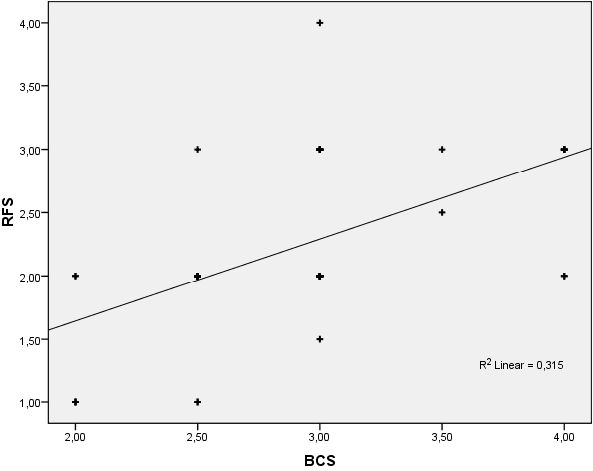
Correlations of BCS with RFS of buffalo cows. For abbreviations, see Table I.
References
- Bramley, E., Costa, N.D., Fulkerson, W.J. and Lean I.J., 2013. N. Z. Vet. J., 61: 323-329. https://doi.org/10.1080/00480169.2013.806882[CrossRef]
- Burfeind, O., Sepulveda, P., von Keyserlingk, M.A.G., Weary D.M., Veira D.M. and Heuwieser, W., 2010. J. Dairy Sci., 93: 3635-3640. https://doi.org/10.3168/jds.2009-3044[CrossRef]
- Delfino, N.C., Bulcão, L.F.A., Alba, H.D.R., Oliveira, M.X.D.S., Queiroz, F.P.S., Carvalho, G.G.P., Rennó, F.P., de Freitas-Júnior, J.E., 2018. Asian-Australas. J. Anim. Sci., 31:1756–1765. https://doi.org/10.5713/ajas.17.0223[CrossRef]
- Nalubwama, S., Kabi, F., Vaarst, M., Smolders, G. and Kiggundu, M., 2016. Trop. Anim. Hlth. Prod., 48: 1525-1532. https://doi.org/10.1007/s11250-016-1123-5[CrossRef]
- Patel, M., Lakhani, G.P., Ghosh, S., Nayak, S., Roy, B., Baghel, R.P.S. and Jain, A., 2018. Int. J. Curr. Microbiol. appl. Sci., 7: 1204-1212. https://doi.org/10.20546/ijcmas.2018.711.140[CrossRef]
- Roche, J.R., Friggens, N.C., Kay, J.K., Fisher, M.W., Stafford, K.J. and Berry, D.P., 2009. J. Dairy Sci., 92: 5769-5801. https://doi.org/10.3168/jds.2009-2431[CrossRef]
- Stadník, L., Louda F. and Ježková, A., 2002. Czech J. Anim. Sci., 47: 169-175.
- Stadnik, L. and Atasever, S., 2015. Indian J. Anim. Res., 49: 774-777. https://doi.org/10.5958/0976-0555.2015.00048.5[CrossRef]
- Stadnik, L., Atasever, S. and Ducháček, J., 2017. Anim. Reprod., 14: 1264-1269. https://doi.org/10.21451/1984-3143-AR944[CrossRef]
- von Keyserlingk, M., Ruschen. J., de Pasillé, A. and Weary, D., 2009. J. Dairy Sci., 92: 4101-4111. https://doi.org/10.3168/jds.2009-2326[CrossRef]
Services
Article usage statistics
Loading…