
Current study was designed for the development of an economic and environment friendly mechanism for the production of thermostable cellulase. Production of cellulase was focused due to its diverse range of application in industry. In the present study, conditions were optimized for the maximal production of recombinant thermostable cellulase from Thermotoga naphthophila using BL21-CodonPlus (DE3) cells as expression host and pET28a as expression vector. Effect of various concentration of Isopropyl β-D-1-thiogalactopyranoside (IPTG), post induction time, effect of temperature and pH were examined for the maximal production of recombinant cellulase. The effect of supplementation of LB medium with additional carbon and nitrogen sources was also analyzed for maximal production of recombinant protein. Higher level enzyme activity was recorded at 25°C, pH 7.0 when the cells were induced with 0.5 mM IPTG with 22h post induction incubation. Supplementation of LB medium with 1% glucose and yeast extract enhanced the production of recombinant thermostable cellulase. Enzyme showed strong potential for its use in paper and poultry feed industry. Under the optimal conditions we could able to produce 48 U/mL of recombinant cellulase.
Research Article · Volume 51, Issue 4, 3 May 2019 · Open Access
Optimization of Conditions for Maximal Production of Recombinant Thermostable Cellulase from Thermotoga naphthophila using E. coli BL21-CodonPlus (DE3) as Expression Host
· · · · · · · ·
Affiliations & Notes ⌄
- 1Institute of Biochemistry and Biotechnology, University of Veterinary and Animal Science, Lahore 2Department of Microbiology, University of Veterinary and Animal Science, Lahore 3Department of Biochemistry, University of Central Punjab, 1 - Khayaban-e-Jinnah Road, Johar Town, Lahore , * Corresponding author: muhammad.tayyab@uvas.edu.pk
Article Info ⌄
- Journal:
- Pakistan Journal of Zoology
- Published:
- 3 May 2019

From the article
- Current study demonstrated the enhanced production of recombinant protein with the increase in IPTG concentration.
- Maximal cellulase production was achieved at 0.5 mM IPTG while further increase in IPTG resulted in reduced enzyme production (Fig. 1).
- Optimization of post induction incubation temperature is important for the higher level production of recombinant protein in soluble form.
- This study demonstrated the optimization of conditions for the enhanced production of recombinant thermostable cellulase using a prokaryotic expression system.
Selected from the article's own text.
Abstract
Introduction
Cellulose is the most abundant organic compound on earth and is the principal component of plant cell wall . It is a homo-polymer of glucose where monomers are linked each other through β-1,4 glycosidic linkage . A variety of industrial and agricultural wastes have cellulose as a major component which can be transformed into simple sugar via the hydrolysis process. Two methods are available for hydrolysis of cellulose to its monomeric units. The chemical hydrolysis method requires the treatment of cellulose with strong acid under high temperature >300°C at 25 MPa which make this method as cost efficient with poor quality and low yield of final product . Enzymatic hydrolysis method is preferred over chemical hydrolysis due to its environment friendly nature. Cellulases are biocatalyst required for digestion of cellulose under ordinary temperature and pH conditions which is not hazardous to environment .
On the basis of catalytic action, the cellulases have been divided into the three major classes including endoglucanases (EC 3.2.1.4), β-glucosidase (EC 3.2.1.21) and exoglucanase (EC 3.2.1.91) which are responsible for the de-polymerization of complex cellulose to simple glucose units . Cellulases have been immensely used in various industries including textile industry for improvement of fiber softness ; , in paper and pulp industry for refinement and strengthing of paper ; ; , in bioethanol production for saccharification of lignocellulosic materials ; ; , in wine and brewery industry for improving the quality and yield of the fermented product ; ; , in food processing industry for the improvement of extraction procedure, cloud stability, texture and clarification of fruit and vegetable juices ; , in animal feed industry for the improvement of nutritional value of feed by adding the digestion process and ultimately the performance of animals , in agriculture for enhancement of crop growth by controlling plant diseases ; and in detergent industry for improving colour brightness, feel and dirt removal from garments ; ; .
Recombinant DNA technology played significant role for the fulfilment of industrial requirement of enzymes. Selection of appropriate expression vector and its compatibility with expression system is very important for the successful production of recombinant protein. An efficient expression system which can fulfil the industrial demand of enzyme in a limited time with low cost is required in order to meet the industrial demand . Optimization of conditions is another strategy being followed by scientists for the higher level production of recombinant proteins ; ; ; ; .
Present study deals with the utilization of BL21-CodonPlus (DE3) a prokaryotic expression system as expression host and pET28a having cellulase gene from T. naphthophila as expression vector for the production of recombinant cellulase. The conditions including inducer concentration, post induction time, medium composition, temperature and pH were analyzed for the enhanced production of recombinant cellulase.
Materials and methods
Chemicals
All the chemicals utilized in this study were of analytical grade and were purchased from Merck, Life Sciences, Darmstadt, Germany.
Expression machinery
Recently, we have characterized a recombinant thermostable cellulase from T. naphthophila . Cellulase gene from T. naphthophila was cloned in pET28a and was expressed in BL21-CodonPlus (DE3) cells. The recombinant cells harboring the pET28a with cellulase gene from T. naphthophila were utilized for the optimizing of conditions for the maximal production of recombinant thermostable cellulase.
Production of recombinant cellulase
Regarding the production of recombinant cellulase, the overnight grown recombinant BL21-CodonPlus (DE3) cells were diluted to 1% with fresh LB medium and was incubated at 37°C under shaking conditions (I3000, Lab Tech, Korea) till the OD660 reached to 0.4. The cells were induced with 1 mM IPTG followed by further incubation at 37°C. The production of recombinant protein was analyzed after lyzing the cells by sonication (Sonics, Newtorn, USA) .
Activity assay
Cellulase activity was determined in 50 mM sodium acetate buffer (pH 4.8) using carboxymethyl cellulose as substrate. The reaction mixture was incubated in water bath at 90°C for 30 min. The production of monomeric sugars was estimated by DNS method. One unit of enzyme was the amount of enzyme required to liberate 1 µmol of reducing sugars under the assay conditions .
Optimization of conditions for the maximal cellulase production
Effect of IPTG concentration
In order to explore the effect of inducer on the production of recombinant protein, the BL21-CodonPlus (DE3) cells were induced by varying the IPTG concentration from 0.1 to 1 mM and cellulase production was recorded at each IPTG concentration .
Effect of post-induction temperature and incubation time
The production of recombinant cellulase was analyzed at 20, 25 and 37°C. For this purpose, the cells were shifted to respective temperature before induction after attaining the OD660 to 0.4 and were induced with 0.5 mM IPTG. The cellulase production was recorded at 20, 25 and 37°C. Regarding the optimization of incubation time, the sample after induction was withdrawn after every hour and was utilized for the determination of enzyme activity .
Effect of pH
The overnight grown recombinant BL21-CodonPlus (DE3) cells were diluted to 1% with fresh LB broth prepared in 50 mM of each of sodium acetate buffer (3-5), Sodium phosphate buffer (5-7) and Tris HCl buffer (7-9). The cells were incubated again at 37°C till the achievement of OD660 to 0.4 and were induced with 0.5 mM IPTG followed by further incubation at 25°C for 22 h. The enzyme activity was recorded at each pH after losing the cells .
Effect of supplementation of medium
Various carbon sources including glucose, sucrose, lactose, starch, fructose & maltose and nitrogen sources including yeast extract, tryptone, peptone, urea, glycine and inorganic nitrogen sources including ammonium chloride and ammonium sulphate were utilized for the supplementation of LB medium at a final concentration of 1%. The overnight grown recombinant BL21-CodonPlus (DE3) cells having recombinant pET28a were diluted to 1% with the LB medium supplemented with additional carbon and nitrogen sources separately. The cells were induced with 0.5 mM IPTG and the expression of recombinant protein was analyzed at 25°C after 22 h of incubation .
Results and discussions
Prokaryotic expression system is being preferred over eukaryotic expression system due to its low cost, rapid growth rate, flexibility and ease to scale up for higher level production of proteins which don’t require post translational modifications . More over optimization of conditions is another strategy along with the suitable expression system for eminent production of recombinant proteins. IPTG is an inducer molecule, commonly utilize for production of recombinant protein being produced under the lac operon. Current study demonstrated the enhanced production of recombinant protein with the increase in IPTG concentration. Maximal cellulase production was achieved at 0.5 mM IPTG while further increase in IPTG resulted in reduced enzyme production (Fig. 1). The reduced production of recombinant cellulase at higher concentration of IPTG is due to its toxicity to cell and its ability to diminish the rate of synthesis of ribosomal RNA . These results are in agreement with the previous report for the production of cellulases from E. cellulosolvens , C. saccharolyticus and T. maritima whereas in contrast to this, maximal cellulase production from P. furiosus was recorded at 0.1 mM IPTG.
Optimization of post induction incubation temperature is important for the higher level production of recombinant protein in soluble form. The recombinant protein was produced mainly as insoluble inclusion bodies at 37°C and the expression of recombinant cellulase was quite low at 20°C whereas the maximal soluble production of recombinant protein was achieved at 25°C (Fig. 2) after 22 h of incubation (Fig. 3). We could produce maximum of 18, 28 and 08 U/mL of recombinant cellulase at 20, 25, 37°C, respectively. This strategy of expressing protein at low temperature with extended incubation time was previously reported by Rincon et al. (2017), Tayyab et al. (2011) and Zhang et al. (2009). Cellulases from T. maritima , Acidothermus cellulolyticus , Eubacterium cellulosolvens and Fervibacterium nodosum showed their optimal production under low temperature between 16 to 28°C whereas cellulase from Caldicellulosiruptor saccharolyticus showed its high level production at 30°C with overnight incubation.
Table I.- Effect of various carbon and nitrogen sources on the production of recombinant cellulase.
| Sources | Relative activity (%) | |
| Carbon sources | Control | 100 |
| Glucose | 163 | |
| Maltose | 161 | |
| Lactose | 153 | |
| Sucrose | 127 | |
| Fructose | 109 | |
| Starch | 105 | |
| Nitrogen sources | Control | 100 |
| Yeast extract | 197 | |
| Tryptone | 171 | |
| Peptone | 120 | |
| Ammonium sulphate | 40 | |
| Ammonium chloride | 38 | |
| Urea | 34 | |
| Glycine | 23 | |
Change in pH always shows significant influence on the growth of bacteria. No significant bacterial growth or cellulase production was recorded at pH 3 or 4. However the cellulase production was increased with the increase in pH beyond 5 and maximal cellulase production was recorded at pH 7 while further increase in pH resulted in reduced enzyme production (Fig. 4). These findings are in agreement with the findings of Oelschlagel et al. (2015) while according to other reports optimal production of recombinant proteins was recorded at pH 7.5 ; ; .
Medium supplementation with various carbon and nitrogen sources showed the enhanced production of recombinant cellulase. The high level production of recombinant protein was achieved when the medium was supplemented with glucose or maltose at a final con centration of 1%. The results depicted that glucose or maltose are carbon sources being preferred by BL21-CodonPlus (DE3) cells for their growth and for the production of recombinant protein (Table I). This is might be due to their monomeric nature and ease in absorption as compared to lactose or sucrose (disaccharides) and starch (polysaccharide). Similarly, aldo-sugars are being preferred over keto-sugars by BL21-CodonPlus (DE3) cells for their growth. These results are in agreement with previous reports by Nur et al. (2016), Bren et al. (2016), Wang et al. (2015) and Bettenbrock et al. (2007). Production of recombinant cellulase was also enhanced when the LB medium was supplemented with yeast extract or tryptone as additional nitrogen sources whereas the rest of selected nitrogen sources could not contribute significantly in the production of recombinant protein (Table I). The results demonstrated that BL21-CodonPlus (DE3) cells preferred organic nitrogen sources over inorganic nitrogen sources for the growth (Table I). These results are in agreement with previous reports by Fu et al. (2006), Zhang et al. (2009), Mahmoudi et al. (2012) and Lee and Chang (1994), who observed the higher level cellular growth and the enhanced production of recombinant protein when the medium was supplemented with yeast extract and tryptone, respectively.
Conclusion
This study demonstrated the optimization of conditions for the enhanced production of recombinant thermostable cellulase using a prokaryotic expression system. Optimization studies revealed the highest cellulase activity when recombinant cells were induced with 0.5 mM IPTG with post induction incubation of 22h at 25°C (28 U/mL) in the presence of 50 mM sodium phosphate buffer pH 7 (37 U/mL) and when the LB medium was supplemented with glucose and yeast extract as carbon and nitrogen sources (48 U/mL). Current work was a foundation study that will act as milestone for the industrial scale production of recombinant cellulase at domestic level and for the fulfilment of local industrial requirement of the enzyme in Pakistan.
Acknowledgements
This work was supported by Higher Education Commission of Pakistan.
Statement of conflict of interest
The authors have no conflict of interest.
Figures
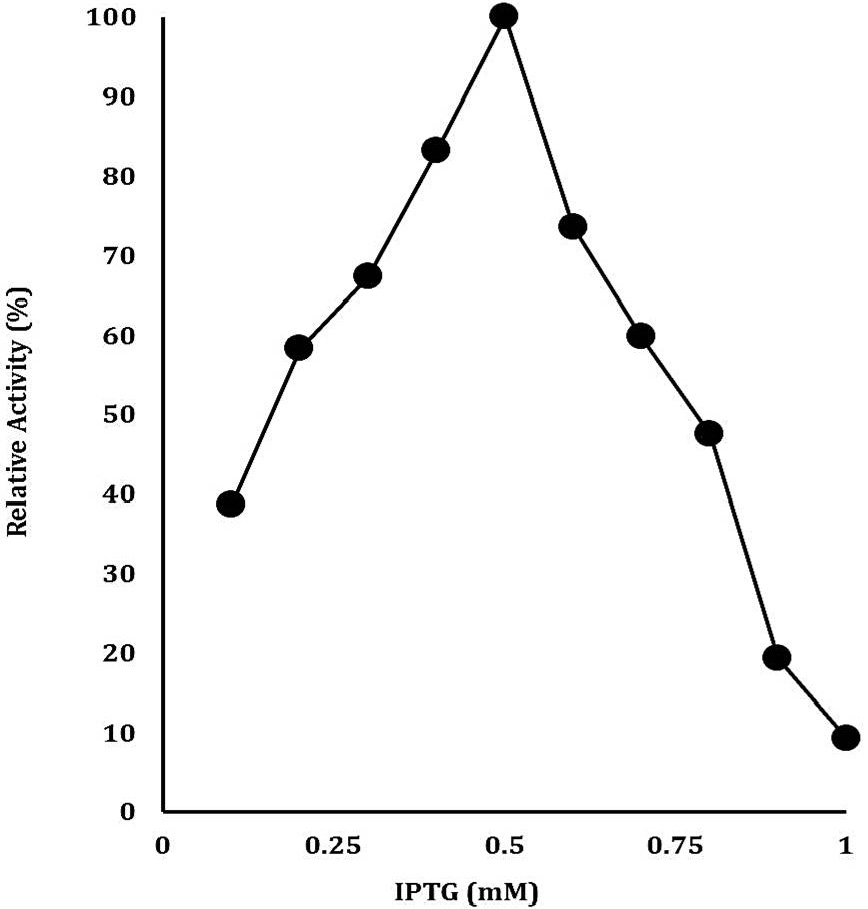
Optimization of IPTG concentration for the maximal production of recombinant cellulase. The data on X-axis shows the IPTG concentration (mM) whereas on Y-axis shows the relative activity (%).
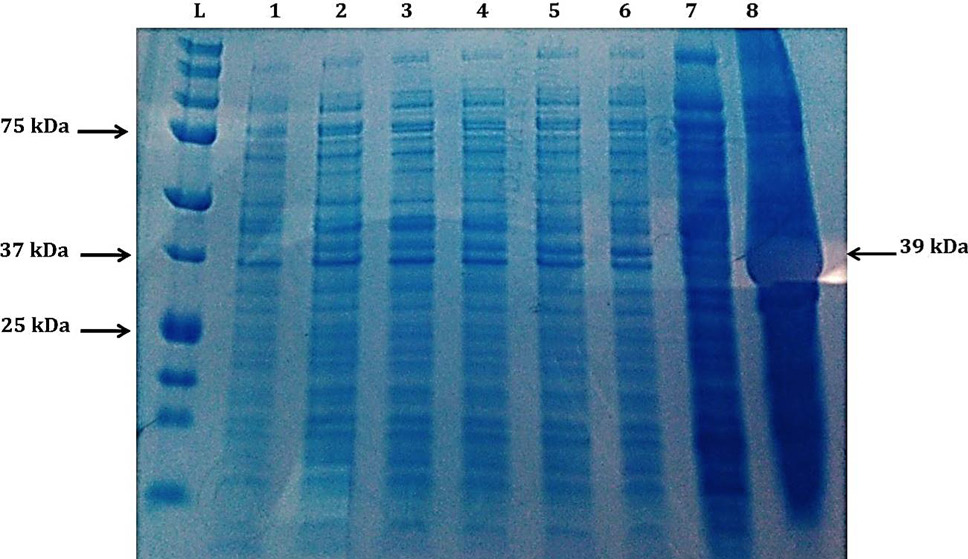
Coomassie Brilliant Blue R-250 Stained SDS-PAGE Gel Showing effect of incubation temperature on the production of recombinant cellulase (39 kDa): Lane L, protein ladder (Precision Plus Protein Ladder, Bio RAD, USA); Lane 1, soluble fraction after lysis of cells having pET28a without insert as negative control; Lane 2-6, Soluble part after lysis of cells having pET28a with cellulase gene with post induction period of 1–5 h at 37°C; Lane 7, soluble part after lysis of cells having pET28a with cellulase gene with post induction period of 22 h at 20°C; Lane 8, soluble part after lysis of cells having pET28a with cellulase gene with post induction period of 22 h at 25°C.
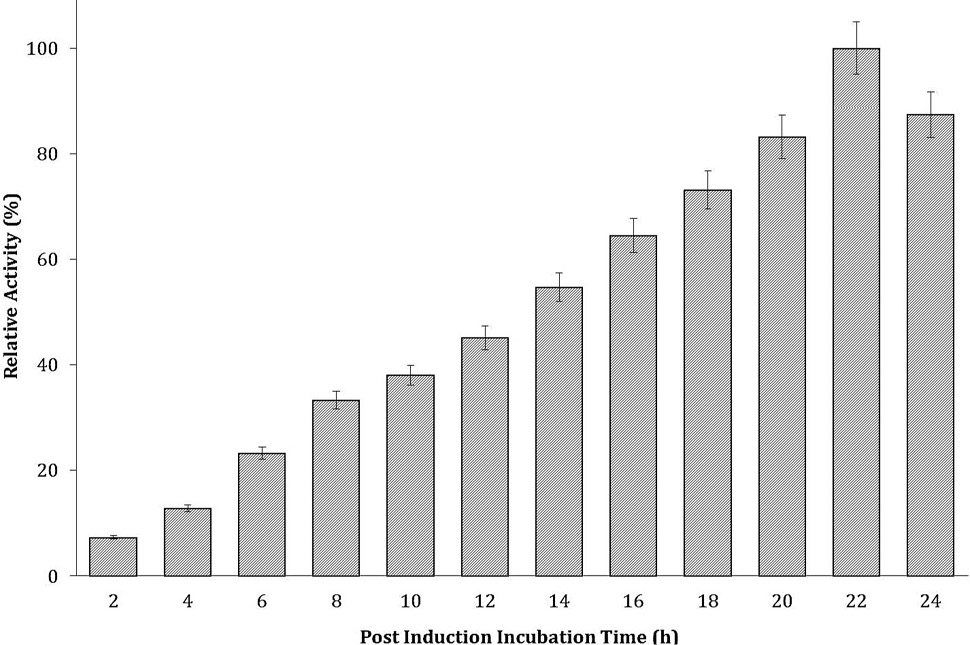
Effect of post induction incubation time on recombinant cellulase production. Experiment was conducted at 25°C. The data on X-axis shows the post induction incubation time (h) and Y-axis shows the relative activity (%).
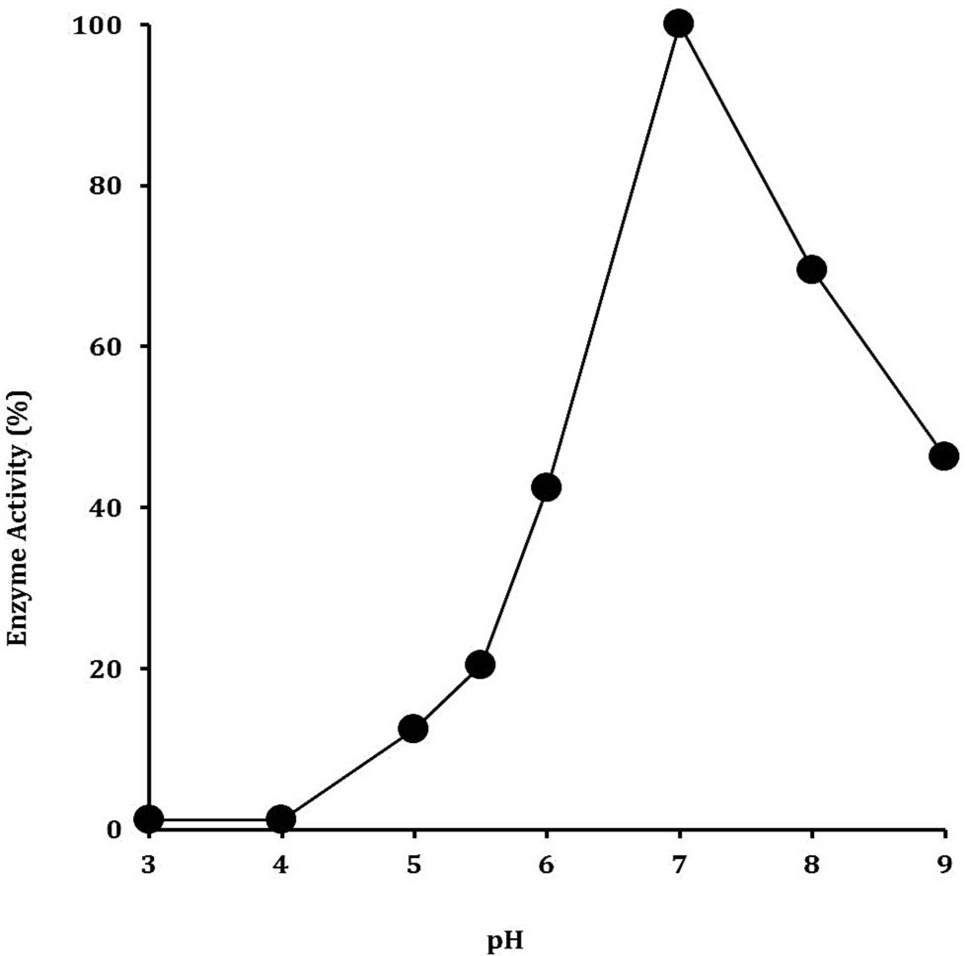
Optimization of pH for the maximal production of recombinant cellulase. The cellulase production was analyzed in 50 mM of each of sodium acetate buffer (3-5), sodium phosphate buffer (5-7) and Tris HCl buffer (7-9). The data on X-axis indicates the buffer pH values while on Y-axis show relative activity (%).
References
- Akhtar, M., 1994. Biochemical pulping of aspen wood chips with three strains of Ceriporiopsis subvermispora. Holzforschung, 48: 199-202. https://doi.org/10.1515/hfsg.1994.48.3.199[CrossRef]
- Bamforth, C.W., 2009. Current perspectives on the role of enzymes in brewing. J. Cereal Sci. Sp. Sec.: Enzymes Grain Process, 50: 353-357. https://doi.org/10.1016/j.jcs.2009.03.001[CrossRef]
- Bettenbrock, K., Sauter, T., Jahreis, K., Kremling, A., Lengeler, J.W. and Gilles, E.D., 2007. Correlation between growth rates, EIIACrr phosphorylation and intracellular cyclic AMP levels in Escherichia coli K-12. J. Bact., 189: 6891-6900. https://doi.org/10.1128/JB.00819-07[CrossRef]
- Bhat, M.K., 2000. Cellulases and related enzymes in biotechnology. Biotechnol. Adv., 18: 355-383. https://doi.org/10.1016/S0734-9750(00)00041-0[CrossRef]
- Bren, A., Park, J.O., Towbin, B.D., Dekel, E., Rabinowitz, J.D. and Alon, U., 2016. Glucose becomes one of the worst carbon sources for E. coli on poor nitrogen sources due to suboptimal levels of cAMP. Scient. Rep., 6: 24834. https://doi.org/10.1038/srep24834[CrossRef]
- Carvalho, L.M.J., Castro, I.M. and Silva, C.A.B., 2008. A study of retention of sugars in the process of clarification of pineapple juice (Ananas comosus, L. Merril) by micro- and ultra-filtration. J. Fd. Engin., 87: 447-454. https://doi.org/10.1016/j.jfoodeng.2007.12.015[CrossRef]
- Chet, I., Benhamou, N. and Haran, S., 1998. Mycoparatism and lytic enzymes. In: Trichoderma and Gliocladium enzymes (eds. G.F. Harman and C.P. Kubicek). Taylor & Francis, London, UK, pp. 327-342.
- Couto, M.R., Rodrigues, J.L. and Rodrigues, L.R., 2017. Optimization of fermentation conditions for the production of curcumin by engineered Escherichia coli. J. R. Soc., 14: e0470. https://doi.org/10.1098/rsif.2017.0470[CrossRef]
- Deguchi, S., Tsujii, K. and Horikoshi, K., 2006. Cooking cellulose in hot and compressed water. Chem. Commun., 31: 3293-3295. https://doi.org/10.1039/b605812d[CrossRef]
- Dhiman, T.R., Zaman, M.S., Gimenez, R.R., Walters, J.L. and Treacher, R., 2002. Performance of dairy cows fed forage treated with fibrolytic enzymes prior to feeding. Anim. Feed Sci. Technol., 101: 115-125. https://doi.org/10.1016/S0377-8401(02)00177-3[CrossRef]
- Fu, X.Y., Wei, D.Z. and Tong, W.Y., 2006. Effect of yeast extract on the expression of thioredoxin–human parathyroid hormone from recombinant Escherichia coli. J. Chem. Technol. Biotechnol., 81: 1866-1871. https://doi.org/10.1002/jctb.1615[CrossRef]
- Galante, Y.M., De, C.A. and Monteverdi, R., 1998. Application of Trichoderma enzymes in the food and feed industries. In: Trichoderma and liocladium (eds. G.E. Harman and C.P. Kubicek). Taylor & Francis, London, UK, pp. 327-342.
- Gupta, R., Khasa, Y.P. and Kuhad, R.C., 2011. Evaluation of pretreatment methods in improving the enzymatic saccharification of cellulosic materials. Carbohydr. Polym., 84: 1103-1109. https://doi.org/10.1016/j.carbpol.2010.12.074[CrossRef]
- Harman, G.E. and Kubicek, C.P., 1998. Trichoderma and Gliocladium enzymes, Volume 2: Biological control and commercial applications. Taylor & Francis, London, UK.
- Kang, H.K., Kim, N.M., Kim, G.J., Seo, E.S. and Ryu, H.J., 2011. Enhanced saccharification of rice straw using hypochlorite-hydrogen peroxide. Biotechnol. Bioproc. Engin., 16: 273-281. https://doi.org/10.1007/s12257-010-0262-1[CrossRef]
- Karmakar, M. and Ray, R.R., 2011. A statistical approach for optimization of simultaneous production of β-Glucosidase and endoglucanase by Rhizopus oryzae from solid-state fermentation of water hyacinth using central composite design., Biotechnol. Res. Int., 6: 41-53. https://doi.org/10.4061/2011/574983[CrossRef]
- Kataoka, M. and Ishikawa, K., 2014. A new crystal form of a hyperthermophilic endocellulase. Acta Crystallogr. Sect. F: Struct. Biol. Commun., 70: 878-883. https://doi.org/10.1107/S2053230X14010930[CrossRef]
- Khalid, A., Tayyab, M., Shakoori, A.R., Hashmi, A.S., Yaqub, T., Awan, A.R., Wasim, M., Firyal, S., Hussain, Z. and Ahmad, M., 2019. Cloning, expression and characterization of highly active recombinant thermostable cellulase from Thermotoga naphthophila. Pakistan J. Zool., 51: 925-934, 2019. http://dx.doi.org/10.17582/journal.pjz/2019.51.3.925.934[Full text][CrossRef]
- Koomnok, C., 2005. Selection of cellulase producing thermophilic fungi. In: Proceedings of the 31st Congress on Science and Technology of Thailand of Technology. Suranaree University.
- Kuhad, R.C., Gupta, R. and Khasa, Y.P., 2010. Bioethanol production from lignocellulosic biomass: An overview. In: Wealth from waste (ed. B. Lal). Teri Press, New Delhi, India.
- Larentis, A.L., Argondizzo, A.P.C., Santos, E.G., Jessouron, E., Galler, R. and Medeiros, M.A., 2011. Cloning and optimization of induction conditions for mature PsaA (Pneumococcal Surface Adhesion A) expression in Escherichia coli and recombinant protein stability during long-term storage. Protein Exp. Purif., 78: 38-47. https://doi.org/10.1016/j.pep.2011.02.013[CrossRef]
- Lee, S.Y. and Chang, H., 1994. Effect of complex nitrogen source on the synthesis and accumulation of poly (3-hydroxybutyric acid) by recombinant Escherichia coli in flask and fed-batch cultures. J. Polym. Environ., 2: 169-176.
- Mahmoudi, S., Abtahi, H., Bahador, A., Mosayebi, G., Salmanian, A.H. and Teymuri, M., 2012. Optimizing of nutrients for high level expression of recombinant streptokinase using pET32a expression system. J. clin. Med., 7: 241-246. https://www.ncbi.nlm.nih.gov/pubmed/23400422
- Mansoor, S., Tayyab, M., Jawad, A., Munir, B., Firyal, S., Awan, A.R., Rashid, N. and Wasim, M., 2018. Refolding of misfolded inclusion bodies of recombinant α-amylase: Characterization of cobalt activated thermostable α-amylase from geobacillus SBS-4S. Pakistan J. Zool., 50: 1147-1155. http://dx.doi.org/10.17582/journal.pjz/2018.50.3.1147.1155[Full text][CrossRef]
- Mendoza C.A., Castro, A.R.M., Olvera, A., Zavala, G., Mendoza, V.M., Garcia, H.E., Alagon, A., Trujillo, R.M.A. and Valdez, C.N.A., 2014. Influence of pH control in the formation of inclusion bodies during production of recombinant sphingomyelinase-D in Escherichia coli. Microb. Cell Factor., 13: 137. https://doi.org/10.1186/s12934-014-0137-9[CrossRef]
- Miller, G.L., 1959. Use of dinitrosalicylic acid reagent for determination of reducing sugar. Anal. Chem., 31: 426-428. https://doi.org/10.1021/ac60147a030[CrossRef]
- Minussi, R.C., Pastore, G.M. and Duran, N., 2002. Potential applications of laccase in the food industry. Trends Fd. Sci. Technol., 13: 205-216. https://doi.org/10.1016/S0924-2244(02)00155-3[CrossRef]
- Mohajeri, A., Soltanahmadi, Y.P., Abdolalizadeh, J., Karimi, P. and Zarghami, N., 2016. Effect of culture condition variables on human endostatin gene expression in Escherichia coli using response surface methodology. Jundishapur J. Microbiol., 9: 8. https://doi.org/10.5812/jjm.34091[CrossRef]
- Morowvat, M.H., Babaeipour, V., Memari, H.R. and Vahidi, H., 2015. Optimization of fermentation conditions for recombinant human interferon beta production by Escherichia coli using the response surface methodology. Jundishapur J. Microbiol., 8: e16236. https://doi.org/10.5812/jjm.8(4)2015.16236[CrossRef]
- Muntari, B., Amid, A., Mel, M., Jami, M.S. and Salleh, H.M., 2012. Recombinant bromelain production in Escherichia coli: process optimization in shake flask culture by response surface methodology. AMB Express, 2: 12. https://doi.org/10.1186/2191-0855-2-12[CrossRef]
- Nur, I., Tahera, J., Munna, M.S., Rahman, M. and Noor, R., 2016. Impact of different carbon sources on the in vitro growth and viability of Escherichia coli (SUBE01) and Salmonella spp. (SUBS01) cells. Bangladesh J. Microbiol., 32: 39-44. https://doi.org/10.3329/bjm.v32i0.28476[CrossRef]
- Oelschlagel, M., Heiland, C., Schlömann, M. and Tischler, D., 2015. Production of a recombinant membrane protein in an Escherichia coli strain for the whole cell biosynthesis of phenylacetic acids. Biotechnol. Rep., 7: 38-43. https://doi.org/10.1016/j.btre.2015.05.002[CrossRef]
- Park, J.I., Kent, M.S., Datta, S., Holmes, B.M., Huang, Z., Simmons, B.A., Sale, K.L. and Sapra, R., 2011. Enzymatic hydrolysis of cellulose by the cellobiohydrolase domain of CelB from the hyperthermophilic bacterium Caldicellulosiruptor saccharolyticus. Bioresour. Technol., 102: 5988-5994. https://doi.org/10.1016/j.biortech.2011.02.036[CrossRef]
- Pereira, J.H., Chen, Z., McAndrew, R.P., Sapra, R., Chhabra, S.R., Sale, K.L., Simmons, B.A. and Adams, P.D., 2010. Biochemical characterization and crystal structure of endoglucanase Cel5A from the hyperthermophilic Thermotoga maritima. J. Struct. Biol., 172: 372-379. https://doi.org/10.1016/j.jsb.2010.06.018[CrossRef]
- Porowinska, D., Wujak, M., Roszek, K. and Komoszynski, M., 2013. Prokaryotic expression systems. Postepy Hig. Med. Doswiadczalnej Online, 67: 119-129. https://doi.org/10.5604/17322693.1038351[CrossRef]
- Porro, D., Sauer, M., Branduardi, P. and Mattanovich, D., 2005. Recombinant protein production in yeasts. Mol. Biotechnol., 31: 245-259. https://doi.org/10.1385/MB:31:3:245[CrossRef]
- Rincon, D.D.J., Duque, I., Osorio, E., Rodriguez L.A., Espejo, M.A., Parra, G.C.M., Poutou, P.R.A., Almeciga, D.C.J. and Quevedo, H.B., 2017. Production of recombinant Trichoderma reesei cellobiohydrolase II in a new expression system based on Wickerhamomyces anomalus. Enzyme Res., 2017: 6980565. https://doi.org/10.1155/2017/6980565[CrossRef]
- Rizkia, P.R., Silabana, S., Hasanc, K., Kamaraa, D.S., Subrotoa, T., Soemitroa, S. and Maksum, I.P., 2015. Effect of Isopropyl-β-D-thiogalactopyranoside concentration on prethrombin-2 recombinan gene expression in Escherichia coli ER2566. Procedia Chem., 17: 118-124. https://doi.org/10.1016/j.proche.2015.12.121[CrossRef]
- Sharyo, M., Sakaguchi, H. and Ohishi, M., 1978. Method of making sanitary paper from chemical pulp using a single component cellulase that does not contain cellulose-building domain. US Patent 6468391.
- Singh, A., Kuhad, R.C. and Ward, O.P., 2007. Industrial application of microbial cellulases, In: Lignocellulose biotechnologgy: Future prospects (eds. R.C. Kuhad and A. Singh). I.K. International Publishing House, New Delhi, India, pp. 345-358.
- Sreenath, H.K., Shah, A.B., Yang, V.W., Gharia, M.M. and Jeffries, T.W., 1996. Enzymatic polishing of jute/cotton blended fabrics. J. Ferment. Bioeng., 81: 18-20. https://doi.org/10.1016/0922-338X(96)83113-8[CrossRef]
- Sukumaran, R.K., Singhania, R.R. and Pandey, A., 2005. Microbial cellulases production, applications and challenges. J. scient. indust. Res., 64: 832-844.
- Tayyab, M., Rashid, N., Angkawidjaja, C., Kanaya, S. and Akhtar, M., 2011. Highly active metallocarboxypeptidase from newly isolated Geobacillus strain SBS-4S: Cloning and characterization. J. Biosci. Bioeng., 3: 259-265. https://doi.org/10.1016/j.jbiosc.2010.11.002[CrossRef]
- Wang, H., Wang, F., Wang, W., Yao, X., Wei, D., Cheng, H. and Deng, Z., 2014. Improving the expression of recombinant proteins in E. coli BL21 (DE3) under acetate stress: An alkaline pH shift approach. PLoS One, 9: e112777. https://doi.org/10.1371/journal.pone.0112777[CrossRef]
- Wang, J., Gao, G., Li, Y., Yang, L., Liang, Y., Jin, H., Han, W., Feng, Y. and Zhang, Z., 2015. Cloning, expression and characterization of a thermophilic endoglucanase, AcCel12B from Acidothermus cellulolyticus 11B. Int. J. mol. Sci., 16: 25080-25095. https://doi.org/10.3390/ijms161025080[CrossRef]
- Wang, J., Wen, B., Xu, Q., Xie, X. and Chen, N., 2015. Optimization of carbon source and glucose feeding strategy for improvement of L-isoleucine production by Escherichia coli. Biotechnol. Biotechnol. Equip., 29: 374-380. https://doi.org/10.1080/13102818.2015.1006899[CrossRef]
- Wang, Y., Wang, X., Tang, R., Yu, S., Zheng, B. and Feng, Y., 2010. A novel thermostable cellulase from Fervidobacterium nodosum. J. Mol. Catal. Enzym., 66: 294-301. https://doi.org/10.1016/j.molcatb.2010.06.006[CrossRef]
- Yoda, K., Toyoda, A., Mukoyama, Y., Nakamura, Y. and Minato, H., 2005. Cloning, sequencing, and expression of a Eubacterium cellulosolvens 5 gene encoding an endoglucanase (Cel5A) with novel carbohydrate-binding modules and properties of Cel5A. Appl. environ. Microbiol. 71: 5787-5793. https://doi.org/10.1128/AEM.71.10.5787-5793.2005[CrossRef]
- Zhang, H.B., Mao, X.Q., Wang, Y.J. and Hu, X.Q., 2009. Optimization of culture conditions for high-level expression of dextransucrase in Escherichia coli. J. Fd. Agric. Environ., 7: 75-78.
Cited by 1 article
In journals published by ResearchersLinks.
Services
Article usage statistics
Loading…