
The occurrence of larval Dicrocoelium dendriticum and Brachylaima sp. is described with molecular evidences in gastropod intermediate hosts from Fergana Valley, Uzbekistan. Larvae of D. dendriticum were detected in 28 (10.7%) out of 262 Xceropicta candacharica, and 8 (9.7%) of 82 Angiomphalia gereliana. Brachylaima sp. larvae were found in 3 (1.6%) of 95 Pseudonapaeus sogdiana. The total number of larvae per snail varied from 8 to 110 individuals. Alignment of the first four sequences of 28S rDNA was revealed a 99-100% similarity to D. dendriticum. Larvae from P. sogdiana snails were 98% similar to Brachylaima sp. In this study, it was confirmed that 2 species of terrestrial snail, X. candacharica and A. gereliana, act as the first intermediate hosts of D. dendriticum, and P. sogdiana snail play a role of intermediate host of Brachylaima sp. in the Fergana Valley, Uzbekistan.
Short Communication · Volume 52, Issue 3, 15 March 2020 · Open Access
Occurrence of Larval Dicrocoelium dendriticum and Brachylaima sp. in Gastropod Intermediate Hosts from Fergana Valley, Uzbekistan
· · · ·
Affiliations & Notes ⌄
- 1Institute of Zoology, Uzbekistan Academy of Sciences, 100125, Tashkent, Uzbekistan 2Namangan State University, 160119, Namangan, Uzbekistan 3School of Veterinary Medicine, Rakuno Gakuen University, Ebetsu, Hokkaido 0698501, Japan , * Corresponding author: askam@rakuno.ac.jp
Article Info ⌄
- Journal:
- Pakistan Journal of Zoology
- Published:
- 15 March 2020

Abstract
Materials and methods
Several species of gastropods were collected in the Fergana Valley at AM in rainy day of September and October, 2017. To detect the larval trematodes, collected snails were individually crushed and dissected in a petri dish with 0.85% buffered saline, and the hepatopancreatic portion was mainly observed under a stereomicroscope. Some collected larvae were morphologically observed under a light microscope (ML 2000 microscope, Meiji) and some of them were used in the molecular study (Kuchboev et al., 2017a). Gastropods were collected around Baharstan and vicinity of Kasansay reservoir, Kasansay district (41°14’12.6”N, 71°32’10.1”E), and Govasoy village, Chust district (41°00’00.1”N, 71°13’28.8”E), Namangan region, Fergana Valley, Uzbekistan (Fig. 1). Shells of positive and negative snails were preserved and identified on morphological and morphometric features .
Genomic DNA was isolated from individual trematode larvae (cercariae) recovered from host gastropod taxa. Larvae were first rinsed in distilled water, then oven dried at 36°C, after which DNA was extracted using a Qiamp DNA mini kit (Qiagen, Hilden, Germany) following manufacturer instructions. D2 of 28S rDNA PCR (iCycler iQ Real Time PCR BIORAD, USA) amplifications were carried out in 25 μl reactions containing 1 μl of each of C2 primer (5`-GAAAAGAACTTTGRAR-3`) and D2 primer (5`-TCCGTGTTTCAAGACGGG-3`) , 1 μl DNA template, 12.5 μl GoTaq Green Master Mix (Promega Corp., USA) and 9.5 μl nuclease-free water; amplification began with an initial denaturation at 94°C for 3 min, followed by 40 cycles at 94°C for 30 sec, 40°C for 1 min, and 68°C for 1 min, and a final extension at 68°C for 10 min. Electrophoresis of amplified DNA fragments was performed on a 1.5% agarose gel, purified using a GenEluteTM PCR Clean-Up Kit (Sigma-Aldrich). Resulting PCR products were directly sequenced in both directions using primers for DNA amplification (Genoscreen, Japan).
Our phylogenetic tree was built using a Maximum likelihood approach and MEGA version 7 Software. For ML analyses, the most appropriate nucleotide substitution model was determined, gaps were treated as missing data and internal node support was assessed by bootstrapping over 500 replicates. Nucleotide sequences (AF153917, JQ081965 AY222167, DQ060330 and as out groups AY222169 for Dicrocoelium and AF184254 for Brachyima) were sourced from GenBank; our sequences were deposited in GenBank (accession numbers MK796127 for D. dendriticum, and MK796833 for Brachylaima sp.).
Results and discussion
This study at determined the presence and prevalence of two trematode larvae species D. dendriticum and Brachylaima sp. in the three terrestrial snails from Fergana Valley of Uzbekistan (Table I; Fig. 2). Gastropod collections comprised 439 snails: 262 X. candacharica from pastures rearing sheep, goats and cattle in the vicinity of Kasansay reservoir, 82 A. regeliana from “Baharistan” village, and 95 P. sogdiana from Govasoy village. Daughter sporocysts and cercariae of D. dendriticum occurred in the digestive gland and hepatopancreas of 28 (10.7%) of 262 X. candacharica, and 8 (9.7%) of 82 A. gereliana; the number of D.dentriticum larvae per snail varied average from 14 to 110 individuals; branched sporocysts of Brachylaima sp. occurred in the digestive gland of 3 (1.6%) of 95 P. sogdiana and number of larvae per snail 8-19 individuals (Table I).
Table I.- Prevalence (%) of D. dendriticum and Brachlayma sp. larvae in gastropods in Fergana Valley, Uzbekistan.
| Gastropod species | n | D. dendriticum | Brachlayma sp. | ||||
| Infected | % | No. of larvae | Infected | % | No. of larvae | ||
| Xeropicta candacharica | 262 | 28 | 10.7 | 54-110 | - | - | - |
| Pseudonapaeus sogdiana | 95 | - | - | - | 3 | 1.6 | 8-19 |
| Angiomphalia regeliana | 82 | 8 | 9.7 | 14-78 | - | - | - |
| Total | 439 | 36 | 10.2 | 14-110 | 3 | 1.6 | 8-19 |
n, number of gastropods analysed.
The most prevalent snails are X. candacharica (prevalence ca. 11.0 %). As one of reasons of the high prevalence shown, it might the definitive host range of D. dentriticum is wide, including over 20 mammalian species , and the possible hosts occur throughout the survey area. In particular, the most important intermediate host is apparently X.candacharica, which presents a high risk factor for transmission of protostrongylid nematodes to small ruminants by being both the most abundant gastropod (>50% of samples) and the gastropod with the highest prevalence of protostrongylid larvae (Kuchboev et al., 2017b). The total infection of gastropods by D. dendriticum and Brachlayma sp. larvae is a ranged from 1.6 % to 10.7%, and the intensity in a snail is a ranged from 8 to 110 individuals, respectively. The species name of the larvae in Table I is given after the molecular analysis.
Though larval dicrocoeliids have been previously reported to infest 1.5-5.2% of X. candacharica and Agriolimax agrestis snails in Samarkand region, Uzbekistan , ours is the first to report the prevalence of larval D. dendriticum in A. regeliana snails, and, to the best of our knowledge, Brachylaima sp. in Fergana Valley, Uzbekistan.
So, infection of X. candacharica and A. gereliana with larvae of D. dendriticum in the region investigated in the present study is rather high. In the period from September to October in 2017, the density of X. candacharica populations on pastures fields of foothill zones reached 50 individuals per m2. Dicrocelium cercariae are found only in gastropods collected in plants for banks of streams. They did not occur in open dry pasture areas. Therefore, focal distribution is characteristic of larval stages of D. lanceatum.
Metacercaria of Brachylaima sp. was found in the snails of P. sogdiana in forests along the northern slopes of the mountains, under stones. Detected metacercariae by us morphologically similar to trematode metacercariae from the Brachylaemidae family. The question of the species of Brachylaima sp. can be resolved only by experimental study of its further development and infection of the definitive hosts or by molecular analysis using sequences.
In this study, we showed a very simple method for preparing PCR templates. By using this method, we could determine parasite DNA sequences even in a single metacercaria or a small portion of sporocysts. From amplified partial 28S rDNA sequences we obtained fragments from five samples of larval trematode and one of nematode (534–590 bp for A. regeliana, 558–566 bp for X. candacharica, and 592 bp for P. sogdiana). Alignment of the first four sequences of 28S rDNA with GenBank data revealed a 99–100% similarity to D. dendriticum. Larvae from P. sogdiana were 98% similar to species of Brachylaima.
The phylogenetic tree constructed, using our 28S rDNA sequences and those of other Dicrocoeliidae and Brachylaimidae taxa from GenBank, revealed Dicrocoelium sequences to be united in one clade, with three branches with nodal statistical support indicating reliable differentiation to species. Our Brachylaima sp., B. virginicum and a Brachylaima sp. taxon from GenBank also united in a single clade, also with clear species differentiation. The families Dicrocoeliidae and Brachylaimidae belong to different super families of trematodes. Therefore we use trematode with Encyclometra colubrimurorum as outgroup (based on 28S rDNA analysis) for D. dentriticum and with Leucochloridium perturbatum for Brachylaima sp. Their division into two clades is very likely (Fig. 3). For these same sequences, the same clades are apparent on a phylogenetic tree constructed using a maximum economy method.
Data coded in the primary structure of different parts of trematode DNA, which significantly contributes to the solution of a number of topical issues of helminthology, contributes to an improved understanding of the systematics and evolution of parasites. Ribosomal molecular marker used by us confirms the validity of morphological features used to identify dicrocoeliid and brachylaimid species, and clearly determine the systematic position of genera in trematode phylogeny. The integration of DNA barcoding and morphological approaches is essential for identifying cryptic species of the trematodes and reorganizing their systematics.
Thus, due to the difficulty to morphologically differentiate cercariae and metacercariae isolated from gastropod of snails were characterized by molecular analysis using sequences. We intend to describe with molecular evidences the occurrence of larval D. dendriticum and Brachylaima sp. in the gastropod intermediate hosts. Using a molecular approach for parasites, this study examined the natural intermediate hosts of D. dendriticum and Brachylaima sp. two parasitic nematodes responsible for dicrocoeliasis and brachylaimids animals. Understanding the life cycle of these species is essential for risk factor identification. Among the different habitats sampled, wet pasture fields foothill zones seem most favorable to the life cycle of dicrocoeliid and brachylaima species in Fergana Valley, Uzbekistan.
Acknowledgements
We thank Professor Abduvaet Pazilov from the Gulistan State University for assistance with morphological studies gastropods during this study. We also would like to thank Steve O’Shea, PhD, of the Edanz Group (www.edanzediting.com/ac), for editing a draft of this manuscript.
Statement of conflict of interest
The authors declare no conflict of interest.
Figures
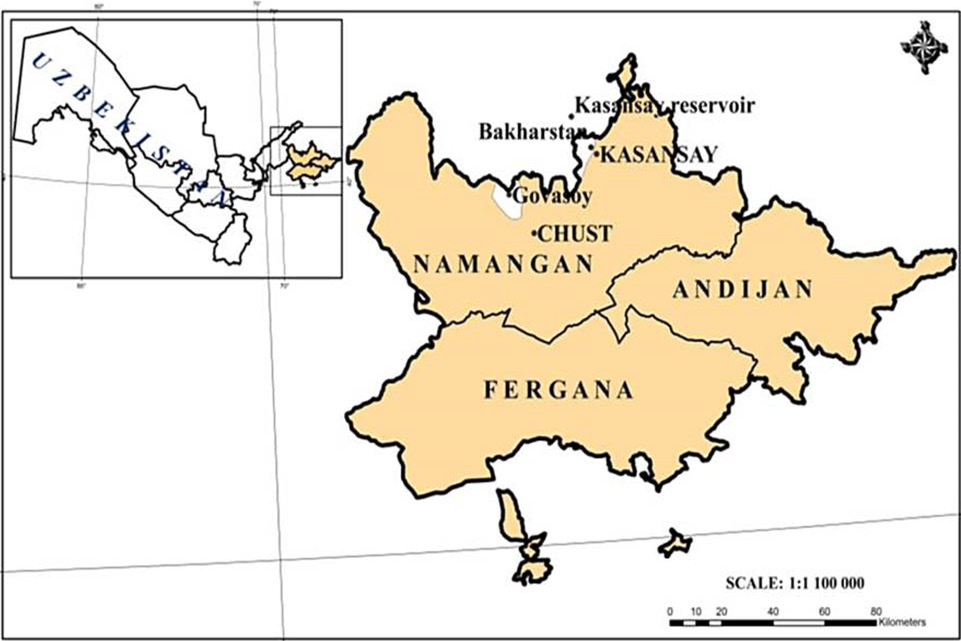
Study sites divided into two districts in the foothill zone of Namangan regions Fergana Valley, Uzbekistan.

Intermediate hosts gastropods (shells) and larval stages of trematodes: A, Xceropicta candacharica; B, Angiomphalia regeliana; C, Cercariae of Dicrocoelium dendriticum; D, mollusk Pseudopanaeus sogdiana; E, Cercariae of Brachylaima sp.
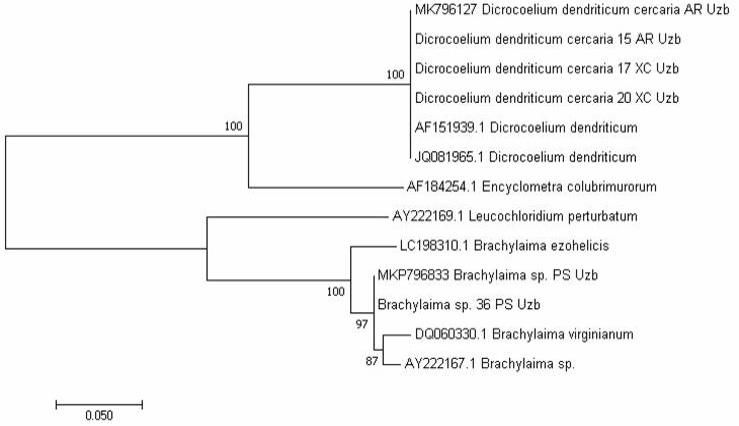
Phylogenetic relationships between dicrocoeliid and brachylaima trematodes using a maximum likelihood approach.
References
- Butcher, A.R. and Grove, D.I., 2001. Syst. Parasitol., 49: 211-221. https://doi.org/10.1023/A:1010616920412[CrossRef]
- Ernazarov, J., 1972. Dicrocoeliasis of sheep and cattle in the conditions of the south of Uzbekistan. PhD thesis, Samarkand Agrarian Institute, Samarkand, Uzbekistan.
- Gouy de Bellocq, J., Ferte, H., Depaquit, J., Justine, J.L., Trillier, A. and Durette-Desset, M.C., 2001. Mol. Phylogenet. Evol., 19: 430-442. https://doi.org/10.1006/mpev.2001.0925[CrossRef]
- Gürelli, G., 2017. Turkiye Parazitol. Derg., 41: 169-172. https://doi.org/10.5152/tpd.2017.5177[CrossRef]
- Köse, M., Eser, M., Kartal, K. and Bozkurt, M.F., 2015. Korean J. Parasitol., 53: 647-651. https://doi.org/10.3347/kjp.2015.53.5.647[CrossRef]
- Kuchboev, A.E., Karimova, R.R., Egamberdiev, M.H., Endoh, D. and Asakawa, M., 2017a. Jpn. J. Vet. Parasitol., 16: 1-10.
- Kuchboev, A.E., Krücken, J., Karimova, R.R., Ruziev, B.H. and Pazilov, А., 2017b. J. Helminthol., 91: 235-243. https://doi.org/10.1017/S0022149X16000171[CrossRef]
- Maurelli, M.P., Rinaldi, L., Capuano, F., Perugini, A.G., Veneziano, V. and Cringoli, G., 2007. Parasitol. Res., 101: 1251-1255. https://doi.org/10.1007/s00436-007-0629-1[CrossRef]
- Nadler, S.A. and De Leon, G.P., 2011. Parasitology, 138: 1688-1709. https://doi.org/10.1017/S003118201000168X[CrossRef]
- Nakao, M., Waki, T., Sasaki, M., Anders, L.J., Koga, D. and Asakawa, M., 2017. Parasitol. Int., 66: 240-249. https://doi.org/10.1016/j.parint.2017.01.015[CrossRef]
- Onyishi, G.C., Aguzie, I.O., Okoro, J. O., Nwani, C.D., Ezenwaji, N.N., Oluah, S., Okafor, C. Pakistan J. Zool., 50: 1079-1085. http://dx.doi.org/10.17582/journal.pjz/2018.50.3.1079.1085[Full text][CrossRef]
- Panin, V.Y., 1984. Dicrocoeliid trematodes of world fauna. Nauka Publisher, Alma Ata.
- Pazilov, A. and Kuchboev, A.E., 2017. Terrestrial mollusks are intermediate hosts of helminths of wild and domestic animals in Uzbekistan. FAN Publishers, Tashkent.
- Salimov, B.S., 1974. Experimental studies on the dicrocoliosis of animals, epizootology and measures to combat it in Uzbekistan. PhD thesis, VIGIS, Moscow, SSSR.
- Shakarboev, E.B., 2009. Trematodes of vertebrate fauna of Uzbekistan. PhD thesis, Institute of Zoology, Tashkent, Uzbekistan.
- Suleman, S. and Khan, M.S., 2016. Turk. J. Zool., 40: 595-600. https://doi.org/10.3906/zoo-1510-36[CrossRef]
Cited by 1 article
In journals published by ResearchersLinks.
Services
Article usage statistics
Loading…