
Melanopsis praemorsasnails are considered one of the intermediate hosts for digenetic trematode cercariae. Digenean larvae were obtained from M. praemorsa snails that were collected from Palestine. Cercaria melanopsi palestinia I and III were identified as a xiphidiocercaria belonging to the microcotylae sub-group and as a microcercous cercaria, respectively. Phylogenetic analyses based on sequences of the ITS2 region of the nuclear rDNA revealed that C. melanopsi palestinia I belongs to the family Lecithodendriidae Luhe, 1901, and it could be placed in the genus, or closely related to known Lecithodendrium. Analysis of ITS1 rDNA indicates that Cercaria melanopsi palestinia III belongs to the family Opecoelidae Ozaki, 1925. The present study supported the presence of non-virgulate xiphidiocercariae among the Lecithodendriidae. Molecular characterization of certain cercariae obtained from M. praemorsa snails has not been investigated previously elsewhere. C. melanopsi palestinia I and C. melanopsi palestinia III could be placed in the genera Lecithodendrium and Opecoeloides, respectively, or to closely related genera. Further studies are needed using laboratory experimental infections to clarify the complete life cycle for these larval trematode species.
Research Article · Volume 51, Issue 6, 13 August 2019 · Open Access
Molecular Identification of Two Larval Trematodes in Melanopsis praemorsa (L., 1758) Intermediate Host from the West Bank-Palestine
· ·
Affiliations & Notes ⌄
- 1Department of Biology and Biotechnology, An-Najah N. University, P.O. Box 7, Nablus, Palestine , * Corresponding author: adwang@najah.edu
Article Info ⌄
- Journal:
- Pakistan Journal of Zoology
- Published:
- 13 August 2019

From the article
- These cercariae were C. melanopsi palestinia I and C. melanopsi palestinia III, identified as a xiphidiocercaria belonging to the microcotylae sub-group and as a microcercous cercaria, respectively.
- However, the sequence divergence between the C. melanopsi palestinia I and other Lecithodendrium sp. deposited in GenBank ranged between 6-7%, and this indicates that these organisms are not same species.
- The molecular phylogenetic analysis of ITS1 rDNA sequences placed the microcercous C. melanopsi palestinia III among genera in the family Opecoelidae and indicates that it represents the larval stage of an opecoelids.
- Cercaria melanopsi palestinia I and C. melanopsi palestinia III cercariae are likely to be species in genera Lecithodendrium and Opecoeloides, respectively, or to closely related genera.
Selected from the article's own text.
Abstract
Introduction
Digenetic trematodes are distributed world-wide and continue to be a major issue in public health for both humans and animals. These types of worms have a complex life cycle as they need intermediate hosts such as fish or specific types of snails for development and maturation of the infective stages, while the definitive host is usually infected by eating raw or half-cooked fish.
Several studies have been conducted on the cercariae that infect the snails of Melanopsis sp., particularly M. praemorsa. List of cercariae recovered in Melanopsis sp. snails from different countries are presented in Table I.
The taxonomic placement of many larval trematodes is usually difficult to establish based on their morphological features alone. This may be due to the deficiency of significant, reliable and unique taxonomic distinguishing features at larval stages of digenean development. Frequently, based on morphological features, the cercariae of trematodes can be identified to the level of family or superfamily only, and identification of the larval stages of digenean parasites is particularly difficult and not always effective, since linking life-cycle stages requires experimental completion of the life-cycle . As an alternative to laboratory experimental infections, molecular biological tools, and particularly PCR-based methods, were used to demonstrate and confirm parasite life cycles ; ; ; ; ; . The most common genetic markers used in the systematic studies of digeneans are nuclear ribosomal DNA (rDNA) genes (including their spacer regions) and mitochondrial protein encoding genes ; ; ; ; . Nucleotide sequences of internal transcribed spacer (ITS) regions have been used to match various stages for studying life cycles of the trematodes including adults ; ; ; . The ITS region is a conservative region in given organisms of the same species and can help to differentiate between related species of these organisms .
As part of the study of digenean larvae biodiversity in M. praemorsa snails in the West Bank-Palestine, we reported previously on six species of cercariae called Cercaria melanopsi palestinia I–VI (Bdir and Adwan, 2010, 2011). This research aimed to identify the xiphidiocercaria, which belongs to the microcotylae sub-group (C. melanopsi palestinia I) and the microcercous cercaria (C. melanopsi palestinia III), and explore their phylogenetic relationships using nuclear rDNA sequences from the cercarial stages and sequences of adult digeneans currently deposited in GenBank and our obtained sequences. According to our knowledge, molecular characterization of certain cercariae obtained from M. praemorsa snails has not been investigated previously elsewhere.
Materials and methods
Cercarial collection
The cercariae were obtained from collected M. praemorsa snails by emerging or crushing methods as described previously (Bdir and Adwan 2010, 2011). Cercariae of the same species from one snail were rinsed in saline and then stored at -20ºC until DNA extraction.
PCR and DNA sequencing
Total genomic DNA for molecular analysis was extracted from cercariae using a commercial DNeasy Blood and Tissue Kit for DNA purification (QIAGEN®) according to the manufacturer’s instructions to achieve highest yield. The ITS1 region of the rDNA was amplified using universal primers located at 3’ end of the 18S rDNA (5’-GTA GGT GAA CCT GCA GAA GG-3’) and at 5’ end of the 5.8S rDNA (5’-GCT GCG CTC TTC ATC GAC A-3’) . The ITS2 region was amplified using the forward primer 3S 5’-GGT ACC GGT GGA TCA CGT GGC TAG TG-3’ and the reverse Primer ITS2.2 5’-CCT GGT TAG TTT CTT TTC CTC CGC-3’ . Each PCR reaction mix (25 μl) was performed using 12.5 μl of PCR premix with MgCl2 (ReadyMixTM Taq PCR Reaction Mix with MgCl2, Sigma), 0.4 μM of each primer and 100–150 ng DNA template. DNA amplification was performed using a thermal cycler (Mastercycler Personal, Eppendorf) as the following thermal conditions: initial denaturation for 3 min at 94ºC; followed by 35 cycles of denaturation at 94ºC for 40 s, annealing at 52ºC for 40 s and extension at 72ºC for 60 s; with a final extension step at 72ºC for 5 min. The amplified PCR products were purified by Wizard® SV Gel and PCR Clean-Up System (Promega) and sequenced by the dideoxy chain termination method using an ABI PRISM sequencer, model 3130 (Hitachi Ltd, Tokyo, Japan), at Bethlehem University, Bethlehem, Palestine. DNA sequence information was further submitted for accession numbers in GenBank.
Table I.- Presently known cercariae recovered from Melanopsis sp. snails from different countries.
| Snail | Country | Cercaria | Reference |
| M. praemorsa | Israel | Plettrolophocerca (C. orospinosa) | Ullman, 1954 |
| M. praemorsa | Israel | Xiphidiocercaria (Pusilla sub-group), xiphidiocercaria (Paravirgulae sub-group) and furcocercous cercaria (Vivax sub-group) | Lengy and Stark, 1971 |
| M. praemorsa | Jordan | Virgulate xiphidiocercariae, microcotylous xiphidiocercaria (Pusilla sub-type), microcercous cercaria, brevifurcate lophocercous cercaria, pleurolophocercous cercariae, gymnocephalus cercaria, tailless cercaria, furcocercaria (pharyngeate longifurcate monostome cercaria) and furcocercaria (pharyngeate longifurcate distome cercaria) | Ismail and Abdel-Hafez, 1983, 1984; Ismail et al., 1983; Ismail and Bdair, 1989 |
| M. praemorsa | Israel | Philophthalmus lucipetus cercaria | Radev et al., 1999 |
| M. praemorsa | Israel | Oculate and fin-tailed cercariae | Mutafova et al., 2001 |
| M. praemorsa | Morocco | Cotylocercous, lophocercous apharyngeate, cercariaeum, brevifurcate apharyngeate distome | Laamrani et al., 2005 |
| Melanopsis sp. | Iran | Heterophyid cercariae, echinostomatid cercariae, cyathocotylid cercariae, philophthalmid cercariae, monostome group cercariae | Farahnak et al., 2006 |
| M. praemorsa | Azerbaijan | Virgulate cercariae, lecithodendroid cercaria, stylet cercariae, heterophyidae cercariae and cyathocotylid cercariae | Manafov, 2008, 2010, 2011a, b, c, d |
| M. praemorsa | Palestine | Two types of microcercous cercaria, xiphidiocercaria (microcotylae sub-group), xiphidiocercaria (virgulate subgroup), furcocercous cercaria (apharyngeal brevifurcate monostome cercaria) and longifurcate furcocercous cercaria | Bdir and Adwan, 2010, 2011 |
| M. praemorsa | Iraq | Parapleurolophocercous cercaria, furcocercous cercaria, xiphidiocercous cercaria | Mohammad, 2015 |
Sequence homology and phylogenetic analysis
The comparison of the continuous sequences was made with previously available rDNA of ITS1 or ITS2 sequences from cercarial stages and adult digeneans currently deposited in GenBank using BLAST. Multiple alignments were done using ClustalW in MEGA version 5 . Phylogenetic analyses were carried out based on alignments obtained from ClustalW, and construction of rooted phylogenetic trees was conducted using the Neighbor-Joining (NJ) method in the same software. The evolutionary distances were computed using the Maximum Composite Likelihood method. The robustness of the groupings in the Neighbor-Joining analysis was assessed with 1000 bootstrap resamplings. The sequences of Taenia saginata (AY825540) and Taenia hydatigena (LC004202) are used as an out-groups to study phylogenetic analyses for C. melanopsi palestinia I and C. melanopsi palestinia III, respectively.
Results
Two types of cercariae collected from M. praemorsa snails from Al-Bathan fresh water body-Palestine were analysed. These cercariae were C. melanopsi palestinia I and C. melanopsi palestinia III, identified as a xiphidiocercaria belonging to the microcotylae sub-group and as a microcercous cercaria, respectively. One of the major feature of C. melanopsi palestinia I is the absence of the virgula organ. The molecular phylogenetic analysis based on sequences of the ITS2 region showed that C. melanopsi palestinia I clustered with typical representatives of the genus Lecithodendrium (Looss, 1896), being close, but not the same species, to Lecithodendrium spathulatum Ozaki, 1929, Lecithodendrium linstowi Dollfus, 1931, and other unclassified Lecithodendrium sp. deposited in GenBank (Fig. 1). The molecular phylogenetic analysis based on sequences of the ITS1 region sowed that C. melanopsi palestinia III clustered with the typical representatives of the genus Opecoeloides Odhner, 1928, being close, but not the same species, to Opecoeloides furcatus (Bremser in Rudolphi, 1819) and other unclassified Opecoelidae gen. sp. deposited in GenBank (Fig. 2).
The sequences were registered at the GenBank database under the accession numbers (KX594824–KX594826) for C. melanopsi palestinia I and (KX594822 and KX594823) for C. melanopsi palestinia III.
Discussion
The freshwater snails M. praemorsa served as the intermediate host for various species of trematodes and displayed a high susceptibility for cercarial infection (Ismail and Abdel-Hafez, 1983; Ismail and Bdair, 1989; Laamrani et al., 2005; Farahnak et al., 2006;
Manafov, 2008, 2010, 2011a, 2011b, 2011c, 2011d; Bdir and Adwan, 2011, 2012; Mohammad, 2015). Our previous studies in Palestine , 2012), showed that M. praemorsa snails in the Al-Bathan stream were infected by at least six species of cercariae, including C. melanopsi palestinia I (microcotylae sub-group of the xiphidiocercariae), C. melanopsi palestinia II (brevifurcate lophocercous cercaria), C. melanopsi palestinia III (microcercous cercaria), C. melanopsi palestinia IV (virgulae subgroup of the xiphidiocercariae), C. melanopsi palestinia V (microcercous cercaria) and C. melanopsi palestinia VI (longifurcate furcocercous cercaria).
The classification position of digenean trematode species usually depends on the morphology of the adult stages of these organisms. However, the classification of the larval stages of these parasites is a difficult process and need special techniques. In particular, to study the complete the life-cycle of digenean trematode parasites requires experimental host infection in the laboratory. As an alternative to classical methods, application of molecular tools, particularly DNA sequencing, provides a promising and efficient method for understanding trematode life cycles and identification of larval stages involved, including the Lecithodendriidae and related digenean families . Accumulation of digenean sequence data in the primary bioinformatics web servers, especially the nucleotide sequences of the ITS regions from rDNA gene cluster of digenean species, have provided a solid, stable ground and are widely used for examination by primary sequence comparisons of digenean species complexes, identification of cryptic species and life-cycle elucidation . Sometimes, sequences of ITS regions alone may not serve as an efficient marker to discriminate between species within certain genera such as Diplostomum .
After alignment of the C. melanopsi palestinia I sequences (KX594824–KX594826) with Lecithodendriidae sequences in GenBank using BLAST, we found that the sequences of C. melanopsi palestinia I were closely related to Lecithodendrium sp. (Cercaria helvetica XII Dubois, 1928), L. spathulatum and L. linstowi. The phylogenetic tree topology resulting from the analysis of rDNA of ITS2 sequences confirmed that C. melanopsi palestinia I which belongs to the microcotylae sub-group of the non-virgulate xiphididiocercariae, placed this cercaria among genera belonging to the family Lecithodendriidae Luhe, 1901 and represents a larval stage of lecithodendriids. However, the sequence divergence between the C. melanopsi palestinia I and other Lecithodendrium sp. deposited in GenBank ranged between 6-7%, and this indicates that these organisms are not same species. This cercaria is likely to be a species belonging to the genus Lecithodendrium or to species not yet have a DNA sequence in Genbank or to a new genus that is closely related to Lecithodendrium. Members of the digenean family Lecithodendriidae are characterized by a three-host life cycle . Lecithodendriid adults infect both birds and mammals, bats are most commonly infected lecithondendriids particularly L. linstowi . The virgula organ is considered as one of the most prominent features that can be used to classify ‘lecithodendriid-like’ species as a natural group, the ‘virgulate digeneans’ . The digeneans with virgulate cercariae are considered as monophyletic group, called the Lecithodendriidae. Thus, the presence of this glandular virgula organ was utilized as a synapomorphy for the ‘lecithodendriid-like’ digenean lineages . Now, it is known that a non-virgulate xiphidocercaria have been identified in family Pleurogenidae . However, the results of the current study support results recently published from Ukraine, which described the presence of non-virgulate xiphidiocercariae among the Lecithodendriidae . These authors showed that molecular phylogenetic analyses based on the sequences of the ITS2 region and partial 28S gene of the nuclear rDNA revealed that Cercaria helvetica XII Dubois, 1928 from Bithynia tentaculata (Linnaeus), clustered with L. linstowi Dollfus, 1931, the typical representative of the genus Lecithodendrium, and being very close but not identical to that species .
The cosmopolitan digenean family Opecoelidae Ozaki, 1925, is considered one of the largest digenean families with more than 90 genera and around 900 species, almost always found in marine and freshwater teleost fishes . Subfamily level classification within the Opecoelidae Ozaki, 1925, is very complex. Recently, according to Bray et al. (2016), the family Opecoelidae divided into five subfamilies, the Opecoelinae Ozaki, 1925, Plagioporinae Manter, 1947, Stenakrinae Yamaguti, 1970, Helicometrinae Bray et al., 2016 and Opecoelininae Gibson and Bray, 1984.
After alignment of the C. melanopsi palestinia III sequences (KX594822 and KX594823) with Opecoelidae sequences in GenBank using BLAST, we found that the sequences of C. melanopsi palestinia III were closely related to unclassified Opecoelidae gen. sp. and O. furcatus. The molecular phylogenetic analysis of ITS1 rDNA sequences placed the microcercous C. melanopsi palestinia III among genera in the family Opecoelidae and indicates that it represents the larval stage of an opecoelids. However, the sequence divergence between the C. melanopsi palestinia III and other Opecoeloides sp. deposited in GenBank has ranged between 4–5%, and this means that this organism is not of those species. The C. melanopsi palestinia III could be a new species belongs to a new Opecoeloides sp. or a species that its DNA sequence is not deposited in GenBank or species belongs to other genus closely related to Opecoeloides. The placement of this type of cercaria in the right genus is still dependent on sequences of other markers such as ITS2 sequences.
Conclusion
Molecular characterization of certain cercariae collected from M. praemorsa snails has not been investigated previously. Cercaria melanopsi palestinia I and C. melanopsi palestinia III cercariae are likely to be species in genera Lecithodendrium and Opecoeloides, respectively, or to closely related genera. The present study has supported the presence of non-virgulate xiphidiocercariae among the Lecithodendriidae. Further studies are needed using classical methods (laboratory experimental infections) to elucidate the complete life cycle for these larval species.
Acknowledgements
This work was completely sponsored by the Association of Arab Universities.
Statement of conflict of interest
We declare that we have no conflict of interest.
Figures
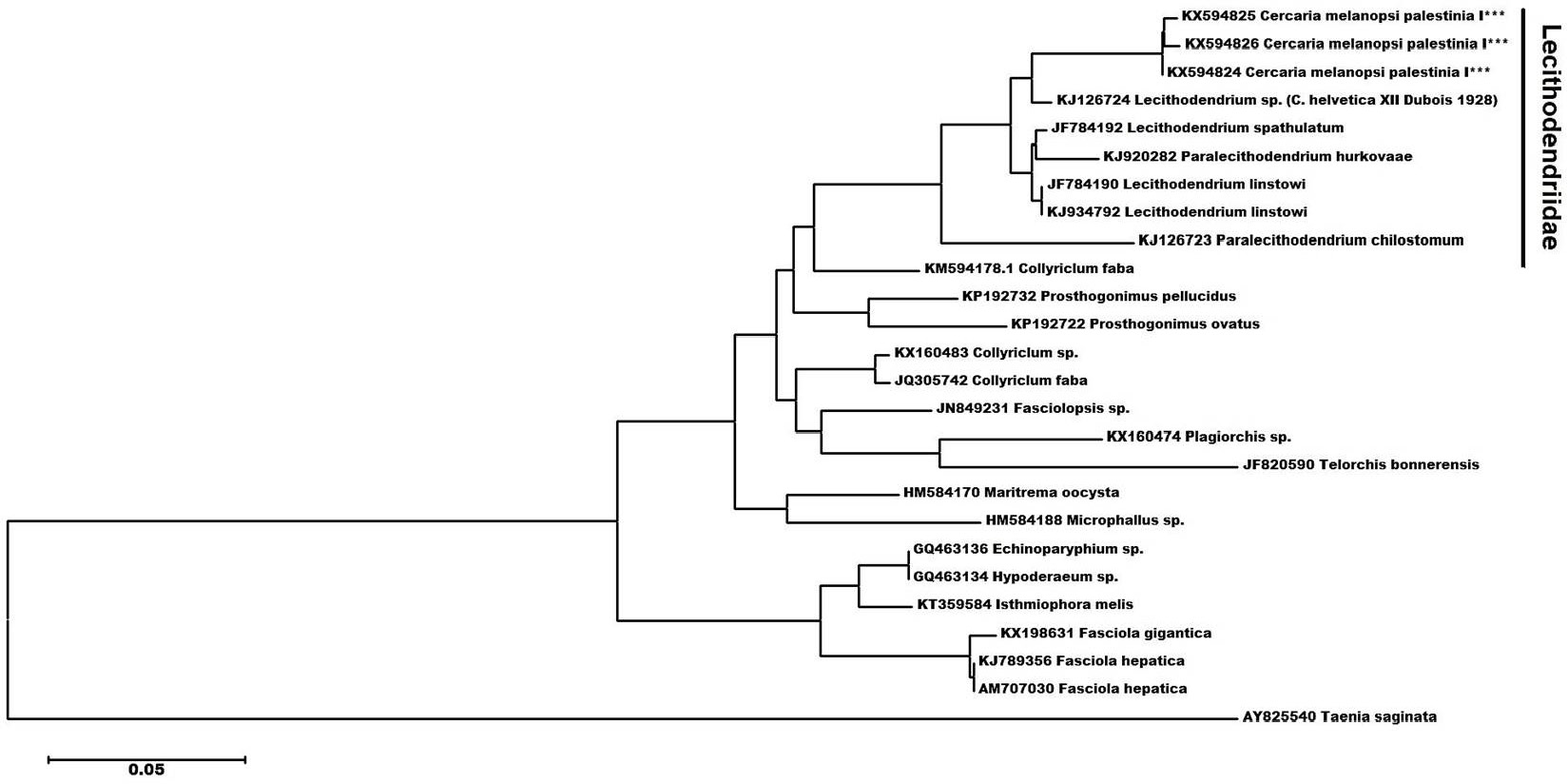
Phylogenetic analysis by Neighbor-Joining (NJ) based on ITS2 sequences. The relationship between C. melanopsi palestinia I (denoted by asterisks) and other reference sequences of digenean species from different taxa were used for phylogenetic analysis. The sequences of Taenia saginata (AY825540) used as an out-group to study phylogenetic analysis for C. melanopsi palestinia I.
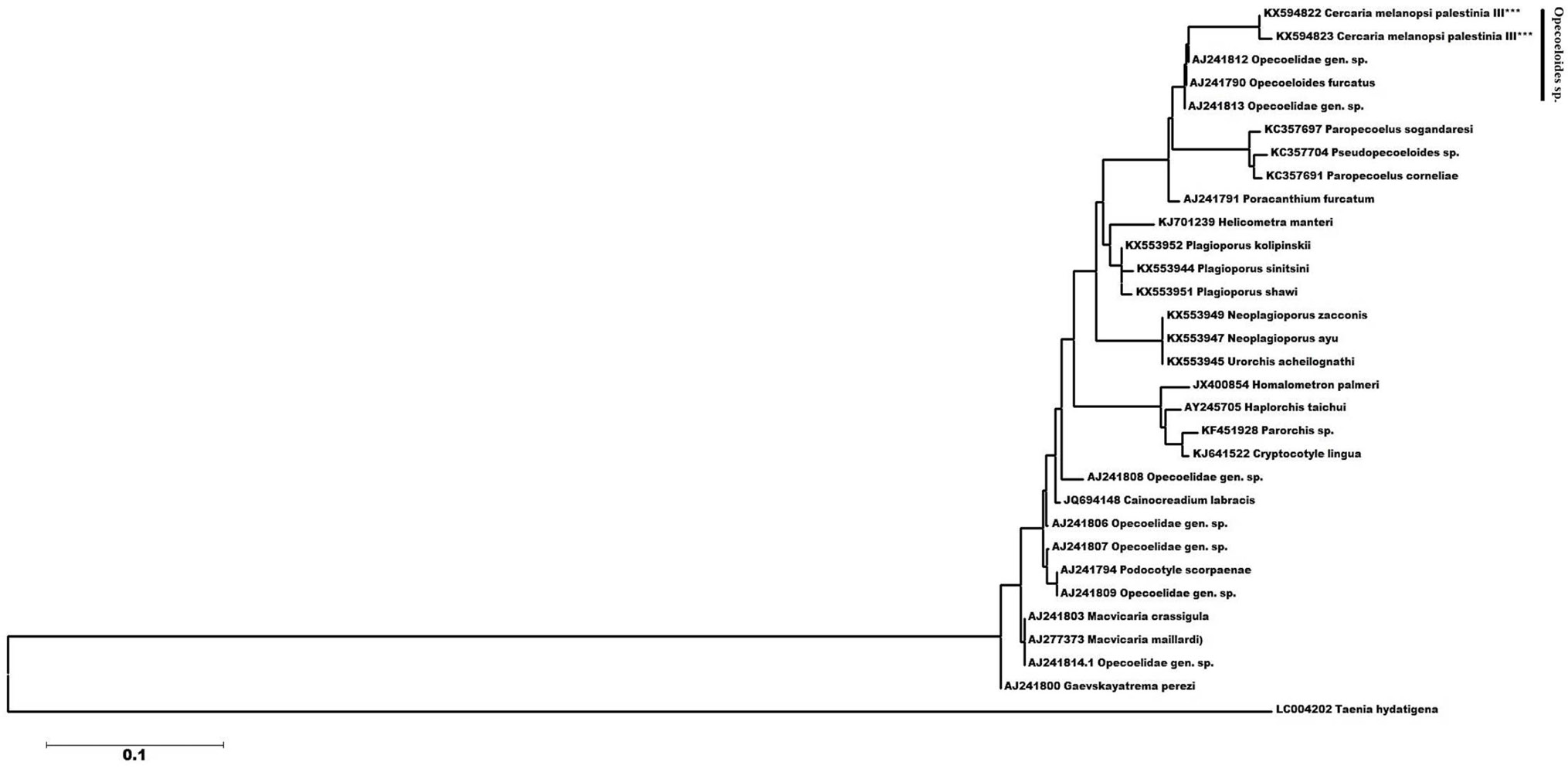
Phylogenetic analysis by Neighbor-Joining (NJ) based on ITS1 sequences. The relationship between C. melanopsi palestinia III (denoted by asterisks) and other reference sequences of digenean species from different taxa were used for phylogenetic analysis. The sequence of Taenia hydatigena (LC004202) used as an out-group to study phylogenetic analysis for C. melanopsi palestinia III.
References
- Anderson, GR., 1999. Identifications and maturation of the metacercaria of Indodidymozoon pearsoni (Digenea: Didymozoidae). J. Heminthol., 73: 21-26. https://doi.org/10.1017/S0022149X99000025[CrossRef]
- Anucherngchai, S., Tejangkura, T. and Chontananarth, T., 2016. Epidemiological situation and molecular identification of cercarial stage in freshwater snails in Chao-Phraya Basin, Central Thailand. Asian-Pac. J. trop. Biomed., 6: 539-545. https://doi.org/10.1016/j.apjtb.2016.01.015[CrossRef]
- Bdir, S. and Adwan, G., 2011. Larval stages of digenetic trematodes of Melanopsis praemorsa snails from freshwater bodies in Palestine. Asian-Pac. J. trop. Biomed., 1: 200-204. https://doi.org/10.1016/S2221-1691(11)60027-0[CrossRef]
- Bdir, S. and Adwan, G., 2012. Three new species of cercariae from Melanopsis praemorsa (L. 1758, Buccinum) snails in Al-Bathan fresh water body, Palestine. Asian-Pac. J. trop. Biomed., 2: S1064-S1069. https://doi.org/10.1016/S2221-1691(12)60362-1[CrossRef]
- Bhutta, M.S. and Khan, D., 1974. Studies on the life cycle of Ganeo micracetabulus new species (Lecithodendriidae: Trematoda). Pakistan J. Zool., 6: 111-121.
- Born-Torrijos, A., Kostadinova, A., Raga, J.A. and Holzer, A.S., 2012. Molecular and morphological identification of larval opecoelids (Digenea: Opecoelidae) parasitising prosobranch snails in a Western Mediterranean lagoon. Parasitol. Int., 61: 450-460. https://doi.org/10.1016/j.parint.2012.03.002[CrossRef]
- Bowles, J., Hope, M., Tiu, W.U., Liu, X.S. and McManus, D.P., 1993. Nuclear and mitochondrial genetic markers highly conserved between Chinese and Philippine Schistosoma japonicum. Acta Trop., 55: 217-229. https://doi.org/10.1016/0001-706X(93)90079-Q[CrossRef]
- Brabec, J., Kostadinova, A., Scholz, T. and Littlewood, D.T., 2015. Complete mitochondrial genomes and nuclear ribosomal RNA operons of two species of Diplostomum (Platyhelminthes: Trematoda): A molecular resource for taxonomy and molecular epidemiology of important fish pathogens. Parasit. Vectors, 8: 336. https://doi.org/10.1186/s13071-015-0949-4[CrossRef]
- Bray, R.A., Cribb, T.H., Littlewood, D.T. and Waeschenbach, A., 2016. The molecular phylogeny of the digenean family Opecoelidae Ozaki, 1925 and the value of morphological characters, with the erection of a new subfamily. Folia Parasitol., 63: pii: 2016.013. https://doi.org/10.14411/fp.2016.013[CrossRef]
- Brooks, D.R., Bandoni, S.M., Macdonald, C.A. and O’Grady, R.T., 1989. Aspects of the phylogeny of the Trematoda Rudolphi, 1808 (Platyhelminthes: Cercomeria). Can. J. Zool., 67: 2609-2624. https://doi.org/10.1139/z89-370[CrossRef]
- Choudhary, k., Kumar Verma, A., Swaroop, S. and Agrawal N., 2015. A review on the molecular characterization of digenean parasites using molecular markers with special reference to its region. Helminthologia, 52: 167-187. https://doi.org/10.1515/helmin-2015-0031[CrossRef]
- Chuboon, S. and Wongsawad, C., 2009. Molecular identification of larval trematode in intermediate hosts from Chiang Mai, Thailand. Southeast Asian J. trop. Med. Publ. Hlth., 40: 1216-1220.
- Cribb, T.H., Anderson, G.R., Adlard, R.D. and Bray, R.A., 1998. A DNA-based demonstration of a three-host life-cycle for the Bivesiculidae (Platyhelminthes: Digenea). Int. J. Parasitol., 28: 1791-1795. https://doi.org/10.1016/S0020-7519(98)00127-1[CrossRef]
- Dzikowski, R., Levy, M.G., Poore, M.F., Flowers, J.R. and Paperna, I., 2004. Use of rDNA polymorphism for identification of Heterophyidae infecting freshwater fishes. Dis. Aquat. Organ., 59: 35-41. https://doi.org/10.3354/dao059035[CrossRef]
- Farahnak, A., Vafaie-Darian, R. and Mobedi, I., 2006. A faunistic survey of cercariae from fresh water snails: Melanopsis spp. and their role in disease transmission. Iran. J. Publ. Hlth., 35: 70-74.
- Ismail, N.S. and Abdel-Hafez, S.K., 1983. Larval sages of digenetic tematodes of Melanopsis praemorsa (L. 1758, Bueeinum) (Thiaridae) snails from Yarmouk River, Jordan. Z. Parasitenkd., 69: 613-626. https://doi.org/10.1007/BF00926672[CrossRef]
- Ismail, N.S. and Abdel-Hafez, S.K., 1984. two new furcocercariae from melanopsis praemorsa (l., 1875) (thiaridae) snails in Azraq Oasis, Jordan. Jpn. J. Parasitol., 33: 353-359.
- Ismail, N.S. and Bdair, S.M., 1989. Two new furcocercariae from Melanopsis praemorsa (L., 1875) (Thiaridae) snails in Jordan. Helminthologia, 26: 15-20.
- Ismail, N.S., Slaiba, E.K. and Tomo, M., 1983. Studies on larval stages of digenetic trematodes of melanopsis praemorsa l. snail from Azraq Oasis, Jordan. Jpn. J. Parasitol., 32: 517-523.
- Jousson, O. and Bartoli, P., 2000. The life cycle of Opecoeloides columbellae (Pagenstecher, 1863) n. comb. (Digenea, opecoelidae): Evidence from molecules and morphology. Int. J. Parasitol., 30: 747-760. https://doi.org/10.1016/S0020-7519(00)00056-4[CrossRef]
- Jousson, O., Bartoli, P. and Pawlowski, J., 1999. Molecular identification of developmental stages in Opecoelidae (Digenea). Int. J. Parasitol., 29: 1853-1858. https://doi.org/10.1016/S0020-7519(99)00124-1[CrossRef]
- Jousson, O., Bartoli, P., Zaninetti, L. and Pawlowski, J., 1998. Use of the ITS rDNA for elucidation of some life-cycles of Mesometridae (Trematoda, Digenea). Int. J. Parasitol., 28: 1403-1411. https://doi.org/10.1016/S0020-7519(98)00117-9[CrossRef]
- Kostadinova, A. and Pérez-del-Olmo, A., 2014. The systematics of the trematoda. In: Digenetic Trematodes (eds. R. Toledo and B. Fried). Adv. exp. Med. Biol., 766: 21-44. https://doi.org/10.1007/978-1-4939-0915-5_2[CrossRef]
- Kudlai, O., Stunzenas, V. and Tkach, V., 2015. The taxonomic identity and phylogenetic relationships of Cercaria pugnax and C. helvetica XII (Digenea: Lecitho-dendriidae) based on morphological and molecular data. Folia Parasitol., 62: pii: 2015.003. https://doi.org/10.14411/fp.2015.003[CrossRef]
- Laamrani, H., Boelee, E. and Madsen, H., 2005. Trematode infection among freshwater gastropods in Tessaout Amont irrigation system, Morocco. Afri. Zool., 40: 77-82. https://doi.org/10.1080/15627020.2005.11407312[CrossRef]
- Lengy, J. and Stark, A., 1971. Studies on larval stages of digenetic trematodes in aquatic mollusks of Israel. 2. On three cercariae encountered in the freshwater snail Melanopsis praemorsa L. Israel J. Zool., 20: 41-51.
- Lord, J.S. and Brook, D.R., 2014. Bat endoparasites: A UK perspective. In: Bats (Chiroptera) as vectors of diseases and parasites facts and myths (eds. S. Kimpel and H. Mehlhorn). Springer-Verlag, Berlin, Heidelberg, pp. 63-86. https://doi.org/10.1007/978-3-642-39333-4_4[CrossRef]
- Lord, J.S., Parker, S., Parker, F. and Brooks, D.R., 2012. Gastrointestinal helminths of pipistrelle bats (Pipistrellus pipistrellus/Pipistrellus pygmaeus) (Chiroptera: Vespertilionidae) of England. Parasitology, 139: 366-374. https://doi.org/10.1017/S0031182011002046[CrossRef]
- Lotz, J.M. and Font, W.F., 2008. Family Lecithodendriidae Lühe, 1901. In: Keys to the Trematoda (eds. R.A. Bray, A. Jones and D.I. Gibson), Volume 3. CABI, Wallingford and Natural History Museum, London, pp. 527-536. https://doi.org/10.1079/9780851995885.0527[CrossRef]
- Manafov, A.A., 2008. Two new species of virgulate cercariae from the freshwater molluscs Melanopsis praemorsa (L.). Parazitologiia, 42: 467-75.
- Manafov, A.A., 2010. Trematode fauna of the freshwater mollusc Melanopsis praemorsa (L.) from water bodies of Azerbaijan. I. Cercaria rhionica II. Parazitologiia, 44: 531-542.
- Manafov, A.A., 2011a. Some results of the trematode fauna investigation in the freshwater mollusk Melanopsis praemorsa (L.) from water bodies of Azerbaijan. 2. New species of virgulate cercaria. Parazitologiia, 45: 37-49. https://doi.org/10.2478/v10058-011-0007-4[CrossRef]
- Manafov, A.A., 2011b. Some results of the study of trematode fauna of the freshwater mollusc Melanopsis praemorsa (L.) from Azerbaijan water bodies. Report 3. New species of stylet cercaria. Parazitologiia, 45: 205-219. https://doi.org/10.2478/v10058-011-0025-2[CrossRef]
- Manafov, A.A., 2011c. Some results of the study of the trematod fauna of the fresh-water molluscs Melanopsis praemorsa (L.) from water bodies in Azerbaijan. Communication 4. New species of cyathocotylid cercariae. Parazitologiia, 45: 306-316.
- Manafov, A.A., 2011d. Some results of the study of trematode fauna of the freshwater mollusc Melanopsis praemorsa (L.) from Azerbaijan water bodies. Report 5. The morphology of cercaria metagonimus sp. Parazitologiia, 45: 367-378. https://doi.org/10.2478/v10058-011-0025-2[CrossRef]
- Mohammad, M.K., 2015. The parasitic infection of the freshwater snails collected in central Iraq. Int. J. Curr. Microbiol. appl. Sci., 4: 47-55.
- Mutafova, T., Kanev, I., Pencheva, M. and Gold, D., 2001. Karyological studies on oculate and fin-tailed cercariae from Melanopsis praemorsa collected in Israel. Helminthologia, 38: 227-230.
- Nolan, M.J. and Cribb, T.H., 2005. The use and implications of ribosomal DNA sequencing for the discrimination of digenean species. Adv. Parasitol., 60: 101-163. https://doi.org/10.1016/S0065-308X(05)60002-4[CrossRef]
- Radev, V., Kanev, I., Nollen, P.M. and Gold, D., 1999. Life history and identification of Philophthalmus lucipetus from Israel. J. Parasitol., 85: 291-294. https://doi.org/10.2307/3285636[CrossRef]
- Skov, J., Kania, P.W., Dalsgaard, A., Jørgensen, T.R. and Buchmann, K., 2009. Life cycle stages of heterophyid trematode in Vietnamese freshwater fishes traced by molecular and morphometric methods. Vet. Parasitol., 160: 66-75. https://doi.org/10.1016/j.vetpar.2008.10.088[CrossRef]
- Tamura, K., Peterson, D., Peterson, N., Stecher, G., Nei, M. and Kumar, S., 2011. MEGA5: molecular evolutionary genetics analysis using maximum likelihood, evolutionary distance, and maximum parsimony methods. Mol. Biol. Evol., 28: 2731-2739. https://doi.org/10.1093/molbev/msr121[CrossRef]
- Tatonova, Y.V., Chelomina, G.N. and Besprosvannykh, V.V., 2012. Genetic diversity of nuclear ITS1-5.8S-ITS2 rDNA sequence in Clonorchis sinensis Cobbold, 1875 (Trematoda: Opisthorchidae) from the Russian Far East. Parasitol. Int., 61: 664-674. https://doi.org/10.1016/j.parint.2012.07.005[CrossRef]
- Ullman, H., 1954. Observations on a new cercaria developing in Melanopsis praemorsa in Israel. Parasitology, 44: 1-15. https://doi.org/10.1017/S0031182000018710[CrossRef]
Services
Article usage statistics
Loading…