Research Article · Volume 14, Issue 10, 18 September 2026 · Open Access
Morphometric Characteristics as Predictors of Rabbit Body Weight in Smallholder Farming Systems in Kabawetan Subdistrict, Kepahiang Regency
· · · ·
Affiliations & Notes ⌄
1Graduate School of Animal Production and Technology, Faculty of Animal Science, IPB University, Bogor 16680, Indonesia
2Department of Animal Science Faculty of Agriculture Universitas Bengkulu 38119, Indonesia
3Department of Animal Production and Technology, Faculty of Animal Science, IPB University, Bogor 16680, Indonesia
4Research Center for Animal Husbandry, Research Organization for Agriculture and Food, National Research and Innovation Agency, Bogor, 16915, Indonesia. *Correspondence | Henny Nuraini, Department of Animal Production and Technology, Faculty of Animal Science, IPB University, Bogor 16680, Indonesia
The present study demonstrated that age and breed significantly influenced body weight and several morphometric characteristics of Rex and Local rabbits under smallholder farming conditions.
Most morphometric traits showed strong positive correlations with body weight, particularly those associated with trunk development.
Based on correlation strength, biological relevance, and statistical stability, chest depth was selected as the most appropriate predictor for body weight estimation.
Therefore, chest depth is recommended as a simple, practical, and reliable phenotypic measurement method for estimating rabbit body weight in smallholder farming systems.
Selected from the article's own text.
Abstract
Morphometric measurements may provide a practical alternative for estimating rabbit body weight in smallholder farming systems where weighing equipment is not always readily available. This study aimed to evaluate the relationships between morphometric traits and body weight and to develop age-specific body weight prediction models for rabbits raised under smallholder farming conditions. A total of 107 rabbits from 32 smallholder farms in the Kabawetan Subdistrict, Kepahiang Regency, Bengkulu Province, Indonesia, comprising 48 Rex and 59 local rabbits, were evaluated. The study population consisted of 56 males and 51 females and was classified into 3-month-old (n= 43) and 6-month-old (n= 64) groups. Rabbits were maintained primarily in battery-type cages and fed mainly forage and vegetables. Body weight and 14 morphometric traits were analyzed using descriptive statistics, General Linear Model (GLM), Pearson correlation with 95% confidence intervals, Principal Component Analysis (PCA), and regression analysis. Age significantly affected body weight and all morphometric traits (P < 0.001), while breed significantly influenced body weight and several morphometric measurements. Mean body weight increased from 901.00 ± 96.87 g at 3 months to 1,950.02 ± 107.52 g at 6 months. Chest depth showed the strongest positive correlation with body weight at both ages (3 months: r= 0.992, 95% CI= 0.985–0.996; 6 months: r= 0.990, 95% CI= 0.983–0.994; P < 0.001). PCA confirmed substantial common variation among morphometric traits, with KMO values of 0.827 and 0.890 for the 3- and 6-month groups, respectively (Bartlett’s test, P < 0.001). Chest depth was retained as the single predictor in the final models: BW= −466.29 + 181.07(CD) for 3-month-old rabbits and BW= 109.07 + 175.90(CD) for 6-month-old rabbits. Both models yielded R²= 0.98 and VIF= 1.00, with coefficient standard errors of 12.47 and 15.02, RMSE values of 92.56 and 100.96 g, and MAE values of 73.91 and 85.68 g, respectively. These findings indicate that chest depth has the potential to be a simple and practical morphometric predictor of rabbit body weight under the smallholder farming conditions studied here. However, external validation is required for broader applications.
Rabbit production has gained increasing attention as an alternative livestock system owing to the biological advantages of rabbits, including rapid reproductive performance, short generation intervals, efficient feed utilization, and relatively low space requirements compared with larger livestock species . These characteristics make rabbits suitable for smallholder farming systems, particularly in regions where farmers have limited land resources and require livestock with relatively low production inputs. In addition to meat production, rabbit farming contributes to livelihood diversification and provides an alternative source of animal protein .
In Indonesia, rabbit farming is mainly conducted under smallholder conditions with diverse management practices. However, the development of rabbit production is constrained by limited information regarding growth evaluation and selection methods . Body weight is one of the most important indicators of the growth performance and production potential of meat rabbits. Accurate determination of body weight is essential for evaluating growth, determining market readiness, and supporting selection decisions in breeding programs . Nevertheless, direct weighing requires appropriate equipment and regular handling, which may not always be possible in smallholder farming systems.
Morphometric measurements provide a potential alternative approach for estimating body weight because they are simple, inexpensive, and can be performed without sophisticated equipment. Several studies on livestock have demonstrated that linear body measurements are associated with live body weight and can be used to develop prediction models ; ; . In rabbits, previous studies have reported positive relationships between body weight and morphometric traits, such as chest circumference, body length, head measurements, and pelvic width. These findings indicate that body measurements may provide useful information for estimating growth performance.
Although morphometric-based prediction models have been developed for several rabbit populations, the relationship between body measurements and body weight may vary depending on breed, age, genetic background, environmental conditions, and management systems. Therefore, prediction models developed for one population cannot be directly applied to other populations without validation. Previous studies have shown that different morphometric traits may become important predictors depending on the evaluated breeds and production environments ; ; Zapl et al., 2020). For example, chest circumference and body length have been identified as important predictors in some rabbit populations, whereas other studies have reported different influential traits.
In Indonesia, information regarding the relationship between morphometric characteristics and body weight of rabbits, particularly under smallholder farming conditions, remains limited. Existing studies have mainly focused on the morphological characterization and genetic relationships among rabbit populations, whereas studies evaluating the predictive ability of specific morphometric traits for body weight estimation are still relatively scarce. Furthermore, environmental variation among farms, differences in management practices, and variation between breeds may influence the association between morphometric traits and body weight.
Kepahiang Regency, Bengkulu Province, represents an area where rabbit farming is conducted by smallholder farmers. However, information regarding rabbit growth characteristics and practical methods for estimating body weight in this production system remains limited. Therefore, evaluation of morphometric traits in rabbits raised under local farming conditions is important to provide baseline information for growth assessment and future selection programs.
Among the various morphometric measurements, chest depth may represent an important body dimension because it reflects thoracic development and overall body conformation . However, the biological and practical relevance of chest depth as a predictor of body weight requires careful evaluation because a high phenotypic correlation does not necessarily indicate genetic superiority or direct suitability as a selection criterion. Therefore, statistical evaluation using correlation analysis, multivariate approaches, and validated prediction models is necessary before recommending any morphometric traits for practical application .
This study aimed to evaluate the relationship between morphometric traits and body weight in Rex and Local rabbits at different growth stages in smallholder farming systems in the Kepahiang Regency. Specifically, this study investigated the effects of breed and age on morphometric characteristics, identified morphometric traits associated with body weight, and developed a predictive model for estimating body weight based on body measurements. These findings are expected to provide scientific information regarding the potential application of morphometric measurements for rabbit growth evaluation under local farming conditions.
MATERIALS AND METHODS
Location and time of research
The study was conducted in the Kabawetan Subdistrict, Kepahiang Regency, Bengkulu Province, Indonesia, an area characterized by highland environmental conditions and smallholder rabbit production. The study area is located approximately 1,000–1,200 m above sea level and has relatively cool and humid environmental conditions. The rabbit farms included in the study were managed by smallholder farmers using their existing production systems. Data collection was conducted from October to December 2025. The study involved rabbits raised by 32 smallholder farmers in the study area.
Animals and study design
A total of 107 rabbits from 32 smallholder farms were included in this study. The rabbits consisted of 48 Rex rabbits and 59 local rabbits. Based on age, the animals were classified into two groups: 43 rabbits aged 3 months and 64 rabbits aged 6 months. The sex of each rabbit was recorded to determine the composition of the study population. The 3-month-old group consisted of 22 males and 21 females, whereas the 6-month-old group consisted of 34 males and 30 females, resulting in a total of 56 males and 51 females. This study employed an observational quantitative design. Individual rabbits were considered as observational units. A total sampling approach was applied to all accessible rabbits within the participating farms that met the predetermined inclusion criteria. This approach was used to maximize the representation of the available rabbit population under smallholder farming conditions and to avoid selecting animals based on body weight or body size.
The inclusion criteria were as follows: (1) rabbits belonging to the Rex or Local population; (2) rabbits aged approximately 3 or 6 months with reliable age information; (3) apparently healthy animals at the time of measurement; and (4) animals without visible physical abnormalities that could interfere with body weight or morphometric measurements. Sex was recorded for descriptive purposes but was not included as a factor in the statistical models because the primary objective of the study was to evaluate the effects of breed, age, and breed × age interaction on body weight and morphometric characteristics.
Breed classification
Two rabbit populations were evaluated: Rex and Local rabbits. Rex rabbits were identified according to breed information available from the participating farmers. Local rabbits were defined as rabbits identified by farmers as local based on available farm information and phenotypic characteristics. Because pedigree records and molecular genetic characterization were not available, the local group was considered a phenotypically defined local population rather than a genetically verified breed. Therefore, this classification was used to describe phenotypic differences between the two populations under smallholder farming conditions, and was not intended to establish genetic purity or breed ancestry.
Farm management and animal health
General farm management information was obtained through direct observation and interviews with the participating farmers. The rabbits were maintained in battery-type cages. The feed consisted primarily of forage and vegetables. The reported weaning age ranged from 25 to 30 days, and the reported litter size ranged from five to eight kits per litter. Cage dimensions were not recorded because the study focused on individual rabbit body weights and morphometric characteristics, rather than on evaluating housing dimensions. Nevertheless, cage type and principal feed categories were recorded to describe the production environment. Because the animals originated from 32 smallholder farms, variations in feeding practices, feed quantity, housing management, health management, and other farm-level environmental factors were not experimentally controlled. Therefore, these differences were considered part of the environmental conditions represented by the study population. Before measurement, each rabbit underwent a visual health assessment. Only rabbits that appeared clinically healthy and had no visible physical abnormalities were included in this study.
Tools and materials
The equipment used included a digital weighing scale with 1 g accuracy, measuring tape, digital caliper, and digital camera. A digital weighing scale was used to determine body weight, while measuring tape and a digital caliper were used for morphometric measurements. Data were recorded and tabulated using Microsoft Excel 2021 and statistically analyzed using IBM SPSS Statistics version 25.
Body weight and morphometric measurements
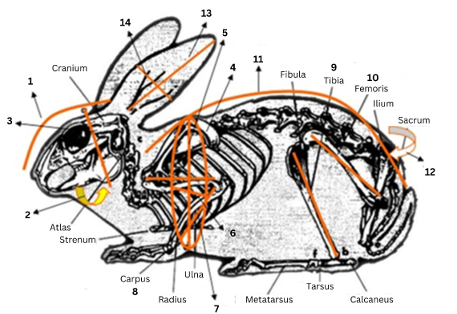
Body weight was measured individually using a digital weighing scale with an accuracy of 1 g and recorded in grams (g). Fourteen morphometric traits were measured according to the Body Size Framework described by Brahmantiyo et al. (2006) including Figure 1.
The following measurements were taken: head length (1), head width (2), head height (3), chest circumference (4), chest depth (5), chest width (6), humerus length (7), radius ulna length (8), tibia length (9), femur length (10), backbone length (11), pelvic bone width (12), ear length (13), and ear width (14) according to the character being measured. Measurements were carried out using a measuring tape and caliper in centimeters (cm) according to the character being measured.
Measurement procedure and repeatability
All measurements were performed by a trained observer using standardized anatomical landmarks and the same measurement procedures for all rabbits. The use of a single observer was intended to minimize variation associated with differences in measurement techniques among observers. Each body weight and morphometric measurement was performed twice for each rabbit. Two measurements were used to reduce the influence of random measurement errors, and the arithmetic mean of the two measurements was used for statistical analysis. The rabbits were positioned as consistently as possible during the measurement, and predefined anatomical landmarks were followed for each morphometric trait. Measurements were conducted directly at the participating farms. Because data collection followed field conditions and farm accessibility, measurements were not restricted to a specific time of the day. Similarly, the measurement schedule was not standardized according to a fixed interval relative to feeding. Formal interobserver reliability testing was not performed because all measurements were conducted by a single observer. Duplicate measurements were used to reduce random measurement error; however, a formal intra-observer reliability coefficient was not calculated.
Research variables
The variables evaluated in this study were body weight, breed, age, and morphometric characteristics. Body weight (BW) was measured as the primary quantitative characteristic of the rabbits and was expressed in grams (g). Rabbits were classified by breed into Rex and Local breeds, and by age into 3-month and 6-month age groups. The interaction between breed and age was also considered in the analysis to determine whether the effects of age on body weight and morphometric characteristics differed across breeds. Morphometric characteristics comprised 14 quantitative traits based on Figure 1. These traits were measured individually for each rabbit and expressed in centimeters (cm). In the subsequent correlation, Principal Component Analysis (PCA), and regression analyses, the influence of these morphometric traits on body weight was evaluated to determine phenotypic associations, patterns of morphometric variation, and their potential contribution to predicting body weight.
Statistical analysis
Data were tabulated using Microsoft Excel 2021 and analyzed using IBM SPSS Statistics version 25. Descriptive statistics, including mean, standard deviation and coefficient of variation (CV), were used to describe body weight and morphometric traits. The effects of breed, age, and breed × age interaction on body weight and morphometric traits were analyzed using a General Linear Model (GLM), followed by estimated marginal means with Bonferroni adjustment when significant effects were detected. Pearson correlation analysis was performed separately for 3- and 6-month-old rabbits to evaluate the linear relationships between body weight and morphometric traits, with correlation coefficients, 95% confidence intervals, and P-values reported. Principal Component Analysis (PCA) was used to describe the major patterns of variation among morphometric traits, with data adequacy assessed using the Kaiser–Meyer–Olkin (KMO) measure and Bartlett’s test of sphericity. Multiple linear regression with stepwise selection was performed separately for each age group to identify candidate morphometric predictors of body weight, while multicollinearity was assessed using tolerance and variance inflation factor (VIF). Model performance was evaluated using adjusted regression coefficients, standard errors, RMSE, and MAE.
RESULTS AND DISCUSSION
General characteristics of rabbits in smallholder farming systems
The descriptive characteristics of body weight and morphometric traits of Rex and Local rabbits reared under smallholder farming systems are presented in Table 1. A total of 107 rabbits were evaluated, consisting of two age groups, namely 3-month-old and 6-month-old rabbits. The results showed a clear increase in body weight and morphometric measurements with increasing age. The average body weight increased from 901.00 ± 96.87 g at 3 months to 1,950.02 ± 107.52 g at 6 months, indicating substantial growth during the evaluated period.
The increase in body weight was accompanied by proportional increases in almost all morphometric traits. At 3 months, chest depth, chest circumference, and backbone length were 7.55 ± 0.53 cm, 20.98 ± 1.14 cm, and 24.18 ± 1.14 cm, respectively. These measurements increased to 10.47 ± 0.61 cm, 27.83 ± 1.12 cm, and 35.71 ± 1.20 cm at 6 months. This pattern demonstrates that body weight gain is associated with overall body development, particularly expansion of trunk dimensions.
Table 1: Morphometric characteristics and body weight of smallholder farm rabbits in Kabawetan District.
Parameter
3 Months
6 Months
Mean ± SD
CV (%)
Mean± SD
CV (%)
Body weight (g)
901.0±96.87
10.75
1950.02 ± 107.52
5.51
Head length (cm)
6.99±0.48
6.85
8.46 ± 0.51
6.08
Head width (cm)
5.60 ± 0.34
6.14
7.22 ± 0.41
5.62
Head height (cm)
4.07±0.22
5.43
5.97 ± 0.54
9.00
Chest circumference (cm)
20.98±1.14
5.44
27.83±1.12
4.04
Chest depth (cm)
7.55 ± 0.53
7.03
10.47±0.61
5.78
Chest width (cm)
6.03 ± 0.44
7.26
8.17 ± 0.42
5.13
Humerus length (cm)
8.17 ± 0.73
8.92
10.06±0.59
5.84
Radius ulna length (cm)
8.27 ± 0.74
8.99
10.82±0.70
6.51
Tibia length (cm)
8.56 ± 0.82
9.56
9.80 ± 0.72
7.31
Femur length (cm)
8.40 ± 0.81
9.63
12.49±1.02
8.18
Backbone length (cm)
24.18±1.14
4.73
35.71±1.20
3.35
Pelvic width (cm)
5.43 ± 0.45
8.28
7.26 ± 0.38
5.22
Ear length (cm)
9.13 ± 0.67
7.37
12.36±0.66
5.31
Ear width (cm)
4.03 ± 0.07
1.80
4.86 ± 0.35
7.22
Note: Note: Values are expressed as mean ± SD. CV = coefficient of variation; BW = body weight (g); all morphometric traits are expressed in cm.
The coefficient of variation (CV) values indicated differences in morphological variation between the age groups. The CV of body weight decreased from 10.75% at 3 months to 5.51% at 6 months, suggesting that body size became more uniform as the rabbits approached maturity. Similar reductions in variation were observed for several morphometric traits, including chest circumference, chest depth, chest width, backbone length, and ear length. This reduction in variation with age may reflect a more stable growth pattern in older rabbits. During the early growth phases, differences in genetic potential, nutritional availability and farm management may contribute to greater variation among individuals. As animals mature, differences in body conformation tend to become less pronounced because growth trajectories become more consistent. Previous studies have also indicated that body measurements are strongly associated with growth performance and can provide useful information for evaluating production potential in rabbits ; .
Under smallholder farming conditions, direct measurement of body weight may be constrained by the limited availability of weighing equipment. Therefore, identifying easily measurable morphometric characteristics that reflect body development is important for practical growth evaluation. Morphometric measurements provide a simple and inexpensive alternative approach because they can be collected directly in the field without requiring specialized equipment ; .
Effect of breed and age on morphometric characteristics
The effects of breed, age, and breed × age interactions on body weight and morphometric characteristics are presented in Table 2. Age significantly affected body weight and all measured morphometric traits (P < 0.001), indicating that growth stage was the dominant factor influencing morphological development. Breeds significantly affected body weight and several morphometric traits, including head width, head height, chest circumference, chest depth, chest width, backbone length, pelvic width, and ear length.
Table 2: Effect of breed, age, and their interaction on body weight and morphometric characteristics.
Parameter
P-Age
P- Breed
P-Breed x Age
Body weight (g)
<0.001
<0.001
0.62
Head length (cm)
<0.001
0.24
0.12
Head width (cm)
<0.001
<0.001
0.29
Head height (cm)
<0.001
0.03
0.21
Chest circumference (cm)
<0.001
<0.001
0.79
Chest depth (cm)
<0.001
<0.001
0.32
Chest width (cm)
<0.001
<0.001
0.9
Humerus length (cm)
<0.001
0.08
0.29
Radius ulna length (cm)
<0.001
0.30
0.31
Tibia length (cm)
<0.001
0.88
0.01
Femur length (cm)
<0.001
0.35
0.03
Backbone length (cm)
<0.001
<0.001
0.62
Pelvic width (cm)
<0.001
<0.001
0.44
Ear length (cm)
<0.001
<0.001
0.81
Ear width (cm)
<0.001
0.04
0.12
Note: P-Age = effect of age, P-Breed = effect of breed, P-Breed x Age = interaction of age × breed. P < 0.05 indicates a significant effect, P ≥ 0.05 indicates no significant effect, P < 0.01 indicates a highly significant effect, and P < 0.001 indicates a highly significant effect with a higher level of significance.
The significant effect of age on all traits reflected the biological growth process of rabbits. Increasing age is accompanied by progressive increases in body weight and dimensions as skeletal structures and tissues develop. Similarly, previous studies reported substantial increases in rabbit body weight during post-weaning growth and differences in growth trajectories among rabbit genetic groups ; . Therefore, the observed increases in chest depth, chest circumference, and backbone length in the present study reflect the overall enlargement of body dimensions during growth.
The breed differences observed in this study indicate phenotypic variation between Rex and Local rabbits. Such variation among rabbit populations is consistent with previous studies showing that genetic groups or breeds can influence body size, morphometric characteristics, growth performance, and carcass-related traits. Brahmantiyo et al. (2021) reported differences in morphometric dimensions among Hycole, Hyla, and New Zealand White rabbits, whereas Sanah et al. (2023) found that a synthetic rabbit line generally exhibited larger morphometric measurements than a local population. Zapletal et al. (2020) also demonstrated differences in growth and body characteristics associated with rabbit crossbreeding. Therefore, differences in genetic background and population history may partly contribute to the phenotypic variation observed between Rex and Local rabbits in the present study.
However, the breed × age interaction was not significant for most traits, suggesting that the general pattern of age-related morphological development was broadly similar between the two populations. This interpretation should be made cautiously because the present study did not estimate genetic parameters, and the local rabbits were phenotypically classified rather than genetically verified. Consequently, the observed breed effects should be interpreted primarily as phenotypic differences between the evaluated populations rather than direct evidence of genetic superiority.
Nevertheless, variations among smallholder farms should also be considered because feeding and housing conditions can influence rabbit growth performance. Birolo et al. (2020) demonstrated that feeding restriction altered the daily weight gain and final live weight of growing rabbits, whereas Krunt et al. (2022) reported differences in live weight, weight gain, and feed intake between rabbits maintained under different housing systems. Therefore, the variation in feeding, housing, and other management practices among the 32 smallholder farms in the present study may have contributed to the observed phenotypic variation and should be considered when interpreting the results.
Morphometric relationship with body weight
Pearson’s correlation analysis between morphometric traits and body weight is presented in Table 3. The results demonstrated that several morphometric traits exhibited strong positive relationships with body weight in both age groups. Similar positive phenotypic associations between body weight and linear body measurements have been reported in rabbits, although the magnitude of the correlations may vary according to age and genetic group ; . Udoh (2021) reported phenotypic correlations ranging from weak to very strong across different age periods, whereas Obasi et al. (2023) reported correlations reaching approximately 0.97–0.98 in some rabbit genotypes and growth stages.
Table 3: Morphometric correlation test with body weight.
Parameter
3 months: r
95% CI
P-Value
6 months: r
95% CI
P-Value
Head length (cm)
0.006
-0.295 – 0.306
0.970
0.082
-0,164 – 0,321
0.522
Head width (cm)
0.982
0,967 – 0,990
<0,001
0.987
0,978 – 0,992
<0,001
Head height (cm)
0.086
-0,220 – 0,376
0.584
0.090
-0,156 – 0,328
0.481
Chest circumference (cm)
0.990
0.981–0.995
<0,001
0.987
0,978 – 0,992
<0,001
Chest depth (cm)
0.992
0.985–0.996
<0,001
0.990
0,983 – 0,994
<0,001
Chest width (cm)
0.990
0.981–0.995
<0,001
0.986
0,976 – 0,992
<0,001
Humerus length (cm)
0.038
-0,265 – 0,335
0.809
0.194
-0,053 – 0,423
0.124
Radius ulna length (cm)
0.046
-0,258 – 0,342
0.768
0.056
-0,191 – 0,299
0.658
Tibia length (cm)
-0.124
-0,409 – 0,183
0.428
0.090
-0,156 – 0,328
0.481
Femur length (cm)
-0.241
-0,505 – 0,064
0.119
0.114
-0,132 – 0,351
0.369
Backbone length (cm)
0.988
0,978 – 0,994
<0,001
0.985
0,974 – 0,991
<0,001
Pelvic width (cm)
0.987
0,976 – 0,993
<0,001
0.984
0,973 – 0,991
<0,001
Ear length (cm)
0.988
0,978 – 0,994
<0,001
0.983
0,971 – 0,990
<0,001
Ear width (cm)
0.101
-0,206 – 0,390
0.518
0.100
-0,146 – 0,337
0.433
Note: Pearson’s correlation coefficient; CI = confidence interval. P < 0.05 indicates a significant correlation with body weight.
Table 4: PCA suitability test and variance explained.
Age
PC
KMO
Bartlett test
Eigenvalue
Variance (%)
Cumulative (%)
3 Months
PC 1
0.827
<0.001
7.026
50.187
50.187
PC 2
3.447
24.624
74.811
PC 3
1.032
7.370
82.181
6 Months
PC 1
0.890
<0.001
7.635
54.535
54.535
PC 2
5.976
42.683
97.218
Note: KMO = Kaiser–Meyer–Olkin measure; PC = principal component. Variance explained represents the proportion of total morphometric variation accounted for by each component.
Among all measured traits, chest depth (CD) showed the strongest correlation with body weight, with correlation coefficients of r= 0.992 in 3-month-old and r= 0.990 in 6-month-old rabbits (P < 0.001). Other trunk-related measurements, including chest circumference, chest width, backbone length, and pelvic width, also showed strong correlations with body weight. This finding is consistent with that of Setiaji et al. (2023), who reported that chest circumference, chest depth, and chest width were particularly informative body dimensions for predicting rabbit body weight.
The strong association between chest depth and body weight may be related to the fact that chest depth represents a part of the overall chest shape and trunk conformation. Chest-related measurements reflect broader changes in body dimensions during growth rather than an isolated skeletal segment. Similarly, Setiaji et al. (2023) found that chest dimensions were more informative for body weight prediction than body length in several rabbit body types. However, this association should be interpreted as a phenotypic relationship rather than direct evidence of biological causation or genetic superiority.
However, several traits showed weak or non-significant correlations with body weight. Head length, head height, humerus length, radius-ulna length, tibia length, femur length, and ear width showed relatively low correlation coefficients in both age groups. Variation in the strength of morphometric associations has also been previously reported. Udoh (2021) found that phenotypic correlations varied substantially across age periods, whereas Obasi et al. (2023) reported that some traits and genotypes exhibited weak or even non-significant relationships with body weight.
The high correlations among several morphometric traits may also indicate substantial redundancy among measurements representing overall body size. When highly correlated predictors are simultaneously included in a regression model, multicollinearity can inflate coefficient variances and reduce the stability and interpretability of individual regression coefficients . Therefore, although chest depth, circumference, width, and backbone length individually showed strong associations with body weight, their simultaneous inclusion should be carefully evaluated using multicollinearity diagnostics.
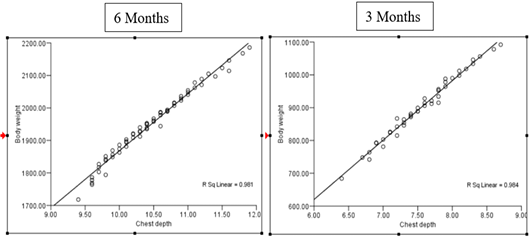
The relationship between chest depth and body weight is illustrated in Figure 2. The scatter plot demonstrated a clear positive linear association between chest depth and body weight, supporting its potential as a morphometric predictor within the population evaluated in the present study. This result is consistent with previous rabbit studies demonstrating the usefulness of morphometric measurements for body weight prediction, although the most informative predictor may differ among populations. For example, Setiaji et al. (2023) highlighted chest dimensions, whereas Brahmantiyo et al. (2025) identified chest circumference and body length as major predictors in a multi-breed rabbit population.
Principal component analysis (PCA)
Principal Component Analysis (PCA) was performed to summarize the variation among correlated morphometric traits and to evaluate the underlying structure of body measurements. PCA is commonly used to reduce the dimensionality of correlated variables while retaining as much of the original variation as possible through a smaller set of uncorrelated components . The suitability of the data for PCA was assessed using the Kaiser–Meyer–Olkin (KMO) measure and Bartlett’s test of sphericity (Table 4). The datasets yielded KMO values of 0.827 for 3-month-old and 0.890 for 6-month-old rabbits, whereas Bartlett’s test was significant (P < 0.001) for both age groups. KMO values in the range of 0.80–0.89 indicate good sampling adequacy for factor-based analyses, while a significant Bartlett’s test indicates that the correlation matrix differs significantly from an identity matrix and therefore contains sufficient intercorrelation for dimension reduction .
The PCA results showed that PC1 represented a substantial proportion of the total morphometric variation. In 3-month-old rabbits, PC1 had an eigenvalue of 7.026 and explained 50.187% of the total variation, whereas in 6-month-old rabbits, PC1 had an eigenvalue of 7.635 and explained 54.535%. Similar applications of PCA in rabbit morphometric studies have demonstrated that major principal components can represent the common dimensions of body size and conformation. Yakubu and Ayoade (2009), for example, identified the first principal component representing general body size in domestic rabbits, while subsequent rabbit studies have also used PCA to characterize interdependence among body measurements and reduce correlated morphometric information.
The high contribution of PC1 in the present study suggests that several morphometric traits changed together as part of a common body size component. Such common variations among morphometric measurements are important because highly correlated linear measurements may provide overlapping information when simultaneously entered into regression models. PCA is particularly useful in this situation because it transforms correlated variables into mutually uncorrelated components, thereby reducing the problems associated with multicollinearity ; . Gouda et al. (2015) similarly demonstrated the usefulness of PCA for correlated rabbit body measurements and specifically noted its value in avoiding multicollinearity when morphometric traits were incorporated into prediction models.
Loading factor analysis (Table 5) showed that several trunk-related measurements were strongly represented within the common morphometric component. Chest depth showed loading values of 0.997 in 3-months old rabbits and 0.995 in 6-months old rabbits, while chest circumference, chest width, backbone length, and pelvic width also showed high loading. These high and similar loading values should primarily be interpreted as evidence that the traits share substantial common variation, rather than as proof that any single measurement is biologically superior. Previous rabbit studies have similarly shown that chest-related dimensions tend to vary within principal components. Gouda et al. (2015) reported that chest width, loin width, chest girth, and chest depth jointly contribute to a principal component representing trunk dimensions.
Table 5: Loading factor of morphometric traits.
Variable
3 Months
6 Months
PC1
PC2
PC3
PC1
PC2
Head length (cm)
0.592
0.991
Head width (cm)
0.984
0.994
Head height (cm)
0.646
0.994
Chest circumference (cm)
0.996
0.994
Chest depth (cm)
0.997
0.995
Chest width (cm)
0.996
0.993
Humerus length (cm)
0.890
0.900
Radius ulna length (cm)
0.859
0.977
Tibia length (cm)
0.599
0.994
Femur length (cm)
0.839
0.965
Backbone length (cm)
0.994
0.994
Pelvic width (cm)
0.994
0.996
Ear length (cm)
0.994
0.994
Ear width (cm)
0.770
0.985
Note: PC= principal component. Factor loadings represent the strength and direction of the association between each morphometric trait and the corresponding principal component.
Furthermore, Setiaji et al. (2023) reported that chest circumference, chest depth, and chest width were informative morphometric dimensions in rabbits, although the components on which individual traits were loaded differed among rabbit body types. This finding highlights that the PCA structure can vary among populations and that a high loading should be interpreted within the specific dataset rather than as universal evidence of biological importance.
Therefore, in the present study, chest depth was retained as a representative predictor not only because of its high PC1 loading but also because it combined a strong association with body weight, representation of the shared trunk-size component, and a more parsimonious structure after multicollinearity reduction. Selecting a representative trait instead of simultaneously including several highly correlated body measurements can improve model interpretability and reduce unstable regression coefficients caused by multicollinearity .
Body weight prediction model
Body weight prediction models were developed by integrating the results of the correlation analysis, PCA, and multicollinearity assessment. Although several morphometric traits were strongly associated with body weight, the high correlations and PCA loadings indicated that many of these measurements represented overlapping aspects of overall body size. Including several highly correlated morphometric variables simultaneously in a regression model may therefore produce unstable regression coefficients and reduce model interpretability because of multicollinearity. Consequently, chest depth (CD) was retained as a parsimonious predictor because it showed the strongest association with body weight in both age groups and represented an important dimension of trunk development. Previous studies have also demonstrated that chest-related measurements, including chest circumference, depth, and width, provide useful information for estimating body weight in rabbits, although the most informative traits may differ among populations and body types ; .
The regression analysis produced two age-specific equations: BW= −466.29 + 181.07(CD) for 3-month-old rabbits and BW= 109.07 + 175.90(CD) for 6-month-old rabbits. Both models yielded a coefficient of determination of R² = 0.98, indicating a strong relationship between chest depth and body weight within the evaluated population. The positive regression coefficients indicated that an increase in chest depth was associated with an increase in body weight within the observed measurement range. This relationship is biologically plausible because chest depth reflects the development of the thoracic and trunk regions, which occurs concurrently with skeletal growth, muscle deposition, and increasing overall body mass. Similar associations between chest-related dimensions and body weight have been previously reported in rabbits . Nevertheless, the high R² values should be interpreted cautiously because goodness of fit within the model development dataset does not necessarily demonstrate predictive performance in independent populations. Brahmantiyo et al. (2025), for example, reported an R² of 0.82 for a linear regression model developed from morphometric measurements of multiple rabbit breeds, indicating that model performance may vary according to population structure, breed composition, and production environment.
The initial evaluation of multiple morphometric predictors showed substantial multicollinearity, which was consistent with the strong correlations and high PCA loadings observed for chest circumference, chest depth, chest width, backbone length, and pelvic width. These variables largely represented a common overall body size component and therefore provided overlapping predictive information. In the final single-predictor model, the variance inflation factor was 1.00. However, this value should be interpreted carefully because a VIF of 1.00 is expected when only one predictor is included in a regression model, as no additional predictor is present with which chest depth could be collinear. Thus, the VIF value does not independently establish the biological superiority of chest depth; rather, the single-predictor approach provides a simpler alternative to including several highly correlated measurements simultaneously. The importance of assessing collinearity when morphometric variables are used for rabbit body weight prediction has also been emphasized in previous regression studies .
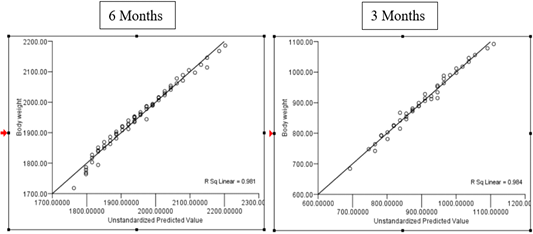
Model performance was further evaluated using the root mean squared error (RMSE) and mean absolute error (MAE). For 3-month-old rabbits, the model yielded an RMSE of 92.56 g and an MAE of 73.91 g, whereas the corresponding values for 6-month-old rabbits were 100.96 g and 85.68 g, respectively. These values describe the magnitude of the deviations between the observed and predicted body weights within the study population and provide additional information beyond R². The relationship between the observed and predicted body weights is illustrated in Figure 3, where both age groups showed a close agreement between the fitted and observed values. However, because these comparisons were based on the same population used to develop the equations, the observed-versus-predicted plots represent a within-sample model fit rather than an independent model validation. Therefore, the present RMSE, MAE, and R² values should be interpreted as measures of model performance within the studied population.
Overall, chest depth provided a parsimonious representation of the strong body size information shared among several morphometric traits. Other measurements, including chest circumference, chest width, backbone length, and pelvic width, were also strongly associated with body weight, but contributed largely to overlapping information. The use of chest depth as a single predictor may therefore reduce the number of measurements required for body weight estimation and simplify field applications when weighing equipment is not readily available. Nevertheless, the present findings do not establish that chest depth can be measured with sufficient repeatability by different farmers or that the equations will retain similar predictive performance in other rabbit populations. Accordingly, chest depth should be considered a potential morphometric predictor within the studied smallholder population, and external validation across different breeds, farms, management systems, and geographical areas is required before the equations can be recommended for broader practical applications.
Table 6: Regression model for estimating rabbit body weight based on morphometric characteristics.
Age
Equation
R²
SE coefficient
VIF
RMSE (g)
MAE (g)
3 months
BW= -466.29+ 181.07 (CD)
0.98
12.47
1.00
92.56
73.91
6 months
BW= 109.07+ 175.90 (CD)
0.98
15.02
1.00
100.96
85.68
Note: BW= body weight (g); CD= chest depth (cm); R²= coefficient of determination; SE = standard error; VIF= variance inflation factor; RMSE= root mean squared error; MAE= mean absolute error.
Study limitations
Several limitations of this study should be considered when interpreting the results. First, the study was conducted under smallholder farming conditions and involved rabbits from multiple farms. Although this approach reflects real production conditions, differences in management practices, feeding systems, housing conditions, and environmental factors may contribute to variations in growth performance. Second, the prediction models were developed using rabbits from the evaluated population; therefore, additional validation using independent rabbit populations from different geographical areas is recommended before wider application. External validation is necessary to confirm whether the developed equations maintain similar accuracy under different management and environmental conditions. Third, this study focused on external morphometric measurements as predictors of body weight. Additional factors, such as nutritional status, genetic background, and physiological characteristics, may also influence body weight variation but were not included in the current prediction model.
Despite these limitations, our findings provide useful information for practical body weight estimation in smallholder rabbit production systems. The high predictive performance of the chest depth-based model suggests that simple morphometric measurements can be effectively utilized as an alternative approach when weighing facilities are unavailable.
CONCLUSION
The present study demonstrated that age and breed significantly influenced body weight and several morphometric characteristics of Rex and Local rabbits under smallholder farming conditions. Most morphometric traits showed strong positive correlations with body weight, particularly those associated with trunk development. However, the high similarity among body measurements resulted in overlapping information and severe multicollinearity when multiple predictors were simultaneously included.
Principal component analysis confirmed that the major variation among morphometric traits was related to overall body size, with chest depth showing one of the highest contributions to the first principal component. Based on correlation strength, biological relevance, and statistical stability, chest depth was selected as the most appropriate predictor for body weight estimation. The chest depth-based regression model demonstrated high predictive accuracy with an R² value of 0.98, and acceptable prediction errors based on RMSE and MAE values. Therefore, chest depth is recommended as a simple, practical, and reliable phenotypic measurement method for estimating rabbit body weight in smallholder farming systems.
ACKNOWLEDGMENTS
The authors express their gratitude to the rabbit farmers in the Kabawetan District, Kepahiang Regency, Bengkulu Province, who granted permission and assisted during the data collection process. The author also expresses his appreciation to the supervisor for the guidance, direction, and input provided during the implementation of the research and manuscript preparation. We also thank all the parties who provided support and assistance for the completion of this research.
NOVELTY STATEMENT
The novelty of this study lies in its field-based application of morphometric body weight estimation in rabbits raised under heterogeneous smallholder farming conditions. Rather than proposing novelty in the statistical methods themselves, this study provides age-specific prediction equations for 3- and 6-month-old rabbits and identifies chest depth as a single representative measurement that can potentially simplify body weight estimation when weighing equipment is unavailable. The study was conducted across 32 smallholder farms and therefore reflects the variability inherent in practical production environments. Although several morphometric traits are strongly associated with body weight, their substantial redundancy limits their simultaneous use in prediction models. Chest depth provided a parsimonious alternative with a high within-population predictive performance. These findings provide locally relevant baseline evidence for the development of practical morphometric assessment tools for smallholder rabbit breeding programs. However, external validation across different populations, breeds, and production environments is required for broader applications.
AUTHOR’S CONTRIBUTION
RAC, HN, LCENSD, BB, and CS developed the study concept. RAC conducted the data collection and analysis, interpreted the research findings, and prepared the manuscript. HN, LCENSD, BB, and CS provided guidance on the research design, supervised the study implementation, critically reviewed and revised the manuscript, and approved the final version.
Ethical approval
The study protocol was reviewed and approved by the Research Ethics Committee of Bengkulu University under approval number 338/KER-LPPM/EC/2026. All procedures involving animals were conducted in accordance with the institutional guidelines for the care and use of animals in research.
Generative AI and AI assisted technology statement
The authors utilized generative artificial intelligence technology to a limited extent to assist with language editing, grammar correction, clarity enhancement, and the refinement of writing structure in certain sections of the background and discussion, ensuring that the manuscript is presented more systematically and is easier to understand. All research data, statistical analysis results, scientific interpretations, citations, and conclusions were independently reviewed, verified, and determined by the authors. Artificial intelligence technology was not used to generate, alter, or manipulate research data; perform statistical analyses; or formulate scientific conclusions. The authors bear full responsibility for the accuracy, integrity, and overall content of this manuscript.
Conflict of interest
The authors declare that they have no financial, personal, professional, or competing interests that could have influenced the design, conduct, analysis, interpretation, or reporting of this study. The authors also declare that they have no relationships or affiliations that could be perceived as having influenced the research findings or preparation of this manuscript.
Figures
Figure 1:.
Morphometric measurement (Brahmantiyo et al., 2006).
Figure 2:.
Relationship between chest depth and body weight.
Figure 3:.
Relationship between observed and predicted body weight
References
Birolo M, Trocino A, Zuffellato A, Xiccato G (2020). Effects of time-based feed restriction on morbidity, mortality, performance and meat quality of growing rabbits housed in collective systems. Animal, 14(3): 626–635. https://doi.org/10.1017/S1751731119002283[CrossRef]
Brahmantiyo B, Martojo H, Mansjoer SS, Raharjo YC (2006). Estimation of genetic distance in rabbits using morphometric analysis. J. Anim. Vet. Sci., 11(3): 206–214. http://peternakan.litbang.pertanian.go.id/fullteks/jitv/jitv113-6.pdf?secure=1 https://doi.org/10.14334/jitv.v11i3.527[CrossRef]
Brahmantiyo B, Nuraini H, Islami AK, Mulyono RH, Siregar GAW, Saputra F, Shiddieqy MI, Azizah N, Hidayat C, Sulistiono W (2025). Smarter ways to predict rabbit body weight across multiple breeds. J. Adv. Vet. Anim. Res., 12(3): 1045. https://doi.org/10.5455/javar.2025.l964[CrossRef]
Brahmantiyo B, Nuraini H, Putri, AW, Mel M, Hidayat C (2021). Phenotypic and morphometric characterization of hycole, hyla and New Zealand white rabbits for KUAT Hybrid (tropical adaptive and superior rabbit). Sarhad J. Agric., 37(Special Issue 1): 9–15. https://doi.org/10.17582/journal.sja/2021/37.s1.09.15[Full text][CrossRef]
Brahmantiyo B, Pratiwi N, Saputra F, Raharjo YC, Prasetyo LH (2021). Growth performance of male line of superior tropical rabbit. Trop. Anim. Sci. J., 44(3): 273–279. https://doi.org/10.5398/tasj.2021.44.3.273[CrossRef]
Brahmantiyo B, Raharjo YC, Prasetyo LH (2018). Production performance of HyCole, New Zealand white rabbits and its reciprocal. J. Ilmu Ternak Dan Vet., 22(1): 16–23. https://doi.org/10.14334/jitv.v22i1.1590[CrossRef]
Contreras JP, Cordero AG, Rojas YC, Carhuas JN, Curasma J, Mayhua P, Salazar K (2024). Prediction models for live body weight and body compactness of Criollo sheep in Huancavelica Region, Peru. Indian J. Anim. Sci., 94(7): 637–641. https://doi.org/10.56093/ijans.v94i7.148186[CrossRef]
Fayeye TR, Chimezie VO, Ashi S (2018). Effects of breed, sex and weaning on subsequent body weights and morphometric measurements in domestic rabbit (Oryctolagus cuniculus Linnaeus, 1758). Trop. Agric., 95(1).
Firdaus F, Atmoko BA, Adinata Y, Panjaitan TS, Krishna NH, Widiyawati R, Makmur M (2025). The meta-analysis of sheep body weight prediction with body measurement, breed and sex categories for practical livestock management purposes. Vet. Integr. Sci., 23(3): 1-10. https://doi. org/10.12982/VIS. 2025.075
Goswami N, Ahamba IS, Kinkpe L, Ali MS, Xiangyang Y, Song B, Dong X, Wang S, Ren Z (2025). Enhancing rabbit farming efficiency with integrated genomics and nutritional strategies. Front. Anim. Sci., 5. https://doi.org/10.3389/fanim.2024.1514923[CrossRef]
Gouda GF, Shemeis AR, Abdallah OY (2015). Prediction of total muscle weight from morphometric live traits in rabbits using principal component analysis. Egypt. J. Rabbit Sci., 25(2): 185–196. https://doi.org/10.21608/ejrs.2015.46749[CrossRef]
Jia X, Kang Z, Wang G, Zhang K, Fu X, Li C, Lai S, Chen SY (2024). Long-read sequencing-based transcriptomic landscape in longissimus dorsi and transcriptome-wide association studies for growth traits of meat rabbits. Front. Vet. Sci., 11: 1320484. https://doi.org/10.3389/fvets.2024.1320484[CrossRef]
Jiang W, Li G, Xu J, Qin Y, Wang L, Wang H (2025). Precision feeding systems in animal husbandry: Guiding rabbit farming from concept to implementation. Agriculture, 15(21): 2215. https://doi.org/10.3390/agriculture15212215[CrossRef]
Jolliffe IT, Cadima J (2016). Principal component analysis: A review and recent developments. Philos. Trans. R. Soc. A: Math. Phys. Eng. Sci., 374(2065): 20150202. https://doi.org/10.1098/rsta.2015.0202[CrossRef]
Kaiser HF, Rice J (1974). Little Jiffy, Mark IV. Educ. Psychol. Measur., 34(1): 111–117. https://doi.org/10.1177/001316447403400115[CrossRef]
Krunt O, Zita L, Kraus A, Bureš D, Needham T, Volek Z (2022). The effect of housing system on rabbit growth performance, carcass traits, and meat quality characteristics of different muscles. Meat Sci., 108953. https://doi.org/10.1016/j.meatsci.2022.108953[CrossRef]
Liao Y, Wang Z, Glória LS, Zhang K, Zhang C, Yang R, Luo X, Jia X, Lai SJ, Chen SY (2021). Genome-wide association studies for growth curves in meat rabbits through the single-step nonlinear mixed model. Front. Genet., 12: 750939. https://doi.org/10.3389/fgene.2021.750939[CrossRef]
Mallam I, Ombugu K (2023). Fixing collinearity instability in body weight estimation based on morpho-biometrical traits of rabbit bucks. AKSU J. Agric. Food Sci., 7(2): 19–28. https://doi.org/10.61090/aksuja.2023.006[CrossRef]
Mínguez C, Sáchez JP, Ragab M, Nagar AGEL, Baselga M (2015). Genetic analysis of slaughter and carcass quality traits in crossbred rabbits coming from a diallel cross of four maternal lines. World Rabbit Sci., 23(4): 225. https://doi.org/10.4995/wrs.2015.3594[CrossRef]
Montgomery DC, Peck EA, Vining GG (2021). Introduction to linear regression analysis. John Wiley and Sons.
Obasi EN, Nosike RJ, Obike OM, Akinsola KL, Orji AC, Obasi IU, Ibe SN (2023). Phenotypic correlations between body weight and morphometric traits in rabbits. Niger. J. Anim. Sci., 21(3): 45–54. https://doi.org/10.51791/njap.v45i3.420[CrossRef]
Sam IM, Essien C, Usoro OO (2023). Heterotic effect on body weight, reproductive, morphometric and carcass traits of crossbred kits of New Zealand white and chinchilla rabbits. Niger. J. Anim. Prod., 50(1): 35–45. https://doi.org/10.51791/njap.v50i1.3902[CrossRef]
Sanah I, Boudjellal A, Becila S (2023). Morphometric traits, carcass characteristics and biochemical composition of meat between local and synthetic algerian rabbit genotypes. J. Indones. Trop. Anim. Agric., 49(1): 51–66. https://doi.org/10.14710/jitaa.49.1.51-66[CrossRef]
Setiaji A, Kurnianto E, Sutopo S, Lestari DA (2023). Morphological structure of rabbits based on body types. J. Adv. Vet. Res., 13(2): 188-192.
Udoh UH (2021). Phenotypic correlations between body weight and morphometric traits in progenies of mongrel rabbits. Niger. J. Anim. Prod., 44(3). https://doi.org/10.51791/njap.v44i3.759[CrossRef]
Yakubu A, Ayoade JA (2009). Application of principal component factor analysis in quantifying size and morphological indices of domestic rabbits. Int. J. Morphol., 27(4): 1013–1017. https://doi.org/10.4067/S0717-95022009000400009[CrossRef]
Zapletal D, Jakešová P, Žáková E, Šimek V, Straková E (2020). Growth performance, mortality and body and carcass characteristics of rabbit fatteners related to crossbreeding of mecklenburger schecke sires with dam line of HYLA rabbits. Czech J. Anim. Sci., 65(9): 337–345. https://doi.org/10.17221/192/2020-CJAS[CrossRef]