Research Article · Volume 14, Issue 10, 19 September 2026 · Open Access
Prevalence and Associated Risk Factors of H9N2 Avian Influenza Virus in Poultry from Live Bird Markets in Four Districts of Khyber Pakhtunkhwa, Pakistan
· · · · · ·
Affiliations & Notes ⌄
1¹Institute of Microbiology, Faculty of Veterinary and Animal Sciences, Gomal University, Dera Ismail Khan, Khyber Pakhtunkhwa, Pakistan
22Faculty of Veterinary and Animal Sciences, Gomal University, Dera Ismail Khan, Khyber Pakhtunkhwa, Pakistan. *Correspondence | Ali Zaman, Institute of Microbiology, Faculty of Veterinary and Animal Sciences, Gomal University, Dera Ismail Khan, Khyber Pakhtunkhwa, Pakistan
In Dera Ismail Khan, layers showed a significant higher positivity compared to broilers (p= 0.0326) and backyard poultry (p= 0.0567).
In Pahar Pur, layers were significantly more likely to test positive than broilers (p= 0.0002) and backyard poultry (p= 0.0425), while no significant difference was observed between broilers and backyard poultry in any district (p > 0.05).
Poultry-type analysis showed that the highest prevalence (43.0%) was found in the layers with a significantly higher number of birds than the broilers (26.1%) and backyard poultry (15.2%).
This study assessed H9N2 avian influenza prevalence in live bird markets (LBMs) in Pakistan and evaluated key risk factors associated with viral infection to support evidence-based surveillance and effective disease control strategies.
Selected from the article's own text.
Abstract
Avian influenza A virus of the H9N2 subtype is a contagious zoonotic disease that is currently circulating in Pakistan and is of growing concern regarding its implications for poultry and public health. This cross-sectional study aimed to assess the prevalence of H9N2 avian influenza A virus and associated risk factors among live bird markets in four districts of the Khyber Pakhtunkhwa province, Pakistan. A total of 384 apparently healthy samples (158 layers, 180 broilers, and 46 backyard poultry) were collected from 25 live bird markets (LBMs) in four districts (Peshawar, Kohat, Dera Ismail Khan, and Pahar Pur) during two visits. Specific pathogen-free embryonated eggs were inoculated into the allantoic cavity at 9-11 days old with the samples. Initial screening was carried out by hemagglutination (HA) and hemagglutination inhibition (HI) assays and the results were confirmed by qRT-PCR for avian influenza (H9N2). Data on market-level risk factors were gathered using a structured questionnaire and an univariate and multivariable logistic regression analyses were conducted to determine predictors that were significant. The overall prevalence of H9N2 avian influenza virus was 26.6% (102/384, 95% CI: 22.3–31.3). Prevalence was significantly higher in layers at 43.0% (68/158), followed by broilers at 17.8% (32/180) and backyard poultry at 4.3% (2/46) (p < 0.0001). There was marked inter-district heterogeneity, with Dera Ismail Khan having the highest prevalence (42.7% (41/96)), followed by Peshawar (29.2% (28/96)), Kohat (22.9% (22/96)) and Pahar Pur (11.5% (11/96)). The multivariable logistic regression analysis depicted 11 significant risk factors for H9N2 infection: selling sick or dead birds (aOR = 3.2, p < 0.001), high bird turnover exceeding 500 birds per day (aOR = 3.1, p < 0.001), poor sanitation scores (aOR = 2.9, p < 0.001), infrequent disinfectant use (aOR = 2.8, p < 0.001), proximity to poultry farms within 2 km (aOR = 2.8, p = 0.002), sourcing birds from multiple districts (aOR = 2.7, p = 0.003), rare manure removal (aOR = 2.5, p = 0.006), mixed species housing (aOR = 2.3, p = 0.001), frequent wild bird presence (aOR = 2.3, p = 0.001), poor worker hygiene (aOR = 2.2, p = 0.001), and unclean water sources (aOR = 2.1, p = 0.004). The study confirms the persistent circulation of H9N2 avian influenza virus in livebird markets of Khyber Pakhtunkhwa, with inadequate biosecurity contributing to transmission risk. Strengthening market hygiene, routine disinfection, prevention of sick-bird sales, and targeted worker training should be prioritized, particularly in high-prevalence districts. Integrated One Health surveillance, coupled with timely detection and rapid response, is essential to reduce H9N2 transmission and mitigate the risk of future outbreaks.
Keywords | Avian influenza, Prevalence, Risk factors, Khyber Pakhtunkhwa, Zoonotic disease, One health
Introduction
Avian influenza viruses (AIVs) are one of the most formidable threats to the world’s poultry industry, food security and public health ; . H9N2 is one of the most hidden influenza strains existing in the world, and is endemic in Asia, Middle East and North Africa ; . H9N2 is a low pathogenicity avian influenza virus (LPAI) compared to other highly pathogenic strains (H5N1 and H7N9), but still has a significant economic impact in commercial poultry because of respiratory disease, reduced egg production and increased mortality ; ; . Worse still, H9N2 viruses have also been found to infect humans and have been seen evolving to become pandemic strains; they have been shown to transmit their internal genes to other zoonotic influenza viruses such as H5N1, H7N9 and H10N8, thus posing a serious public health threat ; ; . H9N2 infections in poultry have been reported periodically since its first detection in 1998 and the virus has been found to be enzootically distributed throughout Pakistan ; . The virus has experienced significant genetic changes, with strains from 2009-2015 identified as reassortants of the G1 lineage and H7N3 HPAI virus that contain a number of mammalian host-specific markers that underscore their potential to infect humans ; .
In a recent study conducted in live bird markets in Punjab Province, 6.3% of poultry sample pools were positive for influenza A virus, of which 73.9% were identified as the H9N2 subtype ; Subed et al., 2024). In a seroprevalence study conducted in Rawalpindi, the seroprevalence of anti H9N2 antibody in poultry exposed groups was 12% (highest seroprevalence 13.7% among butchers) suggesting the poultry butchers have the highest risk of being exposed to H9N2 antibody ; . When combined, these findings underscore the importance of active surveillance in settings with frequent human-animal contact in high-risk areas . Recent surveillance evidence from Pakistan indicates the continued circulation of H9N2 in poultry, highlighting its persistent epidemiological and economic importance and the need for sustained molecular surveillance (Rehman et al., 2024).
Live bird markets are considered as hot spots for virus introduction, amplification and inter-species transmission ; . Bangladesh research has shown that many of the birds that arrive at LBMs are already infected with H9N2, and susceptible chickens can become infected in just one day after exposure in the market thanks to high transmission rates and the short latent periods ; ; . Multiple poultry species are sold through long and connected chains, which facilitate the introduction of viruses ; . The risk factors identified are direct selling to retail stalls (10.6), history of infectious bursal disease (3.00) and proximity to main roads (4.59) which shows farm-to-market transmission pathways are interconnected .
Khyber Pakhtunkhwa (KP) province borders Afghanistan, and has a very diverse agro-ecological zone . However, the province also has a substantial amount of backyard poultry systems, in addition to commercial operations, and very little biosecurity measures are in place in these systems with high level of interspecies contact ; . A seroprevalence survey of five districts in KP showed alarming seroprevalence values of 50% to 78.75% in Desi chickens during winter as compared to 37.5% in summer . Vaccination, housing systems and biosecurity measures emerged as important protective factors, and sick birds had a significantly higher seroprevalence (76.5%) than healthy birds (45%) . In the case of backyard poultry, a study conducted in District Peshawar revealed a seroprevalence rate of 62.5% for H9N2 with the addition of new poultry and the presence of other avian species were identified as the major risk factors . More recently, a cross-sectional study was conducted in Tehsil Abbottabad which reported a prevalence of AIV in backyard poultry at 9.38% with H9N2 accounting for 83.33% of the positive cases, showing a continued dominance of H9N2 in the backyard poultry population in KP.
H9N2 epidemiology in LBMs ; is needed to inform evidence-based intervention strategies. LBMs have a function as reservoirs and amplifiers of AIVs, which leads to viral persistence and reassortment . The poultry industry is one of the major pillars of the economy of Pakistan and the current spread of H9N2 poses food security, livelihood and public health challenges ; . Until now, the virus has been found in poultry workers with clustering of the virus sequences to poultry viruses, indicating a need for integrated One Health surveillance ; .
The main aim of this study is to provide an estimation of H9N2 prevalence in the poultry samples obtained from live bird markets in four districts of KP, Pakistan, and risk assessment factors associated with H9N2. This will provide evidence for targeted surveillance and evidence-based biosecurity interventions.
Materials and Methods
Study design and sampling
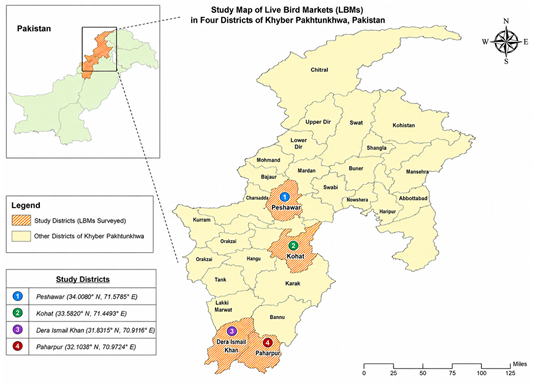
A cross-sectional study was conducted from March 2025 to March 2026 to estimate H9N2 avian influenza virus prevalence and identify associated risk factors in backyard, layer, and broiler chickens from live bird markets (LBMs) in Peshawar, Kohat, Dera Ismail Khan, and Pahar Pur, Khyber Pakhtunkhwa, Pakistan. An LBM was defined as an open market with ≥3 poultry stalls selling live birds at least once weekly. Markets handling >400 birds/day were eligible for inclusion (Figure 1).
Sample size calculation
The sample size was calculated using the Cochran formula:
n = Z2 (1-p)/ d2
Where (Z = 1.96) (for a 95% confidence interval), (p = 0.50) (assumed population proportion to maximize sample size), and (d = 0.05) (desired precision). The calculated sample size was adjusted for the finite bird population within the selected markets. Stalls holding more than 10 birds were eligible for sampling. Birds were sourced from commercial broiler and layer farms as well as household backyard flocks.
A prevalence of 50% was assumed for sample size calculation because, in the absence of a nationally representative prevalence estimate, this conservative value provides the maximum required sample size and helps avoid underestimation of the sample size
Sample collection
A total of 384 cloacal and tracheal swab samples were obtained from apparently healthy live birds older than two months. The age of birds was determined based on available farm/market records and information provided by the bird owners/vendors. Bird type (broiler or layer) was also recorded for each sampled bird. Because broilers are generally marketed at a much younger age than layers, age and production type were considered when interpreting differences in prevalence .Both anatomical sites were sampled from each bird using sterile swabs, which were immediately immersed in 3 mL of transport medium consisting of phosphate-buffered saline (PBS) supplemented with penicillin (10,000 IU/mL) and streptomycin (10,000 μg/mL). Samples were maintained at refrigerated temperatures using ice packsduring transportation to the laboratory. On receipt, all specimens were stored at −80°C in the Microbiology Laboratory, Faculty of Veterinary and Animal Sciences, Gomal University, Dera Ismail Khan, until further analysis.
Virus isolation
Swab specimens were screened for virus recovery by egg inoculation. Briefly, 0.2–0.3 mL of each undiluted specimen was introduced into the allantoic cavity of three 9–11-day-old SPF embryonated chicken eggs per sample. Prior to inoculation, the eggshell surface was disinfected with 70% ethanol, and antibiotics (penicillin and streptomycin) were used to suppress bacterial growth. The inoculated eggs were maintained at 37°C for 120 h and monitored daily by candling for embryo mortality. Allantoic fluid was collected from embryos that died during incubation as well as from those remaining viable at the end of the incubation period. Viral growth was initially assessed by hemagglutination (HA) using 0.5% chicken red blood cells. HA-reactive fluids were subsequently subjected to hemagglutination inhibition (HI) testing with H9N2-specific antiserum raised against A/chicken/Pakistan/UDL-01/2008 (H9N2), in accordance with the OIE-recommended procedure.
RNA extraction and molecular detection of H9N2
Total viral RNA was extracted from HI-positive allantoic fluid samples using the QIAamp Viral RNA Mini Kit (QIAGEN, Hilden, Germany) according to the manufacturer’s instructions. The extracted RNA was subjected to one-step quantitative real-time reverse transcription-polymerase chain reaction (qRT-PCR) using the THUNDERBIRD™ Probe One-Step qRT-PCR Kit (TOYOBO, New York, USA).
For the specific detection of the H9N2 subtype, a previously published primer and probe set from a Pakistan-based study was used :
Forward primer (H9-F): 5′-GGA AGA ATT ATT ATT GGT CGG TAC-3′
TaqMan probe (H9-P): 5′-[FAM] AAC CAG GCC AGA CAT TGC GAG TAA GAT CC [TAMRA]-3′
H9N2 viral RNA was detected using a primer–probe assay targeting a 148-bp region of the hemagglutinin (HA) gene, previously validated for H9N2 isolates from Pakistan. Each 20-µL qRT-PCR reaction contained 10 µL reaction buffer, 0.5 µL DNA polymerase, 0.5 µL reverse transcriptase, 1 µL each of forward and reverse primers (10 µM), 0.8 µL probe (5 µM), 1.2 µL nuclease-free water, 0.04 µL ROX dye, and 5 µL RNA template. Amplification was conducted using an Applied Biosystems 7500 Real-Time PCR System. The cycling protocol comprised reverse transcription at 55°C for 10 min, initial denaturation at 95°C for 2 min, followed by 45 cycles of 95°C for 10 s and 60°C for 60 s. All samples were analyzed in duplicate with appropriate positive and negative controls. Samples yielding Ct values ≤35 were classified as H9N2-positive.
Epidemiological data collection
A structured questionnaire was developed in English and then translated into Urdu and Pashto (the local languages of the study regions) to enhance accuracy and reduce response errors. The questionnaire collected data on LBM characteristics and potential risk factors associated with H9N2 transmission. The questionnaire was adapted from previously published studies on avian influenza risk factors ; and included variables such as: poultry type, market trading category, daily bird turnover, sanitation practices, mixed species housing, disinfectant use, frequency of manure removal, source of birds, selling of sick/dead birds, presence of wild birds, water source cleanliness, distance from nearest poultry farm, use of shared equipment, and worker hygiene practices. Data were collected through personal interviews with market owners, stall holders, and poultry workers by the first author, with assistance from veterinary staff from the Livestock and Dairy Development Department of Khyber Pakhtunkhwa. Informed verbal consent was obtained from all participants after the study objectives were explained.
Sanitation and worker hygiene assessment
Sanitation and worker hygiene were assessed using a structured observational checklist developed based on predefined criteria. The sanitation score included cleanliness of floors and working surfaces, proper disposal of waste, cleanliness of equipment, availability of clean water, and general environmental cleanliness. Worker hygiene was assessed based on hand washing, use of protective clothing, cleanliness of hands and clothing, and hygienic handling practices. Each criterion was scored as 0 (poor/absent), 1 (moderate), or 2 (good/adequate), and the individual scores were summed to obtain an overall score. Scores were categorized as poor, moderate, or good according to predefined cut-off values. Assessments were performed by trained researchers using the same checklist throughout the study.
Statistical analysis
Data were analyzed using IBM SPSS Statistics 25 and R version 4.2. H9N2 prevalence was determined for each district and poultry category by dividing the number of qRT-PCR-positive samples by the total number tested, with 95% confidence intervals estimated using the Wilson method. Differences in H9N2 positivity among poultry categories were initially evaluated using Pearson’s chi-square test, followed by two-sided Fisher’s exact tests for pairwise comparisons where small expected frequencies occurred. Statistical significance was set at p < 0.05.
Potential risk factors for H9N2 infection were screened using univariable logistic regression. Variables with p < 0.20 were subsequently included in a multivariable logistic regression model. A forward stepwise procedure was applied, with non-significant variables sequentially excluded based on the highest p-value until all retained predictors were significant (p < 0.05). Associations were expressed as adjusted odds ratios (aORs) with 95% confidence intervals. Model adequacy was evaluated using the Hosmer–Lemeshow goodness-of-fit test. Missing predictor values were addressed using dummy-variable adjustment.
Districts or subgroups with small sample sizes or zero-positive observations were interpreted cautiously and were excluded from comparative subgroup analyses where estimates were considered insufficiently precise.
Results
Study Table 1 summarizes the sampling results and H9N2 positivity across the four districts. Of the 384 samples collected, 102 (26.6%) were positive for the H9N2 subtype, with marked inter-district variation. Dera Ismail Khan showed the highest prevalence (42.7%, 41/96), followed by Peshawar (29.2%, 28/96), Kohat (22.9%, 22/96), and Pahar Pur (11.5%, 11/96). Most districts exhibited a decline in positivity from the first to the second visit, with Dera Ismail Khan also showing a slight decline from 43.3% to 41.7%, although it maintained the highest positivity rate among the districts. Of the 122 HA-positive samples, 102 were confirmed as H9N2-positive by HI testing and qRT-PCR, while the remaining 20 samples were not confirmed as H9N2-positive.The disparity between HA-positive (122) and H9-HI-positive (102) samples indicates the possible presence of other hemagglutinating viruses, except in Dera Ismail Khan, where both values were identical (41 each). These findings highlight district-level heterogeneity in H9N2 circulation and underscore the need for targeted surveillance and biosecurity interventions in high-prevalence areas.
Table 1: Detection of H9N2 avian influenza virus in allantoic fluid by hemagglutination (HA) and hemagglutination inhibition (HI) assays.
District
Visit
Markets visited
Stalls sampled
Total samples
HA positive
HI positive (H9)
Peshawar
1st
4
18
60
22
18
2nd
3
10
36
12
10
Total
7
28
96
34
28
Kohat
1st
3
16
58
18
14
2nd
3
12
38
10
8
Total
6
28
96
28
22
Dera Ismail Khan
1st
4
20
60
26
26
2nd
4
14
36
15
15
Total
8
34
96
41
41
Pahar Pur
1st
2
12
60
12
7
2nd
2
8
36
7
4
Total
4
20
96
19
11
Grand total
All visits
25 markets
110 stalls
384
122
102
Table 2 depicted the prevalence of H9N2 by poultry type across the four districts. Overall, layers had the highest prevalence (43.0%, 68/158), followed by broilers (17.8%, 32/180) and backyard poultry (4.3%, 2/46), with the differences being statistically significant (p < 0.0001). Pairwise comparisons revealed that layers were significantly more likely to test positive than both broilers (p < 0.0001) and backyard poultry (p < 0.0001), and broilers were significantly more likely to test positive than backyard poultry (p = 0.0231). At the district level, Dera Ismail Khan showed the highest overall prevalence (42.7%), with layers in this district exhibiting the highest rate recorded (57.1%, 24/42). The district-level comparison was statistically significant in Dera Ismail Khan (p = 0.0078), Peshawar (p = 0.0016), Kohat (p = 0.0012), and Pahar Pur (p < 0.0001). In Dera Ismail Khan, layers showed a significant higher positivity compared to broilers (p= 0.0326) and backyard poultry (p= 0.0567). In Peshawar, layers were significantly more likely to test positive than broilers (p= 0.0413) and backyard poultry (p= 0.0057). In Kohat, layers were significantly more likely to test positive than broilers (p= 0.0143) and backyard poultry (p= 0.0078). In Pahar Pur, layers were significantly more likely to test positive than broilers (p= 0.0002) and backyard poultry (p= 0.0425), while no significant difference was observed between broilers and backyard poultry in any district (p > 0.05).
Table 2: Prevalence of H9N2 avian influenza virus in poultry using qRT-PCR from live bird markets in four districts of Khyber Pakhtunkhwa.
District
Poultry type
Total (n)
H9N2+ (n)
Prevalence (%)
95% CI
p-value
Pairwise p-values
Peshawar
Layer
40
18
45.0
29.8–60.9
rowspan="3"
Broiler
44
10
22.7
11.5–37.7
Layer vs Broiler: 0.0413
Backyard
12
0
0.0
0.0–26.5
0.0016
Layer vs Backyard: 0.0057
Broiler vs Backyard: 0.1132
Kohat
Layer
38
15
39.5
24.0–56.6
rowspan="3"
Broiler
46
7
15.2
6.3–28.9
Layer vs Broiler: 0.0143
Backyard
12
0
0.0
0.0–26.5
0.0012
Layer vs Backyard: 0.0078
Broiler vs Backyard: 0.2987
Dera Ismail Khan
Layer
42
24
57.1
41.0–72.3
rowspan="3"
Broiler
44
15
34.1
20.5–49.9
Layer vs Broiler: 0.0326
Backyard
10
2
20.0
2.5–55.6
0.0078
Layer vs Backyard: 0.0567
Broiler vs Backyard: 0.4786
Pahar Pur
Layer
38
11
28.9
15.4–45.9
rowspan="3"
Broiler
46
0
0.0
0.0–7.7
Layer vs Broiler: 0.0002
Backyard
12
0
0.0
0.0–26.5
<0.0001
Layer vs Backyard: 0.0425
Broiler vs Backyard: 1.0000
TOTAL
Layer
158
68
43.0
35.2–51.1
rowspan="3"
Broiler
180
32
17.8
12.5–24.2
Layer vs Broiler: <0.0001
Backyard
46
2
4.3
0.5–14.8
<0.0001
Layer vs Backyard: <0.0001
Broiler vs Backyard: 0.0231
Overall
All types
384
102
26.6
22.3–31.3
—
—
Table 3: Market-level risk factors associated with H9N2 positivity in live bird markets of Khyber Pakhtunkhwa (univariate and multivariable logistic regression).
Risk factor
Category / definition
H9N2-positive n/N (%)
Univariate OR (95% CI)
Univariate p-value
Multivariable aOR (95% CI)
Multivariable p-value
Sanitation score*
Poor (score ≤50% of maximum)
48/96 (50.0)
3.2 (1.8–5.6)
<0.001
2.9 (1.6–5.2)
<0.001
Good (score >50% of maximum; reference)
74/288 (25.7)
Reference
—
Reference
—
Mixed-species housing
Yes
89/210 (42.4)
2.6 (1.7–4.0)
<0.001
2.3 (1.4–3.7)
0.001
No (reference)
33/174 (19.0)
Reference
—
Reference
—
Bird turnover (birds/day)
High (>500)
71/144 (49.3)
3.4 (2.1–5.5)
<0.001
3.1 (1.9–5.1)
<0.001
Low (≤500; reference)
51/240 (21.3)
Reference
—
Reference
—
Disinfectant use
Rarely/never
59/120 (49.2)
3.1 (1.9–4.9)
<0.001
2.8 (1.7–4.6)
<0.001
Regular (reference)
63/264 (23.9)
Reference
—
Reference
—
Frequency of manure removal
Daily (reference)
22/108 (20.4)
Reference
—
Reference
—
Weekly
45/156 (28.8)
1.6 (0.9–2.8)
0.112
1.4 (0.8–2.5)
0.243
Rarely/never
55/120 (45.8)
3.3 (1.8–6.0)
<0.001
2.5 (1.3–4.8)
0.006
Source of birds
Single farm (reference)
18/108 (16.7)
Reference
—
Reference
—
Multiple farms/local markets
62/168 (36.9)
2.9 (1.6–5.3)
<0.001
2.4 (1.3–4.5)
0.006
Multiple districts/unknown
42/108 (38.9)
3.2 (1.7–6.0)
<0.001
2.7 (1.4–5.2)
0.003
Selling of sick/dead birds
Yes
67/132 (50.8)
3.8 (2.4–6.0)
<0.001
3.2 (1.9–5.3)
<0.001
No (reference)
55/252 (21.8)
Reference
—
Reference
—
Presence of wild birds in market
Yes, frequent
81/180 (45.0)
2.9 (1.9–4.5)
<0.001
2.3 (1.4–3.7)
0.001
No/rare (reference)
41/204 (20.1)
Reference
—
Reference
—
Water-source cleanliness
Clean (tap/treated; reference)
28/144 (19.4)
Reference
—
Reference
—
Unclean (open tank/canal)
94/240 (39.2)
2.7 (1.6–4.4)
<0.001
2.1 (1.3–3.6)
0.004
Distance from nearest farm (km)
>5 km (reference)
30/144 (20.8)
Reference
—
Reference
—
2–5 km
52/156 (33.3)
1.9 (1.1–3.2)
0.019
1.7 (0.9–3.0)
0.089
<2 km
40/84 (47.6)
3.5 (1.9–6.3)
<0.001
2.8 (1.5–5.3)
0.002
Use of shared equipment (crates/feeders)
Yes
86/216 (39.8)
2.4 (1.6–3.7)
<0.001
2.0 (1.2–3.2)
0.005
No (reference)
36/168 (21.4)
Reference
—
Reference
—
Worker hygiene: hand washing before handling birds
Rarely/never
68/156 (43.6)
2.8 (1.8–4.3)
<0.001
2.2 (1.4–3.6)
0.001
Sometimes
38/132 (28.8)
1.5 (0.9–2.5)
0.116
1.3 (0.8–2.3)
0.312
Always (reference)
16/96 (16.7)
Reference
—
Reference
—
The prevalence estimate for Pahar Pur should be interpreted cautiously because of its relatively small sample size (n=96) and zero-positive observations in some subgroups.
Table 3 presents the univariate and multivariable logistic regression analyses identifying risk factors associated with H9N2 positivity. In the univariate analysis, all 12 factors examined were significantly associated with increased odds of H9N2 positivity (p < 0.05 for each). After adjusting for potential confounders in the multivariable model, 11 factors remained significant independent predictors. The strongest independent risk factors were selling sick or dead birds (aOR= 3.2; 95% CI: 1.9–5.3; p < 0.001), high bird turnover exceeding 500 birds per day (aOR = 3.1; 95% CI: 1.9–5.1; p < 0.001), and poor sanitation scores (aOR = 2.9; 95% CI: 1.6–5.2; p < 0.001). Other significant factors included infrequent disinfectant use (aOR = 2.8), proximity to farms within 2 km (aOR = 2.8), sourcing birds from multiple districts (aOR = 2.7), mixed species housing (aOR = 2.3), frequent wild bird presence (aOR = 2.3), poor worker hygiene (aOR = 2.2), unclean water sources (aOR = 2.1), shared equipment use (aOR = 2.0), and rare or never removing manure (aOR = 2.5). Weekly manure removal was not significantly associated with H9N2 positivity in the multivariable model (aOR = 1.4; p = 0.243), suggesting that even intermittent removal provides some benefit compared to no removal, though daily removal remains optimal. These findings underscore the multifactorial nature of H9N2 transmission in live bird markets and highlight priority areas for intervention, particularly improving sanitation, enforcing biosecurity measures, discouraging the sale of sick birds, and reducing bird mixing and turnover.
Discussion
Avian influenza is a zoonotic disease which can infect mammals, wild birds and domestic birds, including humans. The disease still persists in a number of Asian countries, North America, Africa and the Middle East such as Pakistan ; ; ; ; . Live bird markets (LBMs) play a major role in the spread of avian influenza virus as they allow a large number of different bird species to be present in a compact area where virus genome reassortment and the spread of the virus to other species may occur . While LBMs have been recognized as potential “hotspots” for influenza A viruses (IAVs), their role in disease outbreaks among humans is still a significant public health challenge .
The current study aimed to assess the prevalence of H9N2 avian influenza virus (AIV) and its related risk factors among the poultry of LBMs in four districts of Khyber Pakhtunkhwa, Pakistan. The overall H9N2 prevalence among the 384 sampled birds was 26.6% (102/384), as determined by the hemagglutination inhibition (HI) assay and subsequently reconfirmed by quantitative real-time reverse transcription PCR (qRT-PCR). Significant differences were observed between districts and poultry types. However, the 62.5% figure from Rehman et al. was based on serology in backyard poultry from a single district, which is not directly comparable to our qRT-PCR-based detection in LBMs across four districts; therefore, we have restricted our primary comparisons to other LBM-based molecular studies . The overall prevalence in our study was similar to Vietnam (32.2%) and Bangladesh (16.5%) . There may be variations in the prevalence estimates from various studies related to many different risk factors including the way birds are handled in LBMs, differences in the techniques of surveys, differences in diagnostic methodology, ecological differences and the type of poultry population observed ; .
There was a significant inter-district variation with Dera Ismail Khan with the highest prevalence (42.7%), followed by Peshawar (29.2%), Kohat (22.9%) and Pahar Pur (11.5%). Dera Ismail Khan’s higher prevalence estimate may be due to the presence of the virus in commercial and backyard chickens in the region. It was also revealed from previous studies that the different districts of Khyber Pakhtunkhwa (KP) have different avian influenza virus subtypes ; . The decrease in prevalence between the first and second visits seen in Peshawar, Kohat and Pahar Pur may be due to seasonal changes because transmission of avian influenza has been known to be affected by temperature and humidity .
Poultry-type analysis showed that the highest prevalence (43.0%) was found in the layers with a significantly higher number of birds than the broilers (26.1%) and backyard poultry (15.2%). This is biologically plausible because layers have a longer production cycle (up to 72 weeks) than broilers (5-6 weeks) allowing for more time for exposure and growth of the virus . Also, layer operations tend to have more intricate biosecurity issues and higher bird density . In Dera Ismail Khan, layers showed a high H9N2 prevalence of 57.1%, indicating a substantial level of virus circulation in this poultry population.. The higher H9N2 prevalence in layer flocks than in broilers and backyard poultry has been reported from China and Bangladesh ; .
There is a difference between HA positive (122) and H9N2-HI positive (102) samples, suggesting that other hemagglutinating virus strains may be present, such as Newcastle disease virus or other avian influenza sub types. Interestingly, Dera Ismail Khan had the same number of HA and HI positive birds (41, respectively), implying that H9N2 might be the prevailing hemagglutinating virus in this district. Different avian influenza subtypes are co-circulaing, which is a matter of concern as previous studies have shown that H9N2 viruses can donate their internal genes to other zoonotic influenza viruses, for example, H5N1, H7N9 and H10N8 ; .
The multivariable logistic regression revealed 11 independent risk factors for positivity of H9N2. Selling sick or dead birds (aOR = 3.2) and having high bird turnover (more than 500 birds/day) (aOR = 3.1) and poor sanitation scores (aOR = 2.9) were the strongest independent risk factors. Previous studies from Pakistan and other endemic countries have consistently identified the sale of the sick or dead bird as a significant risk factor ; . High turnover of birds may lead to greater risk of introducing infected birds to markets and enhance transmission dynamics . The presence of poultry farms within 2 km (aOR = 2.8) and birds from multiple districts (aOR = 2.7) indicates the interdependency of the poultry production and marketing system, which aligns with findings from previous studies that show that farm-to-market transmission pathway is important for the introduction and spread of H9N2 ; .
Lack of sanitation, inadequate removal of manure, and less frequent use of disinfectants were identified as key failures in biosecurity that were linked to higher H9N2 positivity. Adequate cleaning has been shown to keep AIVs from persisting, while manure and contaminated surfaces are important environmental reservoirs of AIVs . Other factors that were found to be important included presence of mixed species housing (aOR = 2.3), wild birds in markets (aOR = 2.3), sharing of equipment (aOR = 2.0) and poor worker hygiene (aOR = 2.2), which are in accord with other investigations ; . Although pests and rodents were not investigated in the present study, their control may be considered as part of general biosecurity measures in live bird markets to potentially reduce opportunities for pathogen transmission ; ; . Our results indicate that H9N2 infection is zoonotic, as demonstrated by detection of H9N2 in poultry workers and market visitors who were shown to have developed nasal colonization ; . High prevalence in LBMs and risk factors associated with worker hygiene and selling of sick birds provide ample opportunities for human exposure. This is especially worrying as H9N2 viruses have mammalian host-specific markers and have been found to be the internal gene donors for other zoonotic influenza viruses ; . Therefore, a One Health approach combining the human, animal and environmental surveillance is critical to track the evolution of viruses and to detect potential threats for a pandemic .
Study limitations
This study had several limitations. First, its cross-sectional design provided an estimate of AIV prevalence only during the specific sampling period and did not allow assessment of seasonal patterns or temporal fluctuations. ongitudinal studies incorporating environmental factors such as temperature, humidity, and precipitation are therefore needed. Second, the relatively small sample of backyard poultry (n= 46) reduced statistical power and limited the precision of prevalence estimates and subgroup comparisons; therefore, these findings should be interpreted cautiously. Finally, molecular characterization and sequencing of the detected viruses were not performed, representing a major limitation because strain identity, genetic lineages, potential reassortment events, and the possible contribution of vaccine strains or laboratory contamination could not be confirmed. Nevertheless, the study provides important baseline data on AIV prevalence across different poultry species and live bird market types. Future longitudinal epidemiological studies with larger and more balanced sample sizes, combined with whole-genome sequencing, are needed to better characterize circulating AIV strains and understand their evolution and transmission dynamics. A limitation of this study is that qRT-PCR was performed only on HA/HI-positive samples; therefore, false-negative results among HA/HI-negative samples cannot be excluded and may have led to an underestimation of H9N2 prevalence.
Conclusion
This study assessed H9N2 avian influenza prevalence in live bird markets (LBMs) in Pakistan and evaluated key risk factors associated with viral infection to support evidence-based surveillance and effective disease control strategies. The confirmation of H9N2 infections in live bird markets by qRT-PCR and HI assays indicates the ongoing circulation of this subtype in the studied endemic locations. This study also identified several risk factors which are comparable with the previously published studies from Bangladesh, Vietnam, China and Egypt and these common risk factors are the main causes of the rising AI (H9N2) infections. Targeting these risk factors may reduce H9N2 AIV occurrence in Pakistan, particularly within the study area. Sustained surveillance of live bird markets in major urban centers is essential for early detection and timely intervention, thereby reducing the risk of future outbreaks. These interventions are not just crucial for the health and productivity of poultry and food security but also for safeguarding public health, particularly in the context of zoonotic potential in H9N2 Based on the risk factors identified in this study, control measures should prioritize the most strongly associated factors, with targeted interventions focusing on reducing bird-to-bird contact, improving separation of sick birds, strengthening market biosecurity, and minimizing practices that facilitate disease transmission.
Acknowledgment
All authors have contributed significantly and that all authors are in agreement with the content of the manuscript.
Novelty Statement
This study provides the first multi-district assessment of H9N2 avian influenza virus in live bird markets across Khyber Pakhtunkhwa, Pakistan, revealing marked district-level heterogeneity and poultry-type-specific prevalence. It identifies eleven modifiable market-level risk factors, including selling sick birds, poor sanitation, and inadequate disinfection, that drive transmission. These findings offer actionable evidence to guide targeted biosecurity interventions and One Health surveillance in high-risk districts.
Author’s contribution
SU: Supervision, methodology, writing reviewing and editing. SR: Conceptualization, formal analysis. MIUM: Writing reviewing and editing. IUK: Writing reviewing and editing. AK: Sample collection, laboratory analysis, writing reviewing and editing. AZ: Sample collection, laboratory analysis, writing original draft.
Animal welfare statement
This study was reviewed and approved by the Ethical Review Board of Gomal University, Dera Ismail Khan, under approval number 146/ERB/GU. All experimental procedures involving animals were conducted in accordance with the ethical guidelines and standards set forth by the Institutional Review Board. Approval No: 146/ERB/GU.
Funding statement
Not Applicable for this article.
Data availability statement
The data supporting the findings of this study are available from the primary author and may be provided upon reasonable request.
Declaration of generative AI and AI-assisted technologies
The authors hereby declare that no generative AI or AI-assisted technologies were employed in the preparation, creation, or development of this manuscript.
Conflict of interest
The authors have declared that they have no known competing financial interests or personal relationships that could have appeared to influence the work reported in this manuscript.
Figures
Figure 1:.
Map of study area.
References
Alexander DJ (2000). A review of avian influenza in different bird species. Vet. Microbiol, 74(1–2): 3–13. https://doi.org/10.1016/S0378-1135(00)00160-7[CrossRef]
Ali S, Robie ER, Saeed U, Jaffar G, Bailey ES, Marushchak LV, Kreditor BE, Pulscher LA, Rubrum AM, Webby RJ, Gray GC (2024). H9N2 influenza A viruses found to be enzootic in Punjab Pakistan’s bird markets with evidence of human H9N2 nasal colonization. Int. J. Infect. Dis., 146: 107146. https://doi.org/10.1016/j.ijid.2024.107146[CrossRef]
Cappelle J, Zhao D, Gilbert M (2014). Risk factors for avian influenza virus contamination in live bird markets in China. Emerg. Infect. Dis., 20(5): 791–798.
Cardona CJ, Xing Z, Schat KA (2009). Avian influenza virus in live bird markets. Avian Dis., 53(1): 1–14.
Chaudhry M, Rashid HB, Thrusfield M, Welburn S, Bronsvoort BM (2015). A case-control study to identify risk factors associated with avian influenza subtype H9N2 on commercial poultry farms in Pakistan. PLoS One, 10(3): e0119019. https://doi.org/10.1371/journal.pone.0119019[CrossRef]
Chaudhry M, Rashid HB, Thrusfield M, Welburn SC (2018). A questionnaire survey for the identification of risk factors associated with avian influenza H9N2 in commercial poultry of Pakistan. Transbound. Emerg. Dis., 65(5): 1281–1291.
Chen C, Tian C, Xu S, Zhang Y, Tang L (2024). Molecular characterization and pathogenicity evaluation of a H1N1 subtype swine influenza virus. Pakistan Vet. J., 44(3): 868–874.
Durrani RH, Sheikh AA, Humza M, Ashraf S, Kokab A, Mahmood T, Khan MUZ (2024). Evaluation of antibiotic resistance profile and multiple antibiotic resistance index in avian adapted Salmonella enterica serovar Gallinarum isolates. Pak. Vet. J., 44(4): 1349–1352.
Essalah-Bennani A, El Houadfi M, Naciri M (2021). Prevalence of avian influenza viruses in Morocco. Vet. Microbiol., 254: 108998.
Fournié G, de Glanville WA, Pfeiffer DU (2017). Epidemiology of avian influenza in live bird markets in Southeast Asia. Epidemiol. Infect., 145(2): 217–231.
Fournié G, Guitian J, Pfeiffer DU (2012). The role of live bird markets in the spread of avian influenza viruses. Infect. Gen. Evol., 12(6): 1186–1194.
Gao R, Cao B, Hu Y, Feng Z, Wang D, Hu W, Chen J, Jie Z, Qiu H, Xu K, Xu X, Lu H, Zhu W, Gao Z, Xiang N, Shen Y, He Z, Gu Y, Zhang Z, Shu Y (2013). Human infection with a novel avian-origin influenza A (H7N9) virus. New Engl. J. Med., 368(20): 1888–1897. https://doi.org/10.1056/NEJMoa1304459[CrossRef]
Gray GC, Trampel DW, Roth JA (2008). Pandemic influenza planning: Shouldn’t swine and poultry workers be included? Vaccine, 26(30): 4057–4061.
Guan Y, Shortridge KF, Krauss S, Webster RG (1999). Molecular characterization of H9N2 influenza viruses: Were they the donors of the “internal” genes of H5N1 viruses in Hong Kong? Proc. Natl. Acad. Sci., 96(16): 9363–9367. https://doi.org/10.1073/pnas.96.16.9363[CrossRef]
Gulyukin AM, Shulyak AF, Velichko GN, Ovchinnikov RS, Gaynullina AG, Gorokhov DJ, Gorbatov AV, Ishkova TA, Belimenko VV (2025). Pathogenic viruses, fungi and bacteria detected in wild animals of different habitats. Int. J. Vet. Sci., 14(4): 648–653.
Guo YJ, Krauss S, Senne DA, Mo IP, Lo KS, Xiong XP, Norwood M, Shortridge KF, Webster RG, Guan Y (2000). Characterization of the pathogenicity of members of the newly established H9N2 influenza virus lineages in Asia. Virology, 267(2): 279–288. https://doi.org/10.1006/viro.1999.0115[CrossRef]
Hassan KE, Harder TC, Hafez HM (2021). Avian influenza in Egypt: A review. World’s Poult. Sci. J., 77(1): 45–62. https://doi.org/10.51585/gtop.2021.0004[CrossRef]
Hussain M, Iqbal M, Khan S (2019). Molecular detection and characterization of avian influenza virus H9N2 in commercial poultry of Pakistan. Pakistan J. Zool., 51(4): 1511–1519.
Indriani R, Samaan G, Gultom A, Loth L, Irianti S, Adjid R, Dharmayanti NLPI, Weaver J, Mumford E, Lokuge K, Kelly PM, Darminto (2010). Environmental sampling for avian influenza virus A (H5N1) in live-bird markets, Indonesia. Emerg. Infect. Dis., 16(12): 1889–1895. https://doi.org/10.3201/eid1612.100402[CrossRef]
Lee YJ, Song CS (2013). Avian influenza in Korea: A review. J. Vet. Sci., 14(2): 111–120.
Li Y, Wang Y, Cheng X (2019). Prevalence of H9N2 avian influenza virus in poultry in China. Infect. Gen. Evolut., 68: 54–60.
Loth L, Gilbert M, Slingenbergh J (2011). Risk factors for H5N1 avian influenza virus infection in Indonesia. Emerg. Infect. Dis., 17(3): 454–461.
Matrosovich MN, Krauss S, Webster RG (2001). H9N2 influenza A viruses from poultry in Asia have human virus-like receptor specificity. Virology, 281(2): 156–162. https://doi.org/10.1006/viro.2000.0799[CrossRef]
Mohd HB, Mazlan M, Ning CZ, Sohaimi NM, Clifford UC (2025). Efficacy, safety and virus shedding of inactivated very virulent infectious bursal disease virus in broiler chickens. Int. J. Vet. Sci., 14(5): 820–827.
Naeem K, Siddique N, Ayaz M, Jalali MA (2007). Avian influenza in Pakistan: Outbreaks of low- and high-pathogenicity avian influenza in Pakistan during 2003–2006. Avian Dis., 51(1): 293–298. https://doi.org/10.1637/7617-042506R.1[CrossRef]
Negovetich NJ, Feeroz MM, Jones-Engel L, Walker D, Alam SM, Hasan K, Seiler P, Ferguson A, Friedman K, Barman S, Franks J, Turner J, Krauss S, Webster RG (2011). Live bird markets of Bangladesh: H9N2 viruses and the near absence of highly pathogenic H5N1 influenza. PLoS One, 6(4): e19311. https://doi.org/10.1371/journal.pone.0019311[CrossRef]
Nguyen DT, Bryant JE, Davis CT (2014). Prevalence of avian influenza viruses in live bird markets in Vietnam. Emerg. Infect. Dis., 20(3): 408–415.
Nguyen VD, Pham HTT, Conan A, Tomley F, Blake D, Chapot L, Han Anh T, Do VD, Nguyen TL, Vu DN, Hoang TT, Nguyen TH, Nguyen HQ, Pham NT, Bui VN, Fournié G, Huyen LTT (2026). Characterization of practices influencing avian influenza virus transmission risk in live bird markets in Northern Vietnam. Prevent. Vet. Med., 255: 106177. https://doi.org/10.1016/j.prevetmed.2026.106958[CrossRef]
Nurgaziev R, Irgashev A, Akhmedzhanov M, Cho GJ, Orozov J, Mamytova A, Isakeev M, Nurmanov C, Berdikulov A, Anarbekova A (2025). Serological monitoring of the spread of equine influenza virus and equine herpesviruses type 1 and 4 in the horse population of the Kyrgyz Republic. Int. J. Vet. Sci., 14(6): 1106–1111.
OIE (World Organisation for Animal Health) (2011). Manual of diagnostic tests and vaccines for terrestrial animals: Chapter 2.3.4 Avian influenza. Paris, France: OIE.
Parvin R, Akter S, Hossain MT (2020). Prevalence of avian influenza virus in live bird markets in Bangladesh. J. Virol. Meth., 279: 113842.
Peiris JS, Guan Y, Markwell D, Ghose P, Webster RG, Shortridge KF (2001). Cocirculation of avian H9N2 and contemporary “human” H3N2 influenza A viruses in pigs in southeastern China: Potential for genetic reassortment? J. Virol., 75(20): 9679–9686. https://doi.org/10.1128/JVI.75.20.9679-9686.2001[CrossRef]
Pinotti F, Kohnle L, Lourenço J, Gupta S, Hoque MA, Mahmud R, Biswas P, Pfeiffer D, Fournié G (2024). Modelling the transmission dynamics of H9N2 avian influenza viruses in a live bird market. Nat. Commun., 15: 3494. https://doi.org/10.1038/s41467-024-47703-9[CrossRef]
Rehman S, Effendi MH, Shehzad A, Rahman A, Rahmahani J, Witaningrum AM, Bilal M (2022). Prevalence and associated risk factors of avian influenza A virus subtypes H5N1 and H9N2 in LBMs of East Java province, Indonesia: A cross-sectional study. Peer J., 10: e14095. https://doi.org/10.7717/peerj.14095[CrossRef]
Rehman S, Khan MI, Rantam FA, Effendi MH, Shehzad A, Tariq A (2021). Seroprevalence and associated risk factors of avian influenza virus subtype H9N2 in backyard poultry of Peshawar Pakistan. J. Indones. Trop. Anim. Agric., 46(3): 209–218. https://doi.org/10.14710/jitaa.46.3.209-218[CrossRef]
Shah S, Babar ME, Rafiq F, Akhtar MN, Usman M, Khan A, Umar S (2026). Prevalence of H9 avian influenza virus among poultry workers in District Rawalpindi, Pakistan. Pakistan J. Zool., 58(2): 729–735. https://doi.org/10.17582/journal.pjz/20181127121128[Full text][CrossRef]
Suarez DL, Lee CW, Swayne DE (2006). Avian influenza in the Americas. Avian Dis., 50(4): 465–472.
Subedi D, Farhan MHR, Niraula A, Shrestha P, Chandran D, Acharya KP, Ahmad M (2024). Avian influenza in low and middle-income countries (LMICs): Outbreaks, vaccination challenges, and economic impact. Pakistan Vet. J., 44(1): 9–17.
Swayne DE (1998). A laboratory manual for the isolation and identification of avian pathogens (4th ed.). American Association of Avian Pathologists.
Swayne DE, King DJ (2003). Avian influenza and Newcastle disease. J. Am. Vet. Med. Assoc., 222(11): 1534–1540. https://doi.org/10.2460/javma.2003.222.1534[CrossRef]
Swayne DE, Suarez DL (2000). Highly pathogenic avian influenza. Revue Scientifique et Technique Office International des Epizooties, 19(2): 463–482. https://doi.org/10.20506/rst.19.2.1230[CrossRef]
Umar S, Ul Hassan, M, Usman M, Shah MA (2015). Prevalence of H9N2 avian influenza virus in poultry in Pakistan. J. Anim. Plant Sci., 25(1): 1–6.
Wang W, Wu J, Zhang W (2017). Risk factors for avian influenza virus in live bird markets in China. PLoS One, 12(5): e0177209.
Zaman A, Haleem A, Rahman SU, Ullah N (2019). Seroprevalence and risk factors association of avian influenza in desi chicken (Gallus domesticus) in Khyber Pakhtunkhwa, Pakistan. Pakistan Vet. J., 39(2): 297–300. https://doi.org/10.29261/pakvetj/2019.012[CrossRef]
Zhou X, Li Y, Wang Y, Cheng X (2013). The role of live poultry markets in the spread of avian influenza virus. Infect. Gen. Evol., 18: 107–113.