
The management of marine fish is extremely important for commercial purposes and has a large impact on the food sector. In addition to several directed studies on fish and fisheries, taxonomy has drawn significant interest from researchers. In recent years, DNA barcoding has gained popularity for use in identification and phylogenetic relationship studies. When compared to the conventional morphological-based identifications. DNA bar-coding is seen to be a more trustworthy method of identification. The cytochrome oxidase sub-unit 1 (COI) was given a lot of attention for identifications among mitochondrial DNA (mtDNA) markers. The COI genetic marker was employed in the current study to identify species belonging to family Lutjanidae. Following species of this family were re-confirmed bases on strong similarity scores in NCBI nucleotide blast and bar-code of life data system (BOLD) findings such as, Lutjanus johni, Lutjanus lutjanus, Lutjanus rivulatus, Lutjanus fulvus, Lutjanus ehrenbergi, and Lutjanus erythropterus. These sequences were submitted to NCBI under accession numbers ON705767, ON706980, ON705756, ON706977, ON705716, ON705711, ON706273, ON706982, ON706952, ON706976, ON706979, ON706983, and ON705701, respectively. The phylogenetic tree described three major clades with bootstrap support values of 100%, 79%, and 100%, respectively. The results of this investigation will be useful for taxonomists and biodiversity monitors.
Research Article · Volume 58, Issue 2, 14 January 2026 · Open Access
Molecular Identification of Commercially Important Marine Fishes (Family Lutjanidae) from Southwestern Coast of Pakistan
· · · · · · · ·
Affiliations & Notes ⌄
- 1Department of Zoology, University of Balochistan, Quetta, Pakistan. 2Center of Excellence in Marine Biology, University of Karachi, Karachi, Pakistan. 3Lasbella University of Agriculture, Water and Marine Sciences, Lasbella, Uthal. 4Center of Advanced Studies in Vaccinology and Biotechnology, University of Balochistan, Quetta, Pakistan * Corresponding author: mshafi3333@yahoo.com
Article Info ⌄
- Journal:
- Pakistan Journal of Zoology
- Published:
- 14 January 2026

From the article
- The fishes of family Lutjanidae are commonly found in marine water of Pakistan.
- In the phylogenetic analysis of marine within six Lutjanus marine fish species from Gwadar showed the minimum genetic distance from 0.0-0.5% while maximum genetic divergence was observed 8.4-21.1% and mean genetic distance was observed 13.3% which declared that all species are genetically separated.
- Six species of family Lutjanidae from coastal area of Gwadar Baluchistan (L. johni, L. rivulatus, L. erythropterus, L. lutjanus, L. fulvus and L. ehrenbergi were successfully recognized molecular identification through mt DNA gene, namely CO1.
- The research proposed that CO1 gene is valid and reliable genetic marker for identification of Lutjanidae distributed in coastal area of Gwadar.
Selected from the article's own text.
Abstract
INTRODUCTON
The coastal areas of Pakistan, as a part of the northern Arabian Sea, is highly productive in terms of fish diversity, abundance, and endemism as it receives nutrient-rich waters from up-sloping in the Gulf of Oman and surrounding areas. These areas are bestowed with a variety of marine habitats including large Indus Delta, numerous major and minor creeks, mudflats, and mangrove forests . The marine fisheries sector plays vital role in generating the economy of Pakistan and significant employment opportunities for foreign exports and representing a great source of protein for local rural population, so is the importance of teleost fishes among fishery resources. The Lutjanidae family has profound importance with 21 genera and 135 species, and commonly called as snappers mostly dwells in marine waters, nevertheless, few are reported in freshwater and estuarine ecosystem as well. The distribution of this import food source family is worldwide .
The classification of fish species is based on morphological character like body color, scale, size, fin ray, fin spines and measurement of the body parts (Stuarts and Bond, 1990). However, this approach of morphological identification required ichthyologic expertise but it becomes complicated when morphological character change according to the life history. Fish has extremely diverse aquatic organism due to morphology character as they change through ontogenetic metamorphism and thus metamorphic character change according to ontogenetic developmental stage of life . For centuries the classification of fishes based on traditionally conducted through visible character which cause widely mislabeled, fraud and substitution that prevent the export and expansion of fishes. In modern taxonomy physical pattern, genes behavior and geographic character are included for appropriate identification .
The use of molecular approach for the identification of fish species is helpful for mitigating the limitation of morphological based identification of taxonomy and the lack of local fish identification expertise . Taxonomist used the DNA barcoding mitochondrial gene as golden tool to complement the morphological data with particular molecular technique known as barcoding . DNA barcoding has been proved as a molecular authenticity of recognition and identification of fish species due to its rapid and cost effectiveness which is robust output based on cytochrome oxidase subunit I (COI) gene . identified marine fishes using the molecular identification from the different areas of Pakistan coast and including some species present in this study Amir et al. (2022).
This investigation of commercially important Lutjanidae fishes from southwest coast of Pakistan would be important contribution of the DNA barcoding and facilitate in management of marine fishes.
MATERIALS AND METHODS
Specimen collection
Specimen for the experiments were collected from the southwest coast of Pakistan (Fig. 1). Specimen were transferred to the center of excellence in marine biology, University of Karachi, Pakistan, identified based on morphological character (Fig. 2) as per national and international available keys ; .
DNA extraction
DNA was extracted from 30 mg of fish muscles by using lysis buffer and followed by standard proteinase K-phenol-chloroform, isoamyl alcohol method . CO1 gene was amplified by universal CO1 primer as given below.
FishF1-5´TCAACCAACCACAAAGACATTGGCAC3.
FishR1-5´TAGACTTCTGGGTGGCCAAAGAATCA3.
The polymerase chain reaction (PCR) was carried out in 25 µl reaction. The mixture was included 1.25 μL of DNA template, 1.25 μL of each primer, 12.5 µl of Es Taq, and 8.75 µl of double distilled water. The PCR conditions were set as denaturation at 94 °C for 5 min; 35 cycles of 94 °C for 30 sec, annealing at 50 °C for 30 sec, and extension at 72 °C for 30 sec; and a final extension at 72 °C for 7 min. Gel electrophoresis (1.2%) agarose gel with ethidium bromide was used to confirm successful amplification).
Sequencing and construction of the phylogenetic tree
The PCR products were sequenced using the Sanger sequencing method. Software (BIOEDIT and MEGA 6) were used for the editing and alignment of sequences . Nucleotide Blast (https://blast.ncbi.nlm.nih.gov/Blast.cgi?PROGRAM=blastnandBLASTSPEC=GeoBlastandPAGE_TYPE=BlastSearch) and BOLDv4 systems (https://v4.boldsystems.org/) were used to identify the possibly accurate species. Using the Kimura 2 parameter (K2P) model and MEGA 6, a neighbor-joining tree was created to compute the evolutionary history among the populations .
RESULTS
The fishes of family Lutjanidae are commonly found in marine water of Pakistan. In present study we have identified these species with morphological and molecular based approaches, the photo morph of all these fishes are shown in (Fig. 2). The molecular based identifications were done using fragments of cytochrome oxidase sub-unit 1 (CO1). The NCBI nucleotide blast and BolDv4 systems search used. The higher similarity percentages were chosen for identification. The confirmed sequences were submitted to NCBI under accession numbers ON705767, ON706980, ON705756, ON706977, ON705716, ON705711, ON706273, ON706982, ON706952, ON706976, ON706979, ON706983, and ON705701. In the phylogenetic analysis of marine within six Lutjanus marine fish species from Gwadar showed the minimum genetic distance from 0.0-0.5% while maximum genetic divergence was observed 8.4-21.1% and mean genetic distance was observed 13.3% which declared that all species are genetically separated.
The neighbor joining tree clearly distinguishing these species and Lutjanus Species west coast of Pakistan are clustered with other similar species of different locations of world (Fig. 4) such as Australia (AU), Bangladesh (BD), China (CN), India (IND), Indonesia (ID), Malaysia (MY), Mozambique (MZ), Myanmar (MM), Oman (OM), Philippines (PH), Saudi Arabia (SA) and United Arab Emirates (UAE).
DISCUSSION
The west coast of Pakistan is rich in bio-diversity so is the diverse species of fishes, Astoal Island, mangrove ecosystem and typical geological process make the area favorable habitat for many species. Presently, scientists are using molecular approaches for accurate taxonomy. Therefore, CO1 mitochondrial gene is being used in large scale.
In present study fishes of family Lutjanidae were investigated using CO1 gene. The six species are listed as native and having high commercial values (Lutjanus johni, L. fulvus, L. lutjanus, L. erythroptreus, L. ehranbergi, L. rivulatus). The composition of species greatly varied in catches from different areas of Gwadar. L.johni and L. rivulatus were highly present. L. erythropterus was found limited in Jiwani and Pasni and their difference in catches reflect the different habitats. Local fisher man could not differentiate in different species of Lutjanus. The group of snapper fish species were largely sharing color pattern from yellow to dark brown .
DNA barcoding analyses the close boundary of identical species, which is helpful in the divergence of close resembling neighbors within the same species. DNA barcoding of our Lutjanus species from Gwadar was similar to Lutjanus barcode of Malaysian fishes while it has very close recognized resemblance with Indian and Pacific Ocean, many process are involved in temperature and sedimentation and direction of Ocean connectivity during the time of high Sea level.
Genetic distance and phylogenetic analysis
Present study of phylogenetic distance is also sustained by Bakar et al. (2018) worked on Malaysian commercial snappers of Lutjanidae species. DNA barcoding is helpful for identification of Lutjanus family and provides potential pattern in identification of Lutjanus ; Chue et al., 2013) found the phylogenetic distance of Lutjanus species taxonomy. DNA barcoding with mitochondrial CO1 gene sequence provided attractive and authentic fish identification (Heberet et al., 2004). Lutjanus taxonomy is carried out by several workers ; ; ; Iwastuki et al., 2013) who declared that DNA barcoding is helpful in identification of fishes. DNA barcoding analyses the close boundary of identical species, which is helpful in the divergence of close resembling neighbors within the same species. Generally, intraspecific divergence is equal to 2% mostly are less than 1%, but there is no universal level of intraspecific divergence. In the present study minimum genetic distance was 0.0% to 0.5% which was observed in L. johni and L. erythropterus, respectively. Observe maximum genetic distance was 8.4% to 21.1% in L. fulvus and L. erythropterus. The mean genetic distance was 13.3%. DNA barcoding of our Lutjanus species from Gawadar were similar to Lutjanus barcode of Malaysian fishes while it is very close recognized resemblance with Indian and Pacific Ocean. The geographically distribution of these species has very close resemblance in monophyletic and genetic observance of the result that is due to the same process of biogeography of Lutjanus fishes, many process are involved in temperature and sedimentation and direction of Ocean connectivity during the time of high Sea level. This result of genetic distance is supported by many researchers (Haleem et al., 2022) worked on Malaysian Lutjanus species through CO1 gene. They observed genetic distance in Lutjanus species from 0.0 - 0.5 % and 8.4 -21.1 %. Present study of phylogenetic distance is also sustained by Bakar et al. (2018) worked on Malaysian commercial snappers of Lutjanidae species. They determined the minimum genetic distance 0% to 0.4% while intraspecific genetic distance ranged from 4.5% to 21.3% Templonuevo et al. (2018) also observed genetic distance in Lutjanus species from 0.0% to 15.90% between species. DNA barcoding is helpful in identification of Lutjanus family and provides potential pattern in identification of Lutjanus ; Chue et al., 2013). Heberet et al. (2004) found the phylogenetic distance of Lutjanus species DNA taxonomy and DNA barcoding with mitochondrial CO1 gene sequence provided attractive and authentic fish identification. Lutjanus taxonomy is carried out by many scientist ; ; ; Iwastuki et al., 2013).
Base pair sequences
The sequence were analyzed and it revealed that overall content of AT% was 53.10% higher than GC% was 46.89% similar result were also observed by many other researchers like Ghouri et al. (2020) found in edible fishes of Pakistan with GC content in marine fishes 46.26% and AT content was 53.73%. In Bangladesh nucleotide composition of CO1 sequences was AT content 53.50% and GC content 46.50% by Ahmad et al. (2021). Same pattern was observed by Templonuevo et al. (2018) in Lutjanus fishes from Cuyo Palawan, Philippines, Osteichthyes in Australia from marine fishes and brackish fishes from Surbandar ; .
DNA barcoding proved as a basic tool of molecular approach for identification and biodiversity of fresh water marine fishes throughout the World. Wang et al. (2010) found a phylogenetic relationship of 13 snapper fishes from South China with the help of mitochondrial CO1 gene. Velamala et al. (2019) found Lutjanus identification which is a challenging task and DNA barcoding is helpful for overlapping the morphological character of Lutjanus species from coastal area of India. Lakra et al. (2011) assessed the genetic diversity of fishes through DNA barcoding. DNA barcoding provided a vision for identification of fishes and it avoided the difficulties associated with field of morphological identification. DNA barcoding proved as a molecular tool with high quality for identification and genetic diversity among marine Lutjanus species from Gwadar. DNA barcoding is helpful for the resolution of hybridization which occurred in close genetically resembling species and leading to species misidentification Lamendin et al. (2015). DNA barcoding provide worth in taxonomy and genetic identification of fishes. DNA barcoding minimize the ambiguousity and complexity in biodiversity and taxonomy of fishes.
Conclusion
Six species of family Lutjanidae from coastal area of Gwadar Baluchistan (L. johni, L. rivulatus, L. erythropterus, L. lutjanus, L. fulvus and L. ehrenbergi were successfully recognized molecular identification through mt DNA gene, namely CO1. The research proposed that CO1 gene is valid and reliable genetic marker for identification of Lutjanidae distributed in coastal area of Gwadar. We hope that diversity of Lutjanus species will be used as a useful resource for future researchers and conserving fisheries manager for authentic information on composition of Lutjanus species from Baluchistan and ultimately it will be effective for conserving and protective agencies for management plan of Lutjanus species west coast is diverse and having abundant marine fauna, accurate species identification will be a key for up-lifting economy of marine resources. Further diversity exploration of Lutjanus is on a large scale can be possible by huge number of sampling and different genetic markers are needed to fill the gap of current study.
Declarations
Acknowledgements
Authors highly acknowledge efforts of Prof. Dr. You-Shao Wang for facilitating lab.
Ethical statement
Permission to undertake surveys in Gwadar district was granted by the Director General Fisheries, Balochistan (BFD/DG/Misc/2021-22/613). In present study we have strictly avoided for sampling of endangered species.
IRB approval
Approval from Institutional Review Board was obtained from the Advance Atudy and Research Board, University of Balochistan, Quetta (UOB/Reg/GSO/464).
Funding
Chinese Govt. research aid which is funded by project South China Sea Institute of Oceanology (SCSIO) with name of Biodiversity survey and data base construction for mangroves in South Asia.
Statement of conflict of interest
The authors have declared no conflict of interest.
Figures
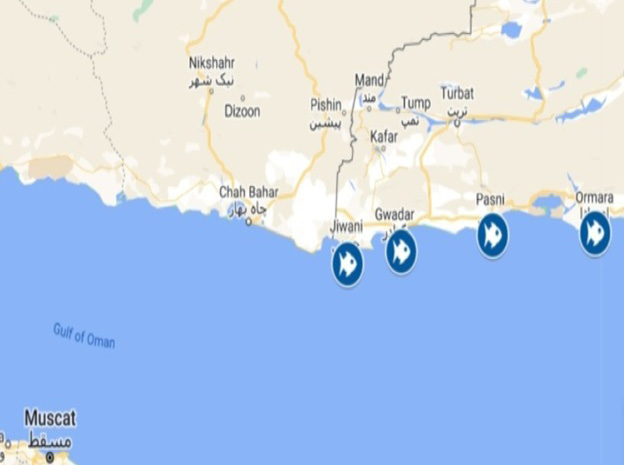
Sampling locations at the southwestern coast of Pakistan.
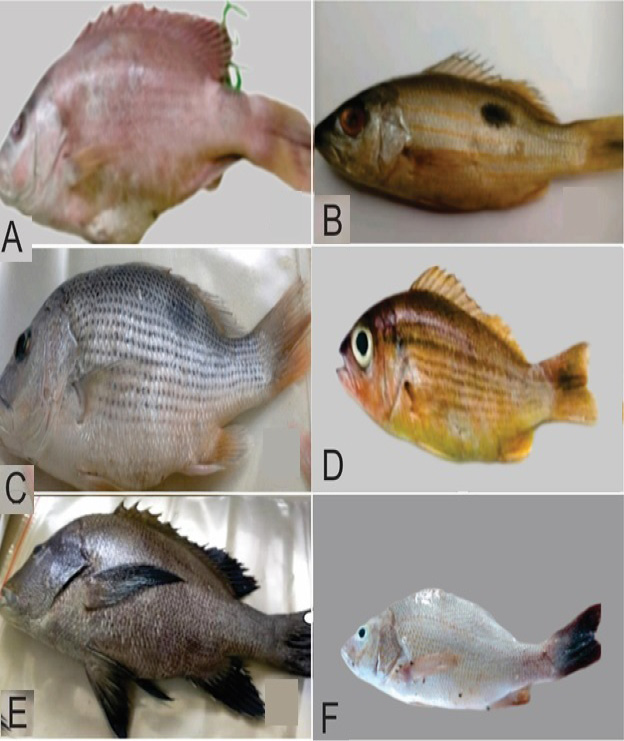
The figure showing the morphology of six Lutjanidae species from Southwestern Coast of Pakistan. A, Lutjanus erythropterus; B, L. ehrenbergi; C, L. johni; D, L. lutjanus; E, L. rivulatus; F, L. fulvus.
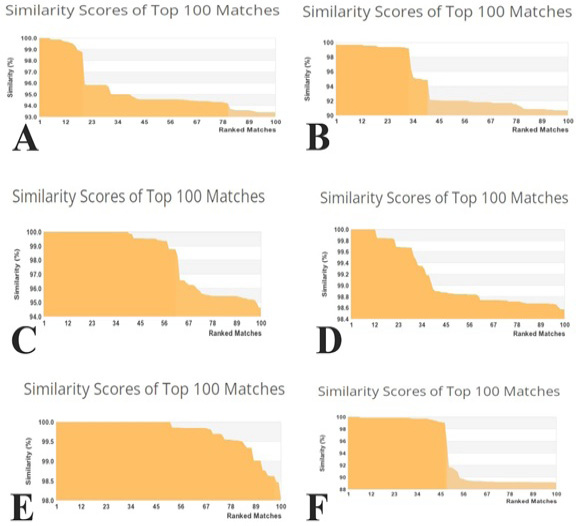
Similarity score of top 100 matches gained from BOLDv4 systemes. A, L. erythropterus; B, L. ehrenbergi; C, L. johni; D, L. Lutjanus; E, L. rivulatus; F, L. fulvus.
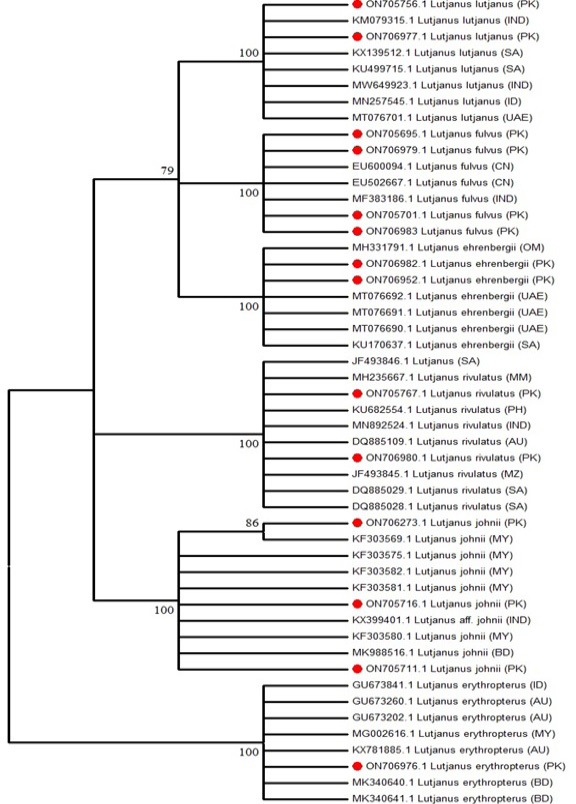
Neighbour joining tree of CO1 barcode for Lutjanus species (maximum composite likelihood method) only bootstrap values (thousand replicates) greater than 50 % are shown with samples collected from the south coast of Baluchistan.
References
- Ahmed, M.S., Datta, S.K., Saha, T. and Hossain, Z., 2021. Molecular characterization of marine and coastal fishes of Bangladesh through DNA barcodes. Ecol. Evol., 11: 3696-3709. https://doi.org/10.1002/ece3.7355[CrossRef]
- Allen, G.R., White, W.T. and Erdmann, M.V., 2013. Two new species of snappers (Pisces: Lutjanidae: Lutjanus) from the Indo-West Pacific. J. Ocean Sci. Found., 6: 33-51.
- Amir, S.A., Zhang, B., Masroor, R., Li, Y., Xue, D.X., Rashid, S. and Liu, J., 2022. Deeper in the blues: DNA barcoding of fishes from Pakistani coast of the Arabian Sea reveals overlooked genetic diversity. Mar. Biodiv., 52: 1-22. https://doi.org/10.1007/s12526-022-01272-6[CrossRef]
- Anderson, W.D. and Allen, G.R., 2003. Lutjanidae. Jobfishes. In: The living marine resources of the Western Central Atlantic (eds. K.E. Carpenter, V. Niem). Volume 5: Bony fishes part (Menidae to Pomacentridae). Food and Agriculture Organization of the United Nations Viale delle Terme di Caracalla, p. 2840–2918. Rome, Italy.
- Bakar, A.B.A., 2018. DNA barcoding of Malaysian marine fish, phylogenetics and phylogeography of the snappers (Perciformes: Lutjanidae). PhD thesis, Universiti Sains Malaysia.
- Betancure, R.R., Wiley, E.O., Arratia, G., Acero, A., Bailly, N., Miya, M. and Orti, G., 2017. Phylogenetic classification of bony fishes. BMC Evol. Biol., 17: 1-40. https://doi.org/10.1186/s12862-017-0958-3[CrossRef]
- Bingpeng, X., Heshan, L., Zhilan, Z., Chunguang, W., Yanguo, W. and Jianjun, W., 2018. DNA barcoding for identification of fish species in the Taiwan Strait. PLoS One, 13: 0198109. https://doi.org/10.1371/journal.pone.0198109[CrossRef]
- Chu, C., Rizman-Idid, M. and Chong, V.C., 2013. Phylogenetic relationships of selected genera of Lutjanidae inferred from mitochondrial regions, with a note on the taxonomic status of Pinjalo pinjalo. Ciencias Marinas, 39: 349-361. https://doi.org/10.7773/cm.v39i4.2287[CrossRef]
- Costa, F.O. and Carvalho, G.R., 2007. The barcode of life initiative: Synopsis and prospective societal impacts of DNA barcoding of fish. Genom. Soc. Policy, 3: 1-12. https://doi.org/10.1186/1746-5354-3-2-29[CrossRef]
- Ghouri, M.Z., Ismail, M., Javed, M.A., Khan, S.H., Munawar, N., Umar, A.B. and Ahmad, A., 2020. Identification of edible fish species of Pakistan through DNA barcoding. Front. Mar. Sci., 7: 554183. https://doi.org/10.3389/fmars.2020.554183[CrossRef]
- Habib, K.A., Neogi, A.K., Rahman, M., Oh, J., Lee, Y.H. and Kim, C.G., 2021. DNA barcoding of brackish and marine water fishes and shellfishes of Sundarbans, the world’s largest mangrove ecosystem. PLoS One, 16: 0255110. https://doi.org/10.1371/journal.pone.0255110[CrossRef]
- Hajibabaei, M., Singer, G.A., Hebert, P.D. and Hickey, D.A., 2007. DNA barcoding: how it complements taxonomy, molecular phylogenetics and population genetics. Trends Genet., 23: 167-172.
- Halim, L.J., Rahim, I., Mahboob, S., Al-Ghanim, K.A., Asmiaty, A.M.A.T. and Naim, D.M., 2022. Phylogenetic relationships of the commercial red snapper (Lutjanidae sp.) from three marine regions. J. King Saud Univ. Sci., 34: 101756. https://doi.org/10.1016/j.jksus.2021.101756[CrossRef]
- Hebert, P.D., Cywinska, A., Ball, S.L. and DeWaard, J.R., 2003. Biological identifications through DNA barcodes. Proc. R. Soc. Lon. B Biol. Sci., 270: 313-321. https://doi.org/10.1098/rspb.2002.2218[CrossRef]
- Hebert, P.D., Penton, E.H., Burns, J.M., Janzen, D.H. and Hallwachs, W., 2004. Ten species in one: DNA barcoding reveals cryptic species in the neotropical skipper butterfly Astraptes fulgerator. Proc. natl. Acad. Sci., 101: 14812-14817. https://doi.org/10.1073/pnas.0406166101[CrossRef]
- Iwatsuki, Y.U.K.I.O., Tanaka, F.U.M.I.Y.A. and Allen, G.R., 2015. Lutjanus xanthopinnis, a new species of snapper (Pisces: Lutjanidae) from the Indo-west Pacific, with a redescription of Lutjanus madras (Valenciennes 1831). J. Ocean Sci. Found., 17: 22-42.
- Iwatsuki, Y., Tanaka, F. and Allen, G.R., 2013. Lutjanus xanthopinnis, a new species of snapper (Pisces: Lutjanidae) from the Indo-Iranian. J. Ichthyol., 4: 69–74.
- Kimura, M., 1980. A simple method for estimating evolutionary rates of base substitutions through comparative studies of nucleotide sequences. J. mol. Evol., 16: 111–120. https://doi.org/10.1007/BF01731581[CrossRef]
- Lakra, W.S., Verma, M.S., Goswami, M., Lal, K.K., Mohindra, V., Punia, P. and Hebert, P., 2011. DNA barcoding Indian marine fishes. Mol. Ecol. Resour., 11: 60-71. https://doi.org/10.1111/j.1755-0998.2010.02894.x[CrossRef]
- Lamendin, R., Miller, K. and Ward, R.D., 2015. Labelling accuracy in Tasmanian seafood: An investigation using DNA barcoding. Fd. Contr., 47: 436–443. https://doi.org/10.1016/j.foodcont.2014.07.039[CrossRef]
- Psomadakis, P.N., 2015. Field identification guide to the living marine resources of Pakistan. FAO Species Identification Guide For Fishery Purposes.
- Sambrook, J., Fritsch, E.F. and Manlatis, T., 1989. Molecular cloning: A laboratory manual. 2nd ed., Cold spring Harbor Laboratory, Cold spring Harbor Laboratory Press, N.Y.
- Strauss, R.E. and Bond, C.E., 1990. Taxonomic methods: Morphology. Methods Fish Biol., pp. 109-140. https://doi.org/10.47886/9780913235584.ch4[CrossRef]
- Talwar, P.K. and Jhingran, A.G., 1991. Inland fishes of India and adjacent countries. CRC Press. Vol. 2.
- Talwar, P.K. and Kacker, R.K., 1984. Commercial sea fishes of India. (Ed. Director, Zool. Surv. India). Publ. Zool. Surv. India, pp. 743-755.
- Tamura, K., Stecher, G., Peterson, D., Filipski, A. and Kumar, S., 2013. MEGA6: molecular evolutionary genetics analysis version 6.0. Mol. Biol. Evol., 30: 2725-2729. https://doi.org/10.1093/molbev/mst197[CrossRef]
- Templonuevo, R.M., Alcantara, S., Juanico, C.S. and Yambot, A., 2018. DNA barcoding of two commercially important fish families (Carangidae and Lutjanidae) collected from Cuyo, Palawan, Philippines. Int. J. Agric. Technol., 14: 2051-2066.
- Velamala, G.R., Naranji, M.K., Kondamudi, R.B. and Netto-Ferreira, A.L., 2019. DNA barcoding of commercially important snapper species (Lutjaniformes; Lutjanidae; Lutjanus) from Visakhapatnam, Central Eastern coast of India. Mitochond. DNA A, 30: 585-591. https://doi.org/10.1080/24701394.2018.1551387[CrossRef]
- Vidya, P., Yashvant, K., Vishal, L. and Maviya, M., 2015. A overview of species identification by DNA barcoding. Int. J. Curr. Microbiol. appl. Sci., 4: 127-140.
- Wang, Z., Guo, Y., Tan, W., Li, L., Tang, E., Liu, C. and Liu, Y., 2010. DNA barcoding, phylogenetic relationships and speciation of snappers (genus Lutjanus). Sci. China Life Sci., 53: 1025-1030. https://doi.org/10.1007/s11427-010-4034-0[CrossRef]
- Ward, R.D., Zemlak, T.S., Innes, B.H., Last, P.R. and Hebert, P.D., 2005. DNA barcoding Australia’s fish species. Philos. Trans. R. Soc. B Biol. Sci., 360: 1847-1857. https://doi.org/10.1098/rstb.2005.1716[CrossRef]
- Willette, D.A., Simmonds, S.E., Cheng, S.H., Esteves, S., Kane, T.L., Nuetzel, H. and Barber, P.H., 2017. Using DNA barcoding to track seafood mislabeling in Los Angeles restaurants. Conserv. Biol., 31: 1076-1085. https://doi.org/10.1111/cobi.12888[CrossRef]
- Zhang, J.B. and Hanner, R., 2011. DNA barcoding is a useful tool for the identification of marine fishes from Japan. Biochem. Syst. Ecol., 39: 31-42. https://doi.org/10.1016/j.bse.2010.12.017[CrossRef]
Services
Article usage statistics
Loading…