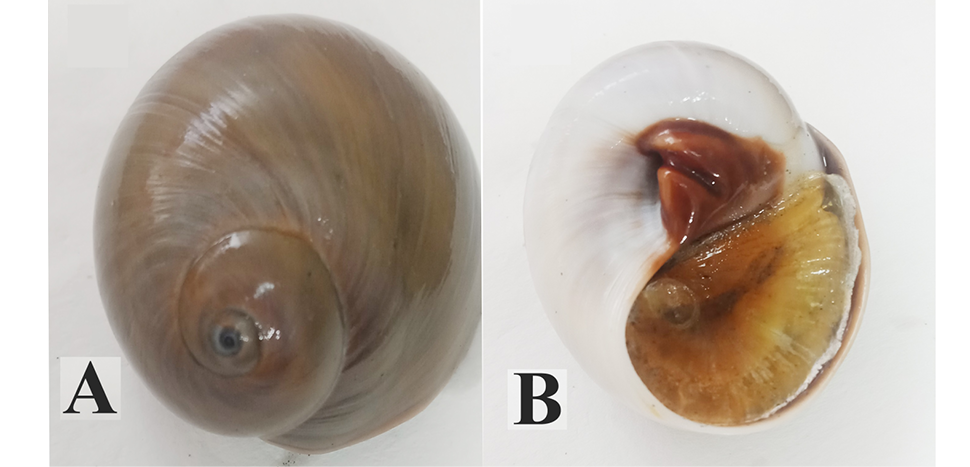
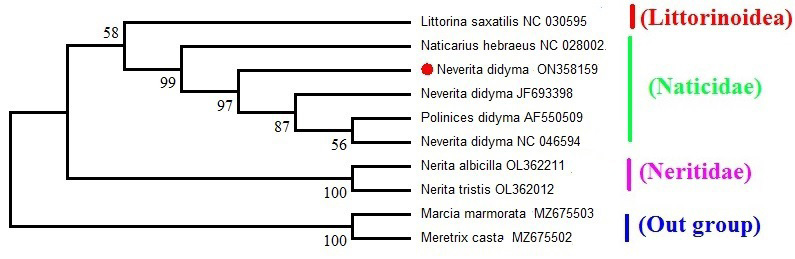
The Phylum Mollusca’s class Gastropoda contains a diverse range of organisms that live in several environments. Neverita didyma is a commercially important snail that is also known as the moon shell or bladder moon snail. Its molecular identification as N. didyma was confirmed in this investigation. The current study’s sequence has been submitted to NCBI under the accession number ON358159. It showed 91.36% similarity with the sequence under accession number NC046594. Neighbour- joining tree revealed that N.didyma from Pakistani coastal waters is distinctly clustered with other species of N. didyma. The present molecular-based confirmation of this species will be helpful for taxonomists, and biodiversity monitors.
Article Information
Received 17 May 2022
Revised 28 May 2022
Accepted 07 June 2022
Available online 20 September 2022
(early access)
Published 18 September 2023
Authors’ Contribution
AS collected samples, conducted experiments, data analysis. QI participated in the collection, typing, and reviewing. MS revised the manuscript. FM designed an experiment, generated funds, and wrote the article.
Key words
DNA barcode, Gastropods, Littorinimorpha, Naticidae, Pakistan
DOI: https://dx.doi.org/10.17582/journal.pjz/20220517060527
* Corresponding author: balouch_23@yahoo.com
0030-9923/2023/0005-2489 $ 9.00/0
Copyright 2023 by the authors. Licensee Zoological Society of Pakistan.
This article is an open access article distributed under the terms and conditions of the Creative Commons Attribution (CC BY) license (https://creativecommons.org/licenses/by/4.0/).
Gastropods live in several environments, including terrestrial, freshwater, and marine environments (Loker, 2010). During low tide, a variety of gastropods can be found along the coast. The gastropods in the marine environment are Euryhaline and have a diverse colour pattern (Haynes, 2005; Tan and Clements, 2008).
Neverita didyma belongs to the family of Naticidae commonly called moon shell or bladder moon snail. It is a carnivore animal and has sexual reproduction (Lee, 1999; Liu and Sun, 2009). It inhabits in the marine benthic environment. The species is widely distributed along the China coast, Indian Ocean, Madagascar, Mozambique, and South Africa. In China, this species has a significant economic and nutritional value (Liu et al., 2013; Zhao et al., 2018), yet no commercial use of this species has been reported in Pakistan and its research is also restricted to the work of (Khan and Dastgir, 1971; Tirmizi and Zehra, 1983; Barkati and Rehman, 2005; Kazmi et al., 2018; Ghani et al., 2018, 2019; Aslam et al., 2020). Khan and Dastgir (1971) described it as N. didyma, and Barkati and Rehman reported it as N. lamarkii in 2005. Until now, no molecular-based identification of this species was reported from this region.
It is significantly important to determine the potential natural resources of the region with an accurate taxonomic approach to understand the diversity of species in the area (Ran et al., 2020). Many species are very complex morphologically, therefore, the DNA bar code-based identifications are being appreciated worldwide. The molecular-based taxonomic investigations on Mollusca species from Pakistani coastal waters are limited to the work of (Zafar et al., 2016; Humayun et al., 2019; George et al., 2021).
The cytochrome oxidase subunit 1 (COX1) is considered suitable for investigations of genetic differentiation, taxonomy, and evolution of species. In the present investigation, we focused to confirm its identification and understanding of phylogenetic relationships. The molecular-based confirmation of this species will be helpful for bio-diversity monitors.