
Molecular identification and characterization of tephritid fruit flies (Diptera: Tephritidae), Bactrocera zonata, Bactrocera dorsalis and Bactrocera cucurbitae was done in Punjab, Pakistan through PCR analysis using mitochondrial cytochrome oxidase I (COI) gene based primers. Phylogenetic analysis was also complemented to differentiate fruit flies identified from other countries of the world. The sequencing results and phylogenetic analysis of collected specimens indicated that sequences of B. dorsalis, B. cucurbitae and B. zonata have 99-100% similarity with fruit flies reported from other countries. This is the first report of molecular identification and characterization of Tephritid fruit flies infesting fruits in Punjab, Pakistan.
Research Article · Volume 51, Issue 6, 5 September 2019 · Open Access
Molecular Identification and Characterization of Fruit Flies of Genus Bactrocera (Diptera: Tephritidae) in Pakistan
· · · ·
Affiliations & Notes ⌄
- 1Department of Entomology, University of Agriculture, Faisalabad 2Department of Botany, University of Agriculture, Faisalabad 3Department of Zoology, University of Agriculture Faisalabad 4Institute of Agricultural Sciences, Punjab University, Lahore , * Corresponding author: jam.ahmad@uaf.edu.pk
Article Info ⌄
- Journal:
- Pakistan Journal of Zoology
- Published:
- 5 September 2019

From the article
- Total of the 1,738 specimens collected from guava and mango orchards in Punjab, the morphological studies of the species using the light microscope revealed that 1,085 samples belonged to B. zonata, 446 to B. cucurbitae and 207 to B. dorsalis (Supplementary Fig. 1).
- The genetic evolutionary divergence among the studied species of Pakistan showed little genetic variation with closely related species whereas it exhibited increasing pattern of divergence for other species of genus Bactrocera as indicated in phylogenetic tree branches (Fig. 2).
- Alignment of sequences of fruit fly species showed 92% similarity between B. dorsalis, B. correcta and B. zonata.
- In Pakistan, only 3 Bactrocera species have been found in guava and mango orchards of Punjab, Pakistan as compared to many species reported from India.
Selected from the article's own text.
Abstract
Introduction
The fruit flies belonging to the family Tephritidae are almost present worldwide in all major fruit and vegetable growing area causing a high potential damage to vegetable and fruit crop production . In Indian subcontinent, nearly 325 species of fruit flies are present, of which 205 are from India . The fruit fly (Bactrocera spp.) is the most dangerous insect pest and a major yield limiting factor that causes 13.40 to 46.60% weight loss and 16 - 40% loss (Hasseb, 2011; Ukey et al., 2012). The most common fruit flies, Bactrocera dorsalis, B. zonata and B. cucurbitae belonging to genus Bactocera are the major widely occurring insect pests while B. correcta, B. diversa and B. latifrons are still confined to their place of origin . In Pakistan, fruit flies are pests of vegetable and fruit crops particularly for guava where B. zonata alone causes damage up to 5 to 100% . The main damage is caused during the development of larvae inside the fruit andtheir control is difficult by adopting a single control measure methodology (Dhilon et al., 2005). The morphological identification and separation of immature stages, adults or sibling species of fruit flies using diagnostic taxonomic keys require tedious procedure of microscopic observation of male genitalia of adults and preparation of samples (White and Hancock, 1987; . Further, for females or immature stages, unambiguous keys are not frequently available and substantial host overlapping and attraction to specific pheromone confined the use of this technique . The identification and differentiation of Bactrocera complexes is of utmost importance, therefore, DNA barcoding has been proposed to identify known species from single specimens based on cytochrome oxidase I (COI) gene ; . The objective of this research was to confirm the identification of fruit fly by DNA barcoding using mitochondrial COI gene.
Materials and methods
Methyl eugenol and cure lure treated cotton wicks were placed in fruit fly traps installed during 2017-2018 in a guava orchards surrounding with mango fields at Post Graduate Agriculture Research Centre (PARS), University of Agriculture Faisalabad. The adult specimens of three Bactrocera spp. were collected from infested fruits of guava in the same experimental farm. Before proceeding with the molecular identification, adult fruit flies were observed under light microscope (Micros, Austria) connected with camera (Canon EOS 750 D, USA). In addition, CD-ROM computer based tool from Lawson et al. (2003) was compared with those described in taxonomic keys of Drew and Hancock (1994) and Lawson et al. (2003). Some of the collected specimens were preserved in 75% alcohol or either stored at −20 °C in a freezer for molecular study. The Bactrocera zonata (Saunders), Bactrocera dorsalis (Hendel) and Bactrocera cucurbitae (Coquillett) species of fruit flies collected from orchards were investigated.
Total genomic DNA from adult body (legs) of fruit fly was extracted with slight modifications to increase DNA yield . Mitochondrial cytochrome oxidase I (mtCOI) based primers were employed for polymerase chain reaction (PCR) in PCR machine (PeqSTAR, Germany) with primers LCO-1490 (5´-GGTCAACAAATCATAAAGATATTGG-3´) and H C O - 2 1 9 8 ( 5 ´ -TAAACTTCAGGGTGACCAAAAAATCA-3´) according to described conditions ; . PCR amplified products were stored at -20 °C till gel electrophoresis and sequencing.
The amplified PCR products were tested for the confirmation of genomic DNA presence using gel electrophoresis in 1.5.0% agarose gel stained with ethidium bromide. The size of DNA fragments from fruit fly samples was estimated by comparing with 1 kb DNA marker (GeneMark-Korea). The amplified band corresponding to the target PCR product was documented using SYNGENE Gel documentation system under UV light.
The 710bp PCR products were sequenced directly in both directions using COI forward and reverse primers and analyzed using Lasergene v. 7.1 software package (DNASTAR, USA). The sequences were further aligned with CLUSTAL OMEGA multiple sequence alignment tool. The comparison of obtained sequences with sequences available in GenBank was accomplished using BLAST service available at http://www.ncbi.nlm.nih.gov:80/BLAST. Phylogenetic studies were performed with MEGA6 software employing the “Maximum Likelihood method” ; . The reference accession numbers of NCBI database sequences for B. dorsalis (KF998634.1, KF801366.1, KF801377.1, KF998789.1, KF318566.1), B. zonata (KP296150.1, KP851002.1, KT151121.1, KX758098.1, JX965418.1, KJ753909.1, KF801374.1) and B. cucurbitae (KJ753953.1, KJ753952.1, KT151115.1, JX129494.1, JX129494.1, KY113315.1, KY113291.1, KY113283.1) were used in construction of ML tree to differentiate Pak fruit flies samples (B. cucurbitae (MK296116); B. zonata (MK296117 (C) B. dorsalis (MK296118).
Results and DISCUSSION
Total of the 1,738 specimens collected from guava and mango orchards in Punjab, the morphological studies of the species using the light microscope revealed that 1,085 samples belonged to B. zonata, 446 to B. cucurbitae and 207 to B. dorsalis (Supplementary Fig. 1). The melon fly, B. cucurbitae, is larger than housefly and is principally an Asian species that can be distinguished morphologically by the presence of midial vita on scutum and apical spot, complete costal band and marking on R-M and Dm-Cu cross veins on wings (Supplementary Fig. 1). B. zonata is differentiable from the other species by the absence of central vita on scutum and by only narrow yellow lateral vita on each side of thorax. It is usually about the size of housefly and on wings; the costal band area is reduced to an apical spot and has no microtrichia in the narrowed basal area of cell br. There is usually a presence of one pair of dark marks on tergite III with no medial dark line except on tergite V (Supplementary Fig. 1B). B. dorsalis has a clear T shaped dark mark on the abdomen and continuous apical costal bands on the wings with two yellow stripes on thorax (Supplementary Fig. 1A). Supplementary Figure 2 shows the amplified products (710 bp) of COI of 9 DNAs of fruit flies.
The PCR products (710bp) were sequenced and aligned with a multiple sequence alignment tool (Supplementary Fig. 2). The result showed the highest percentage of nucleotides identity (99-100%) of the current studied NCBI submitted nucleotides sequences of B. cucurbitae (MK296116) B. zonata (MK296117) and B. dorsalis (MK296118) with NCBI available 3 Bactrocera sequences KJ753953.1, KP296150.1 and KF998634.1 respectively (Fig. 1). The99-100% identity of studied B. dorsalis DNA sequences with maximum score coverage (98-99) for B. dorsalis submitted sequences (KF998634.1, KF801366.1, KF801377.1, KF318566.1) was obtained (Table 1). The results also showed that identity of B. zonata and B. cucurbitae was 99% with the submitted sequences of B. zonatas (KP296150.1, KP851002.1, KT151121.1, KX758098.1, JX965418.1) and B. cucurbitae (KJ753953.1, KJ753952.1, KT151115.1, JX129494.1, JX129494.1, KY113315.1) whereas 94-93% similarity was observed for B. correcta (KJ753909.1), and B. dorsalis (KF801374.1), respectively (Table 1). The DNA sequences of studied Bactrocera species exhibited the same clade in phylogenetic tree whereas different clades were observed by different species of this genus (Fig. 2). The genetic evolutionary divergence among the studied species of Pakistan showed little genetic variation with closely related species whereas it exhibited increasing pattern of divergence for other species of genus Bactrocera as indicated in phylogenetic tree branches (Fig. 2). Molecular identification and differentiation of fruit flies have been reported, using mitochondrial DNA, 18 Bactrocera spp. except 2 (B. carambolae and B. papaya) and 3 (B. dorsalis, B. correcta and B. zonata) have
Table 1.- Comparison of the fragments of the cytochrome oxidase I (COI) gene of Bactrocera species collected from guava and mango orchards of Punjab, Pakistan with those available in the GenBank.
| Pakistani strains | Bactrocera species | Identity | Accessions numbers |
| MK296116 B. cucurbitae isolate FSD-03 | Bactrocera cucurbitae voucher GSY2 | 99% | KJ753953.1 |
| Bactrocera cucurbitae voucher GSY1 | 99% | KJ753952.1 | |
| Bactrocera cucurbitae voucher GB245247 | 99% | KT151115.1 | |
| Bactrocera carambolae isolate FF13_ | 99% | JX129494.1 | |
| Bactrocera cucurbitae isolate UKM000163 | 99% | JX129494.1 | |
| Zeugodacus cucurbitae isolate KD708 | 99% | KY113315.1 | |
| Zeugodacus cucurbitae isolate TL2815 | 99% | KY113291.1 | |
| MK296117 B. zonata isolate FSD-16 | Bactrocera zonata mitochondrion | 99% | KP296150.1 |
| Bactrocera zonata mitochondrion | 99% | KP851002.1 | |
| Bactrocera zonata voucher GB170 | 99% | KT151121.1 | |
| Bactrocera zonata isolate 32 hasa1 | 99% | KX758098.1 | |
| Bactrocera zonata isolate tao | 94% | JX965418.1 | |
| Bactrocera correcta voucher FSL5 | 93% | KJ753909.1 | |
| Bactrocera dorsalis isolate BX120711-056 | 91% | KF801374.1 | |
| MK296118 B. zonata isolate FSD-18 | Bactrocera dorsalis voucher DUHA1 | 100% | KF998634.1 |
| Bactrocera dorsalis isolate BX120426-003 | 99% | KF801366.1 | |
| Bactrocera dorsalis isolate BX120711-138 | 99% | KF801377.1 | |
| Bactrocera dorsalis strain SH2 | 99% | KF318566.1 |
also been identified from other countries ; . Alignment of sequences of fruit fly species showed 92% similarity between B. dorsalis, B. correcta and B. zonata. Similarly, Chua et al. (2009) studied species identification of Bactrocera spp. using COI (F/R) and UEA (F/R) based primers and RFLP analysis. In Pakistan, only 3 Bactrocera species have been found in guava and mango orchards of Punjab, Pakistan as compared to many species reported from India.
Conclusion
The only three species belonging to the family Tephritidae (B. dorsalis, B. correcta and B. zonata) was found and collected from guava and mango orchards in Punjab. COI gene was successfully used for their identification and characterization of Bactrocera spps.
Acknowledgements
Authors are highly grateful to Higher Education Commission of Pakistan (HEC) under grant (No.204535/NRPU/R&D/HEC/14/159) and Framework of Institutional Cooperation Program (FICP-Pak-Norway Grant) to Dr. Jam Nazeer Ahmad and Dr. Samina Jam Nazeer Ahmad for providing funds for research and to establish well equipped Integrated Genomics, Cellular, Developmental and Molecular Biotechnology Research Laboratory (IGCDB) at University of Agriculture Faisalabad, Pakistan.
Supplementary material
There is supplementary material associated with this article. Access the material online at: http://dx.doi.org/10.17582/journal.pjz/2019.51.6.2275.2280
Statement of conflict of interest
The authors declare no conflict of interest.
Figures
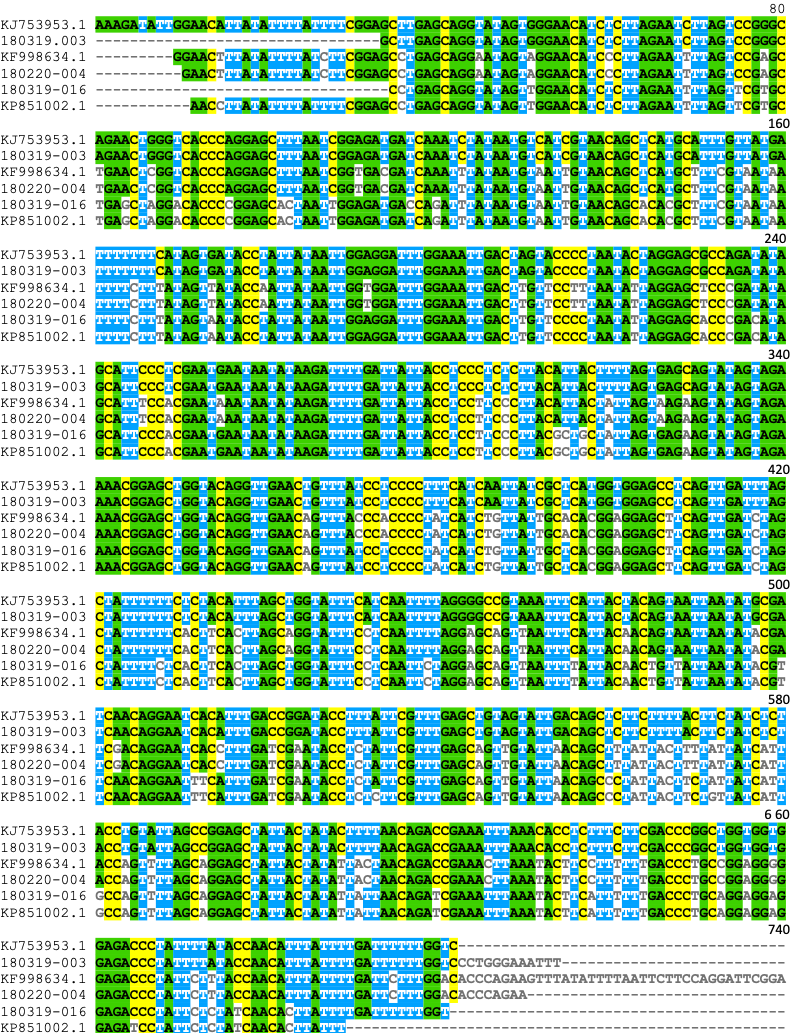
Multiple alignments of DNA sequences through CLUSTAL OMEGA from DNA amplification of 3 Pakistani Bactrocera species, B. cucurbitae 180319-003 (MK296116) isolate FSD-03, B. dorsalis 180319-004 (MK296118)isolate FSD-18 and B. zonata 180319-016 (MK296117) isolate FSD-16 with NCBI GenBank sequences, B. Cucurbitae (KJ753953.1), B. dorsalis (KF998634.1) and B. zonata (KP851002.1)
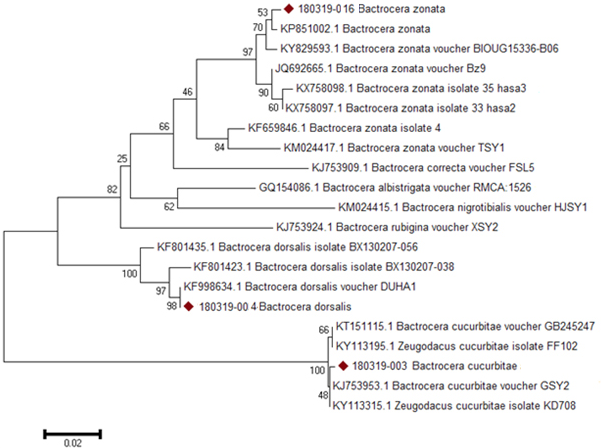
Phylogenetic analysis by Maximum Likelihood Method produced from DNA sequences of 3 Bactrocera species using mitochondrial Cytochrome oxidase I (mCOI) gene based primers. (A) B. cucurbitae 180319-003 (MK296116) (B) B. zonata 180319-016 (MK296117) (C) B. dorsalis 180319-004 (MK296118)
References
- Ahmad, J.N., Ahmad, S.J.N., Ahmad, M.A., Contaldo, N., Paltrinieri, S. and Bertaccini. A.A., 2017. Molecular and biologic characterization of a phytoplasma associated with Brassica campestrisphyllody disease in Punjab province, Pakistan. Eur. J. Pl. Pathol., 149: 117-125.
- Ahmad, J.N., Rashid M., Ahmad S.J.N., Maqsood, S., Ahuja, I. and Bones, A.M., 2018. Molecular identification and pathological characteristics of NPV isolated from Spodoptera litura (Fabricius) in Pakistan. Pakistan J. Zool., 50: 2229-2237. https://doi.org/10.17582/journal.pjz/2018.50.6.2229.2237[Full text][CrossRef]
- Asokan, R., Krishna, K.N.K. and Verghese, A., 2007. Molecular identification of fruit flies, Bactrocera spp. (Diptera: Tephritidae) using mitochondrial cytochrome oxidase I. Curr. Sci., 93: 1668-1669.
- Chua, T.H., Chong, Y.V. and Lim, S.H., 2009. Species determination of Malaysian 225 Bactrocera pests using PCR-RFLP analyses (Diptera: Tephritidae). Pest Manage. Sci., 66: 379-384.
- Clarke, A.R., Armstrong, K.F., Carmichael, A.E., Milne, J.R., Raghu, S. and Roderick. G.K., 2005. Invasive phytophagous pests arising through a recent tropical evolutionary radiation: The Bactrocera dorsalis complex of fruit flies. Annu. Rev. Ent., 50: 293-319. https://doi.org/10.1146/annurev.ento.50.071803.130428[CrossRef]
- Dhillon, M.K., Singh, R., Naresh, J.S. and Sharma, H.C., 2005. The melon fruit fly, Bactrocera cucurbitae: A review of its biology and management. J. Insect Sci., 5: 1-16. https://doi.org/10.1093/jis/5.1.40[CrossRef]
- Drew, R.A.I. and Hancock, D.L., 1994. The Bactrocera dorsalis complex of fruit flies (Diptera: Tephritidae: Dacinae) in Asia. Bull. entomol. Res. Suppl. Ser. 2: 1-68.
- Fleming, C.C., Rao, J., Moreland, B., Craig, D. and Turner, S.J., 2000. Diagnostics of cyst nematodes and tephritid fruit flies using mitochondrial and ribosomal DNA. OEPP/EPPO Bull., 30:585-590. https://doi.org/10.1111/j.1365-2338.2000.tb00952.x[CrossRef]
- Hasseb, M., 2007. Current status of insect pest problems in guava. Acta Hort., 735:453-467. https://doi.org/10.17660/ActaHortic.2007.735.63[CrossRef]
- Haymer, D.S. and Douglas, L.J., 2001. The ESA Annual Meeting. An Entomological Odyssey of ESA (Ecological Society of America).
- Hebert, P.D.N., A. Cywinska., S.L. Ball. and J.R. Dewaard. 2003. Biological identifications through DNA barcodes. Biol. Sci., 270: 313-321. https://doi.org/10.1098/rspb.2002.2218[CrossRef]
- Kapoor, V.C., 2005. Taxonomy and biology of economically important fruit flies of India. Isr. J. Ent., 459: 35-36.
- Lawson, A.E., McGuire, D.J. Yeates, D.K. Drew, R.A.I and Clarke, A.R., 2003. Griffith University Brisbane, Australia. (Multimedia CD- ROM)
- Manzoor, M., Ahmad, J.N., Giblin-Davis, R.M. and Arif, M.J., 2018. Molecular identification and phylogenetic analysis of distinct geographical populations of Rhynchophorus ferrugineus (Olivier) (Coleoptera: Curculionidae) in Pakistan Int. J. Agric. Biol., 20: 1997-2004.
- Muraji, M., Nakahara, S., 2002. Discrimination among pest species of Bactrocera (Diptera: Tephritidae) based on PCR-RFLP of the mitochondrial DNA. Appl. Ent. Zool., 37: 437-446. https://doi.org/10.1303/aez.2002.437[CrossRef]
- Meagher, R.L., Brambil, J. and Hung, E., 2008. Monitoring for exotic Spodoptera Species (Lepidoptera: Noctuidae) in Florida. Fla. Entomol., 91: 517-522.
- Nagoshi, R.N. and Meagher, R.L., 2003. FR tandem-repeat sequence in fall armyworm (Lepidoptera: Noctuidae) host strains. Annls. entomol. Soc. Am., 96: 329-335. https://doi.org/10.1603/0013-8746(2003)096[0329:FTSIFA]2.0.CO;2[CrossRef]
- Nei, M. and Kumar, S., 2000. Molecular evolution and phylogenetics. Oxford University Press, New York
- Pogue, M. G., 2002. A world revision of the genus Spodoptera Guenée (Lepidoptera: Noctuidae). Mem. Am. entomol. Soc., 43: 1-202
- Syed, R.A., Ghani, M.A. and Murtaza, M., 1970. Studies on the tephritids and their natural enemies in West Pakistan. III. Dacus zonatus (Saunders). Tech. Bull. Commonw. Inst. Biol. Contr., 1970: 1-16.
- Stonehouse, J.M., Verghese, A., Mumford, D.J., Thomas, J., Jiji, T., Faleiro, F., 2005. Research conclusions and recommendations for the on–farm IPM of Tephritid fruit flies in India. Pest Manage. Hortic. Ecosys., 11:172-180.
- Tamura K., Stecher, G., Peterson, D., Filipski. A. and Kumar, S., 2013. MEGA6: Molecular evolutionary genetics analysis version 6.0. Mol. Biol. Evol., 30: 2725-2729 https://doi.org/10.1093/molbev/mst197[CrossRef]
- Ukey, N.S., Galande, S.M., Wagh, S.S., 2005. Studies on losses of guava fruits by fruit fly, Bactrocera spp. in Pune region of Maharashtra state. Int. J. Pl. Prot., 5(1):181-182.
- White, I.M. and Elson-Harris, M., 1992. Fruit flies of economic significance: Their identification and bionomics. CAB International, Wallingford, Oxon, UK.
- White, I.M. and Hancock, D.L., 1997. CABIKEY to the Dacini (Diptera: Tephritidae) of Asian, Pacific and Australasia Regions. CAB International, Wallingford, Oxon, UK.
Supplementary material
Cited by 3 articles
In journals published by ResearchersLinks.
- Field Evaluation of Different Pest Management Strategies against Citrus Fruit Fly, Bactrocera dorsalis HendelPunjab University Journal of Zoology · 2023
- DNA Barcodes of Southeast Asian Spiders of Wheat Agro-ecosystemPakistan Journal of Zoology · 2020
- Sub-lethal Dose Reponses of Native Polyhydroviruses and Spinosad for Economical and Sustainable Management of Spodoptera litura in PakistanPakistan Journal of Zoology · 2020
Services
Article usage statistics
Loading…