
Fruit flies (Diptera: Tephritidae) species pose a significant threat to mango and citrus production worldwide including Pakistan. In the present study we identified and monitored the population dynamics of fruit flies species using male attractants Attrex® (methyl eugenol 98%, evyol group) and static Spinosad® (spinosad 2% and methyl eugenol 51%, target group) in mango and citrus orchards at different locations in Multan, Southern Punjab, Pakistan. Bactrocera zonata (Saunders) was the most abundant fruit fly species in this study. Our results indicated a positive and significant correlation between the species of fruit flies and mean temperature in mango and citrus orchards at all locations. In mango orchards, peak population of fruit fly complex was recorded from June to July, a period when the mangoes ripe and mean temperature is high. In citrus orchards, minimum population was observed from January to February, a period when the citrus fruit is available in the orchard but the temperature is too low for larval development. Several factors such as temperature, availability of preferred host and alternate host could contribute towards the population buildup of fruit flies in this region.
Research Article · Volume 54, Issue 1, 11 December 2021 · Open Access
Population Dynamics of Tephritid Fruit Flies in Citrus and Mango Orchards of Multan, Southern Punjab, Pakistan
· · ·
Affiliations & Notes ⌄
- 1Department of Entomology, Faculty of Agricultural Sciences and Technology, Bahauddin Zakariya University, Multan, Punjab, Pakistan 60800 2Pakistan Museum of Natural History, Garden Avenue, Islamabad , * Corresponding author: muhammadrazaq@bzu.edu.pk
Article Info ⌄
- Journal:
- Pakistan Journal of Zoology
- Published:
- 11 December 2021

From the article
- We recorded four species of fruit flies i.e. B. dorsalis, B. cucurbitae, B. zonata and B. correcta.
- From the present study it can be concluded that temperature and availability of preferred host and other host could regulate the population dynamics of fruit fly complex in space and time.
- Thus, it is of considerable importance to monitor fruit fly abundance spatially and temporally all the year around, as the obtained data could be used in developing forecasting models with respect to temperature and the ripening period of the available host crops in the Multan district of Southern Punjab, Pakistan.
Selected from the article's own text.
Abstract
INTRODUCTION
Mango and citrus are important fruits in the Pakistan. These are not only consumed in the country but also important for foreign exchange earnings . Fruit flies (Diptera: Tephritidae) represent a significant threat to mango and citrus production in Pakistan , b). Tephritid fruit flies consist of over 4000 species, of which almost 700 species belong to Sub-family Dacinae . Nearly, 250 species are of economic importance, and are distributed in temperate, sub-tropical and tropical parts of the world . Fruit flies species caused heavy annual farm field losses were estimated at $200 million in Pakistan . Of the 43 species in genus Bactrocera, 11 species have been identified from Pakistan . The the prominent pest complex of fruit flies is comprised of oriental fruit fly, Bactrocera dorsalis (Hendel), melon fruit fly, Bactrocera cucurbitae (Coquillett) and Bactrocera zonata (Saunders) ; ; .
Owing to polyphagous nature, fruit flies feed on a large number of fruit crops including apple, bitter gourd, guava, ber, mango, citrus and muskmelon ; . However, the extent of losses to fruits varies according to fruit fly species and the host plant species . Literature reports exponential increase in losses due to tephritids in Pakistan. A study reported that B. dorsalis caused 30% losses in mango fruit production individually however along with B. zonata it caused 35 % losses . Fruit flies caused 50-55% fruit losses in guava and 74.66% losses in mango orchards. Fruit fly species cause severe trade restrictions, valuable fruits losses and market access loss to traders, producers and governments .
Economic importance of fruit flies in genus Bacterocera is well contributed by many factors such as high reproductive rate, successful dispersion and a wide range of host crops . For the reproduction, survival and development of tephritid fruit fly species, temperature as well as adult nutrition play an important role , 1989). Weather and climatic fluctuations not only affect the insect population build up but also affect intensity, feeding behavior and distribution of insects . Monitoring of pest spatially and temporally is of considerable importance in developing IPM and decision making ; ; . Attraction of male fruit flies using pheromone traps is an important monitoring tool for fruit flies . No research reports species complex, spatial and temporal distribution of fruit flies from Multan region. Therefore, the present study was aimed at to record species complex and monitor the dynamics of fruit flies in mango and citrus orchard at experimental and commercial farms at southern Punjab, Pakistan.
MATERIALS AND METHODS
To monitor the population dynamics of adult male fruit flies, field studies were carried out at two different locations in 2016-17. The selected sites were Experimental orchards of Bahauddin Zakariya University (hereafter referred to as BZU) (30°25’74’’N, 71°51’43”E, 125 feet altitude) and commercial orchard at Lutaf Abad (hereafter referred to as LA), Band Bosan Road (30°27’90’’N, 71°49’71”E, 125 feet altitude) Multan. The mango orchard of BZU was of 4 hectares located near Bio Park, in which most of the mango trees were 20-25 years old and with Chaunsa variety. Experimental orchards at BZU were surrounded by the different ornamentals plants. Mango orchards at LA had variety Dusheri on 6 hectares with age of 20-25 year. Experimental orchard was surrounded by other varieties of mangoes i.e. Malda and Anwar Retaul. Insecticides were not applied on experimental sites but recommended cultural practices by Agriculture Department were adopted.
Citrus orchards were located at Faculty of Agricultural Sciences and Technology (FAST) and in BZU near Bio Park, both were 2 km apart. Both these will be referred as FAST and Bio Park orchards in the manuscript for ease. The citrus trees of FAST and Bio Park orchards were 10-12 years old consisting of variety Kinnow with an area of 1.6-2.0 hectares. Both the orchards at FAST and Bio Park were surrounded by different forest tress.
Commercial cylindrical plastic pheromone traps were used for the monitoring of adult population densities of male fruit flies. Each trap was 24cm in length and 12cm in diameter. The trap had 2 holes form each side for entrance of fruit flies. Male attractant Attrex® (methyl eugenol 98%, evyol group) and static spinosad® (spinosad 2% and methyl eugenol 51%, target group, Multan, Pakistan) were used in the research. The attractant was applied on cotton vick with help of forceps and kept in the trap. A 4g spinosad was poured inside the trap with the help of plastic tea spoon. The male fruit flies attracted towards the methyl eugenol and static spinosad. Male flies were unable to escape and killed due to insecticide. The traps were hanged with the help of strings with tree shoots in represented areas at the height of 2.5-2.7 meter above the ground.
Traps were installed in the mango orchards at both the locations from June to October in 2016 whereas traps were installed in citrus orchards at FAST from September to May in 2016-17. Traps at citrus orchard at Bio Park were installed from February to May in 2017. Traps were refreshed fortnightly and to record densities of adult male fruit flies, traps were removed from trees, and specimens were collected, brought to laboratory and counted. Some specimens (not damaged) were preserved as wet and dry collection and others were discarded. Fruit flies were identified using key developed by Mahmood and Hassan (2005). To find the association between fruit flies and temperature, both variables were subjected to Pearson correlation analysis. Analysis was performed in SPSS version 21.0. All graphs were prepared in the Microsoft excel version 2010.
RESULTS AND DISCUSSION
We recorded four species of fruit flies i.e. B. dorsalis, B. cucurbitae, B. zonata and B. correcta. The most abundant species in these was B. zonata (60%) followed by B. dorsalis (22%), B. cucurbitae (16%), and B. correcta (2%). These species have also been previously reported from various districts of Pakistan ; ; ; . However, abundance and occurrence of fruit fly species could be variable with respect to biotic and abiotic factors, type of food and topography of area ; .
Population dynamics of fruit fly in mango orchards
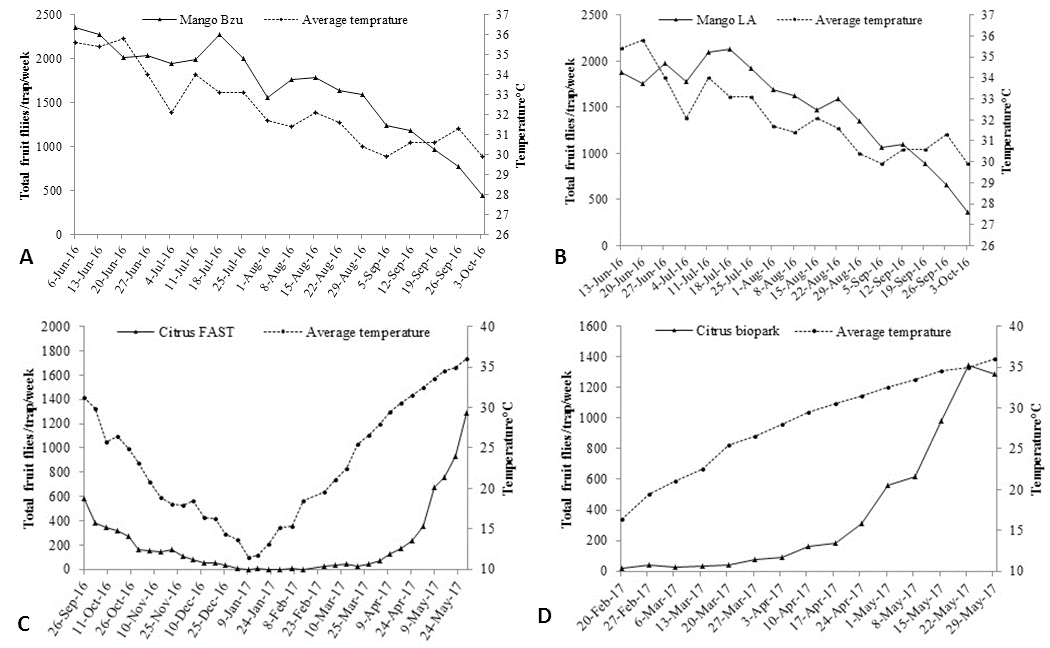
The correlation analysis indicated that the fruit flies captured per trap per week were positively and significantly correlated (r=0.80, P <0.001) with the mean temperature at mango orchard of BZU, Multan. One week after the installation of traps on 6 June, the maximum numbers of fruit flies were recorded (2356/trap) with mean temperature 35.6°C. Afterward, from June 13th to July 11th the fruit flies population gradually decreased (2279 to 1987/trap) with mean temperature decreasing from 35.4 to 34°C. Thereafter, a sudden peak appeared on July 18th (2275/trap) with mean temperature 33.1°C. On August 1st the population suddenly decreased and reached to 1560 with mean temperature 31.7°C. Gradual decrease in population continued from August 22nd to October 3rd (1639 to 445/trap) with mean temperature decreasing from 31.6 to 29.9°C (Fig. 1A).
We also recorded positive and significant correlation between the fruit flies captured per trap per week and the mean temperature (r=0.73, P=0.001) at commercial mango orchard of LA. Similar trend in population fluctuation of fruit fly species were observed as noted in BZU orchard with respect to temperature. The maximum fruit flies numbers recorded per week were 2130/trap with mean temperature of 33.1°C on July 18th. Thereafter, population declined from August 29th to October 3rd (1347 to 360/traps) and with mean temperature decreasing from 30.4 to 29.9°C (Fig. 1B).
Our findings suggested that population dynamics of fruit flies species in the mango orchard at BZU or the commercial orchard at Lutaf Abad was positive and in significant correlation with mean temperature. In past, various studies have documented that abiotic factors such as temperature and rainfall could contribute in regulating the population build-up of fruit flies ; . Many studies also reported that there existed a positive and significant correlation between mean temperature and number of fruit flies captured per trap ; ; .
In current study, peak populations of tephritids were recorded during June and July due to availability of ripened fruits in the mango orchard coupled with the favorable temperature during these months ; . However, from mid-August to October the population decreased due to decrease in temperature and lower availability of fruits. Khan and Naveed (2017) reported after August the fruit fly population started to decline and reached to significantly lower numbers in October. However, in our findings, from mid-August till October, the population decreased but not dropped down to 0 as we got 445 fruit fly adults from BZU orchard and 360 from LA orchard on October 3rd. The availability of fruit flies in higher numbers as compared to the previous studies, even in the absence of mangoes in the orchard indicated that this might be due to the availability of fruits of late varieties in commercial orchards due to economic concerns. This could also be due to other host crops available in the surroundings like vegetables. Further, the availability of fallen fruits at both mango orchards could serve as residential breeding sites for fruit flies. The adoption of proper sanitation measures such as removal of fallen fruits could reduce the fruit damage by fruit fly . Cultivated fruit species such as mango or gauva and fruiting duration also affect the population dynamics of fruit flies of genus Bactrocera.
Population dynamics of fruit fly complex at citrus orchard of FAST and Bio Park
The correlation analysis showed that the fruit flies captured per trap per week at citrus orchard of FAST were positively and significantly correlated (r=0.763, P <0.001) with the mean temperature. In the last week of September numbers of fruit flies recorded were 579/trap at mean temperature 31.3°C on September 26th. Afterward, population of fruit fly complex gradually declined (379 to 31/trap) from October 3rd to December 25th with mean temperature decreasing from 29.9 to 14.3°C. From January 9th to February 13th, no fruit flies were captured in the traps at temperature ranging from 11.4-18.4°C. Thereafter, fruit flies appeared in the last week of February and the population gradually increased (27 to 1290/trap) from February 27th to May 29th with mean temperature increasingfrom 19.5 to 36°C (Fig. 1C).
We also noted that the fruit flies captured per trap per week at Bio Park BZU were positively and significantly correlated (r=0.793, P <0.001) with the mean temperature. We observed similar trends in population fluctuation of fruit fly complex as did in citrus orchard of FAST with respect to temperature. Fruit fly population started to increase from February 27th to May 29th from 37 to 1285/trap with mean temperature increasing from 19.5 to 36°C (Fig. 1D).
Our findings suggested that population dynamics of fruit flies complex in the citrus orchard at FAST was in positive and significant correlation with mean temperature. Many studies reported that there existed a positive and significant correlation between mean temperature and number of fruit flies captured per trap ; ; . From end of September till end of November in citrus orchard at FAST, the fruit fly population slightly declined due to continuously decreasing temperature and almost disappeared during January and February. Citrus fruit is available during January and February, but the fruit fly population could not increase due to low temperature in these months (Fig. 1C, D). Our findings regarding low population build-up of fruit fly complex despite the ripen fruit availability in these months are in accordance with Mahmood and Mishkatullah (2007).
At both citrus orchard locations i.e. FAST and Bio Park, from March to May population increased due to increase in mean temperature. Mahmood and Mishkatullah (2007)reported that from March to August the fruit fly population increased due to increase in temperature. We observed quite higher numbers of fruit flies from March to May in our traps despite no ripen fruits of citrus were available in orchards. Similar findings regarding high population densities of fruit flies at the vegetative and flowering stages of preferred host were reported by Hendrichs and Hendrichs (1990) that indicates that fruit flies continued visiting the citrus orchards in search of food and shelter. In addition, fruits of the vegetables particularly cucurbits were available in the surrounding areas; those might have been used as food source. Phenological association of fruit fly generations with the ripening period of preferred host could be responsible for population fluctuations around the year .
CONCLUSION
From the present study it can be concluded that temperature and availability of preferred host and other host could regulate the population dynamics of fruit fly complex in space and time. Thus, it is of considerable importance to monitor fruit fly abundance spatially and temporally all the year around, as the obtained data could be used in developing forecasting models with respect to temperature and the ripening period of the available host crops in the Multan district of Southern Punjab, Pakistan.
Statement of conflict of interest
The authors have declared no conflict of interest.
Figures
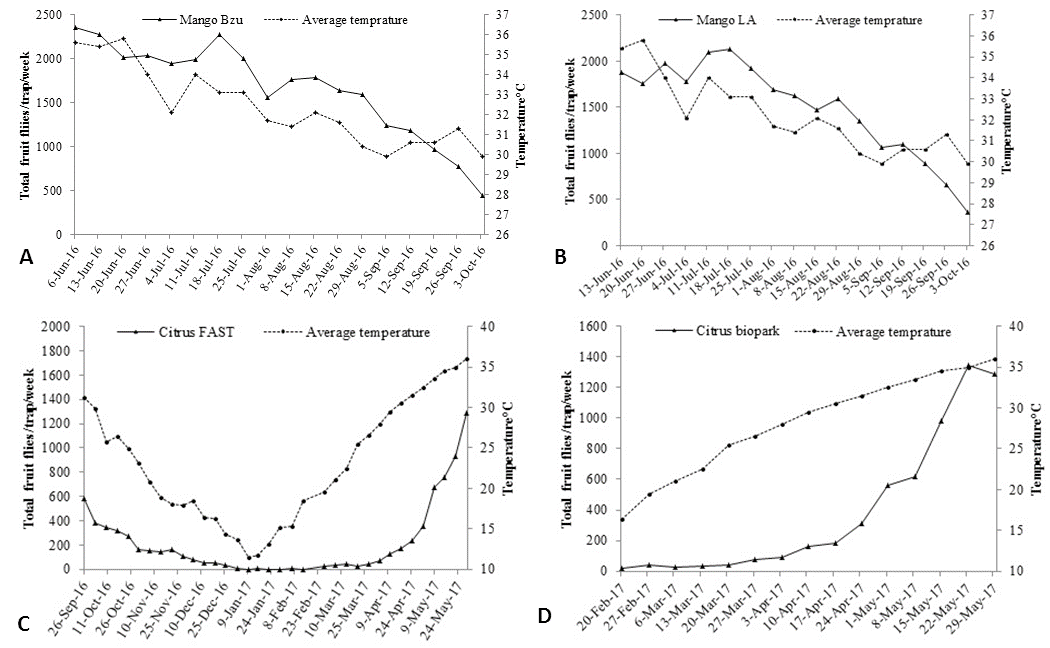
Population dynamics of captured male fruit flies/trap/week in mango orchard of Bio Park BZU, Multan during 2016 (A), mango orchard of Lutaf Abad (LA) during 2016 (B), in citrus orchard of FAST, BZU, Multan during 2016-17 (C) citrus orchard of Bio Park, BZU, Multan during 2017 (D).
Population dynamics of captured male fruit flies/trap/week in mango orchard of Bio Park BZU, Multan during 2016 (A), mango orchard of Lutaf Abad (LA) during 2016 (B), in citrus orchard of FAST, BZU, Multan during 2016-17 (C) citrus orchard of Bio Park, BZU, Multan during 2017 (D).
References
- Agarwal, M., Rahman, S., Singh, S.and Yazdani, S., 1995. Weather conditions and population dynamics of Bactrocera dorsalis (Hendel). J. Res. Birsa Agric. Univ., 7: 149-152.
- Amice, R. and Sales, F., 1997. Seasonal abundance of fruit flies in New Caledonia. In: Management of fruit flies in the Pacific (eds. A.J. Allwood and R.A.I. Drew). ACIAR Proc., 76: 134–139.
- Bart, J., Fligner, M.A., Notz, W.I. and Notz, W., 1998. Sampling and statistical methods for behavioral ecologists. Cambridge University press, Cambridge, UK. https://doi.org/10.1017/CBO9780511612572[CrossRef]
- Bateman, M., 1972. The ecology of fruit flies. Annu. Rev. Ent., 17: 493-518. https://doi.org/10.1146/annurev.en.17.010172.002425[CrossRef]
- Christenson, L. and Foote, R.H., 1960. Biology of fruit flies. Annu. Rev. Ent., 5: 171-192. https://doi.org/10.1146/annurev.en.05.010160.001131[CrossRef]
- Dhillon, M., Singh, R., Naresh, J. and Sharma, H., 2005. The melon fruit fly, Bactrocera cucurbitae: A review of its biology and management. J. Insect Sci., 5: 1-16. https://doi.org/10.1093/jis/5.1.40[CrossRef]
- Drew, R. and Hooper, G., 1983. Population studies of fruit flies (Diptera: Tephritidae) in South-East Queensland. Oecologia, 56: 153-159. https://doi.org/10.1007/BF00379685[CrossRef]
- Fletcher, B., 1987. The biology of Dacine fruit flies. Annu. Rev. Ent., 32: 115-144. https://doi.org/10.1146/annurev.en.32.010187.000555[CrossRef]
- Fletcher, B.S., 1989. Temperature-development rate relationships of the immature stages and adults of Tephritid fruit flies. In: Fruit flies: Their biology, natural enemies and control (eds. A.S. Robinson and G. Hooper). Elsevier, Amsterdam, The Netherlands, pp. 273-289.
- Follett, P.A. and Neven, L.G., 2006. Current trends in quarantine entomology. Annu. Rev. Entomol., 51: 359-385. https://doi.org/10.1146/annurev.ento.49.061802.123314[CrossRef]
- Ghafoor, A., Mustafa, K., Zafar, I. and Mushtaq, K., 2010. Determinants of mango export from Pakistan. J. agric. Res., 48: 105-119.
- Han, P., Wang, X., Niu, C.Y., Dong, Y.C., Zhu, J.Q. and Desneux, N., 2011. Population dynamics, phenology, and overwintering of Bactrocera dorsalis (Diptera: Tephritidae) in Hubei Province, China. J. Pest Sci., 84: 289-295. https://doi.org/10.1007/s10340-011-0363-4[CrossRef]
- Hasyim, A., Muryati, M. and De Kogel, W., 2008. Population fluctuation of adult males of the fruit fly, Bactrocera tau Walker (Diptera: Tephritidae) in passion fruit orchards in relation to abiotic factors and sanitation, Indonesia. Agric. Sci., 9: 29-33. https://doi.org/10.21082/ijas.v9n1.2008.29-33[CrossRef]
- Hendrichs, J. and Hendrichs, M.A., 1990. Mediterranean fruit fly (Diptera: Tephritidae) in nature: Location and diel pattern of feeding and other activities on fruiting and non-fruiting hosts and non-hosts. Annls entomol. Soc. Am., 83: 632-641. https://doi.org/10.1093/aesa/83.3.632[CrossRef]
- Kafi, A., 1986. Progress and problems in controlling fruit flies infestation. Paper presented at FAO expert consultation on progress and problems in controlling fruit fly infestation, RAPA, Bankock, December 1986, pp. 16-19.
- Kakar, M.Q., Ullah, F., Saljoqi, A.u.R., Ahmad, S. and Ali, I., 2014. Detremination of fruit flies (Diptera: Tephritidae) infestation of guava, peach and bitter gourd orcahrds in Khyber Pakhtukhwa. Sarhad J. Agric., 30: 241-246.
- Khan, M., 2003. Role of abiotic factors in population and infestation fluctuation of fruit flies in mango orchards of Multan district, Pakistan. J. agric. Res., 41: 241-248.
- Khan, M. and Ashfaq, M., 2003. Role of abiotic factors in populations and infestation fluctuation of fruit flies in apple orchards of Murree district, Pakistan. J. agric. Res., 41: 249-253.
- Khan, M.A., Ashfaq, M., Akram, W. and Lee, J.J., 2005. Management of fruit flies (Diptera: Tephritidae) of the most perishable fruits. Ent. Res., 35: 79-84. https://doi.org/10.1111/j.1748-5967.2005.tb00140.x[CrossRef]
- Khan, R.A. and Naveed, M., 2017. Occurrence and seasonal abundance of fruit fly, Bactrocera zonata Saunders (Diptera: Tephritidae) in relation to meteorological factors. Pakistan J. Zool., 49: 999-1003. https://doi.org/10.17582/journal.pjz/2017.49.3.999.1003[CrossRef]
- Mahmood, K. and Mishkatullah., 2007. Population dynamics of three species of genus Bactrocera (Diptera: Tephritidae: Dacinae) in BARI, Chakwal (Punjab). Pakistan J. Zool., 39: 123-126.
- Mahmood, K. and Hassan, S.A., 2005. Revision of subfamily Dacinae (fruit flies) (Tephritidae: Diptera) of South-East Asia. Pakistan J. Zool., 7(Suppl.): 1-65.
- Mohyuddin, A. and Mahmood, R., 1992. Integrated control of mango pests in Pakistan. 4th Int. Mango Symp., 341: 467-483. https://doi.org/10.17660/ActaHortic.1993.341.51[CrossRef]
- Rauf, I., Ahmad, N., Rashdi, S.M.S., Ismail, M. and Khan, M.H., 2013. Laboratory studies on ovipositional preference of the peach fruit fly Bactrocera zonata (Saunders) (Diptera: Tephiritidae) for different host fruits. Afr. J. agric. Res., 8: 1300-1303. https://doi.org/10.5897/AJAR2013.6744[CrossRef]
- Sarwar, M., Hamed, M., Yousaf, M. and Hussain, M., 2014a. Monitoring of population density and fruit infestation intensity of Tephritid fruit flies (Diptera: Tephritidae) in Citrus reticulata Blanco orchard. J. Zool. Sci., 2: 1-5. https://doi.org/10.12983/ijsres-2014-p0113-0119[CrossRef]
- Sarwar, M., Hamed, M., Yousaf, M. and Hussain, M., 2014b. Surveillance on population dynamics and fruits infestation of Tephritid fruit flies (Diptera: Tephritidae) in mango (Mangifera indica L.) orchards of Faisalabad, Pakistan. Int. J. Scient. Res. Environ. Sci., 2: 113-119. https://doi.org/10.12983/ijsres-2014-p0113-0119[CrossRef]
- Shukla, R. and Prasad, V., 1985. Population fluctuations of the oriental fruit fly, Dacus dorsalis Hendel in relation to hosts and abiotic factors. Trop. Pest Manage., 31: 273-275. https://doi.org/10.1080/09670878509370999[CrossRef]
- Stonehouse, J., Mahmood, R., Poswal, A., Mumford, J., Baloch, K.N., Chaudhary, Z.M., Makhdum, A.H., Mustafa, G. and Huggett, D., 2002. Farm field assessments of fruit flies (Diptera: Tephritidae) in Pakistan: Distribution, damage and control. Crop Prot., 21: 661-669. https://doi.org/10.1016/S0261-2194(02)00018-2[CrossRef]
- Stonehouse, J.M., Mumford, J.D. and Mustafa, G., 1998. Economic losses to Tephritid fruit flies (Diptera: Tephritidae) in Pakistan. Crop Prot., 17: 159-164. https://doi.org/10.1016/S0261-2194(97)00091-4[CrossRef]
- Su, C., 1984. The study on the relationship between seasonal succession of male adults of melon fly, Dacus cucurbitae, and the meteorological factors. J. Agric. For., 32: 105-109.
- Sultan, M.J., Sabri, M.A. and Tariq, M., 2000. Different control measures against the insect pests of bitter gourd (Momordica charantia L.). Pak. J. biol. Sci., 3: 1054-1055. https://doi.org/10.3923/pjbs.2000.1054.1055[CrossRef]
- Syed, R., Ghani, M. and Murtaza, M., 1970. Studies on the trypetids and their natural enemies in West Pakistan. III. Dacus (Strumeta) zonatus (Saunders). Technical bulletin, common wealth institute of biological control, pp. 1-16.
- White, I.M. and Elson-Harris, M.M., 1992. Fruit flies of economic significance: Their identification and bionomics. CAB International in association with ACIAR, Wallingford, Oxon.
- Yamamura, K. and Kiritani, K., 1998. A simple method to estimate the potential increase in the number of generations under global warming in temperate zones. Appl. Ent. Zool., 33: 289-298. https://doi.org/10.1303/aez.33.289[CrossRef]
- Ye, H. and Liu, J.H., 2005. Population dynamics of the oriental fruit fly, Bactrocera dorsalis (Diptera: Tephritidae) in the Kunming area, South-Western China. Insect Sci., 12: 387-392. https://doi.org/10.1111/j.1005-295X.2005.00048.x[CrossRef]
Cited by 3 articles
In journals published by ResearchersLinks.
- Identification of Major Tephritidae Pests of Kinnow in Pakistan and DNA Barcoding of Bactrocera scutellaris in Gilgit-BaltistanPakistan Journal of Zoology · 2026
- The Study of Correlation Between Ecological Margins and Inhabitants of Bactrocera dorsalis (Handle) in Different Mango Fields of District Naushahro Feroze Sindh, PakistanPakistan Journal of Agricultural Research · 2023
- Irrigation Stress to Wheat at Sensitive Growth Stages: Tri-trophic Effects and Implications for Aphid ControlPakistan Journal of Zoology · 2022
Services
Article usage statistics
Loading…