
Knowledge about the systematic research is problematic, because distinguishing morphological features are difficult to use in identification of organisms. This problem can be inferred based on DNA sequences of mitochondrial Cytochrome C Oxidase subunit 1 (CO1). In this study, we distinguished five species of spiders using their CO1 gene sequences and compared them with 40 earlier published sequences, retrieved from GenBank on the bases of maximum similarity index. The sequences of gene encoding CO1 of all five spider species were deposited in GenBank. Out of five spiders in this study, three species i.e. Leucauge decorata, Oxyopes javanus and Pardosa timidula were first ever spiders of whom any gene sequences were deposited in nucleotide database. A CO1 profile of all spider species was correctly assigned and 100% of subsequently analyzed specimens were identified up to their species levels. Such outcomes establish the potential of CO1 as a rapid identification tool and for phylogenetic relationships of spiders. Despite being sympatric species, the origin and diversification of Araneid fauna in wheat fields are remarkably distinguished which may help to understand the biology, biogeography and the long-standing controversies of their systematic studies.
Research Article · Volume 52, Issue 4, 3 April 2020 · Open Access
DNA Barcodes of Southeast Asian Spiders of Wheat Agro-ecosystem
· · ·
Affiliations & Notes ⌄
- 1Department of Zoology, The Islamia University of Bahawalpur, Bahawalpur 2Department of Biochemistry, Government College University Faisalabad-38000 3Department of Zoology and Fisheries, University of Agriculture, Faisalabad-38040 4Department of Biochemistry, University of Agriculture, Faisalabad-38040 , * Corresponding author: gmustafa_uaf@yahoo.com
Article Info ⌄
- Journal:
- Pakistan Journal of Zoology
- Published:
- 3 April 2020

From the article
- The nucleotide profiles of COI successfully discriminated and identified all selected spider species.
- The evolutionary relationships among five studied spider species and also with forty other species retrieved from nucleotide databases were also revealed.
- A phylogenetic tree was generated to study evolutionary relationships of selected spider species.
- Out of five spider species, one species could not be resolved completely on phylogenetic tree.
Selected from the article's own text.
Abstract
INTRODUCTION
Wheat (Triticum aestivum L.) is the most vantage and pivotal crop in Pakistan . Being an essential food item and most grown crop it may interact with a lot of potential problems that ultimately result the reduction in total yield of crop . One of them is the insect pests intensification that can directly damage the crop through herbivory, or indirectly by acting as vectors of various diseases. These insects, however, have a large range of natural enemies, which under certain circumstances can maintain infestations below economically damaging levels . Naturally occurring ecosystem services like control of pests through natural predators is remarkably significant rather than chemical use.
Spiders (Araneae) can display a good ecosystem service especially for sustainable crop and environment by feeding on pests . This tiny creature belongs to one of the largest universal group of insect predaceous organisms in the animal kingdom. A total of 110 families, 3859 genera and 42751 species of spiders have been reported . They are generalist predators and critically feed on almost all insects and their larvae . Several studies have shown that these spiders have the potential to be an effective component of Integrated Pest Management (IPM) programs ; . Use of these insect predators coupled with insecticides can result in a significant increase of total yield of crops and other natural control pests .
Therefore, engaging spiders in IPM strategies, identification of beneficial species and knowing about their best fitness in fields is essential. In this regard, morphology-based identification of spiders has always remained a problematic issue for several reasons. First, the reference keys, mostly restrict to examine only adults; secondly, the common existence of marked sexual dimorphism produced severe problems of synonymy, for example, 46% of spider descriptions considered just one sex and 1.5% is based upon juveniles ; third, identification is significantly limited by phenotypic plasticity, genetic variability and inability to detect the cryptic species and at the end taxonomic keys demanding an extraordinary level of proficiency ; .
DNA barcoding, a concept of DNA taxonomy to arachnids shows that it is possible to identify members of all existing animal fauna using a short fragment of the mitochondrial gene coding for Cytochrome C Oxidase 1 (CO1) . Most obvious application of a molecular tactic has been proposed that, CO1 sequences are used in Neighbor-Joining (NJ) trees to barcode taxa. Since, morphological analysis does not give a complete picture and are time and resource consuming; thus, DNA-based approach gives advantages over traditional taxonomic analyses . Finally, system of molecular taxonomy is an advanced technique over pre-offered morphological structure and it is really obliging to overcome the discrepancies in the field of molecular taxonomy, which would certainly widen our information about precise identification through DNA barcoding .
Only a handful of papers from Southeast Asia have been reported till now which conferred information regarding phylogenetic analysis of spiders ; whereas from Pakistan, to date, such kind of bio-molecular taxonomy is not reported. Therefore, current study was conducted to investigate the genetic barcode of frequently occurring species of spiders from wheat fields. This attempt will meagerly provide a starting point to reevaluate the Pakistani spider’s fauna on bio-molecular bases and best conservational plan for wheat crop.
MATERIALS AND METHODS
Spiders’ collection
An extensive survey was conducted to collect spiders at University of Agriculture, Faisalabad, Pakistan. Wheat fields of the Department of Agronomy were selected to obtain the spider predators. Sampling was done in morning only for two hours. Captured specimens were recorded and brought to the Araneae laboratory, Department of Zoology and Fisheries, University of Agriculture, Faisalabad. Collected spiders were identified based on traditional morphometric characteristics, assistance was obtained from the reference keys and catalogues already available at laboratory and internet. Only five of them, the most abundantly found species were selected for the barcode analysis and stored at –20°C till further studies.
Isolation and manipulation of nucleic acids
DNA extraction from selected spider species (i.e. Argiope aemula, Leucauge decorata, Oxyopes javanus, Pardosa timidula and Tetragnatha javana) was done following the method of Cheung et al. (1993). The spiders were lowered into liquid nitrogen for 8–10 sec in microcentrifuge tubes and homogenized with the help of sterilized plastic pestle, and 500 µL chilled DNA buffer (200 mm Tris-HCl, 70 mm EDTA, 2 m NaCl and 20 mm Sodium metabisulphite) and 90 µL 5% sarcosyl solution were added with additional grinding to ensure complete destruction of tissues. Tubes were then incubated at 65°C for one hour with occasional mixing and centrifuged at 13,000 rpm for 3 min. The supernatant was precipitated in 90 µL of 10 m ammonium acetate and 500 µL of chilled isopropanol. After centrifugation the pellet was washed with 400 µL of 70% ice cold ethanol and re-suspended in 50 µL sterilized distilled water after heating at 60°C for 1 h.
Primer designing and PCR amplification
We employed in our study one standard forward primer LCO1490 (5ʹ-GGTCAACAAATCATCATAAAGATATTGG), one new forward primer and two new reverse primers. Forward1 (5ʹ-TACTCTACTAATCATAAAGACATTGG), reverse1 (5ʹ-CCTCCTCCTGAAGGGTCAAAAAATGA) and reverse2 (5ʹ-GGATGGCCAAAAAATCAAAATAAATG). A total of 50 µL volume reaction mixture containing 5 µL of 10x PCR Taq buffer (Fermentas), 5 µL of 2 mm dNTPs mix, 1 µL of each reverse and forward primer with final concentration of 5 pmoles, a variable quantity of Taq DNA polymerase, 1-4 µL of 25 mm MgCl2, a variable quantity of template DNA and nuclease free water were used to perform PCR. The PCR conditions included a denaturation step (94°C for 5 min) followed by 35 cycles of 94°C for 1 min, 53°C for 1 min, 72°C for 1 min and a final extension at 72°C for 10 min. Each PCR product was gel purified using the Qiagen kit in accordance with the manufacturer’s instructions.
Sequencing and phylogeny
The partial nucleotide sequences of the mitochondrial CO1 gene fragments from five specimens of spiders were sequenced by the dideoxynucleotide method from Center for Applied Molecular Biology (CAMB), Lahore, Pakistan. We verified that all sequences were from Arthropoda using Basic Local Alignment Search Tool (BLAST algorithm) (Altschul et al., 1990) available on National Center for Biotechnology Information (NCBI) website (http://www.ncbi.nlm.nih.gov/). The partial CO1 gene sequences were used to study the phylogenetic relationships among different spider species. Along with our five selected spider species, their forty CO1 homologs were also retrieved from GenBank. All the sequences were aligned using ClustalX and imported into Bioedit program for manual alignment. Neighbor Joining phylogenetic trees were constructed using the program MEGA5 with 100 bootstrap replicates.
RESULTS AND DISCUSSION
Five query sequences along with subject sequences taken from GenBank were used in the study (Table I).
Table I. Specimens and sequences used in phylogenetic analyses, with GenBank accession numbers indicated.
| Sr. No. | Accession No. | Organism | Superfamily | Family | Homolog |
| 1 | KJ957986.1 | Argiope ranomafanensis | Araneoidea | Araneidae | Argiope aemula |
| 2 | KY467229.1 | Argiope minuta | Araneoidea | Araneidae | |
| 3 | KJ957939.1 | Argiope aetherea | Araneoidea | Araneidae | |
| 4 | KJ957977.1 | Argiope modesta | Araneoidea | Araneidae | |
| 5 | KP657056.1 | Gea heptagon | Araneoidea | Araneidae | |
| 6 | KJ957965.1 | Gea spinipes | Araneoidea | Araneidae | |
| 7 | JN308404.1 | Argiope trifasciata | Araneoidea | Araneidae | |
| 8 | KC195011.1 | Argiope bruennichi | Araneoidea | Araneidae | |
| 9 | KJ157227.1 | Micrathena cubana | Araneoidea | Araneidae | |
| 10 | KU876332.1 | Tetragnatha versicolor | Araneoidea | Tetragnathidae | Tetragnatha javana |
| 11 | KY269834.1 | Tetragnatha pinicola | Araneoidea | Tetragnathidae | |
| 12 | KT707012.1 | Tetragnatha shoshone | Araneoidea | Tetragnathidae | |
| 13 | KY270236.1 | Pachygnatha listeri | Araneoidea | Tetragnathidae | |
| 14 | HQ977051.1 | Pachygnatha dorothea | Araneoidea | Tetragnathidae | |
| 15 | KY269985.1 | Tetragnatha obtusa | Araneoidea | Tetragnathidae | |
| 16 | MF467587.1 | Larinioides sclopetarius | Araneoidea | Araneidae | Leucauge decorata |
| 17 | KT383690.1 | Opadometa fastigata | Araneoidea | Tetragnathidae | |
| 18 | KY017588.1 | Herennia multipuncta | Araneoidea | Nephilidae | |
| 19 | MG738592.1 | Leucauge venusta | Araneoidea | Tetragnathidae | |
| 20 | JN863386.1 | Theridion grallator | Araneoidea | Theridiidae | |
| 21 | KT708013.1 | Yunohamella lyrica | Araneoidea | Theridiidae | |
| 22 | KT383753.1 | Oxyopes birmanicus | Lycosoidea | Oxyopidae | Oxyopes javanus |
| 23 | KY703483.1 | Oxyopes heterophthalmus | Lycosoidea | Oxyopidae | |
| 24 | KY269293.1 | Oxyopes ramosus | Lycosoidea | Oxyopidae | |
| 25 | KY467133.1 | Oxyopes sertatus | Lycosoidea | Oxyopidae | |
| 26 | KX587522.1 | Peucetia viridana | Lycosoidea | Oxyopidae | |
| 27 | JN817197.1 | Oxyopes licenti | Lycosoidea | Oxyopidae | |
| 28 | KX587519.1 | Oxyopes lineatipes | Lycosoidea | Oxyopidae | |
| 29 | KX587534.1 | Oxyopes shweta | Lycosoidea | Oxyopidae | |
| 30 | KX587523.1 | Oxyopes sunandae | Lycosoidea | Oxyopidae | |
| 31 | JF885557.1 | Melocosa fumosa | Lycosoidea | Lycosidae | Pardosa timidula |
| 32 | KT703657.1 | Pardosa moesta | Lycosoidea | Lycosidae | |
| 33 | GQ337373.1 | Dolomedes dondalei | Lycosoidea | Pisauridae | |
| 34 | GQ337361.1 | Dolomedes aquaticus | Lycosoidea | Pisauridae | |
| 35 | GQ337331.1 | Dolomedes minor | Lycosoidea | Pisauridae | |
| 36 | KP650044.1 | Dolomedes triton | Lycosoidea | Pisauridae | |
| 37 | GQ337382.1 | Dolomedes schauinslandi | Lycosoidea | Pisauridae | |
| 38 | KY270304.1 | Dolomedes fimbriatus | Lycosoidea | Pisauridae | |
| 39 | KX537002.1 | Dolomedes plantarius | Lycosoidea | Pisauridae | |
| 40 | JN817192.1 | Dolomedes japonicus | Lycosoidea | Pisauridae |
BLAST is the most popular similarity search algorithm that can efficiently accommodate nucleotide or protein sequences. BLAST was used to identify local regions of similarity and statistical significance of CO1 sequences. The partial nucleotide sequences corresponding to the gene encoding CO1 were deposited in GenBank and allotted accession numbers JX307083 (Argiope aemula), JQ915139 (Leucauge decorata), JX307082 (Oxyopes javanus), JX307081 (Pardosa timidula) and JX294517 (Tetragnatha javana). We introduced Leucauge decorata, Oxyopes javanus and Pardosa timidula to GenBank for the first time by depositing their first ever sequences in database. Along with our five query sequences of spider species, 40 most similar subject sequences were also retrieved from GenBank. Multiple sequence alignments (MSA) were also performed through Geneious . MSA of 5 query and 40 subject sequences is shown in Figure 1 while MSA of 5 query sequences is shown in Figure 3. The truncated sequences were deleted and longer sequences were shortened in the multiple sequence alignments to make them all equal in length. Consensus sequences are also shown in multiple sequence alignments.
Phylogenetic tree construction from CO1 sequences
Phylogenetic trees were generated to study evolutionary relationships of CO1 gene sequences of various spider species (Fig. 2). All selected spider species were found to be belonged to two different superfamilies i.e. Araneoidea and Lycosoidea. Three query spider species (i.e. Argiope aemula, Tetragnatha javana and Leucauge decorata) appeared in Araneoidea superfamily, while Oxyopes javanus and Pardosa timidula fell in Lycosoidea superfamily. The Araneoidea superfamily was further subdivided into two different clades (i.e. Araneidae and Tetragnathidae). Argiope aemula has appeared in Araneidae family clade and Tetragnatha javana appeared in Tetragnathidae family clade and showing their evolutionary closeness at superfamily level and divergence at family levels. Interesting observation was found in case of Leucauge decorata that did not join any clade and showing its evolutionary divergence from rest of the spider species. L. decorata is also a member of Tetragnathidae family according to its taxonomical classification, but it did not appear in Tetragnathidae clade. L. decorata is showing a strong evolutionary relationship (with 100 bootstrap value) with Larinioides sclopetarius of Araneidae family. It is an interesting observation and also a question mark on the classification of both spider species. Moreover, the ancestral node of all spider species belong to Araneoidea superfamily (marked with red arrow) is multifurcating which is evident that this superfamily clade cannot be fully resolved because some of the evolutionary information has been lost.
Oxyopes javanus has appeared in subclade Lycosoidea I and Pardosa timidula in subclade Lycosoidea II. Although both spider species belong to same superfamily yet appeared in two different subclades because the spider species of subclade Lycosoidea I belong to Oxyopidae family while members of Lycosoidea II subclade belong to different families (i.e. Pardosa timidula, Melocosa fumosa and Pardosa moesta belong to Lycosidae family, and rest of the species of this subclade belong to Pisauridae family). This is showing that both families have strong evolutionary relationships. Moreover, the mulrifurcating ancestral node of Pardosa timidula (labeled with black arrow) has revealed that both families could not be resolved completely as the evolutionary information has been lost. At the bottom, Buthus sp. was used as an outgroup to root the tree.
Here, in this study the species clustering within Leucauge and Pardosa are highly debatable. Such genera are found to be fused with other species in tree. The main reason might also be is due to the introgression or incomplete lineage sorting since the time of speciation . Another reason is the presence of mitochondrial fragments in a number of copies that can be preferentially amplified in various times that may lead to the misidentification of species . These arguments point towards the limitations of barcoding approach. In many other circumstances it makes more obvious while analyzing the data if we have very low number of individuals per species for instance, up to 17% misidentified species of gastropods were observed on account of non-inclusive databases that may also cause statistical inconvenience whilst estimating the intra-inter specific variations .
CO1 sequences from five selected query spider species were aligned and compared (Fig. 3). Conserved regions (≥5 bases) were highlighted. The size of bases in sequence logo is showing the number of occurrence of bases in these species at that specific position.
A phylogenetic tree of CO1 sequences from five selected query spider species was also generated (Fig. 4) to reveal evolutionary relationships among these species. Argiope aemula and Leucauge decorata shared a common ancestor with a high bootstrap value (i.e. 91) that revealed a close evolutionary relationship between both species. Tetragnatha javana appeared as a separate branch beneath A. aemula and L. decorata. These three species appeared as a monophyletic group that is expected as they are members of the same superfamily. Oxyopes javanus and Pardosa timidula shared a common ancestor
with maximum bootstrapping (i.e. 100) that is evident of a strong evolutionary relationship between both species.
DNA sequencing technology has been improved greatly in the past 30 years from manual to automated sequencing. Because of improvement in sequencing facilities, the nucleotide databases (i.e. GenBank, DDBJ and ENA) have been providing more and more sequencing data on accepted barcoding markers. This development has greatly improved species identification through DNA barcoding and also helped to propose standardized methods by allowing better designing of universal primers . The DNA barcoding technique uses a standardized DNA region that serves as a tag to identify various species rapidly and accurately . The species identification using classical or morphological traits has number of limitations including misidentification of taxa because of phenotypic plasticity of their traits or presence of cryptic taxa . Therefore, vast experience and expertise are required in ecological studies for correct identification of species. Currently, DNA barcoding method is representing the best solution for species identification when the morphology of those species is of inadequate or no use .
Mitochondrial DNA has been confirmed for instituting the genetic constructions and phylogenetic associations of arthropods . Due to its maternal inheritance it has been proven to be an inexpensive and easy tool for such kind of studies. In mitochondrial gene encoding CO1, a DNA stretch of ~600 base pairs has been accepted as a standardized, practical and species-level DNA barcode for a number of animal groups including spiders . So far, gene encoding COI has been used and proved suitable to identify large range of animal taxa. Greenstone et al. (2005) successfully amplified species-specific CO1 regions of Pardosa milvina, Rabidosa rabida, Frontinella communis, Grammonota texana and Cheiracanthium inclusum all from Araneae order of spiders. They also successfully identified all immature stages (i.e. eggs, larvae/nymphs, pupae) by comparative analysis of amplified regions with those of adults. Similarly, Čandek and Kuntner (2015) also successfully identified 20 spider species of nine different families using CO1 gene and concluded that DNA barcoding is an effective tool to identify spider species over geographic scales. According to our study, the phylogenetic tree demonstrated the discriminatory power of COI barcodes. Present study depicts that each species is representing a different clade because five exclusive unlike species (a very small number) from every solo genus does not agree to extract the exact approximation of the intra-specific comparisons with inter-specific variations. Therefore, we also retrieved forty sequences from GenBank to generate a meaningful phylogenetic tree as accurate species identification needs a broad comparative molecular phylogeny against which unidentified specimens can be identified.
Identification of selected spider species was the main goal of this study not phylogenetic reconstruction. Relatively short and partial sequences of rapidly evolving CO1 gene region we used in this study could not be expected to necessarily give an accurate and deep phylogeny. In fact, it is clear by inspecting Figure 2 that CO1 is unable to provide a deep phylogeny to address the composition of spider families. A single gene cannot be expected and used to resolve complete phylogenies at all levels of our interest . For this purpose, molecular phylogenetic inference based on various sets of more slowly evolving sequences should be used .
Identification of spiders using such molecular method is predictable to become increasingly precise and inexpensive tool in the conservation of species within wheat fields of Pakistan. In spite of the clear need for further systematic studies and for harmonization of molecular and taxonomic data, the consequences of this study are encouraging. Owing to their diversity and significant position in terrestrial food webs, bio-surveillance protocols that include spiders are highly desirable. We propose that cooperation towards building a worldwide community resource consisting of expert-identified specimens in eternal assemblages allied to online specimen and sequence records will be the most productive step towards understanding spider biodiversity. It is further suggested that rechecking all the catalogues and identification reference keys is necessary along the inclusive database updates to the GenBank.
CONCLUSION
The nucleotide profiles of COI successfully discriminated and identified all selected spider species. The evolutionary relationships among five studied spider species and also with forty other species retrieved from nucleotide databases were also revealed. A phylogenetic tree was generated to study evolutionary relationships of selected spider species. Out of five spider species, one species could not be resolved completely on phylogenetic tree. This is the first study reporting the COI barcodes of spiders from Pakistan. Furthermore, its genetic propagation would be further analyzed to explore the Araneae predator-prey roles in wheat fields.
ACKNOWLEDGEMENTS
The work was supported by a grant from Higher Education Commission, Islamabad, Government of Pakistan.
Statement of conflict of interest
Authors have declared no conflict of interest.
Figures
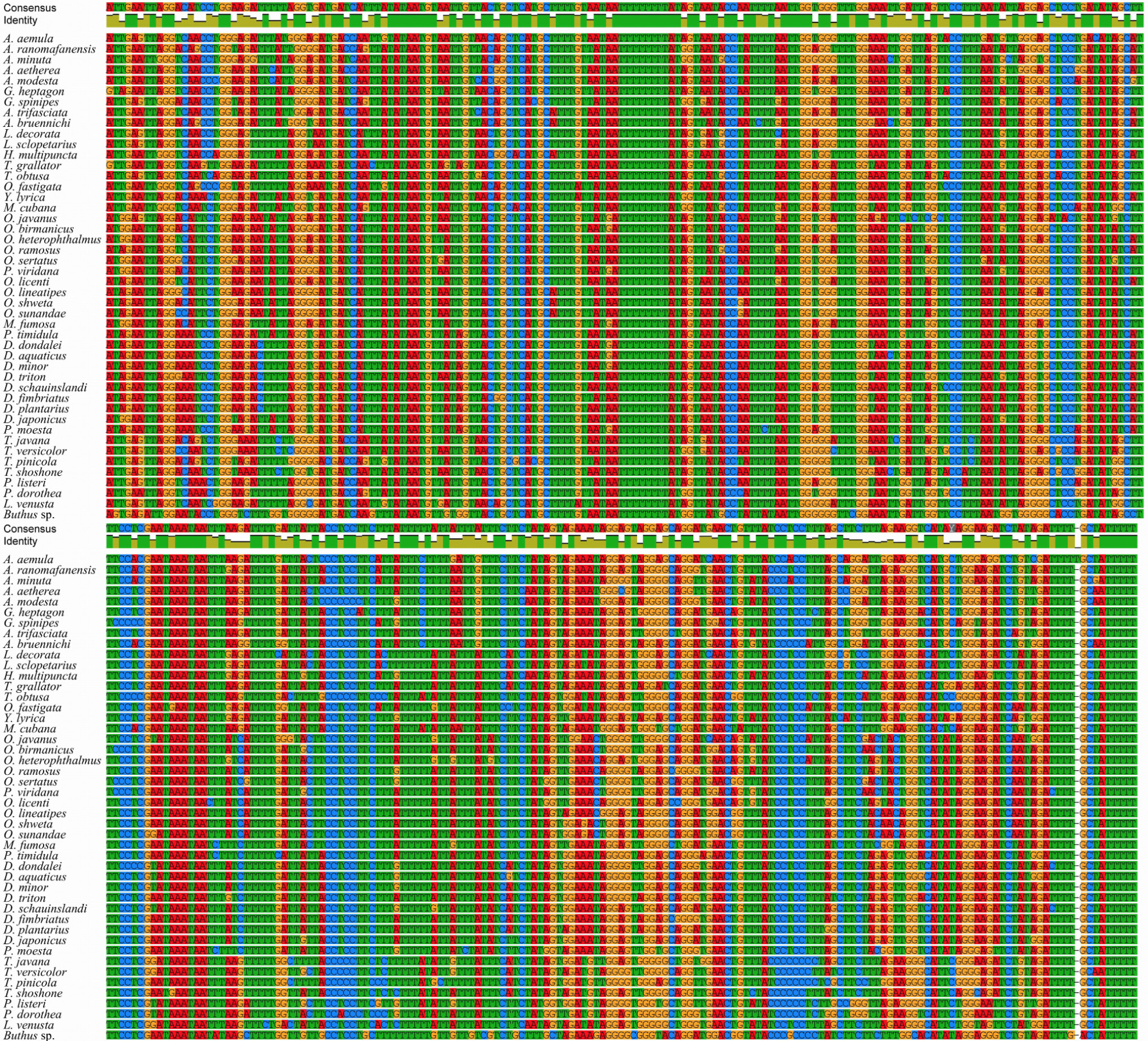
Multiple sequence alignment of Cytochrome C Oxidase subunit 1 from selected spider species. Similar color bars are showing similar sequences. Consensus sequence and identity bars are also shown in the alignment.
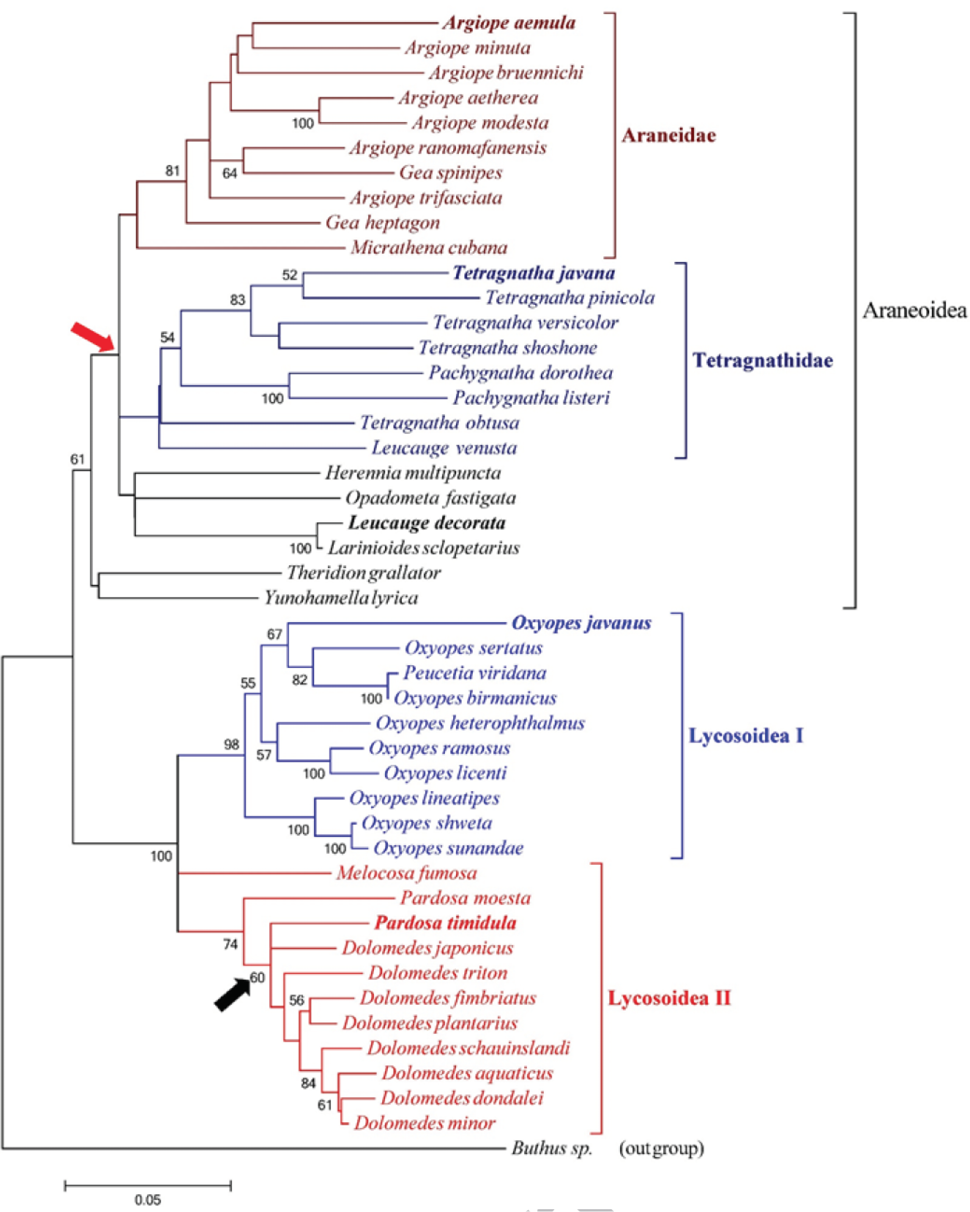
Molecular phylogenetic analysis of Cytochrome C Oxidase subunit 1 from selected spider species. The tree was rooted with Buthus sp. as an out-group. The scale bar represents the sequence divergence. Bootstrap values (100 replicates) are shown at the nodes.
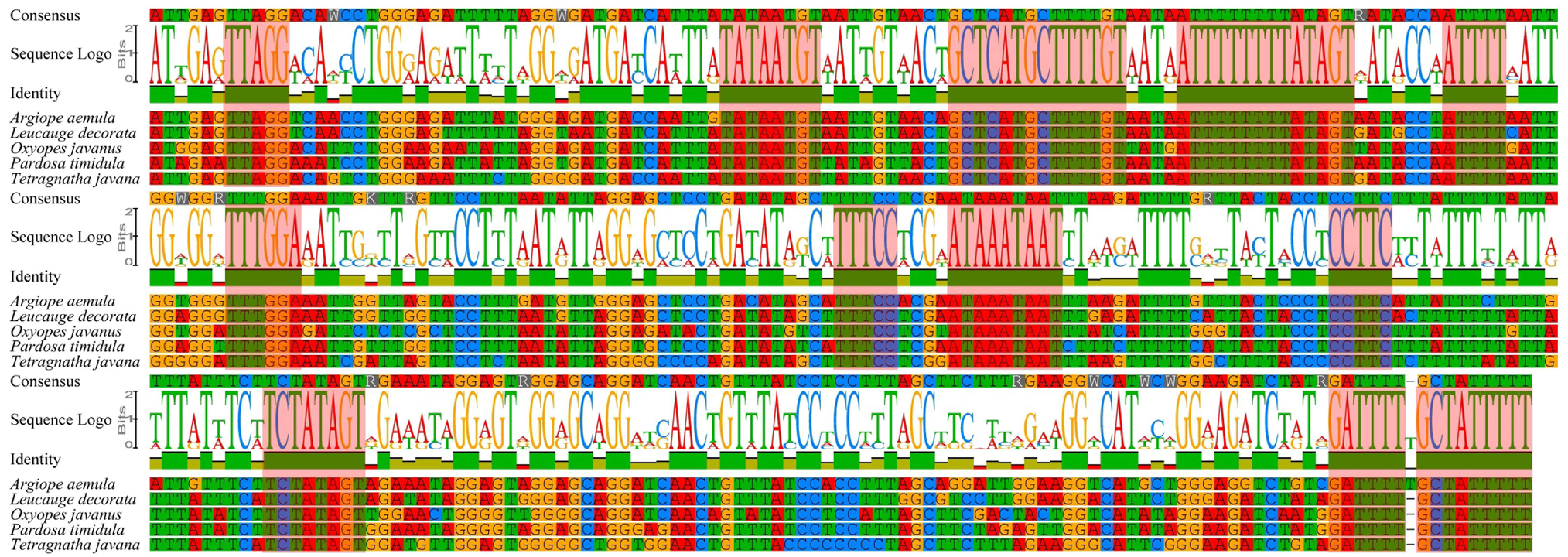
Multiple sequence alignment of Cytochrome C Oxidase subunit 1 from query spider species. Similar color bars are showing similar sequences. Consensus sequence, identity bars and sequence logo are also shown in the alignment. Conserved regions have been highlighted in pink rectangles.
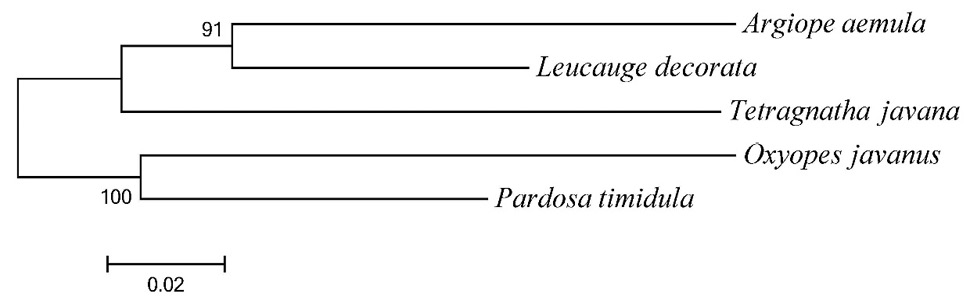
Molecular phylogenetic analysis of Cytochrome C Oxidase subunit 1 from query spider species. The scale bar represents the sequence divergence. Bootstrap values (100 replicates) are shown at the nodes.
References
- Ahmad, J.N., Sharif, T., Ahmad, S.J., Maqsood, S. and Zafar, F., 2019. Molecular identification and characterization of fruit flies of genus Bactrocera (Diptera: Tephritidae) in Pakistan. Pakistan J. Zool., 51: 2275-2280. http://dx.doi.org/10.17582/journal.pjz/2019.51.6.2275.2280[Full text][CrossRef]
- Ahrens, D., Monaghan, M.T. and Vogler, A.P., 2007. DNA-based taxonomy for associating adults and larvae in multi-species assemblages of chafers (Coleoptera: Scarabaeidae). Mol. Phylogenet. Evolut., 44: 436-449. https://doi.org/10.1016/j.ympev.2007.02.024[CrossRef]
- Altschul, S.F., Madden, T.L., Schaffer, A.A., Zhang, J., Zhang, Z., Miller W. and Lipman, D.J., 1997. Gapped BLAST and PSI-BLAST: A new generation of protein database search programs. Nucl. Acids Res., 25: 3389–3402. https://doi.org/10.1093/nar/25.17.3389[CrossRef]
- Arnedo, M.A., Coddington, J., Agnarsson, I. and Gillespie, R.G., 2004. Froma comb to a tree: phylogenetic relationships of the comb-footed spiders (Araneae, Theridiidae) inferred from nuclear and mitochondrial genes. Mol. Phylogenet. Evolut., 31: 225–245. https://doi.org/10.1016/S1055-7903(03)00261-6[CrossRef]
- Aslam, M., Faiz-ul-Hassan, N., Ruhi, R., Murad, H., Ejaz, S., Choudhary, M.S., Mustafa, G., Ashraf, M. and Rehman, J., 2018. Isolation and characteristics of biotechnologically important antagonistic thermophilic bacteria from rhizosphere of Haloxylon salicornicum. Pol. J. Microbiol., 67: 49–58. https://doi.org/10.5604/01.3001.0011.6142[CrossRef]
- Ballard, J.W.O. and Whitlock, M.C., 2004. The incomplete natural history of mitochondria. Mol. Ecol., 13: 729-744. https://doi.org/10.1046/j.1365-294X.2003.02063.x[CrossRef]
- Bashir, S., Bukhari, S.A., Afzal, I., Mustafa, G. and Mahmood-ur-Rahman, 2019. Molecular identification of stem rust resistance gene(s) from Pakistani wheat cultivars. Intl. J. Agric. Biol., 21: 1013‒1018.
- Čandek, K. and Kuntner, M., 2015. DNA barcoding gap: Reliable species identification over morphological and geographical scales. Mol. Ecol. Resour., 15: 268-277. https://doi.org/10.1111/1755-0998.12304[CrossRef]
- Chandler, D., Bailey, A.S., Tatchell, G.M., Davidson, G., Greaves, J. and Grant, W.P., 2011. The development, regulation and use of biopesticides for integrated pest management. Phil. Trans. R. Soc. B., 366: 1987–1998. https://doi.org/10.1098/rstb.2010.0390[CrossRef]
- Cheung, J.H., Whiteley, M. and Felsenfeld, G., 1993. A 5’ element of the chicken-globin domain serves as an insulator in human erythroid cells and protects against position effect in Drosophila. Cell, 74: 505–514. https://doi.org/10.1016/0092-8674(93)80052-G[CrossRef]
- Davey, J.S., 2010. Intraguild predation among generalist predators in winter wheat. Cardiff University (United Kingdom).
- Folmer, O., Black, M., Hoeh, W., Lutz, R. and Vrijenhoek, R., 1994. DNA primers for amplification of mitochondrial cytochrome c oxidase subunit 1 from diverse metazoan invertebrates. Mol. Mar. Biol. Biotechnol., 3: 294–299.
- Greenstone, M.H., Rowley, D.L., Heimbach, U., Lundgren, J.G., Pfannenstiel, R.S. and Rehner, S.A., 2005. Barcoding generalist predators by polymerase chain reaction: carabids and spiders. Mol. Ecol., 14: 3247-3266. https://doi.org/10.1111/j.1365-294X.2005.02628.x[CrossRef]
- Hall, T.A., 1999. BioEdit: A user-friendly biological sequence alignment editor and analysis program for Windows 95/98/NT. Nucl. Acids Symp. Ser., 41: 95-98.
- Hebert, P.D.N. and Barrett, R.D.H., 2005. Reply to the comment by L. Prendini on ‘Identifying spiders through DNA barcodes’. Can. J. Zool., 83: 505–506. https://doi.org/10.1139/z05-026[CrossRef]
- Huber, B.A. and Gonzalez, A.P., 2001. A new genus of Pholcid spider (Araneae: Pholicidae) endemic to western Cuba, with a case of female genitalic dimorphism. Am. Mus. Novit., 3329: 1-23. https://doi.org/10.1206/0003-0082(2001)329<0001:ANGOPS>2.0.CO;2[CrossRef]
- Jinbo, U., Kato, T. and Ito, M., 2011. Current progress in DNA barcoding and future implications for entomology. Ent. Sci., 14: 107-124. https://doi.org/10.1111/j.1479-8298.2011.00449.x[CrossRef]
- Jocque, R., 2002. Genitalic polymorphism a challenge for taxonomy. J. Arachnol., 30: 298-306. https://doi.org/10.1636/0161-8202(2002)030[0298:GPACFT]2.0.CO;2[CrossRef]
- Kearse, M., Moir, R., Wilson, A., Stones-Havas, S., Cheung, M. Sturrock, S., Buxton, S., Cooper, A., Markowitz, S., Duran, C. and Thierer, T., 2012. Geneious basic: An integrated and extendable desktop software platform for the organization and analysis of sequence data. Bioinformatics, 28: 1647–1649. https://doi.org/10.1093/bioinformatics/bts199[CrossRef]
- Kerzicnik, L.M., Frank, B.P., Paula, E.C., Michael L.D. and Scott, C.M., 2013. Spider fauna of semiarid eastern colorado agro-ecosystems: diversity, abundance and effects of crop intensification. Environ. Ent., 42: 131–142. https://doi.org/10.1603/EN12186[CrossRef]
- Knowlton, N., 1993. Sibling species in the sea. Annu. Rev. Ecol. Syst., 24: 189–216. https://doi.org/10.1146/annurev.es.24.110193.001201[CrossRef]
- Krishnamurthy, P.K. and Francis R.A., 2012. A critical review on the utility of DNA barcoding. Biodivers. Conserv., 21: 1901-1919.
- Maddison, D.R., Baker, M.D. and Ober, K.A., 1999. Phylogeny of carabid beetles as inferred from 18S ribosomal DNA (Coleoptera: Carabidae). Sys. Ent., 24: 103–108. https://doi.org/10.1046/j.1365-3113.1999.00088.x[CrossRef]
- Maloney, D., Drummond, F.A. and Alford, R., 2003. Spider predation in agro-ecosystems: can spiders effectively control pest populations. MAFES Tech. Bull., 190: 1-32.
- Matz, M.V. and Nielsen, R., 2005. A likelihood ratio test for species membership based on DNA sequence data. Phil. Trans. R. Soc. B., 360: 1969–1974. https://doi.org/10.1098/rstb.2005.1728[CrossRef]
- Meyer, C.P. and Paulay, G., 2005. DNA barcoding: Error rates based on comprehensive sampling. PLoS Biol., 3: e422. https://doi.org/10.1371/journal.pbio.0030422[CrossRef]
- Miller, K.B., Alarie, Y., Wolfe, G.W. and Whiting, M.F., 2005. Association of insect life stages using DNA sequences: the larvae of Philodytes umbrinus (Motschulsky) (Coleoptera: Dytiscidae). Syst. Ent., 30: 499-509. https://doi.org/10.1111/j.1365-3113.2005.00320.x[CrossRef]
- Platnick, N.I., 2009. The world spider catalogue, version 5.0. Am. Mus. nat. Hist., http/www. research.amnh.org/entomology/spider/catalogue/Indexhtml.
- Platnick, N.I., 2012. The world spider catalogue, version 13.0. Am. Mus. nat. Hist., http://research.amnh.org/iz/spiders/catalog.
- Ramzan, M., Akhter, M., Rehman, A. and Salim, M., 2007. Carryover and population build-up of insect predators in rice-wheat system. J. Anim. Pl. Sci., 17: 83–85.
- Rubinoff, D., 2006. Utility of mitochondrial DNA barcodes in species conservation. Conserv. Biol., 20: 1026-1033. https://doi.org/10.1111/j.1523-1739.2006.00372.x[CrossRef]
- Su, Y.C., Chang, Y.H., Smith, D., Zhu, M.S., Kuntner, M., Tso, I.M., 2011. Biogeography and speciation patterns of the golden orb spider genus Nephila (Araneae: Nephilidae) in Asia. Zool. Sci., 28: 47–55. https://doi.org/10.2108/zsj.28.47[CrossRef]
- Symondson, W.O.C., Sunderland, K.D. and Greenstone, M.H., 2002. Can generalist predators be effective biocontrol agents? Annu. Rev. Ent., 47: 561–594. https://doi.org/10.1146/annurev.ento.47.091201.145240[CrossRef]
- Tamura, K., Peterson, D., Peterson, N., Stecher, G., Nei, M. and Kumar, S., 2011. MEGA5: Molecular evolutionary genetics analysis using maximum likelihood, evolutionary distance, and maximum parsimony methods. Mol. Biol. Evol., 28: 2731–2739. https://doi.org/10.1093/molbev/msr121[CrossRef]
- Taylor, H. and Harris, W., 2012. An emergent science on the brink of irrelevance: a review of the past 8 years of DNA barcoding. Mol. Ecol. Res., 12: 377-388. https://doi.org/10.1111/j.1755-0998.2012.03119.x[CrossRef]
- Valentini, A., Pompanon, F. and Taberlet, P., 2009. DNA barcoding for ecologists. Trends Ecol. Evol., 24: 110-117. https://doi.org/10.1016/j.tree.2008.09.011[CrossRef]
- Wu, K. and Guo, Y., 2005. The evolution of cotton pest management practices in China. Annu. Rev. Ent., 50: 31-52. https://doi.org/10.1146/annurev.ento.50.071803.130349[CrossRef]
Services
Article usage statistics
Loading…