
We sequenced the complete mitochondrial (mt) genome of the kisslip cuttlefish, Sepia lycidas, made the comparison with the mt genomes of other cuttlefishes, and constructed phylogenetic trees estimating their relationships. The genome was 16,228 bp and contained 13 protein-coding genes, 22 transfer RNA genes, 2 ribosomal RNA genes, and 2 long-noncoding regions [both in the control regions (CR)]. The composition and order of genes in S. lycidas were similar to those of most other invertebrates. The overall base composition of S. lycidas is 35.8% T, 14.8% C, 41.3% A, and 8.1% G, with extremely high A+T content (77.1%). Both control regions contain termination-associated sequences and conserved sequence blocks. Maximum likelihood and Bayesian methods were used to build phylogenetic trees based on protein coding mtDNA genes of 37 cuttlefish species. S. lycidas have a close relationship with S. pharaonis, S. aculeata, and S. esculenta. This result confirmed the relationships of S. lycidas as being similar to the traditional taxonomy. This study plays an important role in the investigation of phylogenetic relationships, taxonomic resolution, and phylogeography for Sepiidae species.
Research Article · Volume 50, Issue 4, 26 June 2018 · Open Access
Characterization of Complete Mitochondrial Genome and Phylogeny of Sepia lycidas (Sepioidea, Sepiidae)
· · · · · ·
Affiliations & Notes ⌄
- 1National Engineering Research Center of Maricultural Facilities of China, College of Marine Science and Technology, Zhejiang Ocean University, Zhoushan 316022, PR China 2Zhoushan Fisheries Research Institute, Zhoushan 316000, PR China 3Scientific Observing and Experimental Station of Fishery Resources for Key Fishing Grounds, MOA, Key Laboratory of Sustainable Utilization of Technology Research for Fisheries Resources of Zhejiang Province, Zhoushan 316021, China 4Marine Fisheries Research Instit
Article Info ⌄
- Journal:
- Pakistan Journal of Zoology
- Published:
- 26 June 2018

Abstract
Introduction
Sepia lycidas (Sepioidea, Sepiidae) is a demersal and neritic species , which mainly occurs throughout the East China Sea (including areas near southern Japan), South China Sea, and nearby regions of the Indian and West Pacific Oceans ; . Known as the kisslip cuttlefish, it is a common and large cuttlefish (38 cm adult mantle size), and has high nutritional and medicinal value . Extensive studies of S. lycidas have been focused on breeding, morphological, and biological characteristics (Natsukari and Tashiro, 2009; ; , but preliminary studies about the phylogenetic analysis were based on single gene fragment ; . We sequenced the complete mt genome of S. lycidas (Genbank accession number: KJ162574) to assess its genomic structure and provide a more robust estimate of its phylogenetic relationships.
Most metazoan species possess a compact, circular mt genome, which varies in size from 15 to 20 kb that typically contain 37 genes, including 13 protein coding genes, two ribosomal RNA (rRNA) genes, and 22 transfer RNA (tRNA) genes necessary for translation of the proteins encoded by the mtDNA ; . MtDNA has been extensively used for studying phylogenetic and evolutionary relationships among animal species, due to its maternal inheritance, rapid evolutionary rate, and lack of genetic recombination ; ; ; . Partial sequences of mtDNA genes, such as cytochrome oxidase I (COI), cytochrome oxidase III (COIII), and 16S rRNA, have proved to be important tools in intraspecific and interspecific phylogenetic studies of Cephalopoda and other mollusks ; ; ; . Compared to partial mt genes, complete mtDNA sequences can uncover gene rearrangements and other variation at the genome level for all phyla, and are especially useful because they have sufficient interspecies sequence variability for resolving species-level relationships . The levels of variation of different genes vary significantly, making different genes useful for phylogenetic analysis at different taxonomic levels .
The ability of different cephalopods to efficiently identify members of their own species is very important for breeding. Zheng (2001) showed that there were significant differences in radular structure among nine species of cuttlefish and suggested that radular morphology is informative for their taxonomy. This suggestion has been reinforced by other studies . Radular morphology could be used as a basis for classification of the cuttlefishes in the coastal areas of China. Morphological traits can be difficult to apply for classification of cephalopods due to phenotypic plasticity, overlapping geographical distributions and notable differences during growth and development. In addition, cephalopods are found throughout variable marine habitats and have diverged in response to a variety of ecological pressures ; ; . An understanding is needed of the phylogenetic relationships among genera of Sepiidae, especially when studying the differences among species within different groups.
Wakabayashi et al. (2012) studied phylogenetic relationships in Family Ommastrephidae, based on mtDNA 16S rRNA and COI genes. The relationships among subspecies in the resulting maximum parsimony trees were consistent with neighbor joining trees produced using allozyme data . However, these relationships differed from those inferred from analyses of morphological characters . The first determination of the whole genome sequence of the human mt genome was made in 1981 . Since then, genome-level sequencing has provided many new insights into species relationships. Both molecular and morphological analyses are needed to provide the most informative classification within cuttlefish and among higher taxonomic ranks.
Table I.- Primers used for amplification of the Sepia lycidas mitochondrial genome.
| Primer pair | Primer sequence (5′-3′) | Region | Size (bp) |
| 1 F | GTRGGWATAGAYGTWGATACACGAGCYTATT | 2934-8397 | 5463 |
| 1 R | TGTGCCAGCATYYGCGGTT | ||
| 2 F | TAAAGAATAATAGGGTATCTAATCCTAGT | 8187-9640 | 1454 |
| 2 R | TTTATAACATCAATATAAYCCGTTCA | ||
| 3 F | GAGGCMTTTAACTGTTAATTAAAT | 9548-11260 | 1713 |
| 3 R | AATTGCVGGDATAACTAAAAGAGC | ||
| 4 F | GATATTATTATTACWCCYAATTGACT | 10964-12598 | 1635 |
| 4 R | AATTGCAGGDTCWATRATTTTAGC | ||
| 5 F | AAWGAYTTAAYATCMCTTTGWCC | 12416-14063 | 1648 |
| 5 R | TGARAATTTTATTCCBGCTAAYCC | ||
| 6 F | GGAATWGAACGTAAAATWGCAT | 13968-15463 | 1496 |
| 6 R | GCTAARWHTTWAAGCTATTGGGTTC | ||
| 7 F | GGRATWGCYGAWACTAAATTAG | 14361-15772 | 1412 |
| 7 R | ATAWGCTMRAGGGATGTTTGAGAG | ||
| 8 F | GGGTATGAACCCAATAGCTT | 15433-16172, 1-808 | 1548 |
| 8 R | GCTTAAATTCGGCCACTTAAT | ||
| 9 F | TCHACYTTYTTTGTAGCTACAGG | 577-2087 | 1511 |
| 9 R | RTGRTTWGTKGAGAAWARTCATCG | ||
| 10 F | CCWAAYWTAACYAAACAAATAACTTG | 1400-3041 | 1642 |
| 10 R | WGAWCCATARATAGTRGCTAATCA |
Materials and Methods
Sample and DNA extraction
Specimens of S. lycidas were collected from the Zhanjiang fishing ground (GuangDong Province, 2011.8). The sample was preserved at -80°C until use. Total DNA was extracted from wrist muscle tissue of S. lycidas with the conventional phenol-extraction method .
Polymerase chain reaction (PCR)
We used 10 pairs of primers that amplify contiguous, overlapping segments of the complete mt genome of S. lycidas (Table I). The primers were designed from the complete mt genome sequence of S. officinalis (NC007895, , S. japonica (NC028731, and S. pharaonis (NC021146, Wang and Wu, 2014). The Long-PCR reaction volume was 50 μl, containing 31.5 μl sterile deionized water, 5.0 μl 10× LA PCR Buffer (Mg2+ plus), 8.0 μl dNTPs (2.5 mM each), 1 μl of each primer (25 pmol/ml), 0.5 μl LA Taq DNA polymerase (Takara), and 3 μl DNA template, with the following reaction parameters: 2 min high-denaturation (93°C), followed by 20 cycles of 10 s denaturation (92°C), 30 s annealing (53°C), and a 10 min extension (68°C), with a 7 min final extension (68°C).
Table II.- The complete mitochondrial genome sequence in this study.
| Species | Length(bp) | Taxonomic status | Accession No. | |
| Bathyteuthis abyssicola | 20,075 | Bathyteuthidae | Oegopsida | NC_016423 |
| Doryteuthis opalescens | 17,370 | Loliginidae | Myopsida | KP336703 |
| Loligo bleekeri | 17,211 | Loliginidae | Myopsida | NC_002507 |
| Loliolus beka | 17,483 | Loliginidae | Myopsida | NC_028034 |
| Loliolus uyii | 17,134 | Loliginidae | Myopsida | NC_026724 |
| Sepioteuthis lessoniana | 16,694 | Loliginidae | Myopsida | KM878671 |
| Uroteuthis chinensis | 17,353 | Loliginidae | Myopsida | NC_028189 |
| Uroteuthis duvauceli | 17,413 | Loliginidae | Myopsida | NC_027729 |
| Uroteuthis edulis | 17,360 | Loliginidae | Myopsida | NC_017746 |
| Allonautilus scrobiculatus | 16,132 | Nautilidae | Nautiloidea | NC_026997 |
| Nautilus macromphalus | 16,258 | Nautilidae | Nautiloidea | NC_007980 |
| Amphioctopus aegina | 15,545 | Octopodidae | Octopoda | NC_029702 |
| Cistopus chinensis | 15,706 | Octopodidae | Octopoda | KF017606 |
| Cistopus taiwanicus | 15,793 | Octopodidae | Octopoda | NC_023257 |
| Octopus bimaculatus | 16,084 | Octopodidae | Octopoda | KT581981 |
| Octopus bimaculoides | 15,733 | Octopodidae | Octopoda | NC_029723 |
| Octopus conispadiceus | 16,027 | Octopodidae | Octopoda | NC_029747 |
| Octopus minor | 15,974 | Octopodidae | Octopoda | NC_015896 |
| Octopus ocellatus | 15,979 | Octopodidae | Octopoda | NC_007896 |
| Octopus vulgaris | 15,744 | Octopodidae | Octopoda | NC_006353 |
| Architeuthis dux | 20,333 | Architeuthidae | Oegopsida | KC701764 |
| Watasenia scintillans | 20,089 | Enoploteuthidae | Oegopsida | KJ845633 |
| Dosidicus gigas | 20,324 | Ommastrephidae | Oegopsida | NC_009734 |
| Illex argentinus | 20,278 | Ommastrephidae | Oegopsida | NC_026908 |
| Ommastrephes bartramii | 20,308 | Ommastrephidae | Oegopsida | NC_020348 |
| Sthenoteuthis oualaniensis | 20,306 | Ommastrephidae | Oegopsida | NC_010636 |
| Todarodes pacificus | 20,254 | Ommastrephidae | Oegopsida | NC_006354 |
| Sepia aculeata | 16,219 | Sepiidae | Sepiida | KF690633 |
| Sepia apama | 16,184 | Sepiidae | Sepiida | NC_022466 |
| Sepia esculenta | 16,199 | Sepiidae | Sepiida | NC_009690 |
| Sepia latimanus | 16,225 | Sepiidae | Sepiida | NC_022467 |
| Sepia lycidas | 16,228 | Sepiidae | Sepiida | KJ162574 |
| Sepia officinalis | 16,163 | Sepiidae | Sepiida | NC_007895 |
| Sepia pharaonis | 16,208 | Sepiidae | Sepiida | NC_021146 |
| Sepiella inermis | 16,191 | Sepiidae | Sepiida | KF040369 |
| Sepiella japonica | 16,170 | Sepiidae | Sepiida | NC_028731 |
| Vampyroteuthis infernalis | 15,617 | Vampyroteuthida | Vampyromorphida | NC_009689 |
Table III.- Mitochondrial genome characteristics of S. lycidas.
| Gene | Position | Size (bp) | Codon | Intergenic nucleotidesa | Strand | |||
| From | To | Nucleotide | Amino acid | Initiation | Stop | |||
| CO3 | 1 | 780 | 780 | 259 | ATG | TAA | 0 | L |
| tRNALys | 791 | 858 | 68 | 10 | L | |||
| tRNAAla | 857 | 923 | 67 | -2 | L | |||
| tRNAArg | 923 | 989 | 67 | -1 | L | |||
| tRNASer | 993 | 1058 | 66 | 3 | L | |||
| ND2 | 1059 | 2090 | 1032 | 343 | ATG | TAA | 0 | L |
| CO1 | 2068 | 3600 | 1533 | 510 | ATG | TAA | -23 | L |
| CO2 | 3603 | 4289 | 687 | 228 | ATG | TAA | 2 | L |
| ATP8 | 4354 | 4548 | 195 | 64 | ATG | TAA | 64 | L |
| ATP6 | 4511 | 5203 | 693 | 230 | ATG | TAG | -38 | L |
| tRNAPhe | 5230 | 5293 | 64 | 26 | L | |||
| ND1 | 5295 | 6233 | 939 | 312 | ATG | TAA | 1 | H |
| tRNALeu | 6234 | 6306 | 73 | 0 | L | |||
| tRNALeu | 6307 | 6381 | 75 | 0 | L | |||
| 16S rRNA | 6382 | 7655 | 1274 | 0 | L | |||
| tRNAVal | 7656 | 7726 | 71 | 0 | L | |||
| 12S rRNA | 7727 | 8707 | 981 | 0 | L | |||
| tRNACys | 8708 | 8770 | 63 | 0 | L | |||
| tRNATyr | 8769 | 8832 | 64 | -2 | L | |||
| tRNAGln | 8834 | 8898 | 65 | 1 | L | |||
| tRNAGly | 8905 | 8977 | 73 | 6 | L | |||
| Control region | 8982 | 9558 | 577 | 4 | L | |||
| tRNAAsn | 9561 | 9626 | 66 | 2 | H | |||
| tRNAIle | 9628 | 9692 | 65 | 1 | L | |||
| ND3 | 9693 | 10,046 | 354 | 117 | ATG | TAA | 0 | L |
| tRNAAsp | 10,052 | 10,117 | 66 | 5 | H | |||
| ND5 | 10,129 | 11,850 | 1722 | 573 | ATG | TAA | 11 | H |
| tRNAHis | 11,851 | 11,915 | 65 | 0 | L | |||
| ND4 | 11,914 | 13,275 | 1362 | 453 | ATA | TAA | -2 | H |
| ND4L | 13,272 | 13,568 | 297 | 98 | ATG | TAA | -4 | H |
| tRNAThr | 13,575 | 13,639 | 65 | 6 | L | |||
| tRNASer | 13,640 | 13,705 | 66 | 0 | H | |||
| Cyt b | 13,705 | 14,844 | 1140 | 379 | ATG | TAG | -1 | H |
| ND6 | 14,837 | 15,349 | 513 | 170 | ATG | TAG | -8 | H |
| tRNAPro | 15,351 | 15,418 | 68 | 1 | L | |||
| tRNAMet | 15,419 | 15,486 | 68 | 0 | L | |||
| tRNATrp | 15,489 | 15,555 | 67 | 2 | L | |||
| tRNAGlu | 15,557 | 15,650 | 94 | 1 | L | |||
| Control region | 15,652 | 16,228 | 577 | 1 | L | |||
The PCR products were electrophoresed on a 1% agarose gel and stained with ethidium bromide for band characterization via ultraviolet transillumination. The products were recovered and concentrated using a Gel Extraction Kit (CW2302, CWBIO) according to the manufacturer’s protocol.
Cloning and sequencing of the PCR products
The PCR products were ligated into pMD 18-T vectors and cloned using a TOPO TA Cloning Kit (Invitrogen, USA) according to the manufacturer’s instructions. Each cloned DNA fragment was sequenced according to the manufacturer’s protocol with TOPO vector inner primers T7 and M13R (Invitrogen, USA). Labeled fragments were analyzed on an ABI Prism 3730 DNA Sequencer (Applied Biosystems, USA).
Sequence analysis
The characterization of the mt genome of S. lycidas was performed in comparison with other cuttlefish mt genomes ; ; Wang et al., 2014). MEGA 6.06 software was used for sequence splicing and analyses. Concatenated nucleotide sequences were loaded into DNAStar 7.1 statistical software packages to analyze the full mtDNA sequence, nucleotide content, codon usage, and amino acids. Tandem Repeats Finder (http://tandem.bu.edu/trf/trf.html; ; Huang et al., 2017) was used to analyze sequences that were rich with AT-repeat regions. Finally, we used the online mapping software OGDraw v1.2 (http://ogdraw.mpimp-golm.mpg.de/index.shtml) to diagram the S. lycidas mtDNA circular structure. Protein coding genes were analyzed by ORF Finder using the invertebrate mitochondrial code. Base composition and codon usage were calculated with DNAStar software.
Phylogenetic analysis
All 13 protein-coding gene sequences of mtDNA were used to estimate phylogenetic relationships among 37 species in Cephalopoda, using maximum likelihood (ML) and Bayesian inference (BI). The mtDNA protein-coding regions were concatenated and aligned using the ClustalW algorithm with default parameters implemented in MEGA 6.06 . In order to discuss phylogenetic relationships within Sepiidae and with other families of Cephalopoda (Ommastrephidae, Loliginidae, Vampyroteuthidae, and Octopodidae) thirty-seven species in Genbank were included (Table II). Allonautilus scrobiculatus (NC. 026997.1) and Nautilus macromphalus (NC. 007980.0) were used as outgroup taxa. The ML tree was evaluated with 1000 bootstrap replicates in MEGA 6.06.
MrBayes ver 3.1.2 was used for Bayesian analyses under the Mtzoa-F + C4 model to partition different amino acids positions. Two runs with four chains of MCMC iterations were performed for 100,000 generations, sampling trees every 100 generations.
Results
Genome organization and composition
The complete mt genome of S. lycidas is 16,228 bp in length and consists of 13 protein-coding genes, 22 transfer RNA genes (tRNA), 2 ribosomal RNA genes (rRNA), and 2 long-noncoding regions (CR). The structural organization of the complete mt genome is given in Figure 1 and Table III. The base composition is 35.8% T, 14.8% C, 41.3% A, and 8.1% G. As seen in other invertebrate mt genomes, A+T content (77.1%; Table IV) is much higher than the G+C content.
Protein-coding genes and codon usage
The 13 protein-coding genes of S. lycidas can be classified into two categories: COIII, ND2, COI, COIII, ATP8, ATP6, and ND3 are encoded by the light strand, whereas ND1, ND5, ND4, ND4L, Cyt b, and ND6 are encoded by the heavy strand (Table III). The overall A+T content of the protein genes is 76.2%, with the highest in ATP8 (83.1%), and the lowest in COI (70.1%). AT and CG skew of the 13 protein-coding genes is 0.087 and -0.294, respectively (Table IV).
Most of the protein-coding genes start with an ATG initiation codon, except for ND4, which starts with ATA. Ten protein-coding genes (COI-III, ND1-5, ATP8, and ND4L) use TAA as the termination codon, while the other three (ATP6, Cyt b, and ND6) share the termination codon TAG. The pattern of codon usage of S. lycidas mtDNA is shown in Table V. The most frequently used amino acids are Leu (15.7%), followed by Ile (10.2%), Phe (8.5%), Met (7.9%), Ser (7.3%), and Gly (6.0%). The least frequently used amino acid is Gln (1.6%). The most frequently used codon in S. lycidas and other cuttlefish is UUA (appearing 456 times).
Transfer RNA genes and RNA genes
A total of 22 transfer RNA genes are interspersed in the S. lycidas mt genome and range from 63 bp to 94 bp, with a base composition of 39.2% T, 12.6% C, 39.2% A,
Table IV.- Nucleotide composition in mitochondrial genome of S. lycidas.
| Species | Size (bp) | A% | T% | C% | G% | A+T% | C+G% | |
| S. lycidas | Whole genome | 16,228 | 41.3 | 35.8 | 14.8 | 8.1 | 77.1 | 22.9 |
| 13 PCGs | 11,174 | 41.4 | 34.8 | 15.4 | 8.4 | 76.2 | 23.8 | |
| tRNA | 1,501 | 39.2 | 39.2 | 12.6 | 9.0 | 78.4 | 21.6 | |
| rRNA | 2,255 | 42.0 | 37.6 | 13.7 | 6.7 | 79.6 | 20.4 | |
| 2 LNCRs | 1,154 | 41.6 | 36.0 | 14.4 | 8.0 | 77.6 | 22.4 | |
and 9.0% G (Table IV). In addition, tRNASer and tRNALeu both appear twice; the other 18 types of tRNA appear only once. Nineteen of the tRNA are encoded by the light strand and three are encoded by the heavy strand. The overall AT and CG skew of the 22 tRNA genes is 0 and -0.167, respectively. The CG skew of tRNAArg (CGR), tRNAAsp (GAD), and tRNASer (AGS) is zero.
S. lycidas has two ribosomal RNA genes, 12S rRNA (981 bp) and 16S rRNA (1274 bp). They are located between tRNALeu and tRNACys genes, and separated by the tRNAVal gene. The base composition of the two rRNAs gene sequences is 42.0% A, 37.6% T, 13.7% C, and 6.7% G. The overall AT and CG skew of the rRNA genes is 0.055 and -0.343. The A+T content of 12S rRNA and 16S rRNA is 80.0% and 79.3%, respectively (Table IV).
Non-coding regions
The complete mt genome of S. lycidas has two long, noncoding regions that are both control regions, regulating replication and transcription. Their overall base composition is rich in A and T . Nucleotide composition across the non-coding regions is 42.0% A, 37.6% T, 13.7% C, and 6.7% G. The A+T content is 79.6%. AT and CG skew is 0.055 and -0.343, respectively (Table IV).
Two non-coding regions are both 577 bp in length and contain termination-associated sequences and conserved sequence blocks: one is located between tRNAGly and tRNAAsn, another is located between tRNAGlu and the protein-coding gene COIII. The control region in S. lycidas exhibits the typical tripartite structure with an extended termination-associated sequence domain (ETAS), central conserved sequence block domain (CD), and conserved sequence block domain (CSB). The possible function of the LNCR as the control region is deduced from the potential stem and loop structures . The termination-associated sequence (TAS) domains, which are thought to act as a signal for the termination of heavy strand elongation, were identified in ETAS. This is a hypervariable domain that may be useful for analyzing interspecies variation within S. lycidas .
Table V.- Frequency and count for genetic codons and codon usage in Sepia lycidas mitochondrial genome.
| Codon /1000(C) | Codon /1000(C) | Codon /1000(C) | Codon /1000(C) |
| UUU 280(74.9) | UCU 84(22.5) | UAU 153(41.0) | UGU 61(16.3) |
| Phe | Ser | Tyr | Cys |
| UUC 38(10.2) | UCC 15(4.0) | UAC 24(6.4) | UGC 7(1.9) |
| Phe | Ser | Tyr | Cys |
| UUA 456(122.1) | UCA 94(25.2) | UAA 10(2.7) | UGA 81(21.7) |
| Leu | Ser | Stop | Trp |
| UUG 47(12.6) | UCG 4(1.1) | UAG 3(0.8) | UGG 17(4.6) |
| Leu | Ser | Stop | Trp |
| CUU 39(10.4) | CCU 64(1.7) | CAU 70(18.7) | CGU 23(6.1) |
| Leu | Pro | His | Arg |
| CUC 4(1.1) | CCC 4(1.1) | CAC 18(4.8) | CGC 5(1.3) |
| Leu | Pro | His | Arg |
| CUA 39(10.4) | CCA 49(13.1) | CAA 55(14.7) | CGA 19(5.1) |
| Leu | Pro | Gln | Arg |
| CUG 0 | CCG 1(0.3) | CAG 6(1.6) | CGG 6(1.6) |
| Leu | Pro | Gln | Arg |
| AUU 355(95.0) | ACU 75(20.1) | AAU 162(43.4) | AGU 64(17.1) |
| Ile | Thr | Asn | Ser |
| AUC 27(7.2) | ACC 12(3.2) | AAC 21(5.6) | AGC 18(4.8) |
| Ile | Thr | Asn | Ser |
| AUA 260(69.6) | ACA 64(17.1) | AAA 91(24.4) | AGA 47(12.6) |
| Met | Thr | Lys | Ser |
| AUG 35(.4) | ACG 0 | AAG 9(2.4) | AGG 16(4.3) |
| Met | Thr | Lys | Ser |
| GUU 90(24.1) | GCU 75(20.1) | GAU 60(16.0) | GGU 128(34.3) |
| Val | Ala | Asp | Gly |
| GUC 2(0.5) | GCC 15(4.0) | GAC 10(2.7) | GGC 5(1.3) |
| Val | Ala | Asp | Gly |
| GUA 97(26.0) | GCA 40(10.7) | GAA 73(19.5) | GGA 60(16.1) |
| Val | Ala | Glu | Gly |
| GUG 11(2.9) | GCG 3(0.8) | GAG 15(4.0) | GGG 31(8.3) |
| Val | Ala | Glu | Gly |
Total codon number: 3736.
Phylogenetic status of S. lycidas
Many systematic and population genetic studies have been based on genetic markers in the mt genomes at either the nucleotide or amino acid level . Phylogenetic relationships inferred from ML and Bayesian analyses were basically consistent with each other (Figs. 2 and 3) and with the existing morphological classification.
The use of long DNA sequences can help to resolve major phylogenetic relationships and provide resolution of closely related species. In our study, the phylogenetic trees were inferred using protein sequences. In both phylogenetic trees, the ten sampled species of Sepiidae were divided into three clades. S. lycidas forms a clade with S. pharaonis, S. aculeata and S. esculenta.
Both the ML and BI analyses divided Decapodiformes into three parts: Oegopsida, Myopsida, and Sepiida; the Oegopsida consisted of Ommastrephidae, Architeuthidae, Bathyteuthidae, and Enoploteuthidae; the Myopsida only had one family and the Loliginidae contained eight species. Octobrachia can be divided into two suborders: Cirrina and Incirrina. However, there are no complete mt genomes available for Cirrina, and so our analyses only include Incirrina. Octopus conispadiceus is separated from other Octopodidae in both trees .
The position of Ommastrephes bartramii differed between the ML and BI trees. In the ML tree, O. bartramii was sister to Sthenoteuthis oualaniensis, whereas in the BI tree O. bartramii was sister to the remainder of Ommastrephidae (Figs. 2 and 3).
Discussion
Gene arrangement
The mt genomes of Ommastrephidae and Enoploteuthidae contain six duplicated genes, including COI, COII, COIII, ATP 6 and 8, and tRNAAsp (Fig. 3). These genes occur between 12S RNA and 16S RNA (Yokobori et al., 2007). Each gene in the mt genomes for these taxa possesses specific functions. The level of variation between duplicate genes is low, and every gene copy contains several insertions and deletions . These duplicated genes likely have lost their function, but the secondary structures and anticodon positions of functional genes would be disrupted without them . These duplications are characteristic of all members of Ommatrephida. It is likely that the octopus-type mt genome is most similar to the ancestral state, this state being maintained from at least the Cephalopoda ancestor to the common ancestor of Oegopsida, Myopsida and Sepiolida .
Phylogenetic analysis
The previous classification for cephalopoda was based solely on morphological traits . The three sampled members of the family Ommastrephidae (Dosidicus gigas, O. bartramii, and S. oualaniensis) belong to the subfamily Ommastrephinae and were monophyletic in the ML tree. O. bartramii is sister to S. oualaniensis in our ML tree, but is placed more distantly in our BI tree and in an ML tree base on COI ; .
The largest difference between our results and some of the previous studies is in the Octopodidae. Vampyroteuthis infernalis was separated from the remainder of Octopodidae in our phylogenies, as was also found by Allcock et al. (2011). However, other phylogenetic analyses of the mt genomes of V. infernalis and other Octopodidae suggested a very close relationship . In both the ML and BI trees, Amphioctopus aegina and O. ocellatus are sister species despite belonging to different genera in the traditional taxonomy . Additional data from the nuclear genome are needed to further test the placement of these species.
The relationships that we inferred within family Sepiidae (Figs. 2 and 3) are consistent with the traditional morphological classification . We found a close relationship between S. apama and S. latimanus, as was also seen by Akasaki et al. (2006). However, our results differ from some previous studies in the position of S. officinalis and the relationships among S. esculenta, S. aculeata, S. lycidas, and S. pharaonis. Yokobori et al. (2007) produced phylogenies based on the DNA sequences of 16S, 12S, and COI, and showed a further relationship between S. lycidas and S. esculenta. In comparison, our trees place S. lycidas sister to an S. aculeata + S. pharaonis clade, which was same as the ML phylogenetic relationships based on nucleotide and amino acid sequence data ; ; . Our MP and BI analyses of amino acid sequences allowed inferences of phylogenetic relationships of different families with results that were consistent with Kawashima et al. (2013).
To fully resolve relationships and provide a robust classification, the valuable and extensive information available in mt genomes should be combined with other sources of data, such as nuclear genes and morphological and ecological characteristics.
Acknowledgments
This work was funded by the project of Hong Kong, the Macao and Taiwan science and technology cooperation project (2014DFT30120), Zhejiang Provincial Natural Science Foundation of China (LY14C190002), National Natural Science Foundation of China (41576131, 41406138), National Spark Program (2015GA700014), Zhejiang Provincial Natural Scicence Foundation of China (LY17C190006) and Zhejiang science and technology Program (2015F50055).
Statement of conflict of interest
Authors have declared no conflict of interest.
Figures
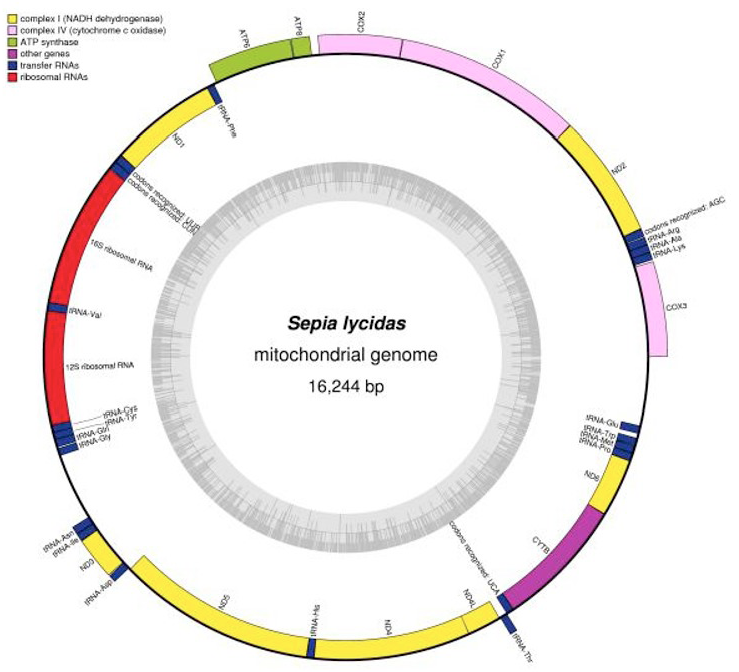
Gene map of S. lycidas mitochondrial genome. Genes encoded on the heavy or light strands are shown outside or inside the circular gene map, respectively. The inner ring indicates the GC content. The figure was initially generated with Organellar Genome DRAW (OGDRAW) and modified manually.
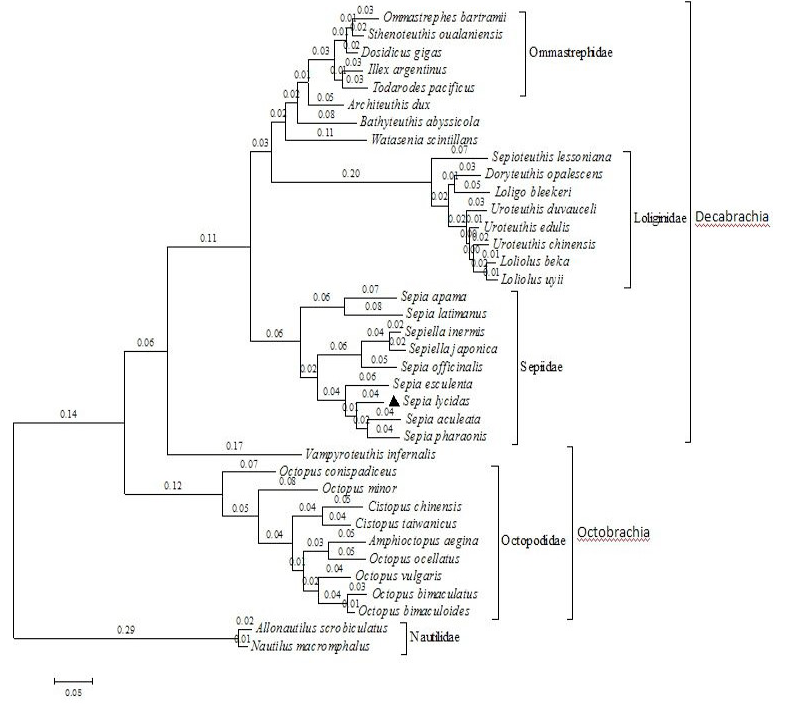
The maximum-likehood phylogenetic tree reconstructed by the amino acid analysis under the ML method with JTT model.
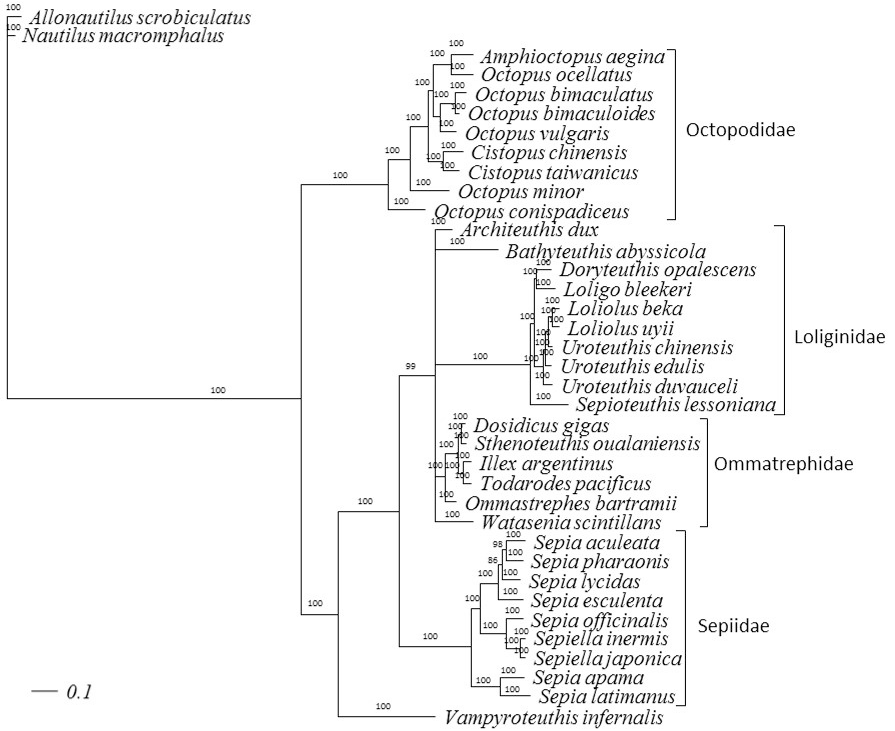
Phylogenetic tree reconstructed by amino acid analysis under the Bayesian method with MtZoa-F + C4 model.
References
- Akasaki, T., Nikaido, M., Tsuchiya, K., Segawa, S., Hasegawa, M. and Okada, N., 2006. Extensive mitochondrial gene arrangements in coleoid Cephalopoda and their phylogenetic implications. Mol. Phylogen. Evolut., 38: 648-658. https://doi.org/10.1016/j.ympev.2005.10.018[CrossRef]
- Allcock, A.L., Cooke, I.R. and Strugnell, J.M., 2011. What can the mitochondrial genome reveal about higher-level phylogeny of the molluscan class Cephalopoda? Zool. J. Linnean Soc., 161: 573–586. https://doi.org/10.1111/j.1096-3642.2010.00656.x[CrossRef]
- Allen, J.J., Bell, G.R., Kuzirian, A.M., Velankar, S.S. and Hanlon, R.T., 2014. Comparative morphology of changeable skin papillae in octopus and cuttlefish. J. Morphol., 275: 371-390. https://doi.org/10.1002/jmor.20221[CrossRef]
- Anderson, S., Bankier, A.T., Barrell, B.G., De, B.M., Coulson, A.R., Drouin, J., Eperon, I.C., Nierlich, D.P., Roe, B.A. and Sanger, F., 1981. Sequence and organization of the human mitochondrial genome. Nature, 290: 457-465. https://doi.org/10.1038/290457a0[CrossRef]
- Benson, G., 1999. Tandem repeats finder: a program to analyze DNA sequences. Nucl. Acids Res., 27: 573-580. https://doi.org/10.1093/nar/27.2.573[CrossRef]
- Boore, J.L., 1999. Animal mitochondrial genomes. Nucl. Acids Res., 27: 1767-1780. https://doi.org/10.1093/nar/27.8.1767[CrossRef]
- Boyle, P.R. and Boletzky, S.V., 1996. Cephalopod populations, definition and dynamics. Phil. Trans. R. Soc. B, 351: 985-1002. https://doi.org/10.1098/rstb.1996.0089[CrossRef]
- Carpenter, K.E. and Niem, V.H., 1999. The living marine resources of the western central pacific. batoid fishes, chimaeras and bony fishes (Elopidae to Linophrynidae). Food and Agriculture Organization of the United Nations.
- Chen, X., Liu, B. and Wang, R.G., 2009. Cephalopods of the World. China Ocean Press, Beijing.
- Cheng, R., Zheng, X., Lin, X., Yang, J. and Li, Q., 2012. Determination of the complete mitochondrial DNA sequence of Octopus minor. Mol. Biol. Rep., 39: 3461-3470. https://doi.org/10.1007/s11033-011-1118-2[CrossRef]
- Cheng, R., Zheng, X., Ma, Y. and Li, Q., 2013. The complete mitochondrial genomes of two octopods Cistopus chinensis and Cistopus taiwanicus: Revealing the phylogenetic position of the genus Cistopus within the Order Octopoda. PLoS One, 8: e84216. https://doi.org/10.1371/journal.pone.0084216[CrossRef]
- Dong, Z.Z., 1988. Chinese Fauna, Mollusca, Cephalopods. Science Press, Beijing.
- Eda, M., Kuro-o, M., Higuchi, H., Hasegawa, H. and Koike, H., 2010. Mozaic gene conversion after a tandem duplication of mtDNA sequence in Diomedeidae (albatrosses). Genes Genet. Syst., 85: 129–139. https://doi.org/10.1266/ggs.85.129[CrossRef]
- Groth, J.G., Arbisser, I., Landman, N.H. and Barrowclough, G.F., 2015. The mitochondrial genome of Allonautilus (Mollusca: Cephalopoda): Base composition, noncoding-region variation, and phylogenetic divergence. Am. Mus. Novitates, 3834: 1-13. https://doi.org/10.1206/3834.1[CrossRef]
- Hanlon, R.T. and Messenger, J.B., 1996. Cephalopod behaviour. Cambridge University Press, Cambridge, pp. 232.
- He, L., Liao, J. and Quan, Q.M., 2016. DNA barcoding and phylogenetic analysis of common species of Sargassum from Leizhou Peninsula based on mtDNA-COI gene sequences. J. Guangdong Ocean Univ., 4: 17-22.
- Huang, Z., Tu, F. and Ke, D., 2016. Complete mitochondrial genome of blue-throated bee-eater Merops viridis (Coraciiformes: Meropidae) with its taxonomic consideration[J]. Pakistan J. Zool., 49: 79-84. http://dx.doi.org/10.17582/journal.pjz/2017.49.1.79.84[CrossRef]
- Huelsenbeck, J.P. and Ronquist, F., 2001. MRBAYES: Bayesian inference of phylogenetic trees. Bioinformatics., 17: 754-755. https://doi.org/10.1093/bioinformatics/17.8.754[CrossRef]
- Jing, H.F., Yan, P., Li, W., Li, X. and Song, Z., 2016. The complete mitochondrial genome of Triplophysa lixianensis, (Teleostei, Cypriniformes, Balitoridae) with phylogenetic consideration. Biochem. System. Ecol., 66: 254-264. https://doi.org/10.1016/j.bse.2016.04.011[CrossRef]
- Kawashima, Y., Nishihara, H. and Akasaki, T., 2013. The complete mitochondrial genomes of deep-sea squid (Bathyteuthis abyssicola), bob-tail squid (Semirossia patagonica) and four giant cuttlefish (Sepia apama, Sepia latimanus, Sepia lycidas and Sepia pharaonis), and their application to the phylogenetic analysis of Decapodiformes. Mol. Phylogen. Evolut., 69: 980-993. https://doi.org/10.1016/j.ympev.2013.06.007[CrossRef]
- Liu, H., Zhang, H.Q. and Cai, S.L., 2016. Analysis of the genetic diversity of six populations of cultured Litopenaeus vannamei based on the mitochondrial DNA control region. Progr. Fish. Sci., 1: 63-73.
- Lucky, N.S., Ihara, R., Yamaoka, K. and Hori, M., 2012. Behavioral laterality and morphological asymmetry in the cuttlefish. Sepia lycidas. Zool. Sci., 29: 286-292. https://doi.org/10.2108/zsj.29.286[CrossRef]
- Ma, P.Z., Zheng, X.D. and Yu, R.H., 2016. A comparative study on the radulae of Loliginidae and Octopodiae. Period. Ocean Univ. China, 5: 32-37.
- Mao, Z.C., Duan, Y.F. and Liu, P., 2016. Sequence comparison in Parapenaeopsis hardwickii and its phylogenetic analysis of mtDNA 16S rRNA and CO I gene sequences with genus Parapenaeopsis. J. Fish. China, 7: 1006-1017.
- Montserrat, E., Juanm, V. and Franciscoj, S., 2010. Species authentication of octopus, cuttlefish, bobtail and bottle squids (families octopodidae, sepiidae and sepiolidae) by fins methodology in seafoods. Fd. Chem., 121: 527-532. https://doi.org/10.1016/j.foodchem.2009.12.042[CrossRef]
- Nagai, T., Yamashita, E., Taniguchi, K., Kanamori, N. and Suzuki, N., 2001. Isolation and characterisation of collagen from the outer skin waste material of cuttlefish (Sepia lycidas). Fd. Chem., 72: 425-429. https://doi.org/10.1016/S0308-8146(00)00249-1[CrossRef]
- Natsukari, Y. and Tashiro, M., 2009. Neritic squid resources and cuttlefish resources in Japan. Mar. Freshw. Behav. Physiol., 18: 149-226. https://doi.org/10.1080/10236249109378785[CrossRef]
- Okutani, T., 2005. Cuttlefishes and squids of the World. National Cooperative Association of Squid Processors, Tokyo.
- Roeleveld, M.A., 1988. Generic Interrelationships within the Ommastrephidae (Cephalopoda). Paleontol. Neontol. Cephalopods, 1988: 277-291. https://doi.org/10.1016/B978-0-12-751412-3.50023-1[CrossRef]
- Sam, J., 1989. Molecular cloning: A laboratory manual, 2nd ed. Cold Spring Harbor Laboratory Press, Cold Spring Harbor, NY.
- Southern, S.O., Southern, P.J. and Dizon, A.E., 1988. Molecular characterization of a cloned dolphin mitochondrial genome. J. Mol. Evolut., 28: 32-42. https://doi.org/10.1007/BF02143495[CrossRef]
- Strugnell, J.M., Hall, N.E. and Vecchione, M., 2017. Whole mitochondrial genome of the Ram’s Horn Squid shines light on the phylogenetic position of the monotypic order Spirulida (Haeckel, 1896). Mol. Phylogen. Evolut., 109: 296-301. https://doi.org/10.1016/j.ympev.2017.01.011[CrossRef]
- Tamura, K., Dudley, J.T., Nei, M. and Kumar, S., 2007. MEGA4, Molecular Evolutionary Genetics Analysis (MEGA) Software Version 4.0. Mol. Biol. Evolut., 24: 1596-1599. https://doi.org/10.1093/molbev/msm092[CrossRef]
- Tamura, K., Stecher, G., Peterson, D., Filipski, A. and Kumar, S., 2013. MEGA6, molecular evolutionary genetics analysis version 6.0. Mol. Biol. Evolut., 30: 2725-2729. https://doi.org/10.1093/molbev/mst197[CrossRef]
- Tanner, A.R., Fuchs, D. and Winkelmann, I.E., 2017. Molecular clocks indicate turnover and diversification of modern coleoid cephalopods during the Mesozoic marine revolution. Proc. R. Soc. B, Biol. Sci., 284: 2016-2818. https://doi.org/10.1098/rspb.2016.2818[CrossRef]
- Tomita, K., Yokobori, S., Oshima, T., Ueda, T. and Watanabe, K., 2002. The cephalopod Loligo bleekeri mitochondrial genome, multiplied noncoding regions and transposition of tRNA genes. J. Mol. Evolut., 54: 486. https://doi.org/10.1007/s00239-001-0039-4[CrossRef]
- Wakabayashi, T., Suzuki, N., Sakai, M., Ichii, T. and Chow, S., 2012. Phylogenetic relationships among the family Ommastrephidae (Mollusca, Cephalopoda) inferred from two mitochondrial DNA gene sequences. Mar. Genom., 7: 11-16. https://doi.org/10.1016/j.margen.2012.04.005[CrossRef]
- Wang, C., Chen, A.H., Cao, Y., Wu, Y.P., Zhang, Y., Yao, G.X. and Cai, Y.X., 2016. Genetic relationship analysis of six Meretrix meretrix populations from different sea areas. Mar. Fish., 38: 262-272.
- Wang, W.C., Guo, B.Y., Li, J.J., Qi, P.Z. and Wu, C.W., 2014b. Complete mitochondrial genome of the common cuttlefish Sepia pharaonis (Sepioidea, Sepiidae). Mitochondrial DNA, 25: 198-199. https://doi.org/10.3109/19401736.2013.796462[CrossRef]
- Wang, W.C. and Wu, C.W., 2014a. Phylogenetic analysis of the family Sepiidae in the coastal waters of China based on complete mitochondrial DNA sequences. Zhejiang Ocean University, Zhejiang.
- Wen, J., Tinacci, L., Acutis, P.L., Riina, M.V., Xu, Y., Zeng, L., Ying, L., Chen, Z., Guardone, L., Chen, L., Sun, Y., Zhao, J., Guidi, A. and Armani, A., 2017. An insight into the Chinese traditional seafood market: Species characterization of cephalopod products by DNA barcoding and phylogenetic analysis using COI, and 16Srrna, genes. Fd. Contr., 2017: 333-342. https://doi.org/10.1016/j.foodcont.2017.07.011[CrossRef]
- Yokawa, K., 1994. Allozyme differentiation of sixteen species of ommastrephid squid (Mollusca, Cephalopoda). Antarc. Sci., 6: 201-204. https://doi.org/10.1017/S0954102094000313[CrossRef]
- Yokobori, S., Lindsay, D.J., Yoshida, M., Tsuchiya, K., Yamagishi, A., Maruyama, T. and Oshima, T., 2007. Mitochondrial genome structure and evolution in the living fossil vampire squid, Vampyroteuthis infernalis, and extant cephalopods. Mol. Phylogen. Evolut., 44: 898-910. https://doi.org/10.1016/j.ympev.2007.05.009[CrossRef]
- Zhang, X., Zheng, X. and Ma, Y., 2015. Complete mitochondrial genome and phylogenetic relationship analyses of Amphioctopus aegina (Gray, 1849) (Cephalopoda, Octopodidae). Mitochondrial DNA, 28: 17-18. https://doi.org/10.3109/19401736.2015.1106522[CrossRef]
- Zheng, F., Wang, B. and Wang, Q., 2015. Complete mitochondrial genome of the Sepiella maindroni (Sepioidea, Sepiidae). Mitochondrial DNA, 27: 3766-3767. https://doi.org/10.3109/19401736.2015.1079896[CrossRef]
- Zheng, X., Yang, J., Lin, X. and Wang, R., 2004. Phylogenetic relationships among the decabrachia cephalopods inferred from mitochondrial DNA sequences. J. Shellf. Res., 23: 881-886.
- Zheng, X.D., 2001. Genetic variation and phylogenesis of the cuttlefishes in the waters of China. Ocean University of Qingdao, Qingdao.
- Zheng, X.D., Ma, Y.Y. and Chang, R.B., 2015. Application of mitochondrial DNA in phylogenetic analysis of Cephalopods. J. Fish. China, 2: 294-303.
- Zou, S., Li, Q., Kong, L., Yu, H. and Zheng, X., 2011. Comparing the usefulness of distance, monophyly and character-based DNA barcoding methods in species identification, a case study of neogastropoda. PLoS One, 6: e26619. https://doi.org/10.1371/journal.pone.0026619[CrossRef]
Cited by 2 articles
In journals published by ResearchersLinks.
- Mitochondrial Genetic Diversity and Population Structure of the Amur Sleeper (Perccottus glenii) in Northeast ChinaPakistan Journal of Zoology · 2020
- The Phylogenetic Relationships among Some Common Species of Amblyseiinae (Acari: Phytoseiidae) in China Orchard Based on the Mitochondrial CO1 GenePakistan Journal of Zoology · 2019
Services
Article usage statistics
Loading…