Research Article · Volume 14, Issue 4, 6 September 2026 · Open Access
Investigating the Interplay of Backfat, Gilt Physiology on Litter Outcomes, and Colostral IgG in F1 Large White × Landrace
· · · ·
Affiliations & Notes ⌄
1Department of Animal Sciences, Tshwane University of Technology, Private Bag X680, Pretoria, 0001, South Africa
2Topigs Norsvin South Africa, Animal Genetic Centre, Farm Bossemanskraal, 538 JR, Bronkhorstspruit 1020, South Africa. *Correspondence | Takalani J. Mpofu, Department of Animal Sciences, Tshwane University of Technology, Private Bag X680, Pretoria, 0001, South Africa
Backfat thickness at mating significantly (p0.05), born alive (rp= 0.02, p>0.05) and born dead (rp= 0.06, p>0.05).
Backfat thickness at mating influenced gilt physiological development but had a limited impact on litter outcomes and colostral IgG concentration in F1 Large White × Landrace gilts.
Gilts with high backfat at mating exhibited greater mating weights and higher backfat at farrowing, but achieved lower gestation gains compared to those with moderate or low backfat.
Collectively, the findings indicate that maintaining gilts at a moderate backfat range (12–14 mm) and adequate body weight before mating supports efficient gestational gain and metabolic balance without compromising immune quality or litter performance.
Selected from the article's own text.
Abstract
This study aimed to examine the relationships among gilt physiological traits, reproductive performance, and colostral immunoglobulin G (IgG) concentration in F1 Large White × Landrace pigs, with a focus on how backfat thickness at mating influences these parameters. A total of 168 gilts were monitored and weighed at first and second estrus, at mating, and at farrowing. Backfat thickness was measured at mating and farrowing. Litter size, number born alive, and stillbirths were recorded. Colostral IgG concentration was estimated using a digital Brix refractometer. Pearson correlation analyses were used to evaluate associations among body weight development, litter traits, and colostral IgG levels. Backfat thickness at mating significantly (p<0.05) affected mating weight, gestation gain, and backfat at farrowing. Gilts with low (80.15 kg) and medium (80.47 kg) backfat exhibited higher gestation gains than those with high backfat (73.88 kg). However, gilts with higher backfat had greater mating weight (162.54 kg) and backfat at farrowing (17.62 mm) than those in the low (157.73 kg; 13.95 mm) and medium (158.30 kg; 16.16 mm) groups. Backfat at mating correlated positively with weights at second (rp = 0.27, p < 0.001) and third estrus (rp = 0.23, p < 0.01), mating weight (rp = 0.12, p < 0.05), and backfat at farrowing (rp = 0.62, p < 0.001). Colostral IgG concentration showed a negative correlation with litter size (rp = –0.34, p < 0.05). The study concluded that, moderate backfat thickness at mating supports optimal growth and gestational development without compromising colostral immune quality or litter performance.
Keywords | Colostrum, Gestation gain, Backfat, Litter size, Sus scrofa domesticus
Introduction
The pig industry serves as a vital component of many countries’ economies, especially in South Africa, where it enhances food security, supports economic growth, and provides income opportunities for rural populations ; . Achieving high reproductive efficiency is essential for maintaining sustainable pig production, as it directly impacts herd productivity and overall profitability . Key physiological traits of gilts, such as age, body weight, and backfat thickness at the time of first mating, are part of the major factors influencing litter performance, piglet survival, and sow longevity . Optimal physiological development before first mating ensures appropriate body reserves to support conception, gestation, and lactation. This, in turn, influences both reproductive performance and subsequent sow productivity .
Backfat thickness is an indicator of body energy reserves, serves as a practical tool for assessing reproductive readiness . Sows with excessive or inadequate backfat at mating exhibit altered endocrine balance, increased risk of farrowing complications, and inconsistent litter performance ; . Moderately conditioned females typically exhibit improved farrowing rates, shorter weaning-to-estrus intervals, and better piglet survival. This emphasizes the need to maintain an optimal body condition score and backfat thickness threshold . Physiological indicators such as thyroid hormones, cortisol, parity and hematological profiles have also been linked to sow body condition and postpartum health ; . This explains the complex endocrine–metabolic interrelationships that influence both sow fitness and neonatal outcomes.
Maternal environment and management further modulate these relationships. Stressors during gestation, such as restrictive housing and elevated cortisol exposure, alter immune competence and colostral immunoglobulin profiles, subsequently affecting piglet immunity and survival . Colostrum remains the sole source of passive immunity for neonatal piglets, with immunoglobulin G (IgG) concentration serving as a key indicator of maternal immune transfer ; . Maternal nutrition, metabolic status, and physiological condition directly influence IgG synthesis and secretion, making colostral quality a sensitive reflection of maternal health ; .
Despite extensive research on sow body condition and litter performance ; , inconsistencies persist across genotypes and management systems as to the optimal range of physiological parameters for gilt selection and breeding . Precisely, limited information exists on how gilt backfat, age, and body weight interact to shape litter characteristics and colostral IgG concentration under commercial South African production conditions. By integrating reproductive, physiological, and immunological indicators, this research provides empirical insights that can guide precision gilt management and enhance neonatal immunity, thereby contributing to improved productivity and herd sustainability. Therefore, this supports food security and efficient protein production (SDG 2: Zero hunger). Furthermore, this research promotes healthier animals and potentially reduces antibiotic usage, therefore, it contributes to animal and human health, including combating antimicrobial resistance (SDG 3: Good Health and Well-being). Lastly, the research fosters more efficient and sustainable livestock practices, minimizing resource waste and environmental impact, thereby aligning with responsible consumption and production patterns (SDG 12: Responsible Consumption and Production). Therefore, this study aimed to elucidate the relationships between gilt physiological traits with focus on body weight, backfat thickness, and age at first service and their influence on litter outcomes and colostral IgG concentration in F1 Large White × Landrace gilts.
Materials and Methods
Study site
The study was conducted at the Topigs Norsvin South Africa-Animal Genetics Centre, located within the Kungwini Local Municipality in Gauteng Province, South Africa.
Experimental animals and management
A total of 168 F1 Large White x Landrace gilts were used in this study, recorded from the year 2022 to 2023. Weight at puberty and age at insemination were among the parameters recorded. These gilts were bred from the Nucleus Unit of Topigs Norsvin South Africa and the arrival weight was between 30 and 35 kg.
The gilts were housed in an automated ventilation system equipped with Hotraco boxes, which were responsible for controlling the inlet, minimum, and maximum fans to regulate airflow and maintain the desired temperature within the houses. To ensure uninterrupted environmental control, a backup generator was installed, designed to activate automatically in the event of a power failure, thereby maintaining temperature and light conditions. During the winter months, diesel heaters were strategically placed in both the gilt house and the farrowing house. This proactive measure was implemented to effectively manage the internal temperature, specifically to prevent scour (wet manure) in piglets within the farrowing house, and to safeguard sows from expending their fat body reserves for warmth, a condition known to result in low feed intake. The stocking density for the gilts was maintained at approximately 5 m2 per pig. Daily monitoring of the animals was diligently performed to observe and address any cases of illness. Furthermore, dedicated trained animal health personnel or a veterinarian was assigned to administer appropriate treatments as needed. The comprehensive feeding program designed for the gilts is presented in Table 1.
For artificial insemination (AI), semen from a single fertility-tested boar was utilized, with each dose containing a minimum concentration of 1.8 billion spermatozoa. Prior to AI, the semen ejaculate underwent comprehensive analysis using Computer-Assisted Semen Analysis (CASA) to assess key quality parameters. Ejaculates were deemed unsuitable for AI and consequently discarded if they exhibited less than 65% motile/live sperm or less than 60% progressive motility. This rigorous selection process ensures the use of high-quality semen, which is crucial for optimizing fertilization rates and reproductive success in pigs.
Table 1: Gilt feeding program.
Gilt stage
Diet
kg/day
At puberty
Gilt 3
3-3.2
Before mating
Sow and Boar
3.2-3.4
At mating
Sow and Boar
2.6
From 56 days of gestation
Sow and Boar
2.6-2.9
At farrowing
Transition
2.8
Data collection and measurements
All gilts were weighed at puberty, during the second and third estrus, at insemination, and at farrowing using an electronic scale (Libra Measuring Instruments, Pretoria, South Africa). The selection of specific backfat measurement thresholds, namely <12 mm as low, 13-14 mm as medium, and >14 mm as high, was predicated on a rigorous statistical analysis of backfat distribution within the studied gilt population. These thresholds were designed to delineate natural divisions or quartiles, thereby facilitating the categorization of subjects into distinct groups based on their adiposity levels. The <12 mm category represents the lowest quartile, encompassing individuals characterized by comparatively minimal backfat deposition. The 13-14 mm range encompasses the middle two quartiles, signifying an average or moderate level of adiposity. Consequently, the >14 mm category then delineates the highest quartile, identifying individuals exhibiting elevated backfat measurements.
At farrowing, litter performance was recorded by counting the total number of piglets born, those born alive, and stillborn piglets. Colostrum samples were collected within 0–3 hours post-farrowing to determine IgG concentration. A 0.3 mL aliquot of colostrum was placed on the prism surface of a digital Brix refractometer, and IgG percentage was measured according to the manufacturer’s instructions. The Brix refractometer has been rigorously validated against the enzyme-linked immunosorbent assay (ELISA) ; , and flow cytometry , recognized gold standards for immunoglobulin G (IgG) quantification. This demonstrate a strong positive correlation between colostrum quality assessments derived from Brix measurements and actual IgG concentrations. Unequivocally, this supports the Brix refractometer as a dependable and accurate methodology for estimating IgG levels in colostrum.
Statistical analysis
One-way analysis of variance was computed to determine the effect of backfat thickness at farrowing of the F1 Large White x Landrace pigs on gilt physiology and litter outcomes, and Fisher’s LSD test was used to separate significant means at p<0.05. The following statistical formula was used:
Figure 1.
Where Yi = measurement of response (backfat at mating, age at mating, mating weight, gestation gain, backfat at farrowing, farrowing weight, litter size at birth, born alive, born dead and colostral immunoglobulin G), μ = overall mean, Ti = fixed effect of backfat at mating (low, medium and high), and ε = random residual effect. The Pearson moment correlation test was computed to determine the relationship between the gilt physiology, litter outcomes, and colostral immunoglobulin G levels (p<0.05).
Results
Backfat thickness at mating significantly (p<0.05) influenced the mating weight, gestation gain and backfat thickness at farrowing (Table 2). The highest gestation gains were observed to be greater (p<0.05) in the low (80.15 ± 1.91 kg) and medium (80.47 ± 1.20 kg) backfat thickness at mating compared to the high backfat thickness at mating (73.88 ± 2.37 kg). Gilts of high backfat thickness at mating yielded significantly higher (p<0.05) mating weight (162.54 ± 1.64 kg) compared to both low (157.73 ± 157.73 kg) and medium (158.30 ± 0.83 kg) backfat thickness at mating. Gilts with the high backfat at mating consistently yielded higher (p<0.05) backfat at farrowing (17.62 ± 0.35 mm), followed by medium (16.16 ± 0.78 mm) and lastly by low (13.95 ± 0.29) backfat thickness. The backfat thickness at mating classes yielded significantly similar (p>0.05) values for age at mating, farrowing weights, litter size at birth, born alive, born dead, and colostral immunoglobulin G.
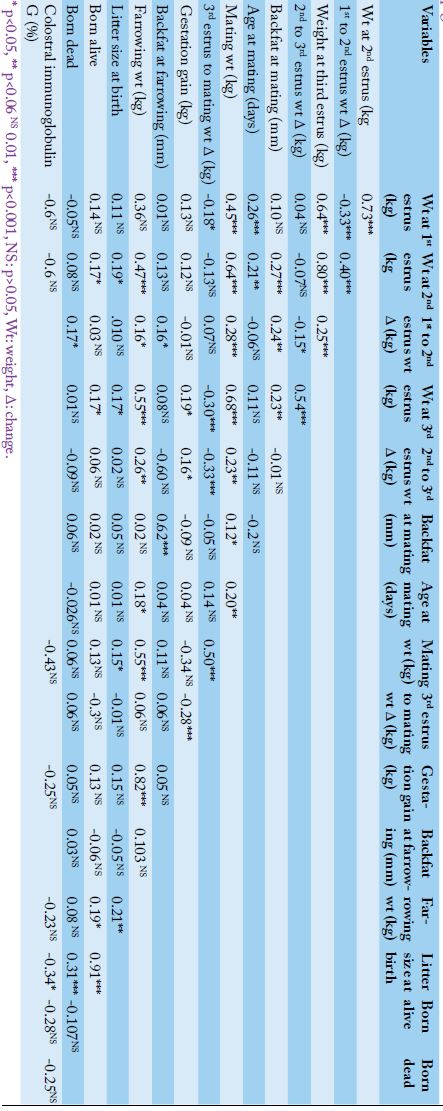
The Pearson Correlation coefficient between gilt development body weight changes, litter characteristics, and colostral immunoglobulin G levels in F1 Large White x Landrace pigs is presented in Table 3. There was a significant positive relationship between the backfat at mating and weight at the second estrus (rp= 0.27, p<0.001), mating weight (rp= 0.12, p<0.05) and weight at the third estrus (rp= 0.23, p<0.01), backfat at farrowing (rp= 0.62, p>0.001). However, the backfat at mating depicted an insignificant relationship with weight at first estrus (rp= 0.10, p>0.05), age at mating (rp= -0.20, p>0.05), gestation gain (rp= -0.09, p>0.05), farrowing weight (rp= 0.02, p>0.05),
Table 2: Effect of the backfat thickness at mating on gilt physiology and litter outcomes.
Traits
Backfat thickness at mating (Mean ± SE)
Low backfat thickness
Medium backfat thickness
High backfat thickness
Backfat at mating (mm)
10.20±0.12c
12.99±0.08b
15.62±0.15a
Age at mating (days)
226.88±0.85a
226.77±0.53a
226.85±1.05a
Mating weight (kg)
157.73±1.33b
158.30±0.83b
162.54±1.64a
Gestation gain (kg)
80.15±1.91a
80.47±1.20a
73.88±2.37b
Backfat at farrowing (mm)
13.95±0.29c
16.16±0.78b
17.62±0.35a
Farrowing weight (kg)
237.88±2.33a
238.77±1.46a
236.35±2.89a
Litter size at birth
14.58±0.41a
15.24±0.26a
14.65±0.51a
Born alive
14.13±0.39a
14.47±0.25a
14.23±0.49a
Born dead
0.45±0.17a
0.77±0.10a
0.423±0.21a
Colostral immunoglobulin G (%)
25.71 ± 0.79a
26.52±0.47a
28.26±1.00a
Row means that do not share a common superscript letter (a, b, c) differ significantly.
litter size at birth (rp= 0.05, p>0.05), born alive (rp= 0.02, p>0.05) and born dead (rp= 0.06, p>0.05). There was also a significant positive relationship between the age at mating and weight at first estrus (rp= 0.26, p<0.001), second estrus (rp= 0.21, p<0.01), mating weight (rp= 0.20, p<0.01) and farrowing weight (rp= 0.18, p<0.05), whereas insignificant relationship was noticed with weight at third estrus (rp= 0.11, p>0.05), gestation gain (rp= 0.04, p>0.05), backfat at farrowing (rp= 0.04, p>0.05), litter size at birth (rp= 0.01, p>0.05), born alive (rp= 0.01, p>0.05) and born dead (rp= 0.03, p>0.05). A positive significant relationship was observed between mating weight with weight at first (rp= 0.45, p<0.001), (rp= 0.64, p<0.001) and estrus (rp= 0.68, p<0.001), farrowing weight (rp= 0.55, p<0.001) and litter size at birth (rp= 0.15, p<0.05). A positive significant relationship between farrowing weight with weight at second (rp= 0.47, p<0.001) and third estrus (rp= 0.55, p<0.001), litter size at birth (rp= 0.21, p<0.01) and born alive (rp= 0.19, p<0.05). Litter size at birth was significantly correlated with weight at second estrus (rp= 0.19, p<0.05) and third estrus (rp= 0.17, p<0.05), born alive (rp= 0.91, p<0.001), and born dead (rp= 0.31, p<0.05). Colostral immunoglobulin was insignificantly correlated with all the traits understudy, except for litter size at birth (rp= -0.34, p<0.05).
Discussion
Influence of backfat thickness on gilt physiology
Body condition at mating is a pivotal factor shaping reproductive and metabolic efficiency in gilts . In the present study, variation in backfat thickness was associated with physiological patterns. This highlights the influence of pre-breeding adiposity on energy utilization during gestation. Gilts with higher backfat reserves appeared to exhibit reduced gestational weight gain . This suggests that excess fat before mating may slow down further body growth, which could impact the rate of metabolism and hormonal influence. Similar metabolic constraints in over-conditioned sows have been reported by Roongsitthichai and Tummaruk (2014) and Ajay et al. (2023a), who noted that excessive adiposity disrupts nutrient partitioning, increases the risk of farrowing difficulties, and contributes to postpartum metabolic disorders.
The physiological explanation for these effects may lie in endocrine modulation of energy metabolism . Over-conditioned gilts tend to exhibit impaired insulin sensitivity and elevated leptin levels. This condition interferes with anabolic processes required for fetal growth and mammary development . Moreover, deviations in energy balance through under- or over-nutrition can trigger metabolic stress ; . Consequently, maintaining moderate body condition before breeding ensures optimal hormonal stability. This maintains stability between maternal energy reserves and fetal nutrient requirements.
The persistence of backfat levels from mating to farrowing in the present study also suggests that pre-breeding condition determines subsequent metabolic patterns. Tummaruk et al. (2023) highlighted that gilts entering reproduction with adequate but not excessive backfat achieve better gestational consistency. This explains that backfat serves as both an indicator and regulator of reproductive readiness. These observations reinforce that balanced conditioning, not maximal adiposity, may optimize reproductive efficiency and support long-term sow productivity . On the other hand, sows with insufficient backfat before breeding may experience impaired future reproductive efficiency as a result of the need to mobilize body reserves differently ; . This may consequently result in issues such as reduced piglet birth weight, lower survival rates, and potentially increased stillbirths and mummified piglets. However, this was not the case in the present study, as it was observed that backfat thickness at mating does not affect litter traits. The observed lack of differences in litter traits across different backfat thickness groups could be attributed to the complex interplay of genetic, physiological, and management factors. More importantly, this could be due to the polygenic architecture of backfat thickness and litter traits , regulated by several small-effect variant genes.
Litter performance and colostral immunological quality
The present study observed no effect of backfat thickness at mating on colostral IgG concentration, although sound gilts showed a tendency to hold higher levels of IgG. This suggests that, within a physiologic range, maternal adiposity alone may not be the sole factor controlling passive immunity transfer efficiency. As highlighted by Ajay et al. (2023a), the mammary gland energy status is an important prerequisite for immunoglobulin synthesis and colostrum quality. More importantly, Amatucci et al. (2022) reported that colostral IgA and IgG production is breed-specific; for example, Duroc sows secrete more colostral IgA and IgG than Large White sows. This indicates the genetic effect on immune-related characteristics. These results overall depict that metabolic status and genotype interactions influence colostral quality and piglet immune level. Therefore, future studies should examine the combined effects of maternal body reserves and genetic variation on immunoglobulin dynamics.
In addition to adiposity, a number of other physiological and environmental factors also have an impact on colostral immunoglobulin production and content. Merlot et al. (2017) reported that gestational stress increases cortisol, which inhibits colostrum formation and impacts immunity in piglets. In accordance with the dilution hypothesis of Quesnel et al. (2012), the inverse relationship between IgG concentration and litter size recorded in this study suggests that larger litters may receive reduced maternal IgG per piglet. These findings demonstrate the integration of metabolism, endocrine regulation, and immune function in mediating colostral quality. The efficiency of immune transfer is also affected by environmental and management situations. Housing, frequency of feeding, and stress reduction could improve piglet liveliness without necessarily changing IgG level . Overall, this study underscores that colostrum immunological quality is a complex trait determined by the interaction of physiological status, genetics, and environmental management.
Interrelationships among gilt development, reproductive traits, and gestational performance
The positive correlations in body weights between successive estrus cycles indicate the steady physiological growth as gilts mature towards breeding readiness. Heavier gilts at service are associated with a greater uterine capacity and placental nutrient transfer that could result in enhanced fetal survival . Nevertheless, the inverse trend between body reserves before first mating and gestational gain observed corroborates with the compensatory growth phenomenon as defined by Bortolozzo et al. (2023). In this situation, the lean gilts have greater gestational tissue accretion to account for fetal energy requirements. This adaptive relationship confirms that reproductive success is not determined by a single measure of weight or fatness, but by the balance between reserve fat and gestational nutrient accumulation. These results are in agreement with the earlier report of Roongsitthichai and Tummaruk (2014) and Ajay et al. (2023b), which all demonstrate that being lean or obese does not result in optimal reproductive outcomes. Similarly, Peppmeier (2020), pointed out that there is a moderate genetic correlation between growth and reproduction traits. Early maturing animals with a rapid growth rate or fat reserves can negatively impact their reproductive longevity. Therefore, gilt development programs should be set to promote moderate growth rates and controlled fat deposition to maintain the physiological equilibrium over reproductive cycles.
Implications for gilt selection and breeding management
From a practical standpoint, maintaining gilts within a moderate backfat range of approximately 12–14 mm and a body weight of 155–160 kg at mating appears to offer the best compromise between metabolic stability and reproductive performance. Over-conditioned gilts are more prone to farrowing complications and reduced gestation gain, whereas under-conditioned animals lack sufficient reserves to support fetal development and early lactation. Similar thresholds have been advocated in literature ; , who emphasized the role of balanced body condition in sustaining sow fertility and productivity. Integrating physiological indicators such as backfat thickness, body weight, and growth trajectory into gilt selection programs can enhance the prediction of reproductive success and sow longevity. Peppmeier (2020) further suggested that genetic selection strategies combining reproductive and metabolic traits could mitigate unfavorable correlations between excessive fatness and reproductive outcomes. Overall, these findings reaffirm that the management of gilt body condition before breeding is an important factor in achieving optimal reproductive performance and piglet viability. Moderate backfat levels ensure endocrine balance, efficient energy utilization, and stable immune function, thereby promoting sustainable productivity in F1 Large White × Landrace herds. While this study provides new insights into the physiological and immunological roles of gilt body condition, further research is warranted to expand its applicability. Future studies should undertake longitudinal monitoring across successive parities to determine how pre-breeding backfat and weight influence lifetime reproductive performance, longevity, and piglet survival. Detailed investigations into metabolic and endocrine pathways, including hormonal and biochemical markers, would clarify mechanisms linking energy reserves with reproductive and immune functions.
Conclusion
Backfat thickness at mating influenced gilt physiological development but had a limited impact on litter outcomes and colostral IgG concentration in F1 Large White × Landrace gilts. Gilts with high backfat at mating exhibited greater mating weights and higher backfat at farrowing, but achieved lower gestation gains compared to those with moderate or low backfat. The weak negative correlation between litter size and colostral IgG suggests that larger litters may dilute passive immunity per piglet, reinforcing the importance of balanced litter sizes for optimal neonatal protection. Collectively, the findings indicate that maintaining gilts at a moderate backfat range (12–14 mm) and adequate body weight before mating supports efficient gestational gain and metabolic balance without compromising immune quality or litter performance. These outcomes underscore the necessity of balanced gilt management strategies that integrate both physiological and immunological considerations to enhance reproductive efficiency and piglet survivability under commercial production systems.
Acknowledgement
Topigs Norsvin South Africa is acknowledged for the provision of animals, facilities and all the staff for this research.
Novelty Statement
This study provides one of the first integrated evaluations of backfat thickness at mating, gilt physiological development, litter performance, and colostral immunoglobulin G (IgG) concentration in F1 Large White × Landrace gilts, generating evidence to support precision breeding and reproductive management under commercial production systems.
Author’s Contribution
All authors reviewed and approved the final manuscript.
Ethical statement
The study received ethical approval from the Animal Research Ethics Committee of Tshwane University of Technology (AREC202306003) and Topigs Norsvin South Africa.
Funding information
This work was supported by Tshwane University of Technology and Topigs Norsvin South Africa.
Generative AI and AI assisted technology statement
The authors declare that no generative AI and AI assisted technology was used in the creation of this manuscript.
Conflict of interest
The authors have declared no conflict of interest.
Figures
Table 3:.
Pearson Correlation coefficient between gilt body weight changes, litter characteristics, and colostral immunoglobulin G levels in F1 Large White x Landrace Variables pigs.
References
Ajay A, Chauhan A, Vaishnav S, Rani C, Kumar B, De UK, Gaur GK (2023a). Impact of body condition on sow and litter performance, postpartum physiological, hematological, and biochemical parameters in Landlly crossbred pigs. Trop. Anim. Health Prod., 55(6): 393. https://doi.org/10.1007/s11250-023-03772-4[CrossRef]
Ajay S, Roongsitthichai A, Tummaruk P (2023b). Influence of sow body condition and parity on reproductive performance, colostrum yield and composition. Trop. Anim. Health Prod., 55(4): 389–400.
Almond GW, Mahan-Riggs E (2018). Factors affecting the reproductive efficiency of pigs. In: Achieving sustainable production of pig meat Volume 2, pp. 61-82. Burleigh Dodds Science Publishing. https://doi.org/10.1201/9781351114349-6[CrossRef]
Amatucci L, Luise D, Correa F, Bosi P, Trevisi P (2022). Importance of breed, parity and sow colostrum components on litter performance and health. Animals, 10, 12(10): 1230. https://doi.org/10.3390/ani12101230.[CrossRef]
Bortolozzo FP, Zanin GP, Ulguim RDR, Mellagi APG (2023). Managing reproduction in hyperprolific sow herds. Animals, 13(11): 1842. https://doi.org/10.3390/ani13111842[CrossRef]
Buthelezi NL, Mtileni B, Nephawe KA, Modiba MC, Mpedi H, Idowu PA, Mpofu TJ (2024). Effects of parity, season of birth, and sex on within-litter variation and pre-weaning performance of F1 Large White × Landrace pigs. Vet. World, 17(7): 1459. https://doi.org/10.14202/vetworld.2024.1459-1468[CrossRef]
Choe J, Kim S, Cho JH, Lee JJ, Park S, Kim B, Kim J, Baidoo SK, Oh S, Kim HB, Song M (2018). Effects of different gestation housing types on reproductive performance of sows. Anim. Sci. J., 89(4): 722-726. https://doi.org/10.1111/asj.12977[CrossRef]
Faccin JEG, Tokach MD, Goodband RD, Derouchey JM, Woodworth JC, Gebhardt JT (2022). Gilt development to improve offspring performance and survivability. J. Anim. Sci., 100(6). https://doi.org/10.1093/jas/skac128[CrossRef]
Gozalo-Marcilla, M., Buntjer, J., Johnsson, M., Batista, L., Diez, F., Werner, C.R., and Ros-Freixedes, R. (2021). Genetic architecture and major genes for backfat thickness in pig lines of diverse genetic backgrounds. Genetics Selection Evolution, 53(1), 76. https://doi.org/10.1186/s12711-021-00671-w[CrossRef]
Hasan SJ, Unnikkala SV, Alros AP, Eltoniemi O, Oliviero C (2016). Validation of Brix refractometer to estimate colostrum immunoglobulin G content and composition in the sow. J. Anim. Sci., 10(10): 1728-1733. https://doi.org/10.1017/S1751731116000896[CrossRef]
Hoving LL, Soede NM, Graat EAM, Feitsma H, Kemp B (2010). Effect of live weight development and reproduction in first parity on reproductive performance of second parity sows. Anim. Reprod. Sci., 122(1-2): 82-89. https://doi.org/10.1016/j.anireprosci.2010.07.009[CrossRef]
Johnston LJ. (2022). Feeding reproducing swine and neonatal pigs. Sustain. Swine Nutr., pp. 623-645. https://doi.org/10.1002/9781119583998.ch22[CrossRef]
Kim JS, Yang X, Baidoo SK (2016). Relationship between body weight of primiparous sows during late gestation and subsequent reproductive efficiency over six parities. Asian-Australas. J. Anim. Sci., 29(6): 768. https://doi.org/10.5713/ajas.15.0907[CrossRef]
Kim KH, Hosseindoust A, Ingale SL, Lee SH, Noh HS, Choi YH, Jeon SM, Kim YH, Chae BJ (2015). Effects of gestational housing on reproductive performance and behavior of sows with different backfat thickness. Asian-Australas. J. Anim. Sci., 29(1): 142. https://doi.org/10.5713/ajas.14.0973[CrossRef]
Li Q, Patience JF (2017). Factors involved in the regulation of feed and energy intake of pigs. Anim. Feed Sci. Technol., 233: 22-33. https://doi.org/10.1016/j.anifeedsci.2016.01.001[CrossRef]
Merlot, E., Calvar, C., and Prunier, A. (2017). Influence of the housing environment during sow gestation on maternal health, and offspring immunity and survival. Animal Production Science, 57(8): 1751-1758. https://doi.org/10.1071/AN15480[CrossRef]
Matukane TH, Idowu PA, Mtileni B, Nephawe KA, Modiba MC, Mpedi H, Mpofu TJ (2025). Domestic pig (Sus domesticus) colostrum-composition and quality, effect on neonates, genetic markers, and assessment methods: A narrative review. Anim. Sci. Genet., 21(3). https://doi.org/10.5604/01.3001.0055.2138[CrossRef]
Mpalala N, Obokoh LO (2024). Small-scale pig farming as a tool for unemployment alleviation in buffalo City, Eastern Cape of South Africa. S. Afr. J. Agric. Ext., 52(3): 85-102. https://doi.org/10.17159/2413-3221/2024/v52n3a15544[CrossRef]
Muro BB, Carnevale RF, Leal DF, Almond GW, Monteiro MS, Poor AP, Garbossa CA (2023). The importance of optimal body condition to maximise reproductive health and perinatal outcomes in pigs. Nutr. Res. Rev., 36(2): 351-371. https://doi.org/10.1017/S0954422422000129[CrossRef]
Oh SM, Hosseindoust A, Ha SH, Mun JY, Moturi J, Tajudeen H, Choi YH, Lee SH, Kim JS (2024). Importance of dietary supplementation of soluble and insoluble fibers to sows subjected to high ambient temperatures during late gestation and effects on lactation performance. Anim. Nutr., 16: 73-83. https://doi.org/10.1016/j.aninu.2023.10.004[CrossRef]
Patterson J, Foxcroft G (2019). Gilt management for fertility and longevity. Animals, 9(7): 434. https://doi.org/10.3390/ani9070434[CrossRef]
Peppmeier ZC (2020). Estimates of variance components for genetic correlations among growth and gilt service traits. North Carolina State University. https://www.lib.ncsu.edu/resolver/1840.20/38061
Quesnel H, Farmer C, Devillers N (2012). Colostrum intake: Influence on piglet performance and factors of variation. Livest. Sci., 146(2-3): 105-114. https://doi.org/10.1016/j.livsci.2012.03.010[CrossRef]
Roongsitthichai A, Tummaruk P (2014). Importance of backfat thickness to reproductive performance in female pigs. Thai J. Vet. Med., 44(2): 171-178. https://doi.org/10.56808/2985-1130.2557[CrossRef]
Sell-Kubiak, E., Knol, E.F., and Lopes, M. (2022). Evaluation of the phenotypic and genomic background of variability based on litter size of Large White pigs. Genetics Selection Evolution, 54(1): 1. https://doi.org/10.1186/s12711-021-00692-5[CrossRef]
Siemińska I, Pejsak Z (2022). Impact of stress on the functioning of the immune system, swine health and productivity. https://doi.org/10.21521/mw.6673[CrossRef]
Souza AZ, Bombassaro GE, Fonseca FN, Lopes LDS, Maciag SS, Volpato FB, Bastos AP (2021). A comparative evaluation of methods for estimating the colostrum quality in sows. Arq. Bras. Med. Vet. Zootec., 73(5): 1047-1057. https://doi.org/10.1590/1678-4162-12269[CrossRef]
Tummaruk P, De Rensis F, Kirkwood RN (2023). Managing prolific sows in tropical environments. Mol. Reprod. Dev., 90(7): 533-545. https://doi.org/10.1002/mrd.23661[CrossRef]