
Environment can affect sows behavioral pattern by creating their physiology and psychology imbalances, and postpartum behavioral pattern of sows is related closely with piglet mortality. However, few studies have focused on effects of pregnancy and lactation environments on Postures of primiparous sows during lactation. This study has investigated the postures of lactating primiparous sows raised in the crates or free pens during pregnancy and lactation. Total 12 gilts were reared in three types of environments randomly during pregnancy and lactation, including gestation pens and farrowing crates (PC), gestation pens and farrowing pens (PP), or gestation rates and farrowing crates (CC). Postures of sows were recorded by monitoring equipment on the 1st to 3rd day of 1-4 week after farrowing, the duration of postures was analyzed, including lateral lying, ventral lying, sitting, and standing. Gestation crates can encourage sow’s sitting behaviour during the first week of postpartum (P=0.032), farrowing crates could increase sow’s lateral lying during 1-4 weeks of postpartum (P=0.001), while the sows reared in farrowing pens performed more ventral lying and standing than farrowing crates (P=0.002; P=0.001, respectively). The restricted pregnancy environments could increase sitting and standing of lactating sows. The restricted lactating environments could prolong the lateral lying and sitting, and decrease the ventral lying and standing of lactating sows.
Research Article · Volume 52, Issue 3, 8 March 2020 · Open Access
Effects of Pregnancy and Lactation Environments on Postures of Primiparous Sows During Lactation
· · · · ·
Affiliations & Notes ⌄
- 1College of Animal Science and Veterinary Medicine, Heilongjiang Bayi Agricultural University, Daqing, 163319, China 2Heilongjiang Key Laboratory of Efficient Utilization of Feed Resources and Nutrition Manipulation in Cold Region, Daqing, 163319, China , * Corresponding author: hbf970304@163.com
Article Info ⌄
- Journal:
- Pakistan Journal of Zoology
- Published:
- 8 March 2020

From the article
- The result of present study showed that sows in loose gestation environment express more lateral lying during lactation than those in restricted gestation environment, but not significantly.
- Farrowing crates had increased the total duration of sitting during 1-4 weeks postpartum.
- Sows express more lateral lying and sitting in farrowing crates, but more ventral lying and standing in farrowing pens.
Selected from the article's own text.
Abstract
INTRODUCTION
Farrowing crates as the most common production systems have been widely used in modern swine industry of many countries, in order to decrease piglet’s mortality due to crushing and improve space utilization of house. As crates system has received increasing criticism due to impaired the welfare of sows , the gestation crates have been gradually replaced by free pens in many countries. Sows have strong motivation to express several natural behaviors, but always being restricted in crates due to barren environment and lack of space ; . Confining pregnancy sows in crates, always cause it chronic physiological and psychological stress. Researches show that, long-term feed in restrictive environment, sows would show a course of stereotypies like bar-biting, sham-chewing, excessive-drinking as a response to maladaptive environment, sows even performed some abnormal maternal behavior in long-term restrictive and barren situation ; ; ; ; . Besides the effects on gestation sow’s physiology and behavior under environmental stress would manifest more bio-markers of physiological stress such as salivary cortisol and change the pattern or frequency of behavior during lactation . Johnson et al. (2001) found that sows among restrictive environment showed more lying and drinking behavior, fewer standing and walking behavior than those among loose environment. Long-term restrictive situations also increase the risk of lameness in sows, and pain or lameness-related sickness could be expected to make their body postures hard to convert . Therefore, animal behavioural parameters can be used as an indicator among evaluation index system of house environment and the welfare of animals ; .
To some extent, the effects of environment on animals’ physical body and physiology can be reflected through their behaviors , such as lateral lying, ventral lying , sitting and standing or walking which are usual body postures of sows during lactation. lateral lying is the sign for piglets’ access to massage the udder and stimulate milk securely , sows show more lateral lying for better actations and reduce the piglet mortality due to crushing during lactation and lateral lying is the optimal posture for sows to rest , so it plays an important role in piglets survival during lactation . Common knowledge is that sows change posture into ventral lying or standing as their main manner for refuse lactation. So the frequency of ventral lying or standing increase means the lactation motivation of sows is decreasing. Sitting is the intermediate step between ventral lying and standing, the frequency of sitting is positive correlation with piglets mortality due to crushing . Sows would show more change between lying and sitting in loose environment during lactation, which will increase the risk of crushing to piglets.
The behavior of primiparous sows is vulnerable to house environment, and express abnormal behaviors, due to the inexperience of farrowing . So it is crucial to provide suitable environment for sows during pregnancy and lactation respectively. The aim of this study was to compare the posture distribution of sows between pregnancy environments and lactation environments combinations after farrowing, hoping to improving the welfare by constantly optimize sows’ house design.
MATERIALS AND METHODS
Animals, treatments, management and feeding
All experiments were approved by the Animal Ethics Committee of College of Animal Science and Veterinary Medicine, Heilongjiang Bayi Agricultural University.
The experiments were carried out in a commercial herd between September and December 2018, a total of 12 cross breeding gilts (Yorkshire × Landrace) were selected after confirmed pregnancy, and all sows were fed in three types of crates or pens combination randomly during pregnancy and lactation (4 sows each), including gestation pens and farrowing crates combination group (control PC group), gestation pens and farrowing pens combination group (Treatment PP group), gestation crates and farrowing crates combination group (Treatment CC group). Gilts were housed in gestation crates or group-housed in gestation pens from 21 days after mating to 7 days before expected date of delivery, and then all gilts were transferred from the pregnancy house to the farrowing house and fed in farrowing crates (Treatment CC group; Treatment PP group) or farrowing pens (Control PC group). Sows were fed 3 times each day (06:00, 10:00 and 17:00), the house was cleaned and changed straw after morning feed every day, sows were fed by complete formula feed with a suitable amount (NRC, 2012). Other management standard, immune procedures and disease treatment refer to the uniform standard of this pig farm.
Housing environment
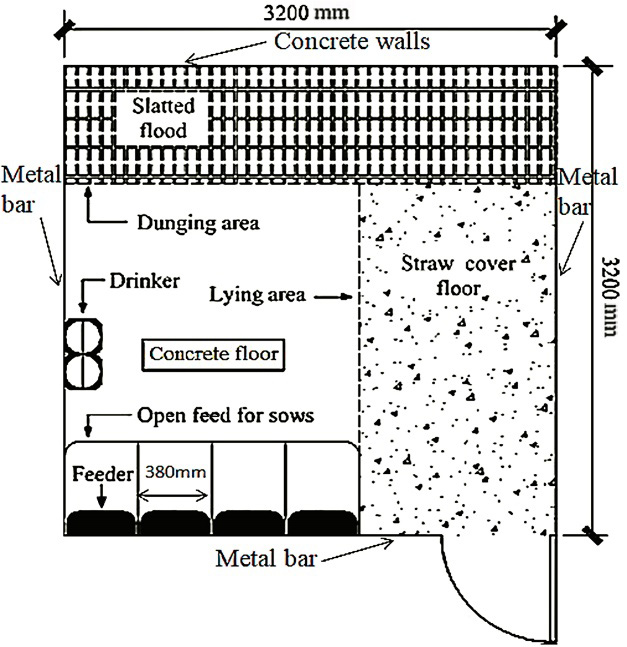
The gestation pens measured 3.2 m×3.2 m and had cement floor with a slope of 5 to allow drainage, it was divided into three parts including lying area, dunging area and feeding area. The wall of gestation pens was surrounded by concrete walls or metal bar with a height of about 1.2m, the ground of lying area was covered with about 100 mm thickness straw, feeding area had equipped four individual open feeding stalls, dunging area had been installed with slatted flood, the planar graph showing the design features the gestation pens was shown in the Figure 1. The gestation crates measured 2.1 m×0.6 m, the ground of gestation crates consisted of a concrete floor with slatted dunging area in the rear, beyond that gestation crates ground was not straw covered.
The gestation crates and gestation pens were located in the same pregnancy house, both are equipped with the same type of drinker.
The farrowing pens measured 3.5 m×2.0 m, in which sows could move freely, the wall of farrowing pens was surrounded by 4 PVC board with about 0.5 m height, the
Table I. The behaviors categories and their definitions.
| Behaviors categories | Definitions |
| Lateral lying | Lying down with one shoulder making contact with the floor. |
| Ventral lying | Lying down with chest and abdomen making contact with the floor and front Legs stretched or folded under the body. |
| Sitting | Partly erected on stretched front legs with hindquarter contacting the floor. |
| Standing | Keeping an upright body postures with hooves contacting the floor only, with locomotion or motionless. |
Some behavioral parameters and their definitions are from .
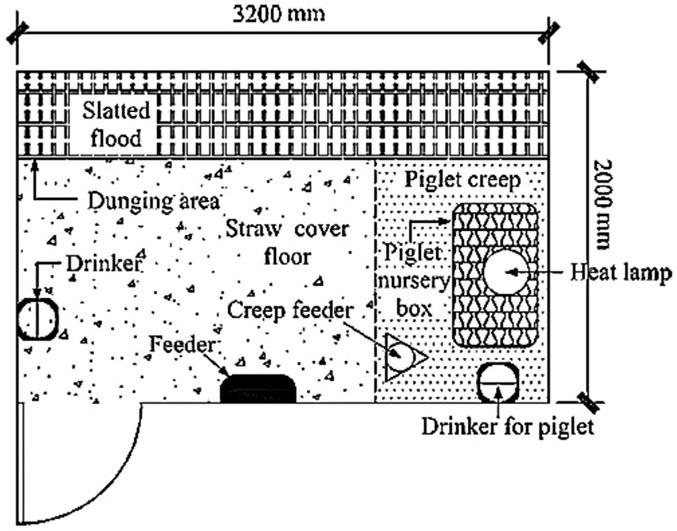
ground of farrowing pens was aboved a solid concrete floor and covered with about 100 mm thickness straw, the planar graph showing the design features the gestation pens was shown in the Figure 2.
The farrowing crates measured 2.1 m×1.8 m, in which ground was not straw covered, the stall of sows was located in the middle of farrowing crates with 0.6 m width.Farrowing pens and farrowing crates were located in the same farrowing house; both were equipped with a piglet creep, different nipple drinker system for piglets or sows, a piglet nursery box with a heat lamp, a creep feeder and feeder for sows.
Behaviour recording and analysis
All sows were monitored by monitoring equipment (Cloudsee JVS-H411-H1, Jinan, China) from the 1st to 4th week of lactation continuously, the monitoring equipment mounted above the pens or crates. From 00:00 to 23:59 on the 1st to 3rd day of each week videotaping was conducted for observing each posture duration. The behavior duration longer than 5s was considered as valid, otherwise invalid. All postures were observed as definitions in Table I. All behavior data was converted into percentages and conformed to the normal distribution before being analyzed with One-Way ANOVA (IBM SPSS statistics 22.0).
RESULTS
Lateral lying
As shown in Table II, PC sows spent more time on lateral lying than CC sows during 1-4 weeks postpartum, but not significantly (P>0.10). Lateral lying was influenced by lactation environment. PP sows spent less time (P=0.001) engaged in lateral lying than PC sows during 1-4 weeks postpartum. However, there was no difference (P=0.229) in lateral lying between PP and PC sows at 1st week postpartum, while the lateral lying time was significantly different between PP group and PC group at the 2nd, 3rd or 4th week (P=0.005; P=0.001; P=0.006, respectively).
Table II. Lateral lying distribution (%).
| Times | PC group | CC group | PP group | SE | Gestation environment | Lactation environment |
| W1 | 85.62 | 81.26 | 79.83 | 4.48 | P=0.356 | P=0.229 |
| W2 | 74.89 | 63.22 | 49.06 | 7.10 | P=0.135 | P=0.005 |
| W3 | 67.13 | 61.97 | 38.54 | 6.13 | P=0.422 | P=0.001 |
| W4 | 70.83 | 58.88 | 55.01 | 10.13 | P=0.272 | P=0.006 |
| W1-4 | 74.62 | 67.07 | 50.09 | 4.15 | P=0.103 | P=0.001 |
Note: The significant level is P<0.05 and the extremely significant level is P<0.01
Ventral lying
As shown in Table III, Pregnancy environment had no significant influence (P>0.05) on ventral lying of lactating sows. Sows’ ventral lying in lactation was influenced by lactation environment. PP sows spent more time (P=0.001) engaged in ventral lying than PC group during 1-4 weeks postpartum. Although the lying duration of PP sows was greater than PC group in each week, there was only significant difference at 2nd week postpartum (P<0.05).
Table III. Ventral lying distribution (%).
| Times | PC group | CC group | PP group | SE | Gestation environment | Lactation environment |
| W1 | 9.71 | 9.3 | 11.46 | 3.83 | P=0.918 | P=0.657 |
| W2 | 17.91 | 16.45 | 41.66 | 10.04 | P=0.888 | P=0.042 |
| W3 | 21.25 | 28.85 | 38.75 | 8.18 | P=0.377 | P=0.061 |
| W4 | 21.66 | 14.1 | 36.14 | 9.46 | P=0.451 | P=0.137 |
| W1-4 | 17.63 | 17.51 | 32.08 | 3.40 | P=0.972 | P=0.002 |
Note: The significant level is P<0.05 and the extremely significant level is P<0.01
Sitting
As shown in Table IV, sitting of CC sows was significant longer than PC sows, but only significant in the first week postpartum (P<0.05). The Lactation environment had no significant influence (P>0.05) on sitting of lactating sows.
Table IV. Sitting distribution (%).
| Times | PC group | CC group | PP group | SE | Gestation environment | Lactation environment |
| W1 | 0.83 | 3.54 | 0.81 | 1.06 | P=0.032 | P=0.983 |
| W2 | 1.56 | 2.6 | 1.25 | 0.89 | P=0.276 | P=0.736 |
| W3 | 2.81 | 2.91 | 2.08 | 1.20 | P=0.933 | P=0.560 |
| W4 | 1.51 | 1.25 | 1.77 | 1.29 | P=0.846 | P=0.834 |
| W1-4 | 1.67 | 2.72 | 1.47 | 0.84 | P=0.250 | P=0.828 |
Note: The significant level is P<0.05 and the extremely significant level is P<0.01
Standing
As shown in Table V, standing of CC sows was longer than that of PC group in each week of postpartum, but only significantly at 4th week postpartum (P<0.05). Location environment also had influence on sitting: PP sows spent more time in standing than PC sows during location (P<0.05), but not significantly at the 1st week (P>0.05).
Table V. Standing distribution (%).
| Times | PC group | CC group | PP group | SE | Gestation environment | Lactation environment |
| W1 | 3.95 | 5.89 | 8.07 | 2.11 | P=0.328 | P=0.083 |
| W2 | 6.66 | 12.81 | 17.7 | 3.58 | P=0.121 | P=0.013 |
| W3 | 7.86 | 12.08 | 20.6 | 3.49 | P=0.258 | P=0.037 |
| W4 | 6.04 | 18.19 | 25.83 | 5.06 | P=0.043 | P=0.003 |
| W1-4 | 6.13 | 11.45 | 18.06 | 2.54 | P=0.066 | P=0.001 |
Note: The significant level is P<0.05 and the extremely significant level is P<0.01
DISCUSSION
The result of present study showed that sows in loose gestation environment express more lateral lying during lactation than those in restricted gestation environment, but not significantly. Lateral lying of lactating sows provides a warm and comfortable micro environment to piglets, and increases udder accessibility . Thus, loose gestation environment might reduce the mortality of piglets.
Studies showed that the mortality of piglets in loose pens was higher than that in crates ; , thus restricted lactation environments are considered beneficial to piglet welfare . However some natural behaviors of sows are forbidden, particularly nesting behavior, thus the crates could cause the chronic stress in sows progressively with the time of restriction ; ; . In general, loose environment could keep sows in a ‘semi-natural’ habitat, which allow sows to perform their normal behavior pattern, sows also showed more lateral lying in loose environment during lactation in present study. But Increasing sow’s activity space by changing the size and shape of the pens, Lou and Hurnik (1998) found no difference in lateral lying between loose pens and restricted crates during lactation. In our study, there was no effect of the gestation environments on sows’ lateral lying during lactation, which may be partially due to the time in restricted crates has been short.
Farrowing pens had increased the duration of ventral lying and standing in sows during 1-4 weeks postpartum significantly. Because of increased teat massage of piglets in the farrowing pens, sows perform ventral lying, standing or walking to avoid piglets. Thus ventral lying and standing/walking can be deemed as the signal of sows’ refusal to breastfeed. Chidgey et al. (2016) found that sows express more standing/walking and less lying in farrowing pens at 1-6 days postpartum. Standing is often expressed along with other behaviors, such as nose-nose contacting, pen-directed behavior or drinking behavior. The loose lactation environment provide enough space for lactation sows to move freely, and gives sows more freedom to start and stop breastfeeding willingness, so loose lactation environment had improved the welfare of sows.
Farrowing crates had increased the total duration of sitting during 1-4 weeks postpartum. The increased sitting might be associated with the result of chronic stress on sows caused by long-term restrictive or barren situations. Oliviero et al. (2008) found that sows fed in crates had a higher level of cortisol than that in the pens. Previous studies also showed that sows housed in gestation crates showed more sitting than those in loose pens during pregnancy or lactation ; ; . The over-expression of sitting might be due to the space provided for the animal is too small or simple and barren housing situation, and sitting was often accompanied by sham-chewing, which was regarded as an symptom of depression and indicated a state of stress of sows, and sitting could be used to evaluate the mental status of sows ; . Besides, increasing sows’ sitting may lead to more postures changing which was positively correlated with the crushing of piglets.
CONCLUSIONS
The gestation crates could promote sows anxiety and stress, sows showed more sitting and standing after farrowing. Sows express more lateral lying and sitting in farrowing crates, but more ventral lying and standing in farrowing pens. To some extent, farrowing crates reduce the risk of piglet’s mortality due to crushing.
ACKNOWLEDGEMENT
This project was supported by University Nursing program for Young Scholars with Creative Talents in Heilongjiang (UNPYSCT-2017107), National Natural Science Foundation of China (31402114) and Heilongjiang Bayi Agricultural University Support Program for San Heng San Zong (TDJH201804).
Statement of conflict of interest
The authors declare no conflict of interest in this study.
Figures
Loose gestation pens.
Loose farrowing pens.
References
- Alakurikka, E., Heinonen, M., Mustonen, K., Peltoniemi, O., Raekallio, M., Vainio, O. and Valros, A., 2017. Behavior changes associated with lameness in sows. Appl. Anim. Behav. Sci., 193: 15-20. https://doi.org/10.1016/j.applanim.2017.03.017[CrossRef]
- Blackshaw, J.K., Blackshaw, A.W., Thomas, F.J. and Newman, F.W., 1994. Comparison of behaviour patterns of sows and litters in a farrowing crate and a farrowing pen. Appl. Anim. Behav. Sci., 39: 281-295. https://doi.org/10.1016/0168-1591(94)90163-5[CrossRef]
- Bolhuis, J.E., Den Boogaard, A.M., Hoofs, A.I. and Soede, N.M., 2018. Effects of loose housing and the provision of alternative nesting material on peri-partum sow behaviour and piglet survival. Appl. Anim. Behav. Sci., 202: 28-33. https://doi.org/10.1016/j.applanim.2018.01.004[CrossRef]
- Chapinal, N., LaTorre, J.L., Cerisuelo, A., Gasa, J., Baucells, M.D., Coma, J., Vidal, A. and Manteca, X., 2010. Evaluation of welfare and productivity in pregnant sows kept in stalls or in 2 different group housing systems. J. Vet. Behav., 5: 82-93. https://doi.org/10.1016/j.jveb.2009.09.046[CrossRef]
- Chidgey, K.L., Morel, P.C., Stafford, K.J. and Barugh, L.W., 2016. Observations of sows and piglets housed in farrowing pens with temporary crating or farrowing crates on a commercial farm. Appl. Anim. Behav. Sci., 176: 12-18. https://doi.org/10.1016/j.applanim.2016.01.004[CrossRef]
- Csermely, D., 1994. Maternal behaviour of free-ranging sows during the first 8 days after farrowing. J. Ethol., 12: 53-62. https://doi.org/10.1007/BF02350080[CrossRef]
- Hales, J., Moustsen, V.A., Nielsen, M.B. and Hansen, C.F., 2014. Higher preweaning mortality in free farrowing pens compared with farrowing crates in three commercial pig farms. Animal, 8: 113-120. https://doi.org/10.1017/S1751731113001869[CrossRef]
- Hales, J., Moustsen, V.A., Nielsen, M.B. and Hansen, C.F., 2016. The effect of temporary confinement of hyperprolific sows in sow welfare and piglet protection pens on sow behaviour and salivary cortisol concentrations. Appl. Anim. Behav. Sci., 183: 19-27. https://doi.org/10.1016/j.applanim.2016.07.008[CrossRef]
- Hemsworth, P.H., 2018. Key determinants of pig welfare: implications of animal management and housing design on livestock welfare. Anim. Prod. Sci., 58: 1375-1386. https://doi.org/10.1071/AN17897[CrossRef]
- Illmann, G., Chaloupkova, H. and Melisova, M., 2016. Impact of sow prepartum behavior on maternal behavior, piglet body weight gain, and mortality in farrowing pens and crates. J. Anim. Sci., 94: 3978-3986. https://doi.org/10.2527/jas.2016-0329[CrossRef]
- Johnson, A.K., Morrowtesch, J. and Mcglone, J.J., 2001. Behavior and performance of lactating sows and piglets reared indoors or outdoors. J. Anim. Sci., 79: 2571-2579. https://doi.org/10.2527/2001.79102571x[CrossRef]
- Lou, Z. and Hurnik, J.F., 1998. Peripartum sows in three farrowing crates: posture patterns and behavioural activities. Appl. Anim. Behav. Sci., 58: 77-86. https://doi.org/10.1016/S0168-1591(96)01144-6[CrossRef]
- Mcglone, J.J. and Morrowtesch, J., 1990. Productivity and behavior of sows in level vs. sloped farrowing pens and crates. J. Anim. Sci., 68: 82-87.
- Merlot, E., Quesnel, H. and Prunier, A., 2013. Prenatal stress, immunity and neonatal health in farm animal species. Animal, 7: 2016-2025. https://doi.org/10.1017/S175173111300147X[CrossRef]
- Moustsen, V.A., Hales, J., Lahrmann, H.P., Weber, P.M. and Hansen, C.F., 2013. Confinement of lactating sows in crates for 4 days after farrowing reduces piglet mortality. Animal, 7: 648-654. https://doi.org/10.1017/S1751731112002170[CrossRef]
- NRC, 2012. Nutrient requirements of swine. 12th ed. National Academy Press, Washington, DC. https://doi.org/10.17226/13298[CrossRef]
- Oliviero, C., Heinonen, M., Valros, A., Halli, O. and Peltoniemi, O.A., 2008. Effect of the environment on the physiology of the sow during late pregnancy, farrowing and early lactation. Anim. Reprod. Sci., 105: 365-377. https://doi.org/10.1016/j.anireprosci.2007.03.015[CrossRef]
- Pedersen, L.J., Damm, B.I., Marchantforde, J.N. and Jensen, K.H., 2003. Effects of feed-back from the nest on maternal responsiveness and postural changes in primiparous sows during the first 24 h after farrowing onset. Appl. Anim. Behav. Sci., 83: 109-124. https://doi.org/10.1016/S0168-1591(03)00116-3[CrossRef]
- Petersen, V., Simonsen, H.B. and Lawson, L., 1995. The effect of environmental stimulation on the development of behaviour in pigs. Appl. Anim. Behav. Sci., 45: 215-224. https://doi.org/10.1016/0168-1591(95)00631-2[CrossRef]
- Puterflam, J., Merlet, F., Faure, J.M., Hocking, P. and Picard, M., 2006. Effects of genotype and feed restriction on the time-budgets of broiler breeders at different ages. Appl. Anim. Behav. Sci., 98: 100-113. https://doi.org/10.1016/j.applanim.2005.08.013[CrossRef]
- Ringgenberg, N., Bergeron, R. and Devillers, N., 2010. Validation of accelerometers to automatically record sow postures and stepping behaviour. Appl. Anim. Behav. Sci., 128: 37-44. https://doi.org/10.1016/j.applanim.2010.09.018[CrossRef]
- Singh, C., Verdon, M., Cronin, G.M. and Hemsworth, P.H., 2017. The behaviour and welfare of sows and piglets in farrowing crates or lactation pens. Animal, 11: 1210-1221. https://doi.org/10.1017/S1751731116002573[CrossRef]
- Temple, D., Manteca, X., Velarde, A. and Dalmau, A., 2011. Assessment of animal welfare through behavioural parameters in Iberian pigs in intensive and extensive conditions. Appl. Anim. Behav. Sci., 131: 29-39. https://doi.org/10.1016/j.applanim.2011.01.013[CrossRef]
- Vanheukelom, V., Driessen, B. and Geers, R., 2012. The effects of environmental enrichment on the behaviour of suckling piglets and lactating sows: A review. Livest. Sci., 143: 116-131. https://doi.org/10.1016/j.livsci.2011.10.002[CrossRef]
- Weber, R., Keil, N.M., Fehr, M. and Horat, T., 2009. Factors affecting piglet mortality in loose farrowing systems on commercial farms. Livest. Sci., 124: 216-222. https://doi.org/10.1016/j.livsci.2009.02.002[CrossRef]
- Wemelsfelder, F., 1993. The concept of animal boredom and its relationship to stereotyped behaviour. In: Stereotypic animal behaviour: Fundamentals and applications to welfare (eds A.B. Lawrence and J. Rushen). CAB International, Wallingford.
- Weng, R.C., Edwards, S.A. and Hsia, L.C., 2009. Effect of individual, group or ESF housing in pregnancy and individual or group housing in lactation on sow behavior. Asian. Austral. J. Anim., 22: 1574-1580. https://doi.org/10.5713/ajas.2009.80254[CrossRef]
- Woodgush, D.G. and Beilharz, R.G., 1983. The enrichment of a bare environment for animals in confined conditions. Appl. Anim. Ethol., 10: 209-217. https://doi.org/10.1016/0304-3762(83)90142-6[CrossRef]
- Yin, G., Liu, H., Li, X., Quan, D. and Bao, J., 2016. Effect of farrowing environment on behaviour and physiology of primiparous sows with 35-day lactation. Int. J. appl. Res. Vet. M., 14: 159-169.
Services
Article usage statistics
Loading…