Research Article · Volume 1, Issue 2, 29 September 2026 · Open Access
Investigating Plant Extracted Novel Phytoactive Compounds as Estrogen Receptor Inhibitor
· · · · · ·
Affiliations & Notes ⌄
- 1Department of Biological Sciences, Virtual University of Pakistan, Pakistan 2Department of Zoology, University of Okara, Okara, Pakistan 3Cancer Research Lab, Institute of Zoology, University of the Punjab, Quaid-e-Azam Campus, Lahore, Pakistan *Corresponding author: Erumzafar660@gmail.com
- 2mkhan.zool@pu.edu.pk
Article Info ⌄
- Journal:
- BIOMEDICUS: Journal of Biological and Biomedical Frontiers
- Published:
- 29 September 2026

From the article
- The present in silico screening of 100 phytoactive compounds against the estrogen receptor alpha (ERα) structure (PDB: 3ERT) identified ten promising candidates with binding affinities ranging from -7.1 to -9.1 kcal/mol, underscoring their potential as selective ERα inhibitors for estrogen-dependent breast cancer.
- Among these, celastrol and echinocystic acid emerged as the most potent, with binding energies of -9.1 and -9.0 kcal/mol, respectively, comparable to established phytoestrogens like genistein (-8.5 to -9.0 kcal/mol) in prior docking studies19,20.
- This research identifies the therapeutic efficacy of phytoactive molecule from natural resources as potential estrogen receptor inhibitors.
- Molecular docking studies against the 3ERT protein showed celastrol and echinocystic acid possess lowest binding energy –9.1 and -9.0kcal/mol followed by koumine, xanthohumol derivatives and Pseudocoptisine.
Selected from the article's own text.
Abstract
Introduction
In 2022, there were an estimated 2296.8 thousand new cases and 666.1 thousand deaths from breast cancer worldwide. An estimated 985.4 thousand new cases and 315.1 thousand deaths were reported in Asia, which corresponds to an age-standardized incidence of 34.3 per 100,000 and an age-standardized mortality of 10.5 per 100,000, respectively. Breast cancer is currently the most common cancer among Asian women1. They may not be lethal during early stages, but if left untreated, the tumors will metastasize all over the body and lead to death2.
Estrogen regulates various biological processes by binding to estrogen receptors (ERs). ERs have been classically known as transcription factors that control the expression of target genes. But evidence for rapid actions of estrogen in various tissues has been increasing and mechanisms of signal transduction other than the transcription factor mechanism have been suggested3. Estrogen signaling is a balance between two opposing forces in the form of two different receptors (ERα and ERβ) and their splice variants. These two pathways can be selectively stimulated or inhibited with subtype-selective drugs, representing new and promising therapeutic opportunities in clinical fields as diverse as hormone replacement, autoimmune disorders, prostate and breast cancer and depression4. The breast cancer conventional treatments mainly include surgery, chemotherapy, and radiotherapy. These, however, are usually linked with serious side effects and a reduced quality of life. However, despite of the advanced therapies a large number of patients are at risk due to the side effects of the current clinical drugs5.
Phyto-bioactive compounds are plant secondary metabolites and bioactive compounds abundantly present in medicinal plants, having tremendous therapeutic potential. Oxidative stress and antibiotic resistance are major causes of present-day ailments such as diabetes, atherosclerosis, cardiovascular disorders, cancer, and inflammation. Phyto-bioactive compounds are the compounds present in plants that provide protection against various diseases. These compounds obtained from plants having distinct structural and functional properties are referred to as phytochemicals or secondary metabolites of plants6. Some of the numerous bioactive compounds contained in medicinal plants are alkaloids, flavonoids, terpenoids, phenolics and essential oils. Pharmacological properties of these compounds, including their antibacterial, antioxidant, anti-inflammatory, anticancer and immunomodulatory activities, have been extensively studied7-9.
Despite advances in cancer therapies, their side effects and the development of long-term treatment resistance remain significant challenges. Therefore, there is a constant need to develop appropriate therapeutic strategies. Nature represents a valid source of bioactive compounds that can be of value for the development of new drugs. Plants, particularly, produce a wide spectrum of secondary metabolites that can be potential prototypes for innovative therapeutic agents10.
In contemporary drug discovery, molecular docking analysis is commonly applied to determine the interaction of a drug molecule with a target protein. Traditional herbal medicines have long been employed as natural drugs for the treatment of different infectious diseases. The ligand binding efficiency was scored with respect to their predicted pharmacological interactions along with binding energy estimations11. In silico molecular docking determine information to comprehend the interaction of phytochemical ligands with targeted protein biding domains and must be done before wet screening of any phytochemicals for its stability and safety profiles12,13. The present research aimed to screen phytoactive compounds of plant origin as estrogen receptor inhibitors against breast cancer receptor 3ERT.
Materials and Methods
Virtual screening was performed and 100 plant compounds were targeted against human estrogen receptor (3ERT) protein. A total of 10 compounds were selected for their lowest binding energies and ADMET profiling.
Protein and ligand preparation
The target protein 3ERT was retrieved from RCSB PDB database. It was prepared by a step-by-step procedure via AutoDock vina as discussed previously14. The selected 14 bioactive compounds were retrieved through online database PubChem and downloaded in .sdf format and was prepared by following the steps as described in our studies14,15.
Molecular docking and visualization
The blind docking was performed for all the selected ligands and protein. Grid box was formulated with x, y and z center as 22.396, 5.644 and 21.988 and dimensions 40, 40 and 40Å, respectively. Total nine possess were generated for each ligand and the best pose with lowest binding energy was selected for further analysis. The docked complexes were then visualized via Pymol and Biovia Discovery Studio Visualizer 2024 (DSV).
Active site prediction
CASTp was used to determine the binding domains for the drug and protein interactions. It is a web tool that detects 3D protein surfaces16. It provides detailed and global quantitative description of the protein topography17.
Physiochemical properties
Web tools SwissADME and pkCSM were used to determine the Lipinski rule of five, ADMET analysis and drug toxicity. The single canonical smiles for all the ligands were retrieved from PubChem, and ADMET analysis and toxicity information was retrieved from SwissADME and pKCSM.
Results
Active site prediction
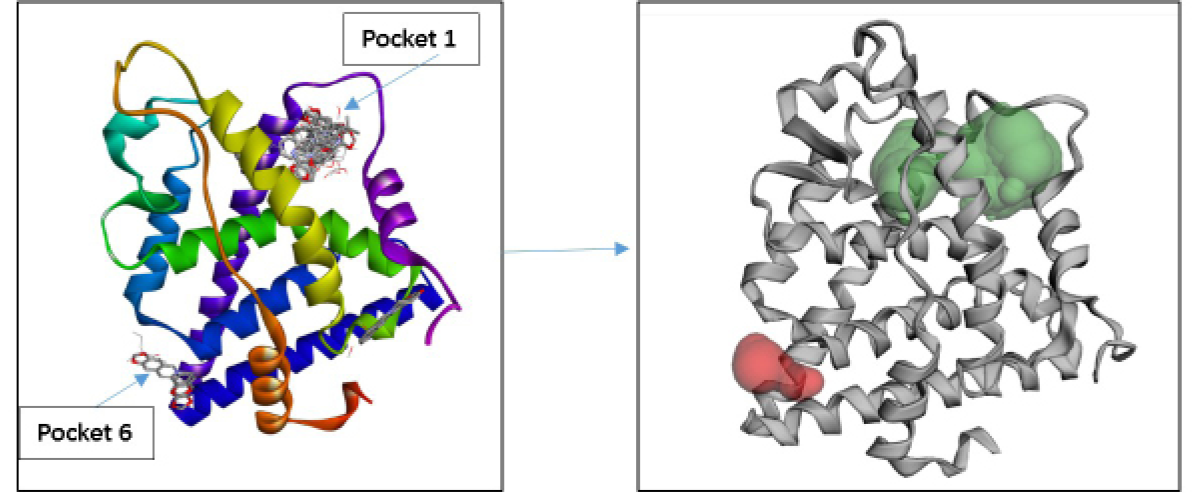
A total of 33 binding sites were predicted with the effective interactive amino acids including GLY521, GLY420, His 420, GLU353, LEU349, ILE326, ARG394, PRO324, MET522, LEU536, GLY 390, LYS 449 etc. Most of studied ligands are docked to the binding pocket 1 while some at binding pocket 6 as shown in Figure 1.
Molecular docking analysis
The targeted protein 3ERT was docked with the selected ligands. The best pose with the lowest binding energy was selected and visualized via pymol and BDSV. The ligands’ negative binding energy values range from –7.1 to –9.1 kcal/mol, indicating thermodynamically stable complexes. The compounds with the lowest binding energies are pseudocoptisine (PubChem ID: 15520811) at -8 kcal/mol, echinocystic acid (PubChem ID: 73309): xanthohumol I and B (PubChem ID: 12986068 and 9799506) at -8.0 kcal/mol, and koumine (PubChem ID: 44583834). Lastly, Celastrol (PubChem ID: 122724) has the highest binding affinity at -9.1 kcal/mol. The majority of noncovalent interactions involve hydrophobic and hydrogen bonding interactions. Strong hydrogen bonds, typically between 2.3 and 3.5 Å, are formed by the majority of these identified ligands, indicating stable and specific bindings (Table I).
Table I. Protein (3ERT) interaction with respective ligands and amino acid residues with their distances and binding energies.
|
Ligand name (PubChem ID) |
Interaction amino acid residues (Distance: Å) |
Binding energy (Kcal/mol) |
|||
|
Hydrogen bond |
Hydrophobic |
Electrostatic interaction |
Other |
||
|
Piperine (638024) |
THR347(2.82) |
ALA350(4.25) |
ASP351(3.57) |
|
-7.8 |
|
LEU525(4.87) |
|||||
|
LEU525(4.81) |
|||||
|
LEU536(4.22) |
|||||
|
LEU539 (5.04) |
|||||
|
LEU536(5.3) |
|||||
|
Berberine (2353) |
|
LYS529(3.4) |
|
|
-7.6 |
|
TYR526(5.1) |
|||||
|
LYS529( 4.61) |
|||||
|
LYS529(4.49) |
|||||
|
CYS530(4.84) |
|||||
|
MET522(4.94) |
|||||
|
Koumine (44583834) |
MET522(3.43) |
LEU536(3.57) |
|
|
-8.0 |
|
MET522(3.39) |
LEU536(4.43) |
||||
|
Xanthohumol I (12986068) |
GLU380(2.16) |
TRP383(5.42) |
|
|
-8.0 |
|
ASP351(2.3) |
MET522(5.42) |
||||
|
MET522(2.33) |
MET522(5.17) |
||||
|
MET522(2.32) |
MET522(5.32) |
||||
|
LEU525(3.63) |
LEU536(4.77) |
||||
|
LEU525(4.63) |
|||||
|
TRP383(5.25) |
|||||
|
LEU536(4.15) |
|||||
|
Table continues on next page..... |
|||||
|
Ligand name (PubChem ID) |
Interaction amino acid residues (Distance: Å) |
Binding energy (Kcal/mol) |
|||
|
Hydrogen bond |
Hydrophobic |
Electrostatic interaction |
Other |
||
|
Xanthohumol B(9799506) |
VAL534(2.56) |
TRP383(5.24) |
ASP351(3.78) |
|
-8.0 |
|
ALA350(2.62) |
TRP383(3.85) |
||||
|
MET522(3.74) |
LYS529(4.1) |
||||
|
MET522(3.71) |
PRO535(5.12) |
||||
|
VAL533(5.43) |
|||||
|
MET522(4.35) |
|||||
|
LEU525(4.77) |
|||||
|
ALA350(4.68) |
|||||
|
LEU354(5.35) |
|||||
|
Echinocystic acid (73309) |
TRP383(2.30) |
LEU525(5.46) |
|
|
-9.0 |
|
CYS530(4.61) |
|||||
|
VAL533(4.80) |
|||||
|
LEU536(4.88) |
|||||
|
MET528(5.46) |
|||||
|
TYR526(4.86) |
|||||
|
Gelselegine (102061673) |
CYS530(2.72) |
TRP383(5.31) |
ASP351(4.70) |
|
-7.4 |
|
LYS529(5.18) |
|||||
|
CYS530(4.78) |
|||||
|
VAL533(5.40) |
|||||
|
VAL533(4.27) |
|||||
|
ALA350(5.25) |
|||||
|
LEU525(4.57) |
|||||
|
Pseudocoptisine (15520811) |
LEU525(3.56) |
TRP383(5.37) |
|
|
-8.5 |
|
TRP383(4.13) |
|||||
|
ALA350(4.51) |
|||||
|
LYS529(4.92) |
|||||
|
LEU354(5.20) |
|||||
|
TRP383(5.35) |
|||||
|
TRP383(5.35) |
|||||
|
TRP383(3.96) |
|||||
|
LYS529(5.2) |
|||||
|
LEU536(5.29) |
|||||
|
Sinomenine (5459308) |
LEU525(2.2) |
TRP383(3.77) |
|
CYS530(5.91) |
-7.1 |
|
MET528(5.29) |
|||||
|
CYS530(3.83) |
|||||
|
LYS529(4.82) |
|||||
|
VAL533(5.45) |
|||||
|
Celastrol (122724) |
GLU380(2.28) |
TRP383(5.18) |
|
-9.1 |
|
|
LYS529(4.88) |
|||||
|
LYS529(3.94) |
|||||
|
LEU536(4.88) |
|||||
|
TYR526(4.56) |
|||||
|
LEU536(4.39) |
|||||
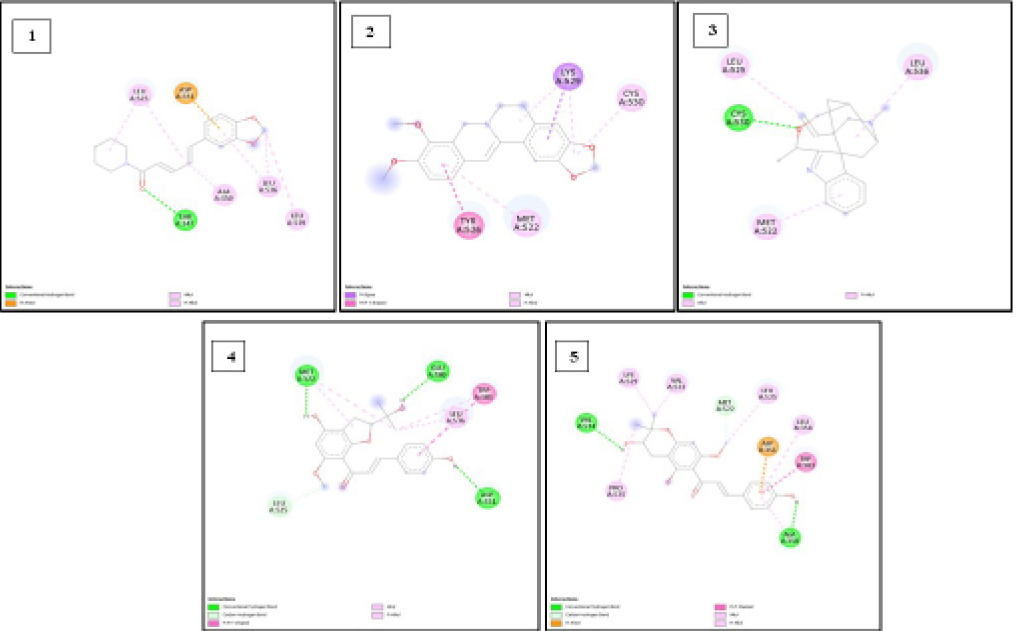
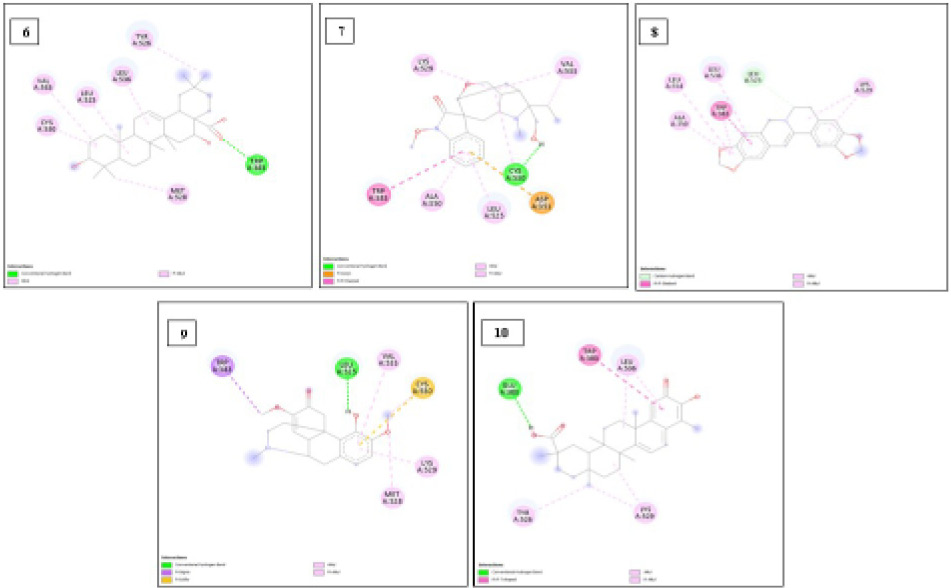
Of the compounds screened, Echinocystic acid and celastrol showed the lowest binding energies of –9.0kcal/mol and -9.1kcal/mol, respectively. The ligand echinocystic acid and celastrol formed a conventional hydrogen bond with TRP383 and GLU380, respectively while hydrophobic interactions were shown with LEU525, CYS530, VAL533, LEU536, MET528, TRP383, ALA350, LYS529 and TYR526 amino acid residues Figure. Koumine and xanthohumol derivatives also exhibited low binding energies of -7.9kcal/mol and –8.0 kcal/mol, respectively. Koumine showed hydrophobic interactions with MET522 LEU525 and LEU536 while hydrogen bond with CYS530. However, xanthohumol I compounds exhibit conventional hydrogen bond with GLU380, MET522, and ASP351 while carbon hydrogen bond with LEU525. Xanthohumol B exhibit conventional hydrogen bond with VAL534, ALA350, carbon hydrogen bond with MET522 while hydrophobic interactions with LYS529, VAL533, PRO535, LEU525, LEU354, TRP383 Similarly, pseudocoptisine possess binding energy –8.5kcal/mol exhibiting carbon hydrogen bond with LEU525 and hydrophobic interactions with LEU536, LEU354, TRP383, ALA350, LYS529.
Moderate binding energies of piperine (–7.8 kcal/mol): berberine (–7.6 kcal/mol): and gelselegine (–7.4 kcal/mol) were observed, piperine and gelselegine showed hydrogen bond with THR347, and CYS530, respectively. However, piperine and berberine showed hydrophobic interactions are expressed with LEU525, LEU536, LEU539, ALA350, LYS525, MET522, TYR526, CYS530. Gelselegine showed electrostatic pi-anion with ASP351. The sinomenine possessed binding energy –7.1 kcal/mol with hydrogen bond interaction with active residues LEU525, and hydropobic interactions with TRP383, VAL535, MET528, and LYS529 while pi-sulphur bond with CYS530. Together, the docking outcomes underscore the importance of MET522, LEU525, TRP383, CYS530, ASP351, and LYS529 as key residues in ligand binding and stabilization in the 3ERT active site. Echinocystic acid proved to be the strongest binder, indicating its high potential as an effective inhibitor directed against the 3ERT protein (Fig. 2).
Drug likeness and toxicity
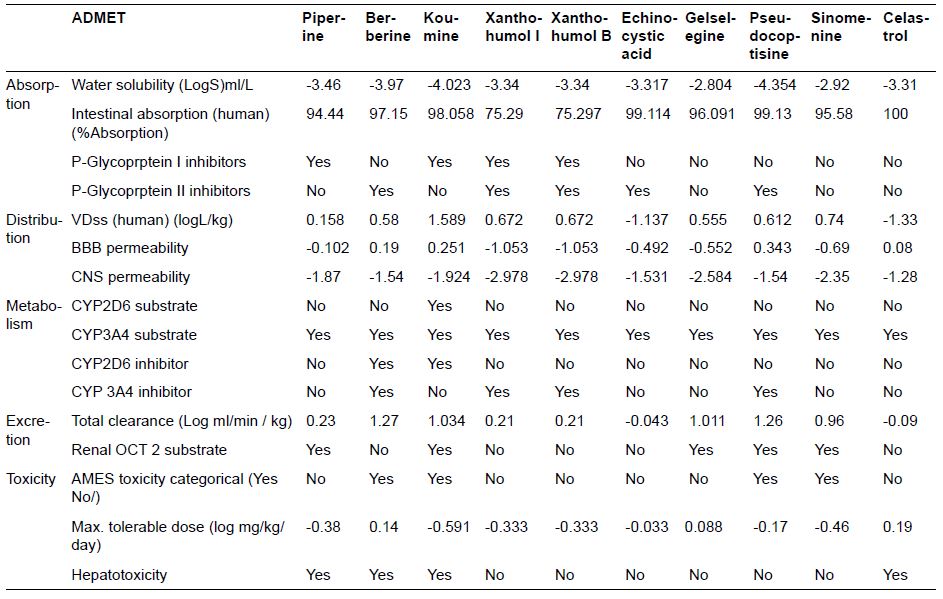
The rule of five by Lipinski is one of the most important guidelines used in assessing the drug-likeness of compounds, and most importantly their oral bioavailability18. All the selected ligands followed Lipinski’s rule of five with zero violation (Table II). Using the SwissADME and pkCSM online server we determine the ADMET (absorption, distribution, metabolism, excretion, and toxicity) profile for each ligand as shown in Table III. All compounds exhibit poor to very poor aqueous solubility (LogS range: –4.35 to –2.80). The most soluble are gelselegine (–2.80) and sinomenine (–2.92): whereas pseudocoptisine (–4.35) and koumine (–4.02) are the least soluble. Most compounds show excellent predicted absorption (>94 % absorbed). Echinocystic acid (99.1 %): pseudocoptisine (99.1 %): and celastrol (100 %) are essentially completely absorbed, while xanthohumol I and B showed ~75 %. Piperine, koumine, xanthohumol I and xanthohumol B are predicted P-gp I inhibitors, whereas berberine, xanthohumol I/B, echinocystic acid, and pseudocoptisine inhibit P-gp II. Berberine, gelselegine, sinomenine, celastrol lack significant P-gp inhibitory activity for at least one isoform, potentially favoring better oral bioavailability.
For volume of distribution (VDss): values range widely from very low (echinocystic acid –1.137 log L/kg and celastrol –1.329 log L/kg, indicating limited tissue distribution) to high (koumine 1.589 log L/kg, suggesting extensive tissue penetration). Only berberine (log BB 0.198): koumine (0.251): pseudocoptisine (0.css343): and celastrol (0.078) are predicted to cross the Blood–brain barrier (BBB) permeability to a relevant extent (log BB > 0). Xanthohumol I and B show the poorest BBB penetration (–1.053). All compounds have low predicted CNS penetration (log PS < –2, mostly < –1.5): indicating limited central nervous system exposure. Xanthohumol I/B (–2.98) and gelselegine (–2.58) are particularly CNS-impermeable. Moreover, all ten compounds are predicted substrates of CYP3A4, highlighting a high likelihood of first-pass metabolism and potential drug–drug interactions with CYP3A4 modulators. Berberine, xanthohumol I/B, and pseudocoptisine are CYP3A4 and CYP2D6 inhibitors. Moreover, highest total clearance is predicted for berberine and pseudocoptisine elimination while echinocystic acid and celastrol show very low clearance (–0.04 to –0.09).
Berberine, koumine, pseudocoptisine, and sinomenine are predicted to be AMES-positive (potential mutagens): while piperine, berberine, koumine, and celastrol carry a hepatotoxicity risk. Echinocystic acid, xanthohumol I/B, gelselegine, and celastrol show the good profile with no mutagenicity and (except celastrol) no hepatotoxicity.
Discussion
The present in silico screening of 100 phytoactive compounds against the estrogen receptor alpha (ERα) structure (PDB: 3ERT) identified ten promising candidates with binding affinities ranging from -7.1 to -9.1 kcal/mol, underscoring their potential as selective ERα inhibitors for estrogen-dependent breast cancer. Among these, celastrol and echinocystic acid emerged as the most potent, with binding energies of -9.1 and -9.0 kcal/mol, respectively, comparable to established phytoestrogens like genistein (-8.5 to -9.0 kcal/mol) in prior docking studies19,20. These affinities showed thermodynamically favorable interactions that is hydrogen bonds in celastrol with Phe404 and Gly521and echinocystic acid with Trp383 and hydrophobic interactions with residues such as Leu525, Met522, and Cys530, which
Table II. Lipinski rule of five analysis of selected ligands predicted via SwissADME.
|
Sr. No |
Ligands |
Plant source |
Molecular weight < 500 (g/mol) |
H-bond acceptor < 10 |
H-bond donors < 5 |
logP<5 |
Polar surface area (Å2) |
|
1 |
Piperine (638024) |
Piper longum L. |
285.343 |
3 |
0 |
2.51 |
38.8 |
|
2 |
Berberine (2353) |
Coptis chinensis French. |
336.36 |
4 |
0 |
3.10 |
40.80 |
|
3 |
Koumine (44583834) |
Gelsemium elegans (Gardner & Chapm) Benth. |
306.40 |
3 |
0 |
2.17 |
24.83 |
|
4 |
Xanthohumol I (12986068) |
Humulus lupulus L. |
370.40 |
6 |
3 |
2.97 |
96.22 |
|
5 |
Xanthohumol B(9799506) |
Humulus lupulus L. |
370.40 |
6 |
3 |
2.97 |
96.22 |
|
6 |
Echinocystic acid (73309) |
Luffa cylindrica (L.) M. Roem. |
472.70 |
4 |
3 |
6.20 |
77.76 |
|
7 |
Gelselegine (102061673) |
Gelsemium elegans (Gardner & Chapm) Benth |
372.46 |
5 |
1 |
0.95 |
62.24 |
|
8 |
Pseudocoptisine (15520811) |
Corydalisturts chaninovii Besser |
320.32 |
4 |
0 |
2.81 |
40.80 |
|
9 |
Sinomenine (5459308) |
Sinomenium acutum (Thunb) Rehder & E.H. Wilson |
329.39 |
5 |
1 |
1.64 |
59.00 |
|
10 |
Celastrol (122724) |
Tripterygium wilfordii Hook.f. |
450.61 |
4 |
2 |
6.70 |
74.60 |
are critical for ligand stabilization. These residue interactions align with structural analyses of ERα antagonists, where Trp383 and Leu525 facilitate π-π stacking and van der Waals forces are essential for inhibition21. Xanthohumol I and B (-8.0 kcal/mol) formed hydrogen bonds with Glu380, Asp351, and Val534. Pseudocoptisine (-8.5 kcal/mol) and koumine (-8.0 kcal/mol). Berberine (-7.6 kcal/mol) showed moderate affinity but notable hydrophobic engagement with LYS529 and MET522. Piperine, sinomenine, and gelselegine exhibited moderate bindings (-7.8, -7.1, and -7.4 kcal/mol): with THR347 and CYS530 with ERα active domain. Overall, the predominance of binding in pocket 1 (as predicted by CASTp) emphasizes the compounds’ convergence on the canonical AF-2 helix interface, a hotspot for selective ER modulators (SERMs) that prevent coactivator expression22.
Moreover, ADMET profiling showed favorable pharmacokinetics for clinical use. All ligands followed Lipinski’s rule of five, predicting high oral bioavailability. Human intestinal absorption is near to 100 for most of the compounds comparable to optimized natural ERα inhibitors like quercetin derivatives23. Low aqueous solubility (LogS -4.35 to -2.80) is a common limitation of triterpenoids and alkaloids, but this is counterpoised by P-glycoprotein inhibition as this study provides piperine and xanthohumols as both I/II inhibitors24. Distribution profiles varied, with low VDss for echinocystic acid and celastrol (-1.137 and -1.329 log L/kg) indicating plasma retention suitable for targeted oncology, while koumine’s high VDss (1.589 log L/kg) suggests broad tissue penetration25. Excretion via renal OCT2 showed efficient clearance, with low total clearance for echinocystic acid and celastrol (-0.04 to -0.09 log mL/min/kg). Toxicity assessments showed Echinocystic acid, xanthohumols, and gelselegine showed AMES-negative and non-hepatotoxic, consistent with triterpene and prenylflavonoid tolerability in preclinical breast cancer models26. This study has some limitations such as the static nature of docking and use of predictive ADMET tools without isoform-specific validation. Future studies should integrate molecular dynamics simulations, in-vivo and in-vitro analysis for its validation and clinical efficacy.
Conclusion
This research identifies the therapeutic efficacy of phytoactive molecule from natural resources as potential estrogen receptor inhibitors. Molecular docking studies against the 3ERT protein showed celastrol and echinocystic acid possess lowest binding energy –9.1 and -9.0kcal/mol followed by koumine, xanthohumol derivatives and Pseudocoptisine. These ligands bound to active site residues MET522, LEU525, TRP383, CYS530, ASP351, and LYS529, predicting their capability to potentially inhibit receptor activity efficiently. ADMET profiling further confirmed good intestinal absorption and moderate blood–brain barrier permeability for most compounds, with echinocystic acid and xanthohumol B exhibiting favorable safety profiles compared to hepatotoxic compounds like koumine and Berberine. Subsequent research should encompass in vitro and in vivo pharmacokinetic examinations to confirm their therapeutic applications in the treatment of breast cancer.
Declarations
Authors’ contribution
AA and AJ contributed equally to the molecular docking analysis, data interpretation, and wrote the manuscript. AQ contributed to ligand preparation and pharmacokinetic analysis. MA and QA contributed to data collection and literature review. EZ and MK conceived and supervised the study. All authors read and approved the final manuscript.
Ethics statement
No human participants, identifiable personal data, or live animals were involved. Therefore, institutional ethics approval was not required.
Funding
This research did not receive any specific grant from funding agencies in the public, commercial, or not-for-profit sectors.
Generative AI and AI-assisted technology statement
The authors declare that they have not used generative AI or AI-assisted technologies in this manuscript.
Publisher’s note
All claims expressed in this article are solely those of the authors and do not necessarily represent those of their affiliated organizations, and those of publishers, the editor and the reviewers. Any product that may be evaluated in this article, or claim that may be made by this manufacturer, is not gaurenteed or endorsed by the publisher.
Conflict of interest statement
The authors declare that they have no known financial or personal conflicts of interest.
Figures


Drug likeness prediction using pkCSM online database server for the selected ligands.

a) Image obtained via DSV indicates that all the studied ligands are docked in binding pocket 1., b) CASTp predicted total 33 binding pockets of the protein (3ERT) of which two binding pockets 1 and 6 are shown high highlighted green and red color.

Binding interactions of phytoactive compounds and ERα complexes. The interactions were obtained via DSV and the interaction types are represented via different colors. 1) Piperine, 2) Berberine, 3) Koumine, 4) Xanthohumol I, 5) Xanthohumol B, 6) Echinocystic acid 7) Gelselegine, 8) Pseudocoptisine, 9) Sinomenine, 10) Celastrol.
References
- Fu, M., Peng, Z., Wu, M., Lv, D., Li, Y. and Lyu, S., 2025. Current and future burden of breast cancer in Asia: A GLOBOCAN data analysis for 2022 and 2050. The Breast, 79: 103835. https://doi.org/10.1016/j.breast.2024.103835[CrossRef]
- Ali-Salman, R., 2023. Prevalence of women breast cancer. Cell. mol. biomed. Rep., 3: 185-196. https://doi.org/10.55705/cmbr.2023.384467.1095[CrossRef]
- Fu, X.D. and Simoncini, T., 2008. Extra-nuclear signaling of estrogen receptors. IUBMB Life, 60(8): 502-510. https://doi.org/10.1002/iub.80[CrossRef]
- Heldring, N., Pike, A., Andersson, S., Matthews, J., Cheng, G., Hartman, J. and Gustafsson, J. A., 2007. Estrogen receptors: how do they signal and what are their targets. Physiol. Rev., 87: 905-931. https://doi.org/10.1152/physrev.00026.2006[CrossRef]
- Luque-Bolivar, A., Pérez-Mora, E., Villegas, V.E. and Rondón-Lagos, M., 2020. Resistance and overcoming resistance in breast cancer. Breast Cancer: Targets and Therapy, pp. 211-229.
- Riaz, M., Khalid, R., Afzal, M., Anjum, F., Fatima, H., Zia, S. and Aslam, M.A., 2023. Phytobioactive compounds as therapeutic agents for human diseases: A review. Fd. Sci. Nutri., 11: 2500-2529. https://doi.org/10.1002/fsn3.3308[CrossRef]
- Wargovich, M.J., Woods, C., Hollis, D.M. and Zander, M.E., 2001. Herbals, cancer prevention and health. J. Nutri., 131: 3034S-3036S. https://doi.org/10.1093/jn/131.11.3034S[CrossRef]
- Metwaly, A.M., Ghoneim, M.M., Eissa, I.H., Elsehemy, I.A., Mostafa, A.E., Hegazy, M.M. and Dou, D., 2021. Traditional ancient Egyptian medicine: A review. Saudi J. Biol. Sci., 28: 5823-5832. https://doi.org/10.1016/j.sjbs.2021.06.044[CrossRef]
- Nobili, S., Lippi, D., Witort, E., Donnini, M., Bausi, L., Mini, E. and Capaccioli, S., 2009. Natural compounds for cancer treatment and prevention. Pharmacol. Res., 59: 365-378. https://doi.org/10.1016/j.phrs.2009.01.017[CrossRef]
- Vieira, S.F., Reis, R.L., Ferreira, H. and Neves, N.M., 2025. Plant-derived bioactive compounds as key players in the modulation of immune-related conditions. Phytochem. Rev., 24: 343-460. https://doi.org/10.1007/s11101-024-09955-7[CrossRef]
- Krishna, P.S., Vani, K., Prasad, M.R., Samatha, B., Bindu, N., Charya, M.A.S. and Reddy-Shetty, P., 2013. In–silico molecular docking analysis of prodigiosin and cycloprodigiosin as COX-2 inhibitors. Springerplus, 2: 172. https://doi.org/10.1186/2193-1801-2-172[CrossRef]
- Abishad, P., Niveditha, P., Unni, V., Vergis, J., Kurkure, N.V., Chaudhari, S. and Barbuddhe, S.B., 2021. In silico molecular docking and in vitro antimicrobial efficacy of phytochemicals against multi-drug-resistant enteroaggregative Escherichia coli and non-typhoidal Salmonella spp. Gut Pathogens, 13: 46. https://doi.org/10.1186/s13099-021-00443-3[CrossRef]
- Paggi, J.M., Pandit, A. and Dror, R.O., 2024. The art and science of molecular docking. Annu. Rev. Biochem., 93: 389-410. https://doi.org/10.1146/annurev-biochem-030222-120000[CrossRef]
- Jamshed, A., Bibi, A., Anwar, A., Qasim, A., Zafar, E. and Khan, M. 2025. Exploring the anticancer potential of marine brown algae as estrogen receptor alpha inhibitor. S. Asian J. Zool., 43: 13-20. https://dx.doi.org/10.17582/sajz/2025/43.1.13.20[Full text][CrossRef]
- Hassan, I., Zaman, A., Zafar, E. and Khan, M., 2024. Molecular docking-aided identification of natural bioactive molecules as potential cancer cell proliferation inhibitors: molecular docking as cancer cell inhibitors. Futur. Biotechnol., pp. 25-30. https://doi.org/10.54393/fbt.v4i02.105[CrossRef]
- Dundas, J., Ouyang, Z., Tseng, J., Binkowski, A., Turpaz, Y. and Liang, J., 2006. CASTp: computed atlas of surface topography of proteins with structural and topographical mapping of functionally annotated residues. Nucleic Acids Res., 34(suppl_2): W116-W118. https://doi.org/10.1093/nar/gkl282[CrossRef]
- Tian, W., Chen, C., Lei, X., Zhao, J. and Liang, J., 2018. CASTp 3.0: Computed atlas of surface topography of proteins. Nucleic Acids Res., 46(W1): W363-W367. https://doi.org/10.1093/nar/gky473[CrossRef]
- Walters, W.P., 2012. Going further than Lipinski’s rule in drug design. Expert Opin. Drug Discov., 7: 99-107. https://doi.org/10.1517/17460441.2012.648612[CrossRef]
- Tripathi, A.K., Ray, A.K. and Mishra, S.K., 2022. Molecular and pharmacological aspects of piperine as a potential molecule for disease prevention and management: evidence from clinical trials. Beni-Suef Univ. J.Basic Appl. Sci., 11: 16. https://doi.org/10.1186/s43088-022-00196-1[CrossRef]
- Xie, J., Xu, Y., Huang, X., Chen, Y., Fu, J., Xi, M. and Wang, L., 2015. Berberine-induced apoptosis in human breast cancer cells is mediated by reactive oxygen species generation and mitochondrial-related apoptotic pathway. Tumor Biol., 36: 1279-1288. https://doi.org/10.1007/s13277-014-2754-7[CrossRef]
- Abdullahi, S.H., Uzairu, A., Shallangwa, G.A., Uba, S. and Umar, A.B., 2022. Molecular docking, ADMET and pharmacokinetic properties predictions of some di-aryl pyridinamine derivatives as estrogen receptor (Er+) kinase inhibitors. Egypt. J. Basic Appl. Sci., 9: 180-204. https://doi.org/10.1080/2314808X.2022.2050115[CrossRef]
- McDougal, D.P., Pederick, J.L., Novick, S.J., Jovcevski, B., Warrender, A.K., Pascal, B.D., Griffin, P.R. and Bruning, J.B., 2025. A ternary switch model governing ERα ligand binding domain conformation. Nature Commun., 16: 10363. https://doi.org/10.1038/s41467-025-65323-9[CrossRef]
- Yu, H., Zhang, Y., Liang, Y., Ma, X., Qi, X., Xiao, J., Xue, W., Luo, Y. and Yue, T., 2020. Advance on the absorption, metabolism, and efficacy exertion of quercetin and its important derivatives: absorption, metabolism and function of quercetin. Fd. Front., 4: 420-434. https://doi.org/10.1002/fft2.50[CrossRef]
- Atriya, A., Majee, C., Mazumder, R., Choudhary, A. N., Salahuddin, Mazumder, A. and Priya, N., 2023. Insight into the various approaches for the enhancement of bioavailability and pharmacological potency of terpenoids: a review. Curr. Pharm. Biotech., 24: 1228-1244. https://doi.org/10.2174/1389201024666221130163116[CrossRef]
- Shi, X., Tang, Y., Zhu, H., Li, W., Li, W., Li, Z. and Duan, J.A., 2014. Pharmacokinetic comparison of seven major bio-active components in normal and blood deficiency rats after oral administration of Danggui Buxue decoction by UPLC-TQ/MS. J. Ethnopharmacol., 153: 169-177. https://doi.org/10.1016/j.jep.2014.02.004[CrossRef]
- Singla, R. K., Wang, X., Gundamaraju, R., Joon, S., Tsagkaris, C., Behzad, S. and Shen, B., 2023. Natural products derived from medicinal plants and microbes might act as a gamechanger in breast cancer: A comprehensive review of preclinical and clinical studies. Crit. Rev. Fd. Sci. Nutr., 63: 11880-11924. https://doi.org/10.1080/10408398.2022.2097196[CrossRef]
Services
Article usage statistics
Loading…