
In China, snails Pomacea canaliculata and its new breed the gold snail, Achatina fulica and its new breeds the white jade snail, have been sold on the Internet in recent years. We concluded that 24,853 sales of P. canaliculata and A. fulica had been made through the Internet selling platform before 2019. Further surveys indicated that 51% sellers were located in endemic areas of Angiostrongylus cantonensis. However, no A. cantonensis-positive snails were found among Internet-sold snails. Laboratory animal infection experiments proved that all 4 breeds of snails could transmit A. cantonensis. Internet sales of the 4 snails are of bio-safty temporarily but still present a high risk to spread angiostrongyliasis in China; moreover. Internet sales of P. canaliculata and A. fulica should be brought to the attention of concerned administrations in China.
Short Communication · Volume 55, Issue 4, 22 July 2023 · Open Access
Internet-Sold Snail Pomacea canaliculata and Achatina fulica Might Transmit Angiostrongylus cantonensis in Mainland China
· · ·
Affiliations & Notes ⌄
- 1Emergency Department, South Taihu Hospital and Affiliated Hospital of Huzhou College, 1566 Gangnan Road, Huzhou, Zhejiang, China 2School of Medicine, Huzhou University, 759 Erhuan Rd, Huzhou, China 3Key Laboratory of Vector Biology and Pathogen Control of Zhejiang Province, Huzhou University, Huzhou, China Yuliang Cao and Yue Guo contributed equally to this paper. * Corresponding author: guoyue66@126.com
Article Info ⌄
- Journal:
- Pakistan Journal of Zoology
- Published:
- 22 July 2023

From the article
- Overall, this is the first report on the internet-sold A. cantonensis intermediate hosts, namely wild type of P. canaliculata, A. fulica, the gold snail and the white jade snail.
- Besides, current surveys found no A. cantonensis-positive snails among internet-sold snails, suggesting that all internet-sold snails were biosafe temporarily.
- However, laboratory animal infection experiments exhibited that all 4 breeds of snails could transmit A. cantonensis.
- It is our strong recommendation that internet sales of all 4 snail breeds be strictly monitored.
Selected from the article's own text.
Abstract
Materials and methods
Relevant information of online sales was collected from the Taobao sales platform, the earliest and largest Internet shopping platform in China (website: https://www.taobao.com/) using the keywords of snail, apple snail, white jade snail and gold snail. The natural endemic area of A. cantonensis, especially the geographical distribution of P. canaliculata and A. fulica, was obtained from published articles ; ; .
Forty wild type P. canaliculata, gold snails, wild type A. fulica and white jade snails were bought from the Internet. Their infection status was detected both directly under a microscope and indirectly by enzyme digestion. Ten-gram snail meat was grinded and digested at 37 °C, 1.5 h. Then the digest was filtered by 260 mesh filter and the sediment on the filter was taken for microscopic examination. The digest composition was 1000 ml distilled water, 7 ml hydrochloric acid, pepsin 5 g .
Microscopic detection was conducted after the snail was cracked and the lung sac of the snail was cut from the body. Worm nodules found in the lung sac were used for morphological examination of worms inside the nodules to determine A. cantonensis infection status. Enzyme lysis of snails was undertaken as previously described.
To determine the 4 breeds of snails’ ability to transmit A. cantonensis, artificial animal infection examinations were conducted. In short, 4 groups of snails were formed, and each group had 20 snails that were 20 g in weight. Each snail was infected with 1000 larvae of A. cantonensis individual, and larvae that developed in the snail were collected 10 dpi (days post infection). Collected larvae were used to infect Sprague-Dawley rats (SD rats), with 200 larvae for each rat. Rat stool examination was conducted under a microscope 40 dpi to determine the infection status of A. cantonensis.
Results and discussion
According to the data obtained from the internet selling platform, a total number of 24,853 snail sales had been made by 2019. Most of the sales, that is, 19,662, were of the apple snail (Table I). The remaining 5191 sales were of the giant African snail. Some sellers did not provide information in detail, and the snails they sold were divided into unspecified groups. Besides, 51% of all selling (12,668) took place in endemic regions.
The geographical information of 2 species and 4 breeds are shown in Figure 2.
Neither worm nodules in the lung sac nor larvae 3 stage of A. cantonensis were found by snail dissection or enzymolysis. No A. cantonensis was detected among none of 4 snail group, indicating that all 4 breeds of snail bought on the Internet were A. cantonensis negative.
Table I. Snails sold on the internet in China.
| Location | Snails sold on the internet | |||||
| P. canaliculata | Gold snail | P. canaliculata or gold snail | A. fulica | White jade snail | A. fulica or white jade snail | |
| Endemic regions | ||||||
| Guangxi | 0 | 0 | 0 | 1 | 0 | 0 |
| Guangdong | 1094 | 19 | 1719 | 77 | 413 | 4 |
| Hunan | 0 | 0 | 0 | 0 | 2 | 0 |
| Fujian | 6 | 0 | 701 | 0 | 0 | 49 |
| Zhejiang | 80 | 0 | 38 | 66 | 2764 | 190 |
| Shanghai | 134 | 11 | 4531 | 29 | 415 | 0 |
| Jiangsu | 64 | 0 | 186 | 68 | 0 | 7 |
| Sub-total | 12,668 ( 51%) | |||||
| Non-endemic regions | ||||||
| Shandong | 388 | 0 | 15 | 3 | 0 | 0 |
| Tianjin | 1018 | 14 | 395 | 0 | 0 | 0 |
| Beijing | 87 | 0 | 807 | 0 | 582 | 0 |
| Hebei | 0 | 0 | 27 | 8 | 0 | 0 |
| Shanxi | 138 | 0 | 42 | 0 | 0 | 0 |
| Henan | 4 | 0 | 4 | 0 | 358 | 0 |
| Shaanxi | 0 | 0 | 7 | 0 | 0 | 0 |
| Hubei | 4 | 0 | 0 | 0 | 0 | 0 |
| Sichuan | 909 | 0 | 178 | 0 | 139 | 11 |
| Liaoning | 343 | 2 | 6688 | 0 | 0 | 0 |
| Heilongjiang | 0 | 0 | 9 | 0 | 0 | 0 |
| No identified location | 0 | 0 | 0 | 0 | 5 | 0 |
| Total sales | 4269 | 46 | 15347 | 252 | 4678 | 261 |
| Total | 24,853 | |||||
Animal experiments proved that all 4 snail breeds could be infected by the 1st satge larvae of A. cantonensis, and the 3rd stage larvae obtained from the snail host could infect SD rats without a difference in ability, suggesting that all 4 snail breeds could be transmitters of A. cantonensis.
In China, angiostrongyliasis has become an important parasitic disease in many southern provinces, including Yunnan, Hainan, Guangxi, Guangdong, Fujian, Zhejiang, Jiangsu and Hunan ; . Historical angiostrongyliasis outbreaks have occurred in Zhejiang, Fujian, Yunnan, Heilongjiang, Liaoning, and Beijing many times. At present, two species of invasive snails, P. canaliculata and A. fulica, are becoming the most important transmitters of A. cantonensis in China. In most provinces, wild type P. canaliculata is strictly monitored to avoid human infection and spread of the disease by the local CDC (Center for Disease Control and Prevention). However, Internet sales of snails lack monitoring.
Recent analysis has shown that the natural distribution of P. canaliculata includes Sichuan, Yunnan, Guangxi, Guangdong, Fujian, Zhejiang, Jiangxi, Hunan, and Hainan. A. fulica is mainly distributed in Yunnan, Guangxi, Guangdong, and Fujian.
Although all 4 breeds of snail bought on the Internet were A. cantonensis negative, animal experiments showed that all 4 breeds could transmit A. cantonensis. We believe that the 4 breeds of internet-sold A. fulica and P. canaliculata present a risk of transmission of A. cantonensis for the following reasons: (1) the sources of internet-sold snails lack supervision; some internet-sold snails might be collected from the wild in endemic regions, and some snails might even be A. cantonensis positive. Internet selling might cause new infections. Taking P. canaliculata as an example, the A. cantonensis endemic region, natural habitat, and internet sellers are commonly distributed in Guangdong, Fujian and Zhejiang. There is no report indicating that A. fulica has invaded Zhejiang, but many snail farms have been established in the cities of Jinhua and Jiaxing, Zhejiang. This will be discussed in another paper. Local snail internet sellers might collect wild snails for sale with a high risk of transmitting A. cantonensis. (2) Although most of the snails were bought as pets and aquarium cleaners, some snails might escape or be dumped into the wild, leading to new spreading of these invasive snails. Internet selling might carry the risk of new introductions of snails, even damaging ecological systems and leading to new endemic regions of angiostrongyliasis.
Conclusion
Overall, this is the first report on the internet-sold A. cantonensis intermediate hosts, namely wild type of P. canaliculata, A. fulica, the gold snail and the white jade snail. Raw data indicated that 24,853 sales had been made by 2019. Besides, current surveys found no A. cantonensis-positive snails among internet-sold snails, suggesting that all internet-sold snails were biosafe temporarily. However, laboratory animal infection experiments exhibited that all 4 breeds of snails could transmit A. cantonensis. It is our strong recommendation that internet sales of all 4 snail breeds be strictly monitored.
Acknowledgements
This research was supported by Open project of Key Laboratory of Vector Biology and Pathogen Control of Zhejiang Province (HUZUL202101).
Statement of conflict of interest
The authors have declared no conflict of interest.
Figures
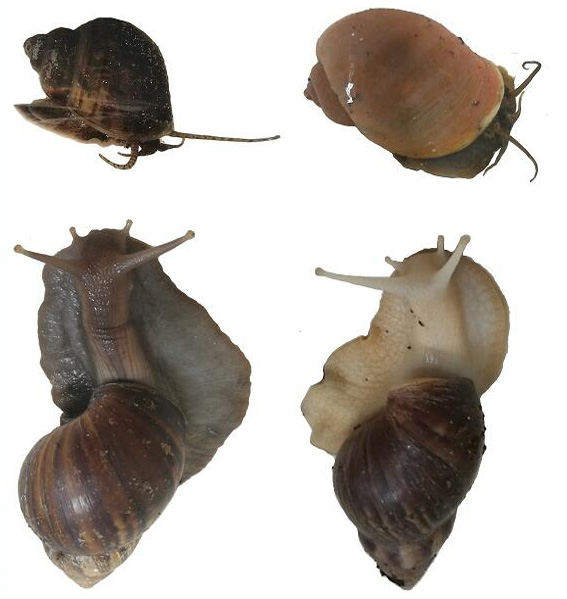
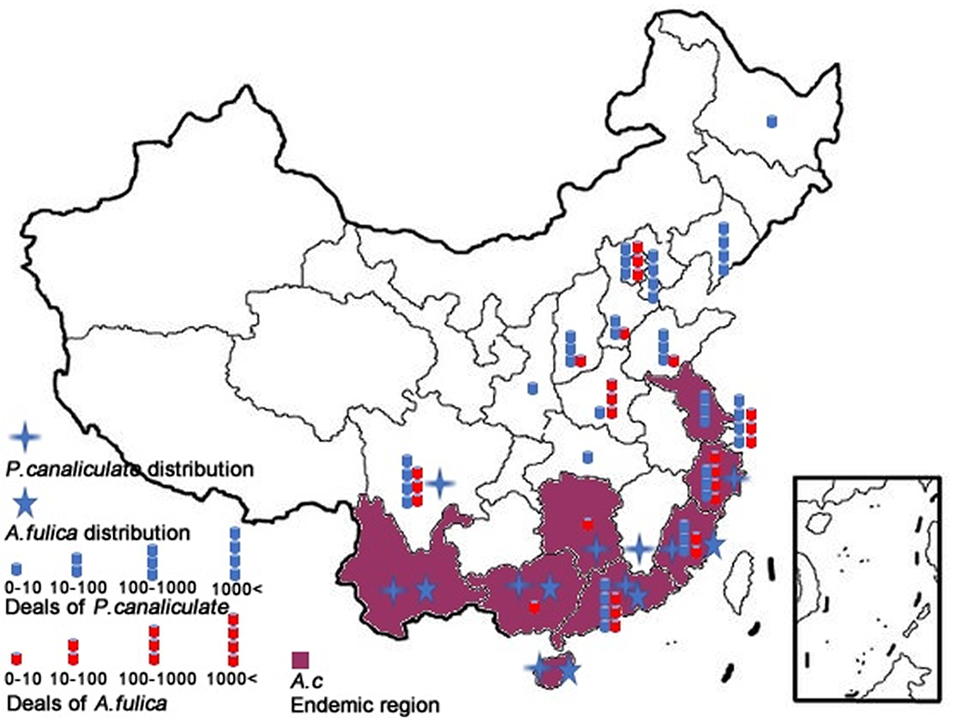
Endemic regions of A. cantonensis and its two snail transmitters and sales made on the internet.
References
- Estebenet, A.L., Martín P.R., and Burela S., 2006. Biocell, 30: 329-335.
- He, J.Z., Ding, B.L., and Luo, Y.Z., 1983. Acad. J. Guangzhou. Med. Coll., 2: 1-11. (in Chinese).
- Karraker, N.E. and Dudgeon, D., 2014. Invasions, 16: 1785-1789. https://doi.org/10.1007/s10530-014-0640-2[CrossRef]
- Lv, S., Zhang, Y., Liu, H.X., Hu, L., Yang, K., Steinmann, P., Chen, Z., Wang, L.Y., Utzinge, R.J., Zhou, X.N., 2009. PLoS. Neglect. Trop. D., 3: e368. https://doi.org/10.1371/journal.pntd.0000368[CrossRef]
- Lv, S., Zhang, Y., Steinmann, P., and Zhou, X.N., 2008. Emerg. Infect. Dis., 14: 161. https://doi.org/10.3201/eid1401.061529[CrossRef]
- Qin, Y., Zhou, W., Li, X.W., Feng, M.Q., and Zhou, P., 2007. Enzyme Microb. Tech., 40: 1358-1366.
- Song, L.G., Wang, X.W., Yang, Z., Lv, Z.Y., and Wu, Z.D., 2016. Parasitol. Res., 115: 913-923. https://doi.org/10.1007/s00436-015-4849-5[CrossRef]
- Wang, Q.P., Lai, D.H, Zhu, X.Q., Chen, X.G., and Lun, Z.R., 2008. Lancet Infect. Dis., 8: 621-630. https://doi.org/10.1016/S1473-3099(08)70229-9[CrossRef]
- Wang, Q.P., Wu, Z.D., Wei, J., Owen, R.L., and Lun, Z.R., 2012. Eur. J. clin. Microbiol., 31: 389-395. https://doi.org/10.1007/s10096-011-1328-5[CrossRef]
- Yang, T.B., Wu, Z.D., and Lun, Z.R., 2013. Hawaii. J. Med. Publ. Hlth., 72(6 Suppl 2): 23.
- Yang, Y.X., Hu, Y.C., Li, X.H., Wang, X.J., Mou, X.D., Song, H.M., Wang, P.X., Liu, C., and Luo, J.R., 2010. Chinese Agric. Sci. Bull., 5.
- Yusa, Y., 2004. J. Mollus. Stud., 70: 43-48. https://doi.org/10.1093/mollus/70.1.43[CrossRef]
Services
Article usage statistics
Loading…