
To perform transcriptional profiling of adult female Angiostrongylus cantonensis, three groups of adult female A. cantonensis were isolated and their mRNA was separated and sequenced through the next-generation sequencing (NGS) technology. Sequencing data were assembled into unigenes and transcripts. Finally, all unigenes and transcripts were annotated by querying the NR, Gene Ontology (GO), COG and KOG databases.A total of 71047 unigenes and 106652 transcripts were assembled. A. cantonensis was successfully annotated by the NR and GO databases, resulting in 8107 unigenes and 16105 transcripts. Meanwhile, 10422 unigenes and 20974 transcripts were annotated by the COG/KOG databases. ORF querying annotated 10531 unigenes and 28186 transcripts. It could be observed that the unigenes and transcripts associated with metabolism and parasitism of adult female A. cantonensis were highly expressed.In this study, the transcriptome of adult female Angiostrongylus cantonensis was analyzed and successfully annotated. Metabolism and parasitism related genes were highly expressed at adult female A. cantonensis.
Short Communication · Volume 55, Issue 3, 20 April 2023 · Open Access
Bioinformatic Analysis of the Transcriptome Profile of Adult Female Angiostrongylus cantonensis
· · ·
Affiliations & Notes ⌄
- 1School of Medicine, Huzhou University, 759 Erhuan Rd, Huzhou, Zhejiang, Peoples R China 2Key Laboratory of Vector Biology and Pathogen Control of Zhejiang Province, Huzhou University, Huzhou, Zhejiang, Peoples R China Yue Guo and Hui Zhang contributed equally to this study. * Corresponding author: guoyue66@126.com
Article Info ⌄
- Journal:
- Pakistan Journal of Zoology
- Published:
- 20 April 2023

From the article
- A total of 10422 unigenes and 20974 transcripts were annotated by the COG/KOG databases.
- ORF (open reading frames) querying annotated 10531 unigenes and 28186 transcripts.
- Species-level NR annotation of both unigenes and transcripts showed that A. cantonensis was successfully annotated at the top rank.
- Besides, metabolism-related categories were highly annotated in both unigenes and transcripts, indicating that the adult female A. cantonensis had a high energy demand, as shown in Figure 2.
Selected from the article's own text.
Abstract
Material and methods
All animal experiments were conducted in strict compliance with the Regulations for the Ad-ministration of Affairs Concerning Experimental Animals (as approved by the State Council of the People’s Republic of China).
Adult female A. cantonensis worms were collected from the A. cantonensis positive rad lung. Three biological repetitions were used in this study. A total of 3 rats were employed, each providing 1 adult female A. cantonensis.
The obtained live adult female worm samples were washed with PBS three times for isolation of RNA. Then, the samples were ground in 1.5 ml Trizol (NO. B511311, Sangon Bio-tech Co., Ltd. Shanghai, China) on ice, following the general protocol of extracting RNA by Trizol. Subsequently, the obtained RNA sediment was re-dissolved by 20-40 μl DEPC-treated water (NO. B300592, Sangon Bio-tech Co. Ltd. Shanghai, China) and stored at -80°C for further processing. Before entering the next step of sequencing, the RNA quality was examined, including the purity and concentration by Nanodrop and the integrity by gel electrophoresis.
Using magnetic beads with Oligo d(T), mRNA was extracted from the total RNA samples and rRNA was discarded. Then, mRNA was randomly fragmented by lysis buffer, and fragmented mRNA was reverse transcribed to synthesize the first cDNA strand by random primers. Next, double-stranded DNA, so called the cDNA library, was generated using the cDNA strand as template. Finally, Illumina’s HiSeq TM 2000 was used to sequence the cDNA library.
The raw data collected from sequencing were filtered into clean data. All reads with N ratio ≥ 10% and/or Q ≤ 5 and/or alkali base > 50% were removed in the following steps. Then, all reads information were assembled into unigenes and transcripts using the Trinity method.
Bioinformatic analysis of unigenes and transcripts was conducted by querying the following databases: NR, Gene Ontology (GO) and COG/ KOG (e-value < 0.000 01).
Results
A total of 149010616 raw data elements and 148895426 clean data elements were collected by sequencing. A total of 71047 unigenes and 106652 transcripts were obtained after assembly. Unigenes and transcripts were annotated by querying the NR, COG, KOG and GO databases. The NR annotation of unigenes at the species level showed 968 unigenes to be annotated as A. cantonensis, achieving the 4th rank (Fig. 1A). Among all species annotated by the transcripts, A. cantonensis was annotated by 1591 pieces of transcripts, achieving the 5th rank (Fig. 1B).
A total of 8107 unigenes were annotated with GO. The top 5 Go items were cellular component (CC) terms as follows: GO:0005623, GO:0044464, GO:0009987, GO:0043226 and GO:0008152 (Fig. 1C), annotating 7668, 7664, 7664, 7389 and 7389 related unigenes, respectively.
As per transcripts, a total of 16105 sequences were annotated with GO. The top 5 annotated terms were: a CC term concerning 15195 transcripts, a CC term annotated with 15186 transcripts, a biological process (BP) term related to 14534 transcripts, an organelle CC term with 14107 transcripts and a metabolic BP term annotated with 12870 transcripts. The top 5 most related GO items were GO:0005623, GO:0044464, GO:0009987, GO:0043226 and GO:0008152 (Fig. 1D).
A total of 10422 unigenes and 20974 transcripts were annotated by the COG/KOG databases.
ORF (open reading frames) querying annotated 10531 unigenes and 28186 transcripts.
Discussion
Species-level NR annotation of both unigenes and transcripts showed that A. cantonensis was successfully annotated at the top rank. Other parasites of mammals were also annotated, such as Ancylostoma ceylanicum, Dictyocaulus viviparus and Haemonchus contortus ; ; ; . This indicates that although the genome of A. cantonensis was previously reported , the transcriptome annotation of A. cantonensis was insufficient, and further investigation is needed.
GO annotation was basically identical in the ranking for both unigenes and transcripts, although the number of pieces was different.
In addition, the results of the COG/KOG/NOG annotations of unigenes and transcripts were similar. It is worth mentioning that the functional categories of [O] posttranslational modification, protein turnover and chaperones were highly annotated in the three databases, while the functional categories of [T] signal transduction mechanisms and [J] translation, ribosomal structure and biogenesis were highly annotated in the COG and KOG databases. These characteristics of the functional categories indicate that protein translation-related genes were highly expressed in the female adult A. cantonensis. Besides, metabolism-related categories were highly annotated in both unigenes and transcripts, indicating that the adult female A. cantonensis had a high energy demand, as shown in Figure 2.
The ranking of top unigenes and transcripts annotated by the ORF databases was different, which might be caused by the large number of annotated pieces. The most noteworthy features included HSP70, Glycogen_syn and V_ATPase_I. HSP (heat-shock proteins) play an important role in immunomodulation and parasite-host interaction , which might indicate that the adult female A. cantonensis was active in the parasite-host interaction. Glycogen synthesis is related to the parasite metabolism and nutritional adaptations , which might represent a proof of parasitic adaption of the adult female A. cantonensis. As for V_ATPase_I, it was shown to play a multifunctional role in parasitism , in adult female A. cantonensis, V_ATPase_I might play a role in energy metabolism and transport and other functions.
In recent years, next-generation sequencing has become a powerful tool to explore the transcriptome characteristics of worms, including gender- and stage-specific differences , 2021). In this study, we described the transcriptional profile of adult female
A. cantonensis using NGS. Our results showed that metabolism-related and parasitism related transcriptional information might play a crucial role in the physiology of adult female A. cantonensis. Although more details are still needed, the outcomes of this study might be helpful to understand the gene expression information of adult female A. cantonensis. Meanwhile, the information produced by sequencing still needs further analysis.
Acknowledgements
This research was supported by the Key Laboratory of Vector Biology and Pathogen Control of Zhejiang Province, Huzhou University (Grant No. HUZUL202101) and Huzhou Natural Science Foundation (Grant No. 2019YZ06).
Statement of conflict of interest
The authors have declared no conflict of interest.
Figures
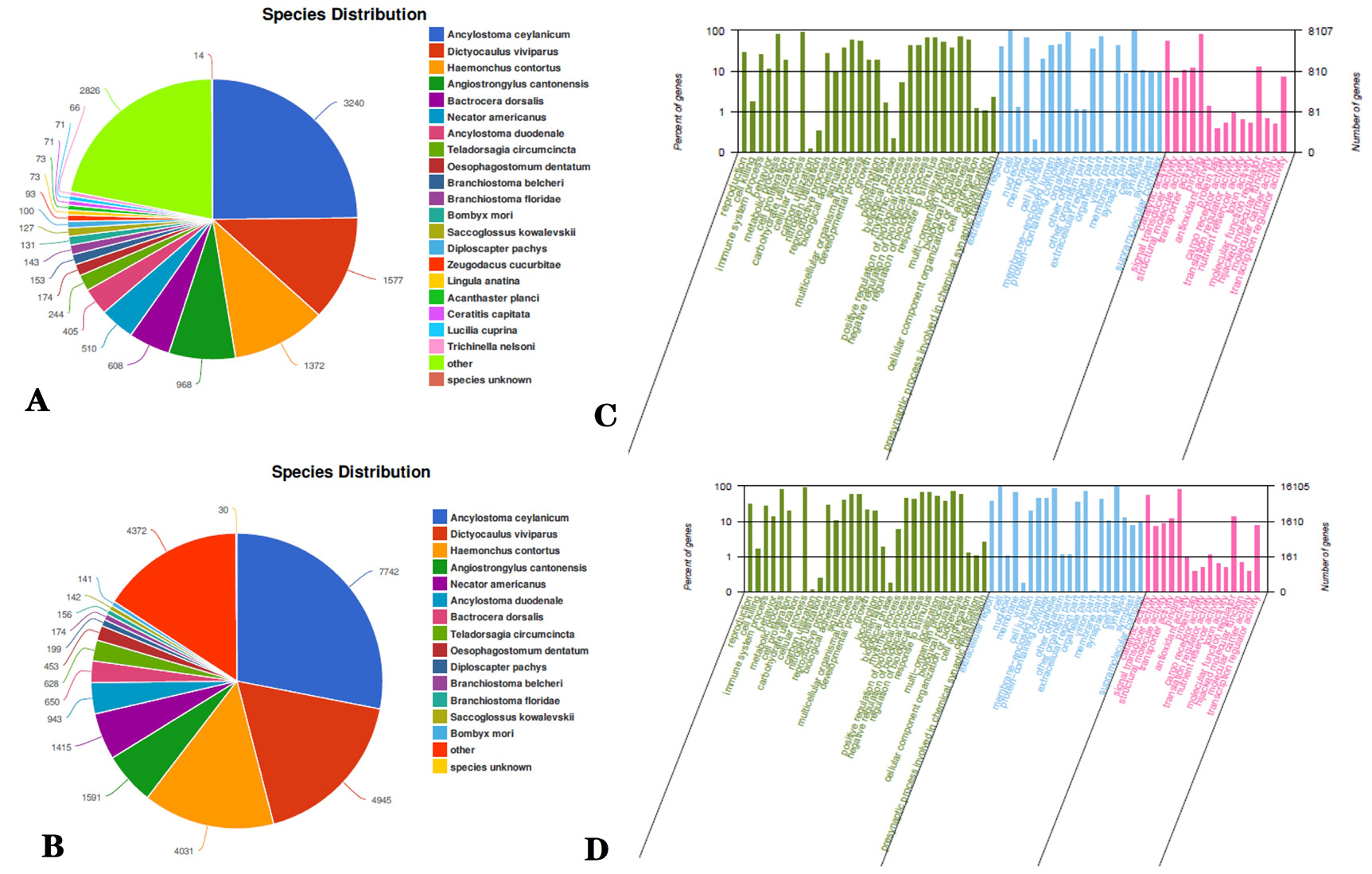
Annotation of unigenes and transcripts provided by NR and GO. (A) Unigenes annotation by the NR database on the species level. (B) Transcripts annotation by the GO database. (C) Unigenes annotation by the GO database. (D) Transcripts annotation by the GO database.
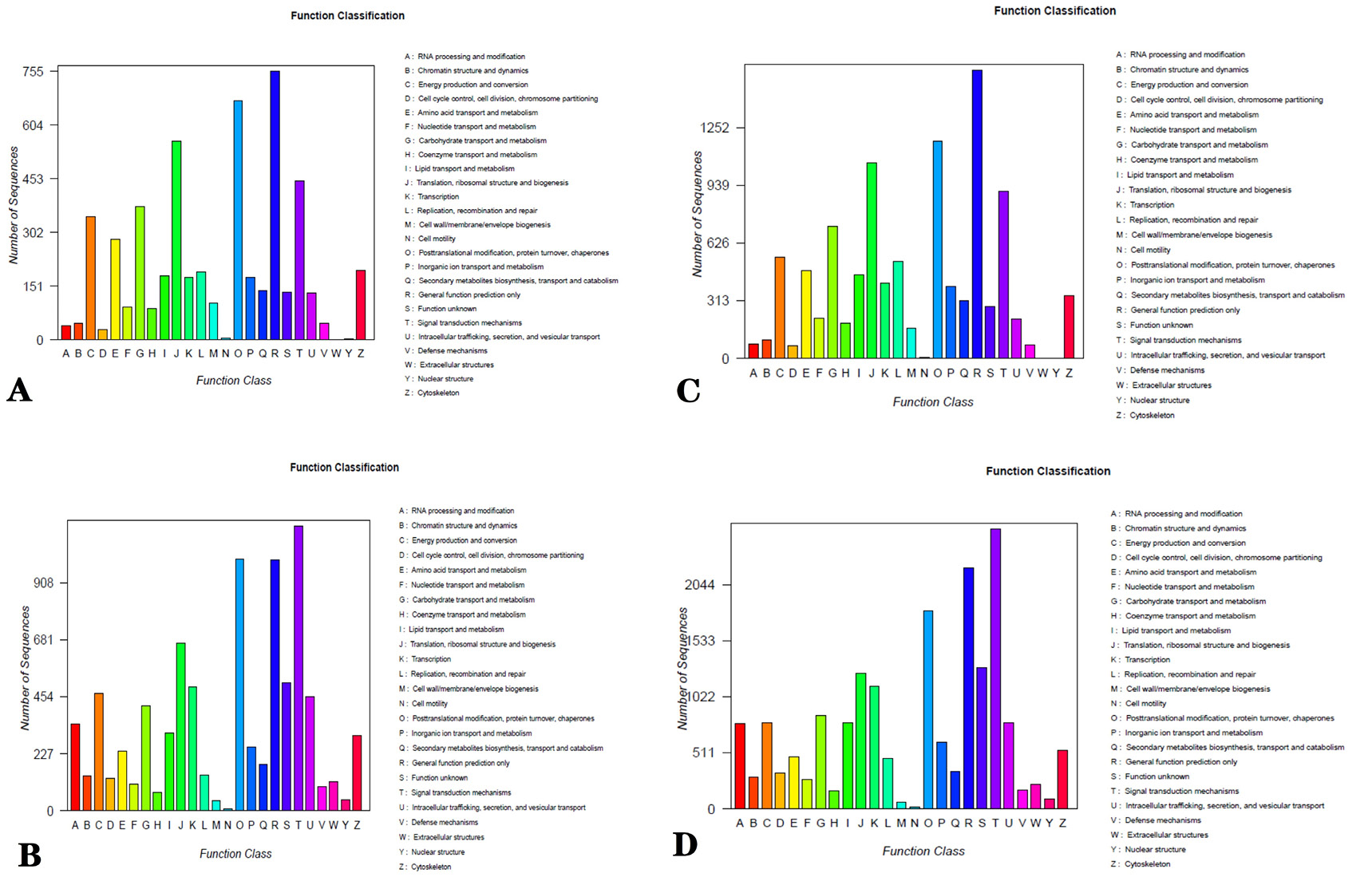
Annotation of unigenes and transcripts provided by the COG and KOG databases. (A) Unigenes annotation by COG. (B) Unigenes annotation by KOG. (C) Transcripts annotation by COG. (D) Transcripts annotation by KOG.
References
- Guo, Y., Dong, H.Y., Zhou, H.C., Zhang, Z.S., Zhao, Y. and Zhang, Y.J., 2021. Iran. J. Parasitol., 16: 454-463.
- Guo, Y., Zhou, H.C., Dong, Y., Dong, H.Y., Yao, Y.L., Qian, J., Zhang, H., Li, X.Y., Zhang, Z.S., Lin, H.B., Zhou, T., Zhao, M.J., Ji, T.Q., Wang, R.Z. and Zhang, F.P., 2020. Iran. J. Parasitol., 15: 587-595.
- Halton, D.W., 1997. Int. J. Parasitol., 27: 693-704. https://doi.org/10.1016/S0020-7519(97)00011-8[CrossRef]
- Ishikawa, L.L., Shoenfeld, Y., and Sartori, A., 2014. Lupus, 23: 577-587. https://doi.org/10.1177/0961203314527369[CrossRef]
- Knight, A.J., and Behm, C.A., 2012. Exp. Parasitol., 132: 47-55. https://doi.org/10.1016/j.exppara.2011.09.004[CrossRef]
- Pien, F.D. and Pien, B.C., 1999. Int. J. Infect. Dis., 3: 161-163. https://doi.org/10.1016/S1201-9712(99)90039-5[CrossRef]
- Porter, D. and Cauthen, G., 1942. Am. J. Vet. Res., 3: 395-400.
- Ransom, B.H., 1906. US Government Printing Office.
- Traub, R.J., 2013. Int. J. Parasitol., 43: 1009-1015. https://doi.org/10.1016/j.ijpara.2013.07.006[CrossRef]
- Xu, L., Xu, M., Sun, X., Xu, J., Zeng, X., Shan, D., Yuan, D., He, P., He, W., Yang, Y., Luo, S., Wei, J., Wu, X., Liu, Z., Xu, X., Dong, Z., Song, L., Zhang, B., Yu, Z., Wang, L., Zhang, C., Fang, X., Gao, Q., Lv, Z. and Wu, Z., 2019. PLoS Negl. Trop. Dis., 13: https://doi.org/10.1371/journal.pntd.0007846[CrossRef]
- Yoshida, Y., Kondo, K., Kurimoto, H., Fukutome, S. and Shirasaka, S.,1974. J. Parasitol., 60: 636-641. https://doi.org/10.2307/3278727[CrossRef]
Services
Article usage statistics
Loading…