Research Article · Volume 13, Issue 1, 1 February 2025 · Open Access
Individual and Synergistic Effect of Adding Zeolite and Yeast to Reduce the Negative Impact of Aflatoxin B1 on the Physiological and Immune Performance of Laying Hens
· · · ·
Affiliations & Notes ⌄
1Education College for Women, University of Anbar, Iraq
2College of Agriculture, University of Anbar, Iraq
3College of Agriculture, Al-Qasim Green University, Iraq. *Correspondence | Tahreer Al-Thuwaini, College of Agriculture, Al-Qasim Green University, Iraq
The results of the statistical analysis shown in Figure 4, indicated that no significant differences (P>0.05) were observed between treatments in white blood cells.
The improvement in T6 may be due to the synergistic effect of the additives in improving blood characteristics of laying hens, where zeolites work to reduce the harmful effects of fungal toxins on blood characteristics, while yeast works to improve blood traits, increase white blood cell count, and improve immunity.
Results indicated that the synergistic role of zeolite and yeast (T6) reduced the negative effects of fungal toxins and significantly improved the activity and concentration of enzyme Adenosine deaminase (ADA) compared to treatment (T2).
We can conclude from this study that adding zeolite and yeast to the diets of laying hens can be effective in improving health and reducing the toxic effects of AFB1.
Selected from the article's own text.
Abstract
This study was carried out to investigate the impact of incorporating zeolite and yeast (Saccharomyces cerevisiae) in laying hen diets contaminated with aflatoxin B1 (AFB1) on some physiological traits and immunological responses. Seventy-two laying hens, 45 weeks old (Lohman Brown), were randomly assigned to six treatments with four replicates per treatment (three hen/replicate). The experiment was carried out in cages. Birds in T1 fed basal diet without addition, birds in T2 fed basal diet contaminated with AFB1 200 ppb, birds in T3 fed basal diet contaminated with AFB1 200 ppb + commercial anti-fungal, birds in T4 fed diet contaminated with AFB1 200 ppb + yeast 4 gm/kg feed, birds in T5 fed diet contaminated with AFB1 200 ppb + zeolite 20 gm/kg feed, birds in T6 fed diet contaminated with AFB1 200 ppb + zeolite 20 gm/kg + yeast 4 gm /kg feed. Results indicated that adding zeolite and yeast synergistic to laying hen diets contaminated with AFB1 (T6) had a positive impact on RBC, PCV, Hb, H/L ratio, and HI titer against Newcastle diseases with a significant increase (P ≤ 0.05) as compared with T2 and T3. No significant differences (P > 0.05) were recorded between treatments in WBC. Also, immunological results observed that Adenosine Deaminase (ADA) in the cecal tonsil and serum exhibited high values by adding a combination of zeolite and yeast to laying hen diets contaminated with AFB1 compared with T2 and T3. Finally, our results indicated that dietary supplements were effective in reducing the negative effects of aflatoxin B1. Findings suggest that adding zeolite and yeast to laying hen diets could be a promising strategy for improving the health and productivity of aflatoxin B1-contaminated flocks.
Aflatoxin B1 (AFB1) is a potent carcinogenic mycotoxin that is produced by certain strains of the fungi Aspergillus flavus and Aspergillus parasiticus. It is a naturally occurring toxin that can contaminate a wide range of food commodities, including cereals, nuts, spices, and milk . The toxin can enter the food chain through contaminated crops, and can also be found in animal feedstuffs, which can lead to the accumulation of AFB1 in animal products . AFB1 is highly stable and resistant to many forms of food processing, making it difficult to remove from contaminated feeds . Chronic exposure to AFB1 can lead to the development of hepatocellular carcinoma (HCC), a type of liver cancer that is responsible for over 80% of all liver cancer cases worldwide . Mycotoxins especially (AFB1) are also implicated in other health problems, including stunted growth and immune suppression . Several strategies have been carried out to minimize the effects of aflatoxins toxic on laying hens and the transfer of its residues to products, such as physical, chemical, and biological methods, These include implementing good agricultural practices to prevent the growth of Aspergillus fungi on crops, such as crop rotation, irrigation management, and use of fungicides .
Zeolite is a naturally occurring mineral with a unique porous structure that has been found to have several beneficial properties, including the ability to adsorb contaminants such as aflatoxins . The use of zeolite in animal feed is a promising strategy to minimize the adverse effects of aflatoxin B1 . Zeolite can bind to and trap AFB1 in its porous structure, preventing it from being absorbed by animals and reducing its toxicity . In addition, zeolite has been shown to improve animal health and performance in the presence of aflatoxin B1 . The results (Mijailovi´c et al., 2022) demonstrated that zeolites have a microporous structure that forms a large internal surface and is associated with their high cation exchange capacity (Ca+2) that makes zeolites efficiently adsorb polar molecules such as AFB1. Zeolite has also been shown to improve immune system function and reduce oxidative stress in animals exposed to aflatoxin B1, which can help to minimize the negative effects of this mycotoxin on animal health . Yeast is a single-celled organism that is widely used in food and feed production . There are several mechanisms by which yeast can help minimize the effects of AFB1. One of the main mechanisms involves the ability of yeast to bind to AFB1 and prevent its absorption in the digestive tract . This reduces the amount of AFB1 that is available to be absorbed into the bloodstream and distributed throughout the body. In addition, yeast has been found to stimulate the immune system and improve gut health, which can help animals cope with the toxic effects of AFB1 . Another mechanism by which yeast can help minimize the effects of AFB1 is through the production of enzymes that can break down the toxin . Certain strains of yeast, such as Saccharomyces cerevisiae, have been found to produce enzymes that can degrade AFB1 into less toxic metabolites. Several studies have demonstrated the effectiveness of yeast in reducing the toxicity of AFB1 in poultry feed ; ; ; . However, further research is needed to optimize the use of zeolite and yeast in laying hens fed AFB1-contaminated diet and to determine its long-term effects on the physiological system and growth rate. This study was carried out to show the role of zeolites and yeast individually or combined to reduce the negative effects of mycotoxins in some physiological and immunological traits of laying hens.
Table 1: Calculated and analyzed nutrient contents, as well as the composition percentages of experimental diets of laying hens during 45-65 weeks.
Ingredients
%
Corn
35.4
Wheat
30
Soy bean (48%)
23
Premix*
2.5
Oil
0.5
Limestone
7.5
Salt
0.1
Di calcium phosphate
1
Total
100
Chemical analysis **
ME kcal/kg
2752
CP %
16.77
Lysine %
0.93
Met. + Cys. %
0.76
Ca %
3.75
Available Phosphor %
0.39
* Premix contains 4.95% protein, kcal / kg 3500 represented energy, 78.95% ash, 6% phosphorus, 11.80٪ available phosphorus, 5.81% calcium, 1.70% lysine, 4.31% methionine; ** The chemical analysis of diets components was carried out according to NRC (1994).
MATERIALS AND METHODS
This study was conducted in the poultry farm which belonged to the Department of Animal Production/College of Agriculture/University of Anbar from lasted for 112 days from 1st February to 20th June, 2023 (28 days/period), to study the effect of adding zeolite and yeast to laying hens diets contaminated with AFB1. Seventy-two-layer hens of Lohmann Brown Hybrid, aged 45 weeks were used in this experiment. Laying hens were distributed randomly to six experiment treatments with 4 replicates per treatment (3 laying hens/replicate) in Cages. Laying hens were fed according to basal diet, as shown in Table 1, in equal amounts (NRC, 1994). Cages were provided with a nipple system and, a lighting period of 15.5 hours per day according to the bird’s guide. Experimental treatments were as follows: T1 birds fed basal diet without any additions (control), T2 birds fed basal diet contaminated with AFB1 200 ppb, T3 birds fed basal diet contaminated with AFB1 200 ppb + commercial anti-fungal (Zero Max 1/2 cm per liter), T4 birds fed basal diet contaminated with AFB1 200 ppb + yeast 4 gm/kg feed, T5 birds fed basal diet contaminated with AFB1 200 ppb + zeolite 20 gm/kg feed, T6 birds fed basal diet contaminated with AFB1 200 ppb + zeolite 20 gm/kg + yeast 4 gm /kg feed. The additives were adopted based on the findings of previous studies and sources, while addition AFB1 was used and approved considering level of contamination and its non-lethal nature .
Production of Aflatoxin B1
The study started by isolating Aspergillus flavus from the College of Veterinary Medicine, Diseases Branch, University of Baghdad, and from the Food Safety Branch at the Ministry of Science and Technology. The isolation method followed the approach of Shotwell et al. (1966) and was modified by West et al. (1973) for mushroom development. The fungus was activated using Potato Dextrose Agar (PDA) medium and then grown on corn grains as a primary development medium, while rice was used as the main development medium. The study also used Saccharomyces cerevisiae produced by Lesaffre, a French industrial company.
Hematological Tests
Hematological parameters were assessed by collecting samples from the wing vein (five birds from each treatment) at the end of the experiment. The blood was taken in capillary tubes containing an anticoagulant, then closed one end of the tube with industrial clay and then placed in a centrifuge for five minutes, The hematological parameters included PCV , RBC and WBC counting and H/L ratio .
Determination of Immunological Tests
The immune response was evaluated by measuring the humoral immunity using the hemagglutination inhibition (HI) test against Newcastle disease .
Adenosine Deaminase Enzyme activity (ADA) in Cecal Tissue and Serum
Enzyme activity was calculated in the extract of the cecum of each bird individually. A portion of the cecum was taken, weighed, and mixed with an equivalent weight of Phosphate Buffer Solution (PBS) solution. The tissue was then homogenized at 4°C and the resulting solution was centrifuged at 2000 rpm for ten minutes with zero-degree cooling. The supernatant was discarded and the sediment was washed with PBS solution three times. The sediment was then placed in 2 mL plastic containers with an equal amount of PBS solution, and to obtain the extract, the cells were broken down through a series of successive grinding and dissolution steps, repeated three times. The extract was then placed in plastic containers and centrifuged in a Microfuge centrifuge at 14000 rpm for ten minutes. The resulting supernatant was used as a source to measure enzyme activity by measuring the ratio of liberated ammonia to the reaction using a spectrophotometer at a wavelength of 624 nanometers, .
Statistical Analysis
The experiment was a completely randomized design with four replicates of three laying hens assigned to each of the six dietary treatments. Data were subjected to Statistical analysis using the general linear models procedure of SAS software . Variable means for treatments showing significant differences in the One-way ANOVA were compared using Duncan´s multiple-range test .
RESULTS AND DISCUSSION
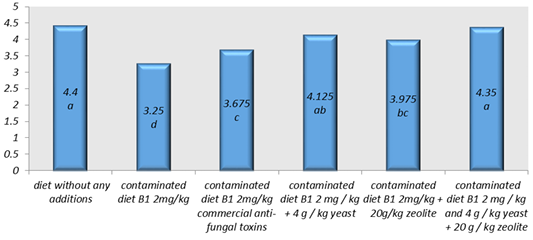
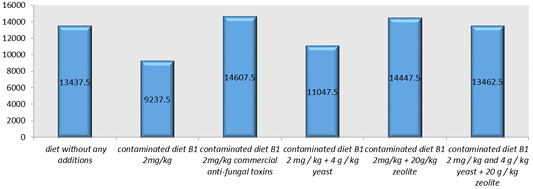
Figure 1, showed a significant decrease (P≤0.05) in red blood cells for T2 which recorded 3.25 as compared with T1, T3, T4, T5, and T6. Also, significant differences (P≤0.05) were observed for treatments T1, T4, and T6 which recorded 4.4, 4.125, and 4.35 ×10⁶ cells/ ml, respectively in comparison with T3 which recorded 3.675 ×10⁶ cell/ ml blood.
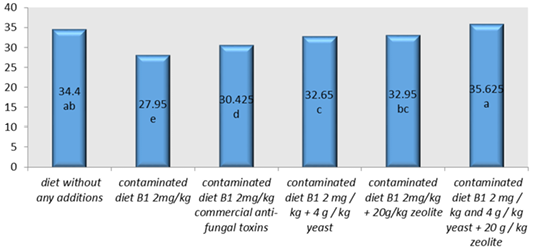
The effect of adding zeolite and yeast to a laying hens diet in packed cell volume was shown in Figure 2. T6 and T1 recorded high values in PCV significantly (35.625 and 34.4) as compared with T2, T3, and T4 (27.95, 30.425, and 32.65 %) respectively. Data in Figure 2 showed that the addition of zeolite and yeast individually (T4 and T5) or synergistically (T6) had significant effects (P≤0.05) in PCV compared with T2 and T3. T2 recorded the lowest value in PCV (27.95 %).
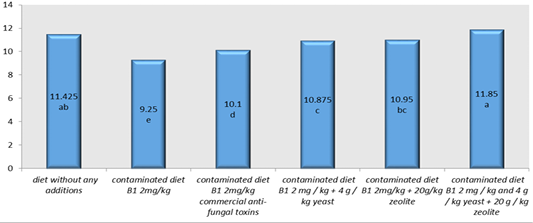
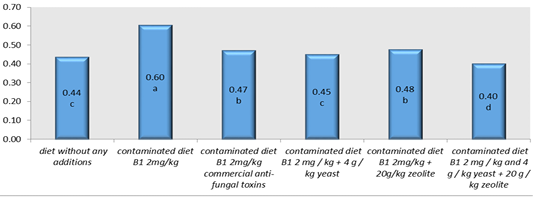
Figure 3 showed that there were significant differences (P≤0.05) between treatments in hemoglobin concentrate of laying hens fed diets contaminated with AFB1 and supplemented with zeolite and yeast synergistic and individually. Results showed that T2 recorded a significant decrease in hemoglobin concentration as compare with all treatments (9.25 gm/dl), while T1 and T6 recorded high values (11.425 and 11.85 gm/dl respectively). The results of the statistical analysis shown in Figure 4, indicated that no significant differences (P>0.05) were observed between treatments in white blood cells. The heterophil/lymphocyte cell ratio was represented in Figure 5, T2 recorded a high value of 0.60 with a significant increase (P≤0.05) as compared with T1, T3, T4, T5, and T6 (0.44, 0.47, 0.45, 0.48, 0.40 %, respectively).
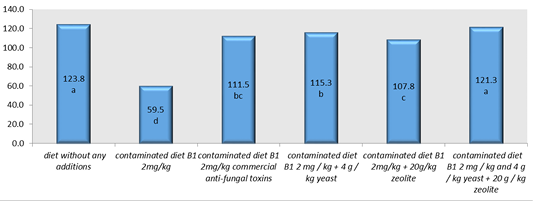
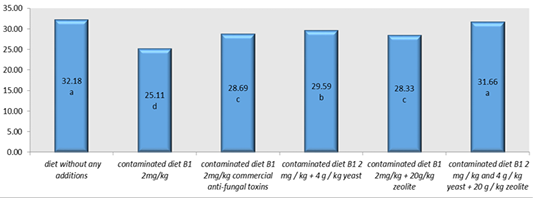
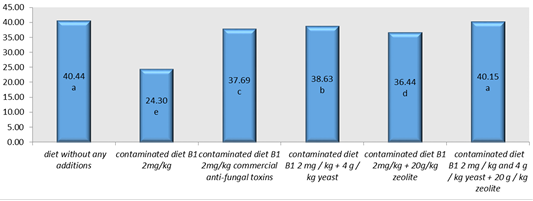
The level of antibodies against Newcastle disease that indicate the development of immune response in laying hens after vaccination is shown in Figure 6, it can be observed that the highest value of antibodies against Newcastle disease was observed in T1 and T6, with a significant difference (P ≤ 0.05) as compared with experimental treatments. On the other hand, T2, which had only fungal toxins added to the basal diet showed the lowest value of antibodies against Newcastle disease (59.5 mg/µL), with a significant decrease (P ≤ 0.05) compared with T3, T4, and T5 (111.5, 115.3, 107.8 mg/µL) respectively. Also, birds in treatments T5 and T3 and the lasted didn’t differ from T4. According to observation data from Figures 7 and 8, the highest ADA enzyme activity was in T1 and T6, with a significant difference (P ≤ 0.05) compared to the experimental treatments. The least effective enzyme activity was shown in T2, which fed a contaminated diet with fungi. Furthermore, birds in T4 recorded a significant increase (P ≤ 0.05) as compared with birds in T3.
Fungal toxins such as AFB1 affect cellular traits of laying hens’ blood, and exposure of birds to this toxin can lead to decrease in red blood cells and hemoglobin levels which leads to decrease in productive performance and deterioration of chicken health . AFB1 can also affect the immune system, leading to increased inflammation and decreased immunity against diseases . To reduce the effects of fungal toxins, natural materials such as zeolites and yeast can be used, the significant improvement in blood characteristics, such as the number of red blood cells, the size of packed cell volume and the blood smear values can be attributed to the addition of zeolites to laying hen diets, which can reduce the harmful effects of fungal toxins on the number of red blood cells and improve the immune system . The improvement may also be due to the role of zeolites in improving antioxidant status, reducing inflammation and enhancing the immune response to disease-causing agents and viral infections . Zeolites and yeast work to improve blood characteristics through various mechanisms, zeolites have a high binding capacity for AFB1 toxins due to their porous structure and high surface area, and they can eliminate heavy toxins before they are absorbed by the bird’s intestines, which in turn reduces the harmful effects of fungal toxins on blood characteristics and improves gut health . The improvement in the addition of zeolites may also be due to their ability to increase the availability of nutrients, which helps to improve blood traits . The improvement may also be due to the role of yeast in improving blood characteristics of laying hens by increasing the internal production of antibiotics, amino acids, vitamins, and amino acids with various health benefits, including enhancing digestion, improving immune function and reducing inflammation .
Yeast is also a rich source of beta-glucans and complex carbohydrates that have various positive effects, which help to enhance the physiological and immune performance of laying hens . The improvement in T6 may be due to the synergistic effect of the additives in improving blood characteristics of laying hens, where zeolites work to reduce the harmful effects of fungal toxins on blood characteristics, while yeast works to improve blood traits, increase white blood cell count, and improve immunity. Overall, the additives work to reduce the harmful effects of fungal toxins on the health of laying hens. Results indicated that the synergistic role of zeolite and yeast (T6) reduced the negative effects of fungal toxins and significantly improved the activity and concentration of enzyme Adenosine deaminase (ADA) compared to treatment (T2). Fungal toxins decrease the concentration of this enzyme in the cecum tonsil or serum, resulting in a clear decrease in its concentration in serum and primary and secondary immune organs under immune suppression or as a result of stress . Reducing the activity of this enzyme can lead to changes in cellular and functional composition as it is one of the important enzymes that convert adenosine to inosine, which is the most beneficial form for the immune system . The enzyme is also essential for the proliferation and differentiation of lymphoid cells, especially T cells, and helps in the maturation of lymphoid granules and transformation into macrophage cells, making it one of the essential factors in cellular immune response . An increase in the concentration of this enzyme in T6 is evidence of a good immune response, and zeolite and yeast addition has been increase cellular immune response.
CONCLUSIONS AND RECOMMENDATIONS
We can conclude from this study that adding zeolite and yeast to the diets of laying hens can be effective in improving health and reducing the toxic effects of AFB1. This discovery can be useful in developing new techniques to improve food quality and safety and provide food security for consumers.
ACKNOWLEDGEMENTS
The authors gratefully acknowledge the University of Anbar for its facilities.
NOVELTY STATEMENT
The novelty of our study has been its strong evidence that adding zeolite and yeast to the diets of laying hens can be effective in improving health and reducing toxic effects of AFB1 of laying hens, in addition to improving food quality and safety for the first time.
AUTHOR’S CONTRIBUTIONS
All authors contributed equally.
Conflict of Interest
None.
Figures
Figure 1:.
Effect of AFB1 combined with zeolite or yeast on RBC count (106).
Figure 2:.
Effect of AFB1 combined with zeolite or yeast on packed cell volume (PCV%).
Figure 3:.
Effect of AFB1 combined with zeolite or yeast on hemoglobin concentration (Hb; g/dl).
Figure 4:.
Effect of AFB1 combined with zeolite or yeast on the number of white blood cells (WBC; 103/ml).
Figure 5:.
Effect of AFB1 combined with zeolite or yeast on H/L ratio.
Figure 6:.
Effect of AFB1 combined with zeolite or yeast on the titer (mg/µL) of antibodies to Newcastle Disease.
Figure 7:.
Effect of AFB1 combined with zeolite or yeast on the activity of the immunostimulant enzyme ADA in serum (u/mg ×10 -3).
Figure 8:.
Effect of AFB1 combined with zeolite or yeast on the activity of immune enzyme ADA in cecal tonsil (u/mg ×10 -3).
References
Abdullah OM, Alnori A, Muthans H (2020). Effect of Bread Yeast and Anti-Myotoxin, Bentonite on the Physiological Traits of Laying Hens Subjected to Aflatoxin. Plant Arch., 20(1): 2019-2022.
Aiuti A (2004). Gene therapy for adenosine-deaminase-deficient severe combined immunodeficiency. Best Pract. Res. Clin. Haematol., 17(3): 505-516. https://doi.org/10.1016/j.beha.2004.05.012[CrossRef]
Alameri MM, Kong ASY, Aljaafari MN, Ali HA, Eid K, Sallagi MA, Cheng WH, Abushelaibi A, Lim SHE, Loh JY (2023). Aflatoxin Contamination: An Overview on Health Issues, Detection and Management Strategies. Toxins, 15: 246. https://doi.org/10.3390/toxins15040246[CrossRef]
Alharthi AS, Al Sulaiman AR, Aljumaah RS, Alabdullatif AA, Ferronato G, Alqhtani AH, Al-Garadi MA, Al-Sornokh H, Abudabos AM (2022). The efficacy of bentonite and zeolite in reducing aflatoxin B1 toxicity on production performance and intestinal and hepatic health of broiler chickens. Ital. J. Anim. Sci., 21(1): 1181-1189. https://doi.org/10.1080/1828051X.2022.2101389[CrossRef]
Ali UH, Mousa BH (2023). Synergetic Role of Energy and Oat with Enzymes on Physiological Performance of Broiler. IOP Conf. Ser. Earth Environ. Sci., 1252 (1): art. no. 012152. https://doi.org/10.1088/1755-1315/1252/1/012152[CrossRef]
Amara AA, El-Baky NA (2023). Fungi as a source of edible proteins and animal feed. J. Fungi, 9(1): 73. https://doi.org/10.3390/jof9010073[CrossRef]
Archer RK (1965). Hematological techniques for use on animals. Oxford: Blackwell Scientific Publication, 135.
Beard CW (1989). Serologic procedures. A laboratory manual for the isolation and identification of avian pathogens. The American Association of Avian Pathologists. 3rd ed. Ames (Io): Kendall/Hunt Publishing Co, 192-193.
Bozzo G, Pugliese N, Samarelli R, Schiavone A, Dimuccio MM, Circella E, Bonerba E, Ceci E, Camarda A (2023). Ochratoxin A and Aflatoxin B1 Detection in Laying Hens for Omega 3-Enriched Eggs Production. Agriculture, 13(1): 138. https://doi.org/10.3390/agriculture13010138[CrossRef]
Burton R, Guion CW (1968). The differential leucocyte blood count: its precision and individuality in the chicken. Poult. Sci., 47(6): 1945-1949. https://doi.org/10.3382/ps.0471945[CrossRef]
Cataldo E, Salvi L, Paoli F, Fucile M, Masciandaro G, Manzi D, Masini CM, Mattii GB (2021). Application of zeolites in agriculture and other potential uses: A review. Agronomy, 11(8): 1547. https://doi.org/10.3390/agronomy11081547[CrossRef]
Chen SS, Li YH, Lin MF (2017). Chronic exposure to the Fusarium mycotoxin deoxynivalenol: Impact on performance, immune organ, and intestinal integrity of slow-growing chickens. Toxins, 9(10): 334. https://doi.org/10.3390/toxins9100334[CrossRef]
Duncan DB (1955). Multiple range and Multiple F test. Biometrics, 11: 1-42. https://doi.org/10.2307/3001478[CrossRef]
Giusti G (1981). Adenosine deaminas. In: Methods of Enzymatic Analysis. Ed. By: H. U. Bergmeyer. Florids. Vevlay Chem. Int., 2nd ed, 1092-1099. https://doi.org/10.1016/B978-0-12-091302-2.50108-0[CrossRef]
Guan Y, Chen J, Nepovimova E, Long M, Wu W, Kuca K (2021). Aflatoxin detoxification using microorganisms and enzymes. Toxins, 13(1): 46. https://doi.org/10.3390/toxins13010046[CrossRef]
Haen PJ (1995). Principles of Hematology. Ed. By: L. Harris-young, 400-421.
Hameed AE, Mousa BH (2025). Role of Bioactive Lycopene in Mitigating the Impact of Aflatoxin B1 on Physiological Performance of Broiler Chickens. Egypt. J. Vet. Sci., 56(7): 1489-1497.
Hernández-Ramírez JO, Merino-Guzmán R, Téllez-Isaías G, Vázquez-Durán A, Méndez-Albores A (2021). Mitigation of AFB1-related toxic damage to the intestinal epithelium in broiler chickens consumed a yeast cell wall fraction. Front. Vet. Sci., 8: 677965. https://doi.org/10.3389/fvets.2021.677965[CrossRef]
Kolawole O, Siri-Anusornsak W, Petchkongkaw A, Meneely J, Elliott C (2022). The efficacy of additives for the mitigation of aflatoxins in animal feed: a systematic review and network meta-analysis. Toxins, 14(10): 707. https://doi.org/10.3390/toxins14100707[CrossRef]
Kraljević PS, Simović MJ, Gumbarević D, Filošević A, Pržulj N, Pavelić K (2018). Critical review on zeolite clinoptilolite safety and medical applications in vivo. Front. Pharmacol., 9: 1350. https://doi.org/10.3389/fphar.2018.01350[CrossRef]
Kucukcakan B, Hayrulai-Musliu Z (2015). Challenging role of dietary aflatoxin B1 exposure and hepatitis B infection on risk of hepatocellular carcinoma. Open access Maced. J. Med. Sci., 3(2): 363. https://doi.org/10.3889/oamjms.2015.032[CrossRef]
Kumar A, Pathak H, Bhadauria S, Sudan J (2021). Aflatoxin contamination in food crops: causes, detection, and management: a review. Food Production, Process. Nutr., 3, 1-9. https://doi.org/10.1186/s43014-021-00064-y[CrossRef]
Mavrommatis A, Giamouri E, Tavrizelou S, Zacharioudaki M, Danezis G, Simitzis PE, Zoidis E, Tsiplakou E, Pappas AC, Georgiou CA, Feggeros K (2021). Impact of mycotoxins on animals’ oxidative status. Antioxidants, 10(2): 214. https://doi.org/10.3390/antiox10020214[CrossRef]
Miazzo R, Rosa CAR, Carvalho EDQ, Magnoli C, Chiacchiera SM, Palacio G, Saenz M, Kikot A, Basaldella E, Dalcero A (2000). Efficacy of synthetic zeolite to reduce the toxicity of aflatoxin in broiler chicks. Poult. Sci., 79(1): 1-6. https://doi.org/10.1093/ps/79.1.1[CrossRef]
Mijailović NR, Nedić Vasiljević B, Ranković M, Milanović V, Uskoković-Marković S (2022). Environmental and pharmacokinetic aspects of zeolite/pharmaceuticals systems—Two facets of adsorption ability. Catalysts, 12(8): 837. https://doi.org/10.3390/catal12080837[CrossRef]
Natt MP, Herrick CA (1952). A new blood diluent for counting the erythrocytes and leucocytes of the chicken. Poult. Sci., 31(4): 735-738. https://doi.org/10.3382/ps.0310735[CrossRef]
Ndagijimana R, Shahbaz U, Sun X (2020). Aflatoxin B1 in food and feed: an overview on prevalence, determination and control tactics. JAIR, 8: 144.
NRC (1994). National Research Council. Nutrient requirement of poultry. 9th revisited National academy press, Washington DC, USA, 176 p.
Ochieng PE, Scippo ML, Kemboi DC, Croubels S, Okoth S, Kang’ethe EK, Doupovec B, Gathumbi JK, Lindahl JF, Antonissen G (2021). Mycotoxins in poultry feed and feed ingredients from Sub-Saharan Africa and their impact on the production of broiler and layer chickens: a review. Toxins, 13(9): 633. https://doi.org/10.3390/toxins13090633[CrossRef]
Oggiano G, Pokimica B, Popović T, Takić M (2023). Beneficial properties of zeolite. Ital. J. Food Sci., 35(1): 72-78. https://doi.org/10.15586/ijfs.v35i1.2325[CrossRef]
Perricone V, Sandrini S, Irshad N, Savoini G, Comi M, Agazzi A (2022). Yeast-derived products: The role of hydrolyzed yeast and yeast culture in poultry nutrition—A review. Animals, 12(11): 1426. https://doi.org/10.3390/ani12111426[CrossRef]
SAS Institute . The SAS System for Windows, Release 9.51. SAS Institute Inc, Cary, NC, 2012.
Shotwell OL, Hesseltine CW, Stubblefield RD, Sorenson WG (1966). Production of aflatoxin on rice. Appl. Microbiol., 14(3): 425-428. https://doi.org/10.1128/am.14.3.425-428.1966[CrossRef]
Signa S, Bertoni A, Penco F, Caorsi R, Cafaro A, Cangemi G, Volpi S, Gattorno M, Schena F (2022). Adenosine deaminase 2 deficiency (DADA2): a crosstalk between innate and adaptive immunity. Front. Immunol., 13: 935957 https://doi.org/10.3389/fimmu.2022.935957.[CrossRef]
Siloto EV, Sartori JR, Santos TSD, Fascina VB, Centenaro LP, Miranda CCD, Testa CAEP, Sartori DRDS (2021). Effects of chromium yeast supplementation on productive and metabolic responses of laying hens fed diets containing different energy levels. Rev. Bras. Zootecnia, 50: e20200173 https://doi.org/10.37496/rbz5020200173.[CrossRef]
Stanley VG, Winsman M, Dunkley C, Ogunleye T, Daley M, Krueger WF, Sefton AE, Hinton JA (2004). The impact of yeast culture residue on the suppression of dietary aflatoxin on the performance of broiler breeder hens. J. Appl. Poult. Res., 13(4): 533-539. https://doi.org/10.1093/japr/13.4.533[CrossRef]
Stefanović D, Marinković D, Trailović S, Vasiljević M, Farkaš H, Raj J, Tolimir N, Radulović S, Nešić V, Trailović JN, Petrujkić B (2023). Evaluation of effectiveness of a novel multicomponent mycotoxins detoxification agent in the presence of AFB1 and T-2 toxin on broiler chicks. Microorganisms, 11(3): 574. https://doi.org/10.3390/microorganisms11030574[CrossRef]
Sun Y, Song Y, Long M, Yang S (2023). Immunotoxicity of three environmental mycotoxins and their risks of increasing pathogen infections. Toxins, 15(3): 187. https://doi.org/10.3390/toxins15030187[CrossRef]
Vasconcelos AA, Len T, de Oliveira ADN, Costa AAFD, Souza ARDS, Costa CEFD, Souza ARDS, Costa CEFD, Luque R, Rocha Filho GND, Noronha RCR, Nascimento LASD (2023). Zeolites: A Theoretical and Practical Approach with uses in (Bio) Chemical processes. Appl. Sci., 13(3): 1897. https://doi.org/10.3390/app13031897[CrossRef]
Wang T, Cheng K, Li Q, Wang T (2022). Effects of yeast hydrolysate supplementation on intestinal morphology, barrier, and anti-inflammatory functions of broilers. Anim. Biosci., 35(6): 858. https://doi.org/10.5713/ab.21.0374[CrossRef]
West S, Wyatt RD, Hamilton PB (1973). Improved yield of aflatoxin by incremental increases of temperature. Appl. Microbiol., 25(6): 1018-1019. https://doi.org/10.1128/am.25.6.1018-1019.1973[CrossRef]
Yiannikouris A, Apajalahti J, Siikanen O, Dillon GP, Moran CA (2021). Saccharomyces cerevisiae cell wall-based adsorbent reduces aflatoxin B1 absorption in rats. Toxins, 13(3): 209. https://doi.org/10.3390/toxins13030209[CrossRef]
Individual and Synergistic Effect of Adding Zeolite and Yeast to Reduce the Negative Impact of Aflatoxin B1 on the Physiological and Immune Performance of Laying Hens · ResearchersLinks