Introduction
Eggs are one of the most important foods for humans due to their rich and balanced nutritional composition. They are a major source of high-quality proteins, containing all the essential nutrients necessary for growth and regeneration. Additionally, eggs provide a wide range of vitamins and minerals, making them a complete food that supports various bodily functions. The egg industry maintains strict veterinary health and safety standards to ensure eggs are free from disease and contaminants, providing a safe and high-quality product for consumption ; .
It is well known that aging in laying hens leads to a significant decline in egg production. This decrease is largely attributed to the accumulation of free radicals unstable molecules naturally produced during metabolism which cause cellular and tissue damage. Increased oxidative stress reduces the activity of antioxidant enzymes, impairing the health and function of ovarian cells responsible for egg production. Consequently, this results in reduced productivity and weakened immunity in older hens ; .
To counteract these effects, researchers and poultry producers increasingly use natural feed additives and bio-alternatives such as herbs, medicinal plants, and bio-precursors known for their antioxidant properties. These additives contain active compounds that help reduce oxidative stress and improve growth, immunity, and overall health . One such promising additive is Gum Arabic a polysaccharide derived from the dried secretion of Acacia senegal trees native to Central and West Africa ; . Gum Arabic is rich in glycoproteins, carbohydrates, amino acids, and minerals like calcium (Magnini et al., 2022; .
Studies have demonstrated that Gum Arabic supplementation in poultry diets can significantly reduce serum cholesterol, triglycerides, and liver enzymes, while improving blood serum levels of albumin, globulin, and calcium . Its anti-inflammatory and antioxidant effects are attributed to its ability to enhance enzyme activity, thereby preventing oxidative damage ; . The antioxidant capacity of Gum Arabic is linked to its amino acid content including cysteine, tyrosine, histidine, and methionine and its role in increasing glutathione levels while reducing harmful radicals like malondialdehyde and superoxide ; .
Therefore, given the significant potential of Gum Arabic to improve oxidative stability and overall health in aging laying hens, this study aimed to evaluate its effects on egg production performance, egg quality, oxidative balance, and body stability, as well as to determine the optimal supplementation level.
MATERIALS AND METHODS
Experimental design and analyses
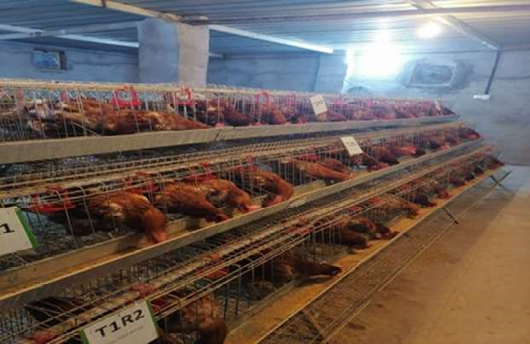
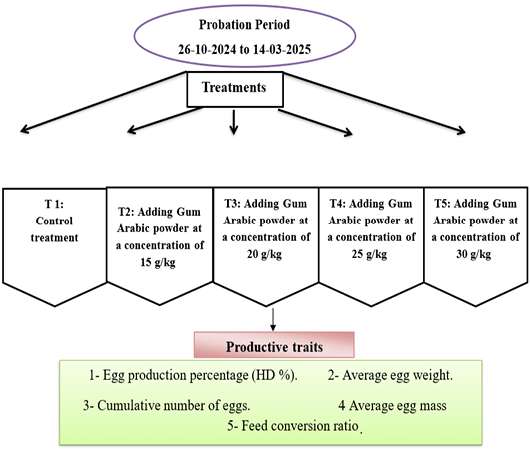
The field experiment was conducted in Babylon over 140 days, from October 26, 2024, to March 14, 2025. The study aimed to evaluate the effects of different levels of gum Arabic powder added to the feed on the productive performance of laying hens. A total of 105 Lohmann Brown hybrid hens (Figure 1), all 65 weeks old at the start, were used. The rearing period was divided into five intervals: 65–68 weeks, 69–72 weeks, 73–76 weeks, 77–80 weeks, and 81–84 weeks. The hens were assigned to five treatments, with each treatment including 21 hens divided into three replicates of 7 hens each. The treatments consisted of a control group with no gum Arabic powder added to the feed, and four experimental groups receiving gum Arabic powder at levels of 15, 20, 25, and 30 grams per kilogram of feed, respectively (Figure 2). The composition and chemical analysis of the experimental diet is presented in Table 1.
After a 2-week adaptation period with no data collection, the hens were randomly distributed into 15 replicates at 65 weeks of age. They were housed in pyramid-style pens measuring 2×2 m², containing six batteries per pen, each battery holding five cages (40×40 cm² each). Each cage was equipped with two automatic nipple drinkers, and feeding was done manually via longitudinal feeders.
The daily feed intake was calculated at 115 g per hen. Lighting was provided for 16 hours of light and 8 hours of darkness at an intensity of 4 watts/m², following poultry guide recommendations. Temperature was recorded twice daily (morning and evening) using four thermometers strategically placed throughout the hall, which was heated by electric heaters to maintain optimal conditions.
Statistical Analysis
A completely randomized design (CRD) was applied to assess the effects of different treatments on the evaluated traits. Significant differences among means were determined using Duncan’s Multiple Range Test (1955) at a significance level of (0.05). Statistical analysis was conducted using SAS (2012).
Table 1: Composition and chemical analysis of the experimental diet used during the study.
| Dietary component | (%) |
| 55 | |
| Bran | ٥.٥ |
| Soybean meal (46% Protein) | 24 |
| Protein premix 2.5% | 2.5 |
| Vegetable oil | 1.3 |
| Limestone | 10.85 |
| Dicalcium phosphate (DCP) | ٥0. |
| Methionine % | 0.1 |
| Lysine % | ٠.0٥ |
| Salt | 0.1 |
| Antitoxin | 0.1 |
| Total | 100 |
| The chemical analysis ** | |
| The representative energy (kilocalorie/kg feed) | ٢٧23 |
| Crude protein (%) | 16 |
| Calcium (%) | 4 |
| Available phosphorus (%) | 0.37 |
| Methionine (%) | 0.39 |
| Lysine (%) | 0.9 |
| Threonine (%) | 0.54 |
| Salt (%) | 0.31 |
| Fiber (%) | 3.8 |
Protein premix from the Dutch company Provim, each kg contains: (5.9%) crude protein, (3600) kcal metabolized energy/kg,( 6.4%) calcium, (5.7%) phosphorus, (6.5%) sodium,( 4000) mg/kg iron, (2800) mg/kg zinc, (600) mg/kg copper, (8.35) mg cobalt, (60) mg/kg iodine, (10) mg/kg selenium, (5.9%) methionine, (1.5%) lysine, (5.9%) methionine with cysteine, (1200) mg/kg niacin, (400,000) IU vitamin A, (140,000) IU D3, (2000) mg/kg E, (100) K, (90) mg/kg Thiamine, (160) ppb Riboflavin, (200) mg/kg Pyridoxine and (1000) meg/kg Vitamin Cobalamin. **Chemical composition calculated based on (NRC, 1994).
RESULTS
Egg production percentage (H.D%)
Table 2 shows the effect of adding Gum Arabic powder at different levels to the feed of older laying hens on egg production percentage (H.D%) over the period from 65 to 84 weeks of age. During the first production interval (65–68 weeks), treatments T3, T4, and T5 showed significant (P < 0.05) improvements in egg production, reaching 68.19%, 68.36%, and 71.93%, respectively, compared to the control group (T1), which had a production rate of 59.69%. Notably, T5 recorded the highest egg production rate in this period.
In the second (69–72 weeks), third (73–76 weeks), and fourth (77–80 weeks) production intervals, all gum-supplemented treatments (T2, T3, T4, and T5) outperformed the control, which had the lowest egg production rates of 60.20%, 62.24%, and 57.14%, respectively, with differences being significant (P < 0.05). During the fifth interval (81–84 weeks) and in the overall average for the entire study period (65–84 weeks), the T2, T3, T4, and T5 groups continued to show significantly (P < 0.05) higher egg production percentages compared to the control, which recorded the lowest values of 53.40% and 58.53%, respectively.
Egg weight
Table 3 presents the impact of Gum Arabic powder supplementation on egg weight (g) during the same periods. In the first (65–68 weeks) and second (69–72 weeks) production intervals, the T2, T3, T4, and T5 treatments achieved significantly (P < 0.05) higher average egg weights than the control (T1), which recorded the lowest weights of 66.60 g and 68.77 g, respectively.
This positive trend continued throughout the third (73–76 weeks), fourth (77–80 weeks), and fifth (81–84 weeks) intervals, where gum-treated groups consistently outperformed the control. In these later stages, T5 exhibited the highest egg weights, reaching 74.18 g, 76.88 g, and
Table 2: The effect of adding Gum Arabic powder at different levels to the feed of older laying hens on egg production percentage (H.D%) during the period from 65 to 84 weeks of age.
| Treatments | First duration (65-68) | Second duration (69-72) | Third duration (73-76) | Fourth duration (77-80) | Fifth duration (81-84) | The general average (65–84) |
| T1 | 59.69 ±٢.٧٩c | 60.20 ±٠.٥١d | 62.24 ±٠.٢٩d | 57.14 ±٠.٥٨d | 53.40 ±٠.٦١e | 58.53 ±٠.١٧e |
| T2 | 64.45 ±١.٨٥b c | 66.15 ±٠.٤٤c | 69.04 ±٠.٤٤c | 64.28 ±٠.٣٧c | 58.33 ±٠.٣٤d | 64.45 ±٠.١٣d |
| T3 | 68.19 ±٢.٤٦a b | 69.72 ±٠.٣٤b | 70.74 ±٠.٥٦b c | 68.70 ±١.٠٣b | 61.73 ±٠.٥١c | 67.81 ±٠.٢٨c |
| T4 | 68.36 ±٣.٠٢a b | 72.27 ±١.١١a | 72.10 ±١.٧٤a b | 71.93 ±٠.٤٨a | 66.83 ±٠.٥٨b | 70.29 ±٠.٣٩b |
| T5 | 71.93 ±٢.٣٥a | 74.31 ±١.٩٠a | 74.48 ±٠.٢٨a | 73.97 ±١.٥٩a | 68.53 ±٠.١٧a | 72.64 ±٠.٢٧a |
| Significant | * | * | * | * | * | * |
*There are significant differences (P≤0.05) between the treatments. T1 (control), T2, T3, T4, and T5 treatments: Adding Gum Arabic powder at concentrations of 15, 20, 25, and 30 g/kg feed, respectively.
Table 3: Effect of adding Gum Arabic powder at different levels to the feed of older laying hens on egg weight (g) during the period from 65 to 84 weeks of age.
| Treatments | First duration (65-68) | Second duration (69-72) | Third duration (73-76) | Fourth duration (77-80) | Fifth duration (81-84) | The general average (65–84) |
| T1 | 66.60 ± 0.44 b | 68.77± 0.14 b | 69.59± 0.04 d | 68.30± 0.11 d | 67.77± 0.04 e | 68.20 ± 0.27 e |
| T2 | 68.63 ± 0.52 a | 70.50 ± 0.54 a | 71.77 ± 0.05 c | 71.38± 0.32 c | 70.94± 0.26 d | 70.64± 0.09 d |
| T3 | 68.74 ± 0.28 a | 71.27 ± 0.29 a | 72.63 ± 0.11b | 73.60± 0.17 b | 72.68 ± 0.11 c | 71.78 ± 0.06 c |
| T4 | 69.26 ± 0.75 a | 71.45± 0.05 a | 73.23± 0.51 b | 74.91 ± 0.24 b | 73.82± 0.16 b | 72.53± 0.12 b |
| T5 | 70.20 ± 0.61 a | 71.92± 0.17 a | 74.18± 0.26 a | 76.88 ± 0.19 a | 75.26± 0.32 a | 73.68± 0.81 a |
| Significant | * | * | * | * | * | * |
* There are significant differences (P≤0.05) between the treatments. T1 (control), T2, T3, T4, and T5 treatments: Adding Gum Arabic powder at concentrations of 15, 20, 25, and 30 g/kg feed, respectively.
Table 4: Effect of adding Gum Arabic powder at different levels to the feed of older laying hens on the cumulative number of eggs during the period from 65 to 84 weeks of age.
| Treatments | First duration (65-68) | Second duration (69-72) | Third duration (73-76) | Fourth duration (77-80) | Fifth duration (81-84) | The general average (65 –84) |
| T1 | 16.71 ±١.٥٠c | 16.85 ±٠.١٤d | 17.42 ±٠.٠٨c | 15.99± 0.16 d | 14.95± 0.17 e | 16.38 ± 0.05 d |
| T2 | 18.04 ±٠.٤٠b c | 18.52 ±٠.١٢c | 19.33 ±٠.١٢b | 17.99± 0.21 c | 16.33± 0.09 d | 18.04± 0.16 c |
| T3 | 19.09 ±٠.٦٩a b | 19.52 ±٠.٠٩b | 19.80 ±٠.١٨b | 19.23± 0.28 b | 17.28 ± 0.14 c | 18.98± 0.10 c |
| T4 | 19.14 ±٠.٢٨a b | 20.23 ±٠.١١a | 20.18 ±٠.١١a | 20.14± 0.16 a | 18.71± 0.16 b | 19.68± 0.09 b |
| T5 | 20.14 ±٠.٣٦a | 20.80 ±٠.٢٥a | 20.85 ±٠.٢١a | 20.71 ± 0.19 a | 19.18 ± 0.04 a | 20.33± 0.07 a |
| Significant | * | * | * | * | * | * |
* There are significant differences (P≤0.05) between the treatments. T1 (control), T2, T3, T4, and T5 treatments: Adding Gum Arabic powder at concentrations of 15, 20, 25, and 30 g/kg feed, respectively.
Table 5: Effect of adding Gum Arabic powder at different levels to the feed of older laying hens on egg mass (g/hen/day) during the period from 65 to 84 weeks of age.
| Treatments | First duration (65-68) | Second duration (69-72) | Third duration (73-76) | Fourth duration (77-80) | Fifth duration (81-84) | The general average (65 –84) |
| T1 | 39.75 ±١.٥٨c | 41.39 ±٠.٢٣e | 43.31 ±٠.٣٥d | 39.02± 0.31 e | 36.18± 0.41 e | 39.93± 0.28 e |
| T2 | 44.23± 1.13 b | 46.63 ± 0.29 d | 49.55 ±٠.١٢c | 45.88 ±٠.٧٢d | 41.37± 0.38 d | 45.53± 0.15 d |
| T3 | 46.87± 1.74 a b | 49.68± 0.05 c | 51.37± 0.30 b | 50.56± 0.56 c | 44.86± 0.32 c | 48.67± 0.31 c |
| T4 | 47.34± 1.09 a b | 51.63 ± 0.32 b | 52.79± 0.83 b | 53.88± 0.42 b | 49.33± 0.49 b | 50.99± 0.22 b |
| T5 | 50.49± 1.93 a | 53.44± 0.47 a | 55.25 ± 0.62 a | 56.86± 0.35 a | 51.57± 0.21 a | 53.52± 0.34 a |
| Significant | * | * | * | * | * | * |
* There are significant differences (P≤0.05) between the treatments. T1 (control), T2, T3, T4, and T5 treatments: Adding Gum Arabic powder at concentrations of 15, 20, 25, and 30 g/kg feed, respectively.
75.26 g, respectively, while T1 recorded the lowest values (69.59 g, 68.30 g, and 67.77 g). All differences were significant (P < 0.05). Overall, across the entire 65–84 weeks period, all gum supplementation treatments showed significant (P < 0.05) superiority in egg weight compared to the control group.
Cumulative number of eggs
Table 4 illustrates the effect of adding Gum Arabic powder at different levels to the diet of older laying hens on the cumulative number of eggs (28 eggs/hen/day) during the period from 65 to 84 weeks of age. In the first production interval (65–68 weeks), treatments T3, T4, and T5 significantly (P < 0.05) outperformed the control (T1). Similarly, during the second (69–72 weeks), third (73–76 weeks), and fourth (77–80 weeks) production intervals, all supplemented groups showed the highest cumulative egg numbers compared to T1, which recorded the lowest values of 16.85, 15.99, and 15.99 eggs/hen/28 days, respectively. Notably, T4 and T5 recorded the highest averages, with cumulative egg numbers of 20.23, 20.18, and 20.14 eggs/hen/28 days for T4, and 20.80, 20.85, and 20.71 eggs/hen/28 days for T5, respectively. In the fifth interval (81–84 weeks) and overall average (65–84 weeks), T2, T3, T4, and T5 continued to show improved cumulative egg numbers compared to the control.
Table 6: Effect of adding Gum Arabic powder at different levels to the feed of older laying hens on feed conversion ratio (g feed/g egg) during the period from 65 to 84 weeks of age.
| Treatments | First duration (65-68) | Second duration (69-72) | Third duration (73-76) | Fourth duration (77-80) | Fifth duration (81-84) | The general average (65-84) |
| T1 | 2.893 ±٠.١١٣a | 2.778 ±٠.٠٢٠a | 2.655 ±٠.٠٢٠a | 2.947 ±٠.٠٢٩a | 3.178 ±٠.٠٣٨a | 2.880 ±٠.٠١٧a |
| T2 | 2.600 ±٠.٠٦٣b | 2.466 ±٠.٠١٧b | 2.320 ±٠.٠٢٦b | 2.506 ±٠.٠٤٠b | 2.779 ±٠.٠٢٧b | 2.525 ±٠.٠٠٨b |
| T3 | 2.453 ±٠.٠٩٦b c | 2.314 ±٠.٠٠١c | 2.238 ±٠.٠١٧c | 2.274 ±٠.٠٣٥c | 2.563 ±٠.٠٢٠c | 2.362 ±٠.٠١٧c |
| T4 | 2.429 ±٠.٠٥٥b c | 2.227 ±٠.٠٣٧d | 2.178 ±٠.٠٢٦c | 2.134 ±٠.٠١٥d | 2.331 ±٠.٠٢٤d | 2.255 ±٠.٠٢٧d |
| T5 | 2.277 ±٠.٠٨٥c | 2.151 ±٠.٠٢٨d | 2.081 ±٠.٠٢٩d | 2.022 ±٠.٠٢٣e | 2.229 ±٠.٠١٨e | 2.148 ±٠.٠١٢e |
| Significant | * | * | * | * | * | * |
* There are significant differences (P≤0.05) between the treatments. T1 (control), T2, T3, T4, and T5 treatments: Adding Gum Arabic powder at concentrations of 15, 20, 25, and 30 g/kg feed, respectively.
Average egg mass
Table 5 presents the impact of Gum Arabic powder supplementation on average egg mass (g/head/day) over the same period. In the first production interval (65–68 weeks), T3, T4, and T5 showed significant (P < 0.05) improvements over the control, with T1 recording the lowest egg mass of 39.75 g/head/day, while T5 achieved the highest value of 50.49 g/head/day. Throughout the subsequent intervals (69–72, 73–76, 77–80, and 81–84 weeks), T2, T3, T4, and T5 consistently outperformed T1, which had the lowest egg masses of 41.39, 43.31, 39.02, and 36.18 g/head/day, respectively. Meanwhile, T5 recorded the highest egg masses of 53.44, 55.25, 56.86, and 51.57 g/head/day in the respective intervals. Overall, for the full duration (65–84 weeks), the gum-supplemented treatments showed significant (P < 0.05) improvement in egg mass compared to the control, which recorded the lowest average egg mass of 39.93 g/head/day, while T5 registered the highest at 53.52 g/head/day.
Feed conversion ratio
Table 6 shows the effect of Gum Arabic powder addition on feed conversion ratio (FCR) from 65 to 84 weeks. During all production intervals (65–68, 69–72, 73–76, 77–80, and 81–84 weeks), treatments T2, T3, T4, and T5 recorded significantly (P < 0.05) better FCR values compared to T1 (control), which showed FCRs of 2.893, 2.778, 2.655, 2.947, and 3.178 g feed/g eggs, respectively. Treatment T5 consistently recorded the best FCRs, with values of 2.277, 2.151, 2.081, 2.022, and 2.229 g feed/g eggs in the respective intervals. The overall average FCR from 65 to 84 weeks also favored the gum-supplemented groups, which significantly (P < 0.05) outperformed the control value of 2.880 g feed/g eggs.
DISCUSSION
The observed improvements in production traits highlight the importance of using Gum Arabic powder, which contains active compounds such as phenols and flavonoids. These compounds enhance feed utilization by the birds, particularly due to constituents like coumarin and resorcinol, which protect and support liver function to optimize metabolic activity (Ahmed and Essien, 2023). Phenols and flavonoids have a positive effect on the productive performance of chickens, especially by enhancing egg production through direct and indirect impacts on the reproductive axis. They contribute to increased estrogen secretion, a key hormone regulating reproduction , which stimulates the release of follicle-stimulating hormone (FSH). FSH, in turn, promotes the growth, differentiation, and development of ovarian follicles, leading to increased ovulation rates and thus a higher number of eggs produced .
Furthermore, phenols and flavonoids enhance progesterone secretion from granulosa cells before ovulation, supporting physiological changes necessary for the ovulation cycle and hormonal balance. These compounds also stimulate the proliferation and differentiation of granulosa cells, improving ovarian efficiency in hormone production and follicular development. Their antioxidant and anti-inflammatory properties reduce oxidative stress, improving overall reproductive health and positively affecting egg quality and production. Given these benefits, phenols and flavonoids are safe and natural feed additives to enhance reproductive and productive performance in laying hens, particularly during later production stages .
Quercetin, one of the bioactive compounds in Gum Arabic powder, acts as an antioxidant and supports digestive function by improving nutrient absorption, which translates into improved egg production characteristics in supplemented groups , 2021). Moreover, Gum Arabic is rich in carotenoids , natural antioxidants that facilitate the transport of yolk precursors (vitellogenin) from the liver to ovarian follicles. This protection of hepatocyte membranes from oxidative stress supports vital cellular metabolism, resulting in enhanced yolk deposition and increased egg mass, accelerating egg maturation and improving production performance ; ; .
Additionally, Gum Arabic contains polysaccharides such as arabinose, glucose, rhamnose, chloronic acid, and xylose, which contribute to its prebiotic properties. These sugars promote a healthy gut environment by producing short-chain fatty acids in the intestine, reducing acidity, preventing pathogen adhesion, and increasing beneficial bacteria. This improves nutrient absorption and overall health status, positively influencing production traits in chickens ; Albaadani et al., 2021; .
The improvement in feed conversion ratio may also be due to phenolic compounds enhancing the digestive tract’s ability to digest proteins and amino acids ; . Antioxidants such as lycopene present in Gum Arabic protect lipids and polyunsaturated fatty acids from oxidative degradation by inhibiting lipid peroxidation and neutralizing free radicals, preserving nutritional value and energy content. This lipid protection leads to better fat utilization and energy yield, contributing to the superior feed conversion ratios observed in Gum Arabic supplemented groups ; .
CONCLUSIONS AND RECOMMENDATIONS
The addition of Gum Arabic powder at concentrations of 15, 20, 25, and 30 g/kg to the diets of laying hens significantly improved several production traits, including hen-day egg production (H.D.), average egg weight, cumulative number of eggs, average egg mass, and feed conversion ratio, compared to the control group (T1). Based on these results, we recommend supplementing laying hen diets with Gum Arabic powder at 30 g/kg throughout the rearing period to enhance the productivity of older hens. Furthermore, we suggest conducting liver histological studies to assess potential physiological effects, as well as investigating the impact of Gum Arabic supplementation in the diets of both laying hens and broiler breeders. Additionally, research into the effects on offspring is warranted, especially considering the current scarcity of local studies on Gum Arabic.
ACKNOWLEDGEMENT
The authors gratefully acknowledge the Al-Qasim Green University for its facilities.
NOVELTY STATEMENT
Our study provides strong evidence that Gum Arabic powder positively influences the productive performance of laying hens. These findings offer new insights into the potential of Gum Arabic as a natural feed additive to enhance both the health and productivity of poultry. Moreover, the bioactive compounds present in Gum Arabic powder such as coumarin and astilbin hold promise for applications beyond animal nutrition. Due to their potent antioxidant and anticancer properties, these compounds could be further explored and extracted for use in the pharmaceutical and nutraceutical industries.
AUTHOR’S CONTRIBUTION
Ibrahim Hamza Yasser: conceived the presented idea, researched and supervised the results of this work, conducted the experiment, supervised the project, and contributed to the final version of the manuscript. Nihad Abdul Lateef Ali: conceived the presented idea, verified the analytical methods, conducted the experiment, and took part in drafting the final manuscript.
Generative AI and AI-assisted technology statement
The author(s) declare that no Genrative AI was used in the creation of this manuscript.
Conflict of interest
The authors have declared no conflict of interest.