
A comprehensive and a comparative taxonomic study of new species of the genus Spodoptera i.e. Spodoptera hirsutus is very similar to the Spodoptera litura but easily distinguish on the basis of different characters of genitalia. Specimens of this genus were identified on the base of their genitalia characters. This new species Spodoptera hirsutus was collected from Muzzafarghar with the help of light traps. The abdomen was dissected for the removal of genitalia and these genitalia were mounted permanently with Hoyer’s medium. A key to the species of the genus Spodoptera from Pakistan is also given here. Taxonomic review of Noctuidae becomes superlative and very essential with this contextual the state of Pakistan. This was selected to the taxonomic study of Noctuidae. This research is initiative clue for further description, illustration and classification of unidentified species of the genus Spodoptera from Pakistan.
Short Communication · Volume 53, Issue 5, 19 August 2021 · Open Access
Genus Spodoptera (Hadeninae: Noctuidae: Lepidoptera): A New Species from Southern Punjab, Pakistan
· · · · · · ·
Affiliations & Notes ⌄
- 1Department of Entomology, FAST, Bahuddin Zakariya University, Multan 2Department of Agriculture and Environmental Sciences, Islamia University, Bahawalpur 3Department of Entomology, MNS-University of Agriculture, Multan 60000, Pakistan. 4Plant Protection Research Institute, Guangdong Academy Agricultural Sciences, No. 7 Jinying Rd., Tianhe District 510640, Guangzhou, Guangdong, China 5Department of Plant Production and Technologies, Ayhan Åžahenk Faculty of Agricultural Sciences and Technologies
Article Info ⌄
- Journal:
- Pakistan Journal of Zoology
- Published:
- 19 August 2021

Abstract
Materials and method
The moths belonging to the subfamily Hadeninae and collected by the conical iron light traps from different localities of the District Muzzafarghar, Punjab, Pakistan. These selected localities (Adam Khakhi, Sheher Sultan, Kalar Wali, and Ali Pur) were divided in two main regions i.e. crop and agro-forest area. Light traps (220Volt, 20 Watt), which is considered one of the preeminent methods to assemble adults’ moths of Noctuidae from a wide range of specific region. Collected specimens were placed in Potassium cyanidejar. After killing the specimens were soaked for 2-3 h on butter papers and placed in glass petri-dishes in order to soften the wings and other body parts, so that specimens can be easily pinned and stretched. For studying the forewings and hindwings venation they were detached by giving a gentle upward jerk. These detached wings were dipped into 70% alcohol for 1-2 minute, after this, they were placed in sodium hypochlorite up to 20 minutes for descaling and finally washed with distal water. For the genital study, the abdomen of the specimen was detached from the body by giving an upward jerk and dipped in 10% KOH solution for twenty-four hours or boiled for two to three minutes. The abdomen of the specimen was dissected with the help of fine forceps and needles under stereo microscopes and after removal the genitalia from the abdomen; it was washed for 2-3 times with distilled water to eliminate KOH. The genitalia was mounted permanently with the Hoyer’s medium. The photos of adult specimen’s and genitalia were taken by a Digital Camera. Identification of moths was carried out by internet sources and standard books. A dichotomous key was also provided. All the research material was deposited in the Department of Entomology, Faculty of Agricultural Science Bahauddin Zakariya University, Multan.
Results and discussion
Key of Genus Spodoptera Guenee:
- Clavus present...................................................…2Clavus absent ........................................................8
- Juxta triangular with narrow base and a pointed process..................................................................3 Juxta quadrate with two ventrolateral projections........................................................................…4
- Clavus in the shape of bumb…........... (S. littoralis) Clavus shaped as a thumb…....................................5
- Ampulla slightly curved …..................... (S. litura)Ampulla elongate and curved…............................6
- Basal sclerite angular ....................…. (S. dolichos)Basal sclerite rounded…............... (S. ornithogalli)
- Clavus shape as a hairy toe.............…(S. pulchella)Clavus as a club shaped.....................................….7
- Costal process large and ampulla elongate, broad and curved…......................................(S. latifascia)Costal process small, narrow, elongate, straight and inclined and ampulla slightly curved …............................................................................ (S. frugiperda)
- Costal process narrow and elongate ...…(S. albula)Costal process short…........................................... 9
- Ampulla short, curved and with thumb shape process…............................................ ( S. eridania)Ampulla elongate, thin and curved…..................10
- Large spine on vesica…......................... ( S.exigua)Spines absent on vesica…............ (S. hirsutus n.sp)
Genus Spodoptera Guenee
Guenée 1852, Boisduval and Guenée, Hist nat. Insects (Lepid.), 5: 153.
Type species
Holotype was collected from Muzaffargarh with a light trap on 18-07-2016 and deposited in the department of entomology Bahauddin Zakariya University Multan.
Etymology
This species epithet is derived from the host cotton (Gossypium hirsutum).
Remarks
This new species is very close to already known species S. litura but this new species differ from S. litura due to following characters:
(i)Vinculum is round shaped at a base in S. litura but vinculum with pointed base in new species i.e. S. hirsutus. (ii) Valva fringed with long setae in S. litura but the valva of S. hirsutus without any long setae. (iii) Juxta of S. litura is Y-shaped but juxta of S. hirsutus is triangular shaped. (iv) Saccus of S. litura is a line like but in S. hirsutus no like structure is present. (v) The basis of valva in S. litura, a plane but the basis of valva in S. hirsutus have prominent nob like structure. (vi) Aedeagus of S. litura is moderately long with a proximal half tube like and plate-like cornuti but the aedeagus of S. hirsutus long, plane sclerotic and bulb shape. (vii) Aedeagus of S. litura yellowish white and plane but the aedeagus of S. hirsutus has a prominent longitudinal lining.
Diagnosis
Labial palpi upturned with frons reaching the second segment, third Segment reduced antennae ciliated, and abdomen with a tuft of hairs at base only; costal margin of forewings slightly curved towards apex; dense tufts of hair on fore tibiae and cilia slightly with small rounded teeth. (Fig. 1).
Male genitalia
Uncus simple, thin, very long, curved and pointed towards the anterior end; tegumen long, inverted u-shaped, lightly sclerotized throughout its length; scaphium with the tuba analis lightly sclerotic; valva broad, leaf-like, differentiated into costa, cucullus, and valvula; costa well developed and sclerotic; cucullus and valvula moderately sclerotic, without long setae; sacculus well-developed; vinculum u shaped with pointed base; saccus thin without line; transtilla well developed; clasper well developed, with broad base, pointed and straight toward tip; juxta triangular-shaped; aedeagus moderately long, cylinder-shaped with bulb-like base; ductus ejaculatorius present at the distal end; membranous vesica, long, without lining and proximal tube and cornute, (Fig. 1C, D).
Female genitalia
Not found.
Statement of conflict of interest
The authors declare there is no conflict of interest.
Figures
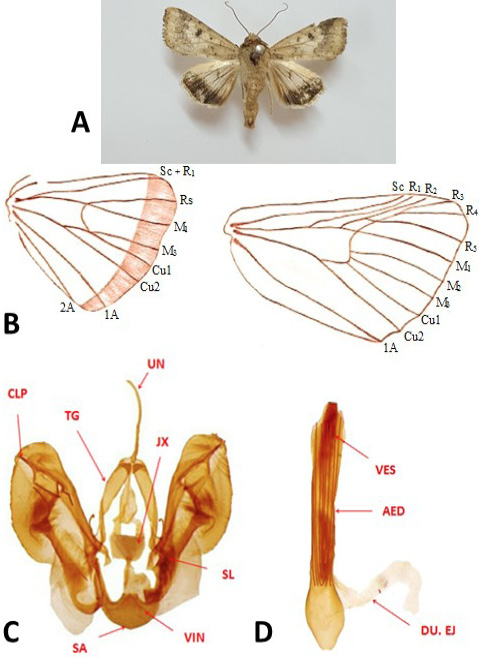
Adult of Spodoptera hirsutus. n.sp. (B) Hind wings, Fore wings. (C) Male genitalia of Spodoptera hirsutus, (D) Adeagus.
References
- Ahmad, M., Arif, M.I. and Ahmad M., 2007. Crop Prot., 26: 809-817.
- Balikai, R.A., Bagali, A.N. and Ryagi, Y.H., 1999. Insect Environ., 5: 32.
- Brambila, J., 2014. Identification methods and resources for Spodoptera litura. Personal communication to L.D. Jackson on January 6, 2014 from J. Brambila (USDA-APHIS-PPQ).
- Brown, E.S. and Dewhurst, C.F., 1975. Bull. entomol. Res., 65: 221–262. https://doi.org/10.1017/S0007485300005939[CrossRef]
- Gueneé, 1852. Histoire Naturelle des Insectes. Species Général des Lépidoptéres. Tome Cinquiéme. Noctuélites. Tome 1 Hist. nat. Ins., Spec. gén. Lépid. 5 (Noct. 1). pp. 407.
- Hampson, G.F., 1894. The Fauna of British India: Moths. Vol. II. Red Lion Court. London.
- Kitching. I.J. and Rawlings, J.E., 1999. The Noctuoidea. In: Lepidoptera, moths and butterflies. Vol. 1. Evolution, systematics and biogeography: Handbook of zoology (ed. N.P., Berlin) Vol. IV. Arthropoda: Insecta. Walter de Gruyter. pp. 355–401.
- Pogue, M.G. and Passoa, S., 2000. Annls entomol. Soc. Am., 93: 1019–1021. https://doi.org/10.1603/0013-8746(2000)093[1019:SOLNAN]2.0.CO;2[CrossRef]
- Pogue, M.G., 2002. Am. entomol. Soc., pp. 1–202.
- Pouge, M.G., 2011. Proc. entomol. Soc. Wash. 113: 497–507. https://doi.org/10.4289/0013-8797.113.4.497[CrossRef]
- Poole, R.W., 1989. Lepidopterorum Catalogus (New Series). Fascicle 118. Noctuidae [in 3 Parts]. E.J. Brill/Flora and Fauna Publications, New York.
- Rishi, K.S. and Khokhar, K.S., 2003. J. entomol. Res., 27: 157–165.
- Robinson, G.S., Ackery, P.R., Kitching, I.J., Beccaloni, G.W. and Hernandez, L.M. 2010. HOSTS– A Database of the World’s Lepidopteran Host plants. Natural History Museum, London. http://www.nhm.ac.uk/host (Accessed on 14 January 2012).
- Ranjith, A.M., Haseena, B. and Nambiar, S.S., 1997. Insect Environ., 3: 44.
- Srivastava, G., 2002. Rec. Zool. Surv. India, pp.11.
- Todd, E.L. and Poole, R.W., 1980a. Proc. entomol. Soc. Wash., 82: 396–400.
- Todd, E.L. and Poole, R.W., 1980b. Ann. entomol. Soc. Am., 73: 722–738. https://doi.org/10.1093/aesa/73.6.722[CrossRef]
- Todd, E.L., Blanchard, A. and Poole, R.W., 1984. Proc. entomol. Soc. Wash., 86: 951–960.
- Waterhouse, D. and Norris, K., 1987. Spodoptera litura (Fabricius). In: Biological control: Pacific prospects. Australian Centre for International Agricultural Research, Canberra. pp. 250–259.
- Zucchi, R.A. and Silveira, N.S., 1984. Taxonomic notes on Spodoptera dolichos (Fabr. 1974) and S. androga (Cramer, 1782) (Lepidoptera; Noctuidae). Resumos. ix. Congnesso Brasileiro de Entomologia Londrina Pr. 22 a 27: 7–84.
Services
Article usage statistics
Loading…