
Armyworm, Spodoptera litura Fabricius (Lepidoptera; Noctuidae) is considered as one of the economically important insect pest in global agriculture. Suitability of host plants is critical for the efficient management of this economically important insect pest. We studied the effect of various host plants on the growth, development and fecundity of S. litura. The larvae of S. litura were offered leaves of cabbage, alfalfa, sesbania and, maize in comparison to artificial diet under laboratory conditions (32±05 oC; 65±05 RH). Thelarval suitability was found maximum on cabbage followed by sesbania, alfalfa and minimum on maize. The larval length and weight were found higher on cabbage followed by alfalfa and sesbania. Similarly, the pupal development was minimum in respect to days on maize than others. The adults lived 11 days more on cabbage compared to other diets. Female life span was found higher than male on all diets provided. Adult emergence rate was high in cabbage (93.11%), followed by alfalfa (87.5%), sesbania (81.33%), and maize (68.44%). Fecundity was higher when fed on leaves of cabbage, alfalfa and sesbania as compared to maize and artificial diet. Number of eggs oviposited were highest on cabbage (2455.5 eggs) followed by alfalfa (1750.0 eggs) and lowest on maize (1055.6 eggs). More egg batches were found on alfalfa and sesbania. All of the biological parameters of S. litura included in the study were affected by the host plants.
Research Article · Volume 51, Issue 6, 14 August 2019 · Open Access
Host Plant Selection Affects Biological Parameters in Armyworm, Spodoptera litura (Lepidoptera: Noctuidae)
· · · ·
Affiliations & Notes ⌄
- 1Department of Entomology, University of Sargodha, 40100, Sargodha , * Corresponding author: muhammad.irfanullah@uos.edu.pk
Article Info ⌄
- Journal:
- Pakistan Journal of Zoology
- Published:
- 14 August 2019

From the article
- The current study results show that larval food directly affects the pupal size and weight and duration as well adult life span on all four host plants.
- Cabbage crop is a potentially good candidate trap crop for oviposition by the S. litura.
- The results of our study will be helpful to determine the population dynamics and preferences for various biological parameters in different host regimes and ultimately will aid in developing the suitable management practices for the control of this notorious pest.
- These findings of this study will be useful in understanding the biology of S. litura that could be utilized in various management protocols including integrated pest management (IPM) .
Selected from the article's own text.
Abstract
INTRODUCTION
Armyworm, also known as common cutworm, Spodoptera litura Fabricius (Lepidoptera: Noctuidae) has achieved the significant position as a destructive insect pest in cotton growing areas of Pakistan ; . It has a wide range of hosts from about 25 genera and 14 families including fodder crops, economically important cash crops, vegetables, weeds, various horticultural and ornamentals plants ; ; ; . This pest has a vigorous migratory ability and is widely distributed throughout the tropical and temperate climatic conditions . This pest cause damage in the form of monstrous patches from one to another host plant, causing inconsiderable economic losses ; . S. litura damage the host plants by feeding leaves, brackets, newly emerged seedlings, tender shoots and fresh seed kernels .
Both species, Spodoptera exigua, Hübner (Lepidoptera: Noctuidae) and S. litura are economically to their high reproductive rate and heavy losses. Due to the absence of common hosts, S. litura may select the grasses for the reproduction and survival. Although it has been a sporadic pest of cotton in Pakistan for many years, it is becoming gradually a very important insect pest of various agricultural crops due Due to the absence of common hosts, S. litura may select the grasses for the reproduction and survival. Although it has been a sporadic pest of cotton in Pakistan for many years, it is becoming gradually a very important insect pest of fodder crops in recent years . The common cultivated fodder crops, mostly affected by the S. litura are corn, Zea maize L. (family: poaceae), alfalfa, Medicago sativa L. (family: fabaceae), barseem, Trifolium alexandrinum L. (family: fabaceae) ; . Alfalfa, being a perennial crop is mostly affected by the S. litura as alternate host ; .
S. litura not only reduce the quality of various crops but also lower the quantity. S. litura damage the immature cobs of maize at milking stage by making galleries . Same trend is observed in cabbage flower due to which fungus develops and stunting in growth occurs . This pest has 1-2 generations on sesbania and completely destroys the plant leaves .
Number of studies have reported S. litura selection of various host plants and mode of damage under different environmental conditions in India ; , Pakistan ; and China ; , 2005; , including other Asian countries. From the last many years, it is reported that this pest has established high immunity against the large groups of pesticides ; ; and also have minute range of susceptibility for the non-conventional growing crops . Due to the resistance, S. litura can survive from the area where application of pesticides carried out .
In this study, we determined the oviposition preferences, development and survival of larval and pupal stages of S. litura on the different host plants (cabbage, alfalfa, sesbania and maize) to determine its host preferences.
MATERIALS AND METHODS
Test insects
Larvae of S. litura were collected from farmer fields from Muzaffargarh (29.5069° N, 70.8536° E) and Sargodha district (32.0740° N, 72.6861° E) and were brought into the laboratory of department of Entomology, University of Sargodha, Sargodha. Artificial diet was prepared from wheat germ based according to the method described by Sorour et al. (2011). The artificial diet contained 90 g of wheat flour, methyle-hydroxy benzoate (2g), streptomycin (0.25g), yeast (10g), vitamin C (2 capsule), wheat flour (90g), ascorbic acid (3g) and sorbic acid (3g). Flour was sterilized for 30 min before using. Diet was provided daily up to the pupation stage for the homogenous and less resistant population. Pupae were collected on the daily basis and kept in separate rearing cage for the adult emergence. Adults were released in separate rearing transparent cages (2x2 ft square) provided with moist cotton and honey solution (9:1%) to feed the adults. Towel paper strips were provided for egg laying. The strips having egg batches were replaced daily and eggs per batch were recorded under the microscope, (OPTIKA-SZM2, Italy). Standard rearing conditions of 27±2°C, 65±05% RH with 16:8 lights to dark ratio were followed ; ; . The F3 generation of reared culture of S. litura was used in this study.
Host plants
Four host plants were used in this study including common name jantar/sesban (Sesbania sesban (L.), lucern/alfalfa (Medicago sativa L.), maize (Zea maize L.) and cabbage (Brassica oleracea L.). These plant species were planted in research area at College of Agriculture, University of Sargodha, Sargodha. No pesticides were applied in the field. Fresh leaves of each host were collected to feed the S. litura. The leaves were first washed with distilled water and then dried at room temperature prior to feeding the larvae.
Development of S. litura
Newly hatched larvae were reared on artificial diet. Second instar larvae were used in the experiment. Larvae were starved for 24 h prior to experimentation. The experimental arena was a petri dish containing 1 larva/plate. There were three replications with 5 larvae in each replication. The data for larval length and weight were recorded daily using measuring scale and digital weight balance. After pupal formation, the pupal weight and length was recorded. Adult emergence ratio was also determined to check the effect of host plant.
Fecundity of S. litura
For each treatment, three pairs of adults were separated and released into clean cages separately. The towel paper was hanged to facilitate the egg laying, number of egg batches and total number of eggs were recorded daily. The honey solution was provided as discussed above.
Statistical analysis
One-way analysis of variance (ANOVA) was performed to test the significance of host plants on the developmental biology, and fecundity of S. litura, by keeping host plant as main factors. Means were separated by Tukey HSD all pairwise comparison test. All the analyses were performed using SPSS 20.0 software.
RESULTS
Overall, larval development was significantly affected by the host plants (P<0.05) and was longest on cabbage (8.86 days) followed by alfalfa (8.00 days) and shortest on maize (7.00 days). Maximum larval length was found on cabbage (3.74 cm), followed by alfalfa (3.54 cm) and minimum on maize (2.93 cm). In case of larval weight, similar trend was found. However, the pupal development was also affected significantly (P<0.05) by hosts. Pupal developmental period was longest on artificial diet (17.00 days), followed by maize (13.66 days) and the shortest on cabbage (9.66 days). Pupal length was also significantly different (P<0.001) by host and was longer 2.05 cm on cabbage, followed by 1.93 cm on artificial diet and shortest 1.34 cm on maize. Pupal weight was significantly different by host and was found heaviest (0.089 g) in cabbage treatment and was the lightest (0.034 g) on maize (Table I).
Table I.- Effect of host plants on larvae and pupal development of Spodoptera litura.
| Larval development | Pupal development | |||||
| Diets | Length (cm) | Weight (g) | Period (No. of days) | Length (cm) | Weight (g) | Period (No. of days) |
| Cabbage | 3.74±0.11a | 0.69±0.03a | 8.86±0.35a | 2.05±0.06a | 0.089±0.01a | 9.66±0.37d |
| Alfalfa | 3.54±0.18ab | 0.61±0.04ab | 8.00±0.37ab | 1.83±0.05b | 0.067±0.00b | 11.26±0.40cd |
| Sesbania | 3.48±0.08ab | 0.54±0.03bc | 7.46±0.32ab | 1.61±0.05bc | 0.065±0.00b | 11.66±0.37c |
| Maize | 2.93±0.24b | 0.42±0.02cd | 7.00±0.39b | 1.34±0.11c | 0.034±0.00c | 13.66±0.49b |
| Artificial | 3.11±0.15ab | 0.33±0.02d | 7.4±0.40b | 1.93±0.42a | 0.036±0.00c | 17.00±0.60a |
| F-value | 3.921 | 23.603 | 3.811 | 15.801 | 526 | 37.703 |
| P-value | <0.05 | <0.001 | <0.05 | <0.001 | <0.05 | <0.05 |
The means±SE in the same column followed by same letters are not significantly different at P > 0.05.
Number of egg masses and total eggs oviposited by S. litura females on host plants differed significantly (egg masses: F = 174.0; df = 4, 74; P < 0.001; total eggs: F = 348.0; df = 4, 74; P < 0.001). S. litura oviposited greater and almost the similar number of egg masses (21-22.6) on alfalfa and sesbania compared to other treatments.
The lowest number of egg masses (9.3) were found on maize. However, the total number of eggs laid by three females were found greater on cabbage (7366.7) followed by 5250.0 on alfalfa and the lowest 2316.0 on artificial diet (Fig. 1).
Adult emergence rate was also significantly affected (F = 28.41 and P > 0.001) by host plants and was maximum on cabbage (93.11%±6.73) followed by alfalfa (87.5%±4.61). While minimum adult emergence percentage 68.44%±2.59 was found on maize (Fig. 2).
There was a significant difference in male (F=26.1 and P>0.00) and female (F=12.1 and P>0.00) adult life span feeding on different host plants. Female adults lived more days compared to male feeding on hosts. However, the adult life span was more; 10±0.29 days for female and 8.80±0.34 days for male followed by alfalfa and sesbania when were fed on cabbage leaves compared to other hosts. The shortest period of both male (4.6±0.31 days) and female (6.6±0.42 days) adults were observed when they fed on maize (Fig. 3). The host suitability was found maximum on cabbage, Alfaalfa and least on artificial diet (Fig. 4).
DISCUSSION
The current study results show that larval food directly affects the pupal size and weight and duration as well adult life span on all four host plants. The results are in line to Xue et al. (2010) and Ahmad et al. (2013), they reported that the food directly affects the larval and pupal developmental period along with length and weight of larvae and pupae. Their findings depicted that during the larval feeding activity, specific storage proteins play an important role in fecundity and metamorphosis of insects. Few work has been reported that focused on the process of protein storage at larval and pupal stages . Our results showed that S. litura preferred the cabbage, lucern (alfalfa) and jantar (sesbania) leaves in comparison to maize and artificial diet, these results supported by Wakil et al. (2011) and Maung (2016). Current study results are in line with Zhu et al. (2000); Chen et al. (2002), Seema et al. (2004) and Courdon et al. (2002) they stated that due to the variation in nutritional values, larval weight and developmental period may differ. Differences in pupal survival, adult sex ratio, longevity, and fecundity may also be affected by temperature and other environmental conditions ; ; .
Similarly, the adult emergence ratio was higher on cabbage leaves than other diets and the adult life span was also higher in this treatment. The results about female longevity and the number of eggs laid is also in accordance to Mabrouk et al. (2001) and El-Awady et al. (2009) who reported that S. litura laid maximum number of eggs feeding on cabbage leaves. Selection of the suitable host plants for feeding help the insects to maintain the population up to several generations and multiplication . The information about the host plants for insect pest development led to the useful implementation for the integrated pest management (IPM) tool ; Saeed et al., 2009; . To understand the insect behavior and for the management tools this basic nutritional ecology can enhance our appreciation of insects’ adaptation to new food resources. The destruction ability of S. litura for host plants represented by the fitness of the pest . The fitness can be determined with the help of pest life table, because life table provides complete and inclusive exposure about the pest developmental stage, reproduction of new progeny and its existence . Integrated pest management program can be established by the life tables as an important ecology-based implementing tool ; . Under the different laboratory circumstances for the life history facts, S. litura was reared on diverse host plant materials reported by Xue et al. (2010) and Shahout et al. (2011). To understand the effect of host plants diversity on the ecosystem of pest is very essential for the population management strategies .
Cabbage crop is a potentially good candidate trap crop for oviposition by the S. litura. However, the effectiveness of trap crops depends on the relative attractiveness of the plant species , the proportion of the field occupied by the trap crop , duration of the trapping effect , insect migratory and host-finding behaviors , and the relative planting times of trap crops. Trap crops at the field edge can prevent the pest from reaching the crop . The use of trap cropping in agriculture is not well established because this approach is more knowledge-intensive than is pesticide use. However, in least developed countries, pesticides can represent an unacceptable extra cost ; and generally lead to many environmental problems.
The results of our study will be helpful to determine the population dynamics and preferences for various biological parameters in different host regimes and ultimately will aid in developing the suitable management practices for the control of this notorious pest.
CONCLUSION
These findings of this study will be useful in understanding the biology of S. litura that could be utilized in various management protocols including integrated pest management (IPM)
ACKNOWLEDGEMENTS
The research work is the part of PhD study of first author and is funded by UOS funded project.
Conflict of interest
The authors declare no conflict of interest.
Figures
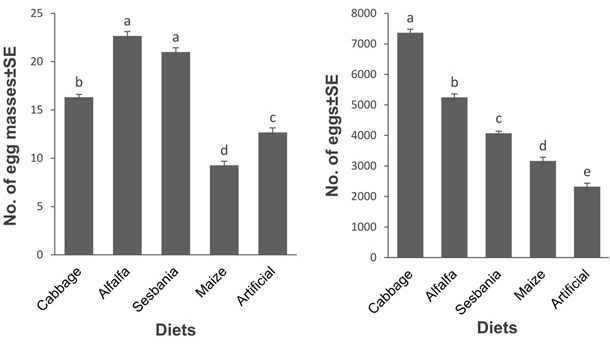
Egg masses and total eggs per three females Spodoptera litura on four host plants in comparison to artificial diet, same letters over the five bars in each figure indicates that the means are not significantly different at P > 0.05.
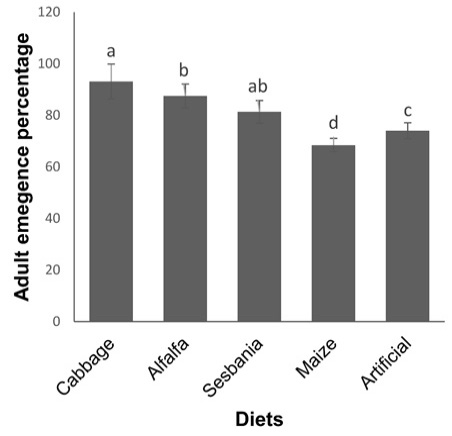
Percentage adult emergence of Spodoptera litura on host plants in comparison to artificial diet, same letters over the bars indicates that the means are not significantly different at P > 0.05.
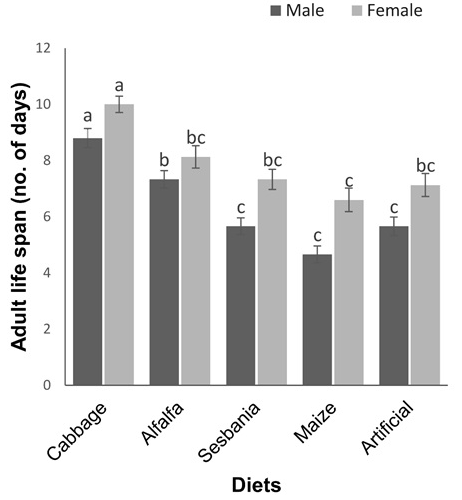
Adult S. litura life span on host plants in comparison to artificial diet, same letters over the bars for each color indicates that the means are not significantly different at P > 0.05.
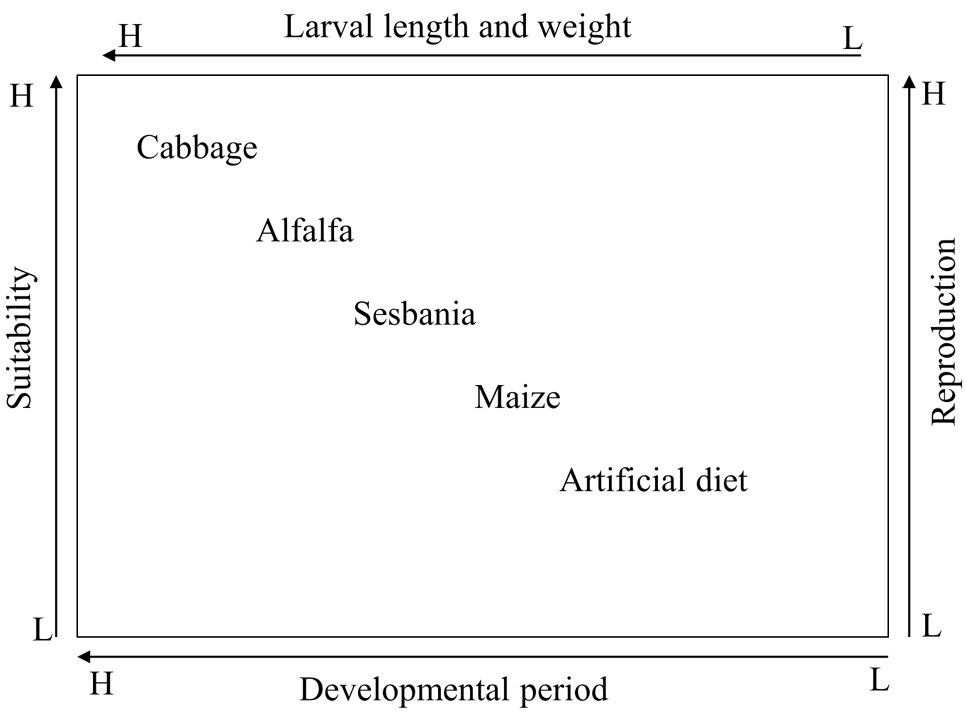
The relationship between fitness indicators of the S. litua and suitability of the host plant→change trend of fitness indicators of S. litura→change trend of host suitability from unsuitable to suitable, L= low and H=high.
References
- Agrell, J., Oleszek, W., Stochmal, A., Olsen, M. and Anderson, P., 2003. Herbivore-induced responses in alfalfa (Medicago sativa). J. chem. Ecol., 29: 303-320. https://doi.org/10.1023/A:1022625810395[CrossRef]
- Ahmad, M. Arif, M.I. and Ahmad, M., 2007. Occurrence of insecticide resistance in field populations of Spodoptera litura (Lepidoptera: Noctuidae) in Pakistan. Crop Protec., 26: 809–817. https://doi.org/10.1016/j.cropro.2006.07.006[CrossRef]
- Ahmad, M., Ghaffar, A., Rafiq, M. and Ali, P.M., 2013. Host plants of leaf worm, Spodoptera litura (Fabricius) (Lepidoptera: noctuidae) in Pakistan. Asian J. Agric. Biol., 1: 23-28.
- Ahmad, M., Sayyed, A.H., Saleem, M.A. and Ahmad, M., 2008. Evidence for field evolved resistance to newer insecticides in Spodoptera litura (Lepidoptera: Noctuidae) from Pakistan. Crop Protec., 27: 1367-1372. https://doi.org/10.1016/j.cropro.2008.05.003[CrossRef]
- Ahmad, J.N., Mushtaq, R., Ahmad, S.J.N., Maqsood, S., Ahuja, I. and Bones, A.M., 2018. Molecular identification and pathological characteristics of NPV Isolated from Spodoptera litura (Fabricius) in Pakistan. Pakistan J. Zool., 50: 2229-2237.
- Arif, M.I., Rafiq, M. and Ghaffar, A., 2009. Host plants of cotton mealybug (Phenacoccus solenopsis): a new menace to cotton agroecosystem of Punjab. Int. J. Agric. Biol., 11: 163-167.
- Badenes-Perez, F.R., Shelton, A.M. and Nault, B.A., 2004. Evaluating trap crops for diamondback moth, Plutella xylostella L. (Lepidoptera: Plutellidae). J. econ. Ent., 97:1365–72. https://doi.org/10.1093/jee/97.4.1365[CrossRef]
- Bhatia, R. and Gupta, D., 2003. Insect and mite pest status of subtropical horticultural crops in Himachal Pradesh. J. Insect Sci., 16: 1-8.
- Banks, J.E. and Ekbom, B., 1999. Modelling herbivore movement and colonization: pest management potential of intercropping and trap cropping. Agric. For. Ent,. 1:165-170. https://doi.org/10.1046/j.1461-9563.1999.00022.x[CrossRef]
- Chaudhry, H.R., Sattar, M.M.K., Ahmad, H. and Shehzad, F., 2017. Fodder production, a module for extension workers. The Islamia University of Bahawalpur, Pakistan. https://www.researchgate.net/publication/321106875_Fodder_Production [accessed Oct 16 2018].
- Chen, Q.J, Yang, J.Q., Zhang, J.Z., Zhang, Y.Z. and Chen, J.H., 2002. Effect of temperature on laboratory population of Spodoptera litura (Fabricius) in tobacco fields. Tobbaco Sci. Technol., 2: 42-45.
- Christou, P., Capell, T., Kohli, A., Gatehouse, J.A. and Gatehouse, A.M., 2006. Recent developments and future prospects in insect pest control in transgenic crops. Trends Pl. Sci., 11: 302-308. https://doi.org/10.1016/j.tplants.2006.04.001[CrossRef]
- Cook, S.M., Khan, Z.R. and Pickett, J.A., 2007. The use of push-pull strategies in integrated pest management. Annu. Rev. Ent., 52: 375-400. https://doi.org/10.1146/annurev.ento.52.110405.091407[CrossRef]
- Courdon, T.A., Wittmeyer, J. and Kim, Y., 2002. Life history and cost analysis for continuous rearing of Podisus maculiventris (Heteroptera: Pentatomidae) on a zoophytophagous artificial diet. J. econ. Ent., 95: 1159-1168. https://doi.org/10.1603/0022-0493-95.6.1159[CrossRef]
- El-Awady, S.M., Ali, F.A.F., Abdel-Sattar, M.M. and Hafez, S.S., 2009. Comparative study for some biological aspects of the Egyptian cotton leafworm Spodoptera littoralis (Boisd.) reared on castor bean leaves and artificial diets. J. agric. Sci. Mansoura Univ., 34(4): 3913-3917.
- Fu, X.W., Zhao, X.Y., Xie, B.T., Ali, A. and Wu, K.M., 2015. Seasonal pattern of Spodoptera litura L. (Lepidoptera: Noctuidae) migration across the Bohai strait in Northern China. J. econ. Ent., 108: 525-538. https://doi.org/10.1093/jee/tov019[CrossRef]
- Ghaffar, A., Attique, M.B., Naveed, M.R. and Jan, M.T., 2002. Host range and population dynamics of beet armyworm, Spodoptera exigua, in cotton agro ecosystem of Punjab, Pakistan. Pakistan J. Zool., 34: 209-213.
- Greenberg, S.M., Sappington, T.W., Legaspi, B.C., Liu, T.X. and Setamou, M., 2001. Feeding and life history of Spodoptera exigua (Lepidoptera: Noctuidae) on different host plants. Annls. ent. Soc. Am., 94: 566-575. https://doi.org/10.1603/0013-8746(2001)094[0566:FALHOS]2.0.CO;2[CrossRef]
- Gupta, G.P., Rani, S., Birah, A. and Raghuraman, M., 2005. Improved artificial diet for mass rearing of the tobacco caterpillar, Spodoptera litura (Lepidoptera: Noctuidae). Int. J. Trop. Insect Sci., 25: 55-58. https://doi.org/10.1079/IJT200551[CrossRef]
- Gurr, G.M., Wratten, S.D., Landis, D.A. and You, M., 2017. Habitat management to suppress pest populations: progress and prospects. Annu. Rev. Ent., 62: 91-109. https://doi.org/10.1146/annurev-ento-031616-035050[CrossRef]
- Jha, R.K., Chi, H. and Tang, L.C., 2012. A Comparison of artificial diet and hybrid sweet corn for the rearing of Helicoverpa armigera (Hubner) (Lepidoptera: Noctuidae) based on life table characteristics. Environ. Ent., 41: 30-39. https://doi.org/10.1603/EN11206[CrossRef]
- Kaur, J., 2012. Development of tobacco caterpillar, Spodoptera litura (Fabricius) (Lepidoptera: Noctuidae) on different cultivars of cabbage. Doctoral dissertation, PAU Ludhiana.
- Kaur, T., Vasudev, A., Sohal, S.K. and Manhas, R.K., 2014. Insecticidal and growth inhibitory potential of Streptomyces hydrogenans DH16 on major pest of India, Spodoptera litura Fab. (Lepidoptera: Noctuidae). BMC Microbiol., 14: 227. https://doi.org/10.1186/s12866-014-0227-1[CrossRef]
- Khan, Z.R., Pickett, J.A., Wadhams, L. and Muyekho, F., 2001. Habitat management strategies for the control of cereal stemborers and striga in maize in Kenya. Insect Sci. Appl., 21:375-80. https://doi.org/10.1017/S1742758400008481[CrossRef]
- Khan, R.R., Ahmed, S. and Nisar, S., 2011. Mortality responses of Spodoptera litura (Fab.) (Lepidoptera: Noctuidae) against some conventional and new chemistry insecticides under laboratory conditions. Pak. Entomol., 33: 147-150.
- Lee, K.P., Raubenheimer, D., Behmer, S.T. and Simpson, S.J., 2003. A correlation between macronutrient balancing and insect host-plant range: evidence from the specialist caterpillar Spodoptera exempta (Walker). J. Insect Physiol., 49: 1161–1171. https://doi.org/10.1016/j.jinsphys.2003.08.013[CrossRef]
- Mabrouk, A., Bekheit, H.K.M. and El-Husseini, M.M., 2001. Economic diet for rearing Spodoptera littoralis (Boisd.), used for the production of the nuclear polyhedrosis virus. Egypt. J. biol. Pest Contr., 11: 127-134.
- Maung, N., 2016. Study of Spodoptera litura larvae parasitoid in cabbage fields, the crucifer pest rearing on natural various foods and explain the knowledge to farmers to apply in fields of Myanmar. Proc. Ninth Agric. Res. Conf., Yezin Agricultural University, Nay Pyi Taw, Myanmar.
- Nathan, S.S. and Kalaivani, K., 2005. Efficacy of nucleopolyhedrovirus and azadirachtin on Spodoptera litura Fabricius (Lepidoptera: Noctuidae). Biol. Contr., 34: 93-98. https://doi.org/10.1016/j.biocontrol.2005.03.001[CrossRef]
- Naz, F., Hussain, M. and Faridullah, Din, M., 2003. Insect pests of maize and their losses. Asian J. Pl. Sci., 2: 412-414. https://doi.org/10.3923/ajps.2003.412.414[CrossRef]
- Qin, H. G,, Zx, Y.E., Huang, S.J., Ding, J. and Luo, R.H., 2004. The correlations of the different host plants with preference level, life duration and survival rate of Spodoptera litura Fabricius. Chinese J. Eco-Agric., 12: 40-42.
- Raubenheimer, D. and Simpson, S.J., 2003. Nutrient balancing in grasshoppers: behavioural and physiological correlates of diet breadth. J. exp. Biol., 206: 1669- 1681. https://doi.org/10.1242/jeb.00336[CrossRef]
- Rea, J.H., Wratten, S.D., Sedcole, R., Cameron, P.J., Davis, S.I. and Chapman, R.B., 2002. Trap cropping to manage green vegetable bug Nezara viridula (L.) (Heteroptera: Pentatomidae) in sweet corn in New Zealand. Agric. Ent., 4: 101-107. https://doi.org/10.1046/j.1461-9563.2002.00130.x[CrossRef]
- Rezapanah, M., Shojai-Estrabragh, S., Jehle, J.A. and Huber, J., 2008. Molecular and biological characterization of new isolates of Cydia pomonella granulovirus (CpGV) from Iran for controlling S. litura. J. Pest Sci., 1: 187–191. https://doi.org/10.1007/s10340-008-0204-2[CrossRef]
- Saeed, S., Sayyed, A.H. and Ahmad, I., 2010. Effect of host plants on life-history traits of Spodoptera exigua (Lepidoptera: Noctuidae). J. Pest Sci., 83: 165-172. https://doi.org/10.1007/s10340-009-0283-8[CrossRef]
- Saleem, M.A., Ahmad, M. and Sayyed, A.H., 2008. Evidence for field evolved resistance to newer insecticides in Spodoptera litura (Lepidoptera: Noctuidae) from Pakistan. Crop Prot., 27:1367-1372. https://doi.org/10.1016/j.cropro.2008.05.003[CrossRef]
- Sang, S., Wang, Z., Qi, J.W., Shu, B.S. and Zhong, G.H., 2013. Research progress on pesticide resistance of Spodoptera litura. J. environ. Ent., 35: 808-814.
- Seema, R., Goel, B.B. and Gupta, G.P., 2004. Effects of temperature on the development and reproduction of Spodoptera litura. Annls. Pl. Prot. Sci., 12: 205-206.
- Shahout, H., Xu, J., Yao, X. and Jia, Q., 2011. Influence and mechanism of different host plants on the growth, development and, fecundity of reproductive system of common cutworm Spodoptera litura (Fabricius) (Lepidoptera: Noctuidae). Asian J. agric. Sci., 3: 291-300.
- Shelton, A.M. and Badenes-Perez, F.R., 2006. Concepts and applications of trap cropping in pest management. Annu. Rev. Ent., 51: 285-308. https://doi.org/10.1146/annurev.ento.51.110104.150959[CrossRef]
- Simpson, S.J., Raubenheimer, D., Behmer, S.T., Whitworth, A. and Wright, G.A., 2002. A comparison of nutritional regulation in solitarious and gregarious phase nymphs of the desert locust, Schistocerca gregaria. J. exp. Biol., 205: 121-129.
- Sorour, M.A., Khamiss, O., Abdel-Wahab, A.S., El-Sheikh, M.A.K. and Abul-Ela, S., 2011. An economically modified semi-synthetic diet for mass rearing the Egyptian cotton leaf worm Spodoptera littolaris. Acad. J. Ent., 4: 118-123.
- Telang, A., Buck, N.A. and Wheeler, D.E., 2002. Response of storage protein levels to variation in dietary protein levels. J. Insect Physiol., 48: 1021-1029. https://doi.org/10.1016/S0022-1910(02)00190-7[CrossRef]
- Tenywa, M.M., Nyamwaro, S.O., Kalibwani, R., Mogabo, J., Buruchara, R. and Fatunbi, A.O., 2018. Innovation opportunities in sorghum production in Uganda. FARA Res. Rep., 2:16-20.
- Tuan, S.J., Lee, C.C. and Chi, H., 2014. Population and damage projection of Spodoptera litura (F.) on peanuts (Arachis hypogaea L.) under different conditions using the age-stage, two-sex life table. Pest Manage. Sci., 70: 805-813. https://doi.org/10.1002/ps.3618[CrossRef]
- Tuan, S.J., Yeh, C.C., Atlihan, R., Chi, H. and Tang, L.C., 2015. Demography and consumption of Spodoptera litura (Lepidoptera: Noctuidae) reared on cabbage and taro. J. econ. Ent., 109: 732-739. https://doi.org/10.1093/jee/tov325[CrossRef]
- Wakil, W., Ghazanfar, M.U., Sahi, S.T., Kwon, Y.J. and Qayyum, M.A., 2011. Effect of modified meridic diet on the development and growth of tomato fruitworm, Helicoverpa armigera (Lepidoptera: Noctuidae). Ent. Res., 41: 88-94. https://doi.org/10.1111/j.1748-5967.2011.00323.x[CrossRef]
- Wan, P., Wu, K.M., Huang, M.S., Yu, D.Z. and Wu, J.P., 2008. Population dynamics of Spodoptera litura (Lepidoptera: Noctuidae) on Bt cotton in the Yangtze River Valley of China. Environ. Ent., 37: 1043-1048. https://doi.org/10.1093/ee/37.4.1043[CrossRef]
- Xue, M., Pang, Y.H., Wang, H.T., Li, Q.L. and Liu, T.X., 2010. Effects of four host plants on biology and food utilization of the cutworm, Spodoptera litura. J. Insect Sci., 10: 14-22. https://doi.org/10.1673/031.010.2201[CrossRef]
- Yinghua, S., Yan, D., Jin, C., Jiaxi, W. and Jianwu, W., 2017. Responses of the cutworm Spodoptera litura (Lepidoptera: Noctuidae) to two Bt corn hybrids expressing Cry1Ab. Sci. Rep., 7: 41577. https://doi.org/10.1038/srep41577[CrossRef]
- Zhang, G.F., Wan, F.H., Liu, W.X. and Guo, J.Y., 2006. Early instar response to plant-delivered Bt-toxin in a herbivore (Spodoptera litura) and a predator (Propylaea japonica). Crop Prot., 25: 527-533. https://doi.org/10.1016/j.cropro.2005.08.008[CrossRef]
- Zhu, J.H, Zhang, F.P. and Ren, H.G., 2005. Development and nutrition of Prodenia litura on four food plants. Chinese Bull. Ent., 42: 643-646.
- Zhu, S.D., Lu, Z.Q., Chen, L.F. Yu, W. and Zhang, S.J., 2000. Effect of temperature and food on Spodoptera litura population. Chinese J. appl. Ecol., 11: 111-114.
Cited by 3 articles
In journals published by ResearchersLinks.
- Laboratory Evaluation of Selected Biorational Insecticidal Formulations against Potato Leafworm Spodoptera litura Fabricius (Lepidoptera: Noctuidae)Pakistan Journal of Zoology · 2024
- In-Vitro Pathogenicity of Entomopathogenic Nematodes Associated Symbiotic Bacteria and their Metabolites against Armyworm Spodoptera litura FabriciusSarhad Journal of Agriculture · 2023
- Effect of Emamectin Benzoate with Leaf Extracts of Parthenium hysterophorus and Moringa oleifera on the Digestibility and Survival Indices of Spodoptera litura (Lepidoptera: Noctuidae)Sarhad Journal of Agriculture · 2021
Services
Article usage statistics
Loading…