
The alopecia of Chinese Merino sheep (ACMS) has a direct impact on the economic value of fine wool. It is generally considered to be caused by both genetic and environmental factors. We aimed to identify single nucleotide polymorphisms (SNPs) and genomic regions that are associated with ACMS in the Chinese Merino sheep population. To identify the genetic risk factors of alopecia in Chinese Merino sheep population, we carried out a genome-wide association study (GWAS). The 60 Chinese Merino sheep alopecia cases and the 190 Chinese Merino sheep controls were from the same livestock farm. DNA was extracted from ear tissue using the saturated phenol-chloroform method. The DNA was genotyped using the Illumina Ovine SNP50 Bead Chip. After quality control, we detected 4,8335 SNPs, which included four SNPs that are significantly associated with the ACMS of sheep. We identified four quantitative trait loci (QTL) regions for ACMS. These QTLs on Ovis aries (OAR) 2 and OAR26. We observe genome-wide significant association with ACMS at four genomic loci: OAR2_130068033.1, OAR2_216769207.1, OAR2_128282778.1 and OAR26_29848682.1. After gene a notation, we found five candidate genes associated with ACMS, including CTL4A and ITGAV. These candidate genes are involved in derma cell differentiation, diet-induced obesity, and nervous system development. The genomic regions identified in this study provided a start-up point for contribute to similar studies and can facilitate the potential utilization of genes involved in etiology of Chinese Merino sheep alopecia in the future.
Research Article · Volume 56, Issue 1, 5 December 2023 · Open Access
Genome-Wide Association Study on Chinese Merino Sheep Alopecia
· · ·
Affiliations & Notes ⌄
- 1College of Animal Science, Tarim University, Alar, Xinjiang, China 2Key Laboratory of Tarim Animal Husbandry Science and Technology, Xinjiang Production and Construction Corps, Alar, Xinjiang, China * Corresponding author: cgygood2007@163.com
Article Info ⌄
- Journal:
- Pakistan Journal of Zoology
- Published:
- 5 December 2023

From the article
- This study describes the discovery of an ovine gene that was associated with alopecia in the Chinese Merino sheep.
- At last, we found six significant haplotypes and 13 genes that were significantly associated with ACMS.
Selected from the article's own text.
Abstract
INTRODUCTION
Alopecia of Chinese Merino sheep (ACMS) is a common skin disease that occurs in the hair follicle and epithelial cells. As a complex disease, ACMS is associated with many genetic and environmental factors, such as genetic variants, sexual activity, and eating habits. Many researchers have shown that alopecia has a high family hereditary, and women will carry the alopecia-risk gene and propagate to the offspring in human. Although the genetic variant played an important role in the alopecia, the exact genetic determinates remain hitherto elusive. How to identify alopecia susceptibility genes is still a challenge in sheep.
ACMS environmental factors including infectious and nutrition alopecia. An observable effect of infectious alopecia is the hairlessness and lack of hair in the sick parts of the skin. The skin of the parasitic alopecia is usually itchy, papula, blistered and pustular crusted of phenomenon in the winter and autumn ; . Parasites were found in a place between diseased and healthy hair . Nutrition alopecia happened a large sheep group, but genomes of ACMS are not common in scientific research.
Sheep alopecia and gene related have been proposed as hypothesis in the early 1974 . Later scientists observed genes associated with alopeciain dogs , horses ; , cattle ; Valentine et al., 2012) and human beings .
Genome-wide association study (GWAS) is a new approach that focuses on the relationship between phenotypic data and genomes. Since 2005, science magazines reported the first GWAS article about macular degeneration. In addition, disease analysis by GWAS was reported in succession in human beings . With high-density chip of dogs , chickens , horses and cattle development, many researchers carried out GWAS for economic concerns and genetic deficiency diseases of animal. Nevertheless, no GWAS for ACMS were performed.
There are many reasons for depilation, which are mainly determined by environmental factors and genetic factors. Through our team’s observation, we found that the offspring of these 60 sheep have the phenomenon of depilation. The Chinese Merino sheep raised in the same environment did not depilate. These individuals had these common traits: their body temperature and pulse of diseased sheep were normal, hair were rough and dull color, which was a sign that the alopecia was eat hairs away. Alopecia was found on the back, legs, and tail of the disease sheep and in some cases, their whole body. After depilation, the exposed skin becomes soft without swelling and fever. We are designing a 50k chip aim to discover etiology of Chinese Merino sheep alopecia on genomic.
MATERIALS AND METHODS
Ethics statement
All experimental animals were managed according to the guidelines approved by the Institutional Animal Care and Use Committee of Tarim University.
Sampling, genotyping and data quality control
A total of 250 female Chinese Merino sheep including the 60 Chinese Merino sheep alopecia cases and the 190 Chinese Merino sheep controls were randomly selected. All sheep were born between 2006 and 2016 in Bohu or kuketubai (Xinjiang, China).
DNA was extracted from ear tissue using the saturated phenol-chloroform method. DNA samples were submitted for genotyping with a 260/280 absorbance ratio of ≥1.8 and a DNA concentration of ≥50 ng/µl. The DNA was genotyped using the Illumina Ovine SNP50 BeadChip, which contained 54,241 SNPs with an average probe distance of 50.9 kb. Following quality control, SNPs were excluded if they had a missing call rate of >5%, a minor allele frequency (MAF) of <0.05, or a P-value for the Hardy–Weinberg equilibrium test of <1×10⁻⁶.
Statistical analyses
Single marker association analyses were conducted using a Fisher’s exact test and a Bonferroni correction has been applied to check for significance levels. The chromosome-wide and genome-wide values analyses were conducted using a Bonferroni correction. The P-values were evaluated according to an adjusted significant threshold generated by dividing the 0.05 threshold by the total number of tests (number of SNPs considered) performed in each case (whole genome or whole chromosome). Statistical analyses were done using the plink 1.07 software . Visualization of association data in Manhattan and Quantile-Quantile (Q-Q) plots were performed using the ggplot package in R software.
Linkage disequilibrium analysis
The LD measurement adopted in this study was, which was the correlation coefficient between SNP pairs, and was calculated according to the following equation:
D′=pij -Pj×Pij
where pij is the frequency of the two-marker haplotype, and p, and p are the marginal allelic frequencies in the ith and jth SNP, respectively . The haplotype blocks were identified the Four Gamete Rule using haploview .
Study of genes and QTLs in the candidate regions
We used the latest sheep genome Ovis_aries_v4.0 (http://www.livestockgenomics.csiro.au/sheep/Oar_v4.0.php,permanent), UCSC Genome Bioinformatics (http://genome.ucsc.edu, permanent.) and National Center for Biotech-nology Information (NCBI) (http://www.ncbi.nlm.nih.gov/, permanent.) for identifying relationship between significant SNPs and human genes. A BLAST search was also performed using the human UCSC Genome Browser to assess genes already mapped to the human genome. QTL database (http://www.animalgenome.org/QTLdb/cattle.html) was used for detection of QTL in the candidate regions.
RESULTS
SNP statistics
After quality control, we identified 48335 SNPs in Chinese Merino sheep distributed over 27 chromosomes. SNPs information for each chromosome is listed in Table I. The total chromosome length was 2,650.80 Mb, with an average chromosome length of 101.95 Mb; the longest Ovis aries autosomal chromosome was OAR1 (299.637 Mb) and the shortest was OAR24 (44.851 Mb). The average distance between adjacent SNPs was 0.058 Mb; the longest adjacent SNP interval was 3.419 Mb in OAR10 and the shortest interval was observed in OAR14.
Chromosome-wise significant associations
Two SNPs showed significant association with the studied ACMS at the 5% chromosome-wise level. These chromosomes were OAR2 and OAR26. A summary of the significant SNPs associated with the studied Chinese Merino sheep alopecia is shown on table 2. A Manhattan plot showing P-values arranged by chromosome position are shown in Figure 1. A series of Quantile-Quantile (Q-Q) plots showing observed versus expected P-value distributions are shown in Figure 2.
LD block analysis
Thirteen SNPs existed near OAR2_128282778.1with each other through a linkagestatus. 12 SNPs and OAR2_128282778.1was calculated with =1 in a state of complete linkage. OAR2_128232653.1 and OAR2_128282778.1was calculated =0.84 in linkage status (Fig. 3). 4 haplotype blocks exist near OAR2_128282778.1. They are haplotype block AGG (OAR2_128232653.1, OAR2_128282778.1, OAR2_128324363.1), haplotype block GA (OAR2_128341984.1, OAR2_128382703.1), haplotype block AG (s04552.1, OAR2_128589677.1) and haplotype block GGA (OAR2_128734630.1, OAR2_128764057.1, OAR2_128772350.1) on chromosome 2 (Fig. 3).
Table I. Distributions of SNPs before and after quality control, and the average distances between adjacent SNPs on each chromosome.
| Chromosome | No. SNPs | Length of chromosome (bp) | Average distance (kb) | ||
| Before QC | After QC | Before QC | After QC a | ||
| 1 | 5930 | 5277 | 299636549 | 50.53 | 56.78 |
| 2 | 5474 | 4958 | 263108520 | 48.07 | 53.07 |
| 3 | 5008 | 4496 | 242770439 | 48.48 | 54.00 |
| 4 | 2680 | 2420 | 127201684 | 47.46 | 52.56 |
| 5 | 2363 | 2144 | 116996412 | 49.51 | 54.57 |
| 6 | 2592 | 2330 | 129053557 | 49.79 | 55.38 |
| 7 | 2252 | 2000 | 21017866 | 9.33 | 10.51 |
| 8 | 2057 | 1865 | 97906876 | 47.60 | 52.50 |
| 9 | 2141 | 1927 | 100790876 | 47.08 | 52.31 |
| 10 | 1851 | 1657 | 94127923 | 50.85 | 56.81 |
| 11 | 1180 | 1073 | 66878309 | 56.68 | 62.33 |
| 12 | 1723 | 1540 | 86402045 | 50.15 | 56.11 |
| 13 | 1696 | 1538 | 89063022 | 52.51 | 57.91 |
| 14 | 1174 | 1044 | 69302979 | 59.03 | 66.38 |
| 15 | 1694 | 1503 | 90027688 | 53.15 | 59.89 |
| 16 | 1580 | 1409 | 77179534 | 48.85 | 54.78 |
| 17 | 1420 | 1265 | 78614401 | 55.36 | 62.15 |
| 18 | 1413 | 1274 | 72480257 | 51.30 | 56.89 |
| 19 | 1248 | 1128 | 64803054 | 51.93 | 57.45 |
| 20 | 1148 | 1006 | 55563675 | 48.40 | 55.23 |
| 21 | 898 | 797 | 55476369 | 61.78 | 69.61 |
| 22 | 1097 | 980 | 55746998 | 50.82 | 56.88 |
| 23 | 1128 | 1020 | 66685354 | 59.12 | 65.38 |
| 24 | 741 | 665 | 44850918 | 60.53 | 67.44 |
| 25 | 1002 | 907 | 48288072 | 48.19 | 53.23 |
| 26 | 923 | 823 | 50043613 | 54.22 | 60.81 |
| X | 1450 | 1309 | 129095549 | 89.03 | 98.62 |
a, Derived from the latest sheep genome sequence assembly (Ovis_aries_v4.0).
COL3A1 gene is located in upstream 628561 of haplotype block AGG. ITGAV is located in downstream 1134125 of haplotype block GGA.
Table II. Chromosome-wise significant SNPs (2.06E-07<P<1.03E-06) associated with alopecia.
| Genome-wise adjusted P value | Chr. | SNP | Position v1.0 (bp) | Position V4.1(bp) | Nearest gene |
| Name | |||||
| 2.97E-07 | 2 | OAR2_130068033.1 | 130068033 | 121646864 | ITGAV |
| 4.17E-07 | 2 | OAR2_128282778.1 | 128282778 | 119941209 | PPIN |
| 6.74E-07 | 2 | OAR2_216769207.1 | 216769207 | 204770220 | CTLA4 |
| 6.97E-07 | 26 | OAR26_29848682.1 | 29848682 | 25763270 | TEX15, PURG |
Seven SNPs exist near OAR26_29848682.1with each otherin linkage. Six SNPs and OAR26_29848682.1 was calculated = 1 in a state of complete linkage. OAR26_29996287.1 and OAR26_29848682.1 was calculated = 0.8 in linkage status (Fig. 4). 2 haplotype blocks exist near OAR26_29848682.1. They are haplotype block AGC (s26069.1, OAR26_29759746.1, OAR26_29848682.1), haplotype block GA (OAR26_30036643.1, OAR26_30128507.1) on chromosome 26 (Fig. 4). GTF2E2 gene is located in haplotype block AGC.
Candidate genes
Through GWAS and LD analysis identified 22 SNPs, of which 14 SNPs are localed on OAR2. These SNPs are located near seven genes, of which have COL3A1 (collagen, type III, alpha 1), GULP1 (GULP, Engulfment Adaptor PTB Domain Containing 1), PPIH [peptidylprolyl isomerase H (cyclophilin H)], CALCRL (calcitonin receptor-like) , ZSWIM2 (zinc finger, SWIM-type containing 2), FAM171B (family with sequence similarity 171, member B) and ITGAV (integrin, alpha V).
Eight SNPs are localed on OAR26. These SNPs are located near six genes, of which have GTF2E2 (general transcription factor IIE, polypeptide 2), GSR (Glutathione Reductase), UBXN8 (UBX domain protein 8), ANP32A [Acidic (Leucine-Rich) Nuclear Phosphoprotein 32 Family, Member A], TEX15 (testis expressed 15), PURG (purine-rich element binding protein G).
DISCUSSION
Sheep population and GWAS
As we all know, complex diseases are caused by a variety of factors, such as genetic factors, environmental factors, and so on. ACMS is also a complex disease, and the genetic factors play an important role in the development of ACMS. However, the identification of genetic risk factors related to ACMS is still a challenge. After quality control, we identified 48335 SNPs in Chinese Merino sheep distributed over 27chromosomes. Here, we carried out a genome-wide association study to identify the ACMS-related QTL. Four SNPs showed significant association with the studied ACMS at the 5% chromosome-wise level. These chromosomes were OAR2 (OAR2_130068033.1, OAR2_216769207.1, OAR2_128282778.1) and OAR26 (OAR26_29848682.1).
OAR2_128282778.1 is located within the 1700kb interval using LD, are COL3A1, GULP1, PPIH, CALCRL, ZSWIM2, FAM171B and ITGAV. Fortunately, the strongest new finding is COL3A1 and ITGAV, which ware genes of hair loss in mice or pigs. COL3A1 had more than 50 mutations, which increased risk for bowel, arterial, and uterine rupture in addition to the diagnostic skin findings . This gene is located upstream in 677686 of OAR2_128282778.1, which increased expression in ultraviolet ir- radiated hairless mice and were all increased in alopecia areata mouse atria ; . ITGAV is a member of the integrin superfamily and may regulate angiogenesis and cancer progression . This gene is located downstream in 1623697 of OAR2_128282778.1, which evaluated as candidate gene for the hairlessness in pig .
In our study, the OAR 26 (OAR26_29848682.1) that is identified within the 700kb interval using LD, are GTF2E2, GSR, UBXN8, ANP32A, TEX15and PURG. Fortunately, the strongest new finding was GTF2E2, which is the gene of WRN (Werner syndrome). This gene implicated in the pathogenesis of colorectal carcinoma and prostate cancer . It is located downstream in 314036 of OAR26_29848682.1, which has previously been considered potential candidates for WRN (Werner syndrome) that was a pleiotropic segmental progeroid phenotype: canities, alopecia and so on ; .
Candidate genes
A summary of the significant SNPs associated with the studied Chinese Merino sheep alopecia is shown on Table I A Manhattan plot showing P-values arranged by chromosome position are shown in Figure 1. A series of Quantile-Quantile (Q-Q) plots showing observed versus expected P-value distributions are shown in Figure 2.
We found that OAR2_216769207.1 is located on the intron of the CTLA4 (cytotoxic T lymphocyte-associated antigen 4, CTLA4), which is a costimulator of T lymphocyte activation and expression. CTLA4 is located in OAR2, with a length of 7050 bp and a range of 219988799 to 219995848 bp by shotgun sequencing. CTLA4 is a leukocyte differentiation antigen and a transmembrane receptor on T cells. CTL4A binds to B7 on antigen-delivering cells, reduces the expression of interleukin-2 and its receptor, and makes T cells stagnate in G1 phase, thereby inhibiting the proliferation of T lymphocytes . This will cause around the hair follicle to be surrounded by immune infiltrates, and cause alopecia.
OAR2_130068033.1 is located on the intron of the ITGAV, which is located in OAR2, with a length of 106228 bp and a range of 132780099 to132886326 bp by shotgun sequencing. This gene encodes a protein that is a member of the integrin superfamily. Integrins are transmembrane receptors involved cell adhesion and signaling, and they are subdivided based on the heterodimer formation of alpha and beta chains. Among them, after the intervention of ITGAV, the secretion level of TGF-B1 in the co-culture system decreased, and the expression of P-Smad2 decreased. This indicates that during the process of stem cell tumorigenesis, ITGAV can mediate the activation of TGF-B1 signal, which is tumorigenic. Key molecule that can cause skin tumors . ITGAV gene is highly expressed in pigs with hair loss .
PPIH gene was found neighboring the OAR2_128282778.1 on the OAR2. TEX15 and PURG genes were found neighboring the OAR26_29848682.1 on OAR26. These three genes (PPIH, TEX15 and PURG) are novel susceptibility candidate genes that have not been reported in association with Alopecia.
CONCLUSION
In livestock species, GWAS have become a powerful strategy to identify DNA sequence variants affecting phenotypic variation. This study describes the discovery of an ovine gene that was associated with alopecia in the Chinese Merino sheep. At last, we found six significant haplotypes and 13 genes that were significantly associated with ACMS. In theory, ACMS is a complex trait, and it may be affected by many genes. Therefore, more genes will likely be found and verified with development of additional genomic approaches and experimental technologies.
ACKNOWLEDGEMENTS
This study was funded by grants form National Natural Science Foundation of China (32060743); Bintuan Science and Technology Program (2022CB001-09), Xinjiang Production and Construction Group (HS201903,HS202008), President Fund of Tarim University (TDZKBS201903), South Innovation Team for Efficient Utilization of High Quality Sheep Germplasm Resources around Tarim (2019CB010) .
IRB approval
All the information required for this study was provided by the Animal Ethics Committee, College of Animal Science and Technology, Tarim University, Xinjiang, China (PJZ120180007).
Ethical statement
In this study, our laboratory animals follow the three R’s. 3R refers to Replacement, Reduction, and Refinement.Replacement: Mainly a way to avoid using animals. Reduction: During the use of animal experiments, the number should be reduced as much as possible to reduce animal pain, etc. Refinement: Use breeding methods and refinement procedures to reduce inhumane procedures. Avoid causing pain and nervousness unrelated to the subject of the experiment.
Statement of conflict of interest
The authors have declared no conflict of interest.
Figures
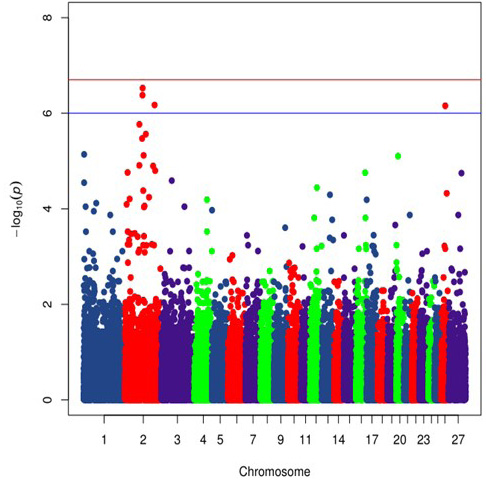
Manhattan plot of Chinese Merino sheep alopecia. The Manhattan plot shows nominal P-values from association with Merino sheep alopecia by chromosomal position. The top red line shows a genome-wide significance threshold defined by nominal P-values of 2.06x 10⁻⁷, which is P= 0.01/48335. The lower blue line shows a genome-wide suggestive significance threshold defined by nominal P-values of 1.03x 10⁻⁶, which is P= 0.05/48335.
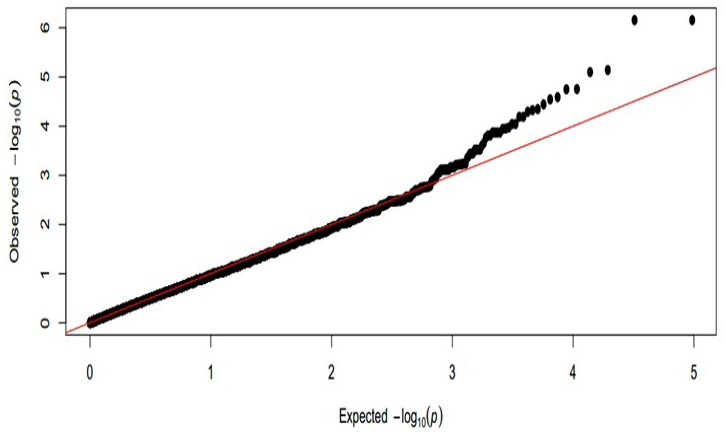
Quantile-Quantile plot of Chinese Merino sheep alopecia. Quantile-quantile plots from association with Merino sheep alopecia, where the red line shows the expected distribution. Comparison of p-value distributions when all the 48335 analyzed Illumina SNPs were included. The expected –log 10 (p) is on the x-axis and the observed –log 10 (p) is on the y-axis.
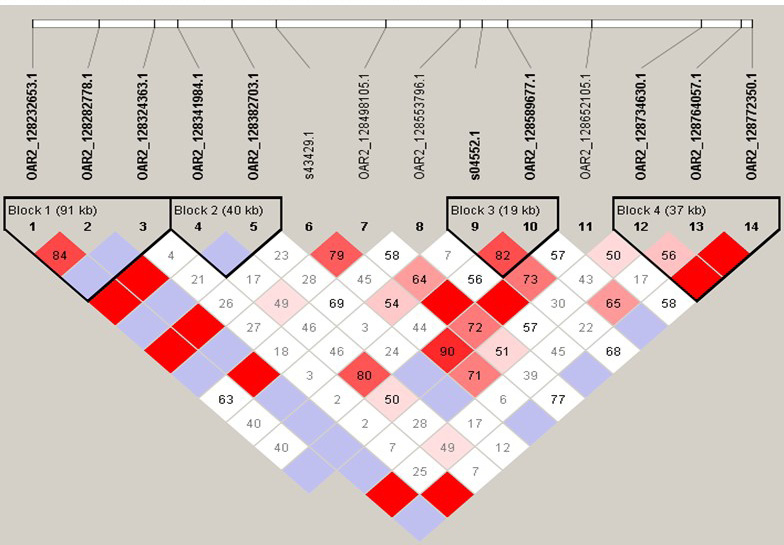
Linkage disequilibrium of the OAR2_128282778.1 surrounding 5.4 Mb, which have 4 haplotype blocks. SNP pairs are coloured according to the standard Haploview colour scheme: D = 1, red; D’<1, other colours. LOD>2 and D’ = 1, red; LOD>2 and D’ <1, shades of pink/red; LOD <2 and D’ = 1, blue; LOD <2 and D’<1, white (LOD is the log of the likelihood odds ratio, a measure of confidence in the value of D’).
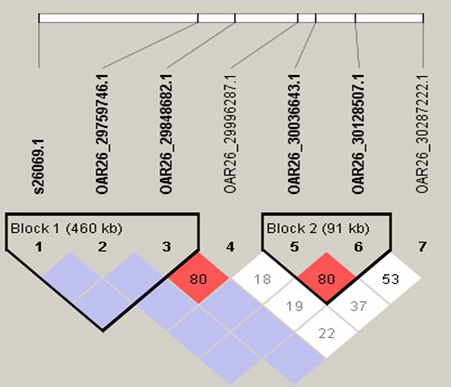
Linkage disequilibrium of the OAR2_128282778.1 surrounding 5.4 Mb, which have 4 haplotype blocks. SNP pairs are coloured according to the standard Haploview colour scheme: D = 1, red; D’<1, other colours. LOD>2 and D’ = 1, red; LOD>2 and D’ <1, shades of pink/red; LOD <2 and D’ = 1, blue; LOD <2 and D’<1, white (LOD is the log of the likelihood odds ratio, a measure of confidence in the value of D’).
References
- Barrett, J.C., Fry, B., Maller, J. and Daly, M.J., 2005. Haploview: Analysis and visualization of LD and haplotype maps. Bioinformatics, 21: 263-265. https://doi.org/10.1093/bioinformatics/bth457[CrossRef]
- Bell, A.F., 2008. Alopecia mucinosa (follicular mucinosis) in a dog. Vet. Dermatol., 6: 221-226. https://doi.org/10.1111/j.1365-3164.1995.tb00068.x[CrossRef]
- Bruskiewich, R., Schertzer, M. and Wood, S., 1997. A 2.8 mega base YAC contig spanning D8S339, which is tightly linked to the Werner syndrome locus. Genome, 40: 77-83. https://doi.org/10.1139/g97-010[CrossRef]
- Bruun, C.S., Jorgensen, C.B., Bay, L., Cirera, S., Jensen, H.E., Leifsson, P.S., Nielsen, J., Christensen, K. and Fredholm, M., 2008. Phenotypic and genetic characterization of a novel phenotype in pigs characterized by juvenile hairlessness and age dependent emphysema. BMC Genomics, 12: 283. https://doi.org/10.1186/1471-2164-9-283[CrossRef]
- Buergelt, C.D., Hall, C., McEntee, K. and Duncan, J.R., 1978. Pathological evaluation of paratuberculosis in naturally infected cattle. Vet. Pathol., l15: 196-207. https://doi.org/10.1177/030098587801500206[CrossRef]
- Chanie, M., Negash, T. and Sirak, A., 2010. Ectoparasites are the major causes of various types of skin lesions in small ruminants in Ethiopia. Trop. Anim. Hlth. Prod., 42: 1103-1109. https://doi.org/10.1007/s11250-010-9531-4[CrossRef]
- Chen, C.Y., Hutzen, B., Wedekind, M.F., Cripe, T.P. and Chen, C.Y., 2018. Oncolytic virus and PD-1 / PD-L1 blockade combination therapy. Oncolytic Virother., 7: 65-77. https://doi.org/10.2147/OV.S145532[CrossRef]
- Consortium, T.I.H., 2005. A haplotype map of the human genome. Nature, 437: 1299-1320. https://doi.org/10.1038/nature04226[CrossRef]
- Correa, T.G., Ferreira, J.M., Riet-Correa, G., Ruas, J.L., Schild, A.L., Riet-Correa, F., Guimaraes, A. and Felippe-Bauer, M.L., 2007. Seasonal allergic dermatitis in sheep in southern Brazil caused by Culicoides insignis (Diptera: Ceratopogonidae). Vet. Parasitol., 145: 181-185. https://doi.org/10.1016/j.vetpar.2006.10.025[CrossRef]
- Daly, M.J., Rioux, J.D., Schaffner, S.F., Hudson, T.J., and Lander, E.S., 2001. High-resolution haplotype structure in the human genome. Nat. Genet., 29: 229-232. https://doi.org/10.1038/ng1001-229[CrossRef]
- Desgrosellier, J.S. and Cheresh, D.A., 2010. Integrins in cancer: Biological implications and therapeutic opportunities. Nat. Rev. Cancer, 10: 9-22. https://doi.org/10.1038/nrc2748[CrossRef]
- Feil, V.J. and Lamoureux, C.H., 1974. Alopecia Activity of cyclophosphamide metabolites and related compounds in sheep. Cancer Res., 34: 2596-2598.
- Fthenakis, G.C, Karagiannidis, A., Alexopoulos, C., Brozos, C. and Papadopoulos, E., 2001. Effects of sarcoptic mange on there productive performance of ewes and transmission of Sarcoptes scabiei to newborn lambs. Vet. Parasitol., 95: 63-71. https://doi.org/10.1016/S0304-4017(00)00417-9[CrossRef]
- Groenen, M.A., Megens, H.J., Zare, Y., Warren, W.C., Hillier, L.W., Crooijmans, R.P., Vereijken, A., Okimoto, R., Muir, W.M. and Cheng, H.H., 2011. The development and characterization of a 60K SNP chip for chicken. BMC Genomics, 12: 274. https://doi.org/10.1186/1471-2164-12-274[CrossRef]
- Imbert, A., Chaffanet, M., Essioux, L., Noguchi, T., Adélaïde, J., Kerangueven, F., Le Paslier, D., Bonaïti-Pellié, C., Sobol, H., Birnbaum, D. and Pébusque, M.J., 1996. Integrated map of the chromosome 8p12-p21 region, a region involved in human cancers and Werner syndrome. Genomics, 32: 29-38. https://doi.org/10.1006/geno.1996.0073[CrossRef]
- Kim, D.Y., Johnson, P.J. and Senter, D., 2011. Severe bilaterally symmetrical alopecia in a horse. Vet. Pathol., 48: 1216-1220. https://doi.org/10.1177/0300985810396103[CrossRef]
- Klein, R.J., Zeiss, C., Chew, E.Y., Tsai, J.Y., Sackler, R.S., Haynes, C., Henning, A.K., SanGiovanni, J.P., Mane, S.M., Mayne, S.T., Bracken, M.B., Ferris, F.L., Ott, J., Barnstable, C. and Hoh, J., 2005. Complement factor H polymorphism in age-related macular degeneration. Science, 308: 385-389. https://doi.org/10.1016/j.ajo.2005.06.004[CrossRef]
- Lee, Y.S., Lee, C.H., Bae, J.T., Nam, K.T., Moon, D.B., Hwang, O.K., Choi, J.S., Kim, T.H., Jun, H.O., Jung, Y.S., Hwang, D.Y., Han, S.B., Yoon, D.Y. and Hong, J.T., 2018. Inhibition of skin carcinogenesis by suppression of NF-κB dependent ITGAV and TIMP-1 expression in IL-32γ over expressed condition. J. exp. clin. Cancer Res., 28; 37: 293. https://doi.org/10.1186/s13046-018-0943-8[CrossRef]
- Lynne, T., Smith, U.S., Jayne, G. and Peter, H.B., 1997.Mutations in the COL3A1 Gene result in the ehlers-danlos syndrome type IV and alterations in the size and distribution of the major collagen fibrils of the dermis. J. Invest. Dermatol., 108: 241-247. https://doi.org/10.1111/1523-1747.ep12286441[CrossRef]
- Matukumalli, L.K., Lawley, C.T., Schnabel, R.D., Taylor, J.F., Allan, M.F., Heaton, M.P., O’Connell, J., Moore, S.S., Smith, T.P., Sonstegard, T.S., Curtis, P. and Van, T., 2009. Development and characterization of a high density SNP genotyping assay for cattle. PLoS One, 4: e5350. https://doi.org/10.1371/journal.pone.0005350[CrossRef]
- McCue, M.E., Bannasch, D.L., Petersen, J.L., Gurr, J., Bailey, E., Binns, M.M., Distl, O., Guérin, G., Hasegawa, T., Hill, E.W., Leeb, T., Lindgren, G., Penedo, M.C., Røed, K.H., Ryder, O.A., Swinburne, J.E., Tozaki, T., Valberg, S.J., Vaudin, M., Lindblad-Toh, K., Wade, C.M. and Mickelson, J.R., 2012. A high density SNP array for the domestic horse and extant Perissodactyla: utility for association mapping, genetic diversity, and phylogeny studies. PLoS Genet., 8: e1002451. https://doi.org/10.1371/journal.pgen.1002451[CrossRef]
- Michie, H.J., Jahoda, C.A.B., Oliver, R.F. and Johnson, B.E., 1991. The DEBR rat: An animal model of human alopecia areata. Br. J. Dennatoiog., 125: 94-100. https://doi.org/10.1111/j.1365-2133.1991.tb06054.x[CrossRef]
- Park, J.E., Pyun, H.B., Woo, S.W., Jeong, J.H. and Hwang, J.K., 2014. The protective effect of Kaempferia parviflora extract on UVB-induced skin photoaging in hairless mice. Photodermatol. Photoimmunol. Photomed., 30: 237-245. https://doi.org/10.1111/phpp.12097[CrossRef]
- Purcell, S., Neale, B., Todd-Brown, K., Thomas, L., Ferreira, M.A., Bender, D., Maller, J., Sklar, P., de Bakker, P.I., Daly, M.J. and Sham, P.C., 2007. PLINK: A tool set for whole-genome association and population-based linkage analyses. Am. J. Hum. Genet., 81: 559-575. https://doi.org/10.1086/519795[CrossRef]
- Stanley, O. and Hillidge, C.J., 1982. Alopecia associated with hypothyroidism in a horse. Equine Vet. J., 14: 165-167. https://doi.org/10.1111/j.2042-3306.1982.tb02378.x[CrossRef]
- Timm, K., Rüfenacht, S., Tscharner, C.V., Bornand, V.F., Doherr, M.G., Oevermann, A., Flury, C., Rieder, S., Hirsbrunner, G., Drögemüller, C. and Roosje, P.J., 2010. Alopecia areata in Eringer cows. Vet. Dermatol., 21: 545-553. https://doi.org/10.1111/j.1365-3164.2010.00906.x[CrossRef]
- Valentine, B.A., Bildfell, R.J., Packham, D., Scott, D.W. and Miller, W.H., 2012. Alopecia areata in two black Angus cows. J. Vet. Diagn. Invest., 24: 405-407. https://doi.org/10.1177/1040638711435808[CrossRef]
- Wang, E., Chong, K., Yu, M., Akhoundsadegh, N., Granville, D.J., Shapiro, J. and McElwee, K.J., 2013. Development of autoimmune hair loss disease alopecia areata is associated with cardiac dysfunction in C3H/HeJ mice. PLoS One, 8: 1-17. https://doi.org/10.1371/journal.pone.0062935[CrossRef]
- Yamabe, Y., Ichikawa, K., Sugawara, K., Imamura, O., Shimamoto, A., Suzuki, N., Tokutake, Y., Goto, M., Sugawara, M. and Furuichi, Y., 1997. Cloning and characterization of Rep-8 (D8S2298E) in the human chromosome 8p11.2–P12. Genomics, 39: 198-204. https://doi.org/10.1006/geno.1996.4480[CrossRef]
- Zhou, Z., Sheng, X., Zhang, Z., Zhao, K., Zhu, L., Guo, G., Friedenberg, S.G., Hunter, L.S., Vandenberg-Foels, W.S., Hornbuckle, W.E., Krotscheck, U., Corey, E., Moise, N.S., Dykes, N.L., Li, J., Xu, S., Du, L., Wang, Y., Sandler, J., Acland, G.M., Lust, G. and Todhunter, R.J., 2010. Differential genetic regulation of canine hip dysplasia and osteoarthritis. PLoS One, 5: e13219.https://doi.org/10.1371/journal.pone.0013219[CrossRef]
Services
Article usage statistics
Loading…