
In this study, 17 microsatellite markers were used to analyze the genetic polymorphism, genetic differentiation, gene flow and genetic distance of Alashan desert Bactrian camel, Alashan Gobi Bactrian camel, Sunite Bactrian camel and Qinghai Bactrian camel.The results indicated that the number of effective alleles of the four Bactrian camel varieties ranged from 2.7302 to 3.0524, and average theoretical heterozygosity and average polymorphic information content were 0.6283 and 0.5546, respectively. Observational heterozygosity, expected heterozygosity and polymorphic information content of Qinghai Bactrian camel were all higher than those of the other three varieties, being 0.8922, 0.6490 and 0.5813, respectively, so Qinghai Bactrian camel was of rich genetic polymorphism. Average gene flow of the microsatellite markers was 12.3188 and average Fst value was 0.0199, namely 1.99% of genetic variation derived between subpopulations and 98.01% came inside the subpopulations, revealing that the genetic differentiation degree between Bactrian camel subpopulations was low. The genetic relationship between Sunite Bactrian camel and Alashan Gobi Bactrian camel was close, so it was classified into the first type and that between Sunite Bactrian camel and Alashan desert Bactrian camel as the second type, but the genetic relationship of Qinghai Bactrian camel and other three Bactrian camel varieties was distant.
Short Communication · Volume 53, Issue 4, 8 June 2021 · Open Access
Genetic Diversity Analysis of Four Bactrian Camel Varieties in China
· · · · ·
Affiliations & Notes ⌄
- 1College of Animal Science and Technology, Henan University of Science and Technology, Luoyang 471023, China 2Institute of Animal, Alxa of Inner Mongolia, Bayanhaote 750306, China 3School of Life Sciences, Henan Universiry, Kaifeng 475000, China , * Corresponding author: byezi@163.com
- 2Wurenl223@vip.sina.corn
Article Info ⌄
- Journal:
- Pakistan Journal of Zoology
- Published:
- 8 June 2021

From the article
- Genetic polymorphisms of the 17 microsatellite markers in the four Bactrian camel varieties are seen in Table I. It could be seen that number of effective alleles of the four varieties ranged from 2.7302 to 3.0524.
- Observational heterozygosity, expected heterozygosity and polymorphic information content of Qinghai Bactrian camel were all higher than those of the other three varieties, being 0.8922, 0.6490 and 0.5813, respectively, so Qinghai Bactrian camel was of rich genetic polymorphism.
- It was revealed in this study that gene exchange degree between the four Bactrian camel subpopulations in different areas was high, which resulted in their low genetic differentiation.
- The genetic distance and identity values between the Bactrian camel subpopulations are shown in Table III.
Selected from the article's own text.
Abstract
Materials and methods
Blood samples (10 ml) were taken from jugular vein 40 Sunite Bactrian Camels, 40 Alashan desert Bactrian camel, 40 Alashan gobi Bactrian camel and 40 Qinghai Bactrian camel. ACD was added for anticoagulation. DNA was extracted from the blood using the whole-blood genomic DNA extraction kit (Beijing Dingguo Changsheng) method and stored at -20oC. Seventeen microsatellite markers with high polymorphism were screened ; . The primers were synthesized by Shanghai Shenggong Bioengineering Technology Service Co., Ltd.
Thermal cycle for PCR comprised pre-denaturation at 94oC for 4 min, then denaturation at 94oC for 40 s, annealing at 60oC for 1 min, annealing at 72oC for 20 s, denaturation, annealing and elongation were carried out
Table I. Population genetic diversity of four Bactrian camels.
| Population | Na | Ne | O_Hom | O_Het | E_Hom | E_Het | PIC |
| Alashan Desert Bactrian camel | 3.8235 | 2.8367 | 0.1309 | 0.8691 | 0.3908 | 0.6192 | 0.5461 |
| Alashan Gobi Bactrian camel | 3.5294 | 2.7302 | 0.1403 | 0.8597 | 0.3932 | 0.6068 | 0.5308 |
| Qinghai Bactrian camel | 3.8235 | 3.0524 | 0.1078 | 0.8922 | 0.3510 | 0.6490 | 0.5813 |
| Sunite Bactrian camel | 3.7647 | 2.8913 | 0.1235 | 0.8765 | 0.3618 | 0.6382 | 0.5602 |
Author: Please explain abbriations used in this table.
Table II. Fixed index and gene flow estimation.
| Microsatellite markers | Fis (inbreeding coefficient of total population) | Fit (inter-population differentiation coefficient) | Fst (intra-population inbreeding coefficient) | Nm (gene flow) |
| LCA33 | -0.3437 | -0.3362 | 0.0056 | 44.5645 |
| LCA37 | -0.8362 | -0.8300 | 0.0034 | 73.1873 |
| LCA63 | -0.4801 | -0.4738 | 0.0043 | 58.2326 |
| LCA66 | -0.3643 | -0.3294 | 0.0256 | 9.5282 |
| LCA71 | -0.7024 | -0.6869 | 0.0091 | 27.1327 |
| LCA82 | -0.5725 | -0.5545 | 0.0114 | 21.6694 |
| LCA90 | -0.2459 | -0.2114 | 0.0277 | 8.7863 |
| CMS15 | -0.4746 | -0.4049 | 0.0473 | 5.0378 |
| CMS18 | -0.5894 | -0.5846 | 0.0030 | 83.1109 |
| CMS36 | 0.8525 | 0.8584 | 0.0401 | 5.9919 |
| CMS104 | -0.4715 | -0.4208 | 0.0345 | 7.0058 |
| CVRL101 | -0.3397 | -0.3263 | 0.0100 | 24.7006 |
| YWLL29 | -0.1197 | -0.0927 | 0.0241 | 10.1027 |
| YWLL36 | -0.6685 | -0.6201 | 0.0290 | 8.3595 |
| YWLL44 | -0.4361 | -0.3897 | 0.0323 | 7.4981 |
| VOLP08 | -0.3489 | -0.3478 | 0.0009 | 291.4601 |
| VOLP32 | -0.3702 | -0.3281 | 0.0307 | 7.8965 |
| Mean | -0.4093 | -0.3813 | 0.0199 | 12.3188 |
Table III. Genetic distance and coherence of four Bactrian camel populations.
| Populations | Alashan Desert Bactrian camel | Qinghai Bactrian camel | Sunite Bactrian camel | Alashan Gobi Bactrian camel |
| Alashan Desert Bactrian camel | 0.9553 | 0.9563 | 0.9607 | |
| Qinghai Bactrian camel | 0.0458 | 0.9408 | 0.9545 | |
| Sunite Bactrian camel | 0.0446 | 0.0610 | 0.9695 | |
| Alashan Gobi Bactrian camel | 0.0401 | 0.0466 | 0.0310 |
Note: The upper triangle is genetic consistency and the lower triangle is Nei’s genetic distance.
for 35 cycles, then elongation at 72oC and finally the reaction was completed and cooled and preserved at 4oC.
For SSCP, 15% non denaturing polyacrylamide gels were used to detect the products. Silver nitrate dyeing method is used for dyeing, mainly through fixation, oxidation, dyeing, color rendering, photography and other links.
Popgene32 software was used to calculate numbers of effective alleles, allele frequencies and heterozygosity of microsatellites.
Results and discussion
Genetic polymorphisms of the 17 microsatellite markers in the four Bactrian camel varieties are seen in Table I. It could be seen that number of effective alleles of the four varieties ranged from 2.7302 to 3.0524. Observational heterozygosity, expected heterozygosity and polymorphic information content of Qinghai Bactrian camel were all higher than those of the other three varieties, being 0.8922, 0.6490 and 0.5813, respectively, so Qinghai Bactrian camel was of rich genetic polymorphism.
Fixed indices and gene flows of the 17 microsatellite markers in the four Bactrian camel populations are seen in Table II according to which Fis and Fts values of microsatellites are negative except for CMS36. The average Fis and Fts values were -0.409 and -0.3813, respectively. According to Wight (1978), if the population Fst value is within 0-0.05, no differentiation exists between the subpopulations. If Fst value is within 0.05-0.15, moderate differentiation is considered. If it is between 0.15-0.25, high differentiation is manifested. Average Fst value of the microsatellite markers in this study was 0.0199, namely 1.99% of genetic variation derived between subpopulations and 98.01% came inside the subpopulations, revealing that the genetic differentiation degree between Bactrian camel subpopulations was low or even no differentiation existed. Gene flows of the microsatellite markers were large with average value of 12.3188. The gene flow values in this study were larger than the study result by Tian et al. (2012) (Nm=5.4869). It was revealed in this study that gene exchange degree between the four Bactrian camel subpopulations in different areas was high, which resulted in their low genetic differentiation.
The genetic distance and identity values between the Bactrian camel subpopulations are shown in Table III. It could be observed that Nei’s genetic distance between the subpopulations was small, ranging from 0.0310 to 0.0610, but the genetic identity was large (0.9408-0.9695). The cluster diagram of the four Bactrian camel populations is seen in Figure 1, which shows that the genetic relationship between Sunite Bactrian camel and Alashan Gobi Bactrian camel was close, so it was classified into the first type and that between Sunite Bactrian camel and Alashan desert Bactrian camel as the second type. The study by Mburu et al. (2003) indicates that 6 dromedary populations are divided into 2 isolated subpopulations. Gene exchange exists between the Bactrian resources, which is an important reason for the correlation between clustering result and the ecological area. This study indicated that genetic relationships of Sunite Bactrian camel, Alashan gobi Bactrian camel and Alashan desert Bactrian camel, which were all located in the Inner Mongolia Autonomous Region, were close due to the frequent gene exchange, and located in Gansu Province, Qinghai Bactrian camel had less frequent gene exchange with other 3 Bactrian camel varieties, so its genetic relationships with them were distant.
All camels in China are Bactrian camels which are dominant livestock resources in desert areas. There are over 280,000 camels in China, where most of them are located in the Inner Mongolia Autonomous Region, accounting for about 67% of the total number, followed by those in Xinjiang Uygur Autonomous Region, accounting for about 20%. The protection of genetic polymorphism of Bactrian camel resources in the Inner Mongolia Autonomous Region not only refers to reasonably managing and utilizing the existing resources but also can maintain a certain resource potential for the future demand.
Acknowledgements
Sincere gratitude goes to the sponsor of Alxa League Science and Technology Project in Inner Mongolia (2012-12).
Statement of conflict of interest
The author declares there is no conflict of interest.
Figures
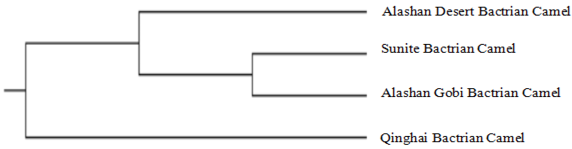
Genetic clustering of four Bactrian camel varieties.
References
- Bai, J.Y., Pang,Y.Z., Qi, Y.X., Zhang, X.H. and Yun, Y.X. 2017. Indian J. Anim. Res., 51: 851-855.
- Bai, J.Y., Pang, Y.Z., Wu, S.J., Yu, M.Q. and Zhang, X.H., 2016a. Indian J. Anim. Res., 50: 1-7.
- Bai, J.Y., Pang, Y.Z., Zhang, X.H., Yun, Y.X. and Qi, Y.X. 2016b. Brazilian J. Poult. Sci., 18: 519-524. https://doi.org/10.1590/1806-9061-2015-0101[CrossRef]
- Bai, J.Y., Pang, Y.Z., Qi, Y.X., Zhang, X.H. and Yun, X.Y. 2016c. Brazilian J. Poult. Sci., 18: 27-32. https://doi.org/10.1590/1806-9061-2015-0101[CrossRef]
- Bai, J.Y., Yang, Y.B., Wang, Y.Q., Zhang, X.H. and Pang, Y.Z., 2015. Indian J. Anim. Res., 49: 585-590.
- Bai, J.Y., Jia, X.P., Yang, Y.B., Zhang, X.H., Pang,Y.Z., Wang,Y.Q. and Qi, Y.X., 2014. J. Anim. Pl. Sci., 24: 965-968.
- Evdotchenko, D., Han, Y., Bartenschlager, H., Preuss, S. and Geldermann, H., 2003. Mol. Ecol. Notes, 3: 431-434. https://doi.org/10.1046/j.1471-8286.2003.00477.x[CrossRef]
- Guo, L.L., Guo, D.L., Zhao, W. and Hou, X.G., 2018. J. Horticul. Sci. Biotechnol., 93: 416-424. https://doi.org/10.1080/14620316.2017.1373039[CrossRef]
- Hedayat-Evrigh, N., Miraei-Ashtiani, S.R., Shahrebabak, M.M., Evrigh, R.K. and Pourasad, K., 2018. J. Agric. Sci. Technol., 20: 1137-1148.
- Mburu, D.N., Ochieng. J.W., Kuria, S.G., Jianlin, H., Kaufmann, B., Rege, J.E. and Hanotte, O. 2003. Anim. Genet., 34: 26-32. https://doi.org/10.1046/j.1365-2052.2003.00937.x[CrossRef]
- Ni, W.W., Jiang, A., Zhang, J., Ei, G.X. and Huang, Y.F., 2018. Indian J. Anim. Res., 52: 1543-1547.
- Sushma, P., Ali, S., Banerjee, P. and Joshi, J., 2014. Int. J. Biomed. Life Sci., 5: 286-296.
- Tian, Y.Z., Nuerbiya, W., Wang, L.J., Wu, W.W., Xu, X.M., Zhang, Y.H., Azhi, T., Tian, K.C., 2012. Anim. Husb. Vet. Med., 44: 38-43.
- Wang, H.J., Ma, K.M., Liu, Z.H., Jin, D.Z. and Wei, W.Q., 2016. J. Camel Pract. Res., 23: 241-246. https://doi.org/10.5958/2277-8934.2016.00041.2[CrossRef]
- Wright, S., 1978. In: Variability within and among natural populations. University of Chicago Press, Chicago.
- Yang, J., Dai, P.F., Zhou, T.H., Huang, Z.H., Feng, L., Su H.L., Liu, Z.L. and Zhao, G.F. 2013. Scient. Horticul., 150: 1-10. https://doi.org/10.1016/j.scienta.2012.11.004[CrossRef]
- Ye, W.L., Wang, F.L., Xie, Z.H., Wang, Y.G., Lin, B. and Wang, J.L., 2014a. J. Camel Pract. Res., 21: 191-198. https://doi.org/10.5958/2277-8934.2014.00033.2[CrossRef]
- Ye, W.L., Xie, Z.H., Wang, F.L., Gen, X., Dong, S. and Wang, J.L. 2014b. J. Camel Pract. Res., 21: 103-109. https://doi.org/10.5958/2277-8934.2014.00020.4[CrossRef]
Services
Article usage statistics
Loading…