
In this study, the correlation between microsatellite marker polymorphism and wool fineness of sunite bactrian camel was analyzed. The results show that, the average effective allele number, heterozygosity and polymorphism information content of 17 microsatellite markers in sunite bactrian camel were 2.8913, 0.6205 and 0.5602, respectively. The wool fineness of AB genotype of CMS36 locus was significantly higher than that of BB genotype (P<0.05). The wool fineness of AC genotype at YWLL44 locus was significantly higher than that of BD, BE and CE genotype (P<0.05). The wool fineness of AA and BC genotype at YWLL 29 locus was significantly higher than that of AC genotype (P<0.05). The wool fineness of AB genotype at LCA33 locus was significantly higher than that of AC, AD and BC genotype (P<0.05). Therefore, CMS36, YWLL 44, YWLL 29 and LCA33 microsatellite markers can be used in marker assisted selection of wool fineness of sunite bactrian camel.
Short Communication · Volume 53, Issue 6, 15 October 2021 · Open Access
Correlation Analysis Between Microsatellite Marker Polymorphism and Wool Fineness of Sunite Bactrian Camel (Camelus bactrianus)
· · · ·
Affiliations & Notes ⌄
- 1College of Animal Science and Technology, Henan University of Science and Technology, Luoyang 471023, China 2 Institute of Animal, Alxa of Inner Mongolia, Bayanhaote 750306, China 3School of Life Sciences, Henan Universiry, Kaifeng 475000, China , * Corresponding author: byezi@163.com
- 2taodi1223@163.com
Article Info ⌄
- Journal:
- Pakistan Journal of Zoology
- Published:
- 15 October 2021

Abstract
Materials and methods
Random collection of 40 sunite bactrian camels, blood was taken from jugular vein (10ml from each Bactrian camel), ACD anticoagulant was added for anticoagulation, blood DNA was extracted using the whole-blood genomic DNA extraction kit method from Beijing Dingguo Changsheng. Seventeen microsatellite markers with high polymorphism were screened ; , The primers were synthesized by Shanghai Shenggong Bioengineering Technology Service Co., Ltd.
Pre-denaturation at 94 for 4 min, then denaturation at 94 for 40 s, annealing at 60 for 1 min, annealing at 72 for 20 seconds, denaturation, annealing and elongation were carried out for 35 cycles, then elongation at 72 and finally the reaction was completed and cooled and preserved at 4oC. 15% non denaturing polyacrylamide gels were used to detect the products, silver nitrate dyeing method is used for dyeing, mainly through fixation, oxidation, dyeing, color rendering, photography and other links. SPSS software was used to analyze the relationship between the wool fineness and microsatellite of sunite bactrian camel.
Results and discussion
It can be seen from Table I. That the number of effective alleles, heterozygosity and polymorphism information content of CVRL101 locus are the highest, which are 4.5262, 0.7464 and 0.7437, respectively. The number of effective alleles, heterozygosity and polymorphism
Table I. Population genetic diversity of microsatellite markers in sunite bactrian camel.
| Locus | Number of effective alleles | Heterozy gosity | Polymo rphism information content | Locus | Number of effective alleles | Heteroz ygosity | Polymor phism information content |
| LCA33 | 2.3038 | 0.5356 | 0.5111 | CMS36 | 1.9406 | 0.3795 | 0.3672 |
| LCA37 | 2.0997 | 0.5248 | 0.4103 | CMS104 | 2.4042 | 0.5728 | 0.5000 |
| LCA63 | 2.9712 | 0.6756 | 0.6004 | CVRL101 | 4.5262 | 0.7464 | 0.7437 |
| LCA66 | 3.5635 | 0.7330 | 0.6680 | YWLL29 | 1.9913 | 0.4025 | 0.4410 |
| LCA71 | 2.2551 | 0.5727 | 0.4566 | YWLL36 | 2.2099 | 0.5993 | 0.4446 |
| LCA82 | 2.4390 | 0.6045 | 0.5039 | YWLL44 | 3.2258 | 0.6963 | 0.6373 |
| LCA90 | 3.7209 | 0.7270 | 0.6823 | VOLP08 | 3.9604 | 0.7413 | 0.7003 |
| CMS15 | 2.9144 | 0.6782 | 0.5938 | VOLP32 | 3.9120 | 0.7298 | 0.6968 |
| CMS18 | 2.7142 | 0.6292 | 0.5664 | Mean value | 2.8913 | 0.6205 | 0.5602 |
information content of CMS36 locus were the lowest, which were 1.9406, 0.3795 and 0.3672, respectively. The average effective allele number, heterozygosity and polymorphism information content of 17 microsatellite markers in sunite bactrian camel were 2.8913,0.6205 and 0.5602, respectively.
The study carried out by Gao et al. (2009) showed that the average polymorphic information content value of microsatellite markers detected in hundreds of Bactrian camels from 13 areas of China and Mongolia was 0.5414. Tian et al. (2012) studied the genetic diversity of Bactrian camels from 6 places of Xinjiang by microsatellite markers, and showed that all of the used microsatellite markers presented high polymorphism, with polymorphic information content values ranging from 0.6099 to 0.6551. So the polymorphic level (PIC=0.5602) of microsatellite markers in this study was moderate, intermediate between Gao et al. (2009) and Tian et al. (2012).
The correlation between microsatellite marker polymorphism and villus fineness of sunite bactrian camel is shown in Figure 1. The wool fineness of AB genotype of CMS36 locus was significantly higher than that of BB genotype (P<0.05). The wool fineness of AC genotype at YWLL44 locus was significantly higher than that of BD, BE and CE genotype (P<0.05). The wool fineness of AA and BC genotype at YWLL 29 locus was significantly higher than that of AC genotype (P<0.05). The wool fineness of AB genotype at LCA33 locus was significantly higher than that of AC, AD and BC genotype (P<0.05). Wu et al. (2018) showed that the marker YWLL 29 of bactrian camel in Alxa Desert was related to body height, body length, chest circumference, tube circumference and body weight; the marker LCA33 was related to body height, chest circumference, body weight and body length; the marker CVRL101 was related to body length, body weight and chest circumference. Gu (2013) showed that microsatellite markers BM1824, BM6506 and LSCV15 were significantly correlated with cashmere fineness. In conclusion, only CMS36, YWLL 44, YWLL 29 and LCA33 had significant correlation with wool fineness of sunite bactrian camel (P<0.05), while the other 13 microsatellite loci had no significant correlation with wool fineness, therefore CMS36, YWLL 44, YWLL 29 and LCA33 microsatellite markers can be used in marker assisted selection of wool fineness of sunite bactrian camel.
Acknowledgements
Sincere gratitude goes to the sponsor of Alxa League Science and Technology Project in Inner Mongolia (2012-12).
Statement of conflict of interest
The authors have declared no conflict of interest.
Figures
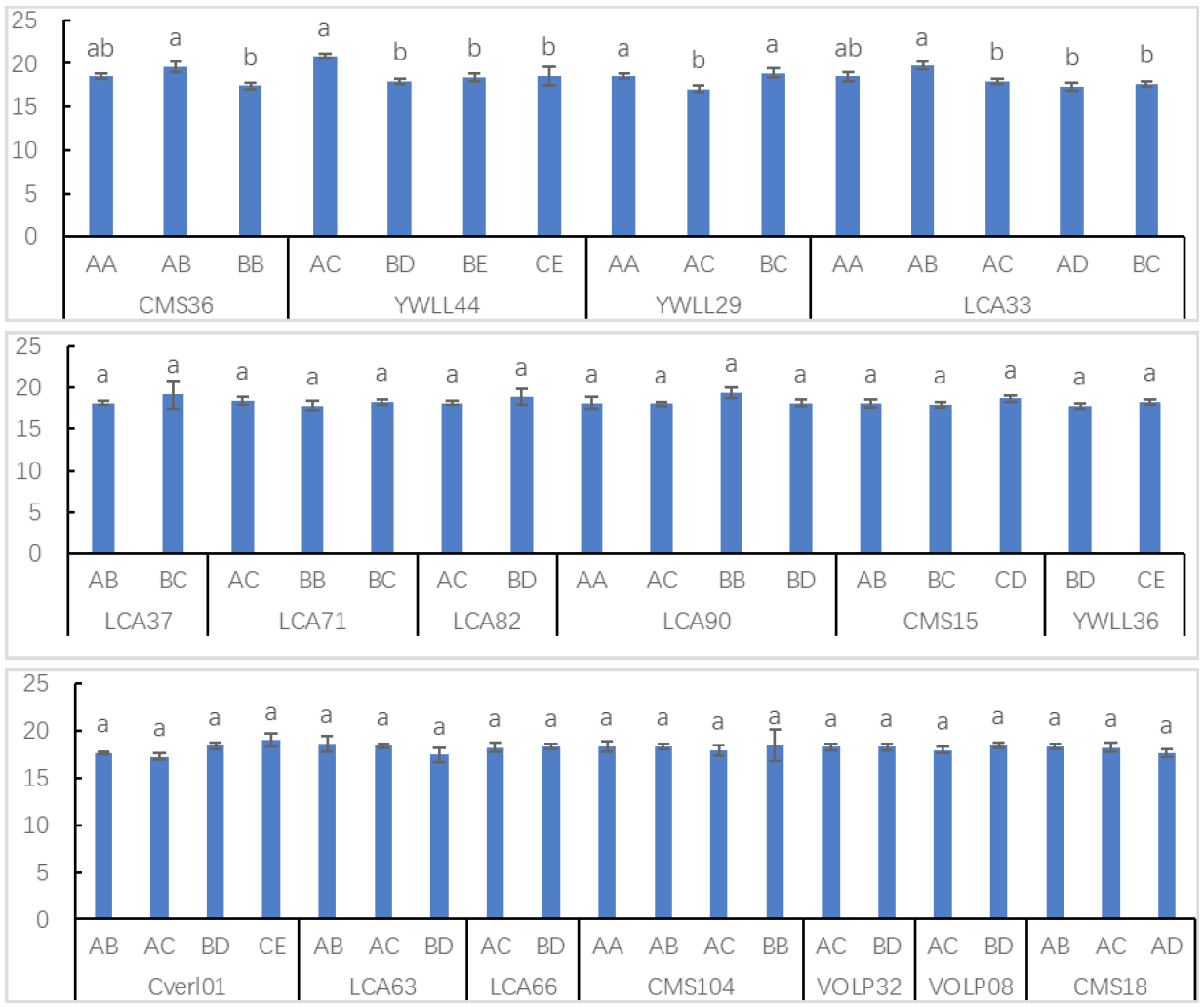
Correlation between microsatellite markers and wool fineness of sunite bactrian camel.
References
- Bai, J.Y., Pang, Y.Z., Qi, Y.X., Zhang, X.H. and Yun, Y.X., 2017. Indian J. Anim. Res., 51: 851-855.
- Bai, J.Y., Pang, Y.Z., Wu, S.J., Yu, M.Q. and Zhang, X.H., 2016a. Indian J. Anim. Res., 50: 1-7.
- Bai, J.Y., Pang, Y.Z., Zhang, X.H., Yun, Y.X. and Qi, Y.X., 2016b. Brazilian J. Poult. Sci., 18: 519-524. https://doi.org/10.1590/1806-9061-2015-0101[CrossRef]
- Bai, J.Y., Pang, Y.Z., Qi, Y.X., Zhang, X.H. and Yun, X.Y., 2016c. Brazilian J. Poult. Sci., 18: 27-32. https://doi.org/10.1590/1806-9061-2015-0124[CrossRef]
- Bai, J.Y., Yang, Y.B., Wang, Y.Q., Zhang, X.H. and Pang, Y.Z., 2015. Indian J. Anim. Res., 49: 585-590.
- Evdotchenko, D., Han, Y., Bartenschlager, H., Preuss, S. and Geldermann, H., 2003. Mol. Ecol. Notes, 3: 431-434. https://doi.org/10.1046/j.1471-8286.2003.00477.x[CrossRef]
- Gao, H.W., Wang, J., He, J.X., Chen, L.Y., Jiri, M. and Meng, H., 2009. J. Shanghai Jiaotong Univ. (Agric. Sci.)., 27: 89-95.
- Gu, L.N.S.T.L.P., 2013. Xinjiang. Xinjiang Agricultural University.
- Guo, L.L., Guo, D.L., Zhao, W. and Hou, X.G., 2018. J. Hortic. Sci. Biotechnol., 93: 416-424. https://doi.org/10.1080/14620316.2017.1373039[CrossRef]
- Ni, W.W., Jiang, A., Zhang, J., Ei, G.X. and Huang, Y.F., 2018. Indian J. Anim. Res., 52: 1543-1547.
- Sushma, P., Sharique, A., Ali. and Priyanka, B., 2014. Int. J. Biomed. Life Sci., 5: 286-296.
- Tian, Y.Z., Nuerbiya, W., Wang, L.J., Wu, W.W., Xu, X.M., Zhang, Y.H., Azhi, T. and Tian, K.C., 2012. Anim. Husb. Vet. Med., 44: 38-43.
- Wang, H.J., Ma, K.M., Liu, Z.H., Jin, D.Z. and Wei, W.Q., 2016. J. Camel Pract. Res., 23: 241-246. https://doi.org/10.5958/2277-8934.2016.00041.2[CrossRef]
- Wu, R.T.D., Siqin, T.Y. and Bai, J.Y., 2018. Anim. Husb. Vet. Med., 50: 4-9.
- Yang, J., Dai, P.F., Zhou, T.H., Huang, Z.H., Feng, L., Su, H.L., Liu, Z.L. and Zhao, G.F., 2013. Sci. Hortic., 150:1-10. https://doi.org/10.1016/j.scienta.2012.11.004[CrossRef]
- Ye, W.L., Wang, F.L., Xie, Z.H., Wang, Y.G., Lin, B. and Wang, J.L., 2014a. J. Camel Pract. Res., 21: 191-198. https://doi.org/10.5958/2277-8934.2014.00033.2[CrossRef]
- Ye, W.L., Xie, Z.H., Wang, F.L., Gen, X., Dong, S. and Wang, J.L., 2014b. J. Camel Pract. Res., 21: 103-109. https://doi.org/10.5958/2277-8934.2014.00020.4[CrossRef]
Services
Article usage statistics
Loading…