Research Article · Volume 52, Issue 6, 24 August 2020 · Open Access
Genetic Association of Two Novel SNPs in CYP7A1 Gene with Lipid Traits of Tianzhu Black Muscovy (Cairina moschata)
· · · ·
Affiliations & Notes ⌄
1Key Laboratory of Animal Genetics, Breeding and Reproduction in the Plateau Mountainous Region, Ministry of Education, College of Animal Science, Guizhou University, West Campus, Huaxi District, Guiyang, Guizhou 550025, People’s Republic of China , * Corresponding author: zyy8yyc@163.com
In this study, two novel silent mutation loci in exon 2 (CDS 216 A>G) and exon3 (CDS 681 T>A) of CYP7A1 gene were identified in Tianzhu Black Muscovy, respectively.
Association analysis revealed that two SNPs were significant association with the content of UFA, EFA and TG.
Allele A of CDS 216 A>G locus and allele T of CDS 681 T>A locus were favorable to improving meat quality, respectively.
Based on our results, we considered that two SNPs of CYP7A1 gene were potential candidate markers for improving meat quality.
Selected from the article's own text.
Abstract
Cholesterol 7α-hydroxylase (CYP7A1) plays a crucial role in the synthesis of bile acid, fatty acid and cholesterol metabolism in human and rodent. However, a little was known in the literature on the question of the effect of CYP7A1 gene on poultry lipid homeostasis. This study was performed to investigate the effect of the polymorphisms of CYP7A1 gene on lipid traits in Tianzhu Black Muscovy (Cairina moschata). We detected two novel silent mutations, CDS 216 A>G and CDS 681 T>A in exon 2 and exon 3 of CYP7A1 gene, respectively, and both SNPs changed DNA single strand conformation. The A and T allele of CDS 216 A>G and CDS 681 T>A was dominant allele, and its frequency was 0.554 and 0.800, respectively. Each SNP resulted in three genotypes. The genotypic distribution of CDS 216 A>G and CDS 681 T>A was not deviated and deviated from Hardy-Weinberg equilibrium (HWE), respectively. The polymorphism information content (PIC) of CDS 216 A>G and CDS 681 T>A was 0.372 and 0.269, respectively, and both belonged to medium levels of genetic diversity. Association analysis revealed that two SNPs were significant association with at least four of seven lipid indexes. Allele A of CDS 216 A>G locus and allele T of CDS 681 T>A locus was favorable to improving meat quality, respectively. Three haplotypes and six diplotypes were identified by the combination of two SNPs. Diplotypes had dominantly affected on tested lipid indexes except for IMF. Diplotype H1H1 was advantageous for the improvement of meat quality. Therefore, our data suggested that two novel SNPs: CDS 216 A>G and CDS 681 T>A in CYP7A1 gene were potential candidate markers for improving meat quality. It also provides reference data for early breeding and selection of Tianzhu Black Muscovy.
Introduction
In avian special, fatty tissue deposition excess is disadvantage for productive benefits. Therefore, increasing intramuscular fat (IMF) and reducing body fat deposition is one of breeding goals in modern poulty production . Lipids contain fatty acids, triglycerides, phospholipids, and cholesterol. Cholesterol, as a vital component in eukaryotic cell membranes, which modulates membrane permeability and fluidity, is the precursor of bile acid, citamin D, and steroid hormones ; . LXRs, PPARs, SRs, and SREBPs are considered as the critical regulatory factors in lipid metabolic pathways ; . To accomplish appropriate physiological levels, the metabolism of fatty acids and cholesterol are accurately dominated at the transcriptional and posttranscriptional stage ; . At present, modern molecular technologies interacted with traditional methods is the best efficiency for decreasing lipid deposition in modern poultry breeding.
Cholesterol 7α-hydroxylase (CYP7A1) also called cytochrome P450 7A1, which is a vital rate-limiting enzyme in bile acid biosynthesis, catalyzing cholesterol to 7α-hydroxycholesterol . CYP7A1 is a target in LXRs signaling pathway . LXRs with retinod X receptors (RXRs) form obligate heterodimers, and trigger the expression of SREBP-1c and cholesterol efflux-related genes, and finally cause triglyceride accumulation through fatty acid synthase (FAS) ; Cai et al., 2018; . The hydroxylation of cholesterol is modulated by bile acid derivatives and hormones via a negative feedback mechanism . Oxycholesterol combines with LXRα, and the liganded LXRα with RXR forms a heterodimer and interacts with liver X receptor (LXR) response element (LXRE) in the CYP7A1 promoter, consequently raising the transcriptional level of CYP7A1. Upregulation of CYP7A1 accelerates bile acid synthesis ; . In addition, small heterodimer partner (SHP) which is a transcriptional repressor interacts with a transactivator LRH-1 and commands it against activating its target genes CYP7A1 and SHP ; ; . Therefore, SHP suppresses the transcription of CYP7A1 and the gene coding itself. In humans and mammal, the lack of CYP7A1 could lead to reduce bile acid production and accumulate cholesterol in the liver, resulting in downregulation of LDL receptors and following hypercholesterolemia ; . The latest results demonstrated that some miRNAs (such as miR-34a, miR-122, miR-17, miR-383, and miR-146b etc.) and lncRNAs (such as lnc-HC, lncLSTR, and hnRNPA2B1 etc.) are the regulators of CYP7A1 in cellular cholesterol and fatty acid metabolism ; ; ; ; ; . According to previous reports, CYP7A1 shows to paly a crucial role in lipid deposition in the liver and hypercholesterolemia. However, CYP7A has been little known about the effect on poultry lipid metabolism. In avian species, CYP7A1 gene include 6 exons. The encoded amino acid sequence of exon 2 and exon 3 contains fifteen function domains and regulates CYP7A1 mRNA transcription level and lipid transport. Thus, the overall aim of this study was to detected whether the SNPs of CYP7A1 gene exon 2 and exon3 are closely related with lipid traits in Tianzhu Black Muscovy (Cairina moschata). To test this hypothesis, we genotyped two novel SNPs of CYP7A1 gene and identified two SNPs that are associated with lipid traits.
Materials and methods
Experimental animal
Bood samples were collected from 195 females of Tianzhu Black Muscovy (Cairina moschata) which is a native breed in China. All the birds were incubated on the same day, and consequently raised in the same environment and management conditions in poultry research institute of Guizhou University, Guizhou, China. Blood samples were achieved through the wing vein, and were euthanized that the specific implementation plan was taken all experimental ducks placed in an operating room filled with a mixture of 90% argon and 10% nitrogen at 70 days of age, and then all of ducks were quickly bled, and collected blood samples and dissected after they were unconscious. All animal experiments were performed according to the Laboratory animal—Guideline for ethical review of animal welfare of China (permit number: GB/T 35892-2018) that was issued by China Laboratory Animal Standardization Technology Committee (SAC/TC 281).
Samples and data collection
Chest muscles and abdominal fat was determinated using slaughter segmentation method , respectively. Intramuscular fat (IMF) content of chest muscles was measured using the Soxhlet extraction method . The percentage of abdominal fat (AFP) was calculated according to Poultry Production Terms and Measurement Method of Ministry of Agriculture of China (NY/T 823-2004). Serum was isolated at 4°C, 3500 rpm for 10 min from blood that was stewed at room temperature for 1 h. The contents of serum total cholesterol (TCH) and triglycerides (TG) were detected using qualified laboratory methods . Unsaturated fatty acids (UFA), polyunsaturated fatty acids (PUFA), and essential fatty acid (EFA) in chest muscle was detected as described by Han et al. (2013), respectively. Genomic DNA was extracted from blood using QIAamp DSP DNA Blood Mini Kit (Shanghai Labpal Co. Ltd., China), and then measured its concentration and purity using ND-2000 spectrophotometer (Thermo Fisher Scientific Inc.), and finally stored at -20°C for further experiments.
Primer design and PCR amplification
Based on the mRNA sequence of duck CYP7A1 gene (GenBank accession: JQ922243) and Anas platyrhynchos reference genomic sequence (NW_004676497.1), three pairs of primers were designed using Oligo 6.22 software and synthesized in Invitrogen Co. Ltd. (Peking, China) (Table I). PCR amplification was accomplished in a total volume of 50 µL containing 2×Pfu Master Mix
Table I.- Primers information for PCR amplification.
Primers
Primers sequence(5'→3')
Position / bp
Annealing temperature (°C)
P1
F: AGGAGAGCCACCACTTGAAA
Exon 2
CDS 87-245 bp /159 bp
58
R: GGGTCAGTGAGGAAATGAA
P2
F: GGTAGCATTGACTCAGCAGA
Exon 3
CDS 334-619 bp /286 bp
60
R: TCTCGGTCTCCTGCTTTGATA
P3
F: AGGAGACCGAGAGAGCACATAT
Exon 3
CDS 608-905 bp/ 298 bp
60
R: GTGGCAGGAATGGTGTTGGC
(Peking Cwbiotech Co. Ltd., China) 20 µL, each of forward and reverse primer (10 µmol/L) 2 μL, template genomic DNA (100ng/μL) 2 μL, and ddH2O 24 μL. PCR protocol was implemented as below: 95°C for 10 min; 35 cycles at 94°C for 40 s, annealing for 40 s at the optimum primer annealing temperature, and at 72°C for 45 s; final extension at 72°C for 5 min.
Gene polymorphism analysis
Each of PCR products was purified and sequenced in Invitrogen Co. Ltd. (Beijing, China), and subsequently identified SNPs using software Align IR version 2. To further analyzed whether SNPs changed DNA conformation. SSCP analysis was performed using the following program: a total volume of 12 μL consisted of 4μL each of PCR products and 8 μL denaturing solution (95% formamide, 25 mM EDTA, 0.025% bromophenol blue and 0.025% xylene-cyanole), denatured at 98 °C for 15 min and then quickly chilled on -20°C for 1 min to acquire single-stranded DNA, and subsequently subjected to electrophoresis on 12% polyacrylamide gel (polyacrylamide : bisacrylamide = 29:1) which was run with 1× TBE buffer for 10 h at 140 voltage constantly. The gel was washed in 10% deionized ethanol for 8 min and then incubated 8 min in 0.1% silver nitrate, and finally visualized 6 min in the mixture of 0.5% (v/v) formaldehyde and 2% sodium hydroxide. The SSCP bands on the gel were photographed using BIO-RAD Gel Doc XR+ imaging system (BIO-RAD, USA). The PCR fragments from different SSCP bands were sequenced and further verified the discovered SNPs in CYP7A1 gene.
Statistical analysis
Genotype and allele frequency, pair-loci D’/r2 value, haplotype and diplotype frequency, and chi-square (χ2) were calculated by SHEsis online software (http://analysis.bio-x.cn/). Heterozygosity (He), effective number of alleles (Ne), and polymorphism information content (PIC) were estimated using Cervus 3.0 software. Correlation analysis were performed using SPSS 16.0 software. The linear model was depicted as follow: Y =µ+ G + e, e - the random error, µ - the mean for each trait, G - the genotype effect or diplotype effect, and Y – a lipid trait. Data were demonstrated as mean ± SE.
Results
SNPs identification
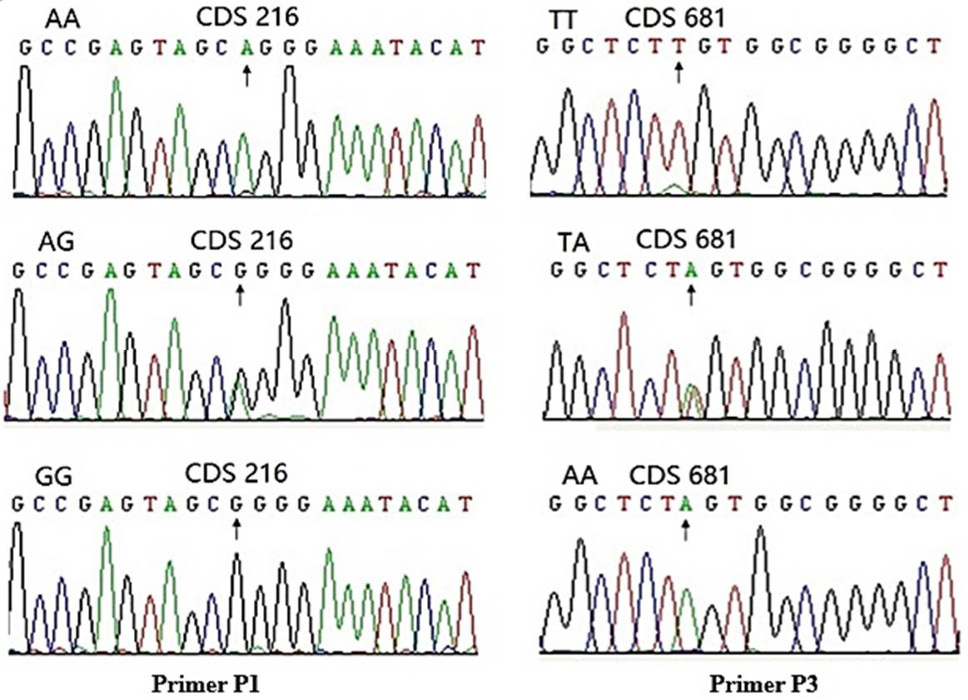
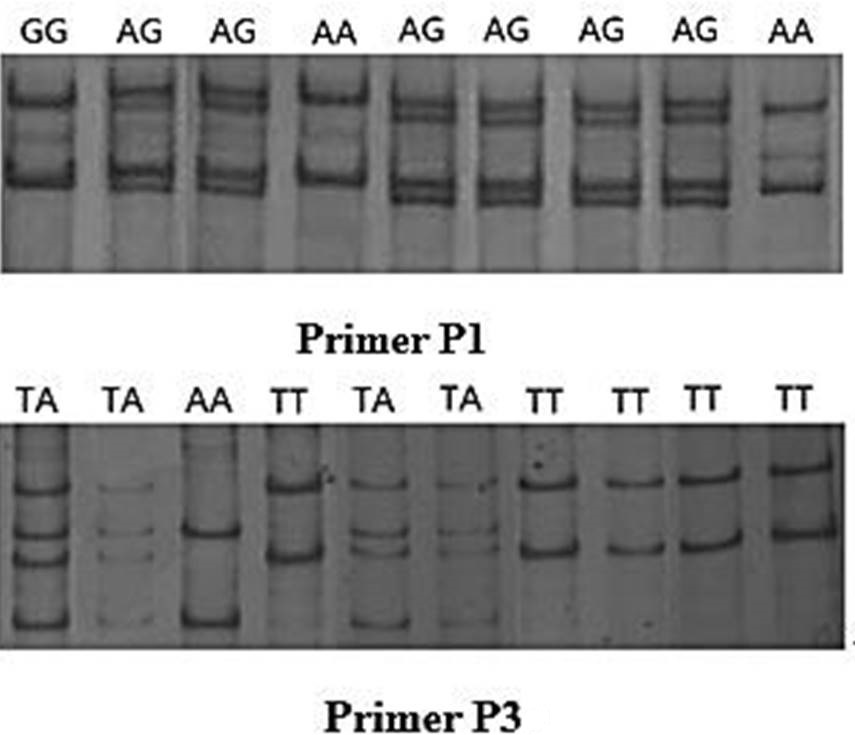
Three different primer pairs for CYP7A1 gene were investigated for SNPs in Tianzhu Black Muscovy through PCR products direct sequencing. Two single-base mutations were detected at the 216th (primer P1) and 681th (primer P3) bp of CDS region of CYP7A1 gene. Both of 216th bp A→G transition in exon 2 and 681th bp T→A transversion in exon 3 were silent mutation (Fig. 1). Furthermore, SSCP analysis indicated that both SNPs resulted in single-stranded DNA conformation changes (Fig. 2). The CDS 216 A>G mutation produced three genotypes AA, AG and GG. The CDS 681 T>A mutation also led to three genotypes TT, TA and AA.
Genotypic frequencies, allelic frequencies, and diversity parameter
Genotypic and allelic frequencies, diversity parameter, and χ2-value of two SNPs of CYP7A1 gene in Tianzhu Black Muscovy were calculated and summarized in Table II. The A and T allele frequency of CDS 216 A>G
Table II.- Population genetic information of two SNPs of CYP7A1 gene in Tianzhu Black Muscovy.
Table III.- Haplotypes and diplotypes analysis based on the two SNPs of CYP7A1 gene.
SNPs
CDS 216 A>G
CDS 681 T>A
Frequency
Haplotypes
H1
A
T
0.554
H2
G
A
0.200
H3
G
T
0.246
Diplotypes
H1H1(60)
AA
TT
0.308
H1H2(33)
AG
TA
0.169
H1H3(63)
AG
TT
0.323
H2H2(16)
GG
AA
0.082
H2H3(13)
GG
TA
0.067
H3H3(10)
GG
TT
0.051
and CDS 681 T>A was 0.554 and 0.800, respectively, which were dominant allele. The AG and TT genotype frequency of CDS 216 A>G and CDS 681 T>A was 0.492 and 0.682, respectively, which are dominant genotype. Chi-square tests (χ2) demonstrated that the genotypic distribution of CDS 216 A>G was in Hardy-Weinberg equilibrium (HWE) (P>0.05), however, CDS 681 T>A deviated from HWE (P<0.01). The PIC of CDS 216 A>G and CDS 681 T>A was 0.372 and 0.269, respectively, and both belonged to medium levels of genetic diversity according to describe by Banerjee and Chaturvedi .
Haplotypes and diplotypes analysis of two SNPs of CYP7A1 gene
Linkage disequilibrium coefficient D’ and r2 between two SNPs of CYP7A1 gene in Tianzhu Black Muscovy was 1 and 0.310, respectively. The CDS 216 A>G and CDS 681 T>A loci has no strong linkage disequilibrium based on the rule that r2>0.33 and |D’|>0.8 are thought about strong linkage disequilibrium in different alleles . Three haplotypes and six diplotypes of both SNPs of CYP7A1 gene were found and showed in Table III. The frequency of haplotypes H1, H2 and H3 was 0.554, 0.200 and 0.246, respectively. H1 was main haplotype. The frequency of diplotypes H1H1, H1H2 and H1H3 were greater than 0.1 (0.308, 0.169 and 0.323, respectively). However, other three diplotypes H2H2, H2H3 and H3H3 frequencies were less than 0.1 (0.082, 0.065 and 0.051, respectively).
Associations between identified SNPs and seven lipid indexes
Association analysis of both SNPs of CYP7A1 gene with lipid traits in Tianzhu Black Muscovy were performed and showed in Table IV. For CDS 216 A>G locus, individuals with genotype AA were higher than those with genotype AG for AFP (P<0.01) and TG (P<0.05), and individuals with genotype AA were higher EFA (P<0.05) and lower UFA (P<0.05) than those with genotype GG. For CDS 681 T>A locus, individuals with genotype TT were significantly lower UFA (P<0.05) and extremely higher TCH (P<0.01) than those with genotype AA, and individuals with genotype TT were extremely higher than those with genotype TA for PUFA and EFA (P<0.01), and finally individuals with genotype TA were significantly higher TG (P<0.05) and extremely higher TCH (P<0.01) than those with genotypes TT and AA.
Associations between diplotypes and seven lipid indexes
Association analysis of combinative diplotypes of CDS 216 A>G and CDS 681 T>A loci with lipid traits in Tianzhu Black Muscovy was done and showed in Table V. Individuals with H1H1 were higher AFP than those with H1H3 (P<0.01) and H1H2 (P<0.05). Individuals with H1H1 were lower UFA than those with H2H2 and H3H3 (P<0.05). For PUFA and EFA, individuals with H1H1 and H1H3 were higher than those with H1H2 and H2H3 (P<0.05). For TCH, individuals with H2H3 were extremely higher than other diplotyes except H1H2 (P<0.01), individuals with H1H2 were extremely higher than those with H1H1, H1H3, H2H2, and H3H3 (P<0.01), individuals with H1H1 were extremely higher than those with H2H2 and H3H3 (P<0.01), individuals with H1H3 were higher than those with H2H2 and H3H3 (P<0.05), and individuals with H1H2 were lower than those with H2H3 (P<0.05).
Table IV.- Association of two SNPs of CYP7A1 gene with lipid traits in Tianzhu Black Muscovy.
Traits
CDS 216 A>G
CDS 681 T>A
AA(60)
AG(96)
GG(39)
TT(133)
TA(46)
AA(16)
IMF / %
5.81±0.13
5.69±0.10
5.49±0.16
5.76±0.09
5.49±0.15
5.61±0.25
AFP / %
1.38±0.05A
1.13±0.04B
1.27±0.07
1.24±0.04
1.21±0.06
1.30±0.11
UFA / %
55.333±0.39a
56.02±0.31
56.85±0.49b
55.76±0.27a
56.03±0.45
57.51±0.77b
PUFA / %
23.05±0.34
22.62±0.27
21.99±0.42
22.97±0.22A
21.70±0.38B
22.50±0.65
EFA / %
22.50±0.32a
22.14±0.25
21.43±0.40b
22.44±0.21A
21.18±0.36B
21.96±0.62
TCH / mmol·L-1
3.51±0.06
3.56±0.05
3.42±0.07
3.46±0.03A
3.84±0.06B
3.08±0.10C
TG / mmol·L-1
1.19±0.02a
1.13±0.02b
1.14±0.03
1.13±0.01a
1.21±0.02b
1.09±0.04a
IMF, intramuscular fat of chest muscle; AFP, abdominal fat percentage; UFA, unsaturated fatty acids; PUFA, Polyunsaturated fatty acids; EFA, essential fatty acid; TCH, serum total cholesterol; TG, serum triglyceride. A, B, and C within the same line with different superscripts indicates P<0.01; a, b within the same line with different superscripts indicates P<0.05.
Table V.- Association of diplotypes with lipid traits in Tianzhu Black Muscovy.
Diplotypes
H1H1(60)
H1H2(33)
H1H3(63)
H2H2(16)
H2H3(13)
H3H3(10)
IMF / %
5.81±0.13
5.54±0.18
5.77±0.13
5.61±0.25
5.36±0.28
5.46±0.32
AFP / %
1.38±0.05Aa
1.19±0.07b
1.10±0.05Bb
1.30±0.10ab
1.24±0.11ab
1.25±0.13ab
UFA / %
55.32±0.39b
56.28±0.53ab
55.88±0.38ab
57.50±0.76a
55.42±0.84ab
57.65±0.96a
PUFA / %
23.05±0.34a
21.79±0.45b
23.06±0.33a
22.49±0.65ab
21.44±0.72b
21.93±0.82ab
EFA / %
22.50±0.32a
21.33±0.43b
22.56±0.31a
21.96±0.62ab
20.82±0.69b
21.36±0.78ab
TCH / mmol·L-1
3.51±0.05C
3.76±0.07ABb
3.46±0.05CDc
3.08±0.09Dd
4.04±0.11Aa
3.14±0.12Dd
TG / mmol·L-1
1.19±0.02A
1.18±0.03a
1.09±0.02Bb
1.09±0.04Bb
1.27±0.04A
1.04±0.05Bb
IMF, intramuscular fat of chest muscle; AFP, abdominal fat percentage; UFA, unsaturated fatty acids; PUFA, Polyunsaturated fatty acids; EFA, essential fatty acid; TCH, serum total cholesterol; TG, serum triglyceride. A, B, C, D within the same line with different superscripts indicates P<0.01; a, b, c, d within the same line with different superscripts indicates P<0.05.
Furthermore, individuals with H3H3 were extremely lower TG than those with H1H1 and H2H3 (P<0.01), and individuals with H1H2 were higher TG than those with H1H3, H2H2 and H3H3 (P<0.05). In addition, there were no significant difference with the lipid indexes between other diplotypes (P>0.05).
Discussion
CYP7A1 is an important factor in hepatic lipid metabolism through effects on cholesterol or fatty acid biosynthesis depending on Acetyl-coenzyme A (AcCoA) metabolic pathways . Previous studies have shown that single-nucleotide polymorphisms (SNPs) of CYP7A1 gene are related with total cholesterol, triglyceride and low-density lipoprotein (LDL) levels, risk of lipid metabolism-related diseases, and other phenotypes. The combination of SNP rs3808607 and SNP rs9297994 in human CYP7A1 gene was associated with hepatic CYP7A1 mRNA expression, total cholesterol and LDL levels . The combination of CYP7A1 rs3808607-TT with ABCG5 rs6720173-CC and DHCR7 rs760241-GG genotypes was related with serum cholesterol responses to dairy consumption . The CYP7A1 gene rs3808607 variant was associated with nonalcoholic fatty liver disease . The rs38088607 mutation of CYP7A1 gene was highly associated with serum TCH and LDL levels in different cohort characteristics . However, in avian species, the function of the SNPs of CYP7A1 gene is less known except for the fact that its expression was involved in cholesterol and fatty metabolism, and bile acid synthesis ; ; ; ; .
In avian species, increasing the percentage of chest muscles and the content of intramuscular fat (IMF) is an important breeding goals in modern poulty production. In this study, we firstly identified two novel silent mutation loci: CDS 216 A>G and CDS 681 T>A in Tianzhu Black Muscovy CYP7A1 gene, and they have no strong linkage disequilibrium. Both SNPs changed the amplified fragment DNA single-stranded conformation. The genotypic distribution of CDS 216 A>G locus was in HWE and indicated that it has not been affected by effect factors including selection, mating system, migration, and random genetic drift or regained balance due to long-term artificial selection breeding . However, the genotypic distribution of CDS 681 T>A locus might be influenced by effect factors, especially selection and genetic drift resulting in deviation from HWE. In addition, for a selected breed, the loci related to measured traits should be expected to deviate from HWE and PIC>0.25 .
Association analysis demonstrated that two SNPs were significant relation with at least four of seven lipid indexes. Genotype AA of CDS 216 A>G mutation and genotype TT of CDS 681 T>A mutation was the highest for IMF, PUFA and EFA, respectively, and suggested that they were advantageous to the improvement of meat quality. Furthermore, three haplotypes and six diplotypes were identified by the combination of two SNPs. Diplotypes were dominant affected on tested lipid indexes except for IMF. Diplotype H1H1 was the most beneficial for improving meat quality, which showed that haplotype H1 may play a positive role on meat quality. Based on our results, we considered that two SNPs might be the valid candidate markers to improve meat quality. However, it also increased the content of abdominal fat when the meat quality was improved, and led to the conflict between improving meat quality and reducing body fat deposition. But we can resolve the contradiction through formulating the timing of breeding objectives. For TG and TCH, we suggested that it has dominance/over-dominance effect between homozygous diplotypes, and obtained proper the levels of TG and TCH through the heterosis between different homozygous diplotypes ; . Furthermore, the previous many studies verified that single-strand DNA conformation change caused the difference of gene copy number, promoter activity, transcription and translation levels, and consequently influenced on animal performance . CYP7A1 as a target gene of LXRs, CYP7A1 signaling has been mentioned to participate in lipid metabolism, and many molecules including FXR, FAS, SREBP-1c, LXRα, CD36, lecithin cholesterol acyltransferase (LCAT), and 3-hydroxy-3-methylglutaryl coenzyme A reductase (HMGR) were involved, and then modulated the dynamic balance of serum TG and TC levels through fat deposition (body fat and IMF) and oxidative decomposition ; ; ; . Therefore, two SNPs of CYP7A1 gene may cause the expressive difference of genes involved in lipid metabolism, and achieved to regulate fat deposition. Certainly, further work is necessary implement, such as the effects of SNPs and its haplotypes/diplotypes on expression of CYP7A1 shall be evaluated in other Muscovy, and association of CYP7A1 gene with other lipid metabolism-related genes should be confirmed in Tianzhu Black Muscovy.
Conclusions
In this study, two novel silent mutation loci in exon 2 (CDS 216 A>G) and exon3 (CDS 681 T>A) of CYP7A1 gene were identified in Tianzhu Black Muscovy, respectively. Association analysis revealed that two SNPs were significant association with the content of UFA, EFA and TG. Allele A of CDS 216 A>G locus and allele T of CDS 681 T>A locus were favorable to improving meat quality, respectively. Three haplotypes and six diplotypes were identified by the combination of two SNPs. Diplotypes had dominantly affected on tested lipid indexes except for IMF. Diplotype H1H1 was advantageous for the improvement of meat quality. Based on our results, we considered that two SNPs of CYP7A1 gene were potential candidate markers for improving meat quality. It also provides reference data for the further studies of poultry CYP7A1 gene.
Acknowledgments
The funding for this work was supported by the National Natural Science Foundation of China (31760663) and science and technology project of Guizhou province (QKHPTRC[2017]5788).
Statement of conflict of interest
Authors have declared no conflict of interest.
Figures
Fig. 1..
SNPs detection using PCR production directing sequencing.
Fig. 2..
SNPs cause single-strand conformation polymorphism.
References
Abdullah, M.M.H., Eck, P.K., Couture, P., Lamarche, B. and Jones, P.J.H., 2018. The combination of single nucleotide polymorphisms rs6720173 (ABCG5), rs3808607 (CYP7A1), and rs760241 (DHCR7) is associated with differing serum cholesterol responses to dairy consumption. Appl. Physiol. Nutr. Metab., 43: 1090-1093. https://doi.org/10.1139/apnm-2018-0085[CrossRef]
Al-Aqil, F.A., Monte, M.J., Peleteiro-Vigil, A., Briz, O., Rosales, R., González, R., Aranda, C.J., Ocón, B., Uriarte, I., de Medina, F.S., Martinez-Augustín, O., Avila, M.A., Marín, J.J.G. and Romero, M.R., 2018. Interaction of glucocorticoids with FXR/FGF19/FGF21-mediated ileum-liver crosstalk. Biochim. Biophys. Acta Mol. Basis Dis., 1864: 2927-2937. https://doi.org/10.1016/j.bbadis.2018.06.003[CrossRef]
Banerjee, S. and Chaturvedi, C.M., 2018. Neuroendocrine mechanism of food intake and energy regulation in Japanese quail under differential simulated photoperiodic conditions: Involvement of hypothalamic neuropeptides, AMPK, insulin and adiponectin receptors. J. Photochem. Photobiol. B, 185: 10-23. https://doi.org/10.1016/j.jphotobiol.2018.05.020[CrossRef]
Baranowski, M., 2008. Biological role of liver X receptors. J. Physiol. Pharmacol., 59(S7): 31-55.
Cai, D., Yuan, M., Liu, H., Pan, S., Ma, W., Hong, J. and Zhao, R., 2016. Maternal betaine supplementation throughout gestation and lactation modifies hepatic cholesterol metabolic genes in weaning piglets via AMPK/LXR-mediated pathway and histone modification. Nutrients, 8: E646. https://doi.org/10.3390/nu8100646[CrossRef]
Chen, B., Cole, J.W. and Grond-Ginsbach, C., 2017. Departure from Hardy Weinberg Equilibrium and genotyping error. Front. Genet., 8: 167. https://doi.org/10.3389/fgene.2017.00167[CrossRef]
Chen, X., Jiang, R. and Geng, Z., 2012. Cold stress in broiler: global gene expression analyses suggest a major role of CYP genes in cold responses. Mol. Biol. Rep., 39: 425-429. https://doi.org/10.1007/s11033-011-0754-x[CrossRef]
Chen, Z., 2015. Progress and prospects of long noncoding RNAs in lipid homeostasis. Mol. Metab., 5: 164-170. https://doi.org/10.1016/j.molmet.2015.12.003[CrossRef]
Chiang, J.Y., 2009. Bile acids: regulation of synthesis. J. Lipid Res., 50: 1955-1966. https://doi.org/10.1194/jlr.R900010-JLR200[CrossRef]
Chiang, J.Y., 2003. Bile acid regulation of hepatic physiology: III. Bile acids and nuclear receptors. Am. J. Physiol. Gastrointest. Liver Physiol., 284: G349-356. https://doi.org/10.1152/ajpgi.00417.2002[CrossRef]
Cui, R., Li, C., Wang, J. and Dai, J., 2018. Induction of hepatic miR-34a by perfluorooctanoic acid regulates metabolism-related genes in mice. Environ. Pollut., 44: 270-278. https://doi.org/10.1016/j.envpol.2018.10.061[CrossRef]
Dekkers, J.C. and Chakraborty, R., 2004. Optimizing purebred selection for crossbred performance using QTL with different degrees of dominance. Genet. Sel. Evol., 36: 297-324. https://doi.org/10.1051/gse:2004003[CrossRef]
Gbaguidi, G.F. and Agellon, L.B., 2004. The inhibition of the human cholesterol 7alpha-hydroxylase gene (CYP7A1) promoter by fibrates in cultured cells is mediated via the liver x receptor alpha and peroxisome proliferator-activated receptor alpha heterodimer. Nucl. Acids Res., 32: 1113-1121. https://doi.org/10.1093/nar/gkh260[CrossRef]
Gong, R., Lv, X. and Liu, F., 2018. MiRNA-17 encoded by the miR-17-92 cluster increases the potential for steatosis in hepatoma cells by targeting CYP7A1. Cell. Mol. Biol. Lett., 23: 16. https://doi.org/10.1186/s11658-018-0083-3[CrossRef]
Han, C., Vinsky, M., Aldai, N., Dugan, M.E., McAllister, T.A. and Li, C., 2013. Association analyses of DNA polymorphisms in bovine SREBP-1, LXRα, FADS1 genes with fatty acid composition in Canadian commercial crossbred beef steers. Meat Sci., 93: 429-436. https://doi.org/10.1016/j.meatsci.2012.10.006[CrossRef]
He, J., Zheng, H., Pan, D., Liu, T., Sun, Y., Cao, J., Wu, Z. and Zeng, X., 2018. Effects of aging on fat deposition and meat quality in Sheldrake duck. Poult. Sci., 97: 2005-2010. https://doi.org/10.3382/ps/pey077[CrossRef]
Helsley, R.N. and Zhou, C., 2017. Epigenetic impact of endocrine disrupting chemicals on lipid homeostasis and atherosclerosis: A pregnane X receptor-centric view. Environ. Epigenet., 3: dvx017. https://doi.org/10.1093/eep/dvx017[CrossRef]
Hu, Y., Sun, Q., Li, X., Wang, M., Cai, D., Li, X. and Zhao, R., 2015. In Ovo injection of betaine affects hepatic cholesterol metabolism through epigenetic gene regulation in newly hatched chicks. PLoS One, 10: e0122643. https://doi.org/10.1371/journal.pone.0122643[CrossRef]
Hubacek, J.A. and Bobkova, D., 2006. Role of cholesterol 7alpha-hydroxylase (CYP7A1) in nutrigenetics and pharmacogenetics of cholesterol lowering. Mol. Diagn. Ther., 10: 93-100. https://doi.org/10.1007/BF03256448[CrossRef]
Huang, W., Zhang, X., Li, A., Xie, L. and Miao, X., 2018. Genome-wide analysis of mRNAs and lncRNAs of lntramuscular fat related to lipid metabolism in two pig breeds. Cell Physiol. Biochem., 50: 2406-2422. https://doi.org/10.1159/000495101[CrossRef]
Huang, Z., Mu, C., Chen, Y., Zhu, Z., Chen, C., Lan, L., Xu, Q., Zhao, W. and Chen, G., 2015. Effects of dietary probiotic supplementation on LXRα and CYP7α1 gene expression, liver enzyme activities and fat metabolism in ducks. Br. Poult. Sci., 56: 218-224. https://doi.org/10.1080/00071668.2014.1000821[CrossRef]
Jiang, Y., Tang, J., Xie, M., Wen, Z.G., Qiao, S.Y. and Hou, S.S., 2017. Threonine supplementation reduces dietary protein and improves lipid metabolism in Pekin ducks. Br. Poult. Sci., 58: 687-693. https://doi.org/10.1080/00071668.2017.1363871[CrossRef]
Lan, X., Yan, J., Ren, J., Zhong, B., Li, J., Li, Y., Liu, L., Yi, J., Sun, Q. and Yang, X., 2016. A novel long noncoding RNA Lnc-HC binds hnRNPA2B1 to regulate expressions of Cyp7a1 and Abca1 in hepatocytic cholesterol metabolism. Hepatology, 64: 58-72. https://doi.org/10.1002/hep.28391[CrossRef]
Li, B., Weng, Q., Dong, C., Zhang, Z., Li, R., Liu, J., Jiang, A., Li, Q., Jia, C., Wu, W. and Liu, H., 2018. A key gene, PLIN1, can affect porcine intramuscular fat content based on transcriptome analysis. Genes, 9: E194. https://doi.org/10.3390/genes9040194[CrossRef]
Li, T., Chanda, D., Zhang, Y., Choi, H.S. and Chiang, J.Y., 2010. Glucose stimulates cholesterol 7alpha-hydroxylase gene transcription in human hepatocytes. J. Lipid Res., 51: 832-842. https://doi.org/10.1194/jlr.M002782[CrossRef]
Lin, F.B., Zhu, F., Hao, J.P., Yang, F.X. and Hou, Z.C., 2018. In vivo prediction of the carcass fatness using live body measurements in Pekin ducks. Poult. Sci., 97: 2365-2371. https://doi.org/10.3382/ps/pey079[CrossRef]
Lin, H.R., 2015. Lepidozenolide from the liverwort Lepidozia fauriana acts as a farnesoid X receptor agonist. J. Asian Nat. Prod. Res., 17: 149-158. https://doi.org/10.1080/10286020.2014.964689[CrossRef]
Meng, Y., Meng, K., Zhao, X., Li, D., Gao, Q., Wu, S. and Cui, Y., 2018. Protective effects of Yinchenhao decoction on cholesterol gallstone in mice fed a lithogenic diet by regulating LXR, CYP7A1, CYP7B1, and HMGCR pathways. Evid. Based Complem. Altern. Med., 2018: 8134918. https://doi.org/10.1155/2018/8134918[CrossRef]
Mercer, K.E., Bhattacharyya, S., Diaz-Rubio, M.E., Piccolo, B.D., Pack, L.M., Sharma, N., Chaudhury, M., Cleves, M.A., Chintapalli, S.V. and Shankar, K., 2018. Infant formula feeding increases hepatic cholesterol 7α hydroxylase (CYP7A1) expression and fecal bile acid loss in neonatal piglets. J. Nutr., 148: 702-711. https://doi.org/10.1093/jn/nxy038[CrossRef]
Moon, Y., Park, B. and Park, H., 2016. Hypoxic repression of CYP7A1 through a HIF-1α- and SHP-independent mechanism. BMB Rep., 49: 173-178. https://doi.org/10.5483/BMBRep.2016.49.3.188[CrossRef]
Pan, Y.X., Zhuo, M.Q., Li, D.D., Xu, Y.H., Wu, K. and Luo, Z., 2018. SREBP-1 and LXRα pathways mediated Cu-induced hepatic lipid metabolism in zebrafish Danio rerio. Chemosphere, 215: 370-379. https://doi.org/10.1016/j.chemosphere.2018.10.058[CrossRef]
Puig, X., Ginebra, J. and Graffelman, J., 2017. A Bayesian test for Hardy-Weinberg equilibrium of biallelic X-chromosomal markers. Heredity, 119: 226-236. https://doi.org/10.1038/hdy.2017.30[CrossRef]
Sato, M., Sato, K. and Furuse, M., 2008. Change in hepatic and plasma bile acid contents and its regulatory gene expression in the chicken embryo. Comp. Biochem. Physiol. B: Biochem. Mol. Biol., 150: 344-347. https://doi.org/10.1016/j.cbpb.2008.04.003[CrossRef]
Slatkin, M., 2008. Linkage disequilibrium-understanding the evolutionary past and mapping the medical future. Nat. Rev. Genet., 9: 477-485. https://doi.org/10.1038/nrg2361[CrossRef]
Smolle, E. and Johannes Haybaeck, J., 2014. Non-coding RNAs and lipid metabolism. Int. J. mol. Sci., 15: 13494-13513. https://doi.org/10.3390/ijms150813494[CrossRef]
Song, Y., Xu, C., Shao, S., Liu, J., Xing, W., Xu, J., Qin, C., Li, C., Hu, B. and Yi, S., 2015. Thyroid-stimulating hormone regulates hepatic bile acid homeostasis via SREBP-2/HNF-4α/CYP7A1 axis. J. Hepatol., 62: 1171-1179. https://doi.org/10.1016/j.jhep.2014.12.006[CrossRef]
Stefl, S., Nishi, H., Petukh, M., Panchenko, A.R. and Alexov, E., 2013. Molecular mechanisms of disease-causing missense mutations. J. mol. Biol., 425: 3919-3936. https://doi.org/10.1016/j.jmb.2013.07.014[CrossRef]
Teslovich, T.M., Musunuru, K., Smith, A.V., Edmondson, A.C., Stylianou, I.M., Koseki, M., Pirruccello, J.P., Ripatti, S., Chasman, D.I., Willer, C.J., Johansen, C.T., Fouchier, S.W., Isaacs, A., Peloso, G.M., Barbalic, M., Ricketts, S.L., Bis, J.C., Aulchenko, Y.S., Thorleifsson, G., Feitosa, M.F., Chambers, J., Orho-Melander, M., Melander, O., Johnson, T., Li, X., Guo, X., Li, M., Shin-Cho, Y., Jin-Go, M., Jin-Kim, Y., Lee, J.Y., Park, T., Kim, K., Sim, X., Twee-Hee-Ong, R., Croteau-Chonka, D.C., Lange, L.A., Smith, J.D., Song, K., Hua-Zhao, J., Yuan, X., Luan, J., Lamina, C., Ziegler, A., Zhang, W., Zee, R.Y., Wright, A.F., Witteman, J.C., Wilson, J.F., Willemsen, G., Wichmann, H.E., Whitfield, J.B., Waterworth, D.M., Wareham, N.J., Waeber, G., Vollenweider, P., Voight, B.F., Vitart, V., Uitterlinden, A.G., Uda, M., Tuomilehto, J., Thompson, J.R., Tanaka, T., Surakka, I. and Stringham, H.M., 2010. Biological, clinical and population relevance of 95 loci for blood lipids. Nature, 466: 707-713. https://doi.org/10.1038/nature09270[CrossRef]
van Solingen, C., Scacalossi, K.R. and Moore, K.J., 2018. Long noncoding RNAs in lipid metabolism. Curr. Opin. Lipidol., 29: 224-232. https://doi.org/10.1097/MOL.0000000000000503[CrossRef]
Wang, D., Hartmann, K., Seweryn, M. and Sadee, W., 2018. Interactions between regulatory variants in CYP7A1 (cholesterol 7α-Hydroxylase) promoter and enhancer regions regulate CYP7A1 expression. Circ. Genom. Precis. Med., 11: e002082. https://doi.org/10.1161/CIRCGEN.118.002082[CrossRef]
Xia, S.F., Duan, X.M., Cheng, X.R., Chen, L.M., Kang, Y.J., Wang, P., Tang, X., Shi, Y.H. and Le, G.W., 2017. Role of miR-383 and miR-146b in different propensities to obesity in male mice. J. Endocrinol., 234: 201-216. https://doi.org/10.1530/JOE-17-0044[CrossRef]
Xu, C.L., Sun, X.M. and Zhang, S.G., 2013. Mechanism on differential gene expression and heterosis formation. Yi Chuan, 35: 714-726. https://doi.org/10.3724/SP.J.1005.2013.00714[CrossRef]
Zeng, Y., Ren, K., Zhu, X., Zheng, Z. and Yi, G., 2018. Long noncoding RNAs: advances in lipid metabolism. Adv. Clin. Chem., 87: 1-36. https://doi.org/10.1016/bs.acc.2018.07.001[CrossRef]
Zhaldak, D.A., Melekhovets, O.K. and Orlovskyi, V.F., 2017. CYP7A1 gene polymorphism and the characteristics of dyslipidemias in patients with nonalcoholic fatty liver disease concurrent with hypothyroidism. Terapevticheskiĭ Arkhiv, 89: 62-65. https://doi.org/10.17116/terarkh2017891062-65[CrossRef]
Zhang, T., Zhao, M., Lu, D., Wang, S., Yu, F., Guo, L., Wen, S. and Wu, B., 2018. REV-ERBα regulates CYP7A1 through repression of liver receptor Homolog-1. Drug Metab. Dispos., 46: 248-258. https://doi.org/10.1124/dmd.117.078105[CrossRef]
Zhao, A.Y., Wang, X.D., Chen, G.H. and Lu, L.Z., 2011. Low-level expression of cholesterol 7 α-hy droxylase is associated with the formation of goose fatty liver. Poult. Sci., 90: 1045-1049. https://doi.org/10.3382/ps.2010-01207[CrossRef]
Zhong, D., Xie, Z., Huang, B., Zhu, S., Wang, G., Zhou, H., Lin, S., Lin, Z. and Yang, B., 2018. Ganoderma lucidum polysaccharide peptide alleviates hepatoteatosis via modulating bile acid metabolism dependent on FXR-SHP/FGF. Cell Physiol. Biochem., 49: 1163-1179. https://doi.org/10.1159/000493297[CrossRef]
Zinkhan, E.K., Yu, B. and Schlegel, A., 2018. Prenatal exposure to a maternal high fat diet increases hepatic cholesterol accumulation in intrauterine growth restricted rats in part through microRNA-122 inhibition of Cyp7a1. Front. Physiol., 9: 645. https://doi.org/10.3389/fphys.2018.00645[CrossRef]