
The growth performance of striped murrel, Channa striata larvae which were produced in the pre-monsoon season (April- May) and another in monsoon season (June-August) under controlled conditions has been evaluated with a 30-day experiment. The experiment was conducted for pre-monsoon and monsoon season separately. Two quadruplicate was assigned as T1 (pre-monsoon season i.e., Beyond breeding season) and T2 (spawn produced during monsoon season i.e., breeding season). At the end of the trial, significant (P<0.05) improved weight gain percent, thermal growth coefficient (TGC), survival, and reduced cannibalism were recorded in larvae produced during the pre-monsoon season (T1). From the present study, it is concluded that larvae produced in the pre-monsoon season (T1) could be an additional benefit for the farmers to generate additional revenue in terms of seed production as well as monetary profit.
Short Communication · Volume 57, Issue 3, 9 May 2025 · Open Access
Evaluation of Growth Performance of Striped Murrel, Channa striata Larvae Produced in Pre-Monsoon and Monsoon Season Under Controlled Condition
· · · · · · ·
Affiliations & Notes ⌄
- 1Dr. M.G.R Fisheries College and Research Institute, Tamilnadu, Dr. J. Jayalalithaa, Fisheries University, Poneri-601204. 2ICAR- Central Institute of Freshwater Aquaculture, Kausalyaganga, Bhubaneswar, Odisha-751002. * Corresponding author: damledk@gmail.com
Article Info ⌄
- Journal:
- Pakistan Journal of Zoology
- Published:
- 9 May 2025

Abstract
Materials and methods
The larvae obtained from pre-monsoon (April- May) and monsoon period (June-August) were reared in FRP Tanks (0.50 m3). The experiment was conducted in eight FRP tanks applying two treatments viz. spawn produced during pre-monsoon season (T1) and spawn produced during monsoon season (T2), each treatment was assigned with four replications. Each tank was stocked with 150 fish and then reared for 30 days. The experiment was conducted for pre-monsoon and monsoon season separately. The heterogeneous mixture of plankton with abundance of rotifers and copepods were continuously produced in well fertilized culture pond through phased manuring method of Air-Breathing Fish Culture Unit, ICAR-CIFA, Bhubaneswar and later collected to fed to larvae from fourth days onwards till 14th day spawns in ad libitum. On 15th day weaning starts means larvae starts taking powdered feed. In the experimental tanks commercial power feed (300-500 μm particle size) with 52% crude protein and 12% lipid was used soon after weaning. The feeding was done @ 10-20% of their total biomass. Initially up to fourteenth day only plankton was given to the larvae but after fourteenth day they were fed four times a day. The leftover feed and excreta were siphoned out daily with siphoning pipes to avoid the deterioration of water quality. Every third day the water was exchanged completely. The layer of waste particles was removed completely for the clear visibility which helps to reduce higher cannibalism and to keep water quality in good condition.
The performance indices were evaluated using the method and formulae followed by Daudpota et al. (2016).
All the physicochemical parameters of water were analysed as per the standard methods .
The data generated with the experiments were analysed for interpretation and all the data were analysed with MS Excel (2019) with the use of mathematical formulae for different parameter.
Table I. Growth performance of larvae produced in pre-monsoon and monsoon.
| Larvae produced in | ||
| Pre-monsoon season (T1) | Monsoon season (T2) | |
| Initial length (mm) | 4.48±0.3 | 4.55±0.26 |
| Final length (mm) | 43.45±2.04 | 44.35±2.93 |
| Initial weight (mg) | 4.91±0.34 | 5.5±0.36 |
| Final weight (mg) | 627.01±125.82a | 610.23±125.23b |
| Weight gain (mg) | 622.1±126.08a | 604.73±124.08b |
| ADWG (mg) | 20.74±3.2 | 20.16±4.23 |
| Weight gain % | 13349.59±3810.93a | 10892.81±3710.53b |
| Condition factor | 0.75±0.07 | 0.68±1.44 |
| SGR % | 16.03±0.8 | 15.43±1.53 |
| TGC | 241.49±46.97a | 232.1±48.77b |
| CV of length | 0.56±0.04 | 0.68±0.38 |
| CV of weight | 0.01±1.32 | 0.01±0.1 |
| Survival% | 86.83±2.56 | 82.00±1.45 |
| Cannibalism % | 8.5±0.61b | 9.83±1.03a |
*Values with different superscript with in the column differ significantly P<0.05% level.
Results and discussion
The performance of the larvae produced in the pre-monsoon period was better than the larvae produced in the spawning season in some parameters. A significant difference in the weight gain, percentage weight gain, specific growth rate, thermal growth coefficient (TGC), survival and cannibalism (Table I) was observed between the larvae produced in T1 (pre monsoon) and T2 (in monsoon). Weight gain at the end of experiment was significantly (P<0.05) higher in T1 (larvae produced in pre monsoon season; 622.1±126.08 mg) than T2 (larvae produced in monsoon season; 604.73±124.08b mg). The length and weight relationship between the larvae produced during pre-monsoon and monsoon is given in Figure 1. As similar to weight gain, the percentage weight gain was higher in T1 (13349.59±3810.93a %) followed by T2 (10892.81±3710.4993b %). Thermal growth coefficient value was higher for the T1 (241.49±46.97a) and lower in T2 (232.1±48.77b). The survival percentage was comparatively better in T1 (larvae produced in pre-monsoon) than T2 (larvae produced in monsoon season). The rate of cannibalism was recorded higher in T2 (9.83±1.03a %) compared to T1 (8.5±0.61b %). Rate of cannibalism was significantly higher in the larvae produced during the spawning season the rate of cannibalism may be brought down with the proper feeding and regular shortening of shooter larvae similar findings is reported by Kumari et al. (2018). The cannibalism rate in the present study was comparatively lower than the previous reports by Qin et al. (1997a), Mehrajuddin et al. (2011), Kumari et al. (2018), Nen et al. (2018) and Hien et al. (2017). Although growth parameters in case of larvae produced in pre-monsoon season was higher and suggest better growth performance than the larvae produced in monsoon season. As both the larvae were reared in different season, the environmental condition may have positive or negative effect on growth of larvae. Therefore, the growth improvement in the larvae reared in the pre monsoon season might be due to the effect of climatological parameters.
Physico-chemical properties of water in experimental water were found within the favourable range. The major difference recorded in the different season were more or less similar except water temperature, therefore average range of the water quality parameters have been given in this section. Water temperature was in slightly higher range (30oC–32oC) during T1 than the temperature recorded during the T2 experimental period. Dissolved oxygen concentration of all experimental tanks was recorded with in the range of 5.04 mg L-1 to 6.29 mg L-1 during the larval rearing. There was no much variation in pH values was observed during the larval rearing experiment. The pH values were recorded with in the range of 7.7 to 8.3. Total alkalinity was found with in the range of 103 mg L-1 to 126 mg L-1, whereas hardness was found to be 100-117 mg L-1 during the experimental period. Water conductivity in experimental tanks was within the range of 0.299 – 0.392 S/m, during the observation of larval rearing phase in the both of the season. Phosphate level in experimental tank water was recorded as 0.005 to 0.028 mg L-1. The total ammonia content of all the experimental tanks were recorded before water exchange. It was found to be in the range of 0.0217 to 0.726 mg L-1. The nitrite-N was found to be in the range of 0.04 to 0.625 mg L-1 in the experimental tanks whereas the nitrate-N was found to be in the range of 0.001 to 0.125 mg L-1 in the experimental tanks during the study period. All the water quality parameters were congenial to the fish growth during the rearing period of the larvae in the both seasons.
The present study successfully provided the package of practice for larval rearing of striped murrel in captivity during the pre-monsoon and monsoon season. Channa striata larvae are reared in the two different monsoon season showed significant changes in the growth and survival. This study also firmly suggested that larvae produced in the different season can be reared successfully. The weaning was achieved through partial and gradual replacement of live feed with formulated feed. From the present study it can be concluded that slightly higher growth and survival of the larvae could be earned by rearing them during pre-monsoon season however the performance of both the season larvae were more or less similar. The aim of the study was to evaluate feasibility of larvae produced in pre-monsoon season. So, there was no intension to prove superiority of different seasoned larvae with this study. As this species is very important high value fish, successful outcome of rearing of larvae in different season will serve as the baseline for the rearing of Channa striata larvae at the commercial level which furthermore, allows fish seed producers to produce seeds for longer period and also it will be helpful in availability of seeds for a longer period. The weaning period was reported to be 15 days after hatching (dah) in present study in compare to the 17 days after hatching reported by Hien et al. (2017), Nen et al. (2018).
Acknowledgments
The authors are thankful to the Director, ICAR-Central Institute of Freshwater Aquaculture, Kausalyaganga, Bhubaneshwar, India for providing all the necessary facilities and support for this research.
Funding
The study was funded by Institute Fund, ICAR - Central Institute of Freshwater Aquaculture, Bhubaneswar, Odisha-751002.
Statement of conflict of interest
The authors have declared no conflict of interest.
Figures
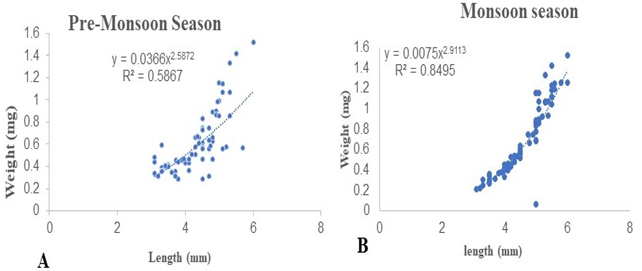
Length weight relationship in larvae produced during pre-Monsoon (A) and Monsoon (B) season.
References
- Aliyu-Paiko, M., Hashim, R. and Shu-Chien, A., 2010a. Aquacult. Nutr., 16: 466-474. https://doi.org/10.1111/j.1365-2095.2009.00683.x[CrossRef]
- Aliyu-Paiko, M., Hashim, R., Shu-Chien Chong, A., Yogarajah, L. and El-Sayed, A.F.M., 2010b. Aquacult. Res., 41: 1365-1376. https://doi.org/10.1111/j.1365-2109.2009.02425.x[CrossRef]
- APHA, 2005. Standard methods of water and wastewater. 21st edn., American Public Health Association, Washington, DC, pp. 2-61. ISBN: 0875530478.
- Courtenay, W.R. and Williams, J.D., 2004. US Geol. Surv., 1251.
- Daudpota, A.M., Abbas, G., Kalhoro, I.B., Shah, S.S.A., Kalhoro, H., Hafeez-ur-Rehman, M. and Ghaffar, A., 2016. Pakistan J. Zool., 48: 809-816.
- Diana, J.S. and Chang, W.Y.B., 1985. Production systems for commonly cultured freshwater fishes of Southeast Asia (No. 36224 (722)). https://doi.org/10.5962/bhl.title.58512[CrossRef]
- Djokosetiyanto, D., Nirmala, K., Harris, E. and Affandi, R., 2017. Aquacult. Aquar. Conserv. Legislat., 10: 265-273.
- Hien, T.T.T., Tam, B.M., Tu, T.L.C. and Bengtson, D.A., 2017. Aquacult. Res., 48: 4774-4782. https://doi.org/10.1111/are.13298[CrossRef]
- Kubitza, F. and Lovshin, L.L., 1999. Rev. Fish. Sci., 7: 1-22. https://doi.org/10.1080/10641269991319171[CrossRef]
- Kumar, R., Gokulakrishnan, M., Debbarma, J. and Damle, D.K., 2022. Anim. Reprod. Sci., pp. 106957. https://doi.org/10.1016/j.anireprosci.2022.106957[CrossRef]
- Kumar, R., Damle, D.K. and Pillai, B.R., 2021. Hormonal influence on induced maturation and spawning in striped Murrel, Channa striata. In: Recent updates in molecular endocrinology and reproductive physiology of fish. Springer, Singapore. pp. 63-76. https://doi.org/10.1007/978-981-15-8369-8_5[CrossRef]
- Kumar, R. and Mohanty, U.L., 2018. Induced breeding and seed production of striped murrel, Channa striatus: Package of practice for breeding and cultureof commercially important freshwater fish species. National fisheries development board, Hyderabad, pp. 1-5.
- Kumar, D., Marimuthu, K., Haniffa, M.A. and Sethuramalingam, T.A., 2008. Ege J. Fish. aquat. Sci., 25: 105-110.
- Kumari, S., Tiwari, V., Rani, A.B., Rajesh, K. and Satya, P., 2018. J. exp. Zool., India, 21: 205-210.
- Ling, S.W., 1977. Snakehead, Ophiocephalus spp. culture. Aquaculture in Southeast Asia: A historical overview. University of Washington Press, Seattle, pp. 60-66.
- Marimuthu, K. and Haniffa, M. A.,2007. Taiwania-taipei, 52: 84.
- Mehrajuddin, W.A.R., Altaff, K. and Haniffa, M.A., 2011. Turk. J. Fish. aquat. Sci., 11.
- Muslim, M., 2019. J. Ruaya, 7: 21-25. https://doi.org/10.29406/jr.v7i2.1312[CrossRef]
- Nen, P.H.A.N.N.A., Phen, C., Nam, S., Tran, T.T.H., Bui, M.T., Hillary, E. and David, B., 2018. Asian Fish. Sci., 31: 209-217.
- Pantazis, P.A., Benekos, G. and Papadomichelakis, G., 2014. Aquacult. Int., 22: 1621-1636. https://doi.org/10.1007/s10499-014-9769-3[CrossRef]
- Parma, L., Bonaldo, A., Massi, P., Yúfera, M., Martínez-Rodríguez, G. and Gatta, P.P., 2013. Aquaculture, 414: 26-35. https://doi.org/10.1016/j.aquaculture.2013.07.043[CrossRef]
- Pillay, T.V.R., 2008. Aquaculture and the environment. John Wiley and Sons.
- Qin, J.G. and Fast, A.W., 1997a. J. appl. Ichthyol., 13: 21-25. https://doi.org/10.1111/j.1439-0426.1997.tb00093.x[CrossRef]
- Qin, J., Fast, A.W. and Kai, A.T., 1997b. J. World Aquacult. Soc., 28: 87-90. https://doi.org/10.1111/j.1749-7345.1997.tb00965.x[CrossRef]
- Rahman, M.A., Molla, M.H.R., Sarker, M.K., Chowdhury, S.H. and Shaikh, M.M., 2018. SF J. Biotechnol. Biomed. Eng., 1: 1005.
- Shirgur, G.A.,1971. J. Indian Fish. Assoc., 1: 25-50. https://doi.org/10.1080/00031305.1971.10478912[CrossRef]
- Siddaiah, G.M., Kumar, R., Kumari, R., Chandan, N.K., Debbarma, J., Damle, D.K., Das, A. and Giri, S.S., 2023. Anim. Feed Sci. Technol., 297: 115597. https://doi.org/10.1016/j.anifeedsci.2023.115597[CrossRef]
- Siddaiah, G.M., Kumar, R., Kumari, R., Damle, D.K., Rasal, K.D., Manohar, V., Sundaray, J.K. and Pillai, B.R., 2022. Aquacult. Res., 53: 3401-3415. https://doi.org/10.1111/are.15848[CrossRef]
- War, M. and Altaf, K., 2014. Pakistan J. Zool., 46: 9-15.
- Yadav, K.C., Mishra, A., Raizada, S., Sahu, V. and Srivastava, P.P., 2016. Proc. natl. Acad. Sci. India B Biol. Sci., 86: 97-103. https://doi.org/10.1007/s40011-014-0414-8[CrossRef]
Services
Article usage statistics
Loading…