
This study was conducted to clarify the short-term effects of a providing winter food on the breeding performance of the great tits (Parus major) in temperate mixed forest in South Korea. In each of two study sites, 45 artificial nest boxes were installed, and food items including peanuts, kidney beans, and brown soybeans were supplied at feeders from November to February of 2017–2019. From March to June of 2018–2021, we examined the breeding ecology of the great tits in the artificial nest boxes. Egg weight, egg volume, hatching success, and fledgling success were significantly higher in food supply than in food non-supply years. Moreover, the weight of chicks and tarsus length of chicks were significantly higher in food supply years. Our results suggest that an artificial winter food supply can have positive effects on the breeding performance of great tits. Wintering food supplied to avian species can be an effective way to increase the quality of habitats impacted by human activities and, therefore, winter food supply could be a useful method for the conservation of wild birds.
Short Communication · Volume 57, Issue 3, 9 May 2025 · Open Access
Short-Term Effects of Winter Food Supply on the Breeding Performance of the Great Tit (Parus major)
· · · ·
Affiliations & Notes ⌄
- 1School of Bioresource and Bioscience, Chung-Ang University, Ansung, South Korea 2Team of Specific Protected Area Research, National Institute of Ecology, Seocheon, South Korea * Corresponding author: sjrhim@cau.ac.kr
Article Info ⌄
- Journal:
- Pakistan Journal of Zoology
- Published:
- 9 May 2025

From the article
- Providing supplementary food resources during winter lead to a change in some breeding performance metrics.
- Egg weight (Mann-Whitney U test, Z=–2.02, P=0.04), egg volume (Z=–3.50, P < 0.01), hatching success (Z=–2.15, P=0.01), and fledgling success (Z=–2.66, P = 0.01) were significantly higher in food-supply years than in non-supply years.
Selected from the article's own text.
Abstract
Materials and methods
This study was carried out from November 2017 to June 2021 in a mixed forest (37° 00’ 04” N, 127° 13’ 96” E) at Chung-Ang University in Ansung, South Korea. This area is dominated by Japanese red pine (Pinus densiflora), Mongolian oak (Quercus mongolica), and Japanese emperor oak (Q. dentate). We selected two 120 m × 240 m study sites and divided them into 30 × 30 m grids marked with flags, facilitating accurate identification of nest box locations. A total 45 artificial nest boxes were positioned 1–2 m above the forest floor on standing trees in each site.
To clarify the effect of a winter food supply on the breeding performance of great tits, we supplied food resources during the winter seasons (from November to February) of 2017–2019. In these periods, we selected six feeding plots in our study sites such that each plot was separated by a least 700 m. Wintering birds could freely feed on peanuts, kidney beans, and brown soybeans at three feeders per plot. The feeders were located above 1.5 m above the ground and 1 m apart from each other feeder in the plot. They were flat 30 × 30 cm trays with 2 cm walls. We supplied food resources for wintering birds three times per day: between 07:00 and 09:00, 12:00 and 14:00, and 16:00 and 18:00. For 30 days before starting the experiment, we supplied food items on the feeders to make birds aware of the food supply.
From March–June of 2018–2021, we examined the status of artificial nest box usage three days per week. Nest boxes were checked daily around the expected hatching day to establish the exact hatching date. The date of the first laid egg and clutch size in the nest boxes were recorded. The first egg date was determined by counting back from the observed day and assuming that one egg was laid each day . We then surveyed the nest boxes daily and recorded the egg weights, the lengths of the major and minor axes of the eggs, breeding success, and the body mass and tarsus length of the chicks. To calculate the egg volume, we used the formula of Lasters et al. (2019):
Egg volume = 0.467 × length × breadth2 + 0.042
Breeding success (%) was calculated as the number of nestlings that left the artificial nest boxes/ number of eggs laid × 100.
To statistically analyze the effects of artificial supplementing food resources during wintering on breeding performance using the metrics of clutch size, brood size, egg weight, egg volume, hatching success, fledgling success, and breeding success, we used Mann-Whitney U tests. Additionally, we ran the Jonckheere-Terpstra trend analyses with package ‘PMCMR plus’ in R to compare the growth of chick weight and tarsus length between food-supply and non-supply years.
Results and discussion
Providing supplementary food resources during winter lead to a change in some breeding performance metrics. Egg weight (Mann-Whitney U test, Z=–2.02, P=0.04), egg volume (Z=–3.50, P < 0.01), hatching success (Z=–2.15, P=0.01), and fledgling success (Z=–2.66, P = 0.01) were significantly higher in food-supply years than in non-supply years. However, clutch size (Z=–0.37, P=0.71), brood size (Z=–1.85, P = 0.06), and breeding success (Z=–0.09, P=0.93) were not different between the two periods (Table Ⅰ).
Table I. Differerences in the breeding performance of Parus major between winter food-supply and non-supply years with results from Mann-Whitney U tests.
| Supply | Non-supply | Z | P | |
| Clutch size | 8.57±0.32 | 8.56±0.32 | -0.37 | 0.71 |
| Brood size | 5.50±0.56 | 7.00 ±0.47 | -1.85 | 0.06 |
| Egg weight (g) | 1.45±0.01 | 1.42±0.01 | -2.02 | 0.04 |
| Egg volume (cm3) | 1.31±0.01 | 1.29±0.01 | -3.50 | <0.01 |
| Hatching success (%) | 52.52±6.30 | 29.18±5.14 | -2.15 | 0.01 |
| Fledgling success (%) | 58.05±10.51 | 19.59±6.44 | -2.66 | 0.01 |
| Breeding success (%) | 8.41±2.89 | 7.81±3.27 | -0.09 | 0.93 |
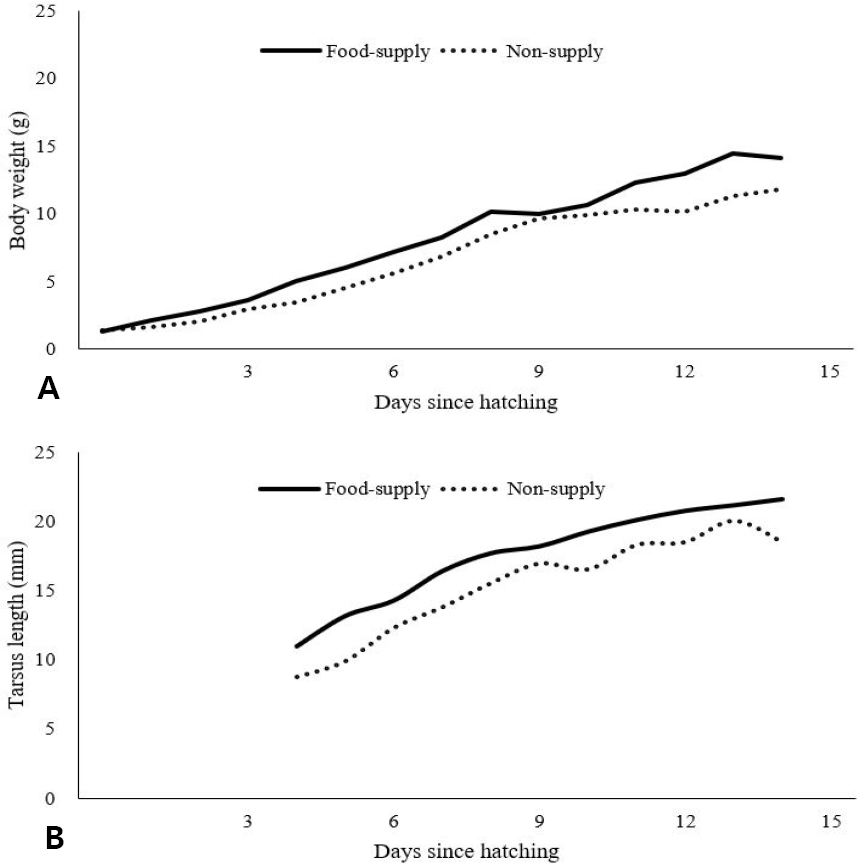
The weight of chicks was significantly different between food-supply and non-supply years (Jonckheere-Terpstra trend analysis, Z = 44.74, P < 0.01; Fig. 1A), with heavier chicks in food-supply years. Moreover, the tarsus length of chicks was significantly higher in food-supply than in non-food supply years (Z = 35.16, P < 0.01; Fig. 1B).
Parents of avian species need to invest in each breeding events, by considering their habitat conditions, which optimally will lead to successful breeding ; . Body condition at the beginning of the breeding season is a critical factor for the onset of breeding events . Larger eggs generally contain greater quantities of nutrients . Moreover, larger eggs cool more slowly when parents are away from the nest and are more likely to hatch .
The supply of anthropogenic food to wild birds has been widely used in many studies, and its effects depend on the ecology of the birds. Food availability influences in all stages of avian breeding , and winter food availability, in particular, is a major determinant of population regulation and mortality in wild birds . Winter food supplementation may bring positive benefits, such as enhanced survival, improved egg quality, increased fledgling success, and increases in adult populations ; Robb et al., 2008a, b; . However, information is still too scant to understand the effect of food supplementation across the entire breeding cycle (Harrison et al., 2010).
Overwintering is challenging for small passerines because they cannot store enough energy in their body. Thus, they need to fulfill a daily energy requirement by feeding . In this study, we show that great tits produced heavier and larger eggs and experienced greater hatching and fledgling success when food was supplied during the preceding winter. Thus, our results suggest that a winter food supply can have positive effects on the breeding performance. Generally, food provided during winter may confer on birds an advantage in winter survival, and better winter feeding leads to increased antioxidant levels and reduced stress. Therefore, an artificial feed supply during winter leads to lead increases in the health of wintering birds , 2018; . A healthier bird can better survive during winter and the breeding season, increasing breeding output (Robb et al., 2008b).
Artificial winter food supplies may create an ecological trap scenario in disturbed habitats ; , where artificial food resources have generally been used as a tools for restoring populations. When supplied with artificial food in the disturbed habitat, birds became grouped for feeding. Especially the non-migratory birds survived winter, ready for the breeding season between late winter and early spring . However, during breeding seasons, food preferences of passerines shift from vegetable-based toward animal-based foods to improve the growth of chicks, and damaged habitat can have poor food resources for breeding, including both plant- and invertebrate-based options (Robb et al., 2008b; . Therefore, an artificial food supply that disappears in late winter may decrease breeding performance in low-quality habitats when birds are left with low food resources during the breeding season.
Artificially supplying winter food resources, when conducted with habitat restoration for bird populations, can be maintained stably if practiced prudently for the specific habitat conditions and characteristics of the population. In the breeding season, most avian species need enough energy for defending territory, finding mates, and raising chicks . Despite this heavy energy burden, an artificial food supply during the preceding winter can be a positive influence on bird populations.
Habitat loss, fragmentation, and degradation undoubtedly impose their anthropogenic influences on wild birds, and many avian species are in decline worldwide . Anthropogenic winter food supplies for avian species may be influential as a counterbalance, increasing the quality of habitats associated with human activity . Therefore, providing supplemental foods in winter could be a useful methods for the conservation of wild birds.
Funding
There was no external funding source for this study.
Ethical statement
Research experiments conducted in this article with animals were approved by Institutional Animal Care and Use Committee, Chung-Ang University (Approval number: CAU 2017-00095) following all guidelines, regulations, legal, and ethical standards as required for animals.
Statement of conflict of interest
The authors have declared no conflict of interest.
Figures
References
- Blount, J.D., Surai, P.F., Nager, R.G., Houston, D.C., Møller, A.P., Trewby, M.L. and Kennedy, M.W., 2001. Proc. R. Soc. Lond. B., 269: 29–36. https://doi.org/10.1098/rspb.2001.1840[CrossRef]
- Broggi, J., Nilsson, J.F., Koivula, K., Hohtola, E. and Nilsson, J.Å., 2019. Oecologica, 189: 339–351. https://doi.org/10.1007/s00442-018-04332-6[CrossRef]
- Broggi, J., Watson, H., Nilsson, J. and Nilsson, J.Å., 2022. J. Avian Biol., 2022: e02969. https://doi.org/10.1111/jav.02969[CrossRef]
- Crates, R.A., Firth, J.A., Farine, D.R., Garroway, C.J., Kidd, L.R., Aplin, L.M., Radersma, R., Milligan, N.D., Voelkl, B., Culina, A., Verhelst, B.L., Hinde, C.A. and Sheldon, B.C., 2016. J. Avian Biol., 47: 678–689. https://doi.org/10.1111/jav.00936[CrossRef]
- Gil, D. and Brumm, H., 2013. Avian urban ecology. Oxford University Press, UK. https://doi.org/10.1093/acprof:osobl/9780199661572.001.0001[CrossRef]
- Harrison, T.J.E., Smith, J.A., Martin, G.R., Chamberlain, D.E., Bearhop, S., Robb, G.N. and Reynolds, S.J., 2010. Physiol. Ecol., 164: 311–320. https://doi.org/10.1007/s00442-010-1645-x[CrossRef]
- Hwang, H.S., Son, S.H. and Rhim, S.J., 2015. For. Sci. Tech., 11: 223–227. https://doi.org/10.1080/21580103.2014.990061[CrossRef]
- Isaksson, C., Andersson, M.N., Nord, A., von Post, M. and Wang, H.L., 2017. Front. Ecol. Environ., 5: 44. https://doi.org/10.3389/fevo.2017.00044[CrossRef]
- Johansen, S.M., Horn, D.J. and Wilcoxen, T.E., 2014. Wildl. J. Ornithol., 126: 374–381. https://doi.org/10.1676/13-066.1[CrossRef]
- Kokko, H. and Sutherland, W.J., 2001. Evol. Ecol. Res., 3: 537–551.
- Lambrechts, M.M., Adriaensen, F., Ardia, D.R., Artemyev, A.V., Atiénzar, F., Bańbura, J., Barba, E., Bouvier, J.C., Camprodon, J., Cooper, C.B., Dawson, R.D., Eens, M., Eeva, T., Faivre, B., Garamszegi, L.Z., Goodenough, A.E., Gosler, A.G., Grégoire, A., Griffith, S.C., Gustafsson, L., Johnson, L.S., Kania, W., Keiśs, O., Llambias, P.E., Mainwaring, M.C., Mänd, R., Massa, B., Mazgajski, T.D., Møller, A.P., Moreno, J., Naef-Daenzer, B., Nilsson, J.Å., Norte, A.C., Orell, M., Otter, K.A., Park, C.R., Perrins, C.M., Pinowski, J., Porkert, J., Potti, J., Remes, V., Richner, H., Rytkönen, S., Shiao, M.T., Silverin, B., Slagsvold, T., Smith, H.G., Sorace, A., Stenning, M.J., Stewart, I., Thompson, C.F., Tryjanowski, P., Török, J., van Noordwijk, A.J., Winkler, D.W. and Ziane, N., 2010. Acta Ornithol., 45: 1–26. https://doi.org/10.3161/000164510X516047[CrossRef]
- Lasters, R., Groffen, T., Lopez-Antia, A., Bervoets, L. and Eens, M., 2019. Environ. Pollut., 246: 237–248. https://doi.org/10.1016/j.envpol.2018.12.014[CrossRef]
- Lee, D.H., Lee, J.K., Eom, T.K., Bae, H.K., Ko, H. and Rhim, S.J., 2023. Turk. J. Zool., 47: 33–38. https://doi.org/10.55730/1300-0179.3110[CrossRef]
- Lee, W.S., Koo, T.H. and Park, J.Y., 2020. A field guide to the birds of Korea. 2nd ed. LG Evergreen Foundation, Korea.
- Mackintosh, M.A. and Briskie, J.V., 2005. Biol. Conserv., 122: 409–414. https://doi.org/10.1016/j.biocon.2004.09.002[CrossRef]
- Matthew, R.E., Lank, D.B., Boyd, W.S. and Cooke, F., 2002. Condor, 104: 610–619. https://doi.org/10.1093/condor/104.3.610[CrossRef]
- Montreuil-Spencer, C., Schoenemann, K., Lendvai, Á.Z. and Bonier, F., 2019. Behav. Ecol., 30: 1642–1652. https://doi.org/10.1093/beheco/arz129[CrossRef]
- Pearson, M. and Husby, M., 2021. Ornis Fenn., 98: 46–58.
- Plummer, K.E., Bearhop, S., Leech, D.I., Chamberlain, D.E. and Blount, J.D., 2013. J. Anim. Ecol., 82: 673–682. https://doi.org/10.1111/1365-2656.12025[CrossRef]
- Plummer, K.E., Bearhop, S., Leech, D.I., Chamberlain, D.E. and Blount, J.D., 2018. Ecol. Evol., 2018: 5059–5068. https://doi.org/10.1002/ece3.4048[CrossRef]
- Reid, N., McDonald, R.A. and Montgomery, W.I., 2010. Biol. Conserv., 143: 1701–1706. https://doi.org/10.1016/j.biocon.2010.03.041[CrossRef]
- Reynolds, J.S., Galbraith, J.A., Smith, J.A. and Jones, D.N., 2017. Front. Ecol. Evol., 5: 24. https://doi.org/10.3389/fevo.2017.00024[CrossRef]
- Reynolds, S.J., Schoech, S.J. and Bowman, R., 2003. Oecologia, 134: 308–316. https://doi.org/10.1007/s00442-002-1126-y[CrossRef]
- Robb, G.N., McDonald, R.A., Chamberlain, D.E. and Bearhop, S., 2008a. Front. Ecol. Environ., 6: 476–484. https://doi.org/10.1890/060152[CrossRef]
- Robb, G.N., McDonald, R.A., Chamberlain, D.E., Reynolds, S.J., Harrison, T.J.E. and Bearhop, S., 2008b. Biol. Lett., 4: 220–223. https://doi.org/10.1098/rsbl.2007.0622[CrossRef]
- Rooney, E., Reid, N. and Montgomery, W., 2015. Ibis, 157: 181–185. https://doi.org/10.1111/ibi.12218[CrossRef]
- Sherry, D.F. and Hoshooley, J.S., 2010. Phil. Trans. R. Soc. B Biol. Sci., 365: 933–943. https://doi.org/10.1098/rstb.2009.0220[CrossRef]
- Sockman, K.W., Sharp, P.J. and Schwabl, H., 2006. Biol. Rev., 81: 629–666. https://doi.org/10.1111/j.1469-185X.2006.tb00221.x[CrossRef]
- Stagoll, K., Lindenmayer, D.B., Knight, E., Fischer, J. and Manning, A.D., 2012. Conserv. Lett., 5: 115–122. https://doi.org/10.1111/j.1755-263X.2011.00216.x[CrossRef]
- Verena, P.S., Stiefel, T., Kotrschal, K., Kleindorfer, S. and Frigerio, D., 2021. J. Ornithol., 162: 277–288. https://doi.org/10.1007/s10336-020-01824-2[CrossRef]
- Wilcoxen, T.E., Horn, D.J., Hogan, B.M., Hubble, C.N., Huber, S.J., Flamm, J., Knott, M., Lundstrom, L., Salik, F., Wassenhove, S.J. and Wrobel, E.R., 2015. Conserv. Physiol., 3: cov058. https://doi.org/10.1093/conphys/cov058[CrossRef]
- Williams, T.D., 2012. Physiological adaptations for breeding in birds. Princeton University Press, USA. https://doi.org/10.23943/princeton/9780691139821.001.0001[CrossRef]
Cited by 1 article
In journals published by ResearchersLinks.
Services
Article usage statistics
Loading…