
This study was conducted to examine the effect of papaya seed on growth performance, gut morphometry, and economics in Japanese quail. Two hundred and twenty day-old quail chicks were used for the experimental purposes and were divided into four groups each with four replicates of 15 quails per replicate. Group 1 was CON (control) with normal feed while groups 2, 3, and 4 were provided with 1, 2, and 3g/kg papaya seed powder in feed respectively. The results showed no effect of papaya seed on overall feed intake, weight gain, feed conversion ratio, and mortality. The villus height and crypt depth were lower in the 3g/kg diet group ratio compared to CON and other groups. Villus width and the dressing percentage had a significantly higher value in the 3g/kg diet group than in the CON and other groups. It is concluded that papaya seed at the level of 3g/kg feed has a useful effect on growth performance, carcass traits, and gut morphology in quails.
Short Communication · Volume 57, Issue 4, 6 July 2025 · Open Access
Effect of Supplementation of Papaya Seed (Carica papaya) on Growth Performance, Carcass Traits, and Histomorphology of Japanese Quails
· · · · · · ·
Affiliations & Notes ⌄
- 1Department of Poultry Science, Faculty of Animal Husbandry and Veterinary Sciences, The University of Agriculture, Peshawar, Pakistan. 2Arid Zone Small Ruminants Research Institute, Ghulam Banda, Kohat, Pakistan. 3College of Veterinary Sciences, Faculty of Animal Husbandry and Veterinary Sciences, The University of Agriculture, Peshawar, Pakistan 4Animal Production, College of Agriculture and Food Sciences, King Saud University, Riyadh, Saudi Arabia 5US National Poultry Research Center, Toxicolo
Article Info ⌄
- Journal:
- Pakistan Journal of Zoology
- Published:
- 6 July 2025

From the article
- Overall and weekly FCR was not affected except in week 2nd, where a significantly higher FCR was observed in the CON group as compared to the 1 and 3 g/kg diet groups.
- The dressing percentage had a significantly higher value in the 3g/kg diet group than in the CON and 1g/kg diet groups.
- It is concluded from the current study that papaya seed powder at the level of 3g/Kg in feed does not affect the feed intake, weight gain, FCR, and mortality and enhances significantly the dressing percentage and ileum morphology.
Selected from the article's own text.
Abstract
Materials and methods
The experiment was carried out at the Department of Poultry Science and samples were analyzed at the Pathology Laboratory of the College of Veterinary Science, the University of Agriculture, Peshawar. Papaya seeds were purchased from the local market and identified by the medicinal plant experts in the Department of Botany at the University of Peshawar. The method described by Myandoab and Hosseini (2012) was followed with a few modifications for the processing.
A total of 240 days old quail chicks were obtained from the local market and were divided into four groups (CON, T2, T3, and T4), each with four replicates and fifteen quail per replicate. Group 1 was a CON (control) group with normal feed while groups 2, 3, and 4 were provided with 1, 2, and 3g/kg of papaya seed powder in feed, respectively. Based on the NRC (1994), the experimental basal diet was made to meet the requirements of quail. The feed and water were given ad libitum to the experimental birds from day 1 to 35. The light was provided for twenty-four hours. The duration of the experiment was five weeks (with 1st week as brooding). Biosecurity was maintained to prevent the spread of illnesses.
Weekly feed intake, body weight gain (BWG), and feed conversion ratio (FCR) were calculated according to the formulae used by Ashiq et al. (2023). Mortality was recorded daily. Post-mortem examinations of dead birds were performed to rule out any disease or lesions. The dressing percentage was calculated with the help of the formula e.g., Dressing percentage = dressed weight/live weight x 100. For gut morphometry, 2 birds from each replicate were randomly slaughtered on the last day of the experiment. After that, a small piece was cut from the ileum portion of the small intestine and was used for the morphological measurement as described by Ashiq et al. (2023).
A completely randomized design (CRD) was used to assess the experimental data. Analysis of Variance (ANOVA) was performed using software statistics 8.1. The Graph Pad Prism 8 software (San Diego, CA, USA) was used to make histograms.
Results and discussion
Table I shows the effect of the addition of papaya seed on feed intake, weight gain, and FCR. Weekly as well as overall feed intake was not affected. The weight gain during the 2nd and 5th week and overall was not affected but during the 3rd and 4th weeks, a significantly higher weight gain was observed in the 2g/kg diet group. Overall and weekly FCR was not affected except in week 2nd, where a significantly higher FCR was observed in the CON group as compared to the 1 and 3 g/kg diet groups. Mortality was not recorded during the whole experiment. Figure 1 shows the result of the papaya seed effect on dressing percentage. The dressing percentage had a significantly higher value in the 3g/kg diet group than in the CON and 1g/kg diet groups. The results related to the intestinal histomorphology are also presented in Table I. The villus height and crypt depth were (p<0.05) higher in the 3g/kg diet group while villus height to crypt depth ratio in the CON group than in the remaining groups. Villus width showed a significantly higher value in the 3g/kg diet group than in the 1g/kg diet group.
The current study indicated that the overall effect of papaya seed-supplemented was calculated as non-significant on feed intake, weight gain, FCR, and mortality. Similarly, Soedji et al. (2017) investigated the effect of graded levels of dried pawpaw in pullets and found no significant effect on weight gain and FCR. The findings of the present study is in line with Tamiru et al. (2021) who investigated the effects of different concentrations of dried papaya pomace
Table I. Effect of papaya seed on feed intake, weight gain, feed conversion ratio (FCR) and histomorphology of quails.
| Parameter | Week | Papaya seed treatment | SEM | P. value | |||
| Control | 1g/kg | 2g/kg | 3g/kg | ||||
| Feed intake (g) | 2nd | 77.81 | 79.35 | 79.71 | 78.52 | 0.85 | 0.441 |
| 3rd | 106.4 | 105.7 | 107.7 | 107.1 | 1.14 | 0.863 | |
| 4th | 137.2 | 140.8 | 139.1 | 139.5 | 0.96 | 0.141 | |
| 5th | 163.1 | 159.9 | 163.4 | 165.3 | 0.93 | 0.582 | |
| Overall | 484.7 | 485.8 | 489.9 | 490.5 | 1.87 | 0.674 | |
| Weight gain (g) | 2nd | 26.70 | 27.49 | 27.48 | 27.21 | 0.49 | 0.671 |
| 3rd | 34.56b | 36.8ab | 37.15a | 37.03a | 2.51 | 0.013 | |
| 4th | 45.19b | 47.8ab | 48.09a | 47.1ab | 1.77 | 0.001 | |
| 5th | 55.73 | 54.47 | 53.79 | 56.10 | 0.75 | 0.181 | |
| Overall | 162.2 | 166.6 | 166.5 | 167.5 | 1.27 | 0.060 | |
| FCR | 2nd | 2.98 | 2.93 | 2.93 | 2.91 | 0.92 | 0.983 |
| 3rd | 2.91a | 2.88b | 2.90ab | 2.88b | 2.04 | 0.032 | |
| 4th | 3.07 | 2.87 | 2.89 | 2.89 | 0.29 | 0.161 | |
| 5th | 3.03 | 2.96 | 2.90 | 2.95 | 0.63 | 0.201 | |
| Overall | 2.92 | 3.02 | 3.03 | 2.94 | 0.89 | 0.072 | |
| Mortality | Overall | 0.00 | 0.00 | 0.00 | 0.00 | 0.00 | 0.000 |
| Histomorphology | |||||||
| VH(μm) | 368.71d | 379.6c | 388.9b | 398.5a | 1.19 | 0.021 | |
| VW (μm) | 106.1ab | 97.12b | 105.1ab | 109.8a | 0.88 | 0.011 | |
| CD (μm | 127.81d | 132.8c | 139.4b | 148.7a | 1.15 | 0.083 | |
| VH:CD (μm) | 2.88a | 2.85b | 2.78c | 2.68d | 1.34 | 0.001 | |
Different superscripts along the row indicate significant difference (p <0.05). VH, Villus height; CD, Crypt depth; VW, Villus width.
meal on different parameters of laying hens and results suggested no significant effect on the feed intake. Similarly, Nideou et al. (2017) used different levels of papaya seed to determine its effect on different performance parameters of broilers and the results showed no significant effect on the feed intake. Omidiwura et al. (2020) tested the combine effect of Chromolaena odorata and pawpaw in broilers and the results suggested no significant effect on the feed conversion ratio. Muazu et al. (2020) determined the effect of papaya seed powder at different concentrations on growth performance and serum biochemistry in broilers and found no effect on these parameters. Adegbeye et al. (2020) studied the effect of papaya and other herbal plants in different levels on broilers and found no significant effect on performance parameters. Rahimsari et al. (2021) performed a study to evaluate the effects of incorporating papaya seed on the quail performance and the result did not show any effect on the FCR. Kusbiyantari et al. (2017) also conducted a study to find the effect of papaya leaf extract on the antimicrobial effect and performance parameters of quail and found no effect on egg weight, feed intake, and death rate. Rahmani and Aldebasi (2017) stated that C.papaya plays a therapeutic role as an analgesic, antioxidant, antimicrobial, antiulcerogenic, anti-inflammatory, and gastro-protectant effects. The dressing percentage had a significantly higher value in the 3g/kg diet group than in the CON and 1g/kg diet groups and this results are in line with the findings of Bolu et al. (2009) who used different concentrations of dried pawpaw levels in broilers and found significant increase in the dressing percentage. Omidiwura et al. (2020) also used the combination of Chromolaena odorata and pawpaw in broilers and the results suggested a positive response on the gut morphology. Result of the current study on histomorphology coincide with the findings of Adegbeye et al. (2020). Similarly, Panzarini et al. (2014) described that papaya seed acts as a free radical scavenger protecting the internal mucosa from oxidative stress. Saleh et al. (2019) also reported that papaya seed contains different vitamins that act as good antioxidants enhancing the bird’s efficiency in preventing oxidative stress.
Conclusion
It is concluded from the current study that papaya seed powder at the level of 3g/Kg in feed does not affect the feed intake, weight gain, FCR, and mortality and enhances significantly the dressing percentage and ileum morphology.
Acknowledgement
The staff of the Department of Poultry Science, The University of Agriculture, Peshawar, is gratefully acknowledged for providing technical and laboratory facilities.
Funding
This study was financially supported by King Saud University, Riyadh, Saudi Arabia, under Researcher Supporting Project (RSP) number “RSP-2024R439”.
IRB approval
The experimental work was approved by the Board of Studies (September 2021) conducted at the Department of Poultry Science, The University of Agriculture Peshawar, KP, Pakistan.
Ethical statement
The experiments were approved by the Ethical Committee of the Faculty of Animal Husbandry and Veterinary Sciences, The University of Agriculture Peshawar.
Statement of conflict of interest
The authors have declared no conflict of interest.
Figures
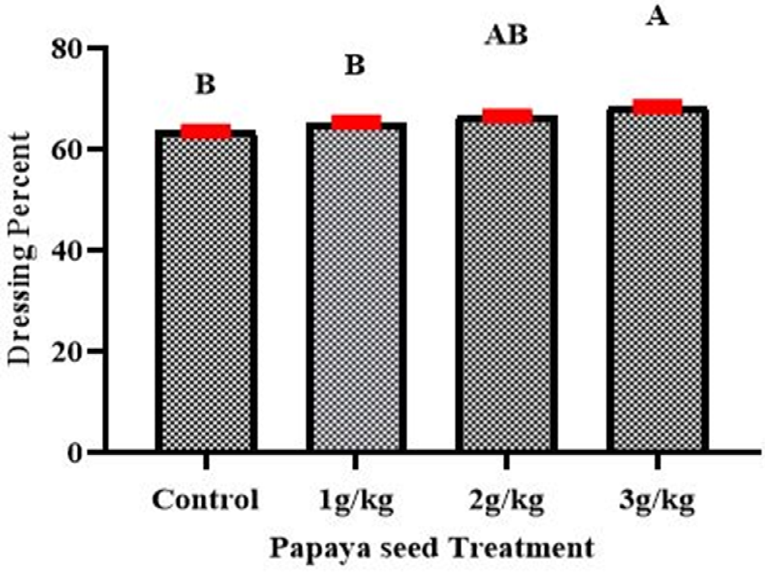
Effect of papaya seed (Carica papaya) in feed on dressing percentage in quails.
References
- Adegbeye, M.J., Elghandour, M.M., Faniyi, T.O., Rivero, P.N., Barbabosa-Pilego, A., Zaragoza-Bastida, A. and Salem, A.Z., 2020. Agrofor. Syst., 94: 1255-1268. https://doi.org/10.1007/s10457-018-0337-0[CrossRef]
- Ashiq, U., Khan, S., Shuaib, M., Hassan, S., Sufyan, A., Lionel, K. and Ullah, Q., 2023. Pakistan J. Zool., 55: 1-8.
- Bolu, S.A.O., Sola-Ojo, F.E. and Olorunsanya, O.A., 2009. Int. J. Poult. Sci., 8: 905-909. https://doi.org/10.3923/ijps.2009.905.909[CrossRef]
- Burt, S., 2004. Int. J. Fd. Microbiol., 94: 223–253. https://doi.org/10.1016/j.ijfoodmicro.2004.03.022[CrossRef]
- Fernando, U., Biswas, D., Allan, B., Wilson, P. and Potter, A.A., 2007. Int. J. Fd. Microbiol., 118: 194-200. https://doi.org/10.1016/j.ijfoodmicro.2007.07.038[CrossRef]
- Fudge, A.M., 2000. Laboratory medicine avian and exotic pets. Saunders, Saint Louis, MO, USA.
- Gha, V., Fisher, D. and Henkel, R., 2019. J. Ethnopharmacol., 241: 111972. https://doi.org/10.1016/j.jep.2019.111972[CrossRef]
- Kadiri, O., Olawoye, B., Fawale, O.S. and Adalumo, O.A., 2016. Turk. J. Agric. Fd. Sci. Technol., 4: 1039-1052. https://doi.org/10.24925/turjaf.v4i12.1039-1052.569[CrossRef]
- Kusbiyantari, A., Kardaya, D. and Sudrajat, D., 2017. J. Peternakan Nusantara., 3: 31-40. https://doi.org/10.30997/jpnu.v3i1.855[CrossRef]
- Mayer, M., Vogl, C.R., Amorena, M., Hamburger, M. and Walkenhorst, M., 2014. Res. Complement. Med., 21: 375-386. https://doi.org/10.1159/000370216[CrossRef]
- Mounia, M., Nadir, A. and Omar, B, 2018. Int. J. Vet. Sci. Res., 4: 9-11. https://doi.org/10.17352/ijvsr.000028[CrossRef]
- Muazu, U. and Aliyu-Paiko, M., 2020. IOSR J. Biotechnol. Biochem., 6: 8-18.
- Myandoab, M.P. and Hosseini, M.N., 2012. Glob. Vet., 8: 39-42.
- Nideou, D., Soedji, K., Teteh, A., Decuypere, E., Gbeassor, M. and Tona, K., 2017. Int. J. Prob. Preb., 12: 89-95.
- NRC, 2013. Nutrients requirements of poultry. 9th revised ed. National Academy Press, Washington, D.C., USA
- NRC, 1994. Nutrient requirements of poultry. National Research Council.
- Omidiwura, B.R.O., Agboola, A.F., Omotosho, O.Y. and Mustapha-Olosho, J.A., 2020. J. Anim. Sci. Vet. Med., 5: 173-183.
- Ong, H.C., Chua, S. and Milow, P., 2011. Stud. Ethno-Med., 5: 95-100. https://doi.org/10.1080/09735070.2011.11886395[CrossRef]
- Panzarine, E., Dwikat, M., Mariano, S., Vergallo, C. and Dini, L., 2014. Antioxidant effect of Carica papaya seed water extract. Evidence-based complementary and alternative medicine. https://doi.org/10.1155/2014/281508[CrossRef]
- Pliego, A.B., Tavakoli, M., Khusro, A., Seidavi, A., Elghandour, M.M., Salem, A.Z. and Rene, R.C.R., 2022. Anim. Biotechnol., 33: 369-391. https://doi.org/10.1080/10495398.2020.1798973[CrossRef]
- Rahmani, A.H. and Aldebasi, Y.H., 2017. Asian J. Pharm. Cl. Res., 10: 49-53. https://doi.org/10.22159/ajpcr.2017.v10i6.17832[CrossRef]
- Rahmasari, R., Hertamawati, R.T., Rafli, A.K. and Nugraha, B.A., 2021. IOP Conf. Ser. Earth Environ. Sci., 672: 012040. https://doi.org/10.1088/1755-1315/672/1/012040[CrossRef]
- Rasool, H.B.A., 2012. Pharma. Anal. Acta, 3: 2153-435.
- Saleh, A.A., Ahmed, E.A. and Ebeid, T.A., 2019. Reprod. Domest. Anim., 54: 846-854. https://doi.org/10.1111/rda.13432[CrossRef]
- Saleh, A.A., Ragab, M.M., Ahmed, E.A.M., Abudabos, A.M. and Ebeid, T.A., 2018. J. appl. Anim. Res., 46: 820–827. https://doi.org/10.1080/09712119.2017.1407768[CrossRef]
- Setargie, A., Mekbib, F. and Abraha, E., 2015. World J. agric. Sci., 11: 84-88.
- Soedji, K., Teteh, A., Gbeassor, M., Tona, K., Nideou, D. and Decuypere, E., 2017. Int. J. Probiot. Prebiot., 12.
- Sugiharto, S., Yudiarti, T., Isroli, I. and Widiastuti, E., 2018. Iran. J. appl. Anim. Sci., 8: 375-385.
- Tamiru, B., Alkhtib, A., Tamiru, M., Demeke, S., Burton, E., Tolemariam, T. and Janssens, G.P., 2021. Vet. Med. Sci., 7: 1914-1920. https://doi.org/10.1002/vms3.516[CrossRef]
- WHO, 2013. WHO traditional medicine strategy 2014-2023. World Health Organization, Geneva.
Services
Article usage statistics
Loading…