
Now a days, DNA barcoding using COI gene (mitochondrial cytochrome c oxidase subunit I) has gained more attention, because of these barcodes validity and simplicity for identification of bird species has increased a lot. In present study, 650bp region of COI gene of two bird species, Chukar patridge (Alectoris chukar) and Sand patridge (Ammoperdix heyi) are sequenced. Total 6 birds (03 birds from each species) were selected. Each sample was aligned with its reference sequence of COI gene available on NCBI and every nucleotide position which did not align with reference sequence was studied to identify SNPs. Our results demonstrated that A. chukar formed a single cluster with Alectoris philbyi while Alectoris rufa and Alectoris melanocephala were a bit distant relatives of A. chukar. The study clearly suggesting efficacy and accuracy of DNA barcodes for molecular identification and characterization of species. Further, barcoding technique used for analysis of molecular diversity and genetic identification of partridges provide a valuable information about population structure, phylogenetic history, molecular conservation and species identification.
Short Communication · Volume 57, Issue 4, 6 July 2025 · Open Access
Molecular Characterization and Genetic Identification of Pakistani Partridges Through DNA-Barcoding
· · · · · · · · ·
Affiliations & Notes ⌄
- 1Institute of Biochemistry and Biotechnology, University of Veterinary and Animal Science, Lahore, Pakistan 2Department of Zoology, Government College University, Lahore, Pakistan * Corresponding author: arawan77@uvas.edu.pk
Article Info ⌄
- Journal:
- Pakistan Journal of Zoology
- Published:
- 6 July 2025

From the article
- The homology anatomization of the reference sequence and COI gene sequences of closest species; chukar patridge and sand patridge disclosed single nucleotide polymorphisms at various sites in COI gene sequences.
- The phylogenetic tree using 650bp nucleotide segment of COI gene was created followed by the comparison of COI gene sequences of both Chukar patridge and Sand patridge with all available sequences of patridges.
- The results showed that A. chukar formed a single cluster with Alectoris philbyi.
- The genus Francolinus formed a single cluster indicated that F. francolinus and its sister species are sharing a common ancestor.
Selected from the article's own text.
Abstract
Materials and methods
Six birds from two different species (3 birds from each species) were selected randomly during the year 2012 to 2016 with the participation of the Punjab Wildlife and Parks Department and Pet Center of University of Veterinary and Animal Sciences, Lahore. The bird’s identification was made based upon their morphological characters.
Blood samples (100-300 μl) were collected from brachial wing vein of each in a vial having 40µL of EDTA solution (0.5M, pH 8.0) and stored at -20°C before extraction of genomic DNA according to Sambrook and Russel (2001) using Thermo Fisher Scientific Kit, USA. This DNA was used for amplification of COI gene using primers as follows .
F 5’ TTCTCCAACCACAAAGACATTGGCAC 3’
R 5’ ACGTGGGAGATAATTCCAAATCCTG 3’
The PCR products (700bp) was sequenced on Applied Bimolecular System Instrument ABI 3100 Genetic Analyzer in Center for Applied Molecular Biology, Punjab, Pakistan. Sequences were analyzed by Bio Edit software and for homology and Clustal W2 was used for pairwise alignment.
By making use of Fast Minimum Evolution Method, phylogenetic trees for both the bird species were constructed in which COI gene sequences of Pakistani patridges were compared with all available sequences of birds to look over their phylogeny and taxonomy ; . The MEGA 6.0 software was used for further phylogenetic analysis.
Results and discussion
In the present study, the COI gene of Pakistani patridges were sequenced. The sequences of gene were submitted to National Centre for Biotechnology Information Genbank and different analysis of COI gene sequences were performed including homology analysis. The homology anatomization of the reference sequence and COI gene sequences of closest species; chukar patridge and sand patridge disclosed single nucleotide polymorphisms at various sites in COI gene sequences. The phylogenetic tree using 650bp nucleotide segment of COI gene was created followed by the comparison of COI gene sequences of both Chukar patridge and Sand patridge with all available sequences of patridges. The results showed that A. chukar formed a single cluster with Alectoris philbyi. A. rufa and Alectoris melanocephala were a bit distant relatives of A. chukar (Fig. 1). In addition, A. heyi showed a single cluster relationship with Francolinus genus. The genus Francolinus formed a single cluster indicated that F. francolinus and its sister species are sharing a common ancestor. Outer group of A. chukar; F. francolinus and F. pondicerianus are Chinese Arborophila bruneopectus (KC352730.2) bar-backed partridge, showed that Pakistani A. chukar, F. francolinus and F. pondicerianus had evolved from Chinese bar backed partridge (Fig. 2).
Many investigators also used mitochondrial control region sequences for phylogenetic and molecular diversity analysis of avain species ; . A study was designed by Huang et al. (2007) in which he utilized mitochondrial control regions for analysis of phylogeographical structure of rusty patridges (neck-laced patridges). The control region sequences have demonstrated phylogeographical structure existence among population of rock patridges resulting from genetic divergence in Southern refugia .
Further, Fleischer et al. (2006) had conducted an experiment for DNA analysis of seven endangered specimens of wood- pecker (Campephilus principalis) and showed the documentation of their molecular diversity. The sequence analysis of these wood peckers had provided an essential DNA barcode resource for discernment of these endangered species. Although patridges have not considered threatened, it is likely that many vulnerable local populations exist within the range of species resulting from hunting and habitat loss and may need special attention . Barilani et al. (2007) in his study have disclosed introgessive hybridization, suggesting that the released captive-bred patridges have hybridized and reproduced in nature polluting the wild rock patridge population’s gene pool in Greece. It means that a fine understanding of evolutionary history and phylogeography provides important information about habitat preference and physical barriers influence on gene flow in birds .
Conclusion
In conclusion, the 650bp sequence of mitochondrial cytochrome c oxidase subunit I act as an important
phylogenetic marker because trees that are obtained with its data set coincides with pre-established phylogeny of patridges species.
Acknowledgments
We are highly thankful to Higher Education Commission (HEC), Pakistan for their tremendous contribution and financial support to the first author of this article during this research work.
Conflict of interest statement
The authors have declared no any conflict of interest in this study.
Figures
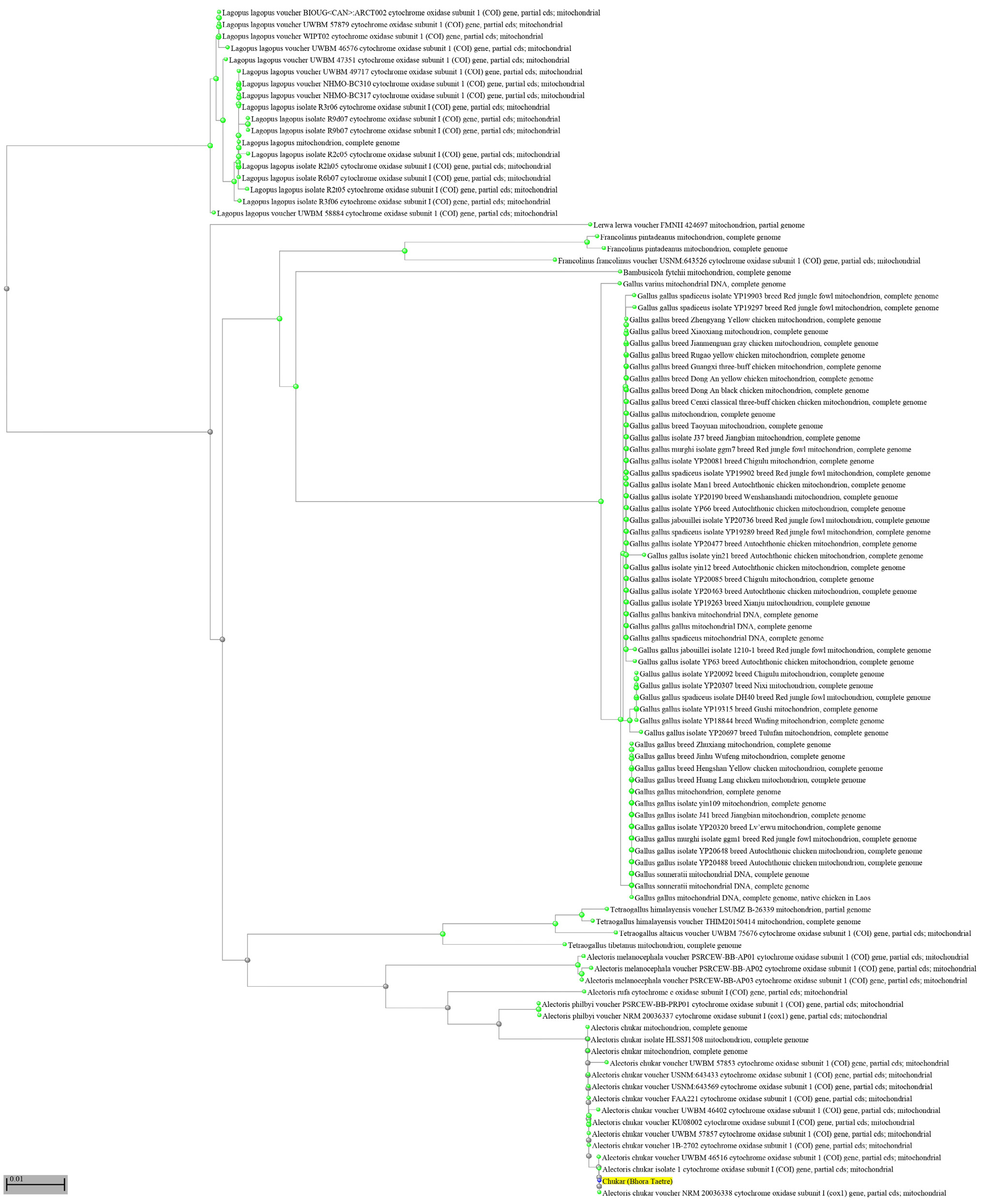
The phylogenetic tree of the Chukar patridge (Alectoris chukar) based on COI gene analysis.
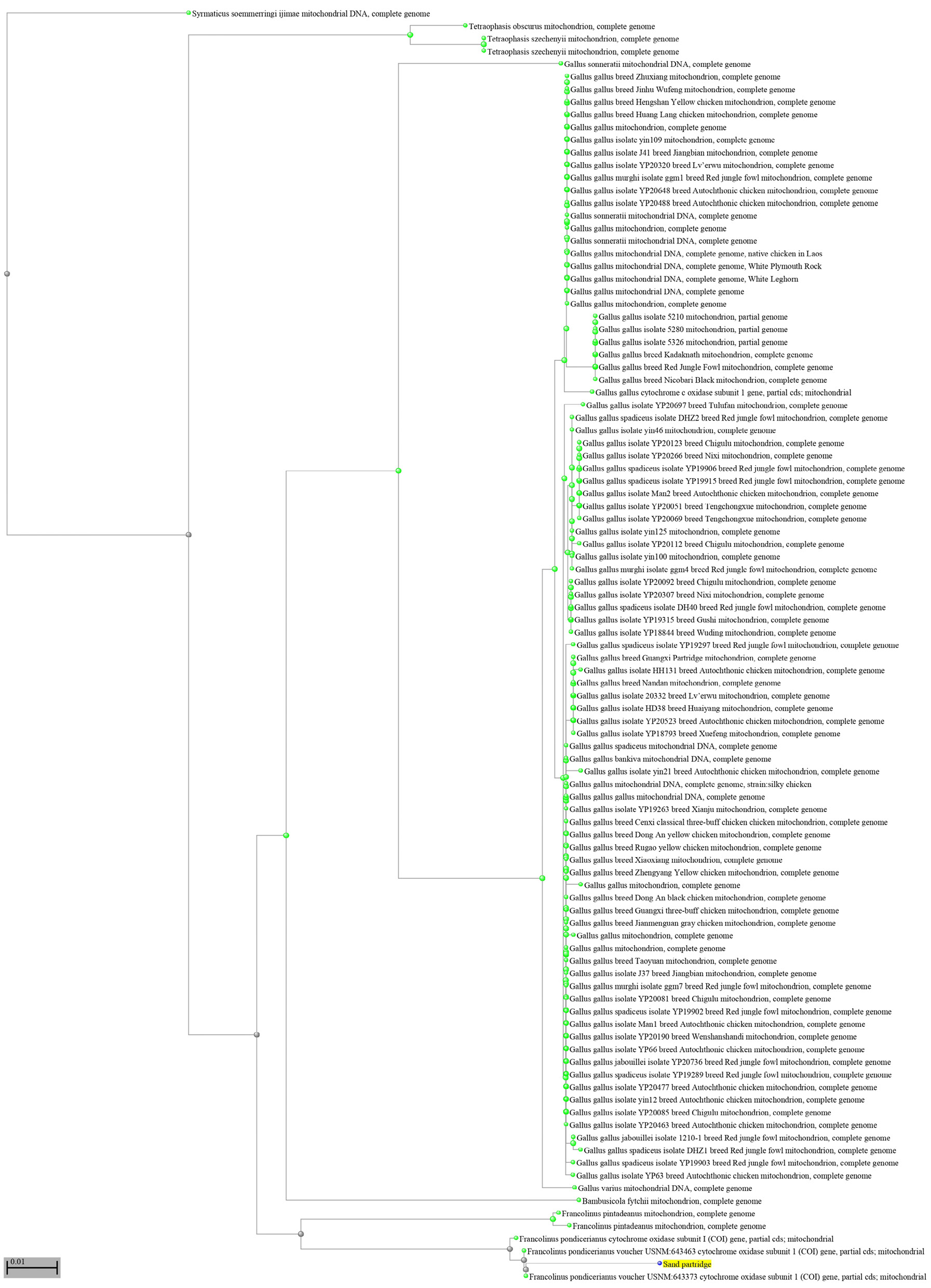
The phylogenetic tree of the sand patridge (Ammoperdix heyi) based on COI gene analysis.
References
- Barilani, M., Sfougaris, A., Giannakopoulos, A., Mucci, N., Tabarroni, C. and Randi, E., 2007. Conserv. Genet., 8: 343–354. https://doi.org/10.1007/s10592-006-9174-1[CrossRef]
- Chaves, A.V., Clozato, C.L., Lacerda, D.R., Sari, E.H.R. and Santos, F.R., 2008. Mol. Ecol. Resour., 8: 1169–1177. https://doi.org/10.1111/j.1755-0998.2008.02218.x[CrossRef]
- Danish, M.T., Geerlinds, E., Solkner, J., Thea, S., Thieme, O. and Wurzinger, M., 2008. Characterization of Indigenous chicken production system in Cambodia. FAO.
- Desper, R. and Gascuel, O., 2004. Mol. Biol. Evol., 21: 587-598. https://doi.org/10.1093/molbev/msh049[CrossRef]
- Fleischer, R.C., Kirchman, J.J. and Dumbacher, J.P., 2006. Biol. Lett., 2: 466–469. https://doi.org/10.1098/rsbl.2006.0490[CrossRef]
- Hebert, P.D.N., Penton E. H., Burns, J.M., Janzen, D. and Hallwachs, W., 2004. Proc. natl. Acad. Sci. USA., 101: 14812–14817. https://doi.org/10.1073/pnas.0406166101[CrossRef]
- Huang, Z., Liu, N., Luo, S. and Long, J., 2007. Mol. Phylogenet. Evol., 43: 379–385. https://doi.org/10.1016/j.ympev.2007.01.005[CrossRef]
- Kark, S., Alkon, P.U., Safriel, U.N. and Randi, E., 1999. Conserv. Biol., 13: 542–552. https://doi.org/10.1046/j.1523-1739.1999.98150.x[CrossRef]
- Khan, H.A., Arif, I.A. and Shobrak, M., 2010. Evol. Bioinf., 6: 151. https://doi.org/10.4137/EBO.S6014[CrossRef]
- Kleinhaus, S., Pin show, B., Bernstein, M.H. and Degen, A.A., 1985. Physiol. Zool., 58: 105-116. https://doi.org/10.1086/physzool.58.1.30161224[CrossRef]
- Lane, C.E., Lindstrom, S.C. and Saunders, G.W., 2007. Mol. Phylogenet. Evol., 44: 634–648. https://doi.org/10.1016/j.ympev.2007.03.016[CrossRef]
- Lerner, H.R., Johnson, J.A., Lindsay, A.R., Kiff, L.F. and Mindell, D.P., 2009. PLoS One, 4: e7336. https://doi.org/10.1371/journal.pone.0007336[CrossRef]
- Lucchini, V. and Randi, E., 1998. Heredity, 81: 528–536. https://doi.org/10.1038/sj.hdy.6884130[CrossRef]
- Morris-Pocock, J.A., Steeves, T.E., Estela, F.A., Anderson, D.J. and Friesen, V.L., 2010. Mol. Phylogenet. Evol., 54: 883–896. https://doi.org/10.1016/j.ympev.2009.11.013[CrossRef]
- Ozaki, K., Yamamoto, Y. and Yamagishi, S., 2010. Genes Genet. Syst., 85: 55–63. https://doi.org/10.1266/ggs.85.55[CrossRef]
- Peg, G.G., Sinclair, B., Briskey, L. and Aspden, W.J., 2006. Austral. Sci. Mar., 70: 7–12. https://doi.org/10.3989/scimar.2006.70s27[CrossRef]
- Sambrook, J. and Russel, D.W., 2001. Molecular cloning: A laboratory manual 111. Cold spring Laboratory press. Cold spring Harbour.
- Tavares, E.S. and Baker, A.J., 2008. BMC Evol. Biol., 8: 81. https://doi.org/10.1186/1471-2148-8-81[CrossRef]
- Valentini, A., Pompanon, F. and Taberlet, P., 2008. Tree, 24: 110–117. https://doi.org/10.1016/j.tree.2008.09.011[CrossRef]
- Waugh, W.J., 2011. DNA barcoding the birds of New Zealand: A thesis presented in fulfillment of the requirements for the degree of Doctor of Philosophy in Molecular Biosciences at Massey University, Auckland, New Zealand. Doctoral dissertation, Massey University.
Services
Article usage statistics
Loading…