
Present paper provides information on the comparative effectiveness of the three repellents: mist nets, reflecting ribbons and distress sound player with respect to the five economically significant crops viz. maize, chickpea, sugarcane and sunflower for the two birds, Psittacula krameri and Corvus splendens at the mature crop stages. Mist nets are considered physical barrier on the various crops to maximally deter their damage and, therefore, act as the potential repellents against the birds. Present study was conducted from January through December, 2021 to determine the movements patterns of the rose-ringed parakeet and house crow impacted by the repellents at the students’ farms of the University Campus. Observations were recorded in the two one-acre crops for eight hours, four each in the morning and afternoon durations, 05:30-9:30 am and from 13:30-17:30 pm, respectively. They were further differentiated for period of 30-min in the two observations hours for the controlled and repellent treated conditions. Apparently, the two crops, sunflower and maize, were significantly damaged by the rose-ringed parakeet in the controlled conditions. They depicted their means 506.43±2.54 and 537.57±5.52. Nonetheless, in the repellents treated conditions, the means were 242.29±4.95 and 273.14±5.86. Mean damage recorded for the crows in controlled conditions for the sunflower was 510.86±7.11 and for maize it was 464.43±3.20. It was, therefore, evident that the repellents sufficiently reduced the numbers of attacking birds on all the crops. Conclusively, the non-chemical measures should be considered obligatory in agriculture to decrease not only the bird depredations but also to maintain the ecosystem sustainability.
Research Article · Volume 58, Issue 1, 14 December 2025 · Open Access
Comparative Effectiveness of Repellents for Rose-Ringed Parakeet and House Crow at University of Agriculture, Faisalabad, Pakistan
· · ·
Affiliations & Notes ⌄
- 1Department of Zoology, Wildlife and Fisheries, Faculty of Sciences, University of Agriculture, Faisalabad 2Department of Entomology, University of Agriculture, Faisalabad, Pakistan * Corresponding author: druafhammad@yahoo.com
Article Info ⌄
- Journal:
- Pakistan Journal of Zoology
- Published:
- 14 December 2025

From the article
- Present results depicted that in the morning time intervals, the average sunflower damage by the rose-ringed parakeets was 439.14±5.02; 132.43±2.51 and that for the maize it was 389.00±1.13; 146.14±3.61.
- During the evening durations, mean values in controlled and treated conditions for all the sampled crops were: 127.00±2.36; 117.43±1.99 for maize, 114.14±1.49; 101.00±3.01 for wheat, 109.86±2.61; 98.43±1.84 for sunflower, 93.43±3.31; 74.43±9.86 for chickpea and 87.71±1.04; 47.14±1.55 for the sugarcane, respectively.
- Considering the crop predilection of both the crows and parakeets regarding their designated habitat (the University Farms) sunflower remained significantly affected due to both the birds.
- Undeniably, wheat and chickpea were also largely destroyed by both the rose-ringed parakeet and house crow; nonetheless, the frequency of damage was largely reduced by the implications of three bird management measures viz. mist nets, reflecting ribbons and distress sound players.
Selected from the article's own text.
Abstract
Introduction
Birds are economically important pests, cause crop mutilation at various growth stages with resulting significant economic losses. Therefore, comparable damage appears to be serious at the various agricultural and horticultural interests ; . Present depredations become largely debilitating to the farmers and stakeholders in the unprotected environments. As such significant economic losses have been recorded owing to their intermittent incursions (Ahmad et al., 2012a, b; ; . Majority of the birds are also recognized as vectors of various zoonotic infections viz. avian influenza, chlamydiosis, avian trichomoniasis and salmonellosis besides their destructive impacts on economically important crops viz. wheat, maize, sugarcane, sunflower, the mandarin orange, mango and few others, therefore, likely to cause severe economic losses ; ; .
The wheat crop is well recognized worldwide and is a significant food crop of Pakistan. It contributes more than 25% value-added chain (VAC) of agriculture in Pakistan with almost 28 million tons of export per year ; IPAD, 2024). Importance of sunflower is also invaluable due to its oil production. It is cultivated over 22 million hectares worldwide ; . Cultivation of sunflower (108 million tons), maize (6.3 million tons), sugarcane (46 million tons) and chickpea (238 million tons) also predominantly contributes in the agriculture of Pakistan with their substantial food and economics (FAO, 2017; GAIN, 2023; GOP, 2024). Undeniably, the rose-ringed parakeet Psittacula krameri, crow Corvus splendens, sparrow Passer domesticus, rock pigeon Columba livia and rosy starling Pastor roseus occur as significant bird pests of the croplands with variable feeding niches, causing considerable damage and economic losses ; ; .
Due to their pestiferous abilities, incorporation of bird-repellents like the metallic drums, pyro-technics and using the fearsome models in the fields, have been used to scare away the invading birds for different crops ; . The traditional approaches are not sufficient to inhibit the depredations of birds on a variety of crops. Customarily, the repellents have provided benefits to inhibit not only the damage patterns but also economic losses for sustainability and to attain the sustainable developmental goals (Ahmad et al., 2012a,b; ; Hannany et al., 2019). Of these, mechanical measures to repel away bird pests includes reflecting ribbons (tapes), multi-mirror reflectors, hawk eye rotator, sound players with scary sounds, terrifying kites, scary balloons. Reflecting ribbons have been ecologically safe selection to be more effective ; .
Bird management for the farmlands is a complex mechanism and requires the ecologically viable methods to deter their sporadic infestations. Precision and regulated approaches should always be implemented to reduce their damage patterns . The repellents or deterrents in the modern time stress on their exact mechanisms, placement and environmental safety to scare and repel the attacking birds. Some of them can be somewhat expensive, while the others remain cost-effective and in the access to the farmers and stakeholders. Considering some of the repellents to be less cost-effective would prove beneficial resulting in large crop output ; Elliot and Bright, 2007; . Various types of bird repellents viz. distress sound player, glossy ribbons, hawk eye rotators, fearsome bird models and large helical balloons have been developed to protect the crops without infringements to the environment. The results obtained with such management measures have been encouraging in improving the crop production and sustainability ; Ahmad et al., 2012a, b; ; .
Present study was designed to compare and contrast the controlled and repellent treated maize and sunflower crops in the designated agricultural sites for the probable reduced attacks of the rose-ringed parakeet and the house crow for the five economically important crops viz. wheat, maize, sugarcane, chickpea and sunflower for their relative effectiveness and management.
MATERIALS AND METHODS
Study sites
The present study was conducted at the Students’ Farms of the University Campus located in the Faisalabad, Punjab, Pakistan. It occurs between 31.42°N latitude and 73.07°E longitude with an elevation of 184 m ; . This district covers the area 58.56 km2 with the two rivers, Ravi and Chenab, on the northern and southern sides of Faisalabad. The Central Punjab contributes predominantly for the canal irrigation system (CIS) and various the excavated water channels (Punjab Portal, 2016). The district Faisalabad is enriched in several economically important crops with the differential old and tall trees comprises viz. Salmalia malabarica, Dalbergia sissoo, Ficus benghalensis, Cedrella toona, Terminalia arjuna, Momordica charantia, Pinus roxburghii, Eucalyptus species and few more ; .
Present investigations were only limited at the Students’ Farms of the University Campus of the Faisalabad. Here, variety of agricultural and horticultural crops were cultivated and majority of them were; wheat, maize, sugarcane, fodders, sunflower, chickpea, citrus, guava, dates, mango, pomegranate and watermelon ; .
Design and sampling
This study provided information for the infestations of rose-ringed parakeet and house crow in the untreated (controlled) and treated (repellents) management measures for both the birds for a period of one year, January through December, 2021. The main focus of the present study was to determine the population abundance and to reduce the impact of rose-ringed parakeet and house crow with the incorporation of the repellents viz. reflecting ribbons, distress sound players and mist nets. In all, five growing crops, wheat, maize, sugarcane, sunflower and chickpea were sampled in the selected one-acre experimental plots. Observations were recorded for four hours (30-min for each interval) in the morning and evening hours to assess the likely impact of the two birds on the stipulated crops during the total period of the investigations to adjudge the crop economics.
Implications of the repellents were incorporated at the mature stages. Repellents comprised the reflecting ribbons, distress sound player and mist nets, which were concurrently implicated for single acreage of crops for one week at the students farms of the agricultural research area. All observations continued without any hiatus distinctly as controlled and treated conditions. Numerical assessments were later made for both the crop states to record the least depredated crops as impacted through the induced repellents with the treated crop profiles till the conclusion of the investigations.
Data analysis
The obtained numerical data were analyzed using the Minitab version 21 and was implicated with generalized liner model (GLM) test to assess their statistical significance along with the post-hoc test (Tuckey’s test). For assessing their significant differences, incorporation of the Analysis of Variance was also applied wherein, the days of observations and selected crops were considered as variables and indicated highly effects of the numerical abundance of rose-ringed parakeets and the house crow on their daily basis crop visitations .
RESULTS
Present results depicted that in the morning time intervals, the average sunflower damage by the rose-ringed parakeets was 439.14±5.02; 132.43±2.51 and that for the maize it was 389.00±1.13; 146.14±3.61. For the wheat, yet again, the damage was 360.00±2.37; 124.00±1.86, for the chickpea it was 326.71±23.2; 91.14±11.4, nonetheless for the sugarcane crop it reflected 311.29±2.12; 62.71±0.68 in controlled and treated conditions (Table Ia). However, in the evening time intervals depredations were significantly reduced as compared to morning time intervals. During the evening durations, mean values in controlled and treated conditions for all the sampled crops were: 127.00±2.36; 117.43±1.99 for maize, 114.14±1.49; 101.00±3.01 for wheat, 109.86±2.61; 98.43±1.84 for sunflower, 93.43±3.31; 74.43±9.86 for chickpea and 87.71±1.04; 47.14±1.55 for the sugarcane, respectively. Perceptibly, the parakeets had left this crop well before the sunset (Table Ib). Similarly, the parakeets showed higher predilections for sunflower and maize crops for their overall day long predatory activities. The value for the sunflower was 537.57±5.52; 242.29±4.95, and for the maize was 506.43±2.54; 273.14±5.86. For the wheat, chickpea and that of the sugarcane values were 474.14±3.69; 225.00±4.04, 420.14±26.25; 165.57±21.25 and 399.00±1.98; 109.86±2.11 subsequently. Conclusively, treatments depicted strong statistical impact to reduce the parakeets crop movements per day in repellent treated crop fields (Table Ic).
Observations on house crow at the mature stages of the designated crops, evidently, proportion of crows which entered in the morning specific time intervals (30-min) were fairly high in the untreated or controlled crop conditions. However, with the inception of the repellents,
Table I. Analysis of variance (mean squares) for parakeets.
| Source | Degrees of freedom | Mean squares | ||
| Entering | Leaving | Total | ||
| Days | 6 | 574.0 | 87.1 | 980.0 |
| Crop | 4 | 23169.0** | 6453.5** | 50744.0** |
| Group | 1 | 1128522.0** | 1872.1** | 1222321.0** |
| Crop x Group | 4 | 3147.0** | 1633.7** | 2506.0* |
| Error | 54 | 503.0 | 101.2 | 882.0 |
| Total | 69 | |||
Table Ia. Crop and group interactions means for parakeet movements (entry) in diurnal hours.
| Crop | Group | Mean
| |
| Control | Treated | ||
| Wheat | 360.00±2.37bc | 124.00±1.86ef | 242.00±32.76B |
| Maize | 389.00±1.13b | 146.14±3.61e | 267.57±33.73A |
| Sugarcane | 311.29±2.12d | 62.71±0.68g | 187.00±34.49C |
| Chickpea | 326.71±23.2cd | 91.14±11.4fg | 208.93±34.95C |
| Sunflower | 439.14±5.02a | 132.43±2.51e | 285.79±42.62A |
| Mean | 365.23±9.04A | 111.29±5.69B | |
Table Ib. Rose-ringed parakeet mean interactions recorded for leaving per day.
| Crop | Group | Mean
| |
| Control | Treated | ||
| Wheat | 114.14±1.49abc | 101.00±3.01be | 107.57±2.43B |
| Maize | 127.00±2.36a | 117.43±1.99ab | 122.21±1.99A |
| Sugarcane | 87.71±1.04ef | 47.14±1.55g | 67.43±5.70D |
| Chickpea | 93.43±3.31de | 74.43±9.86f | 83.93±5.65C |
| Sunflower | 109.86±2.61ad | 98.43±1.84cde | 104.14±2.21B |
| Mean | 102.23±2.18A | 91.89±5.24B | |
Table Ic. Total movement patterns of the parakeets in the day long.
| Crop | Group | Mean
| |
| Control | Treated | ||
| Wheat | 474.14±3.69b | 225.00±4.04d | 349.57±34.65B |
| Maize | 506.43±2.54ab | 273.14±5.86d | 389.79±32.50A |
| Sugarcane | 399.00±1.98c | 109.86±2.11f | 254.43±40.12D |
| Chickpea | 420.14±26.25c | 165.57±21.25e | 292.86±38.85C |
| Sunflower | 537.57±5.52a | 242.29±4.95d | 389.93±41.10A |
| Mean | 467.46±10.25A | 203.17±10.90B | |
the attacking behavior largely subsided as for wheat 331.57±2.51; 115.29±2.41. Minimum pillage was recorded on the chickpea 297.29±15.22; 91.29±13.88 and highest on sunflower 411.57±3.90; 117.57±2.98, indicating the predilection of the crows with sunflower. Similarly, maize 346.00±3.01; 130.86±3.00 and sugarcane 300.43±2.63; 55.29±0.87 also indicated reasonable occurrence of house crow. Overall, in the diurnal hours, significant results pointed out the statistical variance, and the effectiveness of the three repellents to inhibit the crow depredations (Table II). Information for the house crows in the evening time durations at the time of leaving the crops suggested that, invariably the proportion of crop pillage was least as compared to the morning hours which apparently described somewhat hurrying behavior of the crows to reach their roosts. For maize, wheat and sunflower crows indicated higher tenacities 118.43±0.48; 115.57±2.54, 115.86±1.62; 93.00±2.21 101.29±2.84; 99.29±3.35 as compared to average values of chickpea 92.00±0.72; 74.86±12.55 and sugarcane 87.29±1.51; 43.00±1.60 (Table IIa).
Table II. Crop and group interaction means for the house crow diurnal entrance.
| Crop | Group | Mean
| |
| Control | Treated | ||
| Wheat | 331.57±2.51bc | 115.29±2.41ef | 223.43±30.04B |
| Maize | 346.00±3.01b | 130.86±3.00e | 238.43±29.90B |
| Sugarcane | 300.43±2.63cd | 55.29±0.87g | 177.86±34.02C |
| Chickpea | 297.29±15.22d | 91.29±13.88f | 194.29±30.23C |
| Sunflower | 411.57±3.90a | 117.57±2.98ef | 264.57±40.84A |
| Mean | 337.37±7.75A | 102.06±5.34B | |
Table IIa. House crow means recorded for the evening exits.
| Crop | Group | Mean
| |
| Control | Treated | ||
| Wheat | 115.86±1.62a | 93.00±2.21bc | 104.43±3.43AB |
| Maize | 118.43±0.48a | 115.57±2.54a | 117.00±1.31A |
| Sugarcane | 87.29±1.51bc | 43.00±1.60d | 65.14±6.23D |
| Chickpea | 92.00±0.72bc | 74.86±12.55c | 83.43±6.49C |
| Sunflower | 101.29±2.84ab | 99.29±3.35ab | 100.29±2.13B |
| Mean | 102.57±2.28A | 85.54±4.97B | |
Considering the overall day long crow activities around the five crops described maximum infestation of crows for all crop’s mature stages in the morning and evening durations. However, there occurred considerable decline for the crow visitations as recorded in the adjacent one-acre crops implicated by the three repellents. Cumulative depredatory patterns per day and their average statistical values indicated that sunflower 510.86±7.11; 218.86±5.68 and maize 464.43±3.20 were utmost preferred by crows. However, under the influence of day long activities of the crows, wheat 447.43±3.37; 208.29±3.40, chickpea 389.29±14.56; 166.14±26.42, and sugarcane 387.71±3.26; 98.29±2.09 showed less infestation in controlled and treated conditions (Table IIb). Ironically, the combined impact recorded on all the designated crops suggests that the mean numbers of birds for control 907.40±18.75 in the controlled situation remained highly significant for the crow depredations; nonetheless, their infestations were declined (390.89±21.07) for the repellent treated crops. Sunflower yet again hitherto was more depredated followed comparatively by maize, wheat, and, chickpea with sugarcane. Therefore, sunflower perpetually indicated higher influx of crop damage as compared to all other designated crops in untreated conditions, which was subsequently reduced with the incorporation of the ecologically friendly bird repellents (Table III).
Table IIb. Cumulative movement patterns of the crows in the day.
| Crop | Group | Mean
| |
| Control | Treated | ||
| Wheat | 447.43±3.37b | 208.29±3.40de | 327.86±33.24B |
| Maize | 464.43±3.20ab | 246.43±5.50d | 355.43±30.39AB |
| Sugarcane | 387.71±3.26c | 98.29±2.09f | 243.00±40.18D |
| Chickpea | 389.29±14.56c | 166.14±26.42e | 277.71±34.17C |
| Sunflower | 510.86±7.11a | 218.86±5.68d | 364.86±40.73A |
| Mean | 439.94±8.66A | 187.60±10.28B | |
Table III. Crop and group interaction means for the overall number of birds (parakeets, crows) per day.
| Crop | Group | Mean
| |
| Control | Treated | ||
| Wheat | 921.57±6.99b | 433.29±5.86d | 677.43±67.85B |
| Maize | 970.86±5.16ab | 520.14±9.89d | 745.50±62.73A |
| Sugarcane | 786.71±4.21c | 208.14±4.01f | 497.43±80.28D |
| Chickpea | 809.43±40.79c | 331.71±47.59e | 570.57±72.77C |
| Sunflower | 1,048.43±12.51a | 461.14±10.21d | 754.79±81.81A |
| Mean | 907.40±18.75A | 390.89±21.07B | |
For the assessment of bird entrance and leaving throughout the day for rose-ringed parakeets and house crows is provided in the (Table IV). For their inclusive assessments with the Tuckey’s test, indicated (t=8.59) for the parakeet, greater than (p-value 0.000), represented the statistically significant difference for the morning and afternoon durations. Seemingly, for house crow, it was apparent again of the statistical significant difference (P<0.01) for the morning and evening crow depredations on the crops. Therefore, their averages (219.71; 94.06) for the morning and evening time intervals, showed 8.27 t-value highly significant (P<0.01) and overall (t=11.94) displaying statistical significance for both the day long time durations.
Table IV. Comparison between cumulative numbers of entering and leaving birds per day.
| N | Mean | Std. deviation | Std. error mean | t value | P value | ||
| Parakeet | Entering | 70 | 238.26 | 135.37 | 16.18 | 8.59** | 0.0000 |
| Leaving | 70 | 97.06 | 24.14 | 2.89 | |||
| House crow | Entering | 70 | 219.71 | 124.78 | 14.91 | 8.27** | 0.0000 |
| Leaving | 70 | 94.06 | 24.29 | 2.90 | |||
| Total | Entering | 140 | 228.99 | 130.05 | 10.99 | 11.94** | 0.0000 |
| Leaving | 140 | 95.56 | 24.18 | 2.04 |
Results of this study suggested that the mean squares estimated from the Analysis of Variance that the existing crops and treatments were highly significant (P<0.01) for the both rose-ringed parakeet and house crow based on their day time crop visitations for the morning and evening hours (Table I). Moreover, it was also indicated regarding the statistical significance of food crops and treatments for the numbers of the parakeets during different diurnal hours of the day by the incorporation of the Tuckey’s test (5% level). Of the five designated crops in this study, wheat, maize, sugarcane, chickpea and sunflower interactions between the control and treated crop conditions described the mean per day parakeet mean entering and exits were statistically significant based on the variations. The letters used after the standard errors indicates statistically significant differences. Means with the same letter are not significantly different from each other. Nonetheless, the letters A, B, C for each row represented of more significant results as in comparison with the similar letters, the no-significant in the present findings (Table Ia). Observations for the evening time durations of the rose-ringed parakeet in its regular visitations suggest that the mean values for various crops were found to be varied; therefore, showed that all the crops impacted the parakeets exits during the latter half of the day (Table Ib).
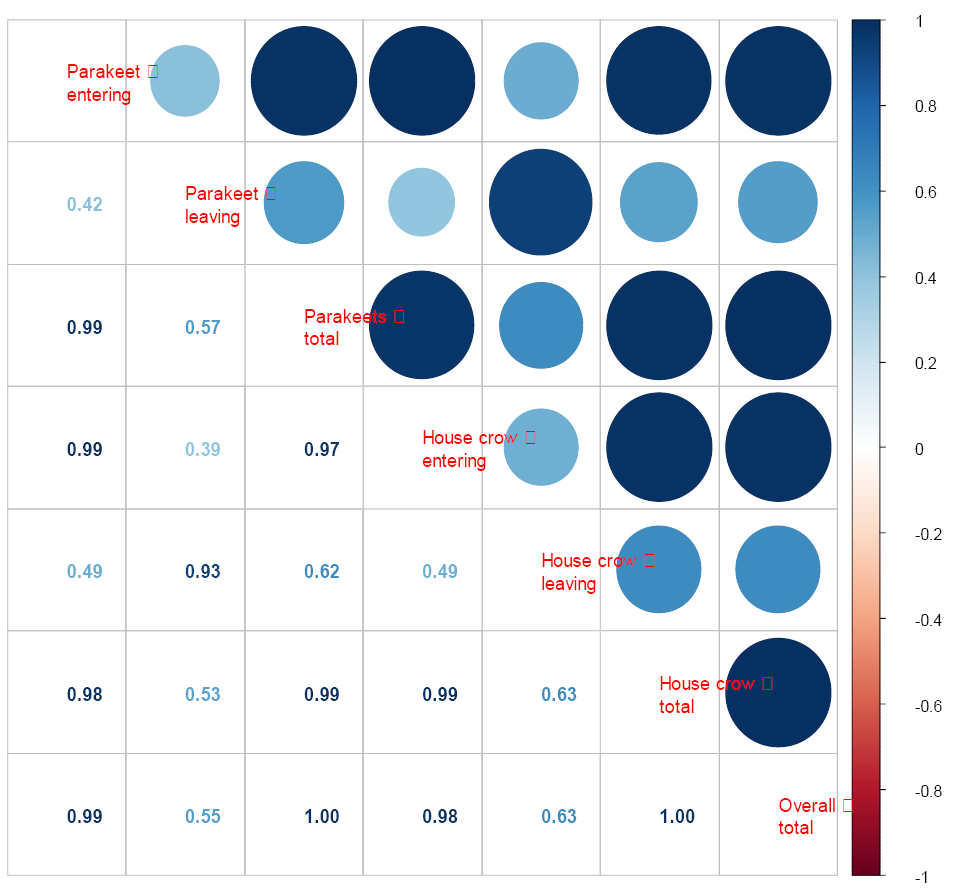
This indicates a strong positive correlation, suggesting that as the number of birds’ entrance increases in crops, the incidence of leaving birds also rises.
Pearson’s correlation coefficients, therefore, provided valuable linear relationships for all the variables and moreover, indicated the positive and linear correlation, to assess its matrix for the experimental data analyses. It also seems mandatory to develop the expressive regression models for the differential variables also. The correlation matrix for the different variables for parakeets and crows, it was apparent that (Pearson’s correlation coefficients) for the variables and levels of significance adjudging the higher levels of correlation coefficient, and the lower coefficients at the significance levels. Therefore, the formulated correlation between the parakeet interference and leaving the crops was 0.409, considered statistically significant and moreover, that the number of parakeet’s incursions in the crops was positively associated with their crop leaving trends (Fig. 2). Contrary to it the house crows which were recorded to enter and leave the designated crops was 0.953 which was highly significant (P<0.01) and specified strong correlation between the number of entering crows per crop to those of the leaving from crops. Results of the present study also discuss that the rose-ringed parakeets and crows occurred in good numbers at the Students Farms, University of Agriculture, Faisalabad. Undeniably, the agro-ecosystems throughout the province of Punjab comprise various sub-habitats viz. forest plantations, road side plantations, croplands, wide-spaced university and college campuses.
DISCUSSION
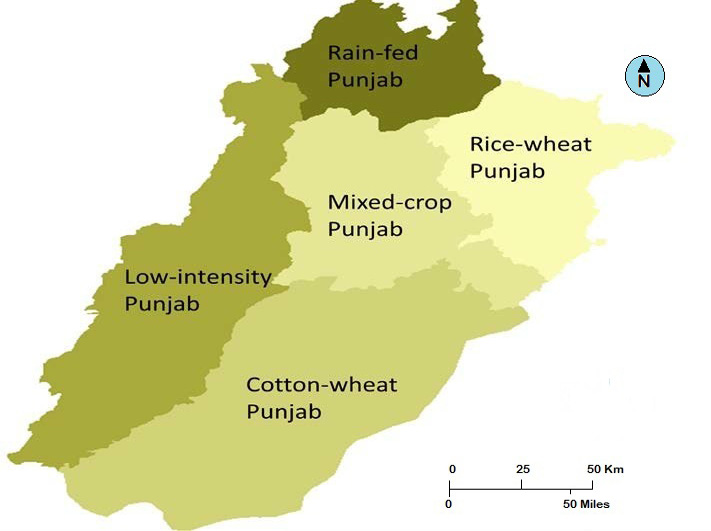
Predominantly, several economically important crops as maize, wheat, sunflower, chickpea and sugar cane are cultivated throughout the year over more than 12.70 million hectares (GOP, 2023). The agro-ecological zones throughout the Punjab province viz. rice-wheat zone, cotton-wheat zone, mixed-crop zone rain-fed zone and low-intensity zone have been devised for sustainable strategies and to promote diversified utilization national resources with the investment to harness agricultural value-added chain . Therefore, the agro-ecological zones have proved to be instrumental for acquiring sustainable agricultural growth throughout the province of Punjab, Pakistan. It was evident in that both birds seemed destructive on the five selected crops in the controlled conditions. Ironically, all these crops are also considered economically significant throughout the Punjab province and, therefore, contribute more than 75% as the value-added chain crop output ; .
The data of this study provides information that in the controlled conditions, the damage patterns were fairly high due to their constant access to the food resources. There were two foraging peaks of the both parakeets and the crows to; during the early morning and yet again the late afternoon. During both these time intervals, the bird entrance and exits from the respective food resources were evinced at the dawn and once more at the dusk before going to their respective roosts. Considering the crop predilection of both the crows and parakeets regarding their designated habitat (the University Farms) sunflower remained significantly affected due to both the birds. However, in the repellent treated conditions, the depredations were significantly reduced. Apparently, maize and wheat were comparably impacted by the two birds and the least impairment was recorded on the sugarcane (Table Ic; Fig. 2). Logically, all the crops which were sampled in the present study were of one-acre in dimension and the observations recorded were at the mature stage. Therefore, in terms of preference, the sunflower appeared to be widely depredated in both the controlled and repellent treated conditions. Undeniably, wheat and chickpea were also largely destroyed by both the rose-ringed parakeet and house crow; nonetheless, the frequency of damage was largely reduced by the implications of three bird management measures viz. mist nets, reflecting ribbons and distress sound players. Present results also conform to the report of Ahmad et al. (2012a, b) showing similar findings on the damage patterns of rose-ringed parakeet on sunflower, guava, citrus and mango. Moreover, the reflecting ribbons and distress sound player proved to be reliable to reduce the bird damage. Similarly, the work done by Dolbeer et al. (1986); Beg et al. (1995) have also suggested on the strong efficiency of the reflecting ribbons against the blackbirds Turdus merula in the cultivations of North Carolina, USA against sunflower and sweet corn along-side of the rose ringed-parakeet in Central, Punjab, Pakistan. The data also indicated invariably the same findings for the five designated crops on the basis of the house crow visitations. Although comparing the tenacity of both birds for the food crops, evidently the damage patterns remained elevated for the parakeets, therefore, truly regarding it as noxious and opportunistic. Although, some management measures have been used to deter the bird depredations in the field, customarily, reliance on the old and traditional methods like the beating of metallic drums and gas exploders have been used with little success. Important consideration of using the repellents is to safeguard and protect the crop biosafety and maintain the crop sustainability for the self-perpetuating agricultural and horticultural systems, therefore, reducing the intensity of bird damage and economic losses ; .
Situation in Pakistan particularly of Central Punjab with predominant multiple-cropping patterns existed for more than five decades having incorporated the suitable ecological conditions for birds to restructure their roosts and nests closer to the food resources and, therefore, providing their tenacious management measures ; . In view of this scenario, comprehensive and logical measures are required to combat the bird crop deterioration patterns. Although the existing devices like the distress players, reflecting ribbons, mist nets and scare crows occur, nonetheless, their precise and rational application is largely unsuitable. Therefore, for the future research, it is imperative to implement the repellent measures on the significant crops intelligently not only to maintain the agro-ecosystems sustainability but also to obtain the desirable goals.
Declarations
Acknowledgement
Authors acknowledge the support by the members of the Vertebrate Pest Ecology Laboratory.
Funding
Funding was provided by the ALP-Project, PARC, Pakistan.
Statement of conflict of interest
The authors have declared no conflict of interest.
Figures
References
- Abdullah, M., Khan, R.A., Rafay, M., Hussain, T., Ruby, T., Rehman, F., Khalil, S. and Akhtar, S., 2017. Habitat ecology and breeding performance of cattle egret (Bubulcus ibis) in Faisalabad, Pakistan. Pakistan J. Zool., 49: 1863-1870. https://doi.org/10.17582/journal.pjz/2017.49.5.1863.1870[CrossRef]
- Ahmad, S., Abbas, G., Ahmed, M., Fatima, Z., Anjum, M.A., Rasul, G., Khan, M.A. and Hoogenboom, G., 2019. Climate warming and management impact on the change of phenology of the rice-wheat cropping system in Punjab, Pakistan. Field Crops Res., 230: 46-61. https://doi.org/10.1016/j.fcr.2018.10.008[CrossRef]
- Ahmad, S., Khan, H.A., Javed, M. and Rehman, K.U., 2012a. Management of maize and sunflower against the depredations of rose-ringed parakeet (Psittacula krameri) using mechanical repellents in an agro-ecosystem. Int. J. Agric. Biol., 14: 286-290.
- Ahmad, S., Khan, H.A. and Javed, M., 2012b. An estimation of rose-ringed parakeet (Psittacula krameri) depredations on citrus, guava and mango in orchard fruit farm. Int. J. Agric. Biol., 14:149-152.
- Anderson, A., C. Lindell, K.M. Moxcey, W. Siemer, G.M. Linz, P. Curtis, J. Carroll, C. Burrows, Boulanger, J.R. and Steensma, K., 2013. Bird damage to select fruit crops: The cost of damage and the benefits of control in five states. J. Crop Prot., 52:103-109. https://doi.org/10.1016/j.cropro.2013.05.019[CrossRef]
- Beg, M., 1978. Some observations on the biology of rose-ringed parakeet. I: Bird pest problems in agriculture. July 5-6, Karachi, Pakistan.
- Beg, M.A., Inam, M., Hassan, M.M. and Khan, A.A., 1995. Foraging behavior of rose-ringed parakeet in sunflower protected by reflecting tape. Pakistan J. Agric. Sci., 32: 68–72.
- Batool, F., Khan, H.A. and Rehman, M., 2019. Feeding ecology of blue rock pigeon (Columba livia) in the three districts of Punjab, Pakistan. Braz. J. Biol., 80: 881-890. https://doi.org/10.1590/1519-6984.225451[CrossRef]
- Clarke, T.L., 2004. An autonomous bird deterrent system. Dissertation submitted for Bachelors of Engineering, Faculty of Engineering and Survey, University of Queensland. https://sear.unisq.edu.au/64/1/TimCLARKE-2004.pdf
- Davis, T.S., Bosque-Perez, N.A., Foote, N.E., Magney, T. and Eigenbrode, S.D., 2015. Environmentally dependent host-pathogen and vector-pathogen interactions in the barley yellow dwarf virus pathosystem. J. appl. Ecol., 52: 1392-1401. https://doi.org/10.1111/1365-2664.12484[CrossRef]
- Dolbeer, R.A., Woronecki, P.P. and Bruggers, R.L., 1986. Reflecting tapes repel blackbirds from millet, sunflowers, and sweet corn. Wildl. Soc. Bull., 14: 418-425. https://www.jstor.org/stable/3782281
- Elliott, C. and Bright, E., 2007. Review of the bird pest problem and bird scaring in South west Nigeria. Res. Agric. appl. Econ., 8:1-35.
- Elser, J.L., Lindell, C.A., Steensma, K.M., Curtis, P.D., Leigh, D.K., Siemer, W.F., Boulanger, J.R. and Shwiff, S.A., 2019. Measuring bird damage to three fruit crops: A comparison of grower and field estimates. Crop Prot., 123: 1-4. https://doi.org/10.1016/j.cropro.2019.05.010[CrossRef]
- FAO, 2017. Food and Agriculture Organization online database: FAOSTAT. http://faostat.fao.org.
- Gilsdorf, J.M., 2002. Effectiveness of frightening devices for reducing deer damage in cornfields. A thesis for Masters of Science, Department of Natural Resource Science, University of Nebraska-Lincolin.
- Global Agricultural Information Network (GAIN), 2023. Pulses outlook. Foreign Agricultural Service, United States Department of Agriculture. https://apps.fas.usda.gov/newgainapi/api/Report/DownloadReportByFileName?fileName=Pulses%20Outlook_Islamabad_Pakistan_PK2023-0015.pdf
- Government of Pakistan, 2024. Major crops in Pakistan. Agricultural Policy Institue, Pakistan. https://api.gov.lopk/TopStoryDetail#:~:text=About%2025%25%20of%20Pakistan’s%20total,7th%20largest%20producer%20of%20wheat
- Government of Punjab, 2023. Punjab agricultural profile. Department of Agriculture, Punjab, Pakistan. https://www.agripunjab.gov.pk/system/files/Punjab%20Agriculture%20Profile.
- Hafeez, S., Khan, T.H., Khan, T., Shahbaz, M. and Ahmed, M., 2008. Use of reflector ribbon as a pest birds repellent in wheat and maize crop. J. agric. Soc. Sci., 4: 92-94. 1814–960.
- Hannay, M.B., Boulanger, J.R., Curtis, P.D., Eaton, R.A., Hawes, B.C., Leigh, D.K., Rossetti, C.A., Steensma, K.M. and Lindell, C.A., 2019. Bird species and abundances in fruit crops and implications for bird management. Crop Prot., 120: 43-49. https://doi.org/10.1016/j.cropro.2019.02.015[CrossRef]
- Hess, S.C., Anderson, C.J., Tillman, E.A., Bukoski, W.P., Shiels, A.B., Klug, P.E., Siers, S.R. and Kluever, B.M., 2023. Differences in feeder visitation by invasive rose-ringed parakeets (Psittacula krameri) between Hawaiian Islands. Pac. Sci., 77: 111-123. https://doi.org/10.2984/77.1.7[CrossRef]
- Hughes, B., 1996. The feasibility of control measures for North American ruddy ducks, Oxyura jamaicensis, in the United Kingdom. A report by the Wildfowl and Wetlands Trust to the Department of the Environment, UK., pp. 397. http://www.iucngisd.org/gisd/species.php?sc=152
- International Production Assessment Division (IPAD), 2024. Wheat production. Foreign Agricultural Service, United States Department of Agriculture. https://ipad.fas.usda.gov/countrysummary/default.aspx?id=PK&crop=Wheat
- Iqbal, M.T., Khan, H.A. and Ahmad, M.H., 2001. Feeding regimens of the rose-ringed parakeet on a brassica and sunflower in an agro-ecosystems in Central Punjab, Pakistan. Pak. Vet. J., 4: 111–115. http://www.pvj.com.pk/pdf-files/20_4/177-179.pdf
- Khan, H.A., 2002. Damage patterns of house crow (Psittacula krameri) in daylight hours in its communal roost. Pak. J. biol. Sci., 4: 506-509. https://www.fspublishers.org/published_papers/88181_pdf
- Khan, H.A., Javed, M. and Zeeshan, M., 2015. Damage assessment and management strategies for house crow (Corvus splendens L.) on the seedling stages of maize and wheat in an irrigated agricultural farmland of Punjab. J. Ent. Zool. Stud., 3: 151-155. http://www.ijab.org/1560–8530/2002/04–4–500–502
- Khan, H.A., Ahmad, S., Javed, M., Ahmad, K. and Ishaque, M., 2011. Comparative effectiveness of some mechanical repellents for management of rose ringed parakeet (Psittacula krameri) in citrus, guava and mango orchards. Int. J. agric. Biol., 13: 396-400. http://www.fspublishers.org/10–653/AWB/2011/13–3–396–400
- Khan, H.A., Javed, M., Tahir, A. and Kanwal, M., 2013. Limiting the rose-ringed parakeet (Psittacula krameri) damage on guava (Psidium guajava) and mango (Mangifera indica) with an ultrasonic sound player in a farmland of Faisalabad, Pakistan. Afr. J. agric. Res., 8: 6608-6614.
- Klug, P.E., Shiels, A.B., Kluever, B.M., Anderson, C.J., Hess, S.C., Ruell, E.W., Bukoski, W.P. and Siers, S.R., 2023. A review of nonlethal and lethal control tools for managing the damage of invasive birds to human assets and economic activities. Manage. Biol. Invasions, 14: 1-44. https://doi.org/10.3391/mbi.2023.14.1.01[CrossRef]
- Li, G., Gao, L., Fan, X., Chen, J., Zhang, G. and Wang, Q., 2018. The design of fixed bird-repellent fitting for eliminating bird damage in substations. I: 2018 2nd Conference on Energy Internet and Energy System Integration (IEEE), pp. 1-5. https://doi.org/10.1109/EI2.2018.8582423[CrossRef]
- Lindell, C.A., Eaton, R.A., Lizotte, E.M. and Rothwell, N.L., 2012. Bird consumption of sweet and tart cherries. Hum. Wild. Interact., 6: 283-290. https://www.jstor.org/stable/24874101
- Linz, G.M., Homan, H.J., Werner, S.J., Carlson, J.C. and Bleier, W.J., 2012. Sunflower growers use non-lethal methods to manage blackbird damage. I: Fourteenth WDM conference (ed. S.N. Frey), Department of Agriculture, United States of America, pp. 113-118.
- Linz, G.M., Homan, H.J., Werner, S.J., Hagy, H.M. and Bleier, W.J., 2011. Assessment of bird management strategies to protect sunflowers. J. Biosci., 61: 960-970. https://doi.org/10.1525/bio.2011.61.12.6[CrossRef]
- Nazir, I. and Mehmood, M.T., 2021. Measuring crop productivity index of agro ecological zones of Punjab and its relationship with climate factors. Forman J. econ. Stud., 17: 161-174. https://doi.org/10.32368/FJES.20211708[CrossRef]
- Punjab Portal, Government of Punjab, Pakistan online database: https://punjab.gov.pk/faisalabad_geography.
- Rehman, A., Jingdong, L., Shahzad, B., Chandio, A.A., Hussain, I., Nabi, G. and Iqbal, M.S., 2015. Economic perspectives of major field crops of Pakistan: An empirical study. Pac. Sci. Rev., 1: 145-158. https://doi.org/10.1016/j.psrb.2016.09.002[CrossRef]
- Roberts, T.J., 1991. Birds of Pakistan. Oxford Univ. Press, London. pp. 728.
- Seamans, T.W. and Gosser, A.L., 2016. Bird dispersal techniques. Wildlife damage management technical series. Ft. Collins, Colorado: USDA, APHIS, WS National Wildlife Research Center, USA. pp. 12. https://digitalcommons.unl.edu/nwrcwdmts/2/[CrossRef]
- Shakoor, A., Zahid, M.K., Farid, H.U., Sultan, M., Aftab, A.K., Ahmad, I. and Azmat, M., 2018. Groundwater vulnerability mapping in Faisalabad district using GIS based drastic model. I: MATEC web of conferences, EDP Sciences, pp. 01001. https://doi.org/10.1051/matecconf/201824601001[CrossRef]
- Skoric, D., Jocic, S., Jovanovic, D., Hladni, N., Marinkovic, R., Atlagic, J., Pankovic, D., Vasic, D., Miladinovic, F., Gvozdenovic, S. and Terzic, S., 2006. Achievements of sunflower breeding. Ratar. Povrt., 42: 131-172. http://fiver.ifvcns.rs/handle/123456789/390
- Stevens, G.R. and Clark, L., 1998. Bird repellents: Development of avian-specific tear gases for resolution of human-wildlife conflicts. Int. Biodeterior. Biodegrad., 42: 153-160. https://doi.org/10.1016/S0964-8305(98)00056-0[CrossRef]
- Steel, R.G.D., Torrie, J.H. and Dickey, D.A., 1997. Principal and procedures of statistics: Multiple comparison. 3rd Ed. McGraw Hill Book Co., New York, USA.
- Stroup, W.W., 2012. Generalized linear mixed models: Modern concept, methods and applications. 1st Ed. CRC Press, New York, USA.
- Swaddle, J.P., Moseley, D.L., Hinders, M.K. and Smith, P.E., 2016. A sonic net excludes birds from an airfield: implications for reducing bird strike and crop losses. Ecol. appl., 26: 339-345. https://doi.org/10.1890/15-0829[CrossRef]
- Taber, M.R. and Martin, L.R., 1998. The use of netting as a bird management tool in vineyards. In: Proceedings of the vertebrate pest conference (eds. R.O. Baker and A.C. Crabb), University of California, Davis, pp. 43-45. https://doi.org/10.5070/V418110295[CrossRef]
- Witmer, G.W., Keirn, G.M., Hawley, N., Martin, C. and Reaser, J.K., 2009. Human dimensions of invasive vertebrate species management. I: The thirteenth wildlife damage management conference (ed. J. Boulanger.), Saratoga Springs, New York, pp. 100-105. https://digitalcommons.unl.edu/icwdm_wdmconfproc/141/
- World-Grain, 2020. Global grain production.International Grains Council, London, United Kingdom.
Services
Article usage statistics
Loading…