Research Article · Volume 14, Issue 10, 15 September 2026 · Open Access
Delivery Form Determines the Biological Efficacy of Lime (Citrus aurantiifolia) Peel (LP) By-products in Growing Japanese Quail
· · · · · · ·
Affiliations & Notes ⌄
1Department of Animal Nutrition and Feed Technology, Faculty of Animal Science, Padjadjaran University, Jalan Ir. Soekarno Km. 21 Jatinangor, Sumedang 45363, West Java, Indonesia
2Department of Animal Bioscience, Faculty of Food Security, Surabaya State University. Campus 3, Jl. Prof. Dr. Moestopo No. 4, Pacar Keling, Tambaksari District, Surabaya, East Java 60131, Indonesia
3Animal Science, Faculty of Agriculture, Sriwijaya University, Jalan Palembang-Prabumulih, KM 32, Inderalaya, Ogan Ilir Regency, 30662, South Sumatra, Indonesia
4Magister Program in Educational Technology, University of Muhammadiyah, Jakarta, Indonesia
5Department of Biology, UIN Alauddin Makassar. Jl. H.M. Yasin Limpo No.36, Gowa 92118, Makassar, South Sulawesi, Indonesia
6Department of Biology, College of Science, De La Salle University, 2401 Taft Avenue, Manila 1004, Philippines. *Correspondence | Deny Saefulhadjar, Department of Animal Nutrition and Feed Technology, Faculty of Animal Science, University of Padjadjaran
The form of LP waste administration significantly affected biological responses, with the LP4 treatment consistently demonstrating superior performance across all parameters.
This treatment increased feed consumption with high feed utilisation efficiency, optimised growth physiology, and strengthened the immune system by reducing inflammatory biomarkers and increasing protective immune biomarkers.
Overall, LP4 produced the most balanced biological profile and has the potential to be an effective phytogenic strategy for improving the productivity and health of farmed quail.
Selected from the article's own text.
Abstract
Feed intake is a key determinant of livestock productivity. This study examined how lime peel (LP) waste affects feed efficiency, growth physiology, and immune and inflammatory responses in grower quail. Four-week-old Japanese quail (n=100) with an average weight of 57.52 g were randomly distributed to five groups: LP0 (control), LP1, LP2, LP3, and LP4. Parameters assessed included feed efficiency, growth indicators, and immune and inflammatory biomarkers. We analysed data using one-way ANOVA with Tukey’s test (P<0.05). To visualise overall biological responses, we used an Integrated Biological Radar Plot and a Heatmap–Hierarchical Clustering based on Z-scores. Results indicated that LP waste significantly affected most parameters (P<0.05). LP4 consistently enhanced feed efficiency and improved growth indicators. It also boosted immune biomarkers while reducing inflammatory ones, indicating a healthier physiological state. Radar plot visualisation showed LP4 had the largest polygon, reflecting broad biological advantages. Hierarchical clustering of heatmap data confirmed distinct biological groups, with LP4 separated from the control, showing a more adaptive immune profile and lower inflammation. In conclusion, LP waste administration significantly influences the biological response in grower quail, with LP4 being the most effective. Radar plots and heatmaps offer a comprehensive way to evaluate the role of agricultural waste-based phytogenics in promoting sustainable poultry production.
Quail production has strong prospects for providing animal feed because the production cycle is relatively short, land requirements are low, and biological efficiency is high. However, the growth phase is critical, as body tissues, digestive organs, the endocrine system, and the immune system develop simultaneously. Disturbances in digestion, nutrient absorption, metabolic balance, or the inflammatory response during this phase can reduce body weight gain and increase the feed conversion ratio. Therefore, developing natural feed additives that improve nutrient utilisation, control inflammation, and regulate growth is an important strategy to increase feed intake in modern poultry nutrition .
Agro-industrial by-products as functional feed ingredients are gaining attention because they can reduce environmental pollution and add value. One such by-product is orange peel, which is generated in large amounts after fruit consumption or processing . Orange peel is rich in nutrients, including dietary fibre, pectin, essential oils, vitamins, carotenoids, phenolic acids, and flavonoids. Key flavonoids in orange peel include hesperidin, naringin, naringenin, eriocitrin, and various polymethoxylated flavones. These compounds exhibit antioxidant, antimicrobial, anti-inflammatory, and immunomodulatory properties, making them promising as phytogenic feed additives for poultry ; .
Orange peel can be used in flour or powder form, but using it whole has several limitations. Its high structural fibre content can limit digestive enzymes’ access to nutrients and active compounds, and some polyphenols can remain bound to the pectin, cellulose, and hemicellulose matrices . Excessive amounts can also reduce palatability and nutrient utilisation. However, at appropriate feeding levels, orange peel flour has been reported to improve growth, feed efficiency, antioxidant response, and several physiological indicators in birds. Adding orange peel flour can also increase the ration’s functional value, although the response depends on dose, orange type, animal age, ration composition, and digestive enzyme availability ; .
One way to increase bioactive compound release is to process orange peel into an extract. Maceration helps the solvent penetrate the plant tissue, dissolve phenolic and flavonoid compounds, and separate them from the mostly insoluble fibre matrix. As a result, extracts can contain more concentrated active compounds that interact more readily with the digestive system compared to powders. Nonetheless, extraction effectiveness depends on factors such as solvent polarity, extraction duration, temperature, the material-to-solvent ratio, and the plant material’s properties. These processing variations mean powders and extracts may not produce identical biological effects, even when derived from the same raw materials ; .
In poultry, citrus bioactive compounds are believed to function via multiple interconnected pathways. Their antimicrobial and anti-inflammatory effects can enhance the gut environment, reduce lipopolysaccharide exposure, preserve mucosal integrity, and decrease energy needed for inflammatory responses . These effects support digestive enzyme activity, facilitate amino acid and energy absorption, improve nitrogen retention, and optimise metabolic energy use. Higher nutrient availability can also help regulate thyroid hormones and the growth hormone insulin-like growth factor-1 axis, which are crucial for protein synthesis, tissue development, and overall growth. Research shows that standardised citrus extracts can strengthen intestinal integrity, reduce putrefactive fermentative metabolites, and increase final body weight in broiler chickens , 2025).
Citrus peel can also influence humoral immunity and inflammatory responses. Dried citrus peel or its extract has been shown to boost antibody production and strengthen immune responses in poultry . In broiler quail, a methanolic extract of orange peel enhanced nutrient digestibility, energy use, performance, and humoral immunity, suggesting that growth benefits are linked to improved immunometabolic health ; .
Most previous studies have examined powder or extract separately, particularly in broiler chickens. However, direct comparisons between these two forms in grower-stage quail are limited. Few studies have combined assessments of nutrient digestibility and retention, metabolisable energy, growth, thyroid hormones, blood metabolites, immunoglobulins, and inflammatory biomarkers within a single framework. Hence, this study investigates the effects of LP waste, administered as powder and macerated extract, on nutrient utilisation, endocrine and metabolic regulation, immune-inflammatory responses, and growth in grower-stage quail. The goal is to determine whether the extraction process yields a more effective biological response than using LP powder directly.
MATERIALS AND METHODS
Animal samples, basal rations, and experimental design
Four-weeks old Japanese quail with an average weight of 57.52 g were used in this study, and they were randomly distributed into five treatment groups of 100 each. Each treatment was replicated five times, so each replicate or experimental unit consisted of 20 quail samples.
Table 1 shows the metabolisable energy and nutrient composition of the basal ration used during the trial period.
Table 1: Nutrient and metabolisable energy content of the basal diet used in the experimental study.
Description
%
Standard requirement
Metabolic energy (kcal/kg)
2985
Minimum 2900
Crude protein (%)
19
18–20
Ether extract (%)
6
Min. 3
Crude fibre (%)
5
Max. 10
Phosphorus (%)
0.8
Minimum 0.55
Calcium (%)
5.1
3.25–4.25
All experimental quails were fed a basal diet throughout the study for 6 weeks. LP (LP) was administered at different levels as follows: LP0: basal ration without LP; LP1: basal ration + LP flour 10 g/kg; LP2: basal ration + LP flour 15 g/kg; LP3: basal ration + LP extract 10 g/kg; and LP4: basal ration + LP extract 15 g/kg.
Preparation of LP powder and extract
Fresh LP (Citrus aurantiifolia) peel, separated from the pulp, was washed under running water to remove dirt and any remaining foreign matter. The peel was then cut into small pieces and oven-dried at 45–50°C to a constant weight. The dried material was ground to a powder, then sieved through a 60-mesh sieve to obtain a uniform particle size. The LP powder was stored in an airtight container at room temperature, protected from light, until use.
The methanol extract was prepared by maceration. 1,000 g of LP powder was placed in a sealed container, then 80% methanol was added at a 1:10 (w/v) ratio. The mixture was macerated for 72 hours at room temperature, protected from light, with regular stirring. Afterwards, the mixture was filtered through Whatman No. 1 filter paper. The residue was re-extracted twice with the same solvent to boost extraction efficiency. All filtrates were pooled and evaporated using a rotary evaporator at 40–45 °C under vacuum until a concentrated extract was obtained, then dried .
Blood sampling and sample analysis
Quail blood samples were collected from the brachial vein using a sterile syringe and placed in a tube without anticoagulant. The samples were left at room temperature for 30 minutes, then centrifuged at 3,000 rpm for 15 minutes to separate the serum. The serum was stored at −20°C until analysis. Blood chemistry parameters were measured spectrophotometrically using a commercial kit, following the manufacturer’s instructions for the Rendox Kit. Immune parameters, including immunoglobulins, were assessed using an enzyme-linked immunosorbent assay (ELISA) with a specific kit, following the protocol provided by MyBiosource.
Energy utilisation was determined using the force-feeding method, with a paste delivered via a syringe through the oesophagus, following the procedure described by Abun et al. (2023). Similarly, digestibility was determined using an internal indicator (lignin), following a modified method described by Abun et al. (2022).
Data analysis
All data were analysed using one-way ANOVA to assess the impact of LP waste application on each parameter; significant differences (P<0.05) were detected. Tukey’s Honestly Significant Difference (HSD) test at a 95% confidence level was used for comparisons. Data are presented as mean ± standard deviation. To analyse the multidimensional biological response, we standardised all parameters as Z-scores and visualised them in a heatmap with Euclidean distance-based hierarchical clustering and the average linkage method. Additionally, we used an Integrated Biological Radar Plot to display the relative biological performance of each treatment simultaneously, helping identify the most biologically effective treatment.
RESULTS AND DISCUSSION
Nutrient and energy utilisation
Feed intake efficiency was evaluated through nutrient and energy utilisation profiles in grower-stage quail fed and unfed LP, as shown in Table 2.
Table 2: Effects of LP powder and macerated extract on nutrient utilisation and energy metabolism of growing quail.
Parameters
Treatment group
P value
LP0
LP1
LP2
LP3
LP4
Nitrogen retention (%)
68.79±1.97ᶜ
71.69±2.15ᵇ
68.41±2.37ᶜ
72.99±2.17ᵇ
77.04±1.96ᵃ
<0.001
Crude protein digestibility (%)
64.72±1.47ᶜ
66.82±1.42ᶜ
65.90±1.63ᶜ
72.20±1.25ᵇ
75.15±1.39ᵃ
<0.001
Nitrogen-corrected metabolisable energy (kcal/kg)
2344±104.34ᶜ
2441±66.25ᵇ
2563±98.93ᵇ
2603±99.57ᵃ
2775±99.65ᵃ
<0.001
Metabolisable energy (kcal/kg)
2362±94.60ᵇ
2400±95.38ᵇ
2566±95.76ᵃ
2578±95.30ᵃ
2607 95.00ᵃ
0.001
Dry matter digestibility (%)
51.04±1.63ᵈ
62.96±1.49ᶜ
66.64±1.72ᵇ
68.23±1.63ᵃ
71.28±1.70ᵃ
<0.001
Dry organic matter digestibility (%)
52.71±0.89ᵉ
61.85±1.43ᵈ
67.96±1.55ᶜ
71.20±1.62ᵇ
76.00±1.22ᵃ
<0.001
Different superscript letters in the same row indicate significant differences based on Tukey’s test at the P < 0.05 level.
Administering LP waste in powder or macerated extract form significantly (P<0.05) affected nutrient utilisation and energy metabolism in grower-stage quail (Table 2). Overall, LP supplementation increased nutrient utilisation efficiency compared with the control group, as indicated by higher nitrogen retention, nutrient digestibility, and metabolisable energy values. These responses generally increased as the form and level of administration changed, with the extract form consistently yielding higher values than the powder. The most notable improvements were in dry matter digestibility, organic matter digestibility, nitrogen retention, and nitrogen-corrected metabolisable energy (AMEn), indicating the birds’ enhanced ability to utilise protein and energy from the diet. Conversely, the control group displayed the lowest values across nearly all measured parameters.
Improved nutrient utilisation and energy metabolism in quail supplemented with LP waste indicate that the bioactive compounds in the supplement can increase feed intake and feed utilisation efficiency. Key flavonoids, such as hesperidin, naringin, and eriocitrin, together with other phenolic compounds, exhibit antioxidant and antimicrobial activity that can modulate the digestive tract environment. This can suppress pathogenic microorganisms, improve gut microbiota balance, and maintain intestinal mucosal integrity, thereby increasing digestive enzyme activity and nutrient absorption. This improved digestive tract function ultimately increases nitrogen retention and energy utilisation efficiency, supporting tissue growth ; .
The macerated extract consistently produced a better response than the powder. This is likely because the extraction process releases phenolic and flavonoid compounds from the lignocellulose matrix, making the bioactive fraction more soluble and readily available for absorption throughout the digestive tract. Conversely, in powder form, some active compounds remain trapped within the fibre-rich plant tissue, resulting in relatively lower bioavailability. This difference in bioavailability is thought to explain the significantly higher protein digestibility, nitrogen retention, and metabolisable energy in the extract group compared with the powder group ; .
Beyond enhancing nutrient utilisation, the high metabolisable energy value indicates that more ration energy is available for growth processes rather than being lost in excretion. This is crucial because sufficient energy is a key factor influencing protein synthesis, tissue development, and feed efficiency in poultry. Therefore, processing LP waste via extraction not only increases the release of bioactive compounds but also improves protein and energy utilisation, supporting better growth performance in quail.
Immunity and inflammatory response
Immune response and inflammatory markers as a result of LP administration on quail in the grower phase are shown in Table 3.
Administering LP waste either as a powder or macerated extract significantly influenced the immune response and inflammatory biomarkers in grower-stage quail (Table 3), with effects reaching statistical significance (P<0.05). Overall, LP supplementation consistently enhanced humoral immunity while reducing systemic inflammation markers compared to the control. Higher immunoglobulin levels, particularly in the extract group, supported the enhanced immune response. Conversely, inflammatory biomarkers such as serum amyloid A (SAA), lipopolysaccharide-binding protein (LBP), interleukin-6 (IL-6), and the neutrophil-to-lymphocyte ratio (N/L) showed a decreasing trend, influenced by the form and dosage of administration.
The group receiving the extract, especially at the highest dose, consistently produced the best immune-inflammatory profile compared to the other treatments. In contrast, the control group showed the highest concentration of inflammatory biomarkers accompanied by a relatively lower humoral immune response. Overall, these results indicate
Table 3: Effects of LP powder and macerated extract on immune responses and inflammatory biomarkers of growing quail.
Parameters
Treatment group
P value
LP0
LP1
LP2
LP3
LP4
Serum amyloid A (ng/mL)
6.79 ± 0.19ᵃ
6.07 ± 0.23ᵇ
5.07 ± 0.15ᶜ
3.85 ± 0.24ᵈ
1.47 ± 0.19ᵉ
<0.001
IgG (mg/L)
2.01 ± 0.14ᶜ
2.77 ± 0.47ᵇ
2.98 ± 0.10ᵇ
3.75 ± 0.23ᵃ
4.97 ± 0.10ᵃ
<0.001
IgM (mg/L)
4.02 ± 0.13ᵉ
4.54 ± 0.09ᵈ
5.05 ± 0.05ᶜ
5.28 ± 0.04ᵇ
5.51 ± 0.03ᵃ
<0.001
Lipopolysaccharide-binding protein (ng/mL)
10.41 ± 0.41ᵃ
8.98 ± 0.29ᵇ
6.14 ± 0.19ᶜ
4.72 ± 0.15ᵈ
2.92 ± 0.10ᵉ
<0.001
IL-6 (pg/mL)
2.32 ± 0.04ᵃ
2.23 ± 0.04ᵃ
2.20 ± 0.02ᵃ
2.00 ± 0.13ᵇ
1.63 ± 0.11ᶜ
<0.001
Neutrophil/Lymphocyte ratio
0.96 ± 0.03ᵃ
0.88 ± 0.03ᵇ
0.85 ± 0.02ᵇ
0.74 ± 0.03ᶜ
0.62 ± 0.03ᵈ
<0.001
Different superscript letters in the same row indicate significant differences based on Tukey’s test at the P < 0.05 level.
that LP waste extract is more effective than the powdered form in modulating the balance between immune and inflammatory responses, thus supporting the creation of physiological conditions more conducive to quail growth.
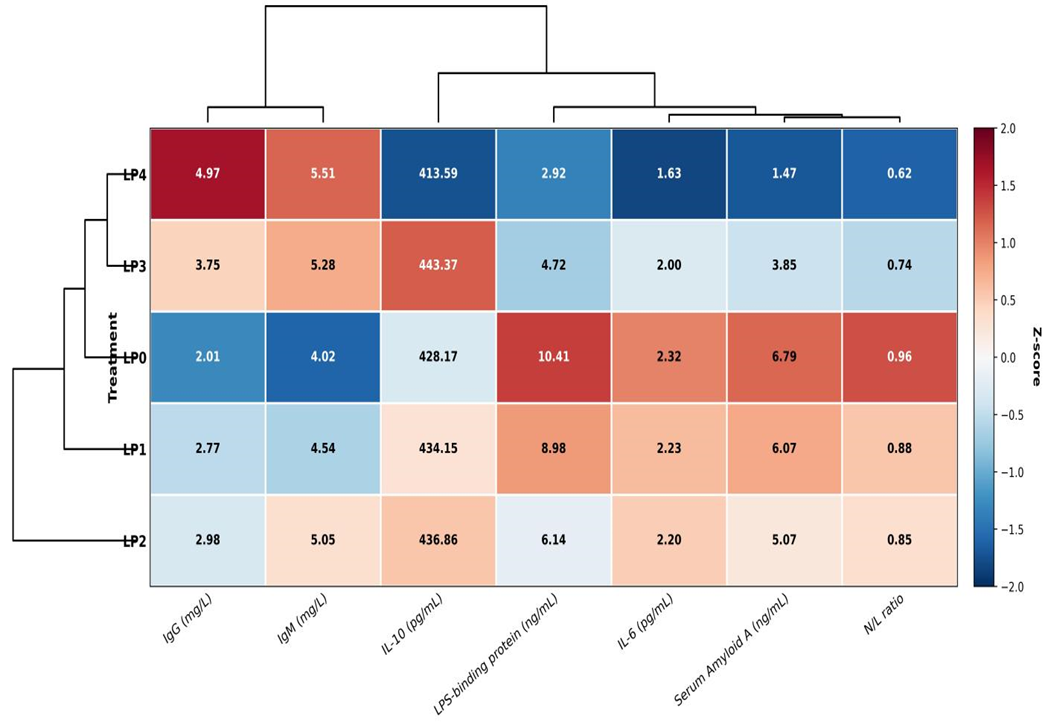
Based on the hierarchical heatmap of the immune response (Figure 1), treatments clustered clearly based on similarities in immunological profiles. Treatments supplemented with LP waste tended to form a separate cluster from the control, indicating that the administration method influenced the quail’s overall immune response pattern. Adaptive immune parameters, such as IgG, IgM, and IgA, formed one cluster and tended to increase in the extract-based treatment, while pro-inflammatory cytokines (IL-1β, IL-6, and TNF-α) clustered separately and showed lower colour intensity in that treatment.
Conversely, the anti-inflammatory cCytokine IL-10 showed the opposite pattern, suggesting a shift toward a more regulated immune response. Overall, the data show that LP extract treatment creates a more advantageous immune profile than flour or the control, marked by higher levels of humoral immunity and lower inflammatory mediators. These findings highlight the importance of the phytobiotic’s form in effectively modulating the immune system in grower-stage quail.
This study indicates that LP waste not only provides bioactive compounds but also acts as an immunomodulator that balances immune activation and inflammation. Flavonoids like hesperidin, naringin, and eriocitrin, along with other phenolic compounds in LP, are recognised for their antioxidant and anti-inflammatory properties. They can suppress the nuclear factor kappa B (NF-κB) pathway, reducing the production of pro-inflammatory cytokines such as interleukin-6 (IL-6) ; . Lower IL-6 levels are also associated with reduced synthesis of acute-phase proteins such as serum amyloid A (SAA), indicating reduced systemic inflammation ; .
Decreased levels of lipopolysaccharide-binding protein (LBP) indicate reduced translocation of lipopolysaccharides from the intestinal lumen to the blood circulation. These findings suggest that orange peel supplementation may improve intestinal mucosal integrity by modulating the microbiota and strengthening intestinal barrier function. Reduced endotoxin stimulation not only suppresses the inflammatory response but also lowers the energy required for immune activation. Energy and nutrients previously
allocated to maintaining the inflammatory response can then be utilised more efficiently for growth and protein synthesis, in line with increased nutrient utilisation as shown in Table 2 ; ; .
The improved humoral immune response, demonstrated by increased IgG and IgM concentrations, indicates that LP supplementation is not immunosuppressive but rather enhances adaptive immune competence while still controlling inflammation. Interestingly, the macerated extract produced a more pronounced response than the powder. This is likely related to the increased bioavailability of flavonoids and phenolic compounds resulting from the extraction process, allowing the active compounds to interact more effectively with intestinal mucosal tissue and immune cells. Thus, LP waste extract can create a more balanced immunometabolic environment, ultimately supporting quail growth efficiency in the grower phase.
Growth and metabolic physiology
The impact of LP administration on growth physiology and metabolism in quail in the grower phase is shown in Table 4.
Administering LP waste as either powder or macSupplemented extract significantly (P<0.05) affects physiological growth and metabolic indicators in grower-stage quail (Table 4). Overall, LP supplementation improves physiological responses, with outcomes varying by form and dose; the extract is more effective than the powder. This is evidenced by increased final body weight and a lower feed conversion ratio (FCR), indicating better feed intake and nutrient utilisation. Additionally, hormonal and metabolic markers tend to rise, indicating enhanced growth and metabolic activity. The highest extract dose consistently yielded the best physiological and metabolic outcomes, whereas the control group recorded lower values. Overall, LP waste extract outperforms powder in optimising growth and metabolic regulation, fostering better growth performance in grower-stage quail.
The improved growth performance and metabolic responses in quail supplemented with LP waste indicate that the bioactive compounds in LP can modulate endocrine and metabolic pathways critical for growth. Flavonoids and phenolic compounds are known to reduce oxidative stress, enhance mitochondrial efficiency, and improve tissue sensitivity to growth hormone signalling. These conditions support activation of the growth hormone (GH)–insulin-like growth factor-1 (IGF-1) axis, which stimulates cell proliferation, protein synthesis, and muscle tissue deposition in poultry (De Paula Dorigam et al., 2021; .
The higher levels of thyroid hormones (T3 and T4) observed in this study suggest improved energy metabolism. These hormones boost basal metabolic rate, speed up the oxidation of energy sources, and activate enzymes vital for protein synthesis and tissue development. The increase in glucose, total protein, albumin, and other energy-related metabolites demonstrates that digested nutrients are being used more effectively for growth, aligning with the observed reduction in the feed conversion ratio (FCR), which reflects a more efficient conversion of feed into body mass ; .
The higher response in the extract group than in the powder group likely reflects increased flavonoid bioavailability following extraction. These more readily absorbed bioactive compounds interact more effectively with metabolic tissues such as the liver, intestines, and endocrine system, resulting in better regulation of growth hormones and metabolism. Furthermore, the reduced inflammation observed in
Table 4: Effects of LP powder and macerated extract on the growth physiology and metabolic responses of growing quail
Parameters
Treatment group
P-value
LP0
LP1
LP2
LP3
LP4
Final body weight (g)
133.95±1.64ᵉ
138.50±1.48ᵈ
145.73±1.72ᶜ
150.87±1.86ᵇ
154.96±1.76ᵃ
<0.001
Feed conversion ratio
3.96±0.06ᵃ
3.45±0.04ᵇ
3.24±0.05ᶜ
2.91±0.05ᵈ
2.67±0.05ᵉ
<0.001
Growth hormone (ng/mL)
2.61±0.11ᶜ
2.69±0.09ᶜ
2.76±.08ᵇ
2.84±0.08ᵃᵇ
2.94±0.08ᵃ
0.003
IGF-1 (ng/mL)
250.21±8.32ᵈ
260.73±7.94ᶜ
270.65±8.56ᶜ
285.81±8.65ᵇ
300.17±8.71ᵃ
<0.001
T3 (ng/mL)
0.61±0.06ᵉ
0.99±0.07ᵈ
1.26±0.08ᶜ
1.62±0.08ᵇ
2.00±0.09ᵃ
<0.001
T4 (µg/dL)
5.01±0.16ᵈ
6.22±0.17ᶜ
7.58±0.18ᵇ
8.63±0.20ᵃ
9.91±0.23ᵃ
<0.001
Glucose (mg/dL)
186.67±3.85ᶜ
194.34±4.12ᵇ
202.06±4.27ᵇ
209.68±4.09ᵃ
216.49±4.28ᵃ
<0.001
Total protein (mg/dL)
43.55±1.26ᵈ
45.61±1.18ᶜ
47.82±1.21ᵇ
49.94±1.36ᵃ
51.75±1.27ᵃ
<0.001
Albumin (mg/dL)
26.87±0.82ᵈ
27.95±0.81ᶜ
29.16±0.84ᵇ
30.35±0.88ᵃ
31.51±0.86ᵃ
<0.001
Triglycerides (mg/dL)
146.82±5.28ᶜ
159.78±5.11ᵇ
171.53±5.36ᵇ
186.60±5.42ᵃ
181.62±5.31ᵃ
<0.001
Cholesterol (mg/dL)
178.47±5.42ᵈ
190.53±5.28ᶜ
201.62±5.41ᵇ
218.58±5.53ᵃ
230.00±5.68ᵃ
<0.001
Superscript letters in the same row indicate significant differences by Tukey’s test at the P < 0.05 level. T3 = Triiodothyronine; T4 = Thyroxine.
Table 2 likely decreases the energy required for immune responses, freeing energy for protein synthesis and growth. Consequently, LP waste extract not only enhances nutrient uptake but also supports metabolic regulation, endocrine health, and energy efficiency, thereby promoting improved growth performance in quail during the grower stage.
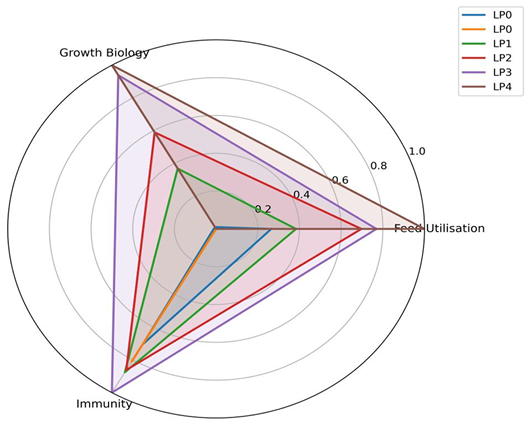
The integrated radar plot (Figure 2) shows that different methods of administering LP waste elicit varying biological responses in grower-stage quail. Generally, extract-based treatments produced a larger radar area than the control, indicating improvements across multiple areas, including feed efficiency, growth physiology, and immune response. Conversely, the control group showed a smaller radar area, indicating lower biological performance. This pattern implies that LP treatment enhances not just a single parameter but also provides a more balanced impact across domains. Therefore, the radar plot demonstrates that the method of active-ingredient delivery significantly influences the overall biological response in grower-stage quail.
The prominence of the LP4 treatment in the radar plot indicates that using LP waste in this manner yields the most balanced biological response among the treatments. A larger polygon area indicates a concurrent boost in feed utilisation efficiency, growth physiology, and immune function, reflecting improved overall biological fitness. This benefit likely stems from increased bioavailability of bioactive compounds such as flavonoids, vitamin C, and phenolics, which can enhance antioxidant capacity, strengthen intestinal integrity, and optimise nutrient absorption ; ; .
This environment promotes growth hormone and body protein synthesis while reducing inflammatory activation, allowing more energy to be allocated to growth. These results align with studies suggesting that the bioavailability of phytogenic compounds significantly influences growth performance, nutritional efficiency, and immune health in poultry ; ; .
CONCLUSION
The form of LP waste administration significantly affected biological responses, with the LP4 treatment consistently demonstrating superior performance across all parameters. This treatment increased feed consumption with high feed utilisation efficiency, optimised growth physiology, and strengthened the immune system by reducing inflammatory biomarkers and increasing protective immune biomarkers. Overall, LP4 produced the most balanced biological profile and has the potential to be an effective phytogenic strategy for improving the productivity and health of farmed quail.
The results also indicate that extraction techniques can enhance the beneficial value of this waste. Further studies employing transcriptomic and metabolomic approaches are needed to elucidate the molecular pathways through which LP extract modulates immune and metabolic responses.
ACKNOWLEDGEMENTS
The authors express their appreciation and gratitude to the Al Hidayah Islamic Education Foundation, Cimareme, West Bandung, Agrotechnology Development Division, for providing in vivo testing facilities, following the recommendation of Mrs Renei Indriaty. The authors also thank the entire research team and other parties directly involved for their cooperation and contributions to sample analysis, especially CV Indosains, Bandung.
NOVELTY STATEMENT
This study offers the first detailed assessment of LP waste’s impact on quail’s biological responses during the grower phase. It examines factors like feed efficiency, growth physiology, immunity, and inflammation. Unlike earlier research that mainly focused on production or individual biomarkers, this study uses a multi-faceted biological approach, using tools like an Integrated Biological Radar Plot and Heatmap-Hierarchical Clustering to identify response patterns. This method enables more precise identification of the best treatment (LP4) and introduces a new framework for evaluating agricultural waste-based phytogenics for sustainable poultry farming.
AUTHORS’ CONTRIBUTION
All authors have contributed equally to developing the idea, designing the research, securing research facilities, implementing the research, and writing this article. Renei Indriaty provided special assistance in managing data tabulation and visualising research results with graphs (heat maps and radar plots).
Ethical approval
The Animal Ethics Committee of the Research Licence Management Directorate at Universitas Muhammadyah Indonesia has reviewed, approved, and endorsed this in vivo study, as outlined in the research methods, to ensure adherence to animal ethics standards. A certificate of approval (No. 0934/KEP.08/SK/009/2025) has been issued.
Generative AI and AI assisted technology statement
The authors declare that no generative AI and AI assisted technology was used in the creation of this manuscript.
Conflict of interest
The authors have declared no conflict of interest.
Figures
Figure 1:.
Hierarchical heatmap of immune responses and inflammatory markers in quail in the grower phase.
Figure 2:.
Integrated Biological Radar Plot as the effect of LP administration on quail in the grower phase.
References
Abd El-Latif MA, Abdel-Wareth AAA, Daley M, Lohakare J (2023). Effect of dietary orange peel meal and multi-enzymes on productive, physiological and nutritional responses of broiler chickens. Animals, 13(15): 2473. https://doi.org/10.3390/ani13152473[CrossRef]
Abd El-Hack ME, El-Saadony MT, Shafi ME, Alshahrani OA, Saghir SAM, Al-Wajeeh AS, Al-Shargi OYA, Taha AE, Mesalam NM, Ashour EA (2022). Prebiotics can restrict Salmonella populations in poultry: A review. Anim. Biotechnol., 33(1): 1–14. https://doi.org/10.1080/10495398.2021.1883637[CrossRef]
Abun, Rusman D, Indriani NP (2023). Penentuan kecernaan ransum mengandung ampas ubi pada ayam broiler. Bionatura, 5(3): 277-283.
Abun, Saefulhadjar D, Haetami K (2022). Nilai energi metabolis dan kecernaan ransum yang mengandung imbuhan pakan dari limbah kulit udang. J. Ilmu Ternak, 12(1): 1-7.
Aguiar MCS, Silva MF, Das GF, Fernandes JB, Forim MR (2020). Evaluation of the microencapsulation of orange essential oil in biopolymers by using a spray-drying process. Sci. Rep., 10(1): 234-239. https://doi.org/10.1038/s41598-020-68823-4[CrossRef]
Ahmad F, Sultan A, Khan S, Ali M, Ali I, Abdullah H, Suliman GM, Swelum AA (2024). Effect of citrus peeling (Citrus sinensis) on production performance, humoral immunity, nutrients, and energy utilization of broiler quails. Poult. Sci., 103(1): 103207. https://doi.org/10.1016/j.psj.2023.103207[CrossRef]
Bortoluzzi C, Lahaye L, Oxford J H, Detzler D, Eyng C, Barbieri NL, Santín E, Kogut, MH (2021). Protected organic acid and essential oils for broilers raised under field conditions: Intestinal health biomarkers and cecal microbiota. Front. Physiol., 12(3): 64-71. https://doi.org/10.3389/fphys.2021.722339[CrossRef]
Cisse S, Bahut M, Marais C, Zemb O, Chicoteau P, Benarbia MEA, Guilet D (2023). Fine characterization and microbiota assessment as keys to understanding the positive effect of standardized natural citrus extract on broiler chickens. J. Anim. Sci., 101: skad069. https://doi.org/10.1093/jas/skad069[CrossRef]
Cisse S, Matuszewski A, Bień D, Ciborowska P, Zalewska A, Urban J, Michalczuk M, Mendel M, Latek U, Polak J, Sobczak-Filipiak M, Konieczka P, Benarbia MEA (2025). Effects of standardized natural citrus extract on growth, gut health, carcass quality, and welfare of broiler chickens. Animals, 15(2): 127. https://doi.org/10.3390/ani15020127[CrossRef]
De Paula Dorigam JC, Sakomura NK, Doranalli K, Boleli IC, Fernandes JBK, Granghelli CA, Viana GS, Van Milgen J (2021). Endocrine regulation and nutritional modulation of growth in poultry: Recent advances and future perspectives. Animals, 11(8): 2288.
Durmus N, Gökçe H, Ersus S (2024). Recovery, bioactivity, and utilization of bioactive phenolic compounds from citrus processing wastes. Foods, 13: 3979.
Emam M, Ebeid T, Al-Homidan I, Al-Mufarrej S, Abou-Emera O (2022). Dietary phytogenic compounds enhance growth performance, metabolic status and endocrine responses in poultry: A review. Front. Vet. Sci., 9: 939739.
Faramarzidozein R, Motamedi E, Tarighi S, Oskoueian E, Bostan A (2024). Improving ROS and expression of SOD, APX, and CAT genes in pear seedlings inoculated with Erwinia amylovora through encapsulated bioactive compounds. Res. Square (Research Square). https://doi.org/10.21203/rs.3.rs-5342311/v1[CrossRef]
Gessner DK, Ringseis R, Eder K (2021). Potential of plant polyphenols to combat oxidative stress and inflammatory processes in farm animals. J. Anim. Physiol. Anim. Nutr., 101(4): 605–628. https://doi.org/10.1111/jpn.12579[CrossRef]
Mousapour A, Salarmoini M, Afsharmanesh M, Ebrahimnejad H, Meimandipour A (2020). Efficacy of savory essential oil utilization in conventional and encapsulated forms on performance of broiler chickens. Braz. J. Poult. Sci., 22(4): 85-92. https://doi.org/10.1590/1806-9061-2020-1284[CrossRef]
Munir H, Sarfraz RA, Rauf A, Bashir K, Din A, Xia W (2024). Unveiling the chemistry of citrus peel: Insights into nutrient composition, therapeutic potential, and health benefits. Foods, 13(11): 1681. https://doi.org/10.3390/foods13111681[CrossRef]
Nawab A, Ibtisham F, Li G, Kieser B, Wu J, Liu W, Zhao Y, Nawab Y, Li K, Xiao M, An L (2019). Heat stress in poultry production: Mitigation strategies to overcome the future challenges facing the global poultry industry. J. Therm. Biol., 78: 131–139. https://doi.org/10.1016/j.jtherbio.2018.08.010[CrossRef]
Pourhossein Z, Qotbi AAA, Seidavi A, Laudadio V, Mazzei D, Tufarelli V (2019). Feeding of dried sweet orange (Citrus sinensis) peel on humoral immune response of broiler chickens. Int. J. Recyc. Organ. Waste Agric., 8(4): 361–367. https://doi.org/10.1007/s40093-019-0272-8[CrossRef]
Rusmana D, Aritonang HN, Sahara E, Mushawwir A (2025). Impact of orange peel essential oil microcapsules (OPEOM) on feed utilisation, performance, and blood biochemistry in grower-phase sentul chickens. Adv. Anim. Vet. Sci., 13(12): 2598-2606. https://doi.org/10.17582/journal.aavs/2025/13.12.2598.2606[Full text][CrossRef]
Scanes CG (2022). Biology of growth of domestic birds: Endocrine and metabolic regulation. Poult. Sci., 101(7): 101998.
Seidavi A, Zaker-Esteghamati H, Salem AZM (2020). A review on practical applications of Citrus sinensis by-products and waste in poultry feeding. Agrofor. Syst., 94(4): 1581–1589. https://doi.org/10.1007/s10457-018-0319-2[CrossRef]
Sugiharto S (2023). The effect of using fruit peel on broiler growth and health: A review. Vet. World, 16(8): 1738–1748.
Surai PF (2020). Antioxidant systems in poultry biology: Superoxide dismutase. Anim. Nutr., 6(4): 519–530.
Zhai SW, Liu FX, Zhao GQ, Chen YJ (2023). Citrus flavonoids improve growth performance, antioxidant capacity and metabolic homeostasis in poultry: A systematic review. Poult. Sci., 102(11): 103021.