Research Article · Volume 14, Issue 10, 15 September 2026 · Open Access
Molecular Identification and Phylogenetic Analysis of Equine Trypanosomiasis in Malaysia
· · · · · ·
Affiliations & Notes ⌄
1¹Department of Veterinary Clinical Studies, Faculty of Veterinary Medicine, Universiti Malaysia Kelantan, 16100 Kota Bharu, Kelantan
2²Department of Veterinary Paraclinical Studies, Faculty of Veterinary Medicine, Universiti Malaysia Kelantan, 16100 Kota Bharu, Kelantan *Correspondence | Rumaizi Shaari, Department of Veterinary Clinical Studies, Faculty of Veterinary Medicine, Universiti Malaysia Kelantan, 16100 Kota Bharu, Kelantan
The present study demonstrated an overall molecular prevalence of Trypanosoma evansi of 5.5% among horses in Malaysia, with infections showing a distinct geographical bias towards Peninsular Malaysia.
This study provides the first comprehensive molecular and phylogenetic characterization of Trypanosoma evansi infection among horses across Malaysia.
Molecular detection demonstrated that T. evansi remains an important equine pathogen, with infections occurring predominantly in Peninsular Malaysia, indicating regional differences in transmission dynamics.
Phylogenetic analysis revealed that Malaysian isolates are genetically diverse and closely related to strains circulating in Asia, the Middle East, Africa, and South America, highlighting the influence of transboundary animal movement on parasite dissemination.
Selected from the article's own text.
Abstract
Trypanosoma evansi, the causative agent of equine trypanosomiasis (surra), is an economically important haemoprotozoan parasite that compromises equine health and productivity. Despite its veterinary significance, current information on molecular epidemiology and genetic diversity of T. evansi in Malaysian horses remains limited. This study aimed to investigate the molecular prevalence and phylogenetic relationships of T. evansi isolates among horses in Malaysia. A cross-sectional study was conducted between January 2023 and January 2024 involving 440 horses sampled from equine facilities across Peninsular Malaysia and Malaysian Borneo. Genomic DNA extracted from whole blood was analysed by PCR targeting the internal transcribed spacer 1 (ITS1) region of T. evansi. Representative PCR-positive amplicons were confirmed by Sanger sequencing. Phylogenetic analysis was performed using the Maximum Likelihood method based on ITS1 sequences together with global reference isolates retrieved from GenBank. Trypanosoma evansi DNA was detected in 24 of 440 horses, corresponding to an overall molecular prevalence of 5.5% (24/440; 95% CI: 3.6–7.9%). Most infections were identified in Peninsular Malaysia (83.3%), particularly in the Southern and Central regions, whereas only sporadic cases were detected in Malaysian Borneo. Phylogenetic analysis of 23 Malaysian isolates demonstrated that all sequences clustered within the established T. evansi clade and showed close genetic relationships with isolates from Asia, Africa, the Middle East, and South America. Malaysian isolates did not form a distinct lineage, although one isolate from Sarawak occupied a separate phylogenetic position closely related to strains from Saudi Arabia and Paraguay, indicating the presence of genetic diversity within the local parasite population. This study provides the first nationwide molecular and phylogenetic characterization of equine T. evansi infection in Malaysia. The predominance of infections in Peninsular Malaysia and the close genetic relatedness of Malaysian isolates to globally circulating strains highlight the influence of transboundary animal movement on parasite dissemination. These findings provide updated baseline data for molecular surveillance and support the implementation of strengthened biosecurity, quarantine, and vector control strategies to reduce the impact of equine trypanosomiasis in Malaysia.
Equine trypanosomiasis (ET), commonly known as surra, is a neglected vector-borne disease caused by Trypanosoma evansi, a haemoflagellate protozoan belonging to the subgenus Trypanozoon . Unlike other pathogenic African trypanosomes that require cyclical development within tsetse flies, T. evansi is transmitted predominantly through mechanical transmission by hematophagous flies, particularly Tabanus and Stomoxys species, without undergoing developmental transformation within the insect vector ; ;. This unique adaptation has enabled the parasite to expand beyond the tsetse belt of Africa, making T. evansi one of the most widely distributed animal trypanosomes and the causative agent of surra in horses and numerous domestic and wild mammals throughout tropical and subtropical regions of Asia, Africa, the Middle East, and South America .
Horses are among the most susceptible hosts to T. evansi, and infection is frequently associated with severe clinical disease. Affected animals commonly exhibit intermittent fever, progressive anaemia, weight loss, ventral oedema, lymphadenopathy, reduced athletic performance, reproductive disorders, ocular lesions, and neurological manifestations resulting from central nervous system involvement ; ; Jaimes-Dueñez et al., 2023). In the absence of timely diagnosis and treatment, the disease may progress to chronic debilitation or death, leading to substantial economic losses through reduced performance, decreased productivity, restrictions on animal movement, and increased veterinary costs.
The epidemiology of T. evansi is closely influenced by the interaction between susceptible hosts, competent vectors, and favourable environmental conditions. Malaysia’s tropical climate, characterized by consistently high temperatures and humidity, supports the survival and proliferation of hematophagous flies, including Tabanus and Stomoxys species, the principal mechanical vectors of T. evansi ; ; . In addition, increasing cross-border movement of livestock, particularly through illegal animal smuggling along the Malaysia–Thailand border, poses a significant biosecurity concern. Cattle and other livestock can act as asymptomatic reservoir hosts, facilitating parasite persistence and increasing the risk of spillover transmission to horses ; . This concern is supported by the report of clinical equine trypanosomiasis associated with horse smuggling activities in Kelantan, Malaysia . Furthermore, the continued expansion of Malaysia’s equine industry through domestic breeding programmes and international horse movement may further increase the risk of pathogen introduction and dissemination despite existing biosecurity measures.
Although T. evansi has been recognized in Malaysia for several decades, contemporary epidemiological information on equine infections remains scarce. Previous investigations were largely restricted to selected regions of Peninsular Malaysia and relied predominantly on conventional parasitological methods, particularly microscopic examination of blood smears, which has limited sensitivity for detecting chronic infections with low parasitaemia ; ; ;; . Consequently, the true prevalence of T. evansi infection may have been underestimated, particularly among subclinically infected horses that serve as important reservoirs for parasite transmission.
Molecular diagnostic methods have substantially improved the detection and characterization of Trypanosoma infections by providing greater sensitivity and specificity than conventional parasitological techniques. Because Trypanosoma species exhibit considerable morphological similarity and mixed infections frequently occur in endemic areas, molecular markers are indispensable for accurate species identification and epidemiological investigations. Among the available genetic targets, internal transcribed spacer 1 (ITS1) regions have become widely used for the detection and characterization of Trypanosoma species. The ITS1 region is a multicopy genetic marker located between the 18S and 5.8S rRNA genes that exhibits sufficient sequence variability and species-specific size polymorphisms to enable sensitive detection and reliable differentiation of Trypanosoma species, including T. evansi ; . In addition to its diagnostic utility, ITS1 sequence analysis has been widely applied to investigate genetic diversity and evolutionary relationships among T. evansi isolates from different geographical regions, making it a valuable marker for molecular epidemiological and phylogenetic studies ; .
Beyond disease detection, molecular characterization has become an essential component of modern epidemiological investigations. Phylogenetic analysis provides valuable insights into the genetic diversity, evolutionary relationships, and geographical distribution of parasite populations, thereby improving understanding of transmission dynamics and the emergence or introduction of novel strains. Comparative molecular studies have demonstrated that T. evansi is genetically closely related to T. brucei, representing a derivative lineage within the Trypanozoon subgenus that evolved following the loss of kinetoplast DNA ; . Furthermore, two principal molecular lineages, designated Type A and Type B, have been identified, with Type A exhibiting a broad global distribution while Type B has been reported predominantly in eastern Africa . Despite the increasing application of molecular epidemiology worldwide, information regarding the genetic diversity and phylogenetic relationships of Malaysian T. evansi isolates remains limited.
Given the favourable ecological conditions for vector survival, increasing animal movement, and the paucity of contemporary molecular epidemiological data, there is a need for updated information on the occurrence and genetic diversity of T. evansi in Malaysian horses. Therefore, the present study aimed to determine the molecular prevalence of T. evansi infection among horses in Malaysia using PCR targeting the ITS1 gene and to characterize the genetic relationships of Malaysian isolates through phylogenetic analysis. The findings will provide updated evidence on the molecular epidemiology of T. evansi in Malaysia, strengthen national surveillance programmes, facilitate early detection of transboundary infections, and support the development of effective prevention and control strategies for equine trypanosomiasis.
Materials and methods
Study design and sample collection
A cross-sectional study was conducted between January 2023 and January 2024 involving horses from equine facilities across six geographical zones in Malaysia, comprising the Central (Kuala Lumpur, Selangor, Putrajaya), Northern (Perlis, Perak, Kedah, Pulau Pinang), Southern (Melaka, Negeri Sembilan, Johor), and East Coast (Kelantan, Terengganu, Pahang) regions of Peninsular Malaysia, and Northeast (Sabah) and Northwest (Sarawak) in Malaysian Borneo. Horses were recruited using convenience sampling with owner consent.
A total of 440 horses representing different breeds, ages, sexes, management systems, and purposes of use were included in the study. Approximately 3 mL of whole blood was collected aseptically from the jugular vein into EDTA tubes by a licensed veterinarian. Samples were transported under cold-chain conditions and stored at 4 °C prior to molecular analysis. Demographic and management information was recorded for each horse. However, these variables were not evaluated for statistical association with T. evansi infection in the present study, as the primary focus was molecular detection and phylogenetic characterization.
All animal procedures were approved by the Institutional Animal Care and Use Committee (IACUC), Universiti Malaysia Kelantan (Approval No. UMK/FPV/ACUE/PG/001/2023).
DNA extraction and PCR amplification
Genomic DNA was extracted from 200 μL of whole blood using the gSYNC™ DNA Extraction Kit (Geneaid Biotech Ltd., Taiwan) according to the manufacturer’s instructions. DNA was stored at −20 °C until analysis. Molecular detection of T. evansi was performed by conventional PCR targeting the internal transcribed spacer 1 (ITS1) region using the universal ITS1 primers described by Desquesnes et al. (2001). These primers amplify an approximately 540-bp fragment, and the presence of the expected amplicon was considered suggestive of T. evansi. As the ITS1 region may also be amplified from other Trypanosoma species, species identity was subsequently confirmed by sequencing of the PCR products.
PCR amplification was carried out in a 25-μL reaction mixture containing 12.5 μL GoTaq Green Master Mix (Promega, USA), 1 μL each of forward and reverse primers (10 μM), 5 μL of genomic DNA, and nuclease-free water to the final volume. Positive controls consisted of previously confirmed T. evansi DNA archived at the Molecular Biology Laboratory, University Veterinary Diagnostic Centre, Universiti Malaysia Kelantan, while nuclease-free water served as the negative control.
Amplified products were separated by electrophoresis on 2% agarose gels stained with Midori Green and visualized using a Gel Doc™ EZ Gel Imager (Bio-Rad, USA).
DNA sequencing and species confirmation
Representative PCR-positive amplicons were purified and subjected to bidirectional Sanger sequencing (Apical Scientific Sdn. Bhd., Malaysia). Forward and reverse sequences were assembled into consensus sequences using BioEdit version 7.2 and compared with reference sequences in the National Center for Biotechnology Information (NCBI) database using BLASTn to confirm species identity.
Phylogenetic analysis
High-quality ITS1 sequences generated in this study were deposited in GenBank and analysed together with representative T. evansi reference sequences retrieved from GenBank. Multiple sequence alignment was performed using the MUSCLE algorithm implemented in MEGA version 11.0. Phylogenetic relationships were inferred using the Maximum Likelihood method based on the Tamura–Nei nucleotide substitution model with 1,000 bootstrap replicates to assess branch support. Bootstrap values ≥50% were considered statistically supported. The resulting phylogenetic tree was visualized and edited using FigTree version 1.4.4.
Statistical analysis
The molecular prevalence of T. evansi infection was calculated as the proportion of PCR-positive horses among the total number of horses examined. Descriptive statistical analyses were performed using IBM SPSS Statistics version 30 (IBM Corp., Armonk, NY, USA).
Results
Molecular detection of trypanosoma evansi
PCR amplification targeting the ITS1 region detected T. evansi DNA in 24 of 440 horses, yielding an overall molecular prevalence of 5.5% (95% CI: 3.6–7.9%). Most PCR-positive horses were detected in Peninsular Malaysia, accounting for 83.3% (20/24) of all positive cases, whereas 16.7% (4/24) originated from Malaysian Borneo (Table 1). Within Peninsular Malaysia, the highest molecular prevalence was observed in the Central region (17.4%; 8/46; 95% CI: 7.9–31.9%), followed by the Southern region (13.3%; 10/75; 95% CI: 6.6–23.0%), Northern region (2.6%; 2/76; 95% CI: 0.3–9.2%), and East Coast region (0/156; 95% CI: 0.0–2.3%). In Malaysian Borneo, T. evansi was detected in the Northeast (5.1%; 3/59; 95% CI: 1.1–14.1%) and Northwest (3.6%; 1/28; 95% CI: 0.1–18.3%) (Table 1).
Phylogenetic analysis of trypanosoma evansi
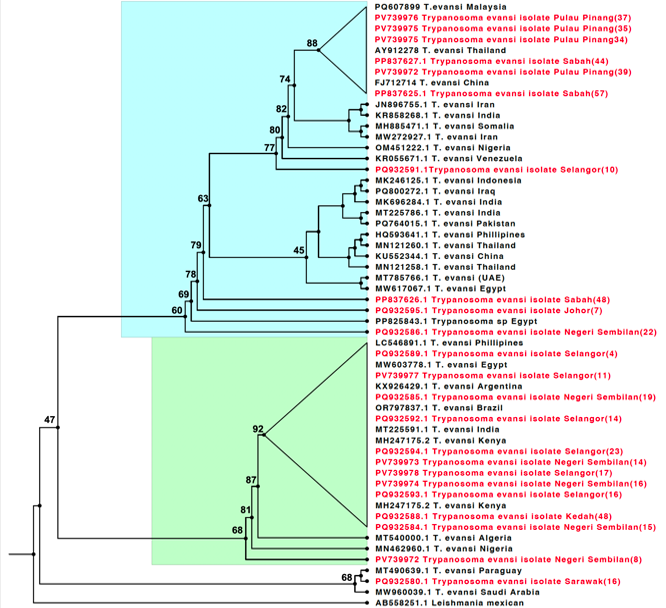
A total of 24 PCR-positive amplicons were submitted for Sanger sequencing, of which 23 high-quality ITS1 sequences were successfully obtained and deposited in GenBank. The corresponding GenBank accession numbers for all 23 sequences generated in this study are provided in the phylogenetic tree (Figure 1). These sequences were analysed together with 32 representative T. evansi reference sequences retrieved from GenBank, while Leishmania mexicana (GenBank accession no. AB558251.1) was included as the outgroup. The phylogenetic tree was reconstructed using the Maximum Likelihood method based on ITS1 sequences (Figure 1).
All Malaysian isolates clustered within the T. evansi lineage and were clearly separated from the outgroup, confirming the molecular identity of the PCR-positive samples. None of the Malaysian isolates formed a separate lineage outside the established T. evansi clade. The Malaysian isolates were interspersed among reference sequences from Asia, Africa, the Middle East, and South America rather than forming a distinct monophyletic cluster, indicating a high degree of genetic similarity with globally circulating T. evansi strains. Most isolates from the Central and Southern regions of Peninsular Malaysia clustered within a well-supported subclade together with reference isolates from Africa and South America. In contrast, isolates from the Northern region of Peninsular Malaysia and Sabah formed a separate cluster closely related to Asian reference isolates. One isolate from Sarawak occupied a distinct phylogenetic position relative to the remaining Malaysian isolates and clustered most closely with reference isolates from Saudi Arabia and Paraguay, suggesting the presence of genetic diversity among T. evansi isolates circulating in Malaysia.
Discussion
The present study demonstrated an overall molecular prevalence of Trypanosoma evansi of 5.5% among horses in Malaysia, with infections showing a distinct geographical bias towards Peninsular Malaysia. More than 80% of PCR-positive horses originated from Peninsular Malaysia, whereas only sporadic cases were detected in Malaysian Borneo. This uneven distribution suggests that T. evansi transmission is influenced by regional differences in livestock movement, vector ecology, and husbandry practices. However, these potential factors should be interpreted cautiously, as formal statistical risk factor analysis was beyond the scope of the present study.
Within Peninsular Malaysia, the Southern and Central regions recorded the highest prevalence of T. evansi. The Southern region accommodates numerous commercial livestock farms, increasing opportunities for contact between horses and potential reservoir hosts. Furthermore, livestock importation from endemic countries, including Argentina, may facilitate the introduction and persistence of T. evansi within the region . Animal movement has long been recognised as a major driver of surra dissemination, contributing to the spread of infected animals across geographical boundaries and introducing the parasite into previously unaffected areas . Nevertheless, these factors represent possible explanations for the observed regional pattern rather than statistically established risk factors in the present study.
Regional differences in horse management may have further influenced the observed distribution. Horses in the Southern and Central regions are predominantly maintained under intensive stable systems, where close confinement and the persistence of hematophagous flies around stables may enhance opportunities for mechanical transmission. Although T. evansi does not undergo biological development within its vectors, interrupted feeding by Tabanus and Stomoxys spp. enables efficient transfer of infected blood between susceptible hosts ; ;.
Table 1 : Molecular prevalence of trypanosoma evansi among horses in Malaysia by geographical region.
Geographical region
Horses examined, n
PCR-positive, n
Molecular prevalence, % (95% CI)
Peninsular Malaysia
East Coast
156
0
0.0 (0.0–2.3)
Northern
76
2
2.6 (0.3–9.2)
Central
46
8
17.4 (7.9–31.9)
Southern
75
10
13.3 (6.6–23.0)
Malaysian Borneo
Northeast
59
3
5.1 (1.1–14.1)
Northwest
28
1
3.6 (0.1–18.3)
Total
440
24
5.5 (3.6–7.9)
Note. CI, confidence interval; PCR, polymerase chain reaction. Values in parentheses represent 95% confidence intervals calculated using the exact binomial method.
Conversely, the comparatively lower prevalence observed in the East Coast, Northeast and Northwest may be associated with more extensive grazing systems, lower stocking densities, and reduced exposure to vectors commonly associated with stable environments. Similar relationships between management practices, vector abundance, and T. evansi transmission have been documented in other endemic regions . However, these observations remain descriptive in the present study, and the specific epidemiological and management-related risk factors for T. evansi infection will be evaluated separately using appropriate statistical analysis.
Phylogenetic analysis confirmed that all Malaysian isolates clustered within the established T. evansi clade and were clearly separated from the Leishmania mexicana outgroup, supporting accurate species identification. These findings further demonstrate the suitability of the ITS1 region as a reliable molecular marker for the detection and phylogenetic characterization of T. evansi, consistent with previous reports ; ; ; .
The Malaysian isolates did not form a distinct country-specific lineage but were interspersed among reference isolates from Asia, Africa, the Middle East, and South America, indicating a high degree of genetic similarity with globally circulating T. evansi strains. This observation is consistent with previous studies reporting limited phylogeographic structure in T. evansi, largely attributable to the parasite’s broad host range and extensive dissemination through domestic and international animal movement ; . Rather than evolving in geographical isolation, the Malaysian T. evansi population appears to comprise multiple lineages introduced through repeated transboundary transmission events.
A notable finding was the distinct phylogenetic placement of one isolate from Sarawak, which clustered closely with reference isolates from Saudi Arabia and Paraguay. This observation agrees with the findings of Javanshir et al. (2023), who reported complete nucleotide sequence identity among T. evansi isolates from Saudi Arabia, Malaysia, Pakistan, India, Egypt, and Kenya. Such close genetic relationships among isolates from geographically distant regions highlight the remarkable dispersal capacity of T. evansi and reinforce the role of international livestock movement in shaping parasite population structure. Although the present study cannot determine the precise route of introduction, the finding emphasizes the importance of continuous molecular surveillance for detecting newly introduced or emerging parasite lineages.
Regional clustering among Malaysian isolates further suggests the coexistence of multiple transmission networks within the country. Most isolates from the Central and Southern regions clustered with reference strains from Africa and South America, whereas isolates from the Northern region of Peninsular Malaysia and Sabah grouped more closely with Asian isolates, particularly those from Thailand and China. Similar phylogenetic relationships have been reported in Indonesia, where T. evansi isolates exhibited high genetic similarity with Chinese strains . Likewise, the clustering of Malaysian isolates with neighbouring Asian strains is consistent with previous evidence of transboundary dissemination of surra within Southeast Asia . Collectively, these findings suggest that Malaysian T. evansi populations comprise multiple genetic lineages shaped by both regional transmission and international animal movement.
Overall, the present study demonstrates that T. evansi populations circulating in Malaysia are genetically diverse and influenced by both local epidemiological factors and transboundary dissemination. The predominance of infections in Peninsular Malaysia, together with the close phylogenetic relationships between Malaysian isolates and strains from multiple continents, underscores the importance of integrating molecular surveillance with strengthened quarantine measures, movement control, and vector management programmes to reduce the risk of disease introduction and limit the further spread of equine trypanosomiasis within Malaysia.
Conclusion
This study provides the first comprehensive molecular and phylogenetic characterization of Trypanosoma evansi infection among horses across Malaysia. Molecular detection demonstrated that T. evansi remains an important equine pathogen, with infections occurring predominantly in Peninsular Malaysia, indicating regional differences in transmission dynamics. Phylogenetic analysis revealed that Malaysian isolates are genetically diverse and closely related to strains circulating in Asia, the Middle East, Africa, and South America, highlighting the influence of transboundary animal movement on parasite dissemination. These findings provide updated baseline data on the molecular epidemiology of equine trypanosomiasis in Malaysia and underscore the importance of integrating molecular surveillance with strengthened biosecurity, quarantine, and vector control measures. Continued molecular monitoring is essential to support early detection of emerging lineages, improve disease surveillance, and safeguard the health and sustainability of Malaysia’s equine industry.
Acknowledgments
This work was under the Fundamental Research Grant Scheme (FRGS) funded by the Ministry of Higher Education (KPT), Malaysia under project number FRGS/1/2022/WAB04/UMK/03/1. We are thankful to Ms. C.W Salma from Molecular Biology Laboratory, University Veterinary Diagnostic Centre (UVDC), UMK for technical help in the molecular work and Mr. Fakhrul Nizam from Hospital Pengajar Veterinar (HPV), UMK for his help in field investigation.
NOVELTY STATEMENT
This study provides the first nationwide molecular and phylogenetic characterization of Trypanosoma evansi in Malaysian horses, establishing updated baseline data on its prevalence and genetic diversity. The findings reveal close genetic relationships between Malaysian and globally circulating T. evansi strains, providing new insights into parasite diversity and supporting future molecular surveillance and control strategies.
Author’s Contribution
Nur Zul Izzati Mohd Rajdi: Methodology, Investigation; Writing‐original draft. Mimi Armiladiana Mohamad: Investigation; Resources. Rumaizi Shaari: Investigation; Writing‐review and editing. Mohd Farhan Hanif Reduan: Formal analysis; Writing‐original draft Mohammad Sabri Abdul Rahman: Methodology; Formal analysis; Writing‐review and editing. Mohammad Dauda Goni: Writing‐review and editing. Tan Li Peng: Formal analysis; Writing‐original draft; Methodology.
Generate AI and AI assisted technology statement
The authors declare that no generative AI and AI assisted technology was used in the creation of this manuscript
Conflict of interest
The authors declare that the research was conducted in the absence of any potential conflict of interest.
Figures
Figure 1:.
Phylogenetic tree of Trypanosoma evansi based on partial ITS1 gene sequences, constructed using the maximum likelihood method with the Tamura – Nei model and 1,000 bootstrap replicates. Sequences highlighted in red represent novel isolates obtained in the current study
References
Berlin D, Loeb E, Baneth G (2009). Disseminated central nervous system disease caused by Trypanosoma evansi in a horse. Vet. Parasitol., 161(3–4): 316–319. https://doi.org/10.1016/j.vetpar.2009.01.030[CrossRef]
BERNAMA (2003). M’sia terima kargo pertama 1,420 lembu, 33 kuda dari Argentina. Perdana Leadership Foundation Digital Library.
Birhanu H, Gebrehiwot T, Goddeeris BM, Büscher P, Van Reet N (2016). New Trypanosoma evansi type B isolates from Ethiopian dromedary camels. PLoS Negl. Trop. Dis., 10(4): e0004556. https://doi.org/10.1371/journal.pntd.0004556[CrossRef]
Chandrawathani P, Yusof M, Slamah B, Rohaya MA (1998). A survey on equine piroplasmosis in Peninsular Malaysia. J. Vet. Malays., 10(1): 25–26.
Desquesnes M, Dávila AMR (2002). Applications of PCR-based tools for detection and identification of animal trypanosomes: A review and perspectives. Vet. Parasitol., 109(3–4): 213–231. https://doi.org/10.1016/S0304-4017(02)00270-4[CrossRef]
Desquesnes M, Holzmuller P, Lai DH, Dargantes A, Lun ZR, Jittaplapong S (2013). Trypanosoma evansi and surra: A review and perspectives. BioMed Res. Int., 2013: 194176. https://doi.org/10.1155/2013/194176[CrossRef]
Elobaid NI, Daffalla OM, Noureldin EM, Abdalla MA (2021). Phylogenetic analysis of Trypanosoma evansi isolates in naturally infected camels from the Kingdom of Saudi Arabia. Int. J. Curr. Microbiol. Appl. Sci., 10(4): 532–543. https://doi.org/10.20546/ijcmas.2021.1004.052[CrossRef]
Elshafie EI, Sani RA, Hassan L, Sharma R, Bashir A, Abubakar IA (2013a). Active infection and morphometric study of Trypanosoma evansi among horses in Peninsular Malaysia. Trop. Biomed., 30(3): 444–450.
Elshafie EI, Sani RA, Hassan L, Sharma R, Bashir A, Abubakar IA (2013b). Seroprevalence and risk factors of Trypanosoma evansi infection in horses in Peninsular Malaysia. Res. Vet. Sci., 94(2): 285–289. https://doi.org/10.1016/j.rvsc.2012.09.004[CrossRef]
Eyob E, Matios L (2013). Review on camel trypanosomosis (surra) due to Trypanosoma evansi: Epidemiology and host response. J. Vet. Med. Anim. Health, 5(12): 334–343.
Gaithuma AK, Yamagishi J, Martinelli A, Hayashida K, Kawai N, Marsela M, Sugimoto C (2019). A single test approach for accurate and sensitive detection and taxonomic characterization of trypanosomes by comprehensive analysis of internal transcribed spacer 1 amplicons. PLoS Negl. Trop. Dis., 13(2): e0006842. https://doi.org/10.1371/journal.pntd.0006842[CrossRef]
Herrera HM, Dávila AMR, Norek A, Abreu UG, Souza SS, D’Andrea PS, Jansen AM (2004). Enzootiology of Trypanosoma evansi in Pantanal, Brazil.Vet. Parasitol., 125(3–4): 263–275. https://doi.org/10.1016/j.vetpar.2004.07.013[CrossRef]
Hoare CA (1964). Morphological and taxonomic studies on mammalian trypanosomes. X. Revision of systematics. J. Protozool., 11(2): 200–207. https://doi.org/10.1111/j.1550-7408.1964.tb01741.x[CrossRef]
Jaimes-Duenez J, Jimenez-Leano A, Enrique-Nino S, Arias-Landazábal N, Bedoya-Ríos M, Rangel-Pachón D (2023). Clinical and epidemiological aspects of infection by Babesia, Theileria and Trypanosoma species in horses from northeastern Colombia. Ticks Tick Borne Dis., 14(6): 102208. https://doi.org/10.1016/j.ttbdis.2023.102208[CrossRef]
Javanshir A, Tavassoli M, Esmaeilnejad B (2023). Morphological, serological, molecular detection, and phylogenetic analysis of Trypanosoma evansi in horses of different regions in Iran. Parasitol. Res., 122(8): 1873–1881. https://doi.org/10.1007/s00436-023-07888-2[CrossRef]
Kamidi CM, Saarman NP, Dion K, Mireji PO, Ouma C, Murilla G, Aksoy S, Schnaufer A, Caccone A (2017). Multiple evolutionary origins of Trypanosoma evansi in Kenya. PLoS Negl. Trop. Dis., 11(9): e0005895. https://doi.org/10.1371/journal.pntd.0005895[CrossRef]
Kamyingkird K, Chalermwong P, Saechan V, Kaewnoi D, Desquesnes M, Ngasaman R (2020). Investigation of Trypanosoma evansi infection in bullfighting cattle in southern Thailand. Vet. World, 13(8): 1674–1680. https://doi.org/10.14202/vetworld.2020.1674-1678[CrossRef]
Kazim AR, Houssaini J, Tappe D, Heo CC (2022). A checklist of the ticks of Malaysia (Acari: Argasidae, Ixodidae), with associated hosts, geographical distribution, and pathogens. Zootaxa, 5190(4): 485–530. https://doi.org/10.11646/zootaxa.5190.4.2[CrossRef]
Khuchareontaworn S, Singhaphan P, Viseshakul N, Chansiri K (2007). Genetic diversity of Trypanosoma evansi in buffalo based on internal transcribed spacerssss (ITS) regions. J. Vet. Med. Sci., 69(5): 487–493. https://doi.org/10.1292/jvms.69.487[CrossRef]
Lai DH, Hashimi H, Lun ZR, Ayala FJ, Lukeš J (2008). Adaptations of Trypanosoma brucei to gradual loss of kinetoplast DNA: Trypanosoma equiperdum and Trypanosoma evansi are petite mutants of T. brucei. Proc. Natl. Acad. Sci. USA, 105(6): 1999–2004. https://doi.org/10.1073/pnas.0711799105[CrossRef]
Mohammed K, Tukur SM, Watanabe M, Abd Rani PA, Lau SF, Shettima YM, Watanabe M (2016). Factors influencing the prevalence and distribution of ticks and tick-borne pathogens among domestic animals in Malaysia. Pertanika J. Scholarly Res. Rev., 2(2).
Mohd Rajdi NZI, Mohamad MA, Tan LP, Choong SS, Reduan MFH, Hamdan RH, Zalati CWS (2021). First case report on the occurrence of Trypanosoma evansi in a Siam B mare in Kelantan, Malaysia. Vet. Med. Sci., 7(2): 303–309. https://doi.org/10.1002/vms3.379[CrossRef]
Naama TA, Rohaya MA, Tuba Thabitah ATT, Nadiah H, Khor SK, Nurul Faizah Z, Wan Norulhuda WAW, Faizah Hanim MS, Masrin A, Chandrawathani P (2021). Common equine parasites diagnosed in Peninsular Malaysia from the year 2014 to 2018. Malays. J. Vet. Res., 12(2): 26–36.
Njiru ZK, Constantine CC, Guya S, Crowther J, Kiragu JM, Thompson RCA, Dávila AMR (2005). The use of ITS1 rDNA PCR in detecting pathogenic African trypanosomes. Parasitol. Res., 95(3): 186–192. https://doi.org/10.1007/s00436-004-1267-5[CrossRef]
Ola-Fadunsin SD, Gimba FI, Abdullah DA, Jesse Abdullah Ff, Sani RA (2020). Dataset on the diversity and distribution of biting flies collected from cattle farms in Peninsular Malaysia. Data Brief, 29: 105177. https://doi.org/10.1016/j.dib.2020.105315[CrossRef]
Setiawan A, Nurcahyo W, Priyowidodo D, Budiati RT, Susanti DSR (2021). Genetic and parasitological identification of Trypanosoma evansi infecting cattle in South Sulawesi, Indonesia. Vet. World, 14(1): 113–119. https://doi.org/10.14202/vetworld.2021.113-119[CrossRef]
Shorba M, Shoulah SA, Arnaout F, Selim A (2024). Seroprevalence and associated risk factors for Trypanosoma evansiinfection in equine in North of Egypt. J. Hellenic Vet. Med. Soc., 75(3): 8065–8072. https://doi.org/10.12681/jhvms.36449[CrossRef]
Stevens J, Rambaut A (2001). Evolutionary rate differences in trypanosomes. Infect. Genet. Evol., 1(2): 143–150. https://doi.org/10.1016/S1567-1348(01)00018-1[CrossRef]
Suprihati E, Suwanti LT, Yudhana A, Kusumaningrum AI (2022). Comparison of ITS-1 and TBR-1/2 primer sensitivity for the detection of Trypanosoma evansi local isolates in experimental rats using a polymerase chain reaction. Vet. World, 15(7): 1772–1778. https://doi.org/10.14202/vetworld.2022.1772-1778[CrossRef]
Thi Nguyen G, Jhaiaun P, Mutchimadilok T, Chimnoi W, Nimsuphan B, Ngasaman R, Arunvipas P, Phasuk J, Inpankaew T, Kamyingkird K (2025). Serological detection of Trypanosoma evansi infection in cattle using an in vitro cultivated antigen for indirect ELISA in Thailand. Vet. Parasitol., 337: 110483. https://doi.org/10.1016/j.vetpar.2025.110483[CrossRef]
Verma R, Punia V, Das G, Kumar S, Nath S, Swamy M (2024). Assessment of genetic diversity of Trypanosoma evansi in domestic animal populations through ITS-1 gene sequence analysis. Parasitol. Res., 123(1): 2. https://doi.org/10.1007/s00436-023-08024-w[CrossRef]
Zangooie F, Ganjali M, Keighobadi M, Nabavi R (2018). Molecular detection of Trypanosoma evansi in camels. Trop. Biomed., 35(4): 1140–1147.
Zawida Z, Chandrawathani P, Nurulaini R, Khor SK, Adnan M, Premaalatha B, Zaini CM, Jamnah O, Azizah D, Norlida A, Noor Suhaila S (2010). Prevalence of protozoan diseases in local horses in Peninsular Malaysia. Indian J. Comp. Microbiol. Immunol. Infect. Dis., 31(1–2): 48–50.