
Blattella germanica L. (German cockroach) a highly adaptable urban pest, poses significant public health risks due to its resistance to insecticides and pathogen transmission. The current study aimed to assess the efficacy of Alphaguard 10% soluble concentration (SC) and Vendetta Nitro® cockroach gel bait in controlling B. germanica populations in an urban setting. The study was conducted in high-infestation zones at Arcadian Café. Alphaguard spray and bait applications were combined in six treatments following Integrated Pest Management (IPM) principles. Temporal trends and spatial variations in pest counts were analyzed using R software, with Chi-square tests assessing its treatment efficacy. Both treatments significantly reduced pest counts, with spray treatments achieving a faster decline and bait traps providing sustained control. The garbage area had the highest initial infestation and required prolonged treatment to reach minimal pest counts (p < 0.05). Combining spray and bait treatments under IPM principles offers an effective and sustainable strategy for managing B. germanica infestations in urban environments.
Short Communication · Volume 58, Issue 3, 11 April 2026 · Open Access
Control of Blattella germanica (L.) in an Urban Café Using α-cypermethrin Spray and Abamectin Bait
· ·
Affiliations & Notes ⌄
- 1Department of Entomology, University of Agriculture, Faisalabad 2Institute of Zoological Sciences, University of Peshawar, Peshawar 3Department of Entomology, PMAS-Arid Agriculture University Rawalpindi, Pakistan 4Faculty of Agriculture, Universiti Putra Malaysia, 43400 UPM Serdang, Selangor, Darul Ehsan * Corresponding author: std103750@uop.edu.pk
Article Info ⌄
- Journal:
- Pakistan Journal of Zoology
- Published:
- 11 April 2026

From the article
- Gel bait treatments, while slower in action, also demonstrated effective control, especially in low-to-moderate infestation zones.
- Spray treatments were notably more effective in high-infestation zones like the garbage area, while bait traps produced a more gradual reduction, particularly in less-affected zones.
- This study confirmed the effectiveness of integrating alphacypermethrin-based spray and abamectin-based gel bait as part of an urban pest control strategy against Blattella germanica.
- Spray treatments achieved immediate population suppression, particularly in areas with high infestation intensity, while bait traps maintained consistent control over time.
Selected from the article's own text.
Abstract
Materials and methods
This study was conducted at the Arcadian Café in Emporium Mall, Pakistan, through a formal agreement with the café management to implement targeted pest control under real operational conditions. High-infestation zones of B. germanica were identified through visual inspection, with confirmed activity in utility zones and non-customer-facing service areas.
Two formulations were selected based on their known efficacy and safety in food-related environments. The first was alphaguard 10% SC (Bruckmann Solutions Pvt Ltd.), a liquid concentrate containing alpha-cypermethrin, applied at 250 mL per 20 L of water using a standard knapsack sprayer. The second was Vendetta Nitro® Cockroach Gel Bait, composed of 0.05% abamectin B1 and 0.50% pyriproxyfen. Spray treatments targeted surfaces and harborages, while gel bait was applied as small dabs in cracks, crevices, and corners to attract both adult and juvenile cockroaches. Both applications followed IPM principles to reduce health risks and chemical exposure.
For treatment schedule six combined treatments (spray followed by bait) were applied at six designated locations within the café such as counter, kitchen, dish washing area, dining area, outside dining area and garbage area. The first and fourth treatments were spaced five days apart, while the rest were applied at seven-day intervals. Gel bait was introduced 24 h after spray treatments to minimize potential repellent effects, in accordance with the U.S. Environmental Protection Agency’s Combat® Roach Gel product label guidelines for bait-spray sequencing (U.S. EPA, 2002). Treatment protocols were adapted from Fardisi et al. (2019), who demonstrated improved suppression of German cockroach populations using this dual-approach method.
Cockroach presence was monitored before each treatment using standardized visual counts during evening h when cockroach activity peaks. Observations were made at the same fixed locations in each area, such as under sinks, behind counters, and around waste bins to ensure consistency. Although no trapping devices were used, live cockroach counts were recorded manually by a single trained observer to reduce bias. While this method may underestimate hidden populations, it provided a practical and repeatable approach in a live commercial setting.
All applications were carried out after operating h to avoid exposure to staff and customers. Treated areas were cleaned before reopening each day, and no products were applied to food-contact surfaces. No adverse health effects or re-infestation reports were received during the study.
Cockroach counts recorded after each treatment were analyzed using R software (version 4.4.1). Trends in pest population over time were visualized using line graphs, while spatial variation across treatment areas was represented using heat maps. A Chi-square test of independence was used to assess the relationship between treatment type and pest counts, with significance defined at p < 0.05.
Results
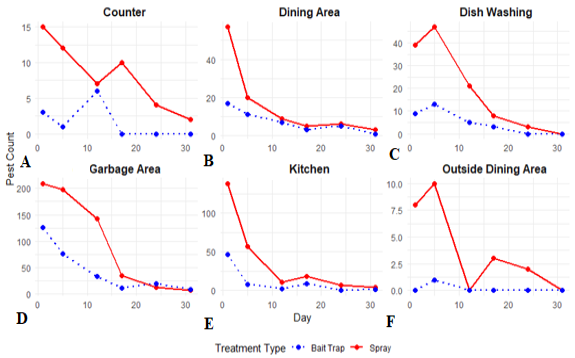
The application of both spray and gel bait treatments resulted in a substantial decline in B. germanica populations across all six monitored areas (Fig. 1). A clear downward trend in pest numbers was observed throughout the 30-day intervention period, with notable variation in the speed and magnitude of reduction between treatment types and locations.
Spray applications produced the most immediate and affected reductions, particularly in areas with high initial infestations. In the garbage area, pest counts dropped from 209 to just 7 individuals, while the kitchen area saw a decrease from 138 to 4. This pattern highlights the fast-acting nature of alpha-cypermethrin when applied directly to infested surfaces and harborages. Gel bait treatments, while slower in action, also demonstrated effective control, especially in low-to-moderate infestation zones. By the end of the study period, pest numbers reached zero in the dishwashing area and the outdoor dining area following bait application alone. This suggests that the combination of abamectin and pyriproxyfen may be particularly suitable for maintenance control or areas where direct spraying is impractical or undesirable.
These trends are visualized in Figure 1. Overall, the data supports the integrated use of both formulations. Spraying appears to be more effective in rapidly suppressing large infestations, while gel bait contributes meaningfully to sustained, area-specific control especially in hard-to-reach or sensitive zones.
Solid red lines represent the spray treatment, and dashed blue lines represent gel bait results
The heat map in Figure 2 illustrates the spatiotemporal progression of pest suppression across six operational zones subjected to two treatment strategies. Initial pest densities were markedly higher in the garbage area and kitchen, indicating these as primary infestation hotspots likely due to food waste exposure and residual humidity. These areas not only began with the highest pest loads but also showed the slowest response to both treatment types, underscoring their resilience and the potential need for intensified intervention in such microenvironments. By contrast, dishwashing, outdoor dining and counter areas exhibited lower baseline infestations and achieved complete suppression earlier, especially under gel bait treatment, which may reflect differences in habitat suitability or foraging behavior.
Taken together, while both treatments led to visible reductions, spray applications produced more uniform and rapid declines across all zones. Gel bait, although slower, proved effective in achieving total eradication in less-infested areas. The variation in reduction patterns across locations underscores the need to consider baseline pest density and site-specific conditions when selecting treatment approaches.
A Chi-square test of independence revealed a significant association between treatment type and pest counts across different areas (χ² = 25.11, df = 5, p < 0.001). The findings suggest that treatment efficacy was not uniform across spaces. Spray treatments were notably more effective in high-infestation zones like the garbage area, while bait traps produced a more gradual reduction, particularly in less-affected zones.
Discussion
Treatments with α-cypermethrin based sprays achieved rapid initial reductions, particularly in high-infestation areas, while abamectin-based bait traps provided reliable, long-term population control. α-cypermethrin acts as a neurotoxin, targeting sodium channels and producing a fast knockdown effect on cockroach populations . In contrast, abamectin gel baits exhibit delayed toxicity and promote secondary kill through mechanisms such as coprophagy and emetophagy, contributing to sustained suppression of the population over time .
The observed variations in treatment efficacy across different locations underscore the influence of environmental conditions, particularly sanitation. Persistent infestations in garbage disposal zones reflect how food availability and moisture support cockroach persistence, even following chemical treatment (AAP Grand Rounds, 2008). These results stress the necessity of coupling chemical control with environmental hygiene improvements to maximize effectiveness and reduce reinfestation risk.
Our findings align with broader evidence supporting the integration of quick-acting neurotoxic sprays and slow-acting bait systems for effective pest control. For instance, Schal (2009) emphasized that bait formulations while slower are critical to long-term suppression, especially when used alongside fast-acting treatments for immediate reduction. Similarly, studies, such as those by Fardisi et al. (2019) and Lee et al. (2021), support these findings, underscoring the effectiveness of integrating quick-acting sprays with sustained baits for comprehensive pest management. This IPM strategy not only optimizes control but also minimizes the risk of resistance by targeting pests through multiple mechanisms .
Finally, the public health implications of B. germanica infestation are well documented. This species is a well-known vector for pathogens, allergens, and food contaminants, particularly in urban food-handling environments . Hence, implementing localized and integrated chemical control alongside consistent sanitation practices offers a practical and evidence-based solution for managing urban cockroach infestations while minimizing public health risks.
Conclusion
This study confirmed the effectiveness of integrating alphacypermethrin-based spray and abamectin-based gel bait as part of an urban pest control strategy against Blattella germanica. Spray treatments achieved immediate population suppression, particularly in areas with high infestation intensity, while bait traps maintained consistent control over time. The statistically significant association between treatment type and pest density across different café zones underscores the importance of site-specific interventions to optimize treatment outcomes.
Declarations
Generative AI and AI-assisted technology statement
During the preparation of this work, the authors used ChatGPT to improve the clarity and readability of the writing. After using this tool, the authors reviewed and edited the content as needed and take full responsibility for the content of the published article.
Statement of conflict of interest
The authors have declared no conflict of interest.
Figures
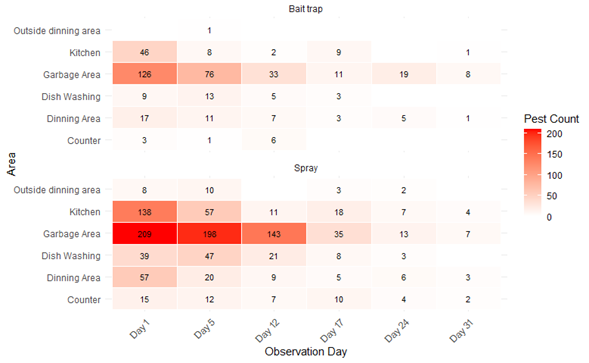
Heat map showing temporal changes in cockroach counts by area and treatment type over 31 days.
References
- AAP Grand Rounds, 2008. AAP Grand Rounds, 19: 55. https://doi.org/10.1542/GR.19-5-55[CrossRef]
- Abudin, S., Martini, M. and Nurjazuli, N., 2023. Majalah Kesehatan Indonesia, 4: 71-76. https://doi.org/10.47679/makein.2023155[CrossRef]
- Arruda, L.K., Vailes, L.D. and Chapman, M.D., 2001. Int. Arch. Allergy Immunol., 124: 3–6. https://doi.org/10.1067/mai.2001.112854[CrossRef]
- Baz, M.M. and Hegazy, M., 2021. Egypt. J. Zool., 75: 39–47. https://doi.org/10.21608/ejz.2021.54858.1047[CrossRef]
- Dimitriadou, I., Memtsas, G., Xystrakis, F., Kavvadas, D., Pa-pamitsou, T. and Avtzis, D.N., 2021. Proc. Int. Electr. Conf. Ent., 1: 682. https://doi.org/10.3390/IECE-10682[CrossRef]
- Ebrahimi, S., Firoozfar, F., Asgaian, T.S. and Vatandoost, H., 2024. Biomed. J. Sci. Tech. Res., 55: 47533–47541.
- Fardisi, M., Gondhalekar, A.D., Ashbrook, A.R. and Scharf, M.E. 2019. Sci. Rep., 9: 1–10. https://doi.org/10.1038/s41598-019-44296-y[CrossRef]
- Ferrero, A.A., Chopa, C.S., González, J.W. and Alzogaray, R.A., 2007. Fitoterapia, 78: 311–314. https://doi.org/10.1016/j.fitote.2006.11.021[CrossRef]
- Gondhalekar, A.D., Appel, A.G., Thomas, G.M. and Romero, A., 2021. Insects, 12: 550. https://doi.org/10.3390/insects12060550[CrossRef]
- Khater, H.F., 2012. Pharmacologia, 3: 641–656. https://doi.org/10.5567/pharmacologia.2012.641.656[CrossRef]
- Lee, C.-Y., Wang, C. and Rust, M.K., 2021. German cockroach infestations in the world and their social and economic impacts. CSIRO Publishing. https://doi.org/10.1071/9781486312078[CrossRef]
- López-Sánchez, M.J., Gil, R., Latorre, A. and Moya, A., 2022. PLoS Genet., 5: e1000721. https://doi.org/10.1371/journal.pgen.1000721[CrossRef]
- Mahmoud, M.F., El-Bahrawy, A.F., El-Sharabasy, H.M., El-Badry, Y.S. and El-Kady, G.A., 2013. Arthropods, 2: 216.
- Manyullei, S., Silalahi, S., Paluseri, A.M.A., Wahdaniyah, I., Waly, H., Jabalnur, W.R. and Putranto, R.H., 2022. Int. J. Life Sci. Res. Arch., 3: 1–12.
- Nasirian, H. and Salehzadeh, A., 2019. J. med. Ent., 56: 181–191. https://doi.org/10.1093/jme/tjy205[CrossRef]
- Pan, X., Wang, X. and Zhang, F., 2020. Insects, 11: 696. https://doi.org/10.3390/insects11100696[CrossRef]
- Portnoy, J., Chew, G.L., Phipatanakul, W., Williams, P. B., Grimes, C., Kennedy, K., Matsui, E.C., Miller, J.D., Bernstein, D., Blessing-Moore, J., Cox, L., Khan, D., Lang, D., Nicklas, R., Oppenheimer, J., Randolph, C., Schuller, D., Spector, S., Tilles, S.A., Sublett, J., 2013. J. Allergy Clin. Immunol., 132: 1012–1025.e1.
- Rust, M.K., Owens, J.M. and Reierson, D.A., 1995. Understanding and controlling the German cockroach. Oxford University Press. https://doi.org/10.1093/oso/9780195064957.001.0001[CrossRef]
- Salazar, M., Agnew, J.L. and Romero, A., 2024. Insects, 15: 171. https://doi.org/10.3390/insects15030171[CrossRef]
- Schal, C., 2009. Adv. Hum. Vector Contr., 1014: 89–106. https://doi.org/10.1021/bk-2009-1014.ch007[CrossRef]
- Tee, H.S. and Lee, C.Y., 2014. In: Urban insect pests: Sustainable management strategies (eds. W.H. Robinson and A.E. Müller). pp. 65–85.
- Wang, C., Eiden, A., Cooper, R., Zha, C., Wang, D. and Reilly, E., 2019. Insects, 10: 266. https://doi.org/10.1093/jipm/pmz031[CrossRef]
Services
Article usage statistics
Loading…