
Honeybees are considered important pollinators of economically important crops that play a significant role in food security. The population of honeybees is declining due to the non-judicious and extensive use of pesticides. The current study was planned to evaluate the toxicity of five solely (abamectin, cypermethrin, imidacloprid, acetamiprid, and pyriproxyfen) and two mixtures of insecticides (carbosulfan+emamectin benzoate and pymetrozine+dinotefuran) formulations against workers of Apis dorsata. Five concentrations of each insecticide were prepared in distilled water and two types of contact bioassay were used i.e. topical bioassay and surface residual bioassay. In topical bioassay, pymetrozine + dinotefuran was found the most toxic insecticide with lower LD50 values (0.09 mg/L) followed by abamectin (0.30 mg/L), carbosulfan+emamectin benzoate (0.68 mg/L) and cypermethrin (0.94 mg/L) after 48 h of exposure. Whereas, in surface residual bioassay, pymetrozine+dinotefuran was found the most toxic insecticide with lower LD50 values (0.30 mg/L) followed by pyriproxyfen (0.48 mg/L), cypermethrin (0.93 mg/L) and carbosulfan+emamectin benzoate (0.96 mg/L) after 48 h of exposure. In topical bioassay, carbosulfan+emamectin benzoate showed faster mortality with a low LT50 value (4.98 h at 2 mg/L) followed by pymetrozine+dinotefuran (6 h at 2 mg/L), cypermethrin (9.01 h at 16 mg/L) and abamectin (9.72 h at 16 mg/L). Whereas, in surface residual bioassay, cypermethrin showed faster mortality with a low LT50 value (2.65 h at 16 mg/L) followed by carbosulfan+emamectin benzoate (4.57 h at 2 mg/L), pymetrozine+dinotefuran (8.76 h at 2 mg/L) and abamectin (10.51 h at 16 mg/L). The findings of the present study revealed that insecticide mixtures were the most toxic towards A. dorsata followed by cypermethrin and abamectin alone. Therefore, care should be taken during the selection of insecticides for the control of pests in field crops.
Research Article · Volume 57, Issue 6, 29 September 2025 · Open Access
Toxicity of Commonly Used Insecticides against Apis dorsata (Hymenoptera: Apidae) in South Punjab, Pakistan
· · · · ·
Affiliations & Notes ⌄
- 1Honeybee Research Institute, National Agricultural Research Centre, PARC, Islamabad, Pakistan 2Department of Entomology, Faculty of Agriculture and Environment, The Islamia University of Bahawalpur, Bahawalpur, Pakistan 3Institute of Plant Protection, MNS University of Agriculture, Multan, Pakistan 4Department of Entomology, University of the Punjab, Lahore, Pakistan 5Department of Environmental sciences, Kohsar University, Murree, Pakistan 6Yaqoob Group of Companies, (Pvt.) Ltd. Multan, Pakista
Article Info ⌄
- Journal:
- Pakistan Journal of Zoology
- Published:
- 29 September 2025

From the article
- In the present study, by using the residual application, pyriproxyfen was highly toxic after 48 h with an LD50 of 0.48 mg/L. Pyriproxyfen is considered to have low acute toxicity against adult honey bees.
- Cypermethrin and abamectin are highly toxic to A. dorsata workers due to low LD50 values.
- It is concluded that all insecticide combinations or certain classes of insecticides when combined yielded a toxic effect on bees.
- Carbosulfan + Emamectin benzoate was found more toxic to A. dorsata.
Selected from the article's own text.
Abstract
Introduction
Pollination is one of the most important ecosystem services that is provided by insects ; ; . Among insect pollinators, bees are considered important pollinators , 2022; especially honeybees as they contribute to more than 80 % of insect pollination ; . Besides this, honeybees are also important because they provide many economically important products i.e., honey, royal jelly, bee pollen, propolis, bee venom, and wax ; ; , 2020). The giant honeybee, Apis dorsata is larger than other honeybees therefore its foraging range is significantly higher . Moreover, A. dorsata is considered the efficient pollinator of various agronomic crops, fruits, and vegetables ; ; ; ; ; ; ; ; .
There are many pivotal factors i.e., climate change, urbanization, deforestation, industrialization, loss of biodiversity and their habitat, and extensive application of broad-spectrum pesticides that cause a decline in the population of honeybees especially non-domesticated like A. dorsata and A. florea ; . In Pakistan, the commercial production of crops mostly depends on the application of pesticides like insecticides, fungicides, weedicides, and entomopathogenic fungi ; , 2021). Among these pesticides, most of them are broad-spectrum and have widely been used since the 1940s ; . This extensive use of pesticides not only causes environmental pollution but also adversely affects the biodiversity of non-target organisms and human health ; ; ; ; ; , 2021, 2022).
Pesticide application is usually considered a quick, easy, and inexpensive method for the control of insect pests, weeds, and diseases. Insecticides are the most widely used group of pesticides in Pakistan ; . Currently, various classes of insecticides are available in the market for the control of insect pests i.e., organophosphates, carbamates, pyrethroids, neonicotinoids, insect growth regulators (IGRs), botanicals, and some other insecticides derived from different origin that affect insect metabolism and nervous system ; .
The major factor leading to bees decline when bees pollinate the crops, is the direct or indirect exposure to insecticides, weedicides, fungicides and some other groups of pesticides that are applied to the crops via seed treatments, soil applications and foliar applications ; ; . After exposure, pesticides enter the foraging honeybees through two main routes such as ingestion of nectar and pollen and direct contact with sprayed parts of the plant . In opened flowers, nectar and pollen directly acquire pesticides that are applied via foliar applications. Whereas, in closed flowers, nectar and pollen acquire those pesticides that translocate systemically through the plant vascular system ; ; . Some pesticides applied during bloom can lead to direct exposure to pollinators ; .
The harmful effects of insecticides have been demonstrated for the honeybees ; ; ; ; and few wild bee species ; ; . Insecticides are considered a major factor that has a detrimental effect on honeybee colony characteristics such as development of deformed larvae and pupae, greater risk of pest attack, death of foraging bees, disturbance of antioxidant activities, acetylcholinesterase activity, learning process, behavioral stress and other biological aspects ; ; ; ; ; ; .
It is proven that insecticides are a major factor in the population decline of honeybees because of the slower detoxification mechanism that leads to the death of honeybees ; . Besides this, residues of insecticides have also been reported in hive products i.e., honey, bee pollen, propolis, royal jelly and wax which may cause bio-magnification of insecticidal residues at higher trophic levels ; Gonzalez-Martin et al., 2017; ; ; .
From Pakistan, many studies reported the effects of various insecticides on honey bees i.e., Apis mellifera Linnaeus, 1758 and A. florea Fabricius, 1787 by using residual and diet incorporation bioassay ; ; , 2020; ; , but there is a scarce literature about the lethal effects of insecticides on A. dorsata Fabricius, 1793 . The current study aimed to evaluate the toxicity of seven insecticides among these, two are combinations of different insecticides against A. dorsata. The insecticides with different modes of action and usage history in the study area were used ; ; . Abamectin and emamectin benzoate affect gamma-aminobutyric acid (GABA) receptors resulting in the disruption of nerve impulses ; ; . Acetamiprid, imidacloprid, and dinotefuran affect the activity of nicotinic acetylcholine receptors (nAChRs) ; . Carbosulfan causes the inhibition of acetylcholinesterase (ACHE) . Cypermethrin causes dysfunction of mitochondrial dehydrogenase . Pyriproxyfen is an insect growth regulator that affects the embryogenesis, morphogenesis, and reproduction of insects . Pymetrozine is an insect behavior regulator that causes rapid cessation of feeding .
The farmers have extensively used these insecticides on crops. Hence, the purpose of the study was to find out the most toxic and harmful insecticide for A. dorsata by topical application and residual bioassay so that recommendations can be made on their proper and judicious use to conserve honeybees in the area.
Materials and Methods
Insecticides
Commercially used five insecticides and two combinations of insecticides were purchased from their respective manufacturing companies to check their topical and residual contact toxicity against Apis dorsata under laboratory conditions (Table I).
Collection of Apis dorsata
For the collection of A. dorsata, three combs containing capped cells were directly collected from trees located at 3 different locations i.e., Cholistan Institute of Desert Studies (29.3784° N, 71.7696° E), Lal Suhanra National Park (29.4426° N, 71.9852° E), and the Agricultural Research Farm (29.3714° N, 71.7652° E). Smoke was continuously provided to calm down the A. dorsata and then removed from the comb with the help of a bee brush. Only the sealed brood portion was cut from the tree and placed in the plastic boxes. These combs were shifted to the laboratory of the Department of Entomology, Faculty of Agriculture and Environment, The Islamia University of Bahawalpur. Each comb was placed in a separate plastic cage provided with ad libitum 50% w/v sucrose solution. These cages were placed in the Incubator or Versatile Environmental Test Chamber MLR-352H (Panasonic Healthcare Co. Ltd.) at 35°C, 65% relative humidity, and without light for the emergence of bees .
Bioassay
The emerged bees were collected from the cages in plastic jars. Prior to conduct the bioassay, the jars were placed in a freezer to immobilize the worker bees by chilling for five min at -20 °C for easy handling . Two types of contact bioassay were used to check the toxicity of insecticides i.e., topical bioassay and surface residual bioassay. Five doses of each formulated insecticide were tested. Range finding bioassay was used to determine the proper range of doses for each insecticide. Thus, the highest and lowest doses of each insecticide needed to cause 100% and 0% mortality, respectively were determined. Solutions of doses 1, 2, 4, 8, and 16 mg/L for abamectin, cypermethrin, imidacloprid, acetamiprid, and pyriproxyfen and 0.125, 0.25, 0.5, 1, and 2 mg/L for carbosulfan+emamectin benzoate and pymetrozine+dinotefuran were prepared. To prepare the solution of each dose, 10 ml of distilled water was used.
Topical bioassay
For topical bioassays, 2 μl solution was applied on the thorax of a worker bee using the Burkard handheld micro applicator (Burkard Manufacturing Co. Ltd.). Ten newly emerged worker bees were treated with each solution. Control bees were treated with just 2 μl distilled water. Treated worker bees were released in plastic jars, provided ad libitum with a 50% w/v sucrose solution, and kept in an Incubator or Versatile Environmental Test Chamber MLR-352H (Panasonic Healthcare Co. Ltd.) at 28±2 °C temperature and 65±5% relative humidity for the duration of the test period.
Table I. List of insecticides used to check their topical and residual toxicity.
| Chemical name with formulation | Trade name | Group | Mode of action | Recommended dose/acre | Manufacturer |
| Abamectin 1.8% EC | Flight | Avermectin | Stomach | 400 ml | ICI |
| Cypermethrin 25% EW | Cypermethrin | Pyrethroid | Contact and stomach | 200 ml | Kanzo AG |
| Imidacloprid 20% SL | Nexus | Neonicotinoid | Contact and stomach | 250 ml | Swat Agro |
| Acetamiprid 20% SL | Acetamiprid | Neonicotinoid | Contact, stomach, and systemic | 100-125 ml | Leader AG |
| Pyriproxyfen 10.8% EC | Pyriproxyfen | Insect growth regulator | Contact, stomach, and translaminar | 400 ml | Swat Agro |
| Carbosulfan+Emamectin benzoate 25% EW | Locater | Carbamate+ Avermectin | Contact, stomach, and systemic | 250 ml | Leader AG |
| Pymetrozine+Dinotefuran 60% WG | Veyong Jinteng | Pyridine+ Neonicotinoid | Contact, stomach, systemic and translaminar | 100 grams | Jaffer Agro |
*WG, Wettable granules; EC, Emulsifiable concentrate; SL, Soluble liquid; EW, Emulsions in water.
Residual bioassay
For surface residual bioassay, a 5 ml solution of each dose was poured into 2-L plastic jars, shaken thoroughly for 2 min, and air dried ; , 2020). Ten newly emerged worker bees were released in each treated jar, provided ad libitum with a 50% w/v sucrose solution and kept in an incubator at 28±2 °C temperature and 65±5% relative humidity for the duration of the test period.
Assessment of bees mortality
Mortality for both topical and surface residual bioassays was assessed 6, 12, 24 and 48 h after the application of insecticides. The treated bees mortality was recorded during the bioassay.
Statistical analysis
To determine the LD50, LT50, chi-square and 95% confidence interval, Probit analysis (Finny, 1971) was performed by using IBM SPSS Statistics 26. The percent mortality was calculated by using Abbott’s formula as follows:

Results
Estimation of LD50 in topical bioassay
The toxicity of different insecticides by using topical application is presented in Table II. The combinations of two insecticides were more toxic to Apis dorsata than solely used insecticides. Carbosulfan + Emamectin benzoate was found more toxic after 6h with low LD50 value (7.66 mg/L) whereas, Pymetrozine+dinotefuran was found more toxic after 12, 24 and 48 h with LD50 of 0.48, 0.10 and 0.09 mg/L, respectively. Among solely used insecticides, topical application of cypermethrin was highly toxic after 6 and 12 h whereas after 24 and 48 h abamectin was more toxic (Table II).
Table II. Topical median lethal dose (LD50) of different insecticides against Apis dorsata.
| Insecticides | Time (h) | LD50 (mg/L) | 95% CI | df | χ2 | p value |
| Abamectin | 6 | 20.59 | 0.014-0.194 | 4 | 1.337 | 0.023 |
| Cypermethrin | 17.31 | 0.011-0.156 | 4 | 1.851 | 0.025 | |
| Imidacloprid | 19.86 | 0.014-0.184 | 4 | 1.763 | 0.022 | |
| Acetamiprid | 22.21 | 0.001-0.239 | 4 | 1.060 | 0.048 | |
| Pyriproxyfen | 20.59 | 0.014-0.194 | 4 | 1.337 | 0.023 | |
| Carbosulfan+Emamectin benzoate | 7.66 | 0.002-0.136 | 4 | 1.243 | 0.042 | |
| Pymetrozine+Dinotefuran | 14.34 | 0.001-0.136 | 4 | 0.930 | 0.046 | |
| Abamectin | 12 | 10.82 | 0.003-0.136 | 4 | 2.247 | 0.039 |
| Cypermethrin | 10.60 | 0.007-0.141 | 4 | 1.859 | 0.030 | |
| Imidacloprid | 18.10 | 0.018-0.178 | 4 | 0.870 | 0.016 | |
| Acetamiprid | 19.86 | 0.014-0.184 | 4 | 1.763 | 0.022 | |
| Pyriproxyfen | 14.34 | 0.001-0.136 | 4 | 0.930 | 0.046 | |
| Carbosulfan+Emamectin benzoate | 1.13 | 0.032-0.298 | 4 | 1.580 | 0.015 | |
| Pymetrozine+Dinotefuran | 0.48 | 0.281-1.574 | 4 | 0.637 | 0.005 | |
| Abamectin | 24 | 2.43 | 0.047-0.298 | 4 | 0.207 | 0.007 |
| Cypermethrin | 2.44 | 0.018-0.176 | 4 | 0.161 | 0.016 | |
| Imidacloprid | 14.34 | 0.001-0.136 | 4 | 0.930 | 0.046 | |
| Acetamiprid | 9.31 | 0.018-0.154 | 4 | 0.264 | 0.013 | |
| Pyriproxyfen | 6.85 | 0.005-0.140 | 4 | 1.457 | 0.034 | |
| Carbosulfan+Emamectin benzoate | 0.68 | 0.011-0.858 | 4 | 0.566 | 0.045 | |
| Pymetrozine+Dinotefuran | 0.10 | 0.202-2.122 | 4 | 0.420 | 0.018 | |
| Abamectin | 48 | 0.30 | 0.008-0.557 | 4 | 0.397 | 0.043 |
| Cypermethrin | 0.94 | 0.030-0.343 | 4 | 0.061 | 0.02 | |
| Imidacloprid | 2.97 | 0.064-0.352 | 4 | 0.889 | 0.005 | |
| Acetamiprid | 2.05 | 0.044-0.305 | 4 | 0.498 | 0.009 | |
| Pyriproxyfen | 1.18 | 0.038-0.380 | 4 | 0.584 | 0.017 | |
| Carbosulfan+Emamectin benzoate | 0.68 | 0.011-0.858 | 4 | 0.566 | 0.045 | |
| Pymetrozine+Dinotefuran | 0.09 | 0.002-0.356 | 4 | 2.192 | 0.048 |
Percent mortality by topical bioassay
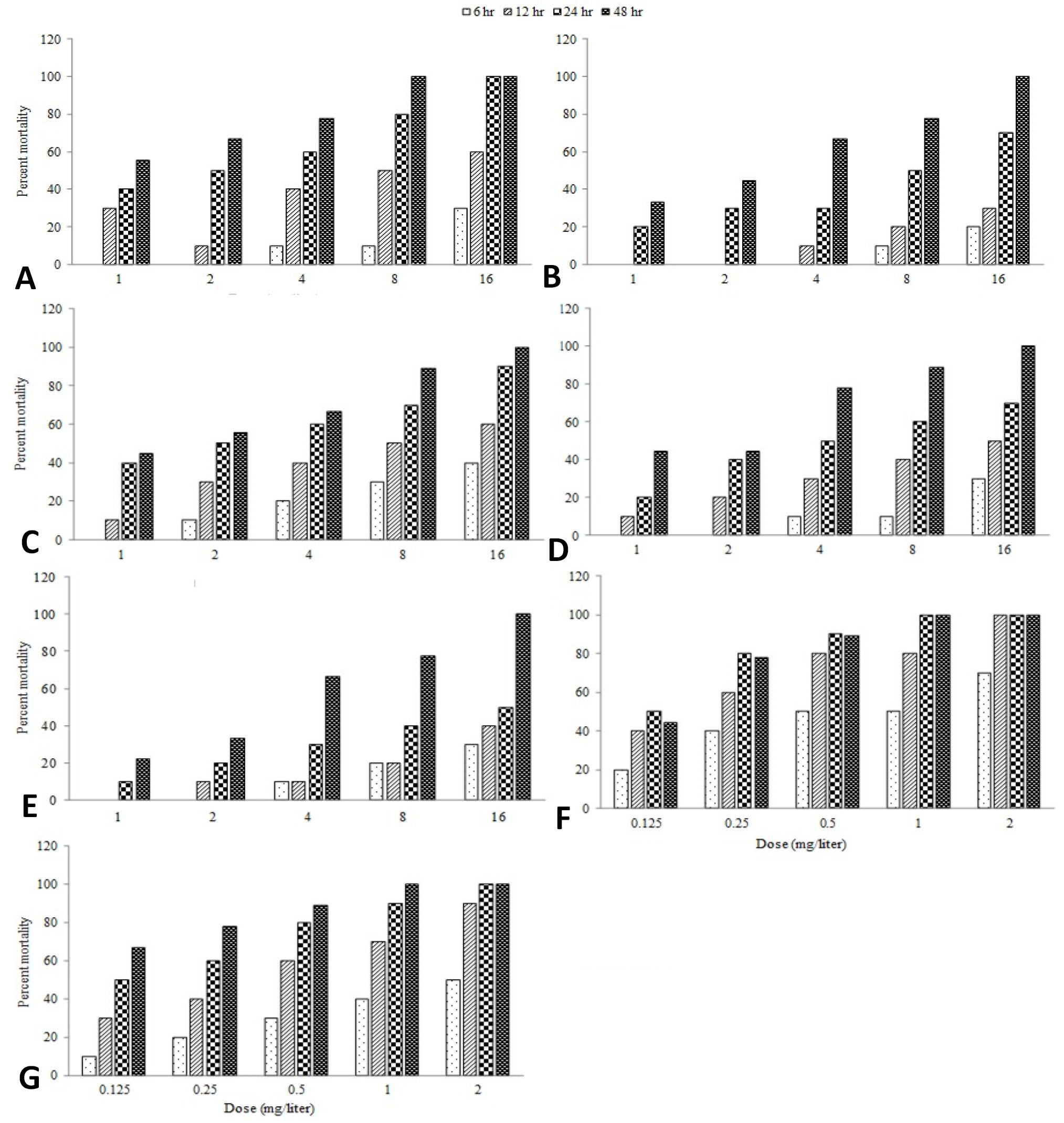
The mortality increased with the increase in dose and exposure time. The lowest mortality was recorded at 1 mg/L ranging from 0% to 56% after 6 and 48 h of exposure to abamectin whereas 100% mortality was recorded at 8 and 16 mg/L after 24 and 48 h of exposure (Fig. 1A). The lowest mortality was recorded at 1 mg/L ranging from 0% to 44% after 6 and 48 h of exposure to cypermethrin whereas 100% mortality was recorded at 16 mg/L after 48 h of exposure (Fig. 1B). The lowest mortality was recorded at 1 and 2 mg/L ranging from 0% to 33% after 6 and 48 h of exposure to imidacloprid whereas the highest was at 16 mg/L from 30 to 100% after 6 and 48 h of exposure (Fig. 1C). The lowest mortality was recorded at 1 mg/L ranging from 0% to 33% after 6 and 48 h of exposure to acetamiprid whereas the highest was at 16 mg/L from 20 to 100% after 6 and 48 h of exposure (Fig. 1D). The lowest mortality was recorded at 1 mg/L ranging from 0% to 44% after 6 and 48 h of exposure to pyriproxyfen whereas the highest was at 16 mg/L from 30% to 100% after 6 and 48 h of exposure (Fig. 1E). The lowest mortality was recorded at 0.125 mg/L ranging from 20% to 44% after 6 and 48 h of exposure to carbosulfan + emamectin benzoate whereas 100% mortality was recorded at 1 and 2 mg/L after 12, 24 and 48 h of exposure (Fig. 1F). The lowest mortality was recorded at 0.125 mg/L ranging from 10% to 67% after 6 and 48 h of exposure to pymetrozine+dinotefuran whereas 100% mortality was recorded at 1 and 2 mg/L after 24 and 48 h of exposure (Fig. 1G).
Estimation of LD50 in residual bioassay
The toxicity of different insecticides by using surface residual bioassay is presented in Table III. The combinations of two insecticides were also more toxic to Apis dorsata than solely used insecticides in terms of surface residual bioassay. Pymetrozine+dinotefuran was found more toxic after 6 and 48 h with low LD50 values of 2.26 and 0.30 mg/L, respectively. Carbosulfan + Emamectin benzoate was found more toxic after 12 and 24 h with LD50 of 0.39 and 0.21 mg/L, respectively. Among solely used insecticides, surface treatment of cypermethrin was highly toxic after 6, 12, and 24 h whereas after 48 h pyriproxyfen was more toxic (Table III).
Percent mortality by residual bioassay
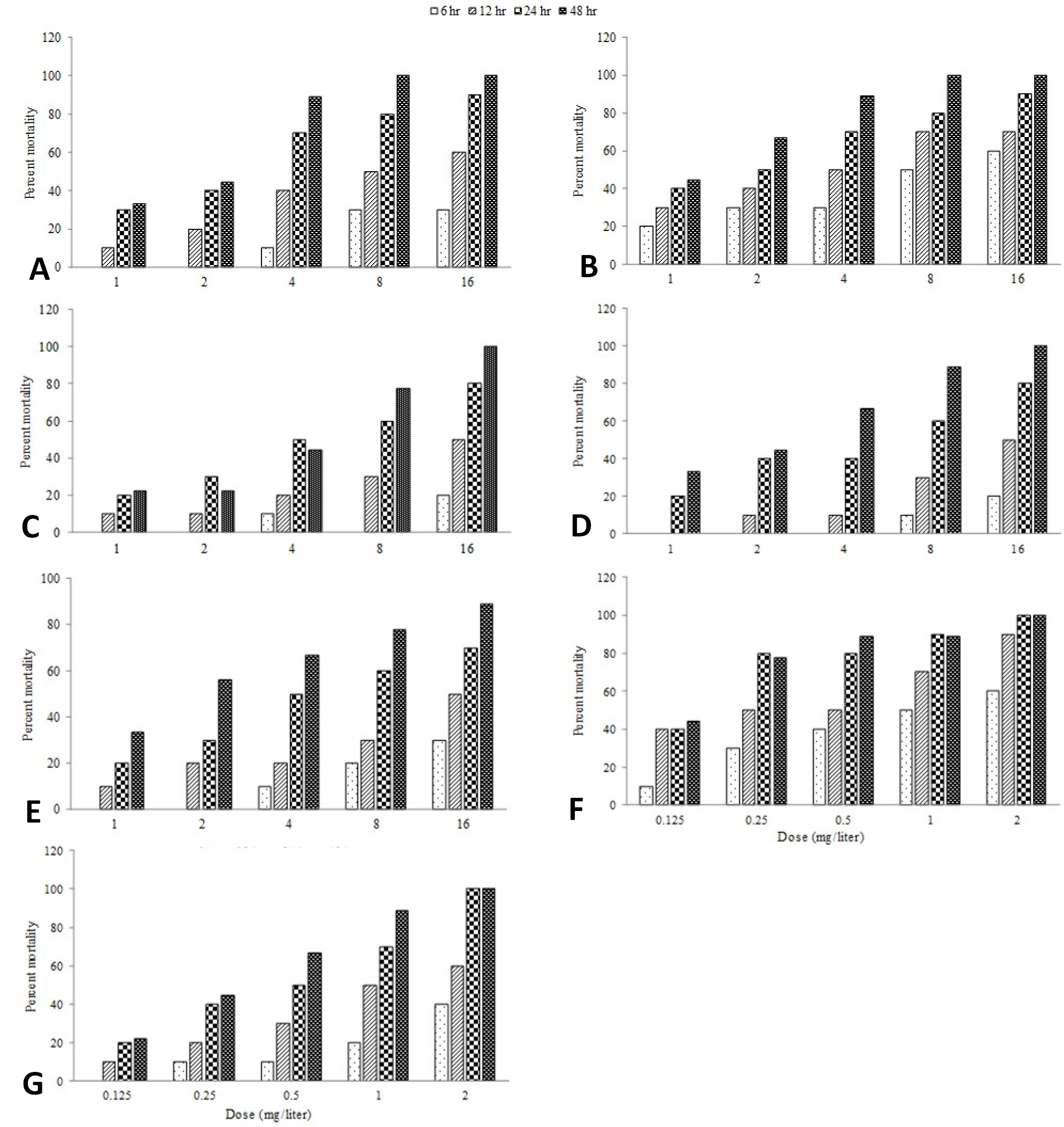
In case of surface residual bioassay, the lowest mortality was recorded at 1 mg/L ranging from 0% to 33% after 6 and 48 h of exposure to abamectin whereas 100% mortality was recorded at 8 and 16 mg/L after 48 h of exposure (Fig. 2A). The lowest mortality was recorded at 1 mg/L ranging from 20% to 44% after 6 and 48 h of exposure to cypermethrin whereas 100% mortality was recorded at 8 and 16 mg/L after 48 h of exposure (Fig. 2B). The lowest mortality was recorded at 1 and 2 mg/L ranging from 0% to 30% after 6 and 48 h of exposure to imidacloprid whereas the highest was at 16 mg/L from 20% to 100% after 6 and 48 h of exposure (Fig. 2C). The lowest mortality was recorded at 1 mg/L ranging from 0% to 33% after 6 and 48 h of exposure to acetamiprid whereas the highest was at 16 mg/L from 20 to 100% after 6 and 48 h
Table III. Residual median lethal dose (LD50) of different insecticides against Apis dorsata.
| Insecticides | Time (h) | LD50 (mg/L) | 95% CI | df | χ2 | p value |
| Abamectin | 6 | 19.05 | 0.015-0.178 | 4 | 3.334 | 0.021 |
| Cypermethrin | 10.93 | 0.002-0.134 | 4 | 0.496 | 0.045 | |
| Imidacloprid | 26.20 | 0.013-0.188 | 4 | 3.044 | 0.090 | |
| Acetamiprid | 22.21 | 0.001-0.239 | 4 | 1.060 | 0.048 | |
| Pyriproxyfen | 19.86 | 0.014-0.184 | 4 | 1.763 | 0.022 | |
| Carbosulfan + Emamectin benzoate | 10.60 | 0.007-0.141 | 4 | 1.859 | 0.030 | |
| Pymetrozine + Dinotefuran | 2.26 | 0.142-1.372 | 4 | 0.87 | 0.016 | |
| Abamectin | 12 | 10.87 | 0.015-0.150 | 4 | 1.958 | 0.016 |
| Cypermethrin | 5.33 | 0.000-0.134 | 4 | 1.264 | 0.051 | |
| Imidacloprid | 15.37 | 0.014-0.154 | 4 | 0.238 | 0.018 | |
| Acetamiprid | 15.02 | 0.037-0.188 | 4 | 1.245 | 0.004 | |
| Pyriproxyfen | 15.69 | 0.004-0.141 | 4 | 0.279 | 0.037 | |
| Carbosulfan + Emamectin benzoate | 0.39 | 0.172-1.424 | 4 | 0.148 | 0.012 | |
| Pymetrozine + Dinotefuran | 1.41 | 0.162-1.251 | 4 | 1.255 | 0.011 | |
| Abamectin | 24 | 2.94 | 0.037-0.207 | 4 | 2.098 | 0.005 |
| Cypermethrin | 1.42 | 0.020-0.185 | 4 | 0.982 | 0.015 | |
| Imidacloprid | 6.56 | 0.031-0.175 | 4 | 0.967 | 0.005 | |
| Acetamiprid | 6.59 | 0.027-0.170 | 4 | 0.770 | 0.007 | |
| Pyriproxyfen | 7.46 | 0.013-0.149 | 4 | 1.469 | 0.020 | |
| Carbosulfan + Emamectin benzoate | 0.21 | 0.020-0.366 | 4 | 2.472 | 0.029 | |
| Pymetrozine + Dinotefuran | 0.54 | 0.586-2.523 | 4 | 0.790 | 0.002 | |
| Abamectin | 48 | 1.70 | 0.110-0.933 | 4 | 0.263 | 0.013 |
| Cypermethrin | 0.934 | 0.030-0.844 | 4 | 0.047 | 0.035 | |
| Imidacloprid | 3.96 | 0.078-0.356 | 4 | 0.190 | 0.002 | |
| Acetamiprid | 1.99 | 0.055-0.395 | 4 | 0.061 | 0.010 | |
| Pyriproxyfen | 0.48 | 0.012-0.176 | 4 | 1.063 | 0.024 | |
| Carbosulfan + Emamectin benzoate | 0.96 | 0.002-0.356 | 4 | 2.192 | 0.048 | |
| Pymetrozine + Dinotefuran | 0.30 | 0.590-3.459 | 4 | 0.379 | 0.006 |
of exposure (Fig. 2D). The lowest mortality was recorded at 1 mg/L ranging from 0% to 33% after 6 and 48 h of exposure to pyriproxyfen whereas the highest was at 16 mg/L from 30% to 89% after 6 and 48 h of exposure (Fig. 2E). The lowest mortality was recorded at 0.125 mg/L ranging from 10 to 44% after 6 and 48 h of exposure to carbosulfan+emamectin benzoate whereas 100% mortality was recorded at 2 mg/L after 24 and 48 h of exposure (Fig. 2F). The lowest mortality was recorded at 0.125 mg/L ranging from 0% to 22% after 6 and 48 h of exposure to pymetrozine + dinotefuran whereas 100% mortality was recorded at 2 mg/L after 24 and 48 h of exposure (Fig. 2G).
Estimation of LT50
The LT50 of different insecticides by using a topical application is presented in Tables IV and V. The results showed that LT50 values decreased with an increase in the concentration of insecticides. The minimum LT50 values were recorded for abamectin 37.05 h at 1 mg/L, 33.67 h at 2 mg/L and 23.77 h at 4 followed by cypermethrin 43.04 h at 1 mg/L, 34.30 h at 2 mg/L and 24.68 h at 4 mg/L and vice versa at 8 and 16 mg/L. Whereas, the highest LT50 values were recorded for imidacloprid (Table IV). The minimum LT50 values were recorded for Carbosulfan+Emamectin benzoate 39.74 h at 0.125 mg/L, 9.62 h at 0.25 mg/L, 6.39 h at 0.5 mg/L, and 4.98 h at 2 mg/L whereas at 1 mg/L (3.25 h) for Pymetrozine+Dinotefuran (Table V).
The LT50 of different insecticides by using surface residual bioassay is presented in Tables VI and VII. The results showed that LT50 values decreased with an increase in the concentration of insecticides. The minimum LT50 values were recorded for cypermethrin 44.77 h at 1 mg/L, 25.09 h at 2 mg/L, 14.49 h at 4 mg/L, 5.25 h at 8 mg/L, and 2.65 h at 16 mg/L followed by acetamiprid 50.98 h at 1 mg/L, pyriproxyfen 39.84 at 2 mg/L and abamectin 19.92 h at 4 mg/L, 12.53 h at 8 mg/L and 10.51 h at 16 mg/L. Whereas the highest LT50 values were recorded for imidacloprid (Table VI). The minimum LT50 values were recorded for Carbosulfan+Emamectin benzoate 42.99 h at 0.125 mg/L, 13.24 h at 0.25 mg/L, 10.27 h at 0.5 mg/L, 5.67 h at 1 mg/L and 4.47 h at 2 mg/L (Table VII).
Table IV. Topical median lethal time (LT50) of different insecticides against Apis dorsata.
| Insecticides | Dose (mg/L) | LT50 (h) | 95% CI | df | χ2 | p value |
| Abamectin | 1 | 37.05 | 0.009-0.063 | 3 | 2.824 | 0.009 |
| Cypermethrin | 43.04 | 0.011-0.068 | 3 | 2.737 | 0.007 | |
| Imidacloprid | 57.86 | 0.005-0.089 | 3 | 0.629 | 0.028 | |
| Acetamiprid | 50.98 | 0.012-0.082 | 3 | 1.645 | 0.009 | |
| Pyriproxyfen | 46.69 | 0.012-0.073 | 3 | 0.684 | 0.006 | |
| Abamectin | 2 | 33.67 | 0.023-0.083 | 3 | 2.981 | 0.001 |
| Cypermethrin | 34.30 | 0.004-0.055 | 3 | 1.501 | 0.024 | |
| Imidacloprid | 52.96 | 0.006-0.066 | 3 | 0.840 | 0.021 | |
| Acetamiprid | 44.78 | 0.017-0.083 | 3 | 2.748 | 0.003 | |
| Pyriproxyfen | 42.80 | 0.006-0.061 | 3 | 2.555 | 0.016 | |
| Abamectin | 4 | 23.77 | 0.014-0.070 | 3 | 1.838 | 0.003 |
| Cypermethrin | 24.68 | 0.003-0.055 | 3 | 1.109 | 0.028 | |
| Imidacloprid | 36.44 | 0.017-0.074 | 3 | 0.144 | 0.002 | |
| Acetamiprid | 36.94 | 0.025-0.087 | 3 | 0.766 | 0.001 | |
| Pyriproxyfen | 27.06 | 0.017-0.073 | 3 | 0.675 | 0.002 | |
| Abamectin | 8 | 14.85 | 0.037-0.177 | 3 | 1.070 | 0.003 |
| Cypermethrin | 14.49 | 0.011-0.073 | 3 | 0.375 | 0.007 | |
| Imidacloprid | 29.06 | 0.015-0.070 | 3 | 0.178 | 0.003 | |
| Acetamiprid | 28.44 | 0.020-0.078 | 3 | 0.491 | 0.001 | |
| Pyriproxyfen | 21.42 | 0.022-0.086 | 3 | 1.244 | 0.001 | |
| Abamectin | 16 | 9.72 | 0.036-0.294 | 3 | 0.234 | 0.012 |
| Cypermethrin | 9.01 | 0.016-0.156 | 3 | 0.004 | 0.017 | |
| Imidacloprid | 17.77 | 0.020-0.095 | 3 | 1.461 | 0.003 | |
| Acetamiprid | 17.32 | 0.030-0.138 | 3 | 0.150 | 0.002 | |
| Pyriproxyfen | 13.67 | 0.019-0.114 | 3 | 0.352 | 0.006 |
Table V. Topical median lethal time (LT50) of insecticide mixtures against Apis dorsata.
| Insecticides | Dose (mg/L) | LT50(h) | 95% CI | df | χ2 | p value |
| Carbosulfan+Emamectin benzoate | 0.125 | 39.74 | 0.010-0.040 | 3 | 1.161 | 0.230 |
| Pymetrozine+Dinotefuran | 40.32 | 0.002-0.048 | 3 | 2.016 | 0.075 | |
| Carbosulfan+Emamectin benzoate | 0.25 | 9.62 | 0.002-0.052 | 3 | 1.417 | 0.075 |
| Pymetrozine+Dinotefuran | 22.01 | 0.010-0.064 | 3 | 0.655 | 0.008 | |
| Carbosulfan+Emamectin benzoate | 0.5 | 6.39 | 0.003-0.061 | 3 | 2.157 | 0.077 |
| Pymetrozine+Dinotefuran | 10.76 | 0.010-0.073 | 3 | 1.530 | 0.010 | |
| Carbosulfan+Emamectin benzoate | 1 | 6.18 | 0.002-0.311 | 3 | 0.051 | 0.053 |
| Pymetrozine+Dinotefuran | 3.25 | 0.004-0.069 | 3 | 2.419 | 0.027 | |
| Carbosulfan+Emamectin benzoate | 2 | 4.98 | 1.845-2.883 | 3 | 0.001 | 0.667 |
| Pymetrozine+Dinotefuran | 6.00 | 0.002-0.430 | 3 | 0.001 | 0.520 |
Table VI. Residual median lethal time (LT50) of different insecticides against Apis dorsata.
| Insecticides | Dose (mg/L) | LT50 (h) | 95% CI | df | χ2 | p value |
| Abamectin | 1 | 51.09 | 0.005-0.063 | 3 | 1.801 | 0.023 |
| Cypermethrin | 44.77 | 0.007-0.043 | 3 | 0.237 | 0.159 | |
| Imidacloprid | 62.87 | 0.002-0.059 | 3 | 1.081 | 0.067 | |
| Acetamiprid | 50.98 | 0.012-0.082 | 3 | 1.645 | 0.009 | |
| Pyriproxyfen | 52.96 | 0.006-0.066 | 3 | 0.840 | 0.021 | |
| Abamectin | 2 | 42.80 | 0.006-0.061 | 3 | 2.555 | 0.016 |
| Cypermethrin | 25.09 | 0.001-0.049 | 3 | 0.056 | 0.065 | |
| Imidacloprid | 60.84 | 0.003-0.056 | 3 | 2.340 | 0.074 | |
| Acetamiprid | 43.04 | 0.011-0.068 | 3 | 2.737 | 0.007 | |
| Pyriproxyfen | 39.84 | 0.013-0.069 | 3 | 1.540 | 0.004 | |
| Abamectin | 4 | 19.92 | 0.023-0.089 | 3 | 1.877 | 0.001 |
| Cypermethrin | 14.49 | 0.011-0.073 | 3 | 0.375 | 0.007 | |
| Imidacloprid | 41.03 | 0.001-0.052 | 3 | 2.032 | 0.043 | |
| Acetamiprid | 35.30 | 0.024-0.085 | 3 | 1.613 | 0.001 | |
| Pyriproxyfen | 31.57 | 0.013-0.068 | 3 | 0.943 | 0.003 | |
| Abamectin | 8 | 12.53 | 0.020-0.137 | 3 | 0.056 | 0.008 |
| Cypermethrin | 5.25 | 0.006-0.104 | 3 | 0.424 | 0.029 | |
| Imidacloprid | 26.68 | 0.023-0.082 | 3 | 3.363 | 0.001 | |
| Acetamiprid | 22.81 | 0.025-0.091 | 3 | 0.695 | 0.001 | |
| Pyriproxyfen | 23.81 | 0.013-0.068 | 3 | 0.552 | 0.004 | |
| Abamectin | 16 | 10.51 | 0.026-0.174 | 3 | 0.115 | 0.008 |
| Cypermethrin | 2.65 | 0.001-0.123 | 3 | 0.058 | 0.052 | |
| Imidacloprid | 13.80 | 0.027-0.155 | 3 | 0.303 | 0.005 | |
| Acetamiprid | 13.80 | 0.027-0.155 | 3 | 0.303 | 0.005 | |
| Pyriproxyfen | 14.49 | 0.011-0.073 | 3 | 0.375 | 0.007 |
Discussion
The study of pesticide effects on honeybees is vital because of the need to control a wide variety of agricultural pests without deleterious impact on bees. This toxicity study provides valuable information about the harmful effects of insecticides on wild honeybees. In both topical and residual methods, cypermethrin was highly toxic for Apis dorsata workers after 6 h (topical: 17.31 mg/L and residual: 10.93 mg/L) and 12 h (topical: 10.60 mg/L and residual: 5.33 mg/L). Pyrethroids are highly toxic insecticides even in small doses for both beneficial and harmful insects . Cypermethrin is a highly toxic insecticide to honeybees because it shows its effect within two days . The age of the bees could be the major factor in the susceptibility of bees. Delabie et al. (1985) found that the susceptibility of A. mellifera to cypermethrin increases with increasing the age of the bee. Contrarily to our findings, few studies found that cypermethrin was less toxic to honeybees than other insecticides i.e., imidacloprid, fipronil, indoxacarb, malathion, clothianidin and thiamethoxam ; ; . These differences could be due to several factors i.e., the origin of the population, age of bees, the effect of post-treatment temperature, and application methods which can influence the toxicity of insecticides.
In the present study, by using the topical application, abamectin was highly toxic after 24 and 48 h with LD50 of 2.43 mg/L and 0.30 mg/L, respectively. Baolan et al. (2017) concluded that oral abamectin was highly toxic to honeybees, and acute poisoning resulting from high-dose exposure normally led to instant death. Many studies reported that abamectin showed its insecticidal activity after 7 days of application against stored grain insect pests ; . Few factors i.e., exposure interval and increase in dose rate enhanced the efficacy of abamectin . In the present study, by using the residual application, pyriproxyfen was highly toxic after 48 h with an LD50 of 0.48 mg/L. Pyriproxyfen is considered to have low acute toxicity against adult honey bees.
Table VII. Residual median lethal time (LT50) of insecticide mixtures against Apis dorsata.
| Insecticides | Dose (mg/L) | LT50 (h) | 95% CI | df | χ2 | p value |
| Carbosulfan+Emamectin benzoate | 0.125 | 42.99 | 0.005-0.045 | 3 | 1.990 | 0.125 |
| Pymetrozine+Dinotefuran | 62.87 | 0.002-0.059 | 3 | 1.081 | 0.067 | |
| Carbosulfan+Emamectin benzoate | 0.25 | 13.24 | 0.004-0.059 | 3 | 2.055 | 0.024 |
| Pymetrozine+Dinotefuran | 43.72 | 0.001-0.053 | 3 | 0.815 | 0.043 | |
| Carbosulfan+Emamectin benzoate | 0.5 | 10.27 | 0.008-0.070 | 3 | 0.653 | 0.014 |
| Pymetrozine+Dinotefuran | 30.20 | 0.010-0.063 | 3 | 1.056 | 0.007 | |
| Carbosulfan+Emamectin benzoate | 1 | 5.67 | 0.000-0.064 | 3 | 1.462 | 0.053 |
| Pymetrozine+Dinotefuran | 16.62 | 0.016-0.079 | 3 | 1.178 | 0.003 | |
| Carbosulfan+Emamectin benzoate | 2 | 4.57 | 0.032-0.380 | 3 | 0.004 | 0.098 |
| Pymetrozine+Dinotefuran | 8.76 | 0.027-0.254 | 3 | 0.537 | 0.015 |
Machado Baptista et al. (2009) concluded that the direct application of pyriproxyfen on A. mellifera workers led to an LT50 value of 466 h. Costa et al. (2013) found the LT50 value of more than 100 h by direct spraying 0.1 g a.i./L of pyriproxyfen on groups of 10 honeybees. The absorption of pyriproxyfen and subsequently its toxicity mostly depended on the solvent used. For example, acetone might cause an underestimation of the adverse effects due to restricted absorption. Whereas, dimethyl sulfoxide (DMSO) significantly enhances the absorption of pyriproxyfen .
In the present study, the combinations of two insecticides were more toxic to A. dorsata than solely used insecticides. Most of the studies reported that the binary mixtures of pesticides are more toxic to honeybees ; ; ; ; ; Wang et al., 2020a, 2020b, 2020c). In both topical and residual methods, Carbosulfan + Emamectin benzoate showed a knockdown effect and was found more toxic than Pymetrozine+dinotefuran. Carbosulfan and emamectin benzoate showed synergistic effects however having different modes of action. Carbosulfan causes the inhibition of acetylcholinesterase (ACHE) whereas, emamectin benzoate affects gamma-aminobutyric acid (GABA) receptors resulting in the disruption of nerve impulse ; ; . Several studies have reported that carbosulfan and emamectin benzoate are lethal to honey bees ; ; ; . The absorption coefficient of avermectins is high and due to this reason, avermectins are considered highly toxic to bees. Emamectin benzoate is more toxic due to its lower detoxification during metabolism and it can penetrate more through insect cuticle ; . Anwar et al. (2022) reported that emamectin benzoate caused high mortality in A. florea at 12h, 24h and 48h with LC50 values of 2.01, 1.67, and 1.02 g/mL after 12 h, 24 h, and 48 h when incorporated with diet. However, field trials conducted on emamectin benzoate have shown a low lifespan in the sunlight. Thus, it can be added to the integrated pest management program depending on the location .
By using the topical application, the minimum LT50 values were recorded for abamectin whereas, by residual method, the minimum LT50 values were recorded for cypermethrin. The main factors that affect the mortality in bioassays are the choice of insecticide bioassay response, the stage of the insects, health of the organism, bioassay environment, method of application, diet, sample size, sampling, and operator skill . Aljedani (2017) found that abamectin has an adverse effect on A. mellifera that causes faster mortality with a minimum LT50 value of 21.026 h as compared to deltamethrin which has an LT50 value of 72.011 h. Anwar et al. (2022) also recorded the minimum LT50 values i.e., 5.09 h at 10 µg/ml and 5.63 h at 40 µg/ml for emamectin benzoate against A. florea. In the present study, the minimum LT50 values were recorded for carbosulfan + emamectin benzoate. Carbosulfan and emamectin benzoate are considered lethal insecticides to beneficial insects because of their lower detoxification during metabolism ; ; .
Conclusion
Apis dorsata, the giant honeybee is considered the efficient pollinator in the studied locality of the Punjab province, Pakistan. It is crucial not only for providing ecological services but also for honey production. However, the extensive use of broad-spectrum pesticides significantly reduces their population. Cypermethrin and abamectin are highly toxic to A. dorsata workers due to low LD50 values. Nowadays, insecticide mixtures are commonly used for the efficient control of pests that have a lethal effect on honeybees. It is concluded that all insecticide combinations or certain classes of insecticides when combined yielded a toxic effect on bees. Carbosulfan + Emamectin benzoate was found more toxic to A. dorsata. Due to field application of pesticides during bloom, their residues persist in pollen grains resulting in behavioral changes, physiological changes, and mortality. Honeybees have minor adaptations so care should be taken during pesticide application to conserve their population and associated environmental benefits.
Declarations
Acknowledgement
We are thankful to Muhammad Khalid Rafique for the guidance regarding the collection of Apis dorsata capped brood combs.
Funding
This study was funded by the Agricultural Linkages Program (ALP) of Pakistan Agricultural Research Council (PARC) under project “Conservation of native bees through ecosystem approach for enhanced crop pollination”.
Ethical statement and IRB approval
The study was approved by the Departmental Research Committee of the Department of Entomology, Faculty of Agriculture and Environment, The Islamia University of Bahawalpur.
Statement of conflict of interest
The authors have declared no conflict of interest.
Figures
References
- Abbott, W.S., 1925. A method of computing the effectiveness of an insecticide. J. econ. Ent., 18: 265-267. https://doi.org/10.1093/jee/18.2.265a[CrossRef]
- Abdu-Allah, G., 2011. Potency and residual activity of emamectin benzoate and spinetoram on Spodoptera littoralis (Boisd.). Afr. Entomol., 19: 733-737. https://doi.org/10.4001/003.019.0313[CrossRef]
- Abrol, D.P., Gorka, A.K., Ansari, M.J., Al-Ghamdi, A. and Al-Kahtani, S., 2019. Impact of insect pollinators on yield and fruit quality of strawberry. Saudi J. biol. Sci., 26: 524-530. https://doi.org/10.1016/j.sjbs.2017.08.003[CrossRef]
- Ahmad, S., Khalofah, A., Khan, S.A., Khan, K.A., Jilani, M.J., Hussain, T., Skalicky, M., Ghramh, H.A. and Ahmad, Z., 2021. Effects of native pollinator communities on the physiological and chemical parameters of loquat tree (Eriobotrya japonica) under open field condition. Saudi J. biol. Sci., 28: 3235-3241. https://doi.org/10.1016/j.sjbs.2021.02.062[CrossRef]
- Akca, I., Tuncer, C., Güler, A. and Saruhan, I., 2009. Residual toxicity of 8 different insecticides on honey bee (Apis mellifera Hymenoptera: Apidae). J. anim. Vet. Adv., 8: 436-440.
- Akram, W. and Sajjad, A., 2022. Pollination of Brassica campestris (Cruciferae) by Andrena savignyi (Andrenidae: hymenoptera): Female vs. male pollination. Sociobiology, 69: e7300-e7300. https://doi.org/10.13102/sociobiology.v69i1.7300[CrossRef]
- Akram, W., Sajjad, A., Ali, M., Ahmad, A., Ali, I., Saddiq, B., Yasin, M. and Aqueel, M.A., 2022. Comparative effectiveness of wild bee pollination on the post-harvest characteristics of Grewia asiatica (Malvaceae). J. Asia-Pac. Ent., 25: 101958. https://doi.org/10.1016/j.aspen.2022.101958[CrossRef]
- Akram, W., Sajjad, A., Ali, S., Farooqi, M.A., Mujtaba, G., Ali, M. and Ahmad, A., 2019. Pollination of Grewia asiatica (Malvaceae) by Megachile cephalotes (Hymenoptera: Megachilidae): Male vs. female pollination. Sociobiology, 66: 467-474. https://doi.org/10.13102/sociobiology.v66i3.4345[CrossRef]
- Aktar, M.W., Sengupta, D. and Chowdhury, A., 2009. Impact of pesticides use in agriculture: Their benefits and hazards. Interdisc. Toxicol., 2: 1-12. https://doi.org/10.2478/v10102-009-0001-7[CrossRef]
- Ali, M.A., 2018. The pesticide registered with recommendations safe handling and use in Pakistan. Pakistan Agricultural Research Council (PARC), Islamabad, Pakistan. pp. 194.
- Aliouane, Y., El-Hassani, A.K., Gary, V., Armengaud, C., Lambin, M. and Gauthier, M., 2009. Subchronic exposure of honeybees to sublethal doses of pesticides: Effects on behavior. Environ. Toxicol. Chem. 28: 113-122. https://doi.org/10.1897/08-110.1[CrossRef]
- Aljedani, D.M., 2017. Effects of abamectin and deltamethrin to the foragers honeybee workers of Apis mellifera jemenatica (Hymenoptera: Apidae) under laboratory conditions. Saudi J. biol. Sci., 24: 1007-1015. https://doi.org/10.1016/j.sjbs.2016.12.007[CrossRef]
- Andreescu, M.E., Crivineanu, V., Goran, G.V. and Codreanu, M.D., 2008. Studies on cypermethrin poisoning in bees. Lucr, Stiint, Univ. Stiin. Agric. Banatului Timisoara, Med. Vet., 41: 494-503.
- Anwar, M.I., Sadiq, N., Aljedani, D.M., Iqbal, N., Saeed, S., Khan, H.A.A., Naeem-Ullah, U., Aslam, H.M.F., Ghramh, H.A. and Khan, K.A., 2022. Toxicity of different insecticides against the dwarf honey bee, Apis florea Fabricius (Hymenoptera: Apidae). J. King Saud Univ. Sci., 34: 101712. https://doi.org/10.1016/j.jksus.2021.101712[CrossRef]
- Ausborn, J., Wolf, H., Mader, W. and Kayser, H., 2005. The insecticide pymetrozine selectively affects chordotonal mechanoreceptors. J exp. Biol., 208: 4451-4466. https://doi.org/10.1242/jeb.01917[CrossRef]
- Ball, H.J., 1981. Insecticide resistance a practical assessment. Bull. entomol. Soc. Am., 27: 261-262. https://doi.org/10.1093/besa/27.4.261[CrossRef]
- Baolan, Z., Cuiqun, C., Hongtao, Z., Feng, L., Haijian, H. and Guoping, S., 2017. The toxicity effects of abamectin on honeybees (Apis mellifera L.). Asian J. Ecotoxicol., 4: 174-182.
- Basit, M., Saeed, S., Saleem, M.A., Denholm, I. and Shah, M., 2013. Detection of resistance, cross-resistance, and stability of resistance to new chemistry insecticides in Bemisia tabaci (Homoptera: Aleyrodidae). J. econ. Ent., 106: 1414-1422. https://doi.org/10.1603/EC12414[CrossRef]
- Becher, M.A., Osborne, J.L., Thorbek, P. Kennedy, P.J. and Grimm, V., 2013. Towards a systems approach for understanding honeybee decline: A stocktaking and Synthesis of existing models. J. appl. Ecol., 50: 868–880. https://doi.org/10.1111/1365-2664.12112[CrossRef]
- Boily, M., Sarrasin, B., Deblois, C. Aras, P. and Chagnon. M., 2013. Acetylcholinesterase in honey bee (Apis mellifera) exposed to neonicotinoids, atrazine and glyphosate: Laboratory and field experiments. Environ. Sci. Pollut. Res., 20: 5603-5614. https://doi.org/10.1007/s11356-013-1568-2[CrossRef]
- Bonmatin, J.M., Giorio, C., Girolami, V., Goulson, D., Kreutzweiser, D.P., Krupke, C., Liess, M., Long, E., Marzaro, M., Mitchell, E.A.D., Noome, D.A. Simon-Delso, N. and Tapparo, A., 2015. Environmental fate and exposure; neonicotinoids and fipronil. Environ. Sci. Pollut. Res. Int. 22: 35-67. https://doi.org/10.1007/s11356-014-3332-7[CrossRef]
- Campbell, W.C., 2012. Ivermectin and abamectin. Springer Science and Business Media.
- Cang, T., Zhao, X.P., Wu, C.X., Wu, S.G., Chen, L.P., Wang, Q. and Zhang, Z.H., 2007. Toxicity and safety evaluation of emamectin benzoate on four types of nontarget organism. Pesticides-Shenyang, 46: 481.
- Casida, J.E. and Durkin, K.A., 2015. Novel GABA receptor pesticide targets. Pestic. Biochem. Physiol., 121: 22-30. https://doi.org/10.1016/j.pestbp.2014.11.006[CrossRef]
- Coats, J.R., 2012. Insecticide mode of action. Academic Press.
- Costa, E.M., Araujo, E.L., Maia, A.V.P., Silva, F.E.L., Bezerra, C.E.S. and Silva, J.G., 2013. Toxicity of insecticides used in the Brazilian melon crop to the honey bee Apis mellifera under laboratory condition. Apidologie, 45: 34-44. https://doi.org/10.1007/s13592-013-0226-5[CrossRef]
- Crane, E., 1990. Apis species of tropical Asia as pollinators, and some rearing methods for them. In: VI international symposium on pollination. pp. 29-48. https://doi.org/10.17660/ActaHortic.1991.288.2[CrossRef]
- Das, R., Jha, S. and Halder, A., 2019. Insect pollinators of litchi with special reference to foraging behaviour of honey bees. J. Pharmacogn. Phytochem., 8: 396-401.
- Decourtye, A., Armengaud, C., Renou, M., Devillers, J., Cluzeau, S., Gauthier, M. and Pham-Delègue, M., 2004. Imidacloprid impairs memory and brain metabolism in the honeybee (Apis mellifera L.). Pestic. Biochem. Physiol., 78: 83-92. https://doi.org/10.1016/j.pestbp.2003.10.001[CrossRef]
- Deepika, N., Suresh, K., Usharani, B., Rajamanickam, C. and Shanthi, M., 2022. Toxicity of insecticides on Indian honey bee Apis cerana indica F. and Stingless BEE Tetragonula iridipennis S. in Cashew. Indian J. Ent., 84: 1-4. https://doi.org/10.55446/IJE.2021.149[CrossRef]
- Delabie, J., Bos, C., Fonta, C. and Masson, C., 1985. Toxic and repellent effects of cypermethrin on the honeybee: Laboratory, glasshouse and field experiments. Pestic. Sci., 16: 409-415. https://doi.org/10.1002/ps.2780160417[CrossRef]
- Desneux, N., Decourtye, A. and Delpuech, J.M., 2007. The sublethal effects of pesticides on beneficial arthropods. Annu. Rev. Ent., 52: 81-106. https://doi.org/10.1146/annurev.ento.52.110405.091440[CrossRef]
- Farooqi, M.A., Hasan, M. and Arshad, M., 2016. Toxicity of three commonly used nicotinoids and spinosad to Apis mellifera L. (Hymenoptera: Apidae) using surface residual bioassays. Pakistan J. Zool., 48: 1983-1987.
- Farooqi, M.A., Irsa, B., Ali, S., Sajjad, A., Muhammad, W.H. and Akhtar, S., 2020. Impact of selected insecticides on Apis mellifera L. (Hymenoptera: Apidae) under controlled conditions. Pakistan J. Zool., 52: 193-198. https://doi.org/10.17582/journal.pjz/2020.52.1.193.198[Full text][CrossRef]
- Fasasi, K.A., 2012. Physicochemical attributes of Nigerian natural honey from honeybees. Pak. J. biol. Sci., 15: 1027-1033. https://doi.org/10.3923/pjbs.2012.1027.1033[CrossRef]
- Feazel-Orr, H.K., Catalfamo, K.M., Brewster, C.C., Fell, R.D., Anderson, T.D. and Traver, B.E., 2016. Effects of pesticide treatments on nutrient levels in worker honey bees (Apis mellifera). Insects, 7: 8. https://doi.org/10.3390/insects7010008[CrossRef]
- Finney, D.J., 1971. Probit analysis. Cambridge University Press, Cambridge.
- Fukuto, T.R., 1990. Mechanism of action of organophosphorus and carbamate insecticides. Environ. Hlth. Perspect., 87: 245-254. https://doi.org/10.1289/ehp.9087245[CrossRef]
- Ghramh, H.A., Khan, K.A. and Alshehri, A.M.A., 2019. Antibacterial potential of some Saudi honeys from Asir region against selected pathogenic bacteria. Saudi J. biol. Sci., 26: 1278-1284. https://doi.org/10.1016/j.sjbs.2018.05.011[CrossRef]
- Ghramh, H.A., Khan, K.A., Ahmad, Z. and Ansari, M.J., 2020. Quality evaluation of Saudi honey harvested from the Asir province by using high-performance liquid chromatography (HPLC). Saudi J. biol. Sci., 27: 2097-2105. https://doi.org/10.1016/j.sjbs.2020.04.009[CrossRef]
- Gill, R.J., Ramos-Rodriguez, O. and Raine, N.E., 2012. Combined pesticide exposure severely affects individual- and colony-level traits in bees. Nature, 491: 105-108. https://doi.org/10.1038/nature11585[CrossRef]
- Giroud, B., Bruckner, S., Straub, L., Neumann, P., Williams, G.R. and Vulliet, E., 2019. Trace-level determination of two neonicotinoid insecticide residues in honey bee royal jelly using ultra-sound assisted salting-out liquid-liquid extraction followed by ultra-high-performance liquid chromatography-tandem mass spectrometry. Microchem. J., 151: 104249. https://doi.org/10.1016/j.microc.2019.104249[CrossRef]
- Gómez-Ramos, M.M., García-Valcárcel, A.I., Tadeo, J.L., Fernández-Alba, A.R. and Hernando, M.D., 2016. Screening of environmental contaminants in honey bee wax comb using gas chromatography–high-resolution time-of-flight mass spectrometry. Environ. Sci. Pollut. Res., 23: 4609-4620. https://doi.org/10.1007/s11356-015-5667-0[CrossRef]
- González-Martín, M.I., Revilla, I., Vivar-Quintana, A.M. and Salcedo, E.B., 2017. Pesticide residues in propolis from Spain and Chile. An approach using near infrared spectroscopy. Talanta, 165: 533-539. https://doi.org/10.1016/j.talanta.2016.12.061[CrossRef]
- Guseman, A.J., Miller, K., Kunkle, G., Dively, G.P., Pettis, J.S., Evans, J.D., VanEngelsdorp, D. and Hawthorne, D.J., 2016. Multi-drug resistance transporters and a mechanism-based strategy for assessing risks of pesticide combinations to honey bees. PLoS One, 11: e0148242. https://doi.org/10.1371/journal.pone.0148242[CrossRef]
- Hayat, K., Afzal, M., Aqueel, M.A., Ali, S., Saeed, M.F., Khan, Q.M., Ashfaq, M. and Damalas, C.A., 2018. Insecticide exposure affects DNA and antioxidant enzymes activity in honeybee species Apis florea and A. dorsata: Evidence from Punjab, Pakistan. Sci. Total Environ., 635: 1292-1301. https://doi.org/10.1016/j.scitotenv.2018.04.221[CrossRef]
- Henry, M., Beguin, M., Requier, F., Rollin, O., Odoux, J.F., Aupinel, P., Aptel, J., Tchamitchian, S. and Decourtye, A.A., 2012. Common pesticide decreases foraging success and survival in honey bees. Science, 336: 348-350. https://doi.org/10.1126/science.1215039[CrossRef]
- Hooven, L., Sagili, R. and Johansen, E., 2013. How to reduce bee poisoning from pesticides. A Pacific Northwest Extension Publication, Oregon State University.
- Hopwood, J., Vaughan, M., Shepherd, M., Biddinger, D., Mader, E., Black, S.H. and Mazzacano, C., 2016. Are neonicotinoids killing bees? A review of research into the effects of neonicotinoid insecticides on bees. The Xerces Society for Invertebrate Conservation.
- Hou, J., Xie, W., Hong, D., Zhang, W., Li, F., Qian, Y. and Han, C., 2019. Simultaneous determination of ten neonicotinoid insecticides and two metabolites in honey and Royal-jelly by solid− phase extraction and liquid chromatography− tandem mass spectrometry. Fd. Chem., 270: 204-213. https://doi.org/10.1016/j.foodchem.2018.07.068[CrossRef]
- Hu, S., Dilcher, D.L., Jarzen, D.M. and Winship Taylor, D., 2008. Early steps of angiosperm pollinator coevolution. Proc. natl. Acad. Sci., 105: 240-245.
- Husain, D., Qasim, M., Saleem, M., Akhter, M. and Khan, K.A., 2014. Bioassays of insecticides against three honeybee species in laboratory conditions. Cercetari Agon. Moldova, 47: 69-79. https://doi.org/10.2478/cerce-2014-0018[CrossRef]
- Imran, M., Naseem, T., Iqbal, A., Mahmood, K. and Sheikh, U.A.A., 2018. Assessment of sensitivity level of honeybee (Apis mellifera) to neonicotinoid insecticides. Asian J. Agric. Biol., 6: 327-334.
- Invest, J.F. and Lucas, J.R., 2008. Pyriproxyfen as a mosquito larvicide. In: Proceedings of the sixth international conference on urban pests, Budapest, Hungary, 13-16 July 2008. p. 239-245.
- Iqbal, J., Jajja, N.I., Jamil, M. and Hassan, M.W., 2014. Field evaluation for efficacy of conventional insecticides and insect growth regulators against spotted bollworms, Earias spp. of cotton. Pak. Entomol., 36: 97-104.
- Iwasa, T., Motoyama, N., Ambrose, J.T. and Roe, R.M., 2004. Mechanism for the differential toxicity of neonicotinoid insecticides in the honey bee, Apis mellifera. Crop Prot., 23: 371-378. https://doi.org/10.1016/j.cropro.2003.08.018[CrossRef]
- Jansson, R.K., Brown, R., Cartwright, B., Cox, D., Dunbar, D.M., Dybas, R.A., Eckel, C., Lasota, J.A., Mookerjee, P.K., Norton, J.A. and Peterson, R.F., 1997. Emamectin benzoate: A novel avermectin derivative for control of lepidopterous pests. In: Proceedings of the 3rd international workshop on management of diamondback moth and other crucifer pests. MARDI, Kuala.
- Jeyalakshmi, T., Shanmugasundaram, R., Saravanana, M., Geetha, S., Mohan, S.S., Gopalraju, A. and Murthy, B.R., 2011. Comparative toxicity of certain insecticides against Apis cerana indica under semi field and laboratory conditions. Pestology, 35: 23-26.
- Jung, C., Noor-ul-Ane, M. and Namin, S.M., 2020. Safety of Dwarf Honeybee, Apis florea in Relation with Agricultural Pest Management. In: The future role of Dwarf honeybees in natural and agricultural systems. CRC Press. p. 125–136. https://doi.org/10.1201/9781003033936-9[CrossRef]
- Kaisarevic, S., Tenji, D., Mihajlovic, V., Micic, B., Francija, E., Periz-Stanacev, J., Skiljo, B.K., Brkic, D. and Teodorovic, I., 2019. Comparative analyses of cellular physiological responses of non-target species to cypermethrin and its formulated product: Contribution to mode of action research. Environ. Toxicol. Pharmacol., 65: 31-39. https://doi.org/10.1016/j.etap.2018.11.007[CrossRef]
- Kavallieratos, N.G., Athanassiou, C.G., Vayias, B.J., Mihail, S.B. and Tomanović, Ž., 2009. Insecticidal efficacy of abamectin against three stored-product insect pests: Influence of dose rate, temperature, commodity, and exposure interval. J. econ. Ent., 102: 1352-1359. https://doi.org/10.1603/029.102.0363[CrossRef]
- Khan, H.A.A., 2020. Side effects of insecticidal usage in rice farming system on the non-target house fly Musca domestica in Punjab, Pakistan. Chemosphere, 241, 125056. https://doi.org/10.1016/j.chemosphere.2019.125056[CrossRef]
- Khan, H.A.A., 2022. An impact assessment of insecticides application on the non-targeted mosquito Aedes albopictus (Skuse) in Punjab rice fields, Pakistan. PeerJ, 10: e13697. https://doi.org/10.7717/peerj.13697[CrossRef]
- Khan, H.A.A., 2021. Pyriproxyfen induces lethal and sublethal effects on biological traits and demographic growth parameters in Musca domestica. Ecotoxicology, 30: 610-621. https://doi.org/10.1007/s10646-021-02394-6[CrossRef]
- Khan, K.A. and Ghramh, H.A., 2021. Pollen source preferences and pollination efficacy of honey bee, Apis mellifera (Apidae: Hymenoptera) on Brassica napus crop. J. King Saud Univ. Sci., 33: 101487. https://doi.org/10.1016/j.jksus.2021.101487[CrossRef]
- Khan, K.A., Al-Ghamdi, A.A. and Ansari, M.J., 2016. The characterization of blossom honeys from two provinces of Pakistan. Ital. J. Fd. Sci., 28: 625-638.
- Khan, M. and Damalas, C.A., 2015. Occupational exposure to pesticides and resultant health problems among cotton farmers of Punjab, Pakistan. Int. J. environ. Hlth. Res., 25: 508-521. https://doi.org/10.1080/09603123.2014.980781[CrossRef]
- Khan, M.J., Zia, M.S. and Qasim, M., 2010. Use of pesticides and their role in environmental pollution. World Acad. Sci. Eng. Technol., 72: 122-128.
- Khan, M.S., 1998. Pakistan crop protection market. PAPA Bull., 9: 7-9. https://doi.org/10.1016/0261-2194(88)90030-0[CrossRef]
- Khooharo, A.A., Memon, R.A. and Mallah, M.U., 2008. An empirical analysis of pesticide marketing in Pakistan. Pak. Econ. Soc. Rev., 46: 57-74.
- Klein, A.M., Vaissière, B.E., Cane, J.H., Steffan-Dewenter, I., Cunningham, S.A., Kremen, C. and Tscharntke, T., 2007. Importance of pollinators in changing landscapes for world crops. Proc. R. Soc., 274: 303-313. https://doi.org/10.1098/rspb.2006.3721[CrossRef]
- Kodandaram, M.H., Rai, A.B. and Halder, J., 2010. Novel insecticides for management of insect pests in vegetable crops. A review. Vegetable Sci., 37: 109-123.
- Kubik, M., Nowacki, J., Pidek, A., Warakomska, Z., Michalczuk, L. and Goszczyñski, W., 1999. Pesticide residues in bee products collected from cherry trees protected during blooming period with contact and systemic fungicides. Apidologie, 30: 521-532. https://doi.org/10.1051/apido:19990607[CrossRef]
- Laurino, D., Porporato, M., Patetta, A. and Manino, A., 2011. Toxicity of neonicotinoid insecticides to honey bees: laboratory tests. Bull. Insectol., 64: 107-113.
- Laycock, I., Cotterell, K.C., O’Shea-Wheller, T.A. and Cresswell, J.E., 2014. Effects of the neonicotinoid pesticide thiamethoxam at field realistic levels on microcolonies of Bombus terrestris worker bumble bees. Ecotoxicol. environ. Saf., 100: 153-158. https://doi.org/10.1016/j.ecoenv.2013.10.027[CrossRef]
- Lumaret, J.P., Errouissi, F., Floate, K., Römbke, J. and Wardhaugh, K., 2012. A review on the toxicity and non-target effects of macrocyclic lactones in terrestrial and aquatic. Environ. Curr. Pharm. Biotechnol., 13: 1004-1060. https://doi.org/10.2174/138920112800399257[CrossRef]
- Machado-Baptista, A.P., Carvalho, G.A., Carvalho, S.M., Carvalho, C.F. and de Souza Bueno Filho, J.S., 2009. Toxicidade de produtos fitossanitários utilizados em citros para Apis mellifera. Ciênc. Rural Santa Maria, 39: 955-961. https://doi.org/10.1590/S0103-84782009005000049[CrossRef]
- Mallinger, R.E., Werts, P. and Gratton, C., 2015. Pesticide use within a pollinator-dependent crop has negative effects on the abundance and species richness of sweat bees, Lasioglossum spp., and on bumble bee colony growth. J. Insect. Conserv., 19: 999-1010. https://doi.org/10.1007/s10841-015-9816-z[CrossRef]
- Mustafa, K.A. and Al-Baggou, B.K., 2020. Toxicological and neurobehavioral effects of chlorpyrifos and deltamethrin insecticides in mice. Iraqi J. Vet. Sci., 34: 189-196. https://doi.org/10.33899/ijvs.2019.125738.1144[CrossRef]
- Nieh, J.C., 1998. The role of scent beacon in the communication of food location by the stingless bee, Melipona panamica. Behav. Ecol. Sociobiol., 43: 47-58. https://doi.org/10.1007/s002650050465[CrossRef]
- Opp, PMRA, and Caldpr, 2014. Guidance for assessing pesticide risks to bees. Washington DC.
- Padamshali, S., Gupta, D.B. and Kumar, A., 2018. Foraging behavior of Apis mellifera and Apis dorsata on onion (Allium cepa L.) flower. J. Pharmacogn. Phytochem., 7: 405-408.
- Panico, S.C., van Gestel, C.A., Verweij, R.A., Rault, M., Bertrand, C., Barriga, C.A.M. and Pelosi, C., 2022. Field mixtures of currently used pesticides in agricultural soil pose a risk to soil invertebrates. Environ. Pollut., 305: 119290. https://doi.org/10.1016/j.envpol.2022.119290[CrossRef]
- Park, M.G., Blitzer, E.J., Gibbs, J., Losey, J.E. and Danforth, B.N., 2015. Negative effects of pesticides on wild bee communities can be buffered by landscape context. Proc. R. Soc. B, 282: 20150299. https://doi.org/10.1098/rspb.2015.0299[CrossRef]
- Pashte, V.V. and Patil, C.S., 2017. Impact of different insecticides on the activity of bees on sunflower. Res. Crops, 18: 153-156. https://doi.org/10.5958/2348-7542.2017.00026.2[CrossRef]
- Pashte, V.V. and Patil, C.S., 2018. Toxicity and poisoning symptoms of selected insecticides to honey bees (Apis mellifera mellifera L.). Arch. biol. Sci., 70: 5-12. https://doi.org/10.2298/ABS170131020P[CrossRef]
- Perišić, V., Perišić, V., Vukajlović, F., Predojević, D., Rajičić, V., Andrić, G. and Kljajić, P., 2020. Effects of abamectin on lesser grain borer, Rhyzopertha dominica F. (Coleoptera: Bostrichidae), infestation on some stored grains. Egypt. J. biol. Pest Contr., 30: 1-7. https://doi.org/10.1186/s41938-020-00307-z[CrossRef]
- Pervez, M. and Manzoor, F., 2021. A study on lethal doses of various pesticides on honeybees (Apis mellifera L.)–a laboratory trial. Physiol. Ent., 46: 34-44. https://doi.org/10.1111/phen.12338[CrossRef]
- Phillips, J.E., 2013. Absorption, accumulation and sub-lethal effects of juvenile hormone analogues in Apis mellifera honeybees. University of Canberra, Canberra, Australia. BSc. Report.
- Qasim, M., Lin, Y., Dash, C.K., Bamisile, B.S., Ravindran, K., Islam, S.U., Ali, H., Wang, F. and Wang, L., 2018. Temperature-dependent development of Asian citrus psyllid on various hosts, and mortality by two strains of Isaria. Microb. Pathog., 119: 109-118. https://doi.org/10.1016/j.micpath.2018.04.019[CrossRef]
- Qasim, M., Xiao, H., He, K., Omar, M.A.A., Hussain, D., Noman, A., Rizwan, M., Khan, K.A., Al-zoubi, O.M., Alharbi, S.A., Wang, L. and Li, F., 2021. Host-pathogen interaction between Asian citrus psyllid and entomopathogenic fungus (Cordyceps fumosorosea) is regulated by modulations in gene expression, enzymatic activity and HLB-bacterial population of the host. Comp. Biochem. Physiol. C: Toxicol. Pharmacol., 248: 109112. https://doi.org/10.1016/j.cbpc.2021.109112[CrossRef]
- Radwan, E.M.M. and Taha, H.S., 2012. Toxic and biochemical effects of different insecticides on the tomato leafminer, Tuta absoluta (Lepidoptera: Gelechiidae). Egypt. Acad. J. biol. Sci., 4: 1-10. https://doi.org/10.21608/eajbsf.2012.17272[CrossRef]
- Raimets, R., Karise, R., Mänd, M., Kaart, T., Ponting, S., Song, J. and Cresswell, J.E., 2018. Synergistic interactions between a variety of insecticides and an ergosterol biosynthesis inhibitor fungicide in dietary exposures of bumble bees (Bombus terrestris L.): Synergistic interactions between a variety of insecticides and fungicide. Pest Manage. Sci., 74: 541-546. https://doi.org/10.1002/ps.4756[CrossRef]
- Razaq, M., Suhail, A., Aslam, M., Arif, M.J., Saleem, M.A. and Khan, H.A., 2013. Patterns of insecticides used on cotton before introduction of genetically modified cotton in Southern Punjab, Pakistan. Pakistan J. Zool., 45: 574-577.
- Rinkevich, F.D., Margotta, J.W., Pittman, J.M., Danka, R.G., Tarver, M.R., Ottea, J.A. and Healy, K.B., 2015. Genetics, synergists, and age affect insecticide sensitivity of the honey bee, Apis mellifera. PLoS One, 10: 2-13. https://doi.org/10.1371/journal.pone.0139841[CrossRef]
- Roubik, D., 2018. The pollination of cultivated plants: A compendium for practitioners. Food and Agriculture Organization of the United Nations.
- Saeed, S. and Masood, A., 2008. Pollinator community of onion (Allium cepa L.) and its role in crop reproductive success. Pakistan J. Zool., 40: 451-456.
- Saeed, S., Sajjad, A., Kwon, O. and Kwon, Y.J., 2008. Fidelity of Hymenoptera and Diptera pollinators in onion (Allium cepa L.) pollination. Entomol. Res., 38: 276-280. https://doi.org/10.1111/j.1748-5967.2008.00187.x[CrossRef]
- Said, F., Jalal, F., Imtiaz, M., Khan, M.A. and Hussain, S., 2018. Foraging behavior of the giant honey bee, Apis dorsata F. (Hymenoptera: Apidae) in sunflower (Helianthus annuus L.) at Peshawar District of Pakistan. Pure appl. Biol., 7: 1115-1121. https://doi.org/10.19045/bspab.2018.700130[CrossRef]
- Sharma, D. and Abrol, D.P., 2005. Contact toxicity of some insecticides to honeybee Apis mellifera (L.) and Apis cerana (F.). J. Asia-Pac. Ent., 8: 113-115. https://doi.org/10.1016/S1226-8615(08)60079-5[CrossRef]
- Sheikh, S.A., Nizamani, S.M., Jamali, A.A. and Kumbhar, M.I., 2011. Pesticides and associated impact on human health: A case of small farmers in southern Sindh, Pakistan. J. Pharm. Nutr. Sci., 1: 82-86. https://doi.org/10.6000/1927-5951.2011.01.01.13[CrossRef]
- Simon-Delso, N., Amaral-Rogers, V., Belzunces, L.P., Bonmatin, J.M., Chagnon, M., Downs, C., Furlan, L., Gibbons, D.W., Giorio, C., Girolami, V., Goulson, D., Kreutzweiser, D.P., Krupke, C.H., Liess, M., Long, E., McField, M., Mineau, P., Mitchell, E.A.D., Morrissey, C.A., Noome, D.A., Pisa, L., Settele, J., Stark, J.D., Tapparo, A., Van Dyck, H., Van Praagh, J., Van der Sluijs, J.P., Whitehorn, P.R. and Wiemers, M., 2015. Systemic insecticides (neonicotinoids and fipronil): Trends, uses, mode of action and metabolites. Environ. Sci. Pollut. Res., 22: 5-34. https://doi.org/10.1007/s11356-014-3470-y[CrossRef]
- Stanley, J. and Preetha, G., 2016. Pesticide toxicity to pollinators: Exposure, toxicity and risk assessment methodologies. In: Pesticide toxicity to non-target organisms. Springer. pp. 153-228. https://doi.org/10.1007/978-94-017-7752-0_3[CrossRef]
- Suwannapong, G., Yemor, T., Boonpakdee, C. and Benbow, M.E., 2011. Nosema ceranae, a new parasite in Thai honeybees. J. Invertebr. Pathol., 106: 236-241. https://doi.org/10.1016/j.jip.2010.10.003[CrossRef]
- Taillebois, E., Cartereau, A., Jones, A.K. and Thany, S.H., 2018. Neonicotinoid insecticides mode of action on insect nicotinic acetylcholine receptors using binding studies. Pestic. Biochem. Physiol., 151: 59-66. https://doi.org/10.1016/j.pestbp.2018.04.007[CrossRef]
- Thangjam, R., Deka, M.K., Borah, R.K., Singh, H.R. and Buragohain, P., 2016. Diversity of insect pollinators and foraging behaviour of honey bee, Apis dorsata on Rapeseed crop. Annls Pl. Prot. Sci., 24: 83-85.
- Tomšič, R., Heath, D., Heath, E., Markelj, J., Kandolf Borovšak, A. and Prosen, H., 2020. Determination of neonicotinoid pesticides in propolis with liquid chromatography coupled to tandem mass spectrometry. Molecules, 25: 5870. https://doi.org/10.3390/molecules25245870[CrossRef]
- Trivedi, N.P., Sisodiya, D.B. and Aniyaliya, M.D., 2022. Impact of pollination frequency of Apis dorsata Fabricius on cucumber fruits. Pharma Innov. J., 11: 627-636.
- Tutun, H., Sevin, S. and Çetintav, B., 2020. Effects of different chilling procedures on honey bees (Apis mellifera) for anesthesia. Ankara Üniv. Vet. Fak. Derg., 67: 289-294. https://doi.org/10.33988/auvfd.641831[CrossRef]
- Wang, Y., Zhu, Y.C. and Li, W., 2020a. Interaction patterns and combined toxic effects of acetamiprid in combination with seven pesticides on honey bee (Apis mellifera L.). Ecotoxicol. environ. Saf., 190: 110100. https://doi.org/10.1016/j.ecoenv.2019.110100[CrossRef]
- Wang, Y., Zhu, Y.C. and Li, W., 2020b. Comparative examination on synergistic toxicities of chlorpyrifos, acephate, or tetraconazole mixed with pyrethroid insecticides to honey bees (Apis mellifera L.). Environ. Sci. Pollut. Res., 27: 6971-6980. https://doi.org/10.1007/s11356-019-07214-3[CrossRef]
- Wang, Y., Zhang, W., Shi, T., Xu, S., Lu, B., Qin, H. and Yu, L., 2020c. Synergistic toxicity and physiological impact of thiamethoxam alone or in binary mixtures with three commonly used insecticides on honeybee. Apidologie, 51: 395-405. https://doi.org/10.1007/s13592-019-00726-4[CrossRef]
- Williams, G.R., Alaux, C., Costa, C., Csaki, T., Doublet, V., Eisenhardt, D., Fries, I., Kuhn, R., McMahon, D.P., Medrzycki, P., Murray, T.E., Natsopoulou, M.E., Neumann, P., Olive, R., Paxton, R.J., Pernal, S.F., Shutlar, D., Tanner, G., Van der Steen, J.J.M. and Brodschneider, R., 2013. Standard methods for maintaining adult Apis mellifera in cages under in vitro laboratory conditions. J. Apic. Res., 52: 1-36. https://doi.org/10.3896/IBRA.1.52.1.04[CrossRef]
- Yang, P., Peng, Y., Zhao, R. and Yang, D., 2018. Biological characteristics, threat factors and conservation strategies for the giant honey bee Apis dorsata. Biodivers. Sci., 26: 476-485. https://doi.org/10.17520/biods.2018036[CrossRef]
- Zhu, Y.C., Adamczyk, J., Rinderer, T., Yao, J., Danka, R., Luttrell, R. and Gore, J., 2015. Spray toxicity and risk potential of 42 commonly used formulations of row crop pesticides to adult honey bees (Hymenoptera: Apidae). J. econ. Ent., 108: 2640-2647. https://doi.org/10.1093/jee/tov269[CrossRef]
- Zhu, Y.C., Yao, J., Adamczyk, J. and Luttrell, R., 2017. Feeding toxicity and impact of imidacloprid formulation and mixtures with six representative pesticides at residue concentrations on honey bee physiology (Apis mellifera). PLoS One, 12: e0178421. https://doi.org/10.1371/journal.pone.0178421[CrossRef]
Services
Article usage statistics
Loading…