
Enoplus minimus n.sp. of free-living marine nematodes of the family Enoplidae Dujardin, 1845, collected from the mangrove areas of Sandspit backwater, Karachi, Pakistan is being described and illustrated. The new species differs from all the other species of the genus Enoplus Dujardin, 1845 in having smallest body size (0.94-1.15 mm) in male and (0.93-1.15 mm) in female. E. minimus is characterized by its small body length; lip region slightly offset and wider than adjoin body; cephalic setae 0.6-0.7 head diameter; amphids at level of the posterior end of cephalic capsule; relatively short spicules 34-50 µm; gubernaculum 4-10 µm long, conico-cylindrical tail 32-44 µm long, first curved ventrally then slightly bent dorsally with three terminal setae. The new species comes close to E. mammillatus Timm, 1959 but differs in smaller body length (L= 0.94-1.15 vs 1.9-2.9 mm); in higher value of ‘c’ ratio (21.36-33.47 vs 9.5-16); in shorter spicules and supplement (Spi= 34-50 vs 112-125; Supp= 14-20 vs 55-60 µm). The new species is also similar to E. sacculus Gerlach, 1958 but differs in smaller body length (L= 0.94-1.15 vs 1.43 mm); in lower value of ‘a’, ‘b’ and higher value of ‘c’ ratio (a= 24.75-34.73 vs 43; b= 4.54-5.02 vs 6; c= 21.36-33.47 vs 15.1); in larger spicules (Spi= 34-50 vs 30-33 µm). The new species also resembles to E. schulzi Gerlach, 1952 but differs in shorter body and spicules length (L= 0.94-1.15 vs 1.93-2.0 mm; Spi= 34-50 vs 60-63 µm); in lower value of ‘b’ and ‘c’ ratio (b= 4.54-5.02 vs 5.3-5.8; c= 21.36-33.47 vs 37-43). An up-to-date list of 41 valid and one new species is also provided.
Short Communication · Volume 58, Issue 2, 26 February 2026 · Open Access
Description of Enoplus minimus n.sp. (Nematoda: Enoplida) from Mangrove Areas of Sandspit Backwater, Karachi, Sindh, Pakistan
· ·
Affiliations & Notes ⌄
- 1Department of Zoology, University of Karachi, Karachi-75270, Pakistan 2National Nematological Research Centre, University of Karachi, Karachi-75270, Pakistan * Corresponding author: nasirak@uok.edu.pk
Article Info ⌄
- Journal:
- Pakistan Journal of Zoology
- Published:
- 26 February 2026

From the article
- Description of Enoplus minimus n.sp. (Nematoda: Enoplida) from Mangrove Areas of Sandspit Backwater, Karachi, Sindh, Pakistan.
- The new species differs from all the other species of the genus Enoplus Dujardin, 1845 in having smallest body size (0.94-1.15 mm) in male and (0.93-1.15 mm) in female.
- The new species is also similar to E. sacculus Gerlach, 1958 but differs in smaller body length (L= 0.94-1.15 vs 1.43 mm); in lower value of ‘a’, ‘b’ and higher value of ‘c’ ratio (a= 24.75-34.73 vs 43; b= 4.54-5.02 vs 6; c= 21.36-33.47 vs 15.1); in larger spicules (Spi= 34-50 vs 30-33 µm).
- During the present study a new species Enoplus minimus n.sp. collected from mangrove areas is being described and illustrated herein.
Selected from the article's own text.
Abstract
Materials and methods
Meiofaunal samples were collected from the mangrove areas of Sandspit backwater and fixed in 4% Formalin and stained with Rose Bengal. Specimens were extracted by decanting and sieving method . By using binocular microscope specimens were handpicked with a fine pipette and processed by placing in a solution of 1.5% aqueous glycerol in distilled water , mounted permanently on glass slide, covered with cover slip, sealed by paraffin wax, supported by a glass rod and studied under compound microscope. Identification was made by Warwick et al. (1998). Line drawings were prepared with camera Lucida attached to Nikon compound microscope. For still photomicrography DS-L2 camera was used.
Enoplus minimus n.sp.
Measurements
Measurements of new species are given in Table I.
Table I. Measurements (Mean ± SD, in µm except L in mm) of Enoplus minimus n.sp. Ranges are given in brackets.
| Characters | Holotype male | Paratype males (n=10) | Paratype females (n=10) |
| L | 1.09 | 1.03 ± 0.07 (0.94-1.15) | 1.08 ± 0.06 (0.93-1.15) |
| a | 31.14 | 30.98 ± 2.96 (24.75-34.73) | 32.26 ± 1.73 (29.24-36.12) |
| b | 4.54 | 4.72 ± 0.13 (4.54-5.02) | 4.88 ± 0.20 (4.67-5.40) |
| c | 25.64 | 27.45 ± 3.53 (21.36-33.47) | 15.80 ± 2.67 (12.48-20.80) |
| ć | 1.88 | 1.69 ± 0.14 (1.45-1.88) | 3.23 ± 0.64 (2.0-4.15) |
| V% | - | - | 54.87 ± 2.28 (50.38-57.31) |
| G1% | - | - | 7.05 ± 1.33 (4.76-9.03) |
| G2% | - | - | 7.21 ± 0.89 (5.87-8.51) |
| Head width | 17.5 | 19.05 ± 1.10 (17.5-21) | 19.4 ± 0.8 (18-20) |
| Body width at base of esophagus | 30 | 30.5 ± 3.77 (23-36) | 30.5 ± 2.15 (26-33) |
| Body width at mid body | 35 | 33.7 ± 3.52 (29-41) | 33.9 ± 2.25 (30-37) |
| Body width at anus | 22.5 | 22.55 ± 1.73 (20-27) | 22.1 ± 1.64 (20-26) |
| Spicules length | 36 | 40.9 ± 4.92 (34-50) | - |
| Gubernaculum length | 9 | 7.8 ± 2.56 (4-10) | - |
| Supplement length | 14 | 16.4 ± 2.28 (14-20) | - |
| Tail length | 42.5 | 38.15 ± 3.75 (32-44) | 70.8 ± 11.52 (52-91) |
Description
Male
Body small stout, slightly tapers to the anterior end. Cuticle smooth and thick 1-2 µm throughout the body. Head bluntly rounded. Six prominent inner labial papillae and outer circle of 10 (6+4) cephalic setae. Six longer cephalic setae 12-15 µm, 68-71% of the head width. Four shorter setae 12-13 µm. Cephalic capsule 13-14 µm long. Maximum body width 29-41 µm. Mandibles solid 8-12 µm long about 45-57% of head diameter. Amphid 8-12 µm from anterior end, amphid opening small, rounded, situated at posterior edge of the cephalic capsule. Esophagus cylindrical, 200-240 µm long. Cardia well developed, 10-14 µm long. Nerve ring 110-116 µm from anterior end, situated at 48-55% of esophageal length from anterior extremity of head. Ocellar pigments absent. Excretory pore of renette opening 90-110 µm from head end, slightly anterior to nerve ring. Short setae in the anterior and caudal regions of males absent. Gonads opposed, outstretched. Spicules smooth symmetrical, curved 34-50 µm long. Gubernaculum small, bifurcate distally and rounded lateral piece. Pre-cloacal supplement tubular shaped, 14-20 µm long, 21-32 µm anterior to cloacal opening. Tail conico-cylindrical, 32-44 µm long, about 1.4-1.8 times of anal body diameter, with three terminal setae.
Female
Similar to male in general habitus. Cephalic setae 10-14 µm. Body length 0.93-1.15 mm long. Mandibles 10-12 µm long. Cephalic capsule 12-14 µm long. Maximum body diameter 30-37 µm. Reproductive system amphidelphic with two opposed reflexed ovaries. Vulva 522-650 µm from anterior end, situated at 50-57% of total body length. Tail length 52-91 µm long, about 2-4 times of anal body diameter.
Type locality
Specimens were collected from mangrove areas of Sandspit backwater, Karachi, Sindh, Pakistan.
Type specimens
Slides of holotype and paratype specimens are deposited in the Nematode Collection of National Nematological Research Centre, University of Karachi, Karachi-75270, Pakistan.
Etymology
The species name minimus is Latin meaning small and refers to small size of the body.
Differential diagnosis
Enoplus minimus n.sp., differs from all other species of the genus Enoplus Dujardin, 1845 in having smallest body size (0.94-1.15 mm) in male and (0.93-1.15 mm) in female. The new species is characterized by its small body length; lip region slightly offset and wider than adjoin body; cephalic setae 0.6-0.7 head diameter; amphids at level of the posterior end of cephalic capsule; relatively short spicules 34-50 µm; gubernaculum 4-10 µm long, conico-cylindrical tail 32-44 µm long, first curved ventrally then slightly bent dorsally with three terminal setae.
The new species comes close to E. mammillatus Timm (1959) but differs in smaller body length (L= 0.94-1.15 vs 1.9-2.9 mm); in higher value of ‘c’ ratio (21.36-33.47 vs 9.5-16); in shorter spicules and supplement (Spi= 34-50 vs 112-125; Supp= 14-20 vs 55-60 µm). The new species is also similar to E. sacculus Gerlach (1958) but differs in smaller body length (L= 0.94-1.15 vs 1.43 mm); in lower value of ‘a’, ‘b’ and higher value of ‘c’ ratio (a= 24.75-34.73 vs 43; b= 4.54-5.02 vs 6; c= 21.36-33.47 vs 15.1); in larger spicules (Spi= 34-50 vs 30-33 µm). The new species also resembles to E. schulzi Gerlach (1952) but differs in shorter body and spicules length (L= 0.94-1.15 vs 1.93-2.0 mm; Spi= 34-50 vs 60-63 µm); in lower value of ‘b’ and ‘c’ ratio (b= 4.54-5.02 vs 5.3-5.8; c= 21.36-33.47 vs 37-43).
List of valid species of Enoplus Dujardin, 1845
Type species
Enoplus tridentatus Dujardin, 1845
Other species
Enoplus alatus Ssaweljev, 1912; E. alpha Inglis, 1971; E. anisospiculus Nelson, Hopper and Webster, 1972; E. auriculatus Ssaweljev, 1912; E. behringicus Filipjev, 1916; E. benhami Ditlevsen, 1930; E. brachyuris Ditlevsen, 1923; E. brevis Bastian, 1865; E. communis Bastian, 1865; E. constrictus Ditlevsen, 1926; E. crassus Filipjev, 1916; E. demani de Man, 1886; E. flagellicaudatus Schuurmans Stekhoven, 1943; E. geminivelatus Hopper and Cefalu, 1973; E. groenlandicus Ditlevsen, 1926; E. harlockae Inglis, 1964; E. heardensis Mawson, 1958; E. inermis Bastian, 1865; E. kurilensis Fadeeva and Yushin, 1998; E. leydigii Eberth, 1863; E. littoralis Filipjev, 1918; E. macrophthalmus Eberth, 1863; E. maeoticus Filipjev, 1916; E. mammillatus Timm, 1959; E. marinus (Leidy, 1855) Walton, 1927; E. meridionalis Steiner, 1921; E. michaelseni (von Linstow, 1896) de Man, 1904; E. micrognathus Allgén, 1947; E. minimus n.sp.; E. obtusocaudatus Eberth, 1863; E. paralittoralis Wieser, 1953; E. paralpha Fadeeva and Yushin, 1998; E. polaris Filipjev, 1946; E. quadridentatus Berlin, 1853; E. sacculus Gerlach, 1958; E. schulzi Gerlach, 1952; E. serratus Ditlevsen, 1926; E. sphaericus Kreis, 1928; E. striatus Eberth, 1863; E. taipingensis Zhang and Zhou, 2012; E. tridentatus Dujardin, 1845; E. velatus Wieser, 1959.
Statement of conflict of interest
The authors have declared no conflict of interest.
Figures
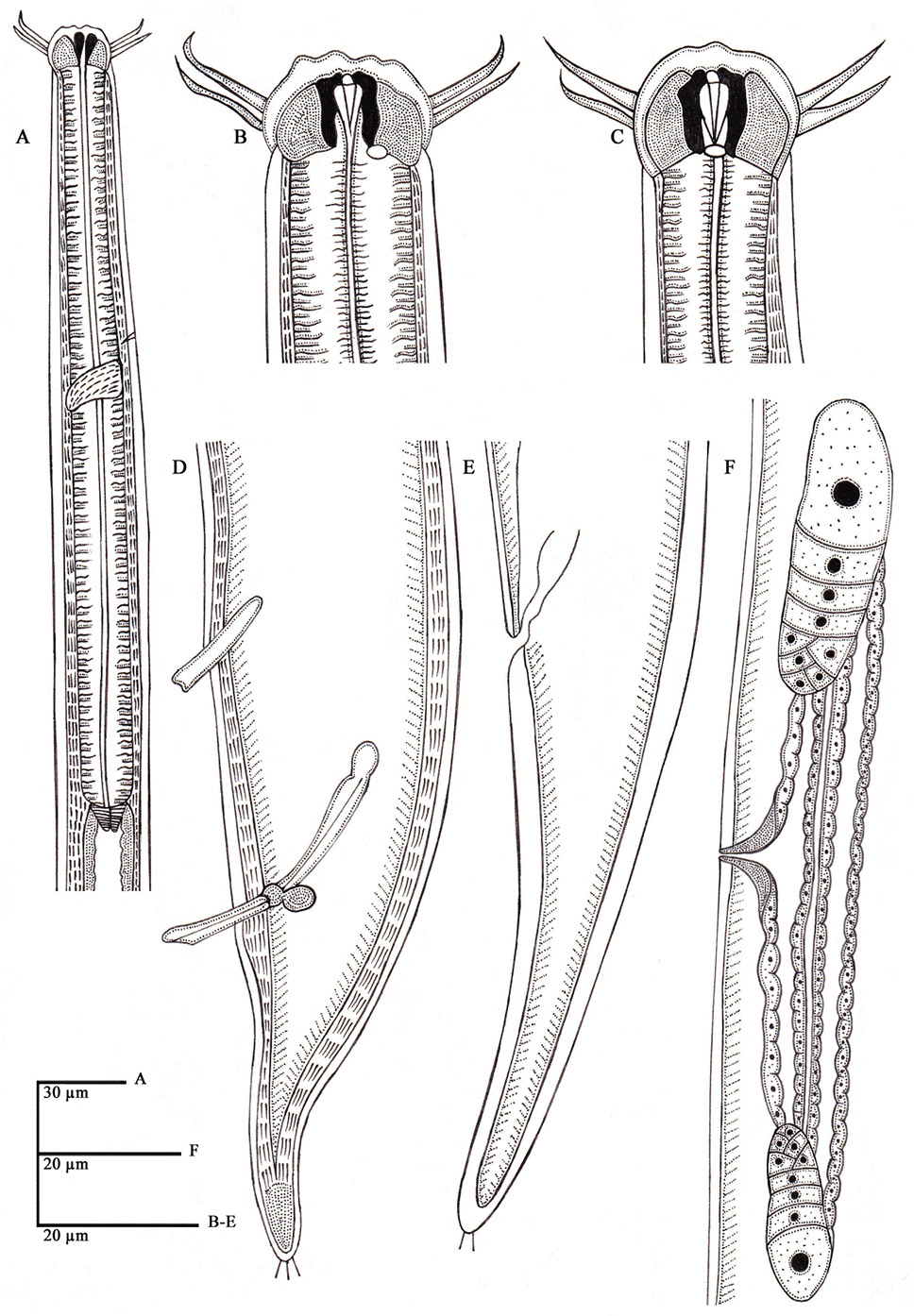
Enoplus minimus n.sp. Male: A, Esophageal region; B, Anterior region; D, Tail region. Female: C, Anterior region; E, Tail region; F, Reproductive system.
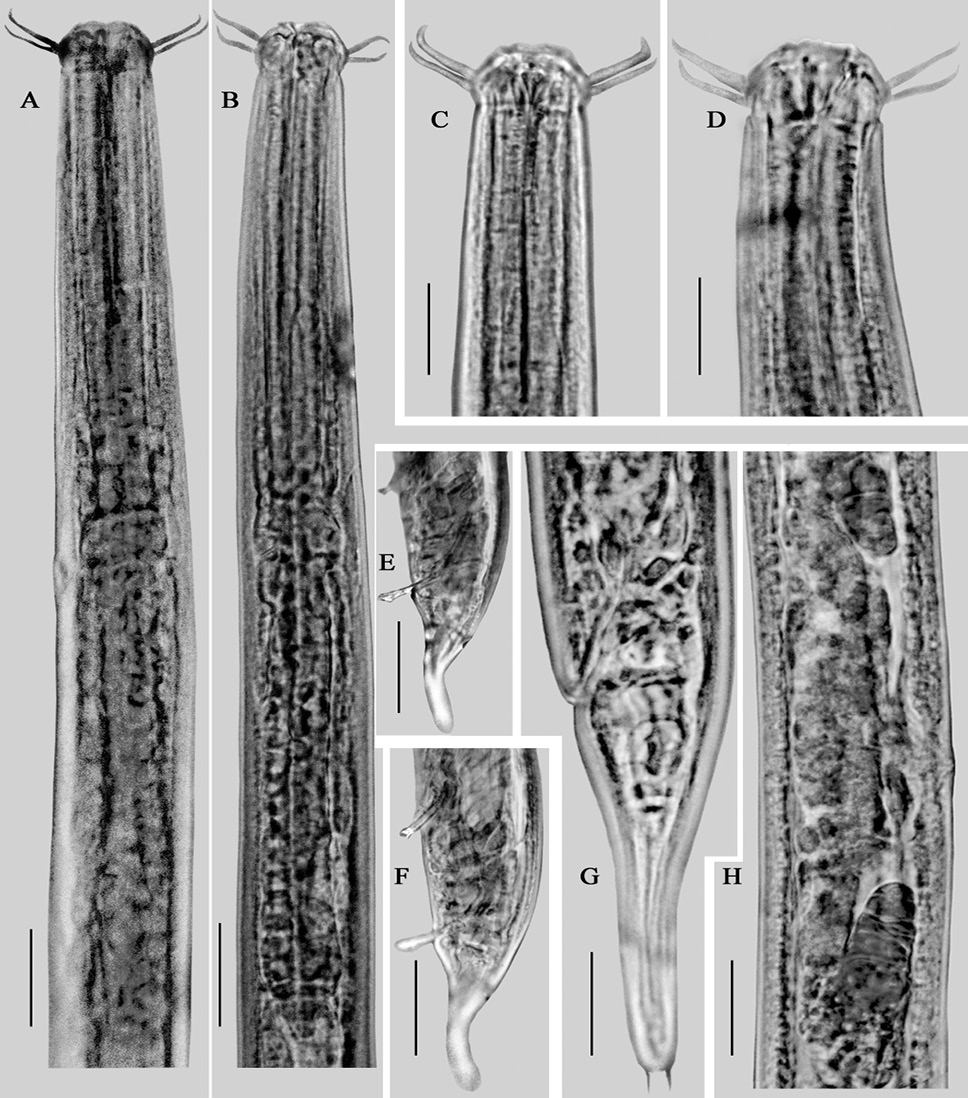
Enoplus minimus n.sp. Male: A, Esophageal region; C, Anterior region; E-F, Tail region. Female: B, Esophageal region; D, Anterior region; G, Tail region; H, Reproductive system. Scale A- B=30μm; C-H=20μm.
References
- Cobb, N.A., 1918. Agric. Tech. Circ. U.S. Dept. Agric., 1: 48.
- Dujardin, F., 1845. Histoire naturelle des helminthes ou vers intestinaux. Librairie Encyclopedique de Roret. Paris. pp. 233-234. https://doi.org/10.5962/bhl.title.10123[CrossRef]
- Fadeeva, N.P. and Yushin, V.V., 1998. Russ. J. Nematol., 6: 95-102.
- Gerlach, S.A., 1952. Abh. math.-naturw. Kl. Akad. Wiss. Mainz., 6: 315-372.
- Gerlach, S.A., 1958. Mém. Inst. Sci. Madagascar (F)., 2: 343-365.
- Huda, I.A. and Khan, S.A., 1996. Biodiversity of benthic fauna in Korangi-Phitti creek system at different ecological niches. Proc. UNESCO Works. Coastal Aquac., pp. 37-46.
- Nasira, K. and Shahina, F., 2007. Pak. J. Nematol., 25: 223-280.
- Nasira, K. and Shahina, F., 2012. Int. J. Phycol. Phycochem., 8: 213-218.
- Nasira, K., Shahina, F., Kamran, M. and Ali, R., 2010. Pak. J. Nematol., 28: 149-151.
- Saifullah, S.M., Shaukat, S.S. and Shams, S., 1994. Aquat. Bot., 47: 329-340. https://doi.org/10.1016/0304-3770(94)90062-0[CrossRef]
- Seinhorst, J.W., 1959. Nematologica, 4: 67-69. https://doi.org/10.1163/187529259X00381[CrossRef]
- Shekhawat, M.S. and Dixit, A.K., 2005. Agrobios Newsl., 4: 57-59.
- Timm, R.W., 1959. J. Bombay nat. Hist. Soc., 56: 204-210.
- Warwick, R.M., Platt, H.M. and Somerfield, P.J., 1998. Free living marine nematodes: Pictorial key to world genera and notes for the identification of British species. Part III, Monohysterids (eds. R.S.K. Bames, and J.H. Crothers). Linnean Society of London and the Estuarine and Coastal Sciences Association by Field Studies Council: Dorchester, UK.
- WoRMS, 2023. World register of marine species. Available from: https://www.marinespecies.org. (accessed 2023-04-13).
Services
Article usage statistics
Loading…