
A comparative analysis of meat quality traits at different segmented parts of small-tailed Han sheep was conducted. The results showed that drip losses of back and tendon were obviously lower than those at other parts (P<0.05). Cooking loss of tendon was significantly lower than that at other parts (P<0.05). The shearing force of hind leg was obviously lower than that at other parts (P<0.05). The flesh color of waist was significantly lower than that at other parts (P<0.05). Crude protein contents in forelegs, hind leg and back were remarkably higher than that in waist (P<0.05). The crude fat content of the waist was significantly higher than that of other parts (P<0.05). To sum up, due to low shearing force, meat quality of hind leg was tender just with slightly low crude fat content; crude fat content of waist was high, so flavor of waist was good. The correlation coefficients of flesh color with crude fat and shearing force were -0.425 and 0.176, respectively, and the correlation coefficients of cooking loss with crude protein and drip loss were 0.272 and 0.179, respectively.
Short Communication · Volume 53, Issue 3, 4 April 2021 · Open Access
Comparative Analysis of Meat Quality in Different Parts of Small-Tailed Han Sheep
· · · · ·
Affiliations & Notes ⌄
- 1College of Animal Science and Technology, Henan University of Science and Technology, Luoyang 471003, China , * Corresponding author: byezi@163.com
Article Info ⌄
- Journal:
- Pakistan Journal of Zoology
- Published:
- 4 April 2021

Abstract
Materials and methods
Small-tailed Han sheep (n=60) from Taiqian County, Puyang City, Henan Province, then brought to the lab to measure meat quality traits, mainly including drip loss, shearing force, water content, cooking loss and flesh color. The determination method of growth traits and meat quality traits referred to the determination part of production performance in Animal Breeding Experimentation by editor-in-chief Liu (2007).
SPSS17.0 software was used to analyze the influence of different parts and sex on the quality of small-tailed Han sheep.
Results and discussion
It could be seen from Figure 1 that drip losses of back and tendon were significantly lower than those at other parts, (P<0.05) but that of forelegs was significantly lower than that of waist (P<0.05). The cooking loss of tendon was notably lower than those at other parts (P<0.05), those of waist and rib were notably lower than those of forelegs, hind leg and rid (P<0.05), and that of back was notably lower than those of forelegs and hind leg (P<0.05). Abdelrahman et al. (2018) research shows that the cooking loss of male Naemi lamb is 20-35.2%, while the cooking loss of Small Tail Han sheep (25-36.803%) in this study is slightly higher than that of Abdelrahman et al. (2018).
The shearing force of hind leg was obviously lower than those at other parts (P<0.05), while that of forelegs was remarkably lower than that of back (P<0.05). The flesh color of waist was obviously lower than those at other parts, and that of hind leg was obviously higher than those of forelegs, back, tendon and rib (P<0.05). The crude protein contents of forelegs, hind leg and back were significantly higher than that of waist (P<0.05). The crude fat content of waist was notably higher than those at other parts (P<0.05). Different parts of sheep meat had no significant difference in water content (P>0.05).
To sum up, due to low shearing force, meat quality of hind leg was tender just with slightly low crude fat content. Crude fat content of waist was high, so its flavor was good, and this study result was slightly different from that of Guo and Li (2008) which indicated that sheep meat at rib and waist had favorable edible qualities.
It can be seen from Figure 2 that both shearing force and crude protein of ram meat were slightly higher than those of ewe meat, but the difference was insignificant (P>0.05). Besides, ram and ewe had no significant differences in the aspects of drip loss, cooking loss, water content, flesh color and crude fat (P>0.05). Ullah et al. (2019) showed that the fat content of ewe was significantly higher than that of ram. The results of this study are not consistent with those of Ullah et al. (2019) which may be the reason for the different characteristics of different sheep breeds.
As shown in Table I crude fat and flesh color presented extremely significant negative correlation with correlation coefficient of -0.425 (P<0.01). Crude protein had a significant negative correlation with water content with correlation coefficient of -0.234 (P<0.05). Significant positive correlation existed between crude protein and cooking loss with correlation coefficient of 0.272 (P<0.05). Shearing force had significant negative correlation with flesh color with correlation coefficient of -0.176 (P<0.05). Drip loss presented significant positive correlation with cooking loss with correlation coefficient of 0.179 (P<0.05).
Table I.- Correlation coefficient between meat quality traits.
| Meat quality traits | Drip loss | Shearing force | Water content | Cooking loss | Flesh color | Crude protein | Crude fat |
| Drip loss | 1 | -0.041 | -0.041 | 0.179* | -0.137 | 0.060 | 0.077 |
| Shearing force | -0.041 | 1 | 0.019 | -0.101 | -0.176* | -0.065 | 0.029 |
| Water content | -0.041 | 0.019 | 1 | -0.103 | -0.091 | -0.234* | 0.193 |
| Cooking loss | 0.179* | -0.101 | -0.103 | 1 | 0.101 | 0.272* | -0.116 |
| Flesh color | -0.137 | -0.176* | -0.091 | 0.101 | 1 | 0.201 | -0.425** |
| Crude protein | 0.060 | -0.065 | -0.234* | 0.272* | 0.201 | 1 | -0.216* |
| Crude fat | 0.077 | 0.029 | 0.193 | -0.116 | -0.425** | -0.216* | 1 |
Acknowledgements
Sincere gratitude goes to the sponsor of National Natural Science Foundation (31201777).
Statement of conflict of interest
The authors declare no conflict of interest.
Figures
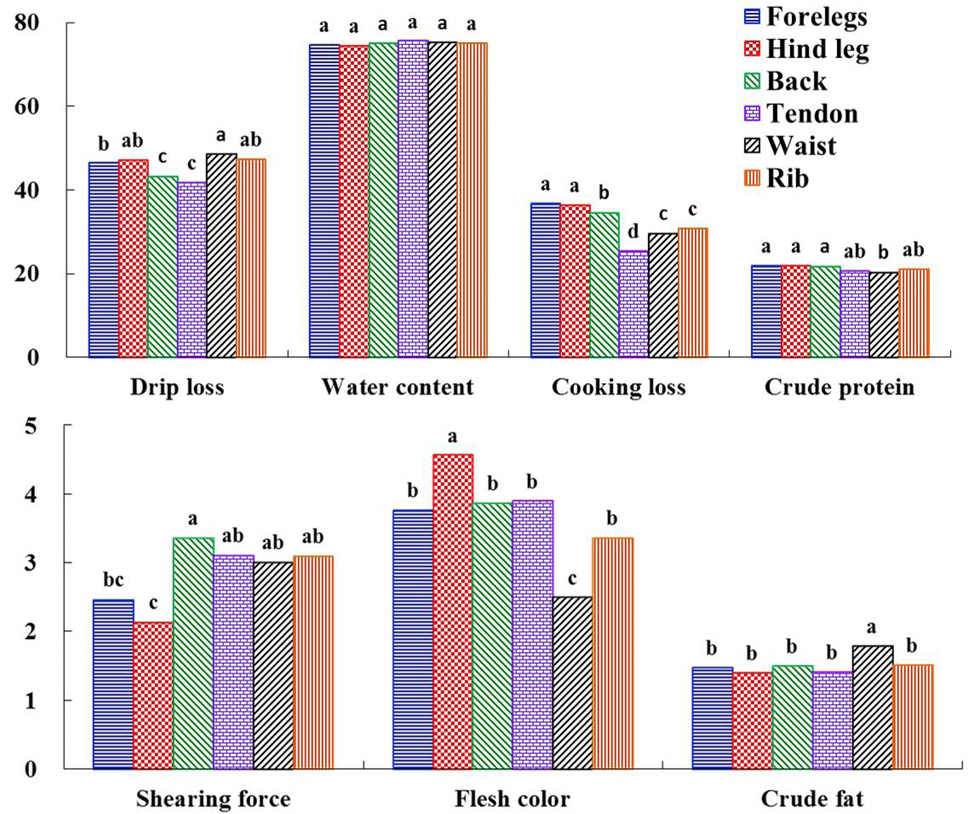
Comparison of meat quality in different parts of small-tailed Han sheep.
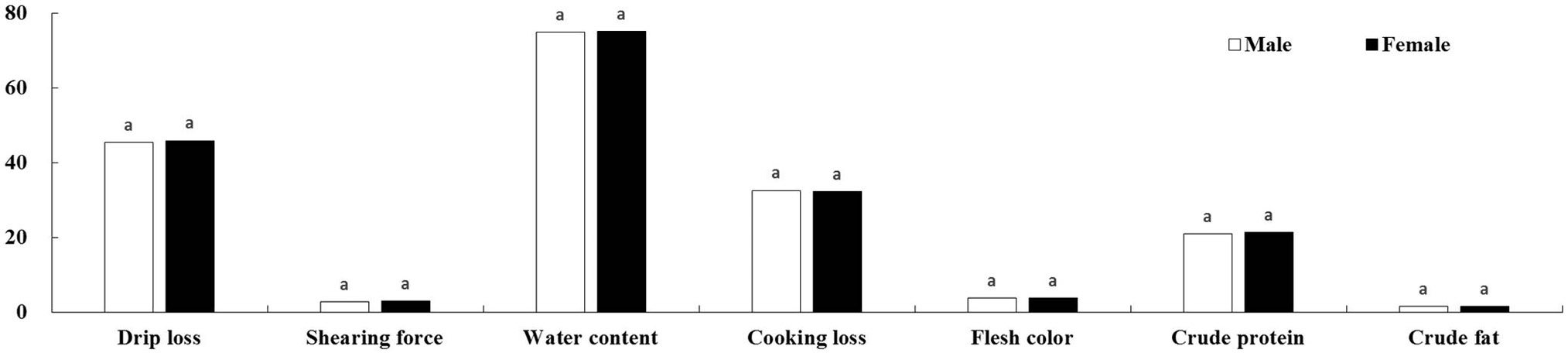
Comparison of meat quality characters between different genders of small-tailed Han sheep.
References
- Abdelrahman, M.M., Alhidary, I.A., Suliman, G.M., Alyemni, A.H., Al-Saiad, M.Y., Alshamiry, F.A., Alobre, M.M. and Aljumaah, R.S., 2018. Pakistan J. Zool., 50: 2129-2134. https://doi.org/10.17582/journal.pjz/2018.50.6.2129.2134[Full text][CrossRef]
- Bai, J.Y., Yang, Y.B., Wang, Y.Q., Zhang, X.H. and Pang, Y.Z., 2015. Indian J. Anim. Res., 49: 855-590.
- Bai, J.Y., Wang, X., Yang, Y.B., Zhang, X.H., Pang, Y.Z., Li, H.W., 2016. R. Bras. Zootec., 45: 604-607. https://doi.org/10.1590/S1806-92902016001000004[CrossRef]
- Bai, J.Y., Jia, X.P., Yang, Y.B., Pang, Y.Z and Wang, Y.Q., 2017. Indian J. Anim. Res., 51: 856-859.
- Bai, J.Y., Zhao, Y.G., Li, G.L., Yang, Y.B., Wang, Y.Q., Wang, X. and Yang, S., 2019. Indian J. Anim. Res., 53: 856-859.
- Bai, J.Y., Wu. R.T.D., Zhou, J.W., Zhang, W.B., Fan, H.D., Cao, H. and Fu, X.Y., 2020. Indian J. Anim. Res., 54: 138-142. https://doi.org/10.18805/ijar.B-1132[CrossRef]
- Guo, Y. and Li, B., 2008. Fd. Sci., 29: 143-147. https://doi.org/10.1057/palgrave.jphp.3200164[CrossRef]
- Liu, W.Z., 2007. Experimental course of animal breeding. China Agricultural University Press, Beijing, China.
- Ullah, H., Rahman, A., Khan, R.U., Ahmad, S., Tariq, A. and Naz, S., 2019. Pakistan J. Zool., 51: 1705-1710. https://doi.org/10.17582/journal.pjz/2019.51.5.1705.1710[Full text][CrossRef]
Services
Article usage statistics
Loading…