ResearchersLinks

Case Report · Volume 4, Issue 2, Pages 30–33, 23 June 2016 · Open Access

Clinical Management of Babesiosis in Cattle: A Case Report

· ·

Article Info ⌄
Journal:
Research Journal for Veterinary Practitioners
Published:
23 June 2016

From the article

  • Variations in the number of parasites injected result in highly significant changes to the prepatent period, peak parasitemia, and the hematological response.
  • Hemoglobinuria, frequently the clinical sign first detected by the owner, occurs at the peak of the hemolytic crisis is in accordance with the present cases.
  • Detection and treatment of babesiosis are important tools to control babesiosis.
  • For years, babesiosis treatment has been based on the use of very few drugs like imidocarb or diminazene aceturate.

Selected from the article's own text.

Abstract

Saritha Gungi*, Gurram Sreeramamurthy Haritha, Karumuri Nalini Kumari

Department of Veterinary Medicine, College of Veterinary Science, SVVU, Tirupati, Andhra Pradesh, India.

Abstract | Babesiosis is a tick-transmitted disease caused by protozoans of the genus Babesia and it is characterized by haemolytic anemia and fever, with occasional hemoglobinuria and death. In the present study 4 cross bred cows aged between 4-6 years were presented to the college hospital with the history of fever, anorexia, passing coffee coloured urine, reduced milk yield, depression and reluctance to move. Examination of the blood smears confirmed the Babesia spp. in all the cows. Microscopy detection methods are still the cheapest and fastest methods used to identify Babesia parasites although their sensitivity and specificity are limited. Haematological studies revealed reduced Hb, PCV and TEC. Serum chemistry revealed hyperglycemia, hyperbilirubinemia, BUN, AST and hypoprotienemia. Urine was positive for haemoglobin, glucose and bile pigments. Three cows were treated successfully with diminazene aceturate (Berenil) at 3 mg/kg body weight, together with supportive therapy. Whereas, one cow died due to severe anemia. 

Keywords | Haemoglibinuria, Cattle, Anemia, Jaundice, BUN
Introduction

It is a disease with a world-wide distribution affecting many species of mammals with a major impact on cattle and man , . The disease is particularly severe in naive animals introduced into endemic areas and is a considerable constraint on livestock development in many part of the world . It occurs most commonly in exotic crossbred cattle under stress conditions particularly in tropical and subtropical countries including India when tick population is very high.

Case presentation and history

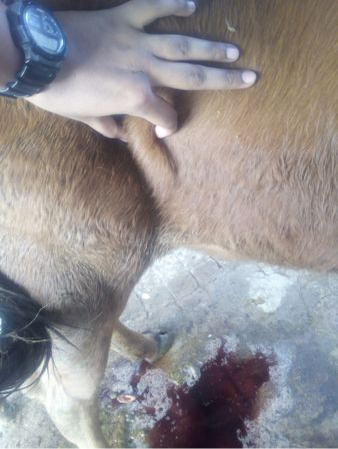
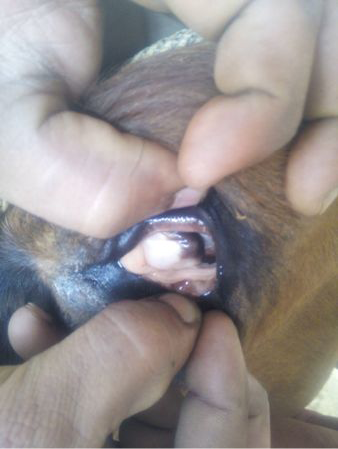
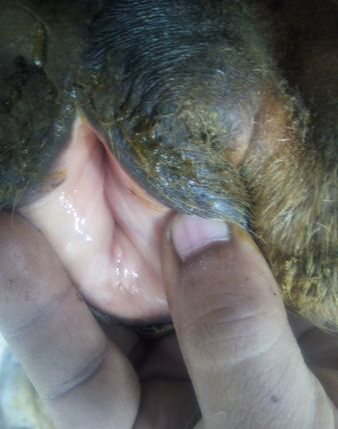
In the present study, 4 cross bred cows aged between 4-6 years were presented to the college hospital with the history of fever, anorexia, passing coffee coloured urine, reduced milk yield, depression and reluctance to move. On clinical examination elevated temperature ranging from 103oF to 104.2oF, accelerated heart rate and respiration, dyspnoea, suspended rumination, presence of icteric mucus membranes (Figure 3 and 4) with mild to moderate tick infestation and enlarged lymphnodes with haemoglobinuria (Figure 2) were observed.

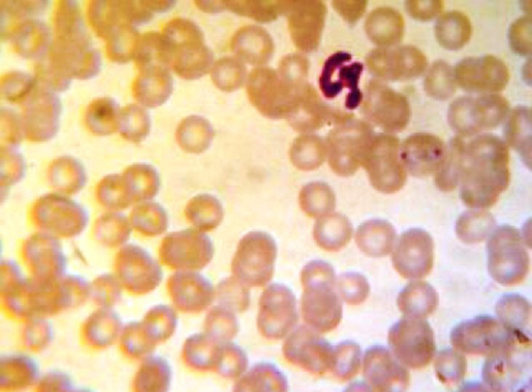
Figure 1: Microscopic picture of blood smear with babesia organisms

Figure 2: Enlarged lymph node and haemoglobinuria

Figure 3: Icteric conjunctival mucous membranes

Figure 4: Icteric vaginal mucous membranes

Blood and serum were collected for laboratory investigation. Blood smears revealed presence of Babesia spp. in 40% of RBCs of all the smears (Figure 1). Haemogram revealed on average extremely low levels of Hb, PCV, TEC and platelets counts. Serum chemistry revealed hyperglycemia, hyperbilirubinemia, BUN, AST and hypoprotienemia. The values are presented in Table 1. Urine was coffee coloured and positive for haemoglobin, glucose and bile pigments in all the four cows.

Treatment

The animals were treated with a single dose of Diminazine accurate (Inj. Berenil RTU, Hoechst®) 3 mg/kg Bwt i/m at two different sites in neck muscles, long acting oxytetracycline (Inj. Intamycin-LA, Intas Pharmaceuticals) @ 20 mg / kg body wt i/m at 48 hours intervals on two occasions, haematinic (Inj. Feritas, Intas Pharmaceuticals®) 10 ml i/m thrice weekly for one week, rumenotoric (liquid Brotone, Virbac® Animal Health) 40 ml daily orally for 10 days and Injection Rintose (Wockhardt®) 500 ml i/v daily for 3 days. After 3 days temperature reduced drastically to 1020F in three animals. Hb and PCV levels improved after 3 wks. Treatment was successful with diminazene aceturate (Berenil) at 3 mg/kg body weight, together with supportive therapy in three cows. Whereas, one cow that was presented at delayed stage died due to severe anemia and delay in initiation of therapy.

Table 1: Average Hemato-biochemical values and urinalysis of affected cows

Parameters

Apparently healthy

cow values

Avg Pre- treatment values

Avg Post- treatment values

Hemoglobin (g/dL)

8 - 15

4.5

6.3

PCV (%)

24 - 46

15

22

TEC X 106/μL

5 - 10

1.3

3.2

TLC X 103/μL

4 - 12

14.25

10.3

MCV (fL)

40 - 60

37.23

42.7

MCH (pg)

11 - 17

11.54

15.2

MCHC (g/dL)

30 - 36

23.21

31.1

Platelets / μL

100000 - 800000

57000

92000

Neutrophils (%)

20 - 45

40

46

Lymphocytes (%)

45 - 75

51

48

Monocytes (%)

2 - 7

2

3

Eosinophils (%)

2 - 8

7

3

Basophils (%)

0 - 1

-

-

Serum Biochemical Values

AST (U/L)

78 - 132

167

124

TP (g/dl)

5.7 – 8.1

5.8

6.1

BUN (mg/dl)

6 - 27

32

24

Tot. Bilirubin (mg/dl)

0.01 - 0.5

0.9

0.56

Glucose (mg/dl)

45 - 75

110

65

Creatinine (mg/dl)

1 - 2

0.9

0.83

Urinanalysis

Blood (Hb)

-

+++

-

Glucose

-

±

-

Bile pigments

-

++

±

Discussion

Babesiosis is a tick-transmitted disease caused by protozoans of the genus Babesia and it is characterized by haemolytic anemia and fever, with occasional hemoglobinuria and death . The minimum infective dose required to produce overt disease is thought to be 103 parasites inoculated intravenously. Variations in the number of parasites injected result in highly significant changes to the prepatent period, peak parasitemia, and the hematological response. In addition to the number of infected ticks that feed on an animal, the immune status of the host and the virulence of the infecting strain. Subclinical infections are quite common and are usually missed by the farmer and clinician. Affected animals have low parasitemia, may suffer mild fever and anorexia, and make an uneventful recovery . Hemoglobinuria, frequently the clinical sign first detected by the owner, occurs at the peak of the hemolytic crisis is in accordance with the present cases. Immediately after the hemolytic crisis, a brief lymphocytosis and monocytosis combine to cause a leukocytosis .

Detection and treatment of babesiosis are important tools to control babesiosis. Microscopy detection methods are still the cheapest and fastest methods used to identify Babesia parasites although their sensitivity and specificity are limited . When tick population is very high, the disease may be so acute as to cause death within a few days, during which the PCV falls below 20% and the parasitaemia, which is usually detectable once the clinical signs appear and may involve 0.2% to 45% of the red cells, depending on the species of Babesia . Most of the clinico-haemotological findings observed in our cases were similar to those reported earlier by Tufani et al. (2015). For years, babesiosis treatment has been based on the use of very few drugs like imidocarb or diminazene aceturate. Recently, several pharmacological compounds were developed and evaluated, offering new options to control the disease . Diminazene aceturate consists of an organic base and organic acid but once dissolved in water, it dissociates. It is usually given by intra-muscular injection at doses of 3-5 mg/kg . Long acting oxytetracyclinehas been shown to have a prophylactic effec against Babesia divergens infection . In humans treatment with quinine and clindamycin, successfully eradicated the organisms. Subsequent studies in animals have supported the usefulness of this combination of antimicrobial agents . Prolonged convalescent period results in considerable loss of production for a long period in babesiosis . B-complex and oral haematenics were continued for 3 weeks till the animals were completely recovered from anemia.

Conflict of interest

There exists no conflict of interest.

Authors’ contribution

All authors contributed equally.

References

  1. Bock R, Jackson L, de Vos A, Jorgensen W (2004). Babesiosis of cattle. Parasitol. (129 Suppl): S247–269. http://dx.doi.org/10.1017/S0031182004005190[CrossRef]
  2. Gray JS, TM Murphy (1985). Bovine babesiosis in Ireland. Ir. Vet. News. 9–14.
  3. Kuttler KL (1981). In: Babesiosis. Ristic M, Keire JP, editors. New York: Academic Press. Pp. 25–63.
  4. Mary J. Homer, Irma Aguilar-Delfin, Sam R. Telford, Peter J. Krause, David H. Persing (2000). Babesiosis. Clinical Microbiology Reviews, July, Vol. 13: 451–469.
  5. Mosqueda J, Olvera-Ramírez A, Aguilar-Tipacamú G, and Canto G J (2012). Current Advances in Detection and Treatment of Babesiosis Curr Med Chem. Apr. 19(10): 1504–1518.
  6. Radostits OM, Gay CC, Blood DC, Hinchcliff KW (2000).Veterinary Medicine ,9th edn, W.B. Sounders, London.
  7. Ristic M. In: Diseases of Cattle in the Tropics. 1981. Firts Edition ed. Ristic M, McIntyre I, editors. Vol. 6. The Hague: Martinus Nijhoff Publishers. Pp. 443–468.
  8. Tufani NA, Fazili MR, Malik HU, Beigh SA, Khadim Hussain Dar (2015). Clinico-Haematological Profile and Therapeutic Management of Acute Babesiosis in A Holstein-Friesian Crossbred Cow. Veterinary clinical sciences, july-sept, VoL.3, issue 3, Jakraya publication (pvt.) Ltd.
  9. Urquhart GM, Armour J, Duncan JL, Dunn AM, Jennings FW (1996). Veterinary Parasitology (2nd Ed.). Book Power, Black well Science. Scotland. Pp. 243-244.
  10. Urquhart GM, Armour J, Duncan JL, Dunn AM, Jennings FW (2003). Veterinary Parasitology. (II Ed.). Book Power, Black well Services, Ltd. Garesington Road, Oxford, UK.
  11. Zintl A, Mulcahy G, Skerrett HE, Taylor SM, Gray JS (2003). Babesia divergens, a bovine blood parasite of veterinary and zoonotic importance. Clin. Microbiol. Rev. 16(4): 6 22–636.

Services

Article usage statistics

Loading…

Clinical Management of Babesiosis in Cattle: A Case Report · ResearchersLinks