
Looking into the importance of tick born diseases in the livestock sector, the present study was conducted to find out the prevalence of babesiosis among domestic cattle of Southern Khyber Pakhtunkhwa. Blood samples (1500) were collected from clinically suspected cattle in span of one year. All blood samples were examined through microscope. Overall incidence of babesiosis was 54.80%.B. bovesshowed high prevalence (35.46%) than B. bigemina (19.33%). Females were more prone as compared to male cattle for both B. bovesandB. bigemina. Cattle having age less than two years showed high positivity for bothB. boves (49.23%)and B. bigemina (26.15%). Similarly rate of positivity for both B. boves (47.12%)andB. bigemina (25.13%) was reported high during summer season.
Short Communication · Volume 52, Issue 6, 20 September 2020 · Open Access
Prevalence of Tick Born Babesia Infection in Domestic Cattle of Khyber Pakhtunkhwa, Pakistan
· · · · · · · ·
Affiliations & Notes ⌄
- 1Department of Zoology, Kohat University of Science and Technology, Kohat-26000, Khyber Pakhtunkhwa, Pakistan 2Department of Botany, Kohat University of Science and Technology, Kohat-26000, Khyber Pakhtunkhwa, Pakistan 3Department of Zoology, University of Malakand, Chakdara, Dir Lower, Pakistan 4Department of Zoology, University of Lakki Marwat, Khyber Pakhtunkhwa, Pakistan , * Corresponding author: dr.kalim@kust.edu.pk
Article Info ⌄
- Journal:
- Pakistan Journal of Zoology
- Published:
- 20 September 2020

From the article
- Examination of blood samples showed that overall 822 (54.80%) domestic cattle were positive for babesiosis.
- High incidence of Babesia species was found in cattles having age less than two years (49.23% B. boves and 26.15% B. bigemina) as shown in Table II.
- Babesia boves (35.46%) were more prevalent in cattle of the study area than B. bigemina (19.33%).
- It is clear from the study that Babesia infection is present in cattle in the study, hense putting them at high risk leading to great economic losses to livestock industry of the country.
Selected from the article's own text.
Abstract
Material and methods
Around 1500 blood samples were collected from the jugular vein of cattles in sterile vacationer having capacity of 5ml and placed in ice jar. Samples were collected from clinically suspected cattle in span of one year from Southern Khyber Pakhtunkhwa (Bannu, Karak, Kohat, Lakki Marwat and Dera Ismail Khan). Samples were labeled showing date of collection, age, sex and area. Samples were transported to Molecular Parasitology and Virology Laboratory of Department of Zoology, Kohat University of Science and Technology and were kept at -20C0 for further processing. Clinical data of animals were recorded on pre-designed questionnaire. Thin and thick blood smears were prepared, fixed with methanol for one minute and then stained with Giemsa stain. Stained slides were observed under 200x magnification using microscope (Olympus Japan) for detection of B. boves and B. bigemina. Prevalence rate of babesiosis was determined by the following formula:
Prevalence rate = No of positive samples/Total number of samples examined×100
Ethical approvel of the study was obtained from the Institutional Review Board of the Kohat University of Science and Technology, Kohat. SPSS statistical software version 20 was used for data entry and analysis.
Results and discussion
Examination of blood samples showed that overall 822 (54.80%) domestic cattle were positive for babesiosis. It was found that B. boves (35.46%) was more prevalent than B. bigemina (19.33). Study conducted in southern Punjab showed that 35% cattle were positive to Babesia infection , southeastern Punjab showed 20% positivity and Khyber Pakhtunkhwa 61% . Similarly, study conducted in China revealed 7.24% prevalence rate of Babesia infection (Zhuo et al., 2019) and Philippines 11.49% .
Furthermore, results obtained from the present study showed that prevalence of babesoiosis was higher in district Dera Ismail Khan compared to other districts as shown in Table I. This high prevalence in D. I. Khan may be due to their hot and wet environmental conditions which favors the growth and development of ticks.
The prevalence of B. boves and B. bigemina in cattles was also analyzed based on their age. The study showed that rate of babesiosis decreased with age. High incidence of Babesia species was found in cattles having age less than two years (49.23% B. boves and 26.15% B. bigemina) as shown in Table II. This high incidence in younger cattles may be due to their thin and soft skin which makes it easy for the ticks to transmit the infection comfortably and may be due to their low level of immunity ; .
Table I. Overall prevalence of babesiosis in domestic cattle of different areas of KP.
| Localities | No. of sample | B. boves % | B. bigemina % | Total/% | P-value |
| Bannu | 300 | 114(38.00) | 62(20.66) | 176(58.66) | |
| Karak | 300 | 100(33.33) | 48(16.00) | 148(49.33) | |
| Chat | 300 | 110(36.66) | 58(19.33) | 168(56.00) | 0.0008* |
| Lakki Marwat | 300 | 82(27.33) | 54(18.00) | 136(45.33) | |
| D.I Khan | 300 | 126(42.00) | 68(22.66) | 194(64.66) |
*paired t test was used.
Table II. Prevalence of babesiosis in relation to the age of domestic cattle of KP.
| Age group (Years) | No. of sample | B. boves % | B. bigemina % | Total/% | P-value |
| >2 | 260 | 128(49.23) | 68(26.15) | 196(75.38) | |
| 2>4 | 296 | 112(37.83) | 62(20.94) | 174(58.78) | |
| 4>6 | 366 | 126(34.42) | 68(18.57) | 194(53.00) | 0.0060* |
| 6>9 | 338 | 102(30.17) | 56(16.56) | 158(46.74) | |
| <9 | 240 | 64(26.66) | 36(15.00) | 100(41.66) |
* Unpaired t test was used.
Relationship of Babesia infection with gender was also determined replacement to the present study showed that females were more prone to B. boves (41%) and B. bigemina (23.24%) than male cattles. The high prevalence of babesiosis in female cattle may be due to the use of contaminated needles used for the injection of drugs to let down milk. Similar results were also reported elsewhere .
Seasonal variation of B. boves and B. bigemina in domestic cattles was also determined. High incidence of both species was found in summer season (47.12% B. boves and 25.13% B. bigemina) followed by spring, autumn and winter (Fig. 1). More invasions in summer season may be due to the association of high ticks activity with increased temperature and humididty of the environment .
Conclusions
Babesia boves (35.46%) were more prevalent in cattle of the study area than B. bigemina (19.33%). Younger cattles were more prone to disease than older animals. Both species of Babesia were more prevalent in summer season. It is clear from the study that Babesia infection is present in cattle in the study, hense putting them at high risk leading to great economic losses to livestock industry of the country.
Acknowledgment
The cooperation of all veterinary doctors and owners of the cattles are highly acknowledged who assisted us during blood and data collection.
Statement of conflict of interest
The authors have declared no conflict of interest.
Figures
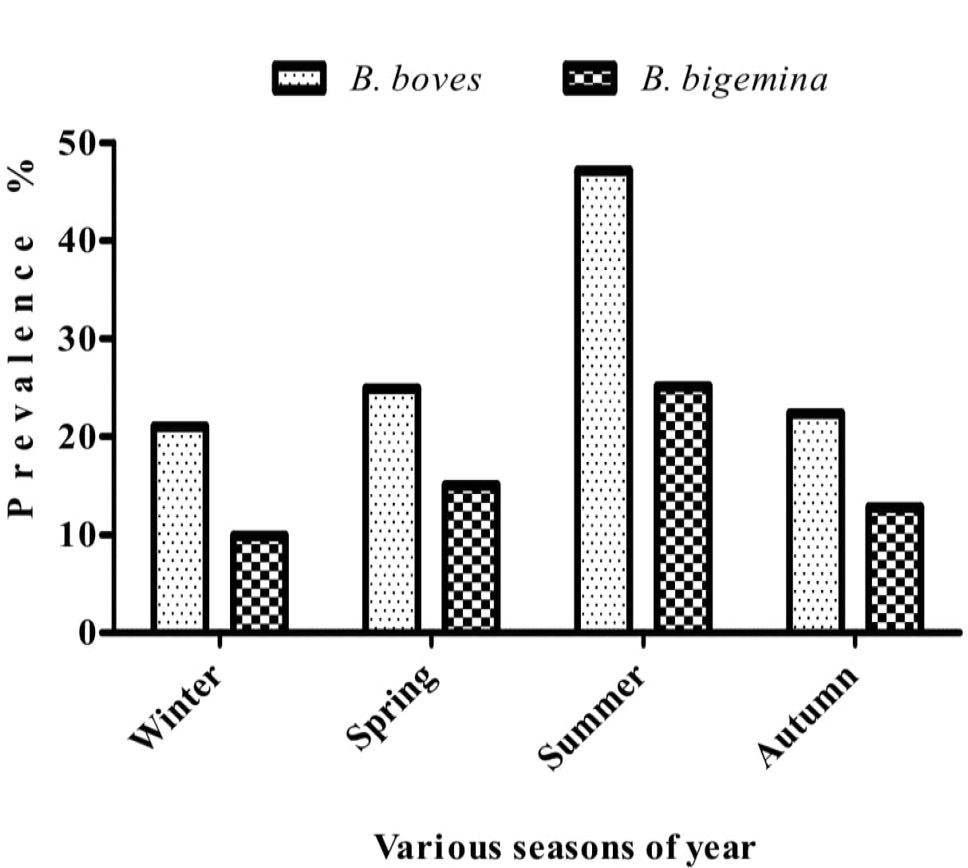
Prevalence of babesiosis amoung domesticated cattle in relation to various seasons.
References
- Ahmad, I., Khwaja, A., Shams, S., Ayaz, S., Khan, S., Akbar, N.U., Waqar, M., Alam, S., Khan, M.A., Rehman, A. and Zakir, M., 2014. Int. J. Bioassays, 3: 3195-3199.
- Herrera, P.C.T., Viloria, V.V., Balbin, M.M. and Mingala, C.N., 2017. Annls Parasitol., 63: 309-316.
- Hunfeld, K.P., Hildebrandt, A. and Gray, J.S., 2008. Int. J. Parasitol., 38: 1219-1237. https://doi.org/10.1016/j.ijpara.2008.03.001[CrossRef]
- Irshad, N., Qayyum, M., Hussain, M. and Khan, M.Q., 2010. Pak. Vet. J., 30: 178-180.
- Iseki, H., Zhou, L., Kim, C., Inpankaew, T., Sununta, C., Yokoyama, N., Xuan, X., Jittapalapong, S. and Igarashi, I., 2010. Vet. Parasitol., 170: 193-196. https://doi.org/10.1016/j.vetpar.2010.02.038[CrossRef]
- Khetran, I.B., Arijo, A.G., Buhtto, M.B., Gadahi, J.A. and Laghari, Z.A., 2019. Veterinaria, 68: 25-30.
- Saad, F., Khaisroon, M., Khan, K. and Akbar, N., 2015. Int. J. Curr. Microbiol. appl. Sci., 4: 1030-1036
- Zhou, Z., Li, K., Sun, Y., Shi, J., Li, H., Chen, Y., Yang, H., Li, X., Wu, B., Li, X. and Wang, Z., 2019. PLoS One, 14: 1-11. https://doi.org/10.1371/journal.pone.0215585[CrossRef]
- Zia, A. and Nazir, Q., 2019. Buffalo Bull., 38: 485-489.
- Zulfiqar, S., Shahnawaz, S., Ali, M., Bhutta, A.M., Iqbal, S., Hayat, S., Qadir, S., Latif, M., Kiran, N., Saeed, A., Ali, M. and Iqbal, F., 2012. Asian Pac. J. trop. Biomed., 2: 104-108. https://doi.org/10.1016/S2221-1691(11)60202-5[CrossRef]
Services
Article usage statistics
Loading…