Research Article · Volume 12, Issue 3, 9 February 2024 · Open Access
Assessing the Impact of Black Soldier Fly Oil (Hermetia illucens) from Various Phases as Feed Additive on the Growth Performance and Histomorphology of Broiler Chickens
· ·
Affiliations & Notes ⌄
- 1Master Student, Department of Animal Nutrition and Feed Science, Faculty of Animal Science University of Brawjaya, Malang 65145, East Java, Indonesia
- 2Faculty of Animal Science, Universitas Brawijaya, Malang 65145, Indonesia. *Correspondence | Osfar Sjofjan, Faculty of Animal Science, Universitas Brawijaya, Malang 65145, Indonesia
- 3Email: osfar@ub.ac.id
Article Info ⌄
- Journal:
- Advances in Animal and Veterinary Sciences
- Published:
- 9 February 2024

From the article
- In conclusion, the utilization of BSF oil extracted from three distinct phases (larvae, prepupae, pupae) proves to be a viable alternative feed additive.
- This choice yields positive effects on production performance, particularly in terms of Feed Conversion Ratio (FCR) and the Performance Index (IP).
- Among the three phases of BSF considered, the extraction at the larval phase is recommended for application of oil then given as a natural feed additive.
Selected from the article's own text.
Abstract
INTRODUCTION
The prohibition of antibiotic use in animal feed has prompted the development of natural antibiotic growth promoters, driven by concerns about animal welfare and potential long-term impacts on both animal and human health from antibiotic residues. The European Union implemented a banned on nearly all antibiotics in animal feed on January 1, 2006 . Subsequently, the Republic of Indonesia prohibited the addition of antibiotics as feed additives through the Regulation of the Minister of Agriculture (No. 14 of 2017), effective from May 2017. Starting from January 1, 2018, the government also banned the use of antibiotic growth promoters (AGP) in feed . Despite these bans, complete elimination of antibiotic use in the livestock industry remains challenging due to concerns about increased mortality and decreased feed efficiency. Consequently, alternative approaches have been explored to address potential declines in livestock performance. Feed was identified as the major contributor to the land occupation, primary production use, acidification, climate change, energy use, and water dependence . Currently, insects are being considered as a replacing protein source for animal feed. In the other hand, a potential local feed ingredient that could be used to like insect species can be grown on organic side streams, reducing environmental contamination and transforming waste into high-protein feed that can replace increasingly more expensive compound feed ingredients .
Then the alternative such as involves the development of essential oils as feed additives, serving as natural growth promoters to sustain livestock productivity . The BSF is utilized for its essential oil, known for its high nutrient content in the form of lipids, predominantly essential fatty acids . During the transition from the larval phase to the prepupae phase, BSF exhibits a lipid content ranging from 15% to 49% of the total dry weight. The composition of these lipids is primarily saturated fatty acids, although substrate type influences the content of unsaturated fatty acids . The high lipid content of BSF is accompanied by other intrinsic factors from the lipid itself so that it can influence the digestibility and/or palatability of feed. Lauric acid is one of the most abundant fatty acids and it can reach up to 50% of the fat isolated from BSF (Muller et al., 2017). Lauric acid belongs to the medium chain fatty acid group which has antimicrobial effects and can increase the medium chain fatty acid content that can be consumed by broiler chickens, thereby providing a positive effect on the intestinal health of broiler chickens.
MATERIALs AND METHODS
Experimental design
A total of 160 Lohmann strain broiler chickens were allocated into plots based on treatment and replication, with each cage plot accommodating 8 broiler chickens. The broiler chickens were raised for a period of 35 days, spanning from day 1 to day 36 of age. The research employed a completely randomized design (CRD) featuring five treatments and four replications. The formulated treatment feeds were categorized as follows: T0 (basic feed), T1 (basic feed + 0.5% bacitracin), T2 (basic feed + 0.5% BSF larval oil), T3 (basic feed + 0.5% BSF prepupal oil), and T4 (basic feed + 0.5% BSF pupa oil). Ad libitum access to both feed and water was provided. The nutritional composition of BSF oil is detailed in Tables 1 and 2, while the composition of the basic feed which already analysis proximate by following is outlined in Table 1.
Table 1: Nutrient Composition of formulated feed during trial.
| Nutrient composition | Starter | Finisher |
| (%) | (%) | |
| Maize | 53.00 | 50.00 |
| Soya bean meal | 25.00 | 23.00 |
| DDGS | 10.00 | 10.00 |
| Rice bran | 5.00 | 10.00 |
| Cassava meal | 5.50 | 5.00 |
| Salt | 0.15 | 0.15 |
| Crude palm oil | 1.00 | 1.00 |
| Enzyme mix | 0.20 | 0.20 |
| Phytase enzyme | 0.5.0 | 0.50 |
| Vitamin premix | 0.2.0 | 0.20 |
| Amino acid | 0.15 | 0.15 |
|
| 100.00 | 100.00 |
| Calculated composition |
| |
| DM | 88.00 | 88.00 |
| CP | 20.00 | 19.00 |
| Fat | 5.00 | 5.00 |
| CF | 5.00 | 5.00 |
| Ash | 8.00 | 8.00 |
| ME (Kcal / Kg) | 3300.00 | 3100.00 |
| Calcium | 1.1 | 1.1 |
| Phosphorus | 0.6 | 0.6 |
| Lysine | 1.2 | 1.2 |
| Methionine | 0.45 | 0.45 |
| Proximate composition | ||
| DM | 90.87 | 92.54 |
| CP | 23.63 | 21.13 |
| Fat | 6.33 | 7.55 |
| CF | 2.45 | 2.95 |
| Ash | .5.92 | 11.07 |
| ME (Kcal / Kg) | 3243.55 | 3000.07 |
CP: crude protein; CF: crude fat; DDGS: distillers dried grains with soluble; DM: dry matter; ME: metabolizable energy.
Table 2: The effect of the BFSO from three different phase as an feed additive on the performance production of broiler.
| Parameters | T0 | T1 | T2 | T3 | T4 | SEM |
| Feed intake (gr) | 3696,34 | 3775,49 | 3714,34 | 3736,74 | 3786,48 | 12.33 |
| Body weight gain (gr/ head) | 1858,03 | 1947,87 | 1994,30 | 1938,81 | 1952,56 | 34.56 |
| Feed conversion ratio | 1.943ᵇ | 1.896ᵃ | 1.866ᵃ | 1.884ᵃ | 1.896ᵃ | 0.45 |
| Index of performances | 279.91ᵃ | 300.55ᵇ | 309.02ᵇ | 300.86ᵇ | 301.12ᵇ | 3.25 |
| IOFC | 4679,88 | 4908,78 | 6468,76 | 5287,61 | 5130,20 | 45.34 |
Table 3: The effect of the BFSO from three different phase as an feed additive on histomorphology of ileum.
| Parameters | T0 | T1 | T2 | T3 | T4 | SEM |
| Crypt Depth | 88.51 | 82.68 | 96.79 | 87.45 | 104.49 | 0.12 |
| Amount of Villi | 5.25ᵃᵇ | 5.5ᵃᵇ | 6.25ᵇ | 4.00ᵃ | 4.00ᵃ | 0.13 |
| Villi Length | 452.03 | 425.00 | 445.42 | 332.30 | 472.03 | 11.34 |
| Villi Surface Area | 1024,10 | 1181,33 | 1535,97 | 883,16 | 1185,23 | 1.23 |
BSFO: black soldier flies oil; IOFC: income over feed cost; SEM: standard error mean; T0 (basic feed), T1 (basic feed + 0.5% bacitracin), T2 (basic feed + 0.5% BSF larval oil), T3 (basic feed + 0.5% BSF prepupal oil), and T4 (basic feed + 0.5% BSF pupa oil).
BSF oil preparation
The black soldier fly (BSF) utilized in this study comprises three distinct growth phases of one life cycle of BSF: BSF larvae (13-18 days old), BSF prepupae (19-25 days), and BSF pupae (>26 days). Before undergoing extraction using the Soxhlet method, freshly collected BSF was immersed in a hexane solution for six days, followed by drying and grinding to achieve a smooth consistency. The extraction process for BSF involved several stages using the following procedure: Initially, the pumpkin fat intended for use was dried in an oven at 105°C for an hour. Subsequently, the fat flask was cooled in a desiccator for 15 minutes and then weighed. Samples of approximately 5 grams were ground, weighed, and enclosed in filter paper shaped into a thimble. The extraction apparatus, comprising a heating mantle, fat flask, soxhlet, and condenser, was assembled. The sample was placed into the soxhlet, which was then supplemented with an ample amount of hexane solvent for one cycle. Each extraction cycle utilized 150 grams of BSF larval flour sample and 1.5 liters of hexane solvent. Extraction was conducted for approximately 4-6 hours until the solvent descended back through the siphon into the clear fat flask. The extracted fat from the fat flask was separated from hexane using a rotary evaporator (rpm 50, temperature 69°C). The separated fat, combined with hexane, underwent heating in the oven at 105°C for an hour. After cooling in a desiccator for 15 minutes, the fat flask was weighed. The sample obtained from the extraction results was then placed into a modified aluminum pan with a hole for steam release. A connecting hose was prepared between the pan and the measuring cup. The stove was activated, reaching a temperature of 135-150oC to generate steam, which was then allowed to transform into oil. To produce 50 ml of BSF oil, each dry form component (1500 g BSF larvae, 750 g BSF prepupa, 500 g BSF pupae) was required.
Statistical analysis
Statistical analysis was carried out through analysis of variance using Graph pad 9.5.1, and the error was represented as the standard error mean (SEM). Subsequently, probability values underwent the Duncan Multiple Range Test. The applied model is as follows: ; Sholikin et al., 2023).
Yij = μ + Ti + eij
Where Yij represents the observed parameters, μ is the overall mean, Ti indicates the different levels of oil effects, and eij is the error term. The treatments are defined as follows: T0 (basic feed), T1 (basic feed + 0.5% bacitracin), T2 (basic feed + 0.5% BSF larval oil), T3 (basic feed + 0.5% BSF prepupae oil), and T4 (basic feed + 0.5% BSF pupa oil). One-way ANOVA was employed to compare the means of feed intake, body weight gain, feed conversion, and live weight, with a significance threshold set at p < 0.05. The analysis was conducted with six replications, and a significant difference was defined at the 5% level (p < 0.05). Finally, probability values underwent the Duncan Multiple Range Test (DMRT).
RESULTS AND DISCUSSION
Effects of BSF oil on the growth performance of the broiler chickens
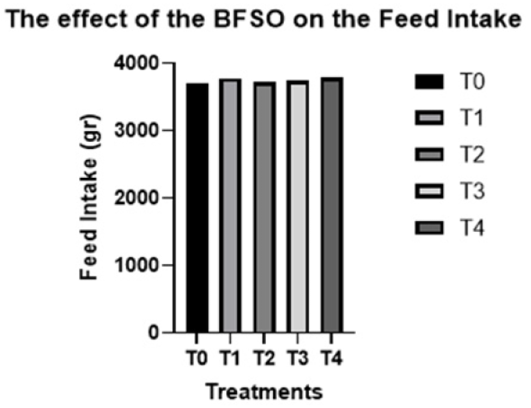
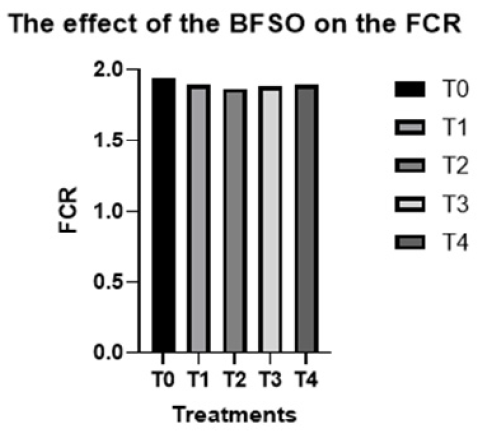
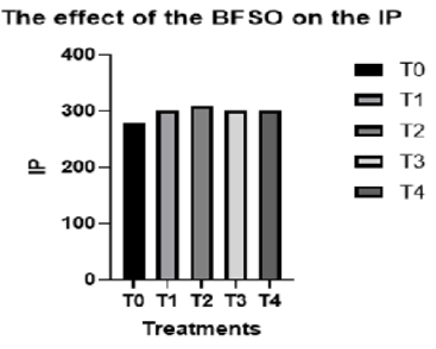
Table 2 illustrates the impact of BSF oil as a feed additive on the production performance of broiler chickens. Additionally, the application of BSF oil from three distinct phases (larval, prepupae, and pupal) led to significant differences (p < 0.05) in the feed conversion ratio (FCR) and performance index (IP) of broiler chickens (Figures 2 and 3). However, there were no substantial differences (p > 0.05) observed in feed intake (FI) Figure 1, body weight gain (BWG), and income over feed cost (IOFC). Feed consumption plays a pivotal role in meeting the fundamental needs of livestock for growth and reproduction. In broiler chickens, feed serves to expedite growth and achieve optimal body weight . The study data revealed that broiler chickens provided with feed supplemented with BSF oil exhibited higher feed intake compared to the control feed. This is attributed to the enhanced palatability resulting from the lipid and amino acid content, as observed in BSF oil, which is rich in lipids and other intrinsic lipid factors affecting feed digestibility and palatability . While the research results did not yield significant differences in feed intake and weight gain, broiler chickens receiving feed with BSF oil demonstrated higher weight gain (T2, T3, T3). Despite the lack of significant differences in feed intake and weight gain, there were noteworthy disparities in FCR. Table 3 shows that FCR with treated feed yielded lower values compared to untreated feed, indicating that BSF oil can enhance the feed conversion efficiency of broiler chickens.
In addition to FCR, the IP results exhibited significant differences (p < 0.05), with favorable IP outcomes in experiments involving treated feed. Higher IP values are indicative of increased profitability in broiler chicken’s cultivation, and values above 301 are considered good . The IOFC results, did not show significant differences. This aligns with the correlation between feed consumption, body weight gain, and their subsequent impact on production sales results. Despite the higher feed consumption and body weight gain in the experimental treatment, it influenced the feed cost and subsequently affected the IOFC results. Income Over Feed Cost, calculated by deducting feed costs from income, demonstrated higher values in the treatment experiment compared to the control experiment, based on the research findings (Morreta et al., 2020).
Effects of BSF oil on the histomorphology of the broiler chickens
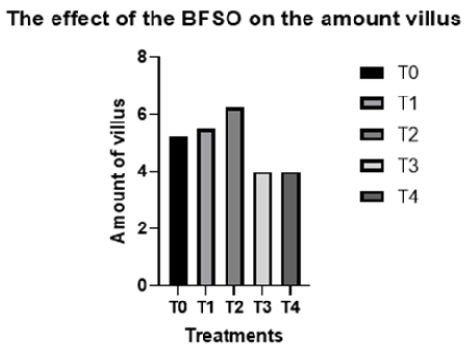
Table 3 explains the effect of BSF oil as a feed additive on the ileum histomorphology. Moreover, BSF oil treatment from three different phases (larval phase, pre pupal phase, and pupal phase) resulted in significant differences (p < 0.05) in the number of villi. However, there were no significant differences (p > 0.05) observed in crypt depth, villi length, and villi surface area. Experiments with BSF oil treatment were able to increase the number of villi and increase the length of the villi the surface area of the villi, although not significantly. The ileum sample was chosen because the ileum is the part of the digestive tract that has the most nutrient absorption activity and the surface area of ileum is influenced by the widht and length of the villi . Increasing the length of the villi can increase the production of digestive enzymes and absorption nutrients, as well as being an indicator of improving intestinal health ; . Furthermore, the results of research on the depth crypts show that the crypts are shallow, this has a positive impact on prolonged villous survival thereby reducing energy used for villous renewal (Biasto et al., 2018). The highest number of villi was in the experiment with BSF larva oil treatment. The increase in the number of villi due to the lauric acid content in BSF oil is thought to be able to inhibit the growth of pathogenic microbes . Lauric acid is classified as a medium chain fatty acid which is easily absorbed in the metabolic processes of the livestock body, and has a positive effect on intestinal health, thus having a positive impact on the nutrient absorption process ; Kozlowski et al., 2021; .
CONCLUSIONS and Recommendations
In conclusion, the utilization of BSF oil extracted from three distinct phases (larvae, prepupae, pupae) proves to be a viable alternative feed additive. This choice yields positive effects on production performance, particularly in terms of Feed Conversion Ratio (FCR) and the Performance Index (IP). Additionally, it contributes to the overall health of the broiler chicken’s digestive tract, notably by enhancing the number of villi in the ileum. Among the three phases of BSF considered, the extraction at the larval phase is recommended for application of oil then given as a natural feed additive.
ACKNOWLEDGeMENTS
We would like to thank the Ministry of Education, Culture, Research and Technology and Universitas Brawijaya for research funding of the contract scheme of “Hibah Professor (Guru Besar) with scheme 2023, number of contract: 2044.1/UN10.F05/PN/2023.
NOVELTY STATEMENT
The novelty of this research is the use of BSF oil from three different phases (larval, pre-pupal, pupal) as an alternative feed additive.
AUTHOR’S CONTRIBUTION
FLA: Contributed to data collection, nutritional analysis, data analysis and manuscript preparation. OS, EW: contributed to research design, supervision and revision of the manuscript. All authors read and approved the final version of the manuscript in the journal at this time.
Ethical approval
This research received ethical approval from the Health Research Ethics Committee at the Faculty of Medicine, Brawijaya University, under the reference number 139/EC/KEPK/06/2023.
Conflict of interest
The authors have declared no conflict of interest.
Figures

Effects of the BFSO on the feed intake of the broiler chickens.

Effects of the BFSO on FCR of the broiler chickens.

Effects of the BFSO on IP of the broiler chickens.

Effects of the BFSO on IP of the broiler chickens.
References
- Abd El-Hack ME, Shafi ME, Alghamdi WY, Abdelnour SA, Shehata AM, Noreldin AE, Ragni M (2020). Black soldier fly (Hermetia illucens) meal as a promising feed ingredient for poultry: A comprehensive review. Agriculture, 10(8): 1-31. https://doi.org/10.3390/agriculture10080339[CrossRef]
- Adli DN, Sadarman S, Irawan A, Jayanegara A, Wardiny TM, Priambodo TR, Nayohan S, Permata D, Sholikin MM, Yekti APA (2023). Effects of oligosaccharides on performance, egg quality, nutrient digestibility, antioxidant status, and immunity of laying hens: A meta-analysis. Ital. J. Anim. Sci., 22(1): 594-604. https://doi.org/10.1080/1828051X.2023.2223211[CrossRef]
- Adli DN, Sjofjan O, Natsir MH, Nuningtyas YF, Sholikah NU, Marbun AC (2020). The effect of replacing maize with fermented palm kernel meal (FPKM) on broiler performance. Livest. Res. Rur. Dev., 32(7): 1-4.
- Adli DN, Sjofjan O, Sholikin MM, Hidayat C, Utama DT, Jayanegara A, Natsir MH, Nuningtyas YF, Pramujo M, Puspita PS (2023). The effects of lactic acid bacteria and yeast as probiotics on the performance, blood parameters, nutrient digestibility, and carcase quality of rabbits: A meta-analysis. Ital. J. Anim. Sci., 22(1): 157-168. https://doi.org/10.1080/1828051X.2023.2172467[CrossRef]
- Amer SA, A-Nasser A, Al-Khalaifah HS, AlSadek DM, Fattah, ADM, Roushdy EM, Metwally AE (2020). Effect of dietary medium-chain α-monoglycerides on the growth performance, intestinal histomorphology, amino acid digestibility, and broiler chickens blood biochemical parameters. Animals, 11(1): 1-14. https://doi.org/10.3390/ani11010057[CrossRef]
- AOAC (2000). AOAC: Official Methods of Analysis. USA.
- Ariyadi B, Sudaryati S, Harimurti S, Wihandoyo SH, Habibi MF, Rahayu D (2019). Effects of feed form on small intestine histomorphology of broilers. IOP Conf. Ser. Earth Environ. Sci., 387(1): 1-5. https://doi.org/10.1088/1755-1315/387/1/012047[CrossRef]
- Biasato I, Gasco L, De Marco M, Renna M, Rotolo L, Dabbou S, Schiavone A (2018). Yellow mealworm larvae (Tenebrio molitor) inclusion in diets for male broiler chickens: Effects on growth performance, gut morphology, and histological findings. Poult. Sci., 97(2): 540-548. https://doi.org/10.3382/ps/pex308[CrossRef]
- Eeckhout M, De Clercq P, De Smet S (2017). Nutritional composition of black soldier fly (Hermetia illucens) prepupae reared on diferent organic waste substrates. J. Sci. Food Agric., 97(1): 2594–2600. https://doi.org/10.1002/jsfa.8081[CrossRef]
- Jankowski J, Kozłowski K, Zduńczyk Z, Stępniowska A, Ognik K, Kierończyk B, Juśkiewicz J (2021). The effect of dietary full fat Hermetia illucens larvae meal on gut physiology and growth performance in young turkeys. Anim. Feed Sci. Technol., 275(1): 1-12. https://doi.org/10.1016/j.anifeedsci.2021.114879[CrossRef]
- Khan I, Zaneb H, Masood S, Yousaf MS, Rehman HF, Rehman H (2017). Effect of Moringa oleifera leaf powder supplementation on growth performance and intestinal morphology in broiler chickens. J. Anim. Physiol. Anim. Nutr., 101(1): 114-121. https://doi.org/10.1111/jpn.12634[CrossRef]
- Kim SA, Rhee MS (2016). Highly enhanced bactericidal effects of medium chain fatty acids (caprylic, capric, and lauric acid) combined with edible plant essential oils (carvacrol, eugenol, resorcylic acid, trans -cinnamaldehyde, thymol, and vanillin) against Escherichia coli O157:H7. Food Contr., 60(1): 447–454. https://doi.org/10.1016/j.foodcont.2015.08.022[CrossRef]
- Kozłowski K, Ognik K, Stępniowska A, Juśkiewicz J, Zduńczyk Z, Kierończyk B, Jankowski J (2021). Growth performance, immune status and intestinal fermentative processes of young turkeys fed diet with additive of full fat meals from Tenebrio molitor and Hermetia illucens. Anim. Feed Sci. Technol., 278(1): 1-12. https://doi.org/10.1016/j.anifeedsci.2021.114994[CrossRef]
- Mai HC, Dao ND, Lam TD, Nguyen BV, Nguyen DC, Bach LG (2019). Purification process, physicochemical properties, and fatty acid composition of black soldier fly (Hermetia illucens Linnaeus) larvae oil. J. Am. Oil Chem. Soc., 96(1): 1303–1311. https://doi.org/10.1002/aocs.12263[CrossRef]
- Moretta A, Salvia R, Scieuzo C, Di Somma A, Vogel H, Pucci P, Falabella P (2020). A bioinformatic study of antimicrobial peptides identified in the Black Soldier Fly (BSF) Hermetia illucens (Diptera: Stratiomyidae). Sci. Rep., 10(1): 16875. https://doi.org/10.1038/s41598-020-74017-9[CrossRef]
- Müller A, Wolf D, Gutzeit HO (2017). The black soldier fly, Hermetia illucens a promising source for sustainable production of proteins, lipids and bioactive substances. Z. Naturforschung C, 72(9-10): 351-363. https://doi.org/10.1515/znc-2017-0030[CrossRef]
- Riekkinen K, Väkeväinen K, Korhonen J (2022). The effect of substrate on the nutrient content and fatty acid composition of edible insects. Insects, 13(7): 590. https://doi.org/10.3390/insects13070590[CrossRef]
- Schiavone A, Dabbou S, De Marco M, Cullere M, Biasato I, Biasibetti E (2018). Black soldier fly larva fat inclusion in finisher broiler chicken diet as an alternative fat source. Animal, 12(1): 32–39. https://doi.org/10.1017/S1751731117003743[CrossRef]
- Sholikin MM, Irawan A, Sofyan A, Jayanegara A, Rumhayati B, Hidayat C, Adli DN, Julendra H, Herdian H, Manzila I, Hudaya MH, Harahap MA, Qomariyah N, Budiarto R, Krisnan R, Asmarasari SA, Hayanti SY, Wahyono T, Priyatno TP, Ujilestari T, Negara W, Wulandari W, Nahrowi N (2022). A meta-analysis of the effects of clay mineral supplementation on alkaline phosphatase, broiler health, and performance. Poult. Sci., 102(3): 102456. https://doi.org/10.1016/j.psj.2022.102456[CrossRef]
- Sjofjan O, Adli DN (2021). The effect of replacing fish meal with fermented sago larvae (FSL) on broiler performance. Livest. Res. Rur. Dev., 33(2): 2-7.
- Sjofjan O, Natsir MH, Adli DN, Adelina DD, Triana LM (2020). Effect of symbiotic flour (Lactobacillus sp. and fos) to the egg quality and performance of laying hens. IOP Conf. Ser. Earth Environ. Sci., 465(1): 12-33. https://doi.org/10.1088/1755-1315/465/1/012033[CrossRef]
- Spranghers T, Michiels J, Vrancx J, Ovyn A, Eeckhout M, De Clercq P, De Smet S (2018). Gut antimicrobial effects and nutritional value of black soldier fly (Hermetia illucens L.) prepupae for weaned piglets. Anim. Feed Sci. Technol., 235(1): 33–42. https://doi.org/10.1016/j.anifeedsci.2017.08.012[CrossRef]
- Spranghers T, Ottoboni M, Klootwijk C, Ovyn A, Deboosere S, De Meulenaer B, Michiels J, Eeckhout M, De Clercq P, De Smet S (2017). Nutritional composition of black soldier fly (Hermetia illucens) prepupae reared on diferent organic waste substrates. J. Sci. Food Agric., 97(1): 2594–2600. https://doi.org/10.1002/jsfa.8081[CrossRef]
- Tran G, Heuze V, Makkar HPS (2015). Insects in fish diets. Anim. Front., 5(1): 37–44.
Services
Article usage statistics
Loading…