
The main objective of this experiment was to see the behaviour, catalase (CAT) activity and total protein contents (TPC) in Ctenopharyngodon idella under binary mixtures of insecticides viz. endosulfan(ES)+chlorpyrifos(CPF) and endosulfan(ES)+bifenthrin (BIF). The fish behaviour was observed from both treated and control groups. Fish under exposure of insecticides mixtures exhibit abnormal behaviour and tried to jump out from water, come to surface and gulp air, showed increased opercular movement and erratic movements, hyper-activity and swimming very fast. Various tissues such as hepatic, neural, renal, cardiac, gills and muscle tissues were studied for the determination of CAT activity and TPC after exposure of 24 and 96 h. Results showed that both treatments caused a significant (P<0.01) decline in CAT activity and TPC of C. idella as compared to control group. CAT activity and TPC decreased with the passage of time. Among both treatments, ES+CPF caused greater decline in CAT activity and TPC. It was concluded that insecticides in mixture form are toxic to fish and response of biomarkers depends on the type of toxicants and exposure duration.
Short Communication · Volume 52, Issue 5, 29 May 2020 · Open Access
Acute Toxic Effect of Technical Grade Insecticides on Behavior, Catalase Activity and Total Protein Contents of Fish, Ctenopharyngodon idella
· · · · ·
Affiliations & Notes ⌄
- 1Department of Zoology, Wildlife and Fisheries, University of Agriculture, Faisalabad 2Department of Zoology, Cholistan University of Veterinary and Animal Sciences, Bahawalpur, Pakistan 3State Key Laboratory for Conservation and Utilization of Subtropical Agro-Bioresources, Guangxi University, Nanning, Guangxi 530005, PR China , * Corresponding author: dr.humanaz98@gmail.com
- 2uaf_sajidabdullah@yahoo.com
Article Info ⌄
- Journal:
- Pakistan Journal of Zoology
- Published:
- 29 May 2020

From the article
- The results showed that C. idella under exposure of binary mixture of pesticides showed abnormal behavior and tried to jump from test media and showing erratic and jerky movements to as well as variation in operculum movement was also observed (Fig. 1).
- The comparisons among both the pesticides mixtures showed that ES+CPF treated fish have more pronounced indications as compared to ES+BIF treated fish.
- In the present research work, the effect of pesticides on fish behaviour was observed by loss of balance, increased.
- The present study concluded that in aquatic ecosystem, pesticides not only affect the behaviour of fish as well as have negative effect on biochemical parameters.
Selected from the article's own text.
Abstract
Materials and methods
The experiment was carried out in the Toxicology laboratory at Fisheries Research Farms, University of Agriculture, Faisalabad, Pakistan. The experimental fish Ctenopharyngodon idella (Age 90-day; Average weight, 9.39±0.19) were purchased from Fish Seed Hatchery, Faisalabad and kept under laboratory conditions for seven days. The chlorpyrifos (98% pure), bifenthrin (98.5% pure) and endosulfan (98.65% pure) of technical grade (Powder form 1 g) were dissolved in 95% analytical grade methanol (100ml) to prepare the individual insecticide solutions while insecticides mixtures (1:1 ratio) were prepared in deionized water by dilutions.
Fish were kept in binary mixture of insecticides as endosulfan (ES)+chlorpyrifos (CPF) and endosulfan(ES)+bifenthrin(BIF) for 4 days. The 96 h LC50 values of ES+BIF and ES+CPF were calculated as 4.23 and 4.60 µgL-1, respectively . The each experiment was carried out with three replicates, separately, in 70-L glass aquaria having a number (n=10) of fish. Throughout the experiment the water pH, total hardness and temperature (Thermo-sensor) were maintained as 7.00±0.02, 222.30±0.90 mg L-1 and 27.01±0.03ᵒC, respectively. Dissolved oxygen was monitored as 5.06±0.11 on daily basis.
The fish behavior was observed from control and treated (ES+CPF and ES+BIF) groups at interval of 12 hours. The changes in behavior were studied such as jumping, opercular movement, balance, movements during swimming and gulping of air.
After each 24 and 96 h interval the sampling was done and fish was scarified and required organs of grass carp were removed to determine the activity of CAT in them. The removed organs were weighted and rinsed with 0.2 M phosphate buffer (pH 6.5) to remove the RBCs. By using the blender it was homogenized in cold buffer (1:4 w/v). After that centrifugation of organ homogenates were carried out for fifteen minutes at 10,000 rpm and 4ºC. The upper liquid substance was separated and stored at cooler temperature of 80 ºC.
The CAT was studied in different organs viz. hepatic, neural, renal, cardiac, gills and muscle of fish by following the protocol of Chance and Mehaly (1997). Total protein contents were estimated in selected tissues by using the Biuret Method (1949).
Data were analyzed by appropriate method of Steel et al. (1996).Two-way ANOVA was used to determine the statistical difference between treated and control fish at P<0.05.MS excel was used to draw graph.
Results and discussion
The results showed that C. idella under exposure of binary mixture of pesticides showed abnormal behavior and tried to jump from test media and showing erratic and jerky movements to as well as variation in operculum movement was also observed (Fig. 1). The movement of operculum and body balance was maximum as the exposure was given but it declined as the duration of exposure increases. The comparisons among both the pesticides mixtures showed that ES+CPF treated fish have more pronounced indications as compared to ES+BIF treated fish. However, throughout the experiment control group showed no changes in behavior. No mortality was observed during experimental trail.
Behavioral changes in fish give us lot of information because any alteration in behaviour is correlated with physiological biomarker in aquatic environment. In the present research work, the effect of pesticides on fish behaviour was observed by loss of balance, increased
Table I. Acute effects of pesticides mixtures on CAT activity (U/mL) and protein contents (mg mL-1) in different organs of grass carp.
| Tissues | Treatments | CAT activity | Protein contents | ||
| 24 h | 96 h | 24 h | 96 h | ||
| Hepatic | Control | 149.17±5.28Aa | 149.14±4.40Ba | 3.97±0.61Aa | 3.95±0.56Ba |
| ES+BIF | 140.86±3.30Ab | 105.86±3.71Bb | 3.72±0.45Ab | 2.31±0.33Bb | |
| ES+CPF | 136.94±3.77Ac | 99.82±2.72Bc | 3.21±0.38Ac | 1.98±0.21Bc | |
| Gills | Control | 138.12±4.55Aa | 138.01±5.37Ba | 2.86±0.31Aa | 2.86±0.33Ba |
| ES+BIF | 131.92±3.59Ab | 92.87±2.83Bb | 2.75±0.32Ab | 1.84±0.20Bb | |
| ES+CPF | 125.67±3.91Ac | 90.71±2.64Bc | 2.53±0.25Ac | 1.46±0.15Bc | |
| Renal | Control | 131.96±4.60Aa | 131.67±4.49Ba | 1.72±0.21Aa | 1.73±0.28Ba |
| ES+BIF | 118.64±3.53Ab | 83.72±2.50Bb | 1.48±0.15Ab | 0.67±0.05Bb | |
| ES+CPF | 118.34±2.49Ac | 80.58±1.40Bc | 1.25±0.18Ac | 0.27±0.04Bc | |
| Neural | Control | 124.56±3.32Aa | 124.39±3.64Ba | 1.25±0.18Aa | 1.24±0.11Ba |
| ES+BIF | 110.90±2.11Ab | 75.41±1.88Bb | 1.02±0.12Ab | 0.43±0.03Bb | |
| ES+CPF | 105.92±2.48Ac | 68.34±1.73Bc | 0.91±0.09Ac | 0.08±0.02Bc | |
| Muscle | Control | 113.21±3.21Aa | 113.15±3.36Ba | 1.03±0.10Aa | 1.04±0.17Ba |
| ES+BIF | 99.76±3.22Ab | 61.87±1.90Bb | 0.96±0.05Ab | 0.32±0.02Bb | |
| ES+CPF | 83.28±2.75Ac | 52.72±1.19Bc | 0.80±0.05Ac | 0.18±0.01Bc | |
| Cardiac | Control | 76.98±2.93Aa | 76.54±2.04Ba | 0.84±0.08Aa | 0.86±0.12Ba |
| ES+BIF | 68.91±2.00Ab | 29.73±1.76Bb | 0.78±0.06Ab | 0.24±0.02Bb | |
| ES+CPF | 57.26±1.86Ac | 32.91±1.38Bc | 0.59±0.03Ac | 0.03±0.01Bc | |
Capital letters represent the significant (P<0.05) difference among the treatments within the same column while small lettered superscripts show the difference between exposure duration within the same row.
opercular movement and erratic movement. Hii et al. (2007) reported the irregular behavioral patterns of fish Asian swamp eel after acute exposure to endosulfan. Marigouder et al. (2009) also observed the behavioral changes of L. rohita. C. gariepinus under exposure of several levels of chlorpyrifos showed inept behavior such as try to jump out of water, erratic and jerky swimming, frequent surfacing and gulping of air and large secretion of mucus on the gills and body followed by exhaustion and ultimately death .
The activity of CAT and total protein contents were significantly decreased (P<0.01) in hepatic, renal, neural, cardiac, gills and muscle tissues of grass carp under exposure of binary mixture of pesticides as compared to control group. The activity of CAT was reduced with the passage of time. Among both the mixture, ES+CPF was found to be more toxic as it adversely affect the enzymatic activity as well as protein contents than ES+BIF mixture (Table I).
Mixture of pesticides disturbs the physiology of fish which ultimately leads to death. When the balance between oxidants and antioxidants is disrupted, oxidative stress occurs due to high formation of reactive oxygen species (ROS) which leads to breakdown of proteins, nucleic acid, lipids and carbohydrates finally damages the structure of cell. An alteration in cell structure indicates oxidative damage. However, organisms are endower with antioxidant enzyme system which neutralizes the effect of ROS . Activation of antioxidant enzyme system is considered as warning signs of contamination. CAT is main antioxidant enzyme which is involved in detoxification of ROS and degradation of H2O2 to oxygen and water. The activity of CAT is controlled by various factors including unnecessary formation of O-2 .
These findings were also supported by Ballesteros et al. (2009) who reported that CAT activity was significantly declined in hepatic, neural, gills and muscle tissues of Jenynsia multidentata under exposure of endosulfan for 24 h. Similarly, Sayeed et al. (2003) investigated the reduced CAT activity in neural, hepatic, renal and gill of C. punctatus after exposure to deltamethrin for 48 h. Decline in CAT activity ultimately declined the rate of reaction which resulted from the excessive production of hydrogen peroxide.
The TPC were significantly decreases as the duration of exposure increases. Our obtained results are similar to Jha and Verma (2002) who reported the decreased TPCs in tissues of Clarias batrachus under insecticides mixture (agrafun, endosulfan and malathion) for 96 h, 7, 14 and 21 day exposures. Singh et al. (2010) stated that after 24 hr exposure to cypermethrin there was a significant decrease in TPCs in muscle and liver of Colisa fasciatus. A decline in TPCs of Danio rerio exposed to λ-cyhalothrin was reported by Ahmad et al. (2012). According to Somaiah et al. (2014) phenthoate caused reduction in TPCs in several organs of L. rohita. In the same way, Jain (2014) observed a substantial decrease in total protein contents in the gills of C. gachua under exposure of methyl parathion. Ramesh et al. (2014) inspected that quinolphos altered the rate of metabolic reactions in various tissues of C. carpio by fluctuating the level of TPCs. Lihos exposure reduced the TPCs in neural, hepatic and renal tissues of C. punctatus . According to Vega et al. (2002) a decline in tissues TPCs of fish may be due to compensation of stress.
Conclusion
The present study concluded that in aquatic ecosystem, pesticides not only affect the behaviour of fish as well as have negative effect on biochemical parameters. These biochemical parameters can also be used to assess the aquatic pollution.
Statement of conflict of interest
The authors declares there is no conflict of interest.
Figures
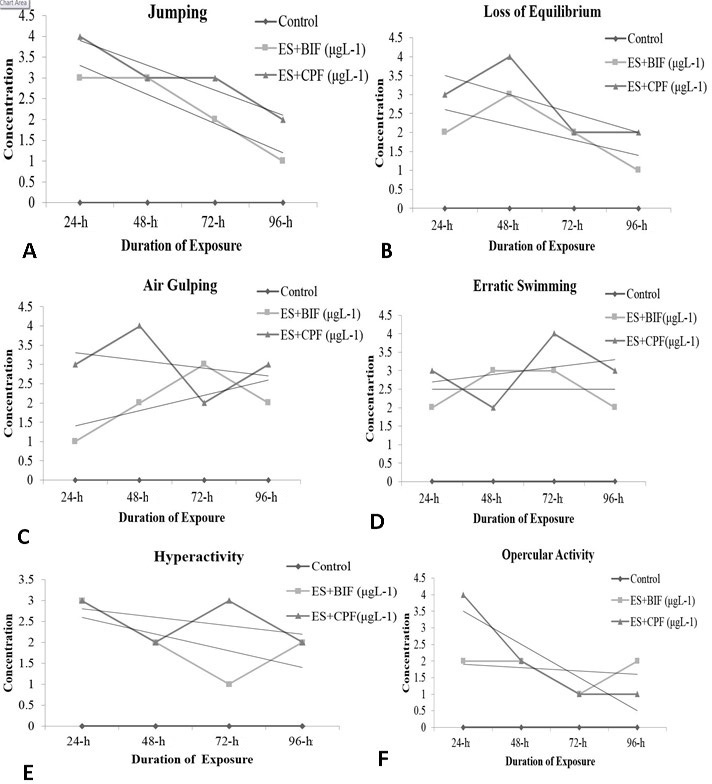
Behavioral responses of fish against insecticide mixtures.
References
- Achuba, F.I. and Osakwe, S.A., 2003. Fish Physiol. Biochem., 29: 97-103. https://doi.org/10.1023/B:FISH.0000035905.14420.eb[CrossRef]
- Ahmad, M.K., Sharma, D.K., Ansari, S. and Ansari, B.A., 2012. Arch. Polish. Fish., 20: 19-25.
- Ambreen, F. and Javed, M., 2015. Pakistan J. Zool., 47: 133-139.
- Ballesteros, M.L., Wunderlin, D.A. and Bistonia, M.A., 2009. Ecotoxical. environ. Safe., 72: 199-205. https://doi.org/10.1016/j.ecoenv.2008.01.008[CrossRef]
- Byrne, P.A. and O’Halloran, J., 2001. Hydrobiologia, 465: 209-217. https://doi.org/10.1007/978-94-010-0434-3_21[CrossRef]
- Chance, M. and Mehaly, A.C., 1997. Methods Enzymol., 2: 764-817.
- Da-Cuna, R.H., Vazquez, G.R., Piol, M.N., Guerreroc, N.V., Maggesea, M.C. and Nostroa, F.L.L., 2011. Ecotoxicol. environ. Safe., 74: 1065-1073. https://doi.org/10.1016/j.ecoenv.2011.02.002[CrossRef]
- Fernandez-Alba, A.R., Guil, L.H., Lopez, G.D. and Chisti, Y., 2001. Anal. Chim. Acta, 426: 289-301.
- Gornall, A.G., Bardwill, C.S. and David, M.M., 1949. J. biol. Chem., 177: 751-766.
- Hellou, J., 2011. Environ. Sci. Pollut. Res., 18: 1-11. https://doi.org/10.1007/s11356-010-0367-2[CrossRef]
- Hii, Y.S., Yee, L.M. and Seng, C.T., 2007. Pestic. Biochem. Physiol., 89: 46-53. https://doi.org/10.1016/j.pestbp.2007.02.009[CrossRef]
- Jain, S., 2014. Int. J. Life Sci., 2: 114-118.
- Jha, B.S. and Verma, B.P., 2002. J. Ecotoxicol. environ. Monit., 12: 177-180.
- Marigoudar, S.R., Nazeer, A.R. and David, M., 2009. World J. Zool., 4: 19-23.
- Naveed, A., Janaiah, C. and Venkateshwarlu, P., 2010. Toxicol. environ. Hlth. Sci., 3: 018-023.
- Nwani, C.D., Ivoke, N., Ugwa, D.O., Atama, C., Onyishi, G.C.O., Echi, P.C. and Ogbonna, S.A., 2013. Pakistan J. Zool., 45: 959-965.
- Pandey, S., Ahmad, I., Pervez, S., Hafeez, B., Haque, R. and Raisuddin, S., 2001. Arch. environ. Contam. Toxicol., 41: 345-352. https://doi.org/10.1007/s002440010258[CrossRef]
- Pi, J., Zhang, Q., Fu, J., Woods, C.G. and Hou, Y., 2010. Toxicol. appl. Pharmacol., 244: 77-83.
- Ramesh, R.C., Manjunath, B., Jaffer, M.G., Ortiz, T.J., Selvaraj, T. and Selvanayagam, M., 2014. Int. J. Pharm. Sci., 2:35-47.
- Roberts, A.P. and Oris, J.T., 2004. Comp. Biochem. Physiol., 138: 221-228. https://doi.org/10.1016/j.cca.2004.08.006[CrossRef]
- Sayeed, I., Pervez, S., Pandey, S., Hafeez, B.B., Haque, R. and Raisudin, S., 2003. Ecotoxicol. environ. Safe., 56: 295-301. https://doi.org/10.1016/S0147-6513(03)00009-5[CrossRef]
- Singh, S.K., Singh, S.K. and Yadav, R.P., 2010. World J. Zool., 5: 25-32.
- Slotkin, T.A., Olivier, C.A. and Seidler, F.J., 2005. Dev. Brain Res., 157: 172-180. https://doi.org/10.1016/j.devbrainres.2005.04.001[CrossRef]
- Somaiah, K., Sunita, K. and Nagraju, B., 2014. Biolife, 2: 475-479.
- Steel, R.G.D., Torrie, J.H. and Dinkkey, D.A., 1996. Principles and procedures of statistics, 3rd ed. McGraw Hill Book Co., Singapore, pp. 627.
- Terra, B.F., Araujo, F.G., Calza, C.F., Lopes, R.T. and Teixeira, T.P., 2008. Water, Air Soil Pollut., 187: 275-284. https://doi.org/10.1007/s11270-007-9515-9[CrossRef]
- Vega, F.C., Sancho, F., Ferrando, M.D. and Andreu, E., 2002. Pestic. Biochem. Physiol., 72: 55-63.
- Vinodhini, R. and Narayanan, M., 2008. Int. J. environ. Sci. Technol., 5: 179-182. https://doi.org/10.1007/BF03326011[CrossRef]
Cited by 3 articles
In journals published by ResearchersLinks.
- Acute Toxicity, Catalase Activity and Histological Examination of Pb+Cd Mixture Stressed TilapiaPunjab University Journal of Zoology · 2026
- Sub-Lethal Effects of Endosulfan+Chlorpyrifos Mixture on Biochemical Parameters and Blood Genotoxicity Markers of Two Cyprinidae Fish Species Catla catla and Labeo rohitaPakistan Journal of Zoology · 2025
- Induced-Toxicity of Pesticides on Edible Freshwater Fishes in Pakistan: A ReviewSarhad Journal of Agriculture · 2024
Services
Article usage statistics
Loading…