
Cleft palates (CP) are the most common birth defect with highly complex etiology, involves both genetic and environmental risk factors. In the present study, we focused on TBX22 gene, which is a major gene determinant essential to human palatogenesis. We analyzed a total of 134 DNA samples including 51 CP clinically assessed patients and 83 healthy controls. Our preliminary results revealed two novel missense substitutions i.e. P180Q in T-box domain and S328I in C-terminal of TBX22, while unrelated healthy controls revealed no sequence variants in these locations. The present report is first of its kind in Pakistani population. The findings suggest that TBX22 polymorphisms may responsible for a significant proportion of non-syndromic CP cases in Pakistani population and confirming its importance as a frequent cause of non-syndromic CP across various populations. The robustness of the association between TBX22 and CP is worth further examination in the future across different populations.
Short Communication · Volume 55, Issue 1, 14 November 2022 · Open Access
Two Novel Missense Tbx22 Mutations Frequently Cause Non-Syndromic Cleft Palate in Pakistani Population
· · · · · · ·
Affiliations & Notes ⌄
- 1Department of Zoology, Government College University, Lahore 2Department of Biotechnology, Faculty of Life Sciences and Informatics, Balochistan University of Information Technology, Engineering and Management Sciences, Quetta 3Department of Biotechnology, Balochistan University of Information Technology, Engineering and Management Sciences, Quetta 4School of Biological Sciences, University of the Punjab, Lahore 5Department of Biotechnology, Virtual University of Pakistan, 1-Davis Road, Lahore 6
Article Info ⌄
- Journal:
- Pakistan Journal of Zoology
- Published:
- 14 November 2022

From the article
- The sequence analysis showed that there were two different sporadic polymorphisms detected in the two exonic regions of TBX22 gene in the CP affected patients.
- The position of this missense substituion was located at the evolutionary conserved residue within the T-box domain of TBX22 gene originated in various species (Fig. 2), and may therefore, result in impaired DNA binding.
- Previous study perfomed in Thai patients with non-synodromic CP revealed four variants in TBX22 gene, two of them were found in two different individuls with positive CP family history and two different individuals were with no family history.
- The another polymorphism 1117G→T was detected in exon 8 in three males patients with no previous family history of CP or any associated case.
Selected from the article's own text.
Abstract
Table I. Primers used in this study.
| Exon | Forward primer (5’→3’) | Reverse (5’→3’) |
| 1 | TCCCTAACCAGTTCAGGTT | ATGTGGCTGTGGCCTGCGT |
| 2 | TGTCTGCTCCAAGATAGGCA | TACTGTATGTCATGGGAGTTG |
| 3 | CTGGAGTCAGCATTTGTCCA | GTCTGAAGGTCCAAATCCCT |
| 4 | CTGGAGTGAAGTCCTCAGGA | GCAGGGCTTGAACAGTTCCT |
| 8 | AAGGATGAAGCACAGATAGT | TGAAGCTCAAGGCCACTGTA |
in TBX22 gene makes a significant contribution to prevalence of CP in Thai, Brazilian and North American cohorts. The present was designed to investigate whether TBX22 gene polymorphisms might be responsible for the formation of non-syndromic CP in Pakistani population.
Materials and methods
The current study used TBX22 gene as a candidate gene and accomplished case-control-based study in Pakistani non-syndromic CP cohort. The patients with non-syndromic CP were recruited for this study at Pediatric Surgery Unit of Farooq Hospital (Westood Branch) Lahore, Punjab province, Pakistan. The individuals with non-syndromic CP were enrolled as determined by patient’s records. In the study, we obtained 134 samples following informed consent with local ethical approval. A total of 51 patients (Pak nationality, 45 males and 6 females) and 83 healthy and age-matched controls (62 males and 21 females) with negative family history of CP were enrolled in this study. A detailed phenotype of each patient was got with CP and also taking note of associated features such as presence or absence of ankyloglossia and previous family-history (Figure 1B). In the study, an additional case with a positive family history for isolated CP, having a sibling with ankyloglossia (a condition sometimes associated with cleft palate in X-linked cleft palate, CPX) was enrolled.
For DNA extraction the blood samples from veins in the elbow (2 mL) were collected in EDTA-containing vacutainer tubes and stored at -20 °C until further use. Genomic DNA was extracted from the peripheral blood using Thermo Scientific Gene JET Whole Blood Genomic DNA Purification Mini Kit (Lot no. 00166055). The DNA was quantified by Nanodrop spectrophotometry (Nanodrop 2000 Spectrophotometer, Thermo Scientific, USA).
In the current study, TBX22 gene exons 1, 2, 3, 4 and 8 were selected and amplified by polymerase chain reaction (PCR) using previously reported primers, shown in Table 1 . PCR was carried out in final volume of 25 µl using 50 ng/µl of genomic DNA as template, 10pMol of each forward-reverse primers, 2.5 mM MgCl2, Buffer 1X (NH4)2 SO4, 100 uM dNTPs mix and 1 U Taq DNA polymerase (Thermo Scientific). The PCR was performed for 35 cycles with 95°C: 30s, 60-50°C: 30s (Touch-Down with -0.5-decrement/cycle), 68°C: 30s with final extension at 68°C for 10 minutes. PCR products were purified by Gene JET gel extraction kit (Thermo Scientific, USA).
A total of five exons of the TBX22 gene were followed by direct sequencing using ABI 3130XL automated sequencer (Applied Biosystem Inc, Faster City, CA). All the obtained sequences were aligned and edited through BioEdit v7.0.9.1 . We analyzed exons containing polymorphisms in affected and unaffected individuals with reference sequence accession number NG_008998, NM_001109878.
Result
In the present study, we sequenced five exons of TBX22 gene (MIM#300307) in subjects enrolled in Pediatric Surgery Unit of Farooq Hospital Lahore, Punjab province, Pakistan. We analyzed a total of 134 candidates, including 51 cases and 83 controls with no previous family history of CP. Among the 51 affected individuals, 45 were male and 6 were female individuals. The sequence analysis showed that there were two different sporadic polymorphisms detected in the two exonic regions of TBX22 gene in the CP affected patients. The variations were identified in TBX22 exon 4 and 8, however, we detected no polymorphism in other sequenced exons. To our knowledge, the two variants detected have never been reported previously.
In the study, a total of 7 male (16%) and no female out of 45 and 6 enrolled patients respectively were found mutated in TBX22 gene (Fig. 1B). This would be consistent with the fact that the incidence of CPs caused by an X-linked gene in men is higher than that of CP in woman. A heterozygous condition C673→A (GenBank accession number MG946715) was detected in male only in exon 4 of TBX22, which cause a nonconservative amino acid substitution from proline to glutamine (P180→Q) (Fig. 1A). This polymorphism was detected in 3 male patients with CP having no previous history of clefting. The similar condition was detected in an individual having sibling with another abnormal condition, ankyloglossia (tongue-tie). While the mother of this patient with the same phenotype, no other additional family history. Ankyloglossia has been reported in the majority of X-linked cleft palate (CPX) patients, and it has been conjectured that the tongue is the site of the primary defect. The position of this missense substituion was located at the evolutionary conserved residue within the T-box domain of TBX22 gene originated in various species (Fig. 2), and may therefore, result in impaired DNA binding. The another polymorphism 1117G→T (GenBank accession number MG946716) was detected in 3 males individuals, which caused a nonconservative amino acid substitution from serine to isoleucine (S328→I) in exon 8 (Fig. 1C). The pateints with this polymorphism have no previous family history of CPs. This mutation was located in the carboxy-terminal (c-terminal) outside the T-box domain (Fig. 2).
Discussion
Cleft palate (Palatoschisis) is among the most common congenital malformation caused by abnormal facial development during gestation. Another case cleft lip (cheiloschisis), which can also occur together with CP (CL/P) are birth defects that affect the upper lip and the roof of the mouth respectively. CP has a complex etiology, comprising both genetic and envinmental influences. Several genes with altered functioning during craniofacial development have been discovered are responsible for casuing X-linked CP . The identification of the genetic risk factor in CP development involves the expression of multiple genes controlling the complex process of palatogenesis. Non-syndromic CP candidate causing TBX22, which has been reported as a susceptibile gene associated with the inherited X-linked disorder, CP or with anklyloglossia (tongue-tie) ; .
TBX22–T-box transcription factor is a member of phylogenetically conserved family of proteins that share a common DNA-binding domain, the T-box. The gene has seven exons encodes a 400 amino acids [aa] protein located on chromosome Xq21.1. TBX22 has been previously reported that the mutations result in non-syndromic CP. . Previous study perfomed in Thai patients with non-synodromic CP revealed four variants in TBX22 gene, two of them were found in two different individuls with positive CP family history and two different individuals were with no family history. Another study carried out by in 256 non-synodromic CP pateints from three ethenic groups, North America, Philippines and Brazalians were screened for polymorphism in TBX22 gene. The study discovered 15 different variants in 238 non-syndromic CP pateints and no polymorphism was identified in 18 syndromic patients in the studied populations. Four of the five coding region polymorphism were present individuals with positive family history and one was discoved in patient with no family history. In our study, we identified two different TBX22 coding region polymorphisms each in exon 4 and 8 in patients affected with non-synodromic CP. A single base substitution C673→A in exon 4 resulting in aa substitution from proline to glutamine (P180→Q) was detected in three patients with no previous family history of clefting. The similar substitution was detected in a patient with positive family history, having sibling with another abnormal condition, ankyloglossia (tongue-tie). Ankyloglossia has been reported in the majority of X-linked cleft palate (CPX) patients, and it has been conjectured that the tongue is the site of the primary defect. The position of this missense substituion is located at the evolutionary conserved residue within the T-box domain of TBX22 gene originated in various species, and may therefore, result in impaired DNA binding ; . Similar region was discribed with two missense mutations, 359G→A in Thai population and 358C→T in Tunisian population resultng in R120Q and R120W substitutions respectively. Another substitution 452G→T (aa substitution R151L) located within c strand of T box domain in Thai population. The mutations in similar region has been discovered for another T box gene such as TBX19, TBX5 and TBX3 . The finding emphasized the importnce of missense mutations in DNA binding domain underlying the non-syndromic CP alone or with ankyloglossia.
The another polymorphism 1117G→T was detected in exon 8 in three males patients with no previous family history of CP or any associated case. The substitution resulting in nonconservative amino acid substitution from serine to isoleucine (S328→I). This mutation was located in the C-terminus outside the T-box domain. The similar region was investigated with two TBX22 mutations 1166 C→A (P389Q) and 1252delG in Thai population . The mutation discovered in this region possibly affects TBX22 function through the mechanisms involving protein-protein interation or nuclear localization as evidenced in functional analysis of other TBX genes . Missense mutation in TBX5 casued Holt-Oram syndrome by interfering nuclear localization leading to reduced transcriptional activation . The present study aimed to investigate the role of variants in TBX22 gene in the development of non-syndromic CP in Pakistani population. The limitation of study was less sample size, however it suggesting the important role of TBX22 holds as a causative factor for non-syndromic CP. Further studies at large scale must be carried out for evaluation of other candidate genes as well as various environmental factors.
Acknowledgment
We thank all patients and their family members for participating in this study. We are grateful to the team at Farooq Hospital (Westwood branch, Lahore) for their kind co-operation. We also thank Higher Education Commission (HEC) of Pakistan for providing research grant for sequencing.
Ethical approval
This research work was approved by the Departmental Ethical Research Committee of the Virtual University of Pakistan, with approval number 006-16.
Statement of conflict of interest
The authors declare no conflict of interest.
Figures
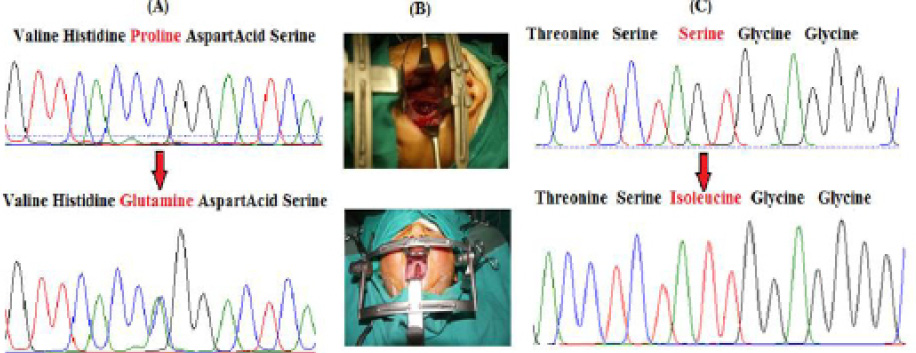
Chromatogram of a novel mutation A) C→A (P180Q) in the TBX22 gene, upper sequences of amino acids of unaffected individual and the lower of affected individual B) Patient images during surgery, C) G→T (S328I) in the TBX22 gene, the upper sequence belong to unaffected individual and below of affected individual.
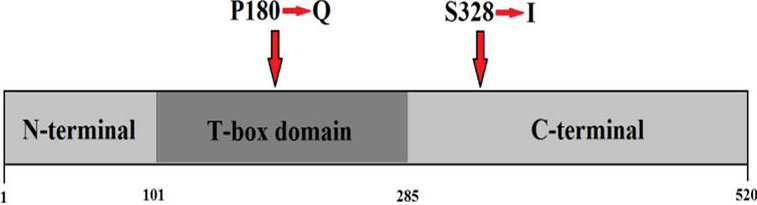
Location of the novel missense substitutions, P180Q and S328I (red arrow), in the TBX22 gene.
References
- Andreou, A.M., Pauws, E., Jones, M.C., Singh, M.K., Bussen, M., Doudney, K., Moore, G.E., Kispert, A., Brosens, J.J. and Stanier, P., 2007. Am. J. Hum. Genet., 81: 700-712. https://doi.org/10.1086/521033[CrossRef]
- Braybrook, C., Doudney, K., Marcano, A.C., Bjornsson, A., Patton, M.A., Goodfellow, P.J., Moore, G.E. and Stanier, P., 2001. Nat. Genet., 29: 179-183. https://doi.org/10.1038/ng730[CrossRef]
- Chen, Q., Wang, H., Schwender, H., Zhang, T., Hetmanski, J.B., Chou, Y.H.W., Ye, X., Yeow, V., Chong, S.S., Zhang, B., Jabs, E.W., Parker, M.M., Scott, A.F. and Beaty, T.H., 2014. PLoS One., 9: 1-10. https://doi.org/10.1371/journal.pone.0109038[CrossRef]
- Fan, C., Liu, M. and Wang, Q., 2003. J. biol. Chem., 278: 8780–8785. https://doi.org/10.1074/jbc.M208120200[CrossRef]
- Hall, T.A., 1999. Nucl. Acid Res., 41: 95–98. https://doi.org/10.1099/00222615-48-1-95[CrossRef]
- Kantaputra, P.N., Paramee, M., Kaewkhampa, A., Hoshino, A., Lees, M., McEntagart, M., Masrour, N., Moore, G.E., Pauws, E. and Stanier, P., 2011. J. Dent. Res., 90: 450–455. https://doi.org/10.1177/0022034510391052[CrossRef]
- Marcano, A.C.B., Doudney, K., Braybrook, C., Squires, R., Patton, M.A., Lees, M. Richieri-Costa, A., Lidral, A., Murray, J., Moore, G. and Stanier, P., 2004. J. med. Genet., 41: 68–74.
- Murray, J.C., 2002. Clin. Genet., 61: 248–256.
- Pegelow, M., Koillinen, H., Magnusson, M., Fransson, I., Unneberg, P., Kere, J., Karsten, A. and Peyrard-Janvid, M., 2014. Cleft Palate Craniofac. J., 51: 49–55. https://doi.org/10.1597/11-220[CrossRef]
- Satokata, I. and Maas, R., 1994. Nat. Genet., 6: 348-356.
- Suphapeetiporn, K., Tongkobpetch, S., Siriwan, P. and Shotelersuk, V., 2007. Clin. Genet., 72: 478-483.
- Wang, W., Jiao, X.H., Wang, X.P., Sun, X.Y. and Dong, C., 2016. Genet. Test Mol. Biomark., 20: 297–303. https://doi.org/10.1089/gtmb.2015.0186[CrossRef]
- Wehby, G.L., Goco, N., Moretti-Ferreira, D., Felix, T., Richieri-Costa, A., Padovani, C., Queiros, F., Guimaraes, C.V.N., Pereira, R., Litavecz, S., Hartwell, T., Chakraborty, H., Javois, L. and Murray, J.C., 2012. BMC Pediatr., 12: 184.
Services
Article usage statistics
Loading…